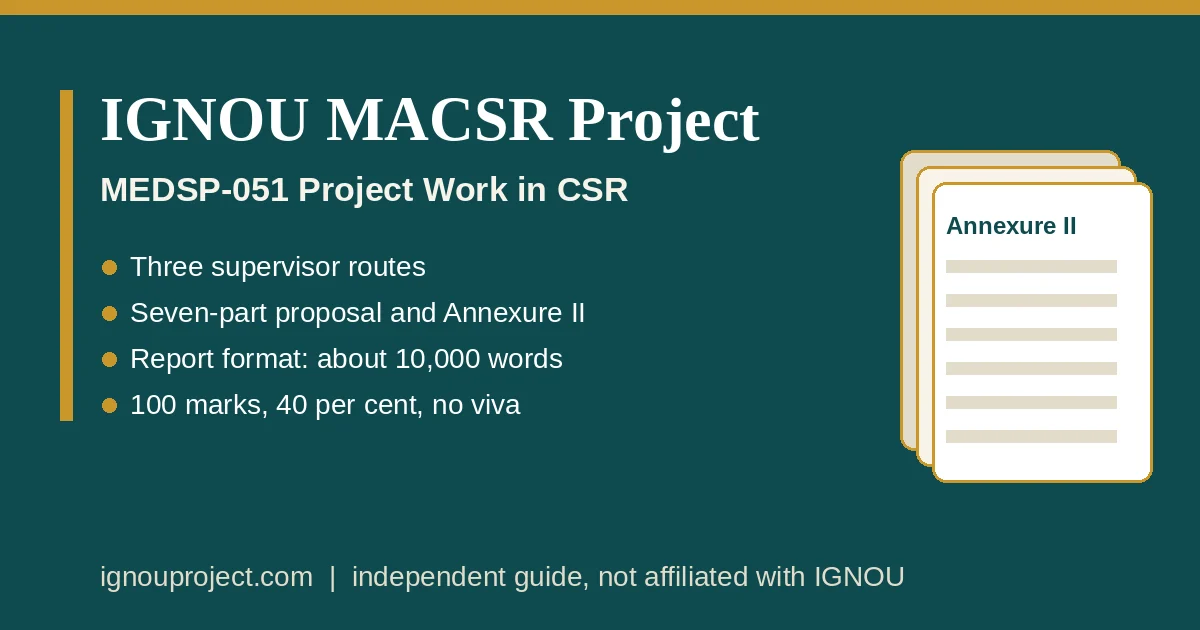
The IGNOU MACSR Project is MEDSP-051, Project Work in CSR: an 8-credit elective in Year I of MACSR, taken instead of MEDSE-046, under the same Handbook PGDCSR learners follow. You choose an eligible supervisor, post a typed proposal of 3 to 5 pages with the Annexure II proforma and the supervisor’s bio-data to SOEDS, and wait up to four weeks for approval. The report of about 10,000 words then goes to the Student Evaluation Division. It carries 100 marks, needs 40 per cent and has no viva.
- MEDSP-051 is optional. MACSR Year I and the PGDCSR diploma both list MEDSE-046 and MEDSP-051 at 8 credits each and ask for one of the two (Common Prospectus, July 2026, pp. 103 and 282).
- The proposal goes to SOEDS, not to your Regional Centre: the Project Coordinator (PGDCSR), Block 15-F, Maidan Garhi, by speed post (Handbook, section 6). MACSR learners use the same address.
- The approved Annexure II proforma is page 2 of the bound report, so the report has to carry a title SOEDS has approved (Handbook, section 7).
- Section 7 lists the report’s contents twice, once short and once long. Our report template merges the two lists so nothing either of them names is left out.
- There is no viva or assignment for MEDSP-051; the report alone earns the 100 marks (Handbook, section 8).
- Two different sums travel with the report: Rs 300, the supervisor’s honorarium that IGNOU pays through the Annexure IV bill, and Rs 500, your project evaluation fee (Prospectus, p. 27).
What the IGNOU MACSR Project (MEDSP-051) asks of you, stage by stage
The IGNOU MACSR Project runs in two stages that never travel together: a proposal that the School of Extension and Development Studies (SOEDS) approves, and later a report that the Student Evaluation Division (SED) sends to an external examiner. Both are governed by the Handbook on Project Work in CSR (MEDSP-051), printed in August 2021, which describes the course as learning by doing: choosing a topic, writing a proposal, building data collection tools, collecting data and reporting on it.
| Stage | What you do | Who receives it | Timing in the Handbook |
|---|---|---|---|
| 1. Supervisor and topic | Find a supervisor who fits one of three routes; settle a focused topic with him or her | Your supervisor | Before the proposal |
| 2. Proposal packet | Annexure II proforma, a typed proposal of 3 to 5 pages, the supervisor’s signed bio-data | Project Coordinator (PGDCSR), SOEDS, Block 15-F | Advised by 30 April (January admission) or 31 October (July admission); accepted all year |
| 3. Approval | Read the decision and any comments; note your PP number | Sent to you by e-mail or post | Within four weeks of the School receiving it |
| 4. Fieldwork and writing | Collect and analyse your own data; write about 10,000 words | Your supervisor reads the drafts | Any time after approval |
| 5. Report | One typed copy, hard or spiral bound, or an upload when IGNOU opens a link | Assistant Registrar (Project Section), SED | Any time; 31 May and 30 November are the suggested deadlines |
| 6. Result | Nothing to send; the report is the whole assessment | An external examiner chosen by SED | Declared with the June or December term-end results, by date of receipt |
Built from sections 6, 7 and 8 of the MEDSP-051 Handbook.
- In our records, 70 to 80 percent of students become active only in the last month before a submission date. On MEDSP-051 that habit runs into the Handbook’s advice to post the proposal by 30 April or 31 October, dates set for timely approval rather than as a cut-off.
- Many students tell us they plan to send the proposal and the report together at the end, without the supervisor’s signature, and such a combined submission is rejected. MEDSP-051 cannot work that way: the approved proforma is page 2 of the report.
- Many students leave the proposal so late that no time is left to write it themselves.
Our MEDSP 51 video walkthrough
The video is our own. Where it differs from this page, follow the page, which was checked line by line against the Handbook in October 2026.
IGNOU MACSR Project documents: what IGNOU prints and what we add
Every rule for the IGNOU MACSR Project sits in one booklet, the MEDSP-051 Handbook, with five annexures at the back. No other IGNOU document sets the proposal parts, the proforma or the report order; the Prospectus adds the credits and the fee, and the December 2026 notices add the upload route.
- Handbook on Project Work in CSR (MEDSP-051)SOEDS, August 2021; sections 1 to 8 on methods, proposal, report and evaluation; eGyanKosh collection for MEDSP-051
- Annexure I, Sample Topics for a Project ProposalHandbook pp. 27 to 28; 31 areas, given as ideas
- Annexure II, Proforma for Approval of Project Proposalp. 29; goes in the proposal packet, then becomes page 2 of the report
- Annexure III, Certificate of Originalityp. 30; page 3 of the report, signed by you and the supervisor
- Annexure IV, Remuneration Bill for Guidance of Project Workp. 31; the supervisor’s Rs 300 claim, enclosed with the report’s cover letter
- Annexure V, Project Report Cover Page Examplep. 32; the model for page 1
- MACSR programme page and PGDCSR programme pageignou.ac.in; courses, fee, duration and coordinators, read October 2026
- Common Prospectus, July 2026MACSR pp. 102 to 103, PGDCSR pp. 281 to 282, project evaluation fee p. 27
- December 2026 project submission noticesIGNOU Regional Centre notices of October 2026: upload through the Online Project Management System on Samarth, last date 30 November 2026
- Sample MEDSP-051 proposal (PDF, 5 pages)The Handbook’s seven parts on a content-analysis topic about CSR impact assessment disclosure; sector, companies and every figure left for you to fill
- MEDSP-051 report format template (PDF, 8 pages)Bound order, title page model, length plan, chapter frames and empty tables; no results
Both files are watermarked study reference. Read them for shape; write your own proposal and report from your own reading and data.
- A pattern we meet often: a proposal drafted with ChatGPT or another AI tool before anyone opened the Handbook. It reads smoothly and still misses what MEDSP-051 asks for, such as the locale, sampling, instruments and statistical tools under Research Methodology.
- Many students are unsure what the proforma is. For MEDSP-051 it is Annexure II on page 29; some forget it, and others send a proforma printed for another course.
- Reports come back when the papers they must carry are missing. MEDSP-051 fixes the first three pages: the title page, the approved Annexure II proforma and the Annexure III certificate signed by you and your supervisor.
MEDSP-051 or MEDSE-046: the elective choice in MACSR and PGDCSR
MEDSP-051 Project Work in CSR is one of two electives. In Year I of MACSR, and in the one-year PGDCSR, the Common Prospectus (July 2026) lists MEDSE-046 Development: Issues and Perspectives and MEDSP-051 at 8 credits each and asks you to choose one. A learner who picks MEDSE-046 has no IGNOU MACSR Project to write; one who picks MEDSP-051 has no MEDSE-046 examination. MEDSP-051 is also the only IGNOU CSR project course in the two programme tables of the July 2026 Prospectus; the MACSR Year II list carries none.
| Point | MACSR | PGDCSR |
|---|---|---|
| Full name | Master of Arts (Corporate Social Responsibility) | Post Graduate Diploma in Corporate Social Responsibility |
| Where MEDSP-051 sits | Year I, with MEDS-051 to MEDS-054 and MSW-009 | The same courses make up the whole diploma |
| Total credits | 72 | 36 |
| Duration | 2 to 4 years | 1 to 3 years |
| Fee in the July 2026 Prospectus | Rs 8,000 a year | Rs 8,000 for the programme |
| After the first year | Any 36 credits from the Year II list | Completers may enter MACSR Year II by credit transfer |
If you are on the IGNOU PGDCSR project
The IGNOU PGDCSR project is the same course under the same Handbook; the Handbook was in fact written for PGDCSR. That is why the proforma asks whether your supervisor counsels for PGDCSR or MADVS, and why the certificate of originality and the cover-page example name the PG Diploma. MACSR learners use the same address and annexures, and should ask the Project Coordinator which programme name to print on the cover and the certificate.
- Students regularly ask whether a published last date is for the proposal or for the report. For MEDSP-051 the Handbook gives the proposal dates as advice (30 April and 31 October) and the report dates as suggested deadlines (31 May and 30 November); the December 2026 notice with its 30 November date is about reports and fees.
- Many students wait because they assume IGNOU will push every last date back by a month. Nothing in the MEDSP-051 Handbook promises that, and the approval reply of up to four weeks comes before the report can even begin.
Who can supervise your MEDSP-051 project
Your IGNOU MACSR Project supervisor must come through one of three routes printed in section 6 of the Handbook, and SOEDS approves the supervisor separately from the proposal: the office box on Annexure II has one line for each.
| Route | Who qualifies | What to show |
|---|---|---|
| (a) | IGNOU Academic Counsellors at Learner Support Centres for the PGDCSR or MADVS programmes, with relevant experience | The courses he or she counsels for and since when, with the name and code of the study centre |
| (b) | Teachers, researchers or development professionals in CSR, Development Studies or a related discipline such as Extension Education, Social Work, Economics, Sociology, Public Administration, Political Science or Rural Development | PhD preferred, or an M.Phil or Masters with 5 years’ experience |
| (c) | Faculty at the School of Extension and Development Studies headquarters | The bio-data, as for every route |
Every route sends the same bio-data: about 2 pages, signed by the supervisor, with date of birth, full office and residential addresses, telephone numbers, academic qualifications with the year of passing, and work experience with designation and organisation. Annexure II warns that a proposal without the complete, signed bio-data will not be entertained, even when the supervisor is an IGNOU counsellor. Guide rules on other courses differ; this comparison of guide criteria across IGNOU courses shows how.
If SOEDS does not accept the supervisor, you are told so, and you resubmit the proposal afresh with a new supervisor’s signature; changing supervisor for any other reason also means a new proposal on a new proforma. The supervisor’s duties in the Handbook include helping you focus the topic, pointing you to literature and field settings, encouraging original work, and giving a letter of authorisation for data collection, which the study centre or Regional Centre can also give. IGNOU pays the supervisor a token honorarium of Rs 300 per learner, claimed on the Annexure IV bill; the Handbook notes that the University may revise it.
- Most students we hear from do not know these criteria and choose a supervisor first, only to find that route (b) asks for a PhD, or five years of experience after an M.Phil or Masters.
- Students often ask their study centre to allot a supervisor and come away without one. The MEDSP-051 Handbook does not promise an allotment; it lists who may supervise, and route (a) covers counsellors at the centres.
- When nobody is allotted, some students turn to a relative or an outside contact without checking eligibility. Test the person against route (a), (b) or (c) first, because SOEDS can refuse the supervisor and the proposal then starts again.
MACSR project topics: from the 31 Annexure I areas to one study
Annexure I lists 31 areas for the IGNOU MACSR Project and states that you need not choose from them; they are there to give ideas. Several lines end with the words “or any organization or corporate company of your choice”, which is the Handbook’s way of leaving the company to you. Section 6 asks you to weigh seven points before you settle: suitability, relevance to CSR, the time you have, whether data can be collected in that time, the difficulties in collecting it, its cost, and communication facilities and local language.
| Kind of study | Annexure I items | Method that usually fits | Data you will need |
|---|---|---|---|
| One company’s CSR | 1, 2, 8, 11 | Case study | Annual reports on CSR, interviews with CSR staff, visits to projects |
| Beneficiaries and stakeholders | 6, 7, 9, 10, 14 | Survey | An interview schedule or questionnaire answered by beneficiaries |
| Reporting and disclosure | 13, 15, 18, 19, 21, 22 | Content analysis | Published CSR reports and annual reports |
| Policy and practice across firms | 3, 12, 16, 17, 20, 23, 26, 28, 29, 30 | Secondary analysis, or a survey of managers | Company documents, the National CSR Portal, managers’ answers |
| A sector or a state | 24, 25, 27 | Mixed methods | Sector spending figures with a small survey |
| Social impact and NGOs | 4, 5, 31 | Case study or mixed methods | NGO records, impact assessment reports, field interviews |
The item numbers are Annexure I’s; grouping them and pairing each group with a method is our reading, to check with your supervisor.
CSR study design planner
A planning aid. The kinds of study and the item numbers come from Annexure I and sections 3 to 5 of the MEDSP-051 Handbook; matching them to your access and your time is our suggestion, to settle with your supervisor.
This planner needs JavaScript. If this line stays visible, use the table above and the explanation below.
Your first answer picks a row of the table above and gives its method, its nearest Annexure I items, the unit you will study, where the data comes from, and a title pattern in which the words in round brackets are yours to replace. Two answers change the advice:
- A beneficiary survey with access to documents only is switched to a document study, because a survey needs people to answer it.
- A document study with access to the field is offered a short survey as well, since section 3 of the Handbook allows mixed methods.
- Under three months asks for a smaller sample or a narrower set of years; more than six months leaves time to pre-test the tool and for your supervisor to read a draft.
- Many students believe they must copy an Annexure I topic word for word. The Handbook says the opposite: the areas are samples meant to give you ideas.
- Topic choice is where students tell us they feel most lost, and many add that IGNOU holds no class on writing a proposal or report. For MEDSP-051, section 6’s seven points are the closest thing to that class.
- Proposals built from widely shared material often carry the same title as other learners’ work, and duplicate topics are a common reason for a return. Change the angle, the place and the period as well as the company name before the title goes on Annexure II.
Section 135 and the CSR Rules: check the company before you study it
A study of one company’s CSR for the IGNOU MACSR Project starts with a legal question: is the company covered at all? Section 135(1) of the Companies Act, 2013 covers every company that, in the immediately preceding financial year, had a net worth of Rs 500 crore or more, a turnover of Rs 1,000 crore or more, or a net profit of Rs 5 crore or more. Section 135(5) then asks its Board to see that the company spends at least two per cent of its average net profits of the three immediately preceding financial years, giving preference to the local area where it operates.
The Companies (Corporate Social Responsibility Policy) Rules, 2014 add the detail. Since the amendment of 22 January 2021 (G.S.R. 40(E)), rule 8(3)(a) requires a company whose average CSR obligation over the three preceding years is Rs 10 crore or more to have an independent agency assess the impact of its CSR projects with outlays of Rs 1 crore or more, completed at least a year earlier, and rule 8(3)(b) places those reports before the Board and with the annual report on CSR. Section 135(9) removes the need for a CSR Committee when the amount to be spent is Rs 50 lakh or less. A Corporate Laws (Amendment) Bill, 2026 proposing changes to the CSR thresholds was still before Parliament in October 2026; until it becomes law, the figures above stand.
Section 135 and impact assessment check
Built from section 135(1), (5) and (9) of the Companies Act, 2013 and rule 8(3) of the CSR Rules as amended on 22 January 2021, read in October 2026. Enter figures in Rs crore from the company’s own annual reports.
This check needs JavaScript. If this line stays visible, apply the rules listed below by hand.
- Coverage: any one of net worth of Rs 500 crore or more, turnover of Rs 1,000 crore or more, or net profit of Rs 5 crore or more in the preceding year brings the company under section 135(1).
- Spending: two per cent of the average net profit of the three preceding years, or of fewer years only for a company not yet three years old (section 135(5)). A zero or negative average gives no amount.
- Committee: Rs 50 lakh or less to spend means the Board does the CSR Committee’s work (section 135(9)); above that, a Committee is required.
- Impact assessment: an average CSR obligation of Rs 10 crore or more over three years brings in rule 8(3); the check needs all three years to test it.
The check reads the law as printed in October 2026. It tells you what the rules ask of a company, not whether the company complied; that question is for your study.
- Many students base the whole MEDSP-051 study on secondary data. The Handbook does not forbid it; Annexure I includes a content analysis of CSR reports, and section 3 allows other methods. What it does ask is that the proposal name its locale, sampling, instruments and statistical tools, whatever the data.
- Evaluators often return proposals asking that the study be based in the learner’s own city or area. Section 135(5) asks companies to prefer the local areas where they operate, so a company that spends near your home often suits both requests.
Writing the MEDSP-051 project proposal in the Handbook’s seven parts
The MEDSP-051 project proposal is typed, runs to 3 to 5 pages, and states seven things in this order: Title, Introduction, Objectives, Problem Statement, Research Methodology, Limitations if any, and References. Research Methodology itself has four named pieces, locale, sampling, data collection instruments and the statistical tools to be used. For the IGNOU MACSR Project, the Handbook points you to Block I of MEDS-054 for how to formulate a good proposal.
| Part | What the Handbook asks | What a careful reader checks |
|---|---|---|
| 1. Title | The title of the study | The same words on Annexure II, and later on the cover page |
| 2. Introduction | The topic and its background | The CSR law, policy or programme it rests on, with a source |
| 3. Objectives | What the study sets out to find | Each objective served by some part of the methodology |
| 4. Problem Statement | The problem the study takes up | Ends in the question the report will answer |
| 5. Research Methodology | Locale, sampling, data collection instruments, statistical tools | All four named; the tool attached or described |
| 6. Limitations, if any | Constraints on the study | Specific to this study, not general |
| 7. References | Works used | APA style, matching what the Introduction cites |
The second column is section 6 of the Handbook; the third is our reading checklist.
Our sample proposal on CSR impact assessment disclosure shows the seven parts on one page plan: a content analysis of the annual reports on CSR of listed companies in one sector, built on rule 8(3), with the sector, companies and figures left for the learner. Use it to see the shape, not the words.
- In many proposals we read, the literature cited in the Introduction does not match the References list.
- Many students do not know the proposal structure and leave out core parts such as the objectives or the research methodology. MEDSP-051 does not ask for hypotheses in every proposal; it does ask for locale, sampling, instruments and statistical tools.
- Proposals come back when the rationale or the questionnaire is missing. MEDSP-051 asks you to name your data collection instruments, and the report’s Introduction must carry the rationale, so settle both now.
Before your IGNOU MACSR Project proposal is posted, a second reader
A MEDSP-051 proposal that drops one Research Methodology piece, or a proforma with a blank box, can send you back to the start of a four-week wait. A reading against the Handbook before the envelope is sealed is the cheapest place to catch either.
In your MEDSP-051 proposal we look for
- All seven parts, in the Handbook’s order
- Locale, sampling, instruments and statistical tools each named
- 3 to 5 typed pages
- The same title on the proposal and on Annexure II
- Every learner box on Annexure II filled, and both signatures
- A supervisor who fits route (a), (b) or (c), with signed bio-data
- References that match the citations
In your bound MEDSP-051 report we look for
- Title page, approved proforma and signed certificate as pages 1 to 3
- Chapters that cover both of the Handbook’s report lists
- About 10,000 words, appendices excluded
- Findings in tables, discussed against earlier studies
- APA references, in alphabetical order
- The questionnaire or schedule in the appendix
- The Annexure IV bill with the cover letter
- Some students post an AI-written proposal or report as it comes out, which is one reason the same CSR topics keep reappearing.
- Many students paste text from internet sources and send it without checking it for plagiarism. The MEDSP-051 certificate you sign says the work is your own, and no correction service can make that promise for you.
- Most approvals we see come back with points to correct, so plan time after approval as well as before it.
Synopsis or proposal correction: Rs 1,000. Report correction: Rs 2,000.
Have my draft readYou remain the author of every page. We mark corrections against the MEDSP-051 Handbook and return your file; approval is decided by IGNOU’s evaluator.
Annexure II for the IGNOU MACSR Project, box by box
Annexure II is a single page with two jobs: it asks SOEDS to approve your supervisor and your proposal, and once approved it becomes page 2 of your report. The table follows the printed form from top to bottom.
| Box on the form | Who fills it | What to watch |
|---|---|---|
| Project Proposal No. | The School | Leave it blank; this becomes your PP number |
| Enrolment No. | You | Exactly as on your identity card |
| Study Centre Code | You | Your own study centre, not the supervisor’s |
| You | One you read; the decision can come by e-mail | |
| Regional Centre Code | You | Your Regional Centre’s code |
| Mobile No. | You | A number that will stay in use |
| Name and Address of the Student | You | Write it clearly: the approved proposal is posted to this address |
| Title of the Project | You | Word for word the title on your proposal |
| Name, Designation and Address of the Supervisor | You, with the supervisor | Matches the bio-data |
| Is the Supervisor an Academic Counsellor of PGDCSR / MADVS? Yes / No | You | Tick one; route (b) and (c) supervisors tick No |
| If Yes, Name and Code of the Study Centre | You | The centre where the supervisor counsels |
| Signature of Student, with date | You | Sign and date before posting |
| Signature of Supervisor, with date | The supervisor | A missing signature stops the packet |
| For Office Use only: Project Proposal and Supervisor, each Approved or Not approved; Comments; Signature of Faculty | SOEDS faculty | Leave the whole block blank |
Built from Annexure II on page 29 of the MEDSP-051 Handbook; the last column is our advice.
Before the envelope is sealed
- Annexure II, filled in and signed by you and your supervisor
- One typed proposal of 3 to 5 pages in the seven parts; keep a copy
- The supervisor’s bio-data, signed, with date of birth, office and residential addresses, telephone numbers, qualifications with year of passing, and experience with designation and organisation
- For a counsellor, the courses counselled and since when, with the study centre’s name and code
- “Project Proposal-MEDSP-051” on the top right-hand corner of the envelope, sent by speed post
- Many proformas reach us with the supervisor’s details half filled, and sometimes the learner’s own name, address or e-mail left blank. On Annexure II the address box matters twice over, because the approved proposal is posted to it.
- Proposals are returned when the title box is left empty.
- On other courses we have seen proposals returned when the guide’s bio-data lacked a stamp or a working ID. The MEDSP-051 Handbook asks for bio-data that is signed and complete, and Annexure II warns that without it the proposal will not be entertained.
Posting to Block 15-F and the four-week wait
The IGNOU MACSR Project proposal goes by speed post to one address, whichever Regional Centre you belong to:
School of Extension and Development Studies (SOEDS)
Block 15-F, IGNOU, Maidan Garhi
New Delhi-110068
Send only one copy and keep one. The Handbook advises learners admitted in January to post by 30 April, and those admitted in July by 31 October, so that approval, report and result follow in time. Proposals are still accepted all through the year, with a matching delay in finishing the programme. Sections 6 and 7 print no e-mail or online route for the proposal; the online link they mention is for the report.
A written decision is to reach you within four weeks of the School receiving the proposal, by e-mail or post. It carries a Project Proposal number (PP No.), which you will need if the proposal has to be sent again. How approval letters work on other IGNOU courses is set out in our guide to IGNOU approval letters.
- Many students post the proposal in the last week before a date they think is final. For MEDSP-051 the April and October dates are advice, but a late proposal still brings the related delay in completion that the Handbook warns about.
- Many students forget to keep the speed post receipt. It is your record of when the packet left you, which matters when you follow up after four weeks.
- Students are unsure whether the proposal goes to the study centre or the Regional Centre, and some carry it to Maidan Garhi themselves. For MEDSP-051 the Handbook’s answer is SOEDS, Block 15-F at Maidan Garhi, by speed post.
MACSR project report format, page by page
The MACSR project report format comes from section 7 of the Handbook. An IGNOU MACSR Project report runs to about 30 to 40 typed pages at 1.5 line spacing and not more than about 10,000 words, excluding appendices and exhibits, with 10 per cent allowed either way. It is written in English, on A4 paper (the Handbook prints the size as 29 x 20 cm; standard A4 is what printers supply), and sent hard bound or spiral bound.
| Order | Part | Source in section 7 |
|---|---|---|
| 1 | Title page: course code MEDSP-051, title, your name, enrolment number, address, school name and year | Format box; Annexure V example |
| 2 | Approved Project Proposal Proforma (Annexure II) | Both lists |
| 3 | Certificate of Originality signed by you and your supervisor (Annexure III) | Both lists |
| 4 | Acknowledgements, if any | Format box |
| 5 | Table of Contents | Format box |
| 6 | Introduction, with objectives, problem statement and rationale | Both lists |
| 7 | Review of the Literature | Format box |
| 8 | Methodology: locale, sampling, tools and statistical techniques | Both lists |
| 9 | Results and Discussion, in tables and graphs, discussed against earlier studies | Both lists |
| 10 | Summary and Conclusion | Summary in point 1; Conclusion in the format box |
| 11 | Limitations, and Suggestions for further work | Format box |
| 12 | References, APA style, in alphabetical order | Both lists |
| 13 | Appendices, with the interview schedule or questionnaire | Both lists |
Section 7 lists the contents once in point 1 and again, at greater length, in its format box. This order keeps everything either list names.
The MEDSP-051 report format template (PDF) lays this order out with a title page model, a word plan and empty table shells for each chapter. The Handbook says the evaluated report is not returned, so keep a copy of your own.
- After approval, many students tell us they do not know the format the report should follow. For MEDSP-051 it is all on pages 23 to 26 of the Handbook, APA examples included.
- Some reports run well past the length the guidelines set and come back. MEDSP-051 sets about 10,000 words, so 9,000 to 11,000 is the permitted band.
- In many reports the references do not follow the style the guidelines set and do not match the sources used. MEDSP-051 sets APA, listed alphabetically.
Sending the report: SED by post, or the December 2026 upload
The Handbook’s route for the IGNOU MACSR Project report is one typed hard-bound or spiral-bound copy, with a cover letter and the supervisor’s Annexure IV bill, by Registered or Speed Post to:
Student Evaluation Division, IGNOU
Maidan Garhi, New Delhi-110068
Envelope marked: PROJECT REPORT- MEDSP-051
The Handbook adds that IGNOU may provide an online link to upload the report as a PDF, and that a learner who uploads need not send the hard copy. For the December 2026 term-end examination, IGNOU Regional Centre notices of October 2026 announced uploads through the Online Project Management System, reached with your Samarth login, with 30 November 2026 as the last date. Press reports of the same announcement add that the whole report goes as one PDF for each course, and that reports already sent as hard copies to SED or a Regional Centre need not be uploaded again. The project evaluation fee of Rs 500, set in the Prospectus for projects above 4 credits from the January 2023 admission cycle, is paid with the term-end examination form; MEDSP-051 has 8 credits.
| Report received | Result declared with |
|---|---|
| 1 December to 31 May | June term-end examination results |
| 1 June to 30 November | December term-end examination results |
Session dates change every cycle; the December 2026 project date tracker follows them, and the project status guide explains what each status line means once the report is in.
- Some students e-mail the report. For MEDSP-051 the routes are a posted copy to SED or an upload when IGNOU opens one, and IGNOU’s online submission guidance says e-mailed reports are not considered.
- Some students skip the receipt when they send the report. Keep the postal receipt or the upload acknowledgement until the result is out.
- Many students mix up the Rs 300 and Rs 500 figures. On MEDSP-051 they are separate: Rs 300 is the supervisor’s honorarium that IGNOU pays through Annexure IV, and Rs 500 is your evaluation fee.
100 marks, 40 per cent and no viva
Section 8 of the Handbook is four sentences long. The IGNOU MACSR Project report carries a maximum of 100 marks, you need at least 40 per cent to complete the project, and there is no viva or assignment for the project work. The external examiner is chosen by the Student Evaluation Division from a list approved by SOEDS. Older guides, including an earlier version of this page, spoke of an optional viva; the Handbook rules it out.
- Many students ask whether a viva applies to them. For MEDSP-051 the Handbook’s answer is no.
- In many reports the analysis chapter is too thin to support the objectives and the methodology. With no viva in which to explain yourself, Results and Discussion has to do that work on paper.
- Some students write the analysis on assumed figures without collecting any data. A report built that way is false, and you sign the certificate of originality on it.
Not approved, a new supervisor or a new title
When an IGNOU MACSR Project proposal is not approved, SOEDS sends comments for reworking it. The revised proposal goes back with a revised proforma, a copy of the rejected proposal, the proforma bearing the evaluator’s comments, and the PP number allotted the first time. A rejected supervisor, or a supervisor you change for any reason, means a fresh proposal on a new proforma with the new supervisor’s signature.
The Handbook has no separate rule for changing the title after approval. Our reading: because the approved proforma is page 2 of the report and the cover carries the title, a new title needs SOEDS’s approval before the report is bound, so write to the Project Coordinator first. The way other IGNOU courses handle it is in our note on topic changes after approval.
- The Handbook promises a written reply within four weeks. In our experience across IGNOU courses, approval often takes two to three months to reach students, so write to the Project Coordinator at SOEDS rather than waiting in silence.
- When asked to resubmit, many students forget to attach the original rejected proposal. MEDSP-051 asks for it, together with the proforma bearing the evaluator’s comments and your PP number.
- We have seen sessions run out while a learner waited for a letter that never arrived. Once four weeks have passed, ask SOEDS in writing, quoting your enrolment number and the date the packet was posted.
MEDSP-051 questions from MACSR and PGDCSR learners
Is the IGNOU MEDSP 51 project the same as MEDSP-051?
Yes. The Handbook and the Prospectus print the code as MEDSP-051; learners also write MEDSP 51 or MEDSP-51. All three mean Project Work in CSR, the 8-credit elective.
Is the IGNOU MACSR Project compulsory?
No. MACSR Year I asks you to choose either MEDSE-046 Development: Issues and Perspectives or MEDSP-051 Project Work in CSR, both of 8 credits. PGDCSR has the same choice.
Can I choose a topic that is not in Annexure I?
Yes. Annexure I says its 31 areas are samples to give you ideas and that you need not choose from them. Agree the topic with your supervisor and test it against the seven points in section 6.
Which papers go with the proposal?
Three: Annexure II signed by you and your supervisor, one typed copy of the proposal of 3 to 5 pages, and the supervisor’s signed bio-data. At our desk many students are unsure of this list until the packet is ready to post.
Does the proposal go to my Regional Centre?
No. It goes by speed post to the Project Coordinator (PGDCSR), SOEDS, Block 15-F, IGNOU, Maidan Garhi, New Delhi-110068, for MACSR and PGDCSR learners alike.
Can the proposal or report be handwritten?
No. The Handbook asks for a typed proposal and a typed report. Other IGNOU courses are compared in our note on handwritten and typed projects.
Can two learners take the same topic?
The Handbook has no rule on shared topics. It asks for original work, and each learner signs a certificate of originality, so make sure the company, place or period differs and the data is your own.
Is a spiral-bound report accepted?
Yes. The Handbook accepts a hard-bound or a spiral-bound copy. Some students we hear from worry after choosing spiral binding; for MEDSP-051 it is allowed.
Whom do I contact if the approval has not come?
Write to the Project Coordinator (PGDCSR) at SOEDS. The programme page lists the coordinators as Prof. Nisha Varghese (nishavarghese@ignou.ac.in, 011-29571668) and Prof. P.V.K. Sasidhar (pvksasidhar@ignou.ac.in, 011-29571665). Most students who ask us do not know how long approval takes or whom to write to after a month or two of silence.
What fee do I pay for MEDSP-051?
A project evaluation fee of Rs 500 for a project above 4 credits, applicable from the January 2023 admission cycle and paid with the term-end examination form (Prospectus, July 2026, p. 27). The Rs 300 in the Handbook is the supervisor’s honorarium, which IGNOU pays.
When will the result come?
A report received between 1 December and 31 May is declared with the June term-end results, and one received between 1 June and 30 November with the December results.
Your next three steps on the IGNOU MACSR Project
The IGNOU MACSR Project rewards learners who start with the paperwork the Handbook fixes and leave the writing for after approval.
- Find a supervisor who fits route (a), (b) or (c), and get the signed bio-data in hand.
- Write the proposal in the seven parts, fill every learner box on Annexure II, and run the Section 135 check if your study is about one company.
- Post the packet by speed post to SOEDS, Block 15-F, keep the receipt, and mark four weeks from posting in your diary for a follow-up.
- Some reports go out without the supervisor’s signature on the certificate of originality.
- Many reports leave the questionnaire or interview schedule out of the appendix.
- Many students are unsure of the page order; for MEDSP-051 the first three pages are fixed, and the rest follow section 7.
MACSR assignments are a separate task, covered in our MACSR handwritten assignment page. For the sister SOEDS course built on a near-identical handbook, see the MADVS project page for MDVP 117.
- Indira Gandhi National Open University, School of Extension and Development Studies. Handbook on Project Work in CSR (MEDSP-051) for PGDCSR. August 2021. Sections 1 to 8 and Annexures I to V. Read in full from a copy of the IGNOU print, October 2026. eGyanKosh collection.
- IGNOU. Common Prospectus, July 2026. Section 1.17 (p. 27), section 3.47 MACSR (pp. 102 to 103), section 8.22 PGDCSR (pp. 281 to 282).
- IGNOU. MACSR programme page and PGDCSR programme page, read 23 October 2026.
- IGNOU Regional Centre notices (Noida, Guwahati) on project submission and fee for the December 2026 term-end examination, October 2026, and IGNOU’s online project submission guidelines for earlier cycles.
- The Companies Act, 2013, section 135, as published by the Income Tax Department, read October 2026.
- Ministry of Corporate Affairs. Companies (Corporate Social Responsibility Policy) Rules, 2014 (G.S.R. 129(E), 27 February 2014) and Amendment Rules, 2021 (G.S.R. 40(E), 22 January 2021), rule 8(3); copy of the 2021 notification.
- Ministry of Corporate Affairs. National CSR Portal.
ignouproject.com is an independent service and is not affiliated with or endorsed by IGNOU. Rules on this page are quoted from IGNOU’s own documents as read in October 2026; IGNOU’s current documents prevail.

BK Sahni iD 0009-0005-8092-459X
Founder, Shri Chakradhar Publication Pvt. Ltd. & ignouproject.com — helping IGNOU distance-learning students since 2010 (5,00,000+ students supported across MBA, MCom, MA & more). Author of IGNOU exam guides, solved assignments & project reference books.
Disclosure: Shri Chakradhar Publication Pvt. Ltd. and ignouproject.com are independent third-party study-help services — not the official IGNOU website. Always verify final dates and rules on ignou.ac.in.