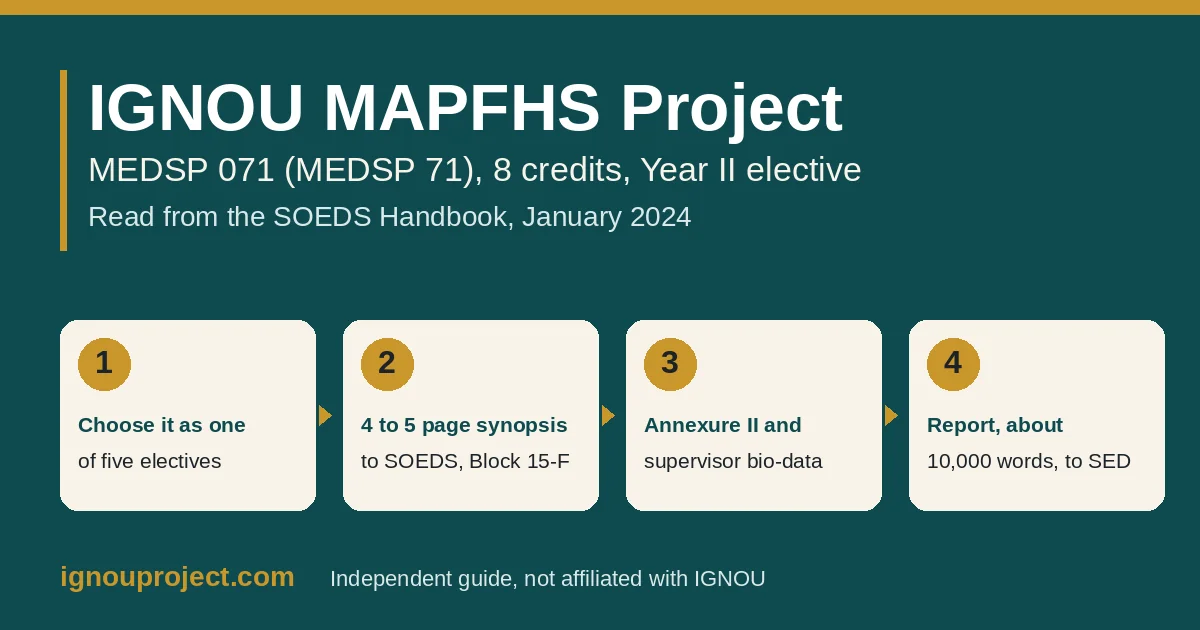
The IGNOU MAPFHS Project is MEDSP 071 (often written MEDSP 71), an 8-credit Year II course that is optional: you pick it as one of five Year II electives. Choose it and you post a typed 4 to 5 page proposal, the Annexure II proforma and your supervisor’s signed bio-data to SOEDS, Block 15-F. A reply comes within four weeks. The report, about 10,000 words, goes hard-bound to the Students Evaluation Division.
- The project is an elective. Page 19 of the MAPFHS Programme Guide says so in plain words, and the learner opts for it as one of the five Year II courses.
- Signed supervisor bio-data travels with every proposal. Without it the proposal “will not be entertained”, even when the supervisor is a MAPFHS academic counsellor (Annexure II).
- The proposal goes to the Project Coordinator (MAPFHS) at SOEDS, Block 15-F; the bound report goes to the Assistant Registrar (Project Section) of the Students Evaluation Division. Both offices are at Maidan Garhi; your Regional Centre is not on either route.
- The report runs to about 40 to 50 typed pages at 1.5 line spacing, roughly 10,000 words without appendices, with 10 per cent leeway either way.
- Two different Rs 500 sums appear: the project evaluation fee you pay with the term-end exam form (Common Prospectus, p. 27) and the honorarium IGNOU pays your supervisor (Annexure IV).
- The 2024 Handbook prints “MEDSP-075” twice and “MDVP-117” once where MEDSP-071 is meant, and describes no viva.
Is the IGNOU MAPFHS Project compulsory? Five IGNOU papers, one answer
No. The IGNOU MAPFHS Project is one of seven Year II options, and you take any five of them. The confusion comes from how IGNOU’s own papers print the course table: the Prospectus and page 8 of the Programme Guide print MEDSP 071 without the elective star, while the launch notification, the programme page, page 19 of the same Guide and the Handbook make the choice clear.
| Document | What it prints for MEDSP 071 | How to read it |
|---|---|---|
| Launch Notification No. 132 (Planning and Development Division, 26 December 2023) | “Project Work (Population and Family Health Studies)*”, with the note “Choose any Five courses from the above electives in the Second year” | Elective, starred like the six theory options |
| MAPFHS Programme Guide, January 2024, p. 19 | “MAPFHS is offering project work as an elective and not a compulsory course” | Elective, stated in words |
| MEDSP-071 Handbook, section 1 | “The project work MEDSP-071 with 08 credits elected by you” | Elective |
| Programme Guide, p. 8, and Common Prospectus July 2026, p. 105 | MEDSP 071 listed after the six starred electives, without a star | Printed without the star; the credit arithmetic below only adds up if MEDSP 071 is one of the five |
| MAPFHS programme page on ignou.ac.in | “MEDSP-071: Project Work*”, 8 credits, Year 2 | Starred |
Built from the five documents named in the table, read in October 2026.
| Year | Courses | Credits |
|---|---|---|
| Year I (all compulsory) | MEDS 071, 072, 073, 074 and 075, 8 credits each | 40 |
| Year II (any five of seven) | MEDS 076, MEDS 077, MEDS 047, MSOE 002, MWG 111, MANE 004, MEDSP 071, 8 credits each | 40 |
| Programme total | Common Prospectus July 2026, p. 105 | 80 |
IGNOU MEDSP 071 Project or a sixth theory course?
The two routes are marked differently. Each theory course carries one compulsory assignment worth 30 per cent and a term-end examination worth 70 per cent, and you need 40 per cent in each separately (Programme Guide, p. 21). The project has no exam paper: the evaluation of your report carries the full weightage, and you need 40 per cent. The Programme Guide also lists one counselling session for the project at the Study Centre. Choose the IGNOU MAPFHS Project work if you can reach a field site or a data source for several months and already have a supervisor in mind; take a sixth theory course if you would rather prepare for an exam.
Learners who completed PGDPFHS and join MAPFHS in Year II by lateral entry (Prospectus, p. 105) meet the same choice. PGDPFHS itself is the five Year I courses, 40 credits, with no project (Prospectus, p. 283).
“Nobody taught us how to write a synopsis” is the sentence we hear most from MAPFHS learners at this point. The Programme Guide lists a single counselling session for the project, so the Handbook has to do most of the teaching.
The learners who regret the project are usually the ones who chose it in the last weeks of the cycle and found no time left to write the proposal in their own words.
A 35-page Handbook, four annexures and one video
Everything IGNOU prints about the IGNOU MAPFHS Project sits in one booklet: the MEDSP-071 Handbook on Project Work, prepared at SOEDS by Prof. B.K. Pattanaik and Dr. Sarda Prasad and dated January 2024. eGyanKosh files it under the title MEDSP-071 Project Work. Its sections 6 to 8 hold the rules; sections 4 and 5 explain the two methods it advises; Annexures I to V hold the topic list and the four papers you fill in, sign or copy.
- MEDSP-071 Handbook on Project Work, SOEDS, January 2024 (eGyanKosh). Read sections 6 and 7 twice.
- Annexure II, Proforma for Approval of Project Proposal, page 28 of the Handbook: goes in the proposal envelope.
- Annexure III, Certificate of Originality, page 29: bound into the report.
- Annexure IV, Remuneration Bill for Guidance of Project Work, page 30: your supervisor fills it; it goes with the report’s cover letter.
- Annexure V, Model Title Page, page 31: the layout of your report’s first page.
- MAPFHS Programme Guide, January 2024: the elective rule and the marks scheme.
- Sample synopsis (PDF): a survey on postnatal home visits by ASHAs, laid out in the Handbook’s seven parts, with every local fact left for you to fill. Watermarked; read it for layout, never copy it.
- Report format template (PDF): the page order, empty table shells and sentence frames, with no findings in it.
Many MEDSP 071 drafts we see were produced with ChatGPT or a similar tool before the Handbook was opened, so the plan does not match section 6: parts it never asks for are there, and parts it does ask for, such as the Problem Statement, are missing.
The proforma is the paper students are least sure about: some forget Annexure II altogether, others send a proforma from another course that they found online.
The other common question: is the proposal filed, stapled or bound? The Handbook asks for one typed copy and says nothing about binding the proposal; only the report must be hard-bound.
Video walkthrough of MEDSP 071
Our own 30-minute walkthrough follows the same order as this page, from the elective choice to the bound report. Where the video and this page differ, this page carries the October 2026 reading of the documents.
Five copy slips in the 2024 Handbook, and what to write instead
The MEDSP-071 Handbook was built on the project handbooks of two sister SOEDS programmes, and some of their wording stayed in. None of these slips changes a rule for the IGNOU MAPFHS Project, but each one misleads a student who copies the Handbook line for line.
| Where | What the Handbook prints | What to use |
|---|---|---|
| Section 3, Project Work | “in MEDSP-075, you are advised to use case study method or survey method” | MEDSP-071. MEDS-075 is the Year I research methodology course the Handbook sends you to; MEDSP-075 does not exist in MAPFHS. |
| Annexure II header | “PROFORMA FOR APPROVAL OF PROJECT PROPOSAL (MEDSP-075)” | Use the form as printed; write MEDSP-071 on your envelope and title page. |
| Format for Project Report, Title | “project course code: MDVP-117” | MEDSP-071, as Annexure V shows. MDVP-117 is the MADVS project. |
| Section 5.6 (b), Mail Survey | “evaluation of urban planning and development programmes” | A line carried over from the urban studies handbook; the method applies to population surveys just the same. |
| Annexure I, items 1 to 30 | Urban and development topics, including Sarva Shiksha Abhiyan and JNNURM | Items 31 to 35 are the population and family health ones. Sarva Shiksha Abhiyan was merged into Samagra Shiksha in 2018 and JNNURM gave way to AMRUT in 2015, so frame any such topic around the current scheme. |
Built from the MEDSP-071 Handbook itself; the scheme changes are public record.
One sum differs from the sister handbooks too: the MEDSP-071 Handbook pays the supervisor Rs 500, where the MADVS (MDVP-117), MAUS (MEDSP-045) and MACSR (MEDSP-051) handbooks print Rs 300. Fill Annexure IV with the MEDSP-071 figure.
Students often believe they must pick one of the 35 Annexure I topics word for word. The Handbook says the opposite: the areas “are just sample areas” and do not limit your choice, which matters here because most of them belong to urban and development studies.
30 April, 31 October and the two result windows
For the IGNOU MAPFHS Project the Handbook gives advisory dates for the proposal and two windows for the report. Neither is a hard cut-off: proposals are accepted all year “with related delay in completion”, and the report can be sent at any time.
| Step | What the Handbook says | Section |
|---|---|---|
| Proposal, January admission | Advised by 30 April | 6.3 |
| Proposal, July admission | Advised by 31 October | 6.3 |
| Reply from SOEDS | Within four weeks of receipt, by e-mail and post | 6.4 |
| Report sent 1 December to 31 May | Result with the June term-end examinations | 7.2 |
| Report sent 1 June to 30 November | Result with the December term-end examinations | 7.2 |
The Handbook calls 31 May and 30 November “suggested deadlines”: they decide which result your report joins. When IGNOU’s Students Evaluation Division notifies an online upload for a term-end cycle, that notice sets the route and its own last date for the cycle, so read it before you post. Our December 2026 submission dates tracker lists the notices as they appear.
In our records, 70 to 80 per cent of students become active only in the last month before a date; with MEDSP 071 that means proposals written in October for a 31 October advisory date.
Many MAPFHS learners post the proposal in the final week before the advisory date.
Some wait for a date to be “extended by a month” before they start. Nobody can predict an extension, and the Handbook’s dates for the proposal are advice in any case.
Three supervisor routes, and the bio-data rule that stops a packet
Section 6.2 of the Handbook names three kinds of supervisor for the IGNOU MAPFHS Project. You find the supervisor; SOEDS approves the person separately from the proposal, in its own box on Annexure II.
| Route | Who qualifies | What Annexure II must show |
|---|---|---|
| (a) | Academic Counsellors of MAPFHS with relevant experience, at Study Centres | “Yes” in the counsellor box, the Study Centre’s name and code, which courses the counsellor counsels and since when |
| (b) | Teachers, researchers, population experts or development professionals in development studies or a related discipline (population studies, geography, extension education, social work, economics, sociology, public administration, political science, rural development and the like); PhD preferred, or M.Phil or Masters with 5 years’ experience | “No” in the counsellor box; full name and address |
| (c) | Faculty at SOEDS headquarters | Name and address |
If SOEDS does not accept the supervisor, you are told so and must resubmit with a new supervisor; a change of supervisor at any stage means a fresh proposal on a fresh proforma, treated as new. The Handbook lists the supervisor’s duties as guiding you to a focused topic, pointing you to literature and field settings, encouraging original work, and giving a letter of authorisation for data collection, which your Study Centre or Regional Centre can also issue. For a wider view of guide rules across courses, see our guide eligibility explainer.
The supervisor’s bio-data, line by line
- Signed by the supervisor (notes 3b); about two pages (section 6.3)
- Date of birth
- Full office address and residential address
- Contact telephone numbers, mobile and e-mail
- Academic qualifications with the year of passing
- Work experience, with designation and the name of the organisation
The Annexure II note leaves no room: if the complete, signed bio-data is missing, “the proposal will not be entertained”, even when the supervisor is a MAPFHS academic counsellor.
Most students who come to us have not read the eligibility clause, so the first person they ask is someone who does not fit route (b).
Route (a) sounds like an allotment, but in practice MAPFHS learners still have to find and approach the counsellor themselves; asking the Study Centre coordinator rarely produces a name.
When no guide turns up, many approach a relative or a family contact without checking route (b) first. Check the clause before you ask anyone to sign.
Choosing an IGNOU MAPFHS Project topic when only five of 35 sample areas are about population
An IGNOU MAPFHS Project topic is tested against seven points in section 6.1: suitability, relevance to population studies, the time you have, whether data can be collected in that time, the problems you will meet in collecting it, the cost, and communication and local language. Annexure I offers 35 areas, but only items 31 to 35 are population and family health topics: population policies and programmes in a selected area, family planning among slum dwellers in Delhi, reproductive and child health from NFHS-5, the diaspora in India, and population and rural development in the poorest state.
| Area and course link | A direction to narrow with your supervisor | Likely method |
|---|---|---|
| Family planning (MEDS-072 Block 4, Population Policies; Annexure I item 32) | Method choice among currently married women in one ward or village, compared with the district’s NFHS-5 figures | Survey |
| Maternal and child health (MEDS-072 Block 5; MEDS-073 Block 4; item 33) | Postnatal home visits after facility births, or first-trimester antenatal check-ups, in one block | Survey with the mother’s MCP card as a record |
| Ageing (MEDS-073 Block 2, Issues of Old Age Population) | Health care access of older persons living alone in one locality | Survey or case study |
| Gender and high-risk behaviour (MEDS-073 Blocks 1 and 3) | Tobacco or alcohol use in one occupational group | Survey |
| Public health and nutrition (MEDS 076) | Feeding practices for children under two attending one anganwadi | Survey |
| Migration and urbanisation (MEDS 077, MSOE 002; items 15, 16, 34) | Health cover and treatment-seeking of migrant construction workers on one site | Survey or case study |
| Secondary data (item 33; Handbook 5.4 iv) | Change between NFHS-4 and NFHS-5 on one indicator across the districts of one state | Secondary survey |
| A programme in one place (item 31; Handbook 4.1) | How one Primary Health Centre runs its family planning services | Descriptive case study |
Our suggestions, not an IGNOU list: the areas and block names come from Annexure I and the MAPFHS course blocks on eGyanKosh; turn a direction into your own title with your supervisor.
For help turning an area into a title, our topic selection guide walks through the narrowing step.
Evaluators often ask that the study be set in the student’s own city or district. For MAPFHS that suits the subject: district NFHS fact sheets give you a figure to compare with.
Duplicate topics are a common reason for return. They come from widely shared material or the same outside source.
An AI-written synopsis submitted as it is adds to the problem: the same titles keep reappearing across students.
Case study or survey: the two methods the Handbook names
Section 3 advises a case study or a survey for MEDSP 071 and sends you to MEDS-075 for the detail. The IGNOU MAPFHS Project allows either, and the choice decides your proposal’s methodology part.
| Point | Case study (section 4) | Survey (section 5) |
|---|---|---|
| Unit | A person, family, institution, cultural group or community, studied as a whole | A sample of respondents, or every unit in a census survey |
| Number of units | Few, not chosen by a sampling technique | Set by your sampling plan (MEDS-075 Block 2) |
| Tools | Records, minutes, reports, interviews, observation, check lists, rating scales | Questionnaire or interview schedule, by mail, telephone or in person |
| Steps | Nine, from introduction and existing situation to follow-up, summary and conclusions (4.4) | Twelve, from selecting the problem to interpretation and report writing (5.3) |
| Population examples in the Handbook | Programmes that failed or succeeded; families moving from village to town | NSSO, NFHS, CRS/VRS and ASI named as surveys; demographic surveys as direct surveys |
| Secondary data | Documents and records used as sources | A secondary survey uses facts already collected; the Handbook calls a primary survey “far more reliable” |
Many MAPFHS proposals we read rest on secondary data only. The Handbook allows a secondary survey and Annexure I item 33 is built on NFHS-5, but it rates a primary survey higher, so say in your proposal why secondary data suits your question.
Proposals also come back when the period of study is missing. Section 5.3 lists “definition of time limits” as a survey step; write the fieldwork months and the reference period of your data into the methodology.
Survey sample and field-days planner
A planning estimate. The Handbook names case study and survey but sets no sample size; the proportion formula, the margin and the response allowance are standard textbook choices, shown under the planner.
This planner needs JavaScript. If this line stays visible after the page loads, use the formula in the box below it.
The planner uses n = z squared times p times (1 minus p), divided by e squared, with z = 1.645, 1.96 or 2.576 for 90, 95 or 99 per cent confidence, p the expected proportion and e the margin, both as fractions. If you give a population size N, it applies the finite population correction n divided by (1 plus (n minus 1) divided by N). It then divides by the expected response and by your interviews a day, rounding up each time. For a case study it returns no number, because section 4.2 says the units are few and not chosen by sampling. Example: p = 50, e = 10 and 95 per cent give 97 respondents before correction.
Seven parts in four to five typed pages
The proposal is the synopsis: the Handbook uses both words, and it asks for “One copy of the typed Project Proposal (4 to 5 pages)”. For the IGNOU MAPFHS Project the parts are fixed in section 6.1 and repeated in note 4.
What an IGNOU MAPFHS synopsis must contain
| Part | What goes in it | Common gap |
|---|---|---|
| Title | Topic, population, place; the same words will go on Annexure II and the report | A title too wide for one district |
| Introduction | Background with dated sources and the rationale for the study | No rationale, or figures without a source |
| Objectives | Neutral statements, each a verb (to study, to examine) plus what will be measured | Objectives that assume the finding |
| Problem Statement | The gap your study addresses, ending in a clear question | Left out; drafts made from general templates rarely have it |
| Research Methodology | Locale, sampling, data collection instruments and statistical tools to be used | No instrument named, or tools that do not match the objectives |
| Limitations, if any | What the study cannot show | Generic limits of research in general |
| References | The sources cited above | A list that does not match the text |
Hypotheses are not one of the seven parts. Add them only if your design tests a relationship, as section 4.4 describes for a case study. Block 1, Unit 1 of MEDS-075 is the course text the Handbook names for formulating a proposal, and our page on writing project objectives covers the verb choice.
Students who do not know the structure tend to drop Research Methodology into one line and skip the Problem Statement altogether.
Proposals come back when the rationale is missing, or when the methodology names no data collection instrument at all.
In many synopses the references do not match the studies quoted in the Introduction; check each name both ways.
MAPFHS Year II and MEDSP 071 packet check
Built line by line from sections 6.1 to 6.3, the notes on the proposal and Annexure II of the MEDSP-071 Handbook (SOEDS, January 2024), with page 19 of the MAPFHS Programme Guide and page 105 of the Common Prospectus (July 2026), read in October 2026.
This check needs JavaScript. If this line stays visible after the page loads, use the rules in the box below it.
The course step counts your ticks: Year II needs exactly five of the seven 8-credit courses, 40 credits, because the Prospectus sets 80 credits in all and Year I gives 40. If MEDSP 071 is not among your five, the check stops, because nothing else applies. If it is, the check reads your supervisor’s route against section 6.2 and each packet line against sections 6.1 and 6.3 and notes 1, 3 and 4 of the Handbook, and lists every unticked line with its section. It never predicts approval: SOEDS decides.
A second reader for your MEDSP 071 papers before they travel
Many of the gaps that send a MEDSP 071 packet back can be seen on the desk before it is posted: a missing part, an unsigned box, a bio-data sheet without a date of birth. Our correction desk reads the draft you wrote against the MEDSP-071 Handbook and returns it marked, so you fix it yourself before SOEDS sees it.
- All seven parts of section 6.1, in 4 to 5 typed pages
- Objectives against the methodology and the instruments named
- Annexure II boxes, both signatures and dates, the counsellor box
- The supervisor’s bio-data against note 3(b)
- Envelope label and address
- Page order against both Handbook lists
- Title matching the approved Annexure II word for word
- Length against 40 to 50 pages and about 10,000 words
- Results tables against the objectives
- APA references and the blank instrument in the appendix
- Annexure III signatures and the Annexure IV bill
Have a second reader check it first
Synopsis correction Rs 1,000, report correction Rs 2,000. You remain the author of every page, and the decision on approval and marks belongs to IGNOU.
Many students leave the proposal so late that there is no time left to write it in their own words, and a rushed copy is exactly what a second reading catches.
Many students paste material from internet sources into the draft and never check it for plagiarism.
Annexure II, box by box
The Proforma for Approval of Project Proposal is the page SOEDS writes its decision on. For the IGNOU MAPFHS Project it has twelve entries for you and your supervisor and an office section below. Its header says “MEDSP-075”, a slip; fill it as printed.
| Box | Who fills it | What to watch |
|---|---|---|
| Project Proposal No. | SOEDS | Leave blank; the School assigns it. Keep the number and quote it when you write to SOEDS. |
| Enrolment no. | You | Current enrolment number, in full |
| Study Centre Code | You | The code on your admission records |
| You | One you read: the reply comes by e-mail as well as post | |
| Regional Centre Code | You | Your Regional Centre’s code |
| Mobile No. | You | Reachable number |
| Name and Address of the Student | You | Write clearly: the approved proposal is posted to this address |
| Title of the project | You | Exactly the title on the proposal; we advise keeping the same words on the report |
| Name and Address of the Supervisor | You, with the supervisor | Full postal address, matching the bio-data |
| Is the supervisor an academic counsellor of MAPFHS? Yes/No | You | Yes only for route (a) |
| If yes, Name and Code of the Study Centre | You | Needed for route (a); add the courses counselled and since when (section 6.2) |
| Name and Signature of Supervisor, Date | Supervisor | Original signature and a date |
| Name and Signature of Student, Date | You | Original signature and a date |
| Note under the boxes | Printed | Enclose the proposal and the supervisor’s complete, signed bio-data, or the proposal is not entertained |
| Project proposal: Approved or Not approved | SOEDS (office use) | The decision on your proposal |
| Supervisor: Approved or Not approved | SOEDS (office use) | A separate decision on your supervisor |
| Comments or suggestions, Signature of Faculty | SOEDS faculty | Read these before Chapter 1; they shape the report |
Many proformas reach us with the supervisor’s address half written, and some with the student’s own e-mail or address left blank, which is where SOEDS sends the reply.
A blank Title box is one of the plainest reasons for a return, and it happens more than you would think.
Some students believe the proposal and the report go together on one last date and post both, unsigned, in one envelope. MEDSP 071 has two stages, two envelopes and two offices.
One envelope to Block 15-F
Send only one copy of the IGNOU MAPFHS Project proposal and keep one with you. The Handbook asks for “MEDSP-071” to be written prominently on the envelope, and section 6.3 asks for “Project Proposal-MEDSP-071” on the top right-hand corner.
| In the envelope | Address |
|---|---|
| Annexure II, signed and dated by both of you; the supervisor’s signed bio-data; one typed copy of the proposal | Project Coordinator (MAPFHS), School of Extension and Development Studies (SOEDS), Block 15-F (Swami Vivekanand Bhawan), IGNOU Maidan Garhi, New Delhi 110068 |
Students regularly ask whether the MEDSP 071 proposal goes to the Study Centre or the Regional Centre. Neither: for this course the Handbook sends it to SOEDS at Maidan Garhi, and handing it in elsewhere does not put it on the SOEDS desk.
Many forget to keep the postal receipt, which is the only proof of the date it left.
Some still send a handwritten proposal. The Handbook asks for a typed one.
Four weeks, then an e-mail, a letter and your proposal number
Section 6.4 promises a written communication on approval or non-approval within four weeks of the proposal reaching the School, by e-mail and by post. SOEDS assigns a Project Proposal (P.P.) number in the top box of Annexure II; keep it, because section 6.5 asks for it with any resubmission, and quote it when you write about your IGNOU MAPFHS Project.
If four weeks pass after delivery with nothing in your inbox or post, write to the Project Coordinator (MAPFHS) at SOEDS with your enrolment number, title and posting date. The MAPFHS programme coordinators listed in the Prospectus are Dr. Sarda Prasad (sardaprasad@ignou.ac.in) and Prof. Grace Don Nemching (gdnemching@ignou.ac.in). Our synopsis approval guide covers the general steps.
The Handbook says four weeks. In our experience across IGNOU courses, approval often takes two to three months to reach the student, so plan the report calendar on the longer figure.
Most students do not know whom to contact when a month passes without news; for MEDSP 071 it is the Project Coordinator at SOEDS, not the Regional Centre.
We have seen sessions run out because no letter ever reached the student. A polite follow-up after four weeks costs nothing.
Approved with comments, or not approved
An approval can come with comments on the proforma; work every one into the report, because the examiner reads the approved proforma bound in as page 2. If the proposal is not approved, the comments for reworking it are sent to you. Your resubmission then goes with four things (section 6.5):
- The revised project proposal
- A revised project proposal proforma
- A copy of the rejected proposal, and the proforma bearing the evaluator’s comments
- Your Project Proposal number, already allotted
When asked to resubmit, many students forget to attach the original rejected proposal, one of the four things section 6.5 asks for.
Approval letters often carry comments that students skip; the report then ignores what SOEDS asked for on its own page 2.
Most approvals we see come with some correction or modification point.
Consent, confidentiality and data that is yours
For a survey the Handbook sets the ethical line itself: participation is voluntary, answers stay confidential, and results are published in a way that keeps them so (section 5). Its interview guidance adds plain rules: introduce yourself and show your credentials, explain how the respondent was chosen, read questions as written, do not press a refusal. For an IGNOU MAPFHS Project on health, our advice is to use code numbers in place of names, and to look at a mother’s MCP card or a register only with her consent or the office’s written permission. Our page on questionnaire design and data collection covers piloting.
Some students write the analysis chapter on assumed figures without running the survey. Every number in a MEDSP 071 report has to come from your own fieldwork or a named secondary source; Annexure III asks you and your supervisor to sign that the work is original.
Many reports leave the interview schedule out of the appendix, and some attach the filled-in questionnaires. The Handbook asks for the instrument used; a blank copy shows it.
The IGNOU MAPFHS Project report: two Handbook lists in one order
The IGNOU MAPFHS Project report is about 40 to 50 typed pages at 1.5 line spacing, not more than about 10,000 words without appendices and exhibits, with 10 per cent variation allowed either way. It is written in English on A-4 paper, which the Handbook prints as 29 x 20 cm. Section 7(1) lists nine items in sequence; the “Format for Project Report” a page later lists fourteen. The order below follows the longer list.
| No. | Page or chapter | Section 7(1) | Format list |
|---|---|---|---|
| 1 | Title page, laid out as Annexure V | Yes | Yes |
| 2 | Approved Project Proposal Proforma (Annexure II) as the second page | Yes | Yes |
| 3 | Certificate of Originality (Annexure III), signed by student and supervisor | Yes | Yes |
| 4 | Acknowledgements, if any | Not listed | Yes |
| 5 | Table of Contents | Not listed | Yes |
| 6 | Introduction, with objectives, problem statement and rationale | Yes | Yes |
| 7 | Review of the Literature | Not listed | Yes |
| 8 | Methodology: locale, sample, tests or tools, statistical analysis | Yes | Yes |
| 9 | Results and Discussion, in tables and graphs | Yes | Yes |
| 10 | Summary and Conclusion | Summary | Conclusion |
| 11 | Limitations | Not listed | Yes |
| 12 | Suggestions for Further Work | Not listed | Yes |
| 13 | References, APA style | Yes | Yes |
| 14 | Appendix: the interview schedule or questionnaire used | Yes | Yes |
Section 7(1) points to Blocks 3 and 4 of MEDS-075 for data collection, analysis and report writing. Our report format template lays this order out page by page with empty table shells; for a cross-course view see the project report format guide.
After approval many MAPFHS learners ask what format the report follows at all; the answer is the fourteen-row order above, not a format borrowed from another university.
The page order is where many students slip; the Handbook puts the approved proforma second and the certificate third.
Some reports run far past the length the Handbook sets and come back for it; 40 to 50 pages and about 10,000 words is the frame for MEDSP 071.
Title page, certificate, APA list and the one appendix
The first page follows Annexure V: “Project Report: MEDSP-071”, the title, “Submitted for the Award of Master of Arts (Population and Family Health Studies) (MAPFHS)”, your name and enrolment number, the School, the University and the month and year. The written instruction also asks for your address and the course code, which it misprints as MDVP-117. The Handbook asks for no separate declaration page; the signed Annexure III certificate states that the work is original and has not been submitted elsewhere.
References are in APA style, listed alphabetically, and the Handbook gives patterns for a book, a journal article, a book chapter and a website with its access date. The appendix is the interview schedule or questionnaire you used, as a blank copy.
Many MEDSP 071 reference lists mix styles and include sources the report never uses; the Handbook sets APA, so keep to it and match every in-text citation.
In our experience an outdated literature review costs marks. For a population topic, check that you cite the latest NFHS round available for your district.
The comment we see most often on approved proposals asks for the review of literature to be brought up to date.
Hard-bound to SED, the bill in the cover letter, and two Rs 500 sums
One typed, hard-bound copy of the IGNOU MAPFHS Project report, in original, goes by Registered or Speed Post with a cover letter. Write “PROJECT REPORT- MEDSP-071” on top of the envelope so the Project Section can sort it, and keep a copy: the evaluated report is not returned.
| What | Detail | Source |
|---|---|---|
| Address | Assistant Registrar (Project Section), Students Evaluation Division, IGNOU Maidan Garhi, New Delhi 110068 | Handbook 7.2 |
| With the cover letter | The supervisor’s Remuneration Bill for Guidance of Project Work (Annexure IV) | Handbook 7.2, Annexure IV |
| Your fee | Project evaluation fee Rs 500 for a project above 4 credits, paid with the term-end examination form, from the January 2023 admission cycle | Common Prospectus July 2026, p. 27 |
| Supervisor’s honorarium | Rs 500 per student, paid by the University on the Annexure IV bill | Handbook 6.2, Annexure IV |
When SED notifies an online upload for your cycle, that notice decides the route. Sending the report by e-mail is not a route the Handbook gives. Our project status guide explains how to follow the report after it is sent.
Some students arrive with a spiral-bound MEDSP 071 report; the Handbook asks for hard binding.
Some e-mail the report to a coordinator in place of posting it to SED.
Many ask how many copies to send. One, to the Project Section of SED, with your own copy kept back.
100 marks, 40 per cent and no viva in the Handbook
The project carries 100 marks and you need at least 40 per cent to complete it. The examiner is chosen by the Students Evaluation Division from a list approved by SOEDS. The Programme Guide gives the evaluation of the report the full weightage, and the Handbook describes no viva-voce for the IGNOU MAPFHS Project.
Students confuse the Rs 300 and Rs 500 project fees. MEDSP 071 has 8 credits, so the Rs 500 slab applies, and the supervisor’s Rs 500 honorarium is a separate sum IGNOU pays.
Many ask whether a viva applies to them. For MEDSP 071 the Handbook describes none.
In many reports the analysis chapter is too thin to answer the objectives and the methodology set out in the approved proposal.
Questions MAPFHS learners ask about MEDSP 071
Is the IGNOU MAPFHS Project compulsory?
No. MEDSP 071 is one of seven Year II options and you take any five, so you can complete MAPFHS without it. The MAPFHS Programme Guide (January 2024, p. 19) calls project work “an elective and not a compulsory course”, and Launch Notification No. 132 stars it as an elective.
Is a synopsis needed before the MEDSP-071 report?
Yes. The report is built on the approved proposal, and the approved Annexure II proforma is bound in as page 2 of the report. The proposal is the synopsis; the Handbook uses both words.
Where do I send my IGNOU MEDSP 071 synopsis?
To the Project Coordinator (MAPFHS), School of Extension and Development Studies (SOEDS), Block 15-F (Swami Vivekanand Bhawan), IGNOU Maidan Garhi, New Delhi 110068, with “Project Proposal-MEDSP-071” on the top right of the envelope. The report goes to a different office: the Students Evaluation Division.
Who can guide the IGNOU MEDSP 71 Project?
A MAPFHS academic counsellor at a Study Centre; a teacher, researcher, population expert or development professional in development studies or a related discipline, with a PhD preferred or an M.Phil or Masters plus 5 years’ experience; or SOEDS faculty (Handbook, section 6.2). SOEDS approves the supervisor separately on Annexure II.
How long should the MAPFHS project report be?
About 40 to 50 typed pages at 1.5 line spacing, not exceeding about 10,000 words without appendices and exhibits, with 10 per cent variation allowed either way (Handbook, section 7.1).
What format does the MEDSP 071 report follow?
Title page as Annexure V, the approved proforma, the Annexure III certificate, acknowledgements, contents, introduction, review of literature, methodology, results and discussion, conclusion, limitations, suggestions for further work, APA references and the instrument as appendix. The order table on this page reconciles the Handbook’s two lists.
Is plagiarism checked in the MAPFHS project?
The Handbook asks for a Certificate of Originality signed by you and your supervisor, stating that the work is original and not submitted elsewhere, and asks supervisors to encourage original work. It names no software or threshold. Write from your own data and cite every source.
Can I choose any topic for MEDSP 071?
Yes, within population and family health and the seven factors of section 6.1. Annexure I lists 35 sample areas and says they do not limit your choice; items 31 to 35 are the population ones.
Is there a viva for MEDSP 071?
The Handbook describes none, and the Programme Guide gives the report the full weightage. The report is evaluated out of 100 by an examiner the Students Evaluation Division picks from the SOEDS list, and you need 40 per cent.
Does the last date apply to the synopsis or the report?
The Handbook’s 30 April and 31 October dates are advisory dates for the proposal. The 31 May and 30 November dates decide which term-end result your report joins. Many students ask us exactly this.
Can I send the synopsis and report together?
No. The report follows an approved proposal and must carry the approved proforma as page 2, so the two travel months apart, in two envelopes, to two offices.
I passed PGDPFHS. Can I take the project?
PGDPFHS has no project; it is the five Year I courses. If you join MAPFHS Year II by lateral entry, as the Prospectus allows, MEDSP 071 is one of your five Year II choices like any other learner’s.
Before the IGNOU MAPFHS Project packet or report leaves your hands
Run this list on the IGNOU MAPFHS Project envelope you are about to seal, then again on the report.
- MEDSP 071 really is one of your five Year II courses
- Supervisor fits route (a), (b) or (c), and the bio-data carries every item of note 3(b)
- Annexure II complete, both signatures dated, the counsellor box answered
- Seven parts, typed, 4 to 5 pages; one copy sent, one kept
- Envelope to SOEDS, Block 15-F, marked Project Proposal-MEDSP-071
- Report title identical to the approved proforma; proforma bound in as page 2
- Annexure III signed by both of you; Annexure IV in the cover letter
- Hard-bound, 40 to 50 pages, APA list, blank instrument in the appendix, envelope marked PROJECT REPORT- MEDSP-071
- Rs 500 project fee paid with the term-end exam form
Keep the speed post receipt for the report too; some students skip it.
Look at the certificate page once more: reports still leave without the supervisor’s signature on Annexure III.
Many students do not know which papers the report must carry. For MEDSP 071 that is the approved proforma as page 2 and the signed Annexure III, and a report without them comes back.
For the other IGNOU project courses we cover, start from our projects hub; for MAPFHS assignments, see the MAPFHS handwritten assignment page.
Papers this page was built from
- MEDSP-071 Project Work: Handbook on Project Work for Master of Arts (Population and Family Health Studies), SOEDS, IGNOU, January 2024, all 35 pages. eGyanKosh record. Read October 2026.
- MAPFHS Programme Guide, SOEDS, January 2024, pp. 8, 18, 19, 21. ignou.ac.in. Read October 2026.
- Academic Programme Launch Notification No. 132, Planning and Development Division, IGNOU, 26 December 2023. ignou.ac.in. Read October 2026.
- IGNOU Common Prospectus, July 2026, pp. 27, 35, 105, 282 to 283. ignou.ac.in. Read October 2026.
- MAPFHS programme page. ignou.ac.in. Read 31 October 2026.

BK Sahni founded Shri Chakradhar Publication Pvt. Ltd., New Delhi, which has served IGNOU distance learners since 2010 with help books, guess papers and project guidance from its own press and in-house editorial team. He is the author of Mind Loop. ORCID 0009-0005-8092-459X.
Questions about this page: WhatsApp +91 93546 37830.
ignouproject.com is an independent service run by Shri Chakradhar Publication Pvt. Ltd. It is not affiliated with or endorsed by IGNOU. The documents named above are IGNOU’s; the explanations, tools and study files on this page are ours.
BK Sahni iD 0009-0005-8092-459X
Founder, Shri Chakradhar Publication Pvt. Ltd. & ignouproject.com — helping IGNOU distance-learning students since 2010 (5,00,000+ students supported across MBA, MCom, MA & more). Author of IGNOU exam guides, solved assignments & project reference books.
Disclosure: Shri Chakradhar Publication Pvt. Ltd. and ignouproject.com are independent third-party study-help services — not the official IGNOU website. Always verify final dates and rules on ignou.ac.in.