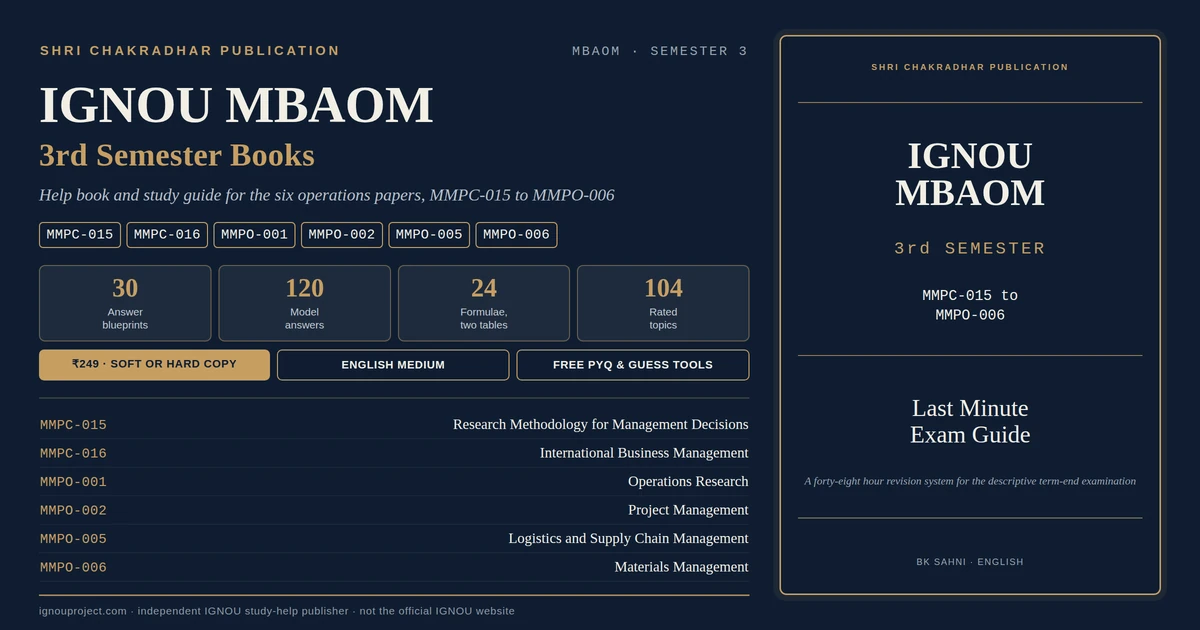
MBAOM Semester 3 · MMPC-015 to MMPO-006
The quantitative semester: six papers, twenty-four formulae, one volume
This is where the operations learner separates from the rest of the MBA. MMPC-015 and MMPC-016 stay shared with every specialisation; MMPO-001, MMPO-002, MMPO-005 and MMPO-006 arrive from the School of Management Studies operations stream; and MMPP-001 runs alongside all of them. The distinguishing feature is arithmetic. No other MBA specialisation in Semester 3 asks you to solve a simplex tableau, a Hungarian assignment matrix and a PERT network in the same examination fortnight.
Six codes matched to your registration before you pay · English only · +91 93546 37830
Quick answer. The IGNOU MBAOM 3rd Semester Books range MMPC-015 to MMPO-006 is sold here as one volume: the IGNOU MBA (OM) 3rd Semester Last Minute Exam Guide from Shri Chakradhar Publication, at ₹249. It covers the six theory papers a Master of Business Administration (Operations Management) learner registers in Semester 3 — MMPC-015 Research Methodology for Management Decisions, MMPC-016 International Business Management, MMPO-001 Operations Research, MMPO-002 Project Management, MMPO-005 Logistics and Supply Chain Management and MMPO-006 Materials Management. IGNOU writes the programme code MBAOM; the volume writes MBA (OM); Amazon and Flipkart sell the same range as an MBA 3rd Semester study material combo for the Operations Management area. Every one of those describes this six-code set.
Counted out of the volume rather than copied off its cover, it carries 30 answer frameworks, 120 worked answers to high-probability questions, 104 ranked topics, 84 named contributors, 92 definitions, 35 comparison tables, 100 golden facts, a 60-question self-test and — the figure that separates this set from the other three specialisations — 24 formulae spread across two tables rather than one. The seventh Semester 3 registration is the MMPP-001 project course, worth eight credits, and it carries no printed material at all, so no guide book covers it. This volume works beside the official IGNOU blocks rather than in place of them. Soft copy and hard copy are both arranged on WhatsApp at +91 93546 37830, and the code check costs nothing.
What You Get for ₹249
Every number below was produced by parsing the volume’s 100 tables. The publisher page was not trusted as a source for any of them, and where the book disagrees with IGNOU’s own documents the disagreement is printed further down instead of being tidied away.
- 30 answer frameworks — five for each paper. Three of the six close on a numerical or algorithmic shape, because MMPO-001, MMPO-002 and MMPO-006 all put working on the page where the other papers put prose.
- One hundred and twenty worked high-probability questions with worked answers, twenty per paper, each tagged to the framework it uses and to its frequency band.
- 24 formulae in two tables — nine statistical expressions in MMPC-015 and fifteen operations expressions in MMPO-001, running from the economic order quantity through the transportation feasibility rule to the M/M/1 queue length and the expected value of perfect information.
- A hundred and four topics ranked by frequency — eighteen each for MMPC-015 and MMPC-016, seventeen for each of the four MMPO papers. Forty-three of them sit in the very-high band.
- 84 named contributors with their exam triggers, from Dantzig, Kuhn and Erlang through Kendall, Little and Gantt to Pareto, Kraljic, Orlicky and Forrester.
- 35 comparison tables, including CPM against PERT, total float against free float, transportation against assignment models, and ABC against VED analysis.
- 92 definitions in the phrasing an examiner marks without hesitating, sixteen for each core paper and fifteen for each operations paper.
- Sixty verb rows, a hundred golden facts, a sixty-question self-test and six capsules, plus a 48-hour plan sequenced around two numerical papers rather than six descriptive ones.
Also inside: an exam-day checklist that flags MMPO-001 as the paper where the book records a calculator as permitted. English medium throughout, scoped to the MMPC-015 to MMPO-006 registration rather than to the wider MMPO series.
The Problem This Book Was Written For
Semester 3 defeats operations learners for a reason none of the other specialisations share. The first year is a reading problem: seven MMPC papers, one kind of answer. This semester is a working problem. Two of your papers are solved rather than written, one more hides a network calculation inside an essay, and the MMPP-001 synopsis has to clear your Regional Centre while all of that is happening.
- MMPO-001 is scored on method. The book’s own strategy note for that chapter says method marks outnumber answer marks, which is why a correct final figure with no tableau, no iteration and no interpretation still loses most of the twenty.
- MMPC-015 looks like theory and is not. Chi-square, the t-test, the F-ratio, correlation and regression all sit inside it, and it is the second of the two chapters carrying a formula table.
- MMPO-002 and MMPO-001 both examine CPM and PERT, from different directions. Learners who revise networks once, in one chapter, meet the same three time estimates again in a paper they thought was descriptive.
- MMPO-006 is a classification paper. ABC, VED, FSN, SDE and HML are five different analyses that look interchangeable at speed and are not, and naming the wrong one converts a full answer into a partial one.
- MMPO-005 runs on chains of cause and consequence — the bullwhip effect, the cost trade-offs, the SCOR measures — where describing the symptom without naming the cause reads as an incomplete answer.
The volume answers those five failure modes directly across its 30 frameworks: a formulate-and-solve shape for MMPO-001 with fifteen formulae behind it, a test-selection shape and nine formulae for MMPC-015, a network application shape for MMPO-002, a classification-plus-control-rule shape for MMPO-006, and a causes-to-consequences-to-remedies engine for MMPO-005.
Six papers. One volume. ₹249.
Send your six course codes and your term-end session and the format options come back in one reply. If your registration reads MMPF, MMPH or MMPM rather than MMPO, or your programme code reads PGDIOM, that is what you will be told.
₹249
Choose PDF or print · English only · the six codes MMPC-015 to MMPO-006
Checking your six MBAOM codes is free and is answered between 9 am and 6 pm, Monday to Saturday.
Inside the Book: The Same Six Sections in Every Chapter
All six operations-set chapters carry the same internal architecture, so the layout is learned once in MMPC-015 and never relearned. Per chapter: eighteen rated topics in Section A for the two core papers and seventeen for each MMPO paper, ten command verbs in Section B, five frameworks in Section C, twenty questions in Section D, four toolkit tables in Section E and four capsule boxes in Section F. Across six chapters that produces the 104 ranked topics, 60 verb rows, 30 frameworks and 120 questions the free tools on this page run on.
| Section of the chapter | What sits inside it here | When it is worth opening |
|---|---|---|
| A — Chapter Opener and Topic Heatmap | A course snapshot plus seventeen or eighteen rated topics with references. MMPC-015 and MMPC-016 cite unit numbers; MMPO-001, MMPO-002, MMPO-005 and MMPO-006 cite block numbers, because block-level coverage is what the volume records for them | At the very start, to put that paper’s topics in order |
| B — The Command Verb Decoder | Ten verbs with a worked example taken from that paper, so Formulate is demonstrated on a linear programming problem in MMPO-001 and on a work breakdown structure in MMPO-002 | A single pass, before any answer is attempted under time |
| C — Answer Frameworks | Five in each chapter. MMPO-001 closes on formulate-and-solve, MMPO-002 on a network application, MMPO-006 on classification plus a control rule, and MMPC-015 on test selection — four differently shaped answers for four differently shaped questions | Through the practice weeks, once the topic order is settled |
| D — The High-Probability Q&A Bank | Twenty questions per paper with worked answers, each carrying its framework number, its frequency tier and a closing exam note | The bulk of revision, where the 120 worked answers carry you |
| E — The Revision Toolkit | Four tables per paper: contributors, definitions, comparisons and common mistakes. MMPC-015 and MMPO-001 each add a fifth — the nine-formula and fifteen-formula tables | The last day before that paper, and every formula-drilling session |
| F — The Thirty-Minute Capsule | Four boxes carrying the five concepts to hold, the sure-shot questions, the emergency openers and the golden keywords | The thirty minutes before you are called in, one capsule per subject |
Narrow screen? The Section A to F table scrolls sideways to its third column.
Two consequences follow from that repetition. The first is coverage: because Section E repeats a contributors table in every chapter, the volume ends up naming 84 people and bodies across the six subjects, and in operations those names are the marks. MMPO-001 answered without Dantzig, Kuhn, Erlang and Kendall is a set of steps with no provenance; MMPO-006 without Pareto, Kraljic and Orlicky is a list of acronyms.
The second is arithmetic, and it is where the ₹249 actually goes. Section E contributes 92 definitions and 35 comparison tables across the six chapters, Section D contributes the 120 worked answers, and Sections A and E together carry the 24 formulae. So the bulk of the volume by table count sits in the toolkit and question sections rather than in the 30 frameworks that get advertised on the cover.
Your Six Papers, and What the Book Does for Each
Anyone typing IGNOU MBAOM 3rd Semester Books or IGNOU MBA Operations Management 3rd Semester books into a search box meets four different lists, because MBAOM, MBAFM, MBAHM and MBAMM share only MMPC-015 and MMPC-016 before diverging entirely. MBAOM Semester 3 registers seven courses: two core theory papers, four operations specialisation papers and the project. Each theory course carries four credits, so the six papers below come to 24 credits, with MMPP-001 adding eight. The six theory papers are what this volume handles. MMPP-001 has no guide book anywhere, because IGNOU publishes no material for a project course.
| Code | Title exactly as the prospectus sets it | Credits | What the volume records |
|---|---|---|---|
| MMPC-015 | Research Methodology for Management Decisions | 4 | Fourteen units over four blocks · 9 formulae |
| MMPC-016 | International Business Management | 4 | Sixteen units over four blocks |
| MMPO-001 | Operations Research | 4 | Four blocks, unit total not given · 15 formulae |
| MMPO-002 | Project Management | 4 | Four blocks, unit total not given |
| MMPO-005 | Logistics and Supply Chain Management | 4 | Four blocks, unit total not given |
| MMPO-006 | Materials Management | 4 | Four blocks, unit total not given |
| MMPP-001 | Project Course (equivalent to two courses) | 8 | Outside this book — IGNOU supplies no material for it |
Narrow screen? The course table scrolls sideways to reach what the volume records.
Where the official documents disagree, and the one that decides whether this is even your book. Six differences are worth reading before you write a course title on an examination form or press buy anywhere.
One, and this one changes who should buy. The Common Prospectus for July 2026 does tabulate these MMPO codes — but under PGDIOM, the Post Graduate Diploma in Operations Management, not under MBAOM. In that table MMPO 001, MMPO 002, MMPO 003 and MMPO 004 sit in Semester I, while MMPO 005, MMPO 006, MMPO 007 and MMPO 008 sit in Semester II, across 36 credits, with the instruction to choose any seven of the electives. IGNOU Help Center likewise tags every one of these codes as belonging to MBA, MBAOM and PGDIOM together. So if your programme code is PGDIOM rather than MBAOM, your MMPO-005 and MMPO-006 are Semester II papers and your set is not the set on this page. Read your programme code before your course codes.
Two. MMPO-006 is spelled two ways by serious sources. The Common Prospectus for July 2026 and this volume both print Materials Management. Gyaniversity, IGNOU Help Center and IGNOU’s own Regional Centre Jorhat programme document print Material Management, singular. Nothing about the syllabus changes; the spelling on your examination form should follow the prospectus.
Three. The Semester 4 operations codes are numbered inconsistently across IGNOU’s own documents. The Common Prospectus lists MMPO 007 Maintenance Management and MMPO 008 International Logistics and Supply Chain Management; the Regional Centre Jorhat document lists the same two subjects as MMPO-507 and MMPO-508. Neither affects your Semester 3 set, but it will confuse a re-registration form.
Four. The volume’s own dating contradicts itself. Its publisher page and copyright notice read 2027 Exam Edition while the printed cover reads 2026 Exam Edition. The six course codes are unaffected.
Five. The specialisation count differs by source. The Common Prospectus describes the MBA as twenty core courses plus seven specialisation courses; the Regional Centre document says seven specialisation courses with four in Semester 3 and three in Semester 4; the MBA Specialization Student Handbook and Prospectus describes nineteen core plus eight specialisation. All of them still arrive at 28 courses and 116 credits.
Six. Hyphens break searches. The Common Prospectus prints the codes unhyphenated as MMPO 001 and MMPO 006, so a hyphenated search inside that document returns nothing at all. Gullybaba drops the leading zeros again and lists the same paper as MMPO-01. Confirm the codes themselves on your Samarth registration record rather than from any listing, this page included.
MMPC-015 Help Book — Research Methodology for Management Decisions
MMPC-015 is the research paper that also supplies the method chapter of your MMPP-001 project, which is why the volume opens the 48-hour plan on it. Fourteen units are distributed over four blocks — an introduction to research methodology, then data collection and measurement, then data presentation and analysis, and finally report writing and presentation. Eight of its eighteen rated topics carry the top band — the meaning and types of research at Unit 1, the research process at Unit 2, research design across Units 2 to 3, probability against non-probability sampling at Unit 4, primary and secondary data at Unit 5, questionnaire design at Unit 7, hypothesis formulation and testing across Units 2 and 10, and parametric against non-parametric tests across Units 10 to 11. What this chapter contributes: the first of the volume’s two formula tables, nine expressions deep, running from the standard deviation through the z and t statistics, chi-square, the F-ratio and the regression line to the sample-size expression; a test-selection framework; and twelve dated names from Kerlinger (1973) and Kothari (2004) to Fisher (1935), Gosset (1908), Pearson (1900), Likert (1932), Thurstone (1928), Spearman (1904), Cronbach (1951) and Kish (1965). The habit that moves an MMPC-015 script up a band is mechanical: state the formula, define every symbol, then write the managerial sentence after the number. Learners searching IGNOU MMPC-015 important questions, IGNOU MMPC-015 previous year question paper or IGNOU MMPC-015 study material are usually missing exactly that closing line.
MMPC-016 Help Book — International Business Management
MMPC-016 is the second shared core paper and the one paper in this set that is scored on names and dates rather than on working. Its sixteen units divide into four blocks covering an introduction to international business, international trade, the strategies firms use abroad, and the functional areas of international business. Seven topics carry three stars — globalisation drivers across Units 1 to 2, domestic against international business across Units 1 and 13, trade theories from Smith to Porter across Units 5 to 6, FDI theories and the eclectic OLI paradigm at Unit 7, modes of entry into foreign markets at Unit 9, the WTO at Unit 8, and the international marketing mix at Unit 13. What this chapter contributes: fourteen dated theorists — Adam Smith (1776), Ricardo (1817), Heckscher-Ohlin (1933), Leontief (1953), Vernon (1966), Hymer (1960), Buckley and Casson (1976), Dunning (1977), Johanson and Vahlne (1977), Krugman (1979), Porter (1990), Hofstede (1980), Perlmutter (1969) and Bartlett and Ghoshal (1989) — plus seven comparisons including absolute against comparative advantage, FDI against FPI and ethnocentric against geocentric orientation. The habit that moves an MMPC-016 script up a band is putting the theory, its year and one Indian multinational into the same paragraph. An MMPC-016 help book, IGNOU MMPC-016 study material or an IGNOU MMPC-016 previous year question paper that leaves the years out is doing half the job.
MMPO-001 Help Book — Operations Research
MMPO-001 is the paper this whole set is really built around, and the only one in the series where the volume records a calculator as permitted. It runs across four blocks — OR foundations and linear programming, transportation, assignment and integer programming, networks, queuing and inventory, and decision theory, games and simulation — without stating a unit total, which this page reports rather than invents. Seven of its seventeen rated topics carry the top band: the nature and models of OR, linear programming formulation and the graphical solution, the simplex method with its optimality test and special cases, the transportation problem through north-west corner, Vogel’s approximation and MODI, the assignment problem by the Hungarian method, network analysis by CPM and PERT, and queuing theory in M/M/1 with Kendall notation. What this chapter contributes: the second and larger formula table, fifteen expressions covering the economic order quantity, the reorder point, the m plus n minus one feasibility rule, the MODI opportunity cost, the three-estimate PERT expected time and its variance, total float, the cost slope, utilisation, queue length, waiting time, expected monetary value and the expected value of perfect information — alongside sixteen contributors from Blackett in the 1940s and Dantzig (1947) to Kuhn (1955), Vogel, Erlang (1909), Kendall (1953), Little (1961), Von Neumann and Morgenstern (1944), Kelley and Walker (1957) and the Polaris team (1958). The habit that moves an MMPO-001 script up a band is the one the book states outright: method marks outnumber answer marks, so write the model, the iterations and the interpretation, never the answer alone. An IGNOU MMPO-001 previous year question paper, an IGNOU MMPO-001 important questions list or IGNOU MMPO-001 study material that gives final figures without the working teaches the wrong thing.
MMPO-002 Help Book — Project Management
MMPO-002 is a vocabulary paper with a network calculation hidden inside it. The volume records four blocks — project concepts, environment and feasibility; project planning, scope, work breakdown and estimation; scheduling and network analysis; and execution, monitoring and closure — again without a unit total. Seven topics sit at three stars: the definition, characteristics and life cycle of a project, feasibility analysis and its components, scope management with the work breakdown structure and work package, network analysis by CPM, PERT and floats, the risk management process, monitoring and control with earned value, and Gantt charts as scheduling tools. What this chapter contributes: fourteen contributors including the Project Management Institute, Henry Gantt around 1910 to 1917, Kelley and Walker (1957), the Polaris team (1958), Tuckman (1965), Brooks (1975), Goldratt (1997), Kerzner, Meredith and Mantel and the Agile Manifesto authors (2001), plus five comparisons including waterfall against agile, total float against free float, and project against operations. The habit that moves an MMPO-002 script up a band is naming the framework before describing it — the PMBOK knowledge areas, the triple constraint, the earned value trio — and then drawing the network rather than talking about it. An MMPO-002 help book, an IGNOU MMPO-002 notes PDF or IGNOU MMPO-002 study material is only useful if the floats are calculated somewhere in it, and an IGNOU MMPO-002 solved assignment will not teach that, because it is not written under time.
MMPO-005 Help Book — Logistics and Supply Chain Management
MMPO-005 is the paper this page used to verify the examination format, because its December 2022 term-end paper sits on IGNOU’s own servers and was opened and read. The volume records four blocks — logistics concepts, interfaces and customer service; logistics functions across transport, warehousing, inventory and packaging; supply chain concepts and integration; and strategic issues — without a unit total. Seven topics carry the top band: the logistics concept with the seven rights and its interfaces, customer service and cost trade-offs, transportation and carrier selection, warehousing, inventory and materials handling, supply chain management and integration, the bullwhip effect with its causes and remedies, and performance measurement including SCOR. What this chapter contributes: fourteen contributors including Forrester (1961), Lee, Padmanabhan and Whang (1997), Fisher (1997), Christopher, Bowersox and Closs, the Supply Chain Council (1996), Kaplan and Norton (1992), Ohno, Hau Lee (2004), Porter (1985) and Xerox in the late 1970s, plus five comparisons including logistics against supply chain management, efficient against responsive chains and lean against agile. The habit that moves an MMPO-005 script up a band runs in one direction only: name the cause, trace the consequence, then give the remedy. An MMPO-005 help book, IGNOU MMPO-005 important questions, IGNOU MMPO-005 study material or an IGNOU MMPO-005 previous year question paper that describes the bullwhip effect without naming Forrester or the four causes leaves marks unclaimed.
MMPO-006 Help Book — Materials Management
MMPO-006 closes the specialisation set and is, above everything else, a classification paper. The volume records four blocks — introduction and the strategic role of materials management; supplier networks and buyer-seller relationships; materials planning, inventory and spare parts; and codification, standardisation and value analysis — again without a unit total, though its heatmap cites unit numbers rather than blocks. Seven topics carry three stars: the concept, scope and functions of materials management, its strategic role and integration, supplier network design, selection and development, materials planning and budgeting, inventory classification through ABC, VED, FSN, SDE and HML, codification and standardisation, and spare parts management. What this chapter contributes: fourteen contributors from Pareto and Harris or Wilson (1913) through Ohno, Shingo, Orlicky (1975), Oliver Wight, Miles (1947), Kraljic (1983), Goldratt (1984), Little (1961), Deming and the Bureau of Indian Standards, plus six comparisons including push against pull, codification against standardisation, single against multiple sourcing and ABC against VED. The habit that moves an MMPO-006 script up a band is naming the analysis before applying it, because five classification systems that look alike at speed are marked as five different answers. Searches for MMPO-006 help book, IGNOU MMPO-006 study material, an IGNOU MMPO-006 notes PDF or an IGNOU MMPO-006 previous year question paper almost always come from that confusion.
Every paper in the set, ordered in a single message.
Give us the codes and the session, and format, courier position and payment instructions all come back at once.
₹249
All six bound together · no single-subject option · MMPP-001 is a project, not an examination
Codes are read against MMPC-015, MMPC-016, MMPO-001, MMPO-002, MMPO-005 and MMPO-006 before anything ships.
Official Study Material or This Guide? You Need Both
The official IGNOU blocks behind the IGNOU MBAOM 3rd Semester Books range are free, they are the primary source, and no revision volume replaces them. You can download IGNOU study material subject-wise at no cost, and the eGyanKosh access guide explains how to reach a block from a course code when the repository search refuses to cooperate.
The two do different jobs, and in an operations semester the division is sharper than reading time alone suggests. Twenty-four blocks of official material are where the understanding is actually built. This volume converts that understanding into five twenty-mark answers written in three hours — and, in MMPO-001 and MMPC-015, into working that has to appear on the page. The blocks are what you read while the MMPP-001 synopsis waits for approval; the guide is what you practise from once the report has gone in.
| What you would search for | The thing that phrase actually names | Where it belongs in your term | How it goes wrong in an operations semester |
|---|---|---|---|
| ignou mbaom study material, ignou mmpo notes pdf free download, ignou books pdf | IGNOU’s own block-and-unit material, sitting free on eGyanKosh | All term, for understanding and for writing assignments | Also pulling MMPO-003, MMPO-004, MMPO-007 and MMPO-008 — those are Semester 4 for MBAOM, and Semesters I and II for a PGDIOM learner |
| ignou mbaom help book, guide book, study guide, ignou guide books | A third-party revision volume that compresses the syllabus into answer-ready form — the category this book belongs to | The closing weeks, for answer writing and for drilling formulae | Buying a four-book operations-only set and finding MMPC-015 and MMPC-016 were never in it |
| ignou mbaom exam revision book, ignou mba 3rd semester last minute guide | The same product, described by when you use it rather than what it is | From roughly seven days out down to the final 48 hours | Starting it after the project report goes in, which leaves no time to practise MMPO-001 by hand |
| mmpo notes, chapter wise notes, ignou study notes | Short subject summaries, thinner than a guidebook and without worked answers | Filling the short gaps between real study sessions | Leaning on summaries for MMPO-001, where the marks sit in iterations that summaries never show |
| ignou mmpo solved assignment, handwritten assignment | Answers written for the assignment, marked by your study centre, never seen in the examination hall | Ahead of the 30 April or 31 October cut-off that governs your session | Treating an IGNOU MMPO-001 solved assignment as coverage of the paper — it carries 30 per cent of the course, the paper carries 70 |
| ignou mmpo previous year question paper, solved question paper, guess paper, most repeated questions | Past papers, and practice sets assembled from the patterns those papers repeat | The practice phase, beside a guide book rather than instead of one | Hunting a June 2026 MMPO paper, which IGNOU had still not published on 10 August 2026, or expecting an IGNOU MMPO-002 previous year question paper to arrive inside a guide book |
Narrow screen? The six-row MBAOM resource table scrolls sideways to its fourth column.
Should the bottom two rows be nearer your real problem, the solved assignments, handwritten assignments, previous year solved question papers and guess papers pages are the right destinations rather than this one. And if MMPP-001 rather than the six papers is what has stalled, the MBA operations management project guide and the general MBA project report page deal with the course no book on this page covers.
How the Guide Book Maps to the Term-End Examination Pattern
The split is 30 per cent assignment and 70 per cent term-end paper, and a pass in one does not cover a fail in the other. A C grade is enough to clear, and the specialisation prospectus puts C at 50 to 59.9 per cent, B at 60 to 79.9 and A at anything from 80. Papers are sat in June and December at ₹200 per theory course, with MMPP-001 charged separately at ₹500 for evaluation. The Common Prospectus also prices Semester 3 at ₹18,000 against ₹16,000 for Semesters 1, 2 and 4, and the project is the reason.
On format, this page reports only what was opened and read — and the good news for MBAOM is that MMPC-016, MMPO-001, MMPO-002, MMPO-005 and MMPO-006 all share one shape.
The four MMPO papers. The December 2022 MMPO-005 paper, published on IGNOU’s own servers and opened for this page, prints across two pages and reads: Time three hours, Maximum Marks 100, this question paper consists of seven questions, attempt any five questions, all questions carry equal marks. Its seventh question is a short-notes cluster asking for any three of five. That is the shape the volume records for MMPO-001, MMPO-002, MMPO-005 and MMPO-006 alike, which means five answers of twenty marks in three hours, or roughly thirty-two minutes each.
MMPC-016. The volume records the familiar core-paper form — eight questions printed, any five attempted at twenty marks, usually including a short-notes question. Functionally identical arithmetic to the MMPO papers.
MMPC-015. The volume records the one exception: Section A with any four of five at twenty marks, plus a compulsory Section B worth twenty that tends to carry a numerical or situational element. That description is the publisher’s, and no actual MMPC-015 paper was opened to test it here. Read the instruction line on your own question paper before planning your attempt, rather than trusting any single pattern printed here or anywhere else.
The consequence is a scheduling advantage MBAFM, MBAHM and MBAMM do not get: one twenty-mark answer shape covers five of the six papers, so practice on MMPO-005 transfers directly to MMPO-006. What does not transfer is the working, and that is where the 24 formulae earn their place. For MMPC-016, MMPO-002 and MMPO-005 a twenty-mark answer is roughly 300 to 350 written words — open with the attributed definition, name the framework, walk its stages, add an Indian example, close on the managerial consequence. For MMPO-001 and the numerical parts of MMPC-015 and MMPO-006 the same twenty marks are earned differently: state the model, show every iteration, box the answer, then write one sentence saying what the number means for the manager. The book ships frameworks rather than model essays precisely because at thirty-two minutes you are reconstructing a procedure, not recalling prose.
No submitted assignment means no seat in the examination hall, and the two cut-offs are 30 April and 31 October. If you are behind, work from the solved assignments page first, read the submission guide, and confirm current dates on ignou.ac.in. Unlike the first year, this semester also carries the project, so the MBA project report guidance applies now rather than in Semester 4.
Free Tools: Previous Year Question Papers, Guess Papers and Most Repeated Questions
Nobody should buy a six-paper MBAOM revision volume on a description alone, so three of its working parts run free in your browser. The first connects you to IGNOU’s own listings for MMPC-015 to MMPO-006. The other two run on the heatmap of 104 ranked topics and the 60 verb rows lifted from these six chapters. What they deliberately withhold is the part that took longest to build — the 120 worked answers, the 30 frameworks, the 92 definitions and both formula tables, the nine in MMPC-015 and the fifteen in MMPO-001.
Start here and finish here. MMPC-015 contributes eight of them; the other five papers contribute seven each.
Open these only after every three-star row has been written out or solved unaided at least once.
MMPC-015 holds two; every other paper holds one. Reach them only with hours to spare.
Those 43 three-star, 54 two-star and 7 one-star ratings record how often each topic recurs across past MMPC and MMPO papers as the volume documents it. Their only job is to fix the order in which you open the 24 official blocks behind MMPC-015 to MMPO-006, four blocks per paper. No rating here forecasts a June or December paper, and none is offered as one.
Tool 1 — IGNOU MBAOM Previous Year Question Paper Finder (PYQ)
Name one of the six codes and a session, and this points you at the IGNOU listing page where that PDF is filed. When this page was checked on 10 August 2026, exactly three sessions were live on IGNOU’s downloads page: December 2025, June 2025 and December 2024. June 2026 has not been released, so it is left out of the dropdown entirely. All six codes were confirmed present in the December 2025 listing when it was opened and parsed; the June 2025 and December 2024 listings are published but were not individually checked code by code, and the tool says so in its own output.
Results are study-oriented suggestions based on the book’s topic structure and general examination-preparation patterns. They are not guaranteed IGNOU examination questions.
Tool 2 — IGNOU MBAOM Guess Paper Builder
This assembles a practice paper in the shape that governs the paper you pick. For MMPO-001, MMPO-002, MMPO-005 and MMPO-006 it builds the seven-question form verified word for word from the December 2022 MMPO-005 paper: three hours, 100 marks, seven questions printed, attempt any five, equal marks, with a short-notes cluster at question seven. For MMPC-016 it builds eight questions with any five attempted, and for MMPC-015 the two-section form the volume records. Every question comes from that paper’s own heatmap, with the three-star rows appearing most often. Solved guess papers for programmes outside the MBA live on the guess papers page instead.
Results are study-oriented suggestions based on the book’s topic structure and general examination-preparation patterns. They are not guaranteed IGNOU examination questions.
Tool 3 — Most Repeated Questions and High Probability Topic Analysis
This lays out the whole frequency picture for one of the six papers — eighteen rated rows for MMPC-015 or MMPC-016, seventeen for any of MMPO-001, MMPO-002, MMPO-005 and MMPO-006 — giving each topic with its band and its unit or block reference, how much of that paper’s weight sits in the top band, and a question stem paired with a verb that paper’s own decoder actually lists. It is what an MMPO important-questions list looks like when it is built from 104 ranked topics and 60 verb rows instead of from a hunch.
Results are study-oriented suggestions based on the book’s topic structure and general examination-preparation patterns. They are not guaranteed IGNOU examination questions.
The method costs nothing. The worked solutions are in the book.
These three tools see only the 104 ranked topics and the 60 verb rows. The 120 worked answers, the 30 frameworks, the 24 formulae, the 92 definitions, the 84 contributors, the 100 golden facts, the 60-question self-test and the 35 comparison tables sit inside the book.
₹249
Six papers · 104 ranked topics · 24 formulae · soft copy or hard copy
The three tools stay free whether or not you order. No selection is stored anywhere, and nothing you click is sent off your device.
Using the Study Guide Across a Semester, a Week, or a Final 48 Hours
The scheduling problem the IGNOU MBAOM 3rd Semester Books set creates is not the number of papers. It is that MMPO-001 and MMPC-015 cannot be revised by reading, while MMPP-001 has no timetable of its own and expands into whatever evenings are left. The volume carries one 48-hour plan and it opens on MMPC-015 for a concrete reason: research design and sampling are examinable content and project method simultaneously, so those are the only hours in the semester that pay twice.
Across a full semester, read the official blocks paper by paper and use the guide as a checkpoint rather than a substitute. Each time you finish a block, open that paper’s Section A heatmap and test whether you can write or solve every three-star topic in it. A three-star topic you cannot handle sends you back into the official unit, not forward into the capsule. Start MMPC-015 alongside the synopsis draft, because the sampling plan you write for MMPP-001 is the sampling answer you will write in the paper.
Across a week, the split that suits this set is unusual and worth following: two full days on MMPO-001, not one, because fifteen formulae and six algorithms cannot be absorbed in a single sitting and because simplex, transportation and assignment each need to be worked by hand at least twice; then one day on MMPC-015, where the nine statistical formulae and the test-selection decision are drilled together; then MMPO-002 and MMPO-005 paired on one day, since both run on chains and both reuse CPM and PERT; then MMPO-006 on its own day because five classification systems need separating; and the final day for the 60-question self-test and the six capsules. MMPC-016 slots into any evening, because it is the one paper here that is pure recall.
In the closing 48 hours the volume splits the time into two twelve-hour days and names which papers belong to each. Day one takes MMPC-015, MMPC-016 and MMPO-001 in that order, giving the two formula-carrying papers the largest share because working decays faster than prose, and closes on the golden facts. Day two takes MMPO-002, MMPO-005 and MMPO-006, then runs all 60 self-test questions closed-book inside an hour, and finishes with the six Section F capsules. The plan states plainly that introducing a new topic inside the last twelve hours lowers scores, and it treats the sleep rule as fixed rather than advisory.
Across all three windows the rule holds: the official blocks plus this one volume, with nothing new added in the final fortnight. If you want short summaries beside the blocks, the study notes page is a reasonable single supplement, and the guide books online page explains how a guide book differs from official material across other programmes. With the first year still to come, MMPC-001 to MMPC-007 are handled on the MBA 1st Semester books page and MMPC-008 to MMPC-014 on the MBA 2nd Semester books page; every specialisation sits those fourteen.
Soft Copy or Hard Copy? Same ₹249, Different Study Habits
Both formats of the IGNOU MBAOM 3rd Semester Books volume hold identical content at the same ₹249, and neither wins in the abstract. What settles it for an operations set is that half your revision is reading and half is working, and those two activities want different objects on the desk.
| What you are trying to do | On screen | On paper |
|---|---|---|
| Working a simplex or Hungarian iteration by hand | Poor — you cannot keep the formula visible and write at the same time | This is the whole argument for print in this set |
| Finding one of the 24 formulae mid-question | A text search lands on it immediately | Only as fast as the tabs you stuck in beforehand |
| Tracing a contributor such as Kendall or Kraljic across chapters | One surname search sweeps all six chapters | Six index checks, one chapter at a time |
| Drawing a PERT network for MMPO-002 practice | Awkward; you end up on paper anyway | Paper beside paper, which is how the paper is sat |
| Separating ABC, VED, FSN, SDE and HML in MMPO-006 | Fine, if you are only reading them | Better, because the comparison table can stay open |
| The last half hour before you are let in | A capsule sits fine on a phone screen | Also fine, provided the courier beat the paper |
| How it reaches you | Released the moment the ₹249 clears | Whatever transit time your pin code carries |
Narrow screen? The MBAOM format table scrolls sideways to the paper column.
For MBAFM, MBAHM and MBAMM the honest answer is that format is a preference. For MBAOM Semester 3 it leans harder than usual towards print, because two of your six papers are solved with a pen and a calculator rather than read. If your MMPO-001 paper falls inside the courier window for your pin code, take the soft copy and print the two formula tables yourself.
How to Buy the IGNOU MBAOM 3rd Semester Book at ₹249
Everything from first question to dispatch happens in a single WhatsApp conversation on +91 93546 37830. The three steps exist so that your codes are read back to you before any money moves, and in this specialisation that check catches something the other three do not: the same six MMPO codes belong to PGDIOM as well as MBAOM, in a different semester order.
| Stage | What you send | What you get back |
|---|---|---|
| 1. Message the details | Write to +91 93546 37830 giving your programme code, your semester, your exact course codes and your term-end session | Your codes are read against MMPC-015, MMPC-016, MMPO-001, MMPO-002, MMPO-005 and MMPO-006, and your programme code against MBAOM rather than PGDIOM |
| 2. Name the format | Name the format you want, and add a pin code if it is the printed volume | Current availability, plus the courier window into your pin code if you chose the printed MBAOM volume |
| 3. Settle and receive | Settle the ₹249 by whichever option is sent to you, before the June or December cut-off you are working towards | PDF access opens as soon as payment clears; a printed MBAOM volume goes to the courier that working day |
Narrow screen? The three-stage ordering table scrolls sideways to its third column.
Put four things in that first WhatsApp message: your programme code, MBAOM or otherwise, exactly as your admission record prints it; your course codes read off that record rather than recalled; your term-end session; and your format with a pin code if it is print. The code check is not decoration here. MMPC-015 and MMPC-016 are shared by MBA, MBAFM, MBAHM, MBAMM, MBAOM and MBF, while MMPO-001, MMPO-002, MMPO-005 and MMPO-006 also belong to the PGDIOM diploma, where the Common Prospectus places them across Semesters I and II instead. If your set does not match this volume you will be told so rather than sold it. Worth knowing before you enrol rather than after: the Common Prospectus states that once you join a specialisation MBA, change of specialisation is not allowed.
Whenever you are ready, one message is enough.
One message with the six codes and your session brings back the formats, the courier position for your area and how to pay.
₹249
MMPC-015 to MMPO-006 · English medium · the code check comes first
Replies come between 9 am and 6 pm, Monday to Saturday, and reading your six MMPO and MMPC codes back to you costs nothing.
Where else this MBAOM volume is listed
Besides the direct WhatsApp route at ₹249, this title is listed on Amazon, Flipkart and Kindle, where rival IGNOU MBAOM guide books sit beside it. Search those platforms for IGNOU MBAOM 3rd Semester Books and you will also meet other publishers’ products titled as an MBAOM 3rd Semester IGNOU study guides combo, as a set of 6 books including MMPC-015, MMPC-016, MMPO-001, MMPO-002, MMPO-005, MMPO-006, as an MBA 3rd Semester IGNOU study material combo (Operations Management Area), as an MBA 3rd Semester Operations Management IGNOU study guides combo, as an MBA 3rd Semester Operations Management study guide book set, as a set of 4 books including MMPO-001, MMPO-002, MMPO-005, MMPO-006 with the two core papers left out, as IGNOU MBA 3rd Semester help books (Operations Management) listed under the spaced forms MMPC 15 MMPC 16 MMPO 1 MMPO 2 MMPO 5 MMPO 6, as an MBA 3rd Semester core courses IGNOU study guides combo holding only MMPC-015 and MMPC-016, as quick readable notes or topic-wise conceptual notes from other publishers, and as an IGNOU help book with solved previous year question papers and important exam notes in its latest edition, and as a set of solved previous year question papers on its own. Those are different publishers’ volumes covering the same codes, not this one. Amazon, Flipkart and Kindle each set their own price, dispatch time and returns policy, so the ₹249 quoted here should not be assumed to follow the book onto them. Two things to check in any listing before ordering, on this site or another: whether the two core papers are actually included, since four-book operations sets are common; and whether the subject titles match your own registration record. Ordering direct has one practical advantage: the thread you bought on is the thread your revision questions get answered on.
How This Guide Was Prepared
Parsed rather than read. The supplied MBA (OM) Semester 3 volume covering MMPC-015 to MMPO-006, 57,852 words long, was converted to HTML and parsed with BeautifulSoup, so every figure on this page comes out of its 100 tables rather than off its cover: 30 frameworks, 120 questions with worked answers, 104 ranked topics, 84 contributors, 92 definitions, 35 comparison tables, sixty command-verb entries, 100 golden facts, 60 self-test questions, six capsules and 24 formulae. The block names, the heatmap bands with their unit and block references, the 48-hour schedule and both formula tables came from that same parse of the 100 tables.
Where the book argues with itself, and where it simply goes quiet. Its copyright notice and publisher page both say 2027 exam edition; the cover supplied with it says 2026. Its cover prints MBAOM while its inside front matter prints MBA (OM), and IGNOU itself writes MBAOM. More usefully for a buyer: it states unit totals for MMPC-015 and MMPC-016 but records only block counts for MMPO-001, MMPO-002, MMPO-005 and MMPO-006, so this page reports block coverage for those four rather than inventing unit numbers. The cover promises 120 or more high-probability questions; the count comes to 120 exactly, with nothing beyond.
Facts taken from IGNOU, not the publisher. Course titles, credits, the course split, medium of instruction, fees, grading bands and assignment deadlines were read from the Common Prospectus for July 2026 and the MBA Specialization Student Handbook and Prospectus, with the Regional Centre Jorhat programme document consulted where those two are silent. Searching the Common Prospectus for these codes requires the unhyphenated forms, because MMPO-001 returns nothing in it while MMPO 001 returns a hit. That search is also what surfaced the PGDIOM table described earlier, which the Common Prospectus prints while giving no course table for MBAOM itself.
IGNOU documents actually opened for this page. The previous-year-papers index was opened on 10 August 2026 and carried three sessions, no more. That December 2025 listing was read right through, and every one of the six codes is in it. The December 2022 MMPO-005 paper was opened on IGNOU’s own server and read end to end, which is where the three-hour, 100-mark, seven-questions-attempt-any-five format quoted on this page comes from, including its short-notes cluster at question seven.
The limits of that verification. Direct PDF paths for individual MMPO papers are not constructed here, so the tools link session listings only. The other two listings exist but were not walked through code by code. The MMPC-015 paper shape is recorded from the book and was not confirmed against a real MMPC-015 paper, and the MMPC-016 shape was taken from the book rather than from a paper opened for this page. MMPO and MMPC papers do vary between sessions, as the 2022, 2024 and 2025 papers consulted for this page show. No claim is made anywhere here about marks, grades, or which questions any June or December paper will carry for any of these six codes.
- Author and reviewer: BK Sahni, who founded Shri Chakradhar Publication Pvt. Ltd. and ignouproject.com. ORCID 0009-0005-8092-459X
- First published 10 August 2026 · reviewed the same day
- Found an error above? Tell us and it gets fixed
- Elsewhere on this site: the author profile, the contact page, our privacy policy and the terms and FAQ
Questions Students Ask Before Buying
Sixteen questions about the MMPC-015 to MMPO-006 MBAOM set, answered without a sales voice. At least eight of them reproduce, word for word, phrasings that surfaced in the MMPO and MBAOM search harvest behind this page.
The IGNOU MBA (OM) 3rd Semester Last Minute Exam Guide covering MMPC-015 to MMPO-006 is ₹249, and that same ₹249 buys either the soft copy or the hard copy. There is no per-subject price, because the six papers are bound as one volume. Orders run through WhatsApp on +91 93546 37830, where your codes are read back before payment. Listings for the same title on Amazon, Flipkart and Kindle set their own prices, so do not assume ₹249 travels across to them.
How many books are in the IGNOU MBAOM 3rd semester set? One. The volume covers six theory papers: MMPC-015 Research Methodology for Management Decisions, MMPC-016 International Business Management, MMPO-001 Operations Research, MMPO-002 Project Management, MMPO-005 Logistics and Supply Chain Management and MMPO-006 Materials Management. The first two are core papers shared with every MBA specialisation; the four MMPO papers are the operations stream. Your seventh registration in this semester, MMPP-001, is the eight-credit project; it comes with no material and no guide book covers it.
Which book is best for IGNOU MBA Operations Management 3rd semester is not a question with one answer, and any page claiming otherwise is selling rather than advising. The defensible answer is a pairing — IGNOU’s blocks to understand the subject, one revision volume to practise writing it. Gyaniversity, Gullybaba, Neeraj, BMA and Shri Chakradhar all publish for these codes. What matters more than the publisher, in this specialisation specifically, is whether the volume covers all six of your codes rather than the four MMPO papers alone, and whether it actually shows worked solutions for MMPO-001 rather than final answers.
Both, and the mix differs by paper. MMPO-001 Operations Research is the genuinely quantitative one: past papers ask you to formulate a linear programming problem, solve an assignment matrix by the Hungarian method and work a queueing model, alongside descriptive questions on game theory and goal programming. MMPO-002 hides a network calculation inside an otherwise descriptive paper. MMPO-005 and MMPO-006 are largely descriptive. MMPC-015 carries statistics. The volume records a calculator as permitted for MMPO-001; confirm that on your own hall-ticket instructions.
For the four MMPO papers, the December 2022 MMPO-005 paper published by IGNOU reads: Time three hours, Maximum Marks 100, seven questions printed, attempt any five, all questions carry equal marks, with a short-notes cluster at question seven. MMPC-016 uses the eight-questions-attempt-any-five form. MMPC-015 is recorded by the volume as a two-section paper instead, and that one was not independently verified for this page. Five of six papers therefore share one shape, which is unusual and helpful. Read your own instruction line regardless.
All four MMPO papers, plus MMPC-015 and MMPC-016, are free on eGyanKosh, IGNOU’s own repository, block by block and unit by unit. Nothing on this page is needed to reach them. The study material download page gathers the subject-wise routes together, and the eGyanKosh access guide shows how to get from a course code to a block. A free IGNOU notes bundle or an IGNOU study material PDF download gives you everything except a compressed revision route, and that route is the whole of what ₹249 buys.
Does this volume include the past papers, or is that on you? You collect them yourself, at no cost, from IGNOU’s downloads page. Checked on 10 August 2026 it publishes three sessions: December 2025, June 2025 and December 2024, and all six of your codes appear in the December 2025 listing. Tool 1 above takes you to the session listing rather than to a constructed file path, because guessed addresses for IGNOU MBAOM previous years solved question paper PDFs simply break. There is no June 2026 paper for these codes yet.
Both spellings are in circulation, from sources that ought to agree. The IGNOU Common Prospectus for July 2026 and this volume print Materials Management, plural. Gyaniversity, IGNOU Help Center and IGNOU’s own Regional Centre Jorhat programme document print Material Management, singular. The syllabus is identical either way, so a listing selling MMPO-006 material management is describing this same course. Use the Common Prospectus spelling on assignment covers and examination forms, and do not let a listing that uses the other spelling convince you it is a different course.
Not at all, and neither does any competing guide book. MMPP-001 is an eight-credit project course for which IGNOU issues no study material; it is assessed on a report and a viva rather than a term-end paper, and carries a separate ₹500 evaluation fee. If the project is where you are stuck, the MBA operations management project guide and the general MBA project report page are the right places. Only the six theory papers are inside it.
How many specialisation courses does an IGNOU MBA specialisation have? Seven by the Common Prospectus count and eight by the specialisation handbook, of which four fall in Semester 3. The programme distinction matters more, and it is why the code check on this page is not decoration. MBAOM is the two-year MBA in Operations Management; PGDIOM is the Post Graduate Diploma in Operations Management. The Common Prospectus for July 2026 tabulates the MMPO codes under PGDIOM, placing MMPO 001, 002, 003 and 004 in Semester I and MMPO 005, 006, 007 and 008 in Semester II across 36 credits. So a PGDIOM learner does not sit these six papers together in a third semester at all. Check your programme code before your course codes.
Yes. The soft copy costs the same ₹249 as the printed volume, holds identical content, and is released once the order is confirmed. It suits searching — one query reaches any of the 24 formulae or a contributor’s surname across all six chapters. It suits working a simplex tableau or a PERT network far less well, which matters more in this specialisation than in the other three. Many learners take the soft copy and print the two formula tables.
The printed volume costs the same ₹249. Delivery depends on your pin code, so send the pin code in your first WhatsApp message and you will be told the courier window for your area before you pay rather than after. This page promises no nationwide delivery time, because any such figure would be invented. If your first MMPO paper falls inside that window, take the soft copy instead.
The book exists in English and in no other medium. There is a documented disagreement worth knowing: the IGNOU Common Prospectus for July 2026 lists MBAOM as available in English and Hindi, while the specialisation prospectus states English only, and the Common Prospectus records the PGDIOM version of these courses as English. Hindi medium students ke liye there is still a route — IGNOU issues the official blocks in Hindi on eGyanKosh, and MMPO-001 appears there as संचालन अनुसंधान, the sanchalan anusandhan title Hindi-medium listings use — so a learner searching IGNOU MBAOM 3rd semester ki kitab in Hindi will find the university’s own material even though this guide is English.
Will IGNOU’s own blocks carry you through the term-end paper unaided? Close, but not quite, and this book is not designed as a substitute either. The official blocks are the primary source, they are free, and the syllabus is written from them. This volume compresses them into a revision path: rated topic orders, answer frameworks, worked answers, two formula tables and capsules. On its own it would be thin: 104 ranked topics are no replacement for 24 blocks of teaching. Used after the blocks it is what turns understanding into a twenty-mark answer written in thirty-two minutes.
No. The 43 very-high, 54 high and 7 low ratings record how often each topic has recurred in past IGNOU MBAOM question paper sets as the volume documents it, which is also all any list of IGNOU MBAOM important questions or IGNOU MBAOM notes can honestly claim. It describes questions already set, not questions still to come. Their purpose is to order your revision when time is short. Nothing here promises anything about a specific June or December sitting.
No. This site is an independent study-support service operated by Shri Chakradhar Publication Pvt. Ltd. This is not IGNOU’s own website, nothing here is endorsed by the university, and the book described is privately published. Course codes and the MBAOM programme code appear only to identify which subjects the volume covers. Dates, deadlines and your own codes should be checked against ignou.ac.in and the Samarth portal.
Important Notice About This Website
This website belongs to Shri Chakradhar Publication Pvt. Ltd., operating on its own account with no tie to Indira Gandhi National Open University or with the operations management faculty at its School of Management Studies. The IGNOU MBAOM 3rd Semester Books described here are an independent product. The six course codes named — MMPC-015, MMPC-016, MMPO-001, MMPO-002, MMPO-005 and MMPO-006 — appear here for one purpose only, which is to say which six subjects the volume covers, and MBAOM appears only to say which of the four MBA specialisations registers them in Semester 3 alongside the eight-credit MMPP-001 project.
What is sold here is a privately published revision aid from Shri Chakradhar Publication Pvt. Ltd. The university neither endorses nor publishes it. Its 104 topic ratings, its 30 frameworks and its 48-hour schedule are the publisher’s editorial work, not university data. Where the cover, the inside pages and IGNOU’s documents disagree — on the 2026 against 2027 edition year, on the MBAOM against MBA (OM) spelling, on Materials against Material Management, on MMPO-007 and MMPO-008 against MMPO-507 and MMPO-508, and on whether the specialisation runs to seven or eight courses — each disagreement is printed above rather than settled quietly.
A separate warning, because it decides whether this volume is your set at all: the Common Prospectus for July 2026 tabulates these same MMPO codes under PGDIOM, the Post Graduate Diploma in Operations Management, where MMPO 001, 002, 003 and 004 fall in Semester I and MMPO 005, 006, 007 and 008 fall in Semester II across 36 credits. IGNOU Help Center likewise lists every one of these codes against MBA, MBAOM and PGDIOM together. If your programme code is PGDIOM, your six papers are not grouped as they are on this page. Read your programme code off your admission record before ordering anywhere.
All three tools above are offered as teaching aids at no charge, and they sit entirely apart from any ₹249 order. Everything happens on your own device, using only the 104 topic ratings and 60 verb rows pulled out of the volume; nothing is stored, nothing is sent, and no IGNOU system is contacted. The first tool points only at the three sessions live on 10 August 2026 and never assembles a file address itself. Running any of them puts you under no obligation whatsoever. Check your six codes, your examination dates and the assignment cut-off against ignou.ac.in and the Samarth portal before you act on anything written here.
Six papers bound as one, at ₹249.
Message the six codes exactly as your registration record prints them, together with your programme code and your June or December session, and the format options, the courier position for your pin code and the payment step come back in a single reply. If MMPC-015 to MMPO-006 is not your set, that is what you will be told.
₹249
MMPC-015 to MMPO-006 · English medium · soft copy or hard copy
+91 93546 37830 · 9 am to 6 pm, Monday to Saturday · the MMPC-015 to MMPO-006 check is free.

BK Sahni iD 0009-0005-8092-459X
Founder, Shri Chakradhar Publication Pvt. Ltd. & ignouproject.com — helping IGNOU distance-learning students since 2010 (5,00,000+ students supported across MBA, MCom, MA & more). Author of IGNOU exam guides, solved assignments & project reference books.
Disclosure: Shri Chakradhar Publication Pvt. Ltd. and ignouproject.com are independent third-party study-help services — not the official IGNOU website. Always verify final dates and rules on ignou.ac.in.