MAJY · Master of Arts (Jyotish) · School of Humanities
Your MJY Paper Is Set in Hindi and Sanskrit, Written on Foolscap, and Still Dated 2024-25
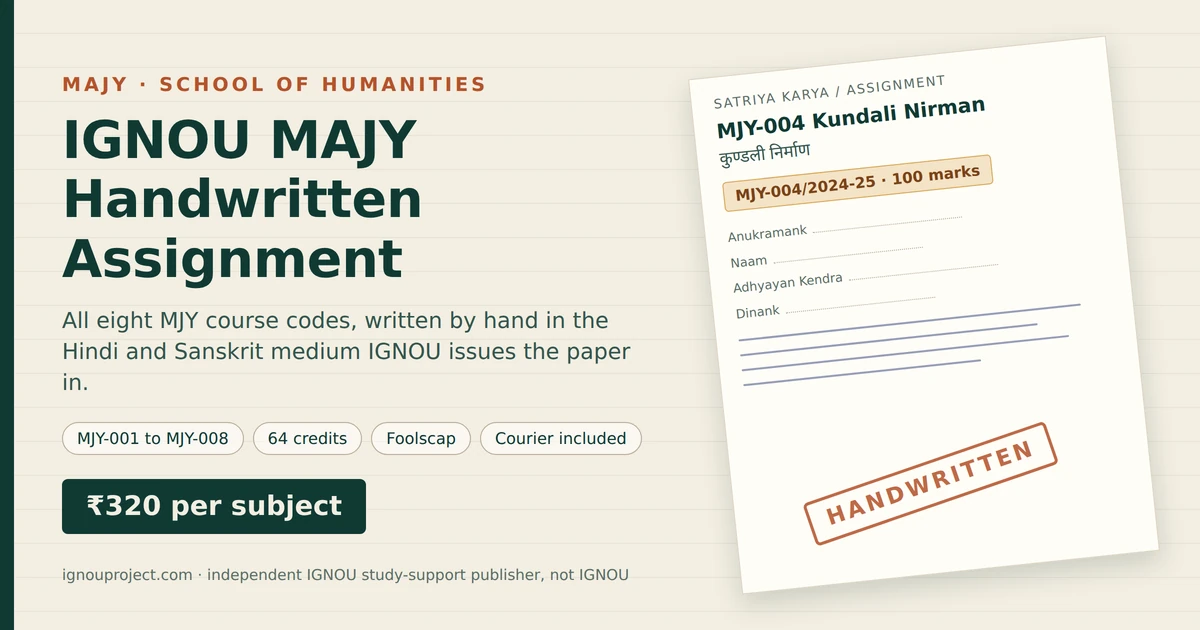
Eight course codes, 64 credits, 100 marks on every assignment. A neatly written MAJY handwritten assignment set, prepared subject-wise in the Hindi medium IGNOU issues the paper in, and couriered to your address.
- ₹320 per subject
- MJY-001 to MJY-008
- Hindi and Sanskrit together
- Foolscap, own handwriting
- 30 April · 31 October
- Courier included
Send Your MJY Codes on WhatsApp
Message the codes, the session and your pin code for a handwritten assignment quote. Delivery depends on your pin code and is confirmed for your order before you pay. No figure is promised on this page.
Quick answer. A handwritten assignment is the answer set for IGNOU’s Tutor Marked Assignment questions, written out by hand on paper and handed in at your Study Centre, and for MAJY — Master of Arts (Jyotish), a two-year School of Humanities programme carrying eight course codes from MJY-001 to MJY-008 and 64 credits — ignouproject.com prepares that handwritten set subject-wise. The rate is ₹320 per subject, hard copy only, with courier included in that price and no separate shipping charge. The service covers all mediums IGNOU issues the TMA paper in, at the same price, which for MAJY means the combined Hindi and Sanskrit medium the university prints these papers in. Any session is accepted, current cycle or older, including backlog courses, at the same ₹320 per subject. Send a photo of a page you have written yourself and the handwritten set is matched to your handwriting at no extra charge. Assignments carry 30 per cent of the final course result and the term-end examination carries the remaining 70 per cent, so each MJY assignment is worth 100 marks against a paper you never sit twice. To order, message the MJY codes and your session on WhatsApp at +91 93546 37830.
MAJY Assignment Last Date for the July and January Sessions
MAJY does not use the dates you will have read on any other IGNOU page. The MJY-001, MJY-005 and MJY-006 booklets for the July 2024 and January 2025 sessions all print the same two cut-offs, and they run in the opposite direction to the School of Management Studies pattern that dominates search results. Read them off the booklet for your own session before you plan any handwritten work, rather than assuming.
July session
30 April
A July session assignment falls due on 30 April of the following calendar year. The July 2024 booklet prints 30 April 2025, which is a ten-month window rather than the three or four months most IGNOU programmes allow.
January session
31 October
A January session assignment falls due on 31 October of the same calendar year. The January 2025 booklet prints 31 October 2025. Both dates appear on page 2 of every MJY booklet, under the heading for the last date of submission.
Two things follow from that. First, a MAJY learner has a genuinely long runway, which is why so many MJY handwritten sets are still unwritten in the final fortnight. Second, the runway is the only real urgency on this page: nothing here is time-limited by ignouproject.com, and the only clock that matters is the one printed in your own booklet. Dates shift by session and by Regional Centre, so confirm yours on ignou.ac.in and with your Regional Centre before you rely on them.
Submission also decides whether you sit the paper at all. Every MJY booklet closes with a note that under the university’s current rules the assignment must be submitted before the examination, failing which the learner is not permitted to appear. That single line converts MJY assignment writing from a scoring exercise into an eligibility gate.
Thirty Marks in Every MJY Paper Are Decided Before the Exam Hall
Each MJY assignment is a 100-mark paper in its own right. The booklet divides it into two compulsory sections: four detailed answers at 15 marks each for 60 marks, then four shorter answers at 10 marks each for 40 marks, with the 10-mark answers expected to run to roughly eight hundred words. Nothing is optional. A learner who skips one section forfeits either 60 or 40 marks outright.
Those marks then travel into the 30 per cent weightage the course result gives to continuous evaluation. A Jyotish learner who writes eight strong MJY assignments walks into the term-end examination with a cushion; one who submits thin, hurried handwritten pages spends the exam trying to recover marks that were already available months earlier. The arithmetic is the same for every course code, and the assignment status and the score become visible on the IGNOU assignment result and grade card page once the Study Centre transmits them.
The honest problem is volume. Eight courses at 100 marks each, with the ten-mark answers alone running to eight hundred words apiece, makes MJY assignment writing a substantial amount of handwritten work in two scripts. The MAJY papers are set in Devanagari, and the Sanskrit content inside them carries conjunct characters and quotation from primary texts that do not survive careless writing. That is the specific reason a MA Jyotish learner outsources the handwritten work rather than the thinking.
What the ₹320 covers, and what it deliberately does not. Twelve things are worth stating plainly before you order a MAJY handwritten assignment, because half of them are the reasons a handwritten set goes wrong and the other half are limits this page will not pretend away.
One rate, no tiers. The rate is ₹320 per subject, hard copy only, with courier included in that price and no separate shipping charge. There is no express tier, no rush surcharge and no separate rate for the Sanskrit-heavy second-year handwritten papers.
No minimum, no bundle. There is no minimum order: one subject or fourteen, same rate. A learner short only on MJY-007 orders one handwritten MJY-007 paper. A learner clearing all four second-year codes orders four. The price does not move either way.
Written in your own hand, effectively. Send a photo of a page you have written yourself and the handwritten set is matched to your handwriting at no extra charge. This matters more for a Hindi medium programme like MAJY than for an English-medium one, because Devanagari letterforms vary far more between writers.
The medium the university actually prints. The service covers all mediums IGNOU issues the TMA paper in, at the same price. The July 2026 Common Prospectus records the MAJY medium of instruction as Hindi and Sanskrit combined, and the MJY booklets are printed accordingly, so any medium question for this programme resolves to that one.
Old cycles are not a problem. Any session is accepted, current cycle or older, including backlog courses, at the same ₹320 per subject. A 2022-23 MJY code left unsubmitted is handwritten to the paper that governs it, not to whichever handwritten set is newest.
Foolscap, as the booklet asks. Every MJY booklet instructs the learner to use foolscap-size paper only and to bind the sheets properly. That instruction is unusual and is followed, rather than defaulting to the A4 convention most assignment front page guides describe.
Paper only, never a file. No soft copy or PDF is sold. If your Regional Centre asks for an upload, you scan the delivered hard copy yourself, which also leaves you holding the original handwritten copy that the Study Centre stamps.
Question numbers preserved. Every MJY booklet asks that the question number be written before each answer. The handwritten set follows the booklet’s own numbering across both sections rather than renumbering answers sequentially.
The cover page filled the booklet’s way. MJY booklets specify the field layout themselves, and the handwritten hard copy arrives with the cover sheet laid out to that specification instead of a generic assignment front page template pulled from a search result.
No promise about marks. No claim is made about the marks any assignment will receive, about how an evaluator will assess it, or about whether it will be accepted. Assignment evaluation is entirely a matter for IGNOU.
No delivery figure. Delivery depends on your pin code and is confirmed for your order before you pay. No figure is promised on this page. MA Jyotish learners are widely distributed and a single number would be dishonest for most of them.
Your reading stays yours. The handwritten set is a legible written record of the course content; you sign the declaration, so you should read it, check it against your own study material and be able to defend it in the term-end paper.
Ready to Hand Over the Longhand?
₹320 per subject · hard copy with courier included · handwriting matched free
All Eight MJY Course Codes, Their Titles and Their 64 Credits
MAJY is the programme code that appears on your admission record. MJY is the course-code prefix printed on every assignment paper and on every study block and its units. There is no online-mode variant and no elective branch: the eight courses below are the whole programme, four in the first year and four in the second, each worth 8 credits, totalling 64. Titles are given in the Devanagari of the July 2026 Common Prospectus with a plain-English gloss, because IGNOU does not publish official English titles for these courses.
First Year MJY Codes: 32 Credits
| Code | Title (Prospectus) | English gloss | Credits |
|---|---|---|---|
| MJY-001 | भारतीय ज्योतिष का परिचय एवं ऐतिहासिकता | Bharatiya Jyotish ka Parichay evam Aitihasikata — introduction to Indian Jyotish and its historicity | 8 |
| MJY-002 | सिद्धांत ज्योतिष एवं काल | Siddhanta Jyotish evam Kaal — Siddhanta Jyotish and the concept of time | 8 |
| MJY-003 | पंचांग एवं मुहूर्त | Panchang evam Muhurta — the almanac and auspicious timing | 8 |
| MJY-004 | कुण्डली निर्माण | Kundali Nirman — construction of the birth chart | 8 |
Scroll the table sideways on a narrow screen to see the credits column.
Second Year MJY Codes: 32 Credits
| Code | Title (Prospectus) | English gloss | Credits |
|---|---|---|---|
| MJY-005 | ज्योतिर्विज्ञान | Jyotirvigyan — the astronomical science | 8 |
| MJY-006 | गणित, ग्रहण, वेध एवं यन्त्रादि विचार | Ganit, Grahan, Vedh evam Yantradi Vichar — mathematics, eclipses, observation and instruments | 8 |
| MJY-007 | संहिता ज्योतिष | Samhita Jyotish — the mundane branch | 8 |
| MJY-008 | फल विचार | Phala Vichara — the predictive branch | 8 |
Scroll the table sideways on a narrow screen to see the credits column.
Four courses multiplied by 8 credits gives 32 credits a year, and 64 across the programme, which is the figure the prospectus states. The prospectus also records an exit provision: a learner who completes 32 credits and the associated examinations, then leaves during the second year, may be awarded a Post Graduate Diploma. Minimum duration is two years and maximum duration is four, so a second-year code carried forward from an earlier cycle is normal rather than exceptional. The MAJY syllabus and its MAJY course codes do change between revisions, so read your own codes off your admission record and your re-registration confirmation, not off any MAJY syllabus table on the internet including this one.
Conflicts found while checking MAJY sources, named individually. Every one of these was verified against IGNOU’s own documents before publishing, and two of them are errors on this website that are pending correction.
- MJY-006 is widely mis-titled. Several MAJY solved assignment and study-help sites describe MJY-006 as covering Vastu, palmistry and omens under a title along the lines of “other dimensions of Jyotish”. IGNOU’s own MJY-006 assignment booklet and the July 2026 Common Prospectus both title it गणित, ग्रहण, वेध एवं यन्त्रादि विचार, and its questions are on Bijaganita, Vedic mathematics, lunar and solar eclipses, Sankranti and spherical trigonometry. Samhita material belongs to MJY-007.
- IGNOU’s own booklet labels the same string two ways. Page 2 of each MJY booklet prints the session-stamped string under the label for course code; page 4 of the same booklet correctly separates the course code MJY-006 from the assignment code MJY-006/2024-25. One document, two labels, one string.
- A mislabelled link on the official index. On IGNOU’s MAJY assignment index, the July 2022 and January 2023 row shows a fifth link written as MJY-00 with a stray digit after it, and that link resolves to the MJY-05 file. The file is right; the label is not.
- Fee and medium figures in circulation are stale. Pages dating from the 2021 launch give a total programme fee of ₹12,600 and describe MAJY as taught in Hindi. The July 2026 Common Prospectus records ₹7,500 per year, ₹15,000 in total, and the medium as Hindi and Sanskrit combined.
- A4 is the wrong default for MJY. Nearly every handwritten assignment listing for this programme, including competitor listings and solved assignment PDF pages, specifies blank A4 sheets. The MJY booklets instruct learners to use foolscap-size paper only. Where the booklet and the convention disagree, the booklet governs.
- The exit award has no published code. The prospectus grants a Post Graduate Diploma on exit after 32 credits but names no programme code for it. If you are planning to exit, ask your Regional Centre in writing what the award will be called on the certificate.
- On this website, pending correction. The ignouproject.com homepage still carries an acceptance-and-refund guarantee, and the MMPC-001 course page still promises dispatch within a fixed number of working days. Neither claim is made here, both are wrong, and both are queued for removal. Where those pages and this one disagree, this one is correct.
How a MAJY Handwritten Set Is Written in Hindi and Sanskrit
The sequence below is what happens in MJY assignment writing between your WhatsApp message and the courier. It is deliberately unglamorous, because the work that goes wrong on a Jyotish paper goes wrong at the boring steps.
Your exact paper is located first. No handwritten page is started until the correct MJY booklet for your session is in hand, because the two sections and their question lists change between cycles. If you already have the file, send it; if not, the codes and session are enough to find it on IGNOU’s portal.
The two sections are answered to their own weight. Section one carries four answers at 15 marks and expects detailed treatment. Section two carries four answers at 10 marks and the booklet sets those at roughly eight hundred words. The booklet also states plainly that no answer should exceed the words prescribed in the question, so length is governed by the paper rather than by anyone’s judgement.
Devanagari is written, not transliterated. Sanskrit terms, verse citations and chart notation are handwritten in the script the paper is set in. Where a question quotes a classical source, the citation is reproduced as the course material gives it, with the explanation in the learner’s own words as the booklet’s stated objective requires.
Foolscap sheets, question numbers, bound properly. Sheets are foolscap as the booklet asks, a clear left margin is left for evaluator comments, each answer opens with its question number, and the handwritten pages are bound so the set survives the Study Centre’s handling. Ink stays blue or black, and red and green are avoided because those are evaluator colours.
Cover sheet, then despatch. The cover sheet is completed with the fields the MJY booklet itself lists, then the handwritten hard copy is packed and couriered to your address. If you want the layout in advance, compare it against the IGNOU assignment cover page guide and the front page format PDF.
Matching Your Own Handwriting on the Foolscap Sheets
Send a photo of a page you have written yourself and the handwritten set is matched to your handwriting at no extra charge. For MAJY this is worth more than it is for an English-medium programme. Devanagari handwriting varies far more between writers than the Latin alphabet does — the shirorekha, the way conjuncts are formed, the slope of the matras — so an unmatched Jyotish assignment looks unmatched at a glance in a way an unmatched English handwritten set often does not.
A usable sample is one full page of your normal writing in the medium you will be assessed in, photographed straight on in daylight. Every MJY booklet instructs the learner to answer in their own handwriting, and the handwritten set is prepared so that the handwritten pages you hand in are consistent with the pages you have written before and will write again. Nothing about the sample is stored beyond the order it belongs to.
If you would rather write the MJY set yourself, that is the better outcome. The whole method, from downloading the booklet to binding the pages, is set out step by step in the handwritten assignment guide, with Hindi-medium specifics in the guide to writing IGNOU assignments in Hindi. Look at a sample assignment to see the finished handwritten shape, check the layout rules in assignment format and structure, and use solved assignments as reference reading rather than as text to copy. IGNOU’s own instruction is that the answers must be your own words, not a re-presentation of the study material.
Two Free MAJY Planners You Can Use Without Ordering
Both tools below run in your browser, send nothing anywhere and are useful whether or not you ever order a handwritten assignment. The first one exists because the MAJY cut-off is genuinely counter-intuitive; the second exists because MJY assignment codes do not carry a TMA segment, and learners keep writing one in.
Free tool 1
Subject Total and Session Deadline Planner
Enter how many MJY subjects you are short on and pick the session you are registered in. The tool works out the cost at ₹320 per subject, the cut-off printed in the MJY booklets for that session, how many days are left from today, and roughly how many hours of handwritten longhand you would be taking on.
Your total, cut-off date and days remaining will appear here.
Confirm This Total at ₹320 a Subject
This tool is guidance from ignouproject.com, not an IGNOU rule. Using it creates no obligation to order anything. The writing-hours figure is an estimate for planning only.
Free tool 2
MJY Code, Year and Assignment-Code Verifier
Pick a course code and the year your session began. The tool returns which year of MAJY the code belongs to, its credit weight, the assignment code in the format IGNOU actually prints on the MJY booklets, and the checklist that applies to that handwritten paper.
The year, credits, assignment code and checklist will appear here.
Have This MJY Paper Written at ₹320
This tool is guidance from ignouproject.com, not an IGNOU rule. Using it creates no obligation to order anything. The assignment code shown follows the format printed on the MJY booklets and should still be checked against your own paper.
Eight Papers, Sixteen Long Answers Each. Or One Message.
₹320 per subject · foolscap, bound, cover sheet filled · courier included
Downloading the Official MJY Question Booklet from IGNOU
Every MJY question paper is free from IGNOU and should always be taken from IGNOU rather than from a reseller. The route is short.
Open the university’s assignment download service, or go directly to the IGNOU assignment portal and choose Master’s Degree Programmes.
Open the MAJY programme index. It lists every session IGNOU has published for this programme, newest first, with one link per course code.
Check the session heading before you download anything. This is the step learners skip, and that is the step that produces a beautifully handwritten set answering last cycle’s questions.
Save the file with your enrolment number and the course code in the filename, then read the two sections and the word guidance on page 4 before writing a single handwritten line.
One fact about MAJY that no other page on this site can tell you. As of this review, the newest MJY set published on IGNOU’s own MAJY index is the one for the July 2024 and January 2025 sessions. There is no 2025-26 or 2026-27 MJY paper on the portal. Four session sets exist in total, running back to July 2021 and January 2022, and that earliest set covers only the four first-year codes. IGNOU’s standing instruction is to submit the latest available assignment even if you were admitted in an earlier cycle, so for MAJY that currently means the 2024-25 set. Confirm the position on the portal on the day you order, because it can change without notice.
Tracking MJY Assignment Marks After the Study Centre Stamp
Handing in the handwritten set is not the end of the transaction. Get the receipt stamped, keep it, and keep a photocopy of the pages — every MJY booklet asks the learner to retain a photocopy or carbon copy of their handwritten answers, which is unusual advice to see in print and worth following.
Marks reach your record in stages. The Study Centre records the submission, the evaluated score is transmitted, and the figure eventually appears against the course code. You can follow that assignment status sequence through the assignment marks status page, and see how the score sits alongside the term-end result on the assignment grade card explainer and the final grade card page. If you are unsure which enrolment number to enter, the enrolment number guide covers where to find it.
A course showing as incomplete usually means one component is missing rather than failed. With eight MJY codes and 30 per cent riding on each, it is worth converting the assignment score into a percentage early using the percentage calculator or the CGPA calculator, so you know exactly how much the term-end paper has to carry. Where you submit — Study Centre counter, Regional Centre, or an upload portal — varies, and the online and offline submission comparison and the submission walkthrough set out both routes.
What MAJY Learners Usually Order With the Handwritten Set
MAJY has no project course and no dissertation, so the second-year workload is four handwritten papers rather than fieldwork. What learners tend to want alongside the handwritten set is reading support for a syllabus whose primary texts are not easy to find.
- Study blocks, units and notes. Free official material sits on eGyanKosh, with an alternate route described on the Gyankosh page, and a general download index at IGNOU books download. Condensed reading is on IGNOU study notes.
- Exam-focused guides. Unit-wise help books and guide books online compress the Jyotish blocks into revision shape, and guess papers point at the recurring questions.
- Previous papers. The term-end pattern for MJY codes becomes obvious quickly from last year’s papers and the solved question papers archive.
- Project work for other programmes. MAJY carries none, but if you are also enrolled elsewhere, project reports, a synopsis and the full list of services and charges are separate from this page’s ₹320 assignment rate.
Medium, session, and why a Jyotish paper expires. The July 2026 Common Prospectus, which you can also reach through the prospectus page, records the MAJY medium of instruction as Hindi and Sanskrit combined. That is the only programme in this series with a two-language medium, and it is the single most common thing learners get wrong when they compare MAJY to another School of Humanities programme such as MA English under the same school, which is English only and uses entirely different cut-off dates.
The service covers all mediums IGNOU issues the TMA paper in, at the same price. Every medium the university prints for this programme is covered, and for MAJY that resolves to the Hindi and Sanskrit paper IGNOU actually prints; there is no English-medium MJY assignment to order because IGNOU does not issue one.
On sessions: a TMA paper is tied to a cycle and stops being valid once that cycle closes. Any session is accepted, current cycle or older, including backlog courses, at the same ₹320 per subject — but the handwritten set is written to the paper that governs your submission, which under IGNOU’s own instruction is normally the latest published set. For MAJY today that is the July 2024 and January 2025 set, and if a newer one appears the sensible move is to write to the newer one.
Placing a MAJY Order: What to Send on WhatsApp
One message with five things in it settles a whole MAJY handwritten assignment order. There is no form, no account and no login.
Message the number. WhatsApp +91 93546 37830 with your MJY codes.
Confirm the paper and the address. The correct booklet is identified, the total is confirmed at ₹320 per subject, and delivery for your pin code is confirmed before you pay.
The handwritten set is written and couriered. You receive the bound handwritten hard copy at your address, ready to hand in.
The five details worth sending in that first message:
- Course codes. The exact MJY codes, for example MJY-003 and MJY-007. Copy them from your admission record.
- Session. July or January, and the year. This determines which booklet is used.
- Handwriting sample. One photographed page in your own hand, if you want the set matched. There is no extra charge for this.
- Pin code. Needed before delivery can be confirmed for your order.
- Anything specific to your Regional Centre. If your centre asks for the question paper stapled in front, or for a particular cover-sheet layout, say so at the start.
Sources Behind This MAJY Page and Who Checked Them
MAJY Handwritten Assignment Questions Learners Actually Ask
The rate is ₹320 per subject, hard copy only, with courier included in that price and no separate shipping charge. One MJY code is one subject in a handwritten assignment order. Eight codes at ₹320 comes to ₹2,560 for the full programme, though almost nobody orders all eight at once because four belong to the first year and four to the second.
Yes, and that is how IGNOU prints it, so that is how the handwritten set is written. The July 2026 Common Prospectus records the MAJY medium of instruction as Hindi and Sanskrit combined, and the MJY booklets carry Sanskrit terminology and citations inside Hindi question text. The service covers all mediums IGNOU issues the TMA paper in, at the same price. There is no English-medium MJY assignment to order, because IGNOU does not issue one.
30 April of the following calendar year. The MJY booklets for July 2024 print 30 April 2025 as the last date for that session. The January session cut-off is 31 October of the same year. These are MAJY’s own dates and they differ from the 31 October and 30 April pairing used by School of Management Studies programmes and from the 31 March and 30 September pairing used by some other School of Humanities programmes. Dates shift by session and by Regional Centre, so confirm yours on ignou.ac.in.
No. Every MJY booklet instructs the learner to write answers in their own handwriting, and the whole continuous-evaluation component is built around handwritten submission. That instruction is the reason this handwritten assignment service exists in hard copy only. No soft copy or PDF is sold.
IGNOU’s standing instruction is to submit the latest published assignment even if you were admitted in an earlier cycle. As of this review the newest set on IGNOU’s MAJY index is the July 2024 and January 2025 set, so a 2023 admission would normally have the handwritten set written to that. The 2023-24 set is still listed on the same index if your Regional Centre specifically asks for it. Any session is accepted, current cycle or older, including backlog courses, at the same ₹320 per subject.
Assignments carry 30 per cent of the final course result and the term-end examination carries the remaining 70 per cent. Each MJY assignment is marked out of 100 at the Study Centre, and the score is transmitted to the university and shown against your course code. Submission must happen before the examination: every MJY booklet states that under the university’s current rules a learner who has not submitted is not permitted to sit the paper.
MAJY material is on eGyanKosh under School of Humanities, Master’s Degree Programmes, Master of Arts (Jyotish), with the first-year codes grouped separately from the second-year codes. It is thinner than the material for older programmes because MAJY was introduced in 2021. Use the eGyanKosh route described in the adjacent-services section above; if the search does not surface the blocks, the codes are listed course by course rather than under the programme name.
100 marks per course code, split across two compulsory sections. Section one asks for four detailed answers at 15 marks each, totalling 60. Section two asks for four answers at 10 marks each, totalling 40, and the booklet sets those at roughly eight hundred words apiece. Both sections are compulsory, and the booklet states that no answer should exceed the words prescribed in the question.
Foolscap. The MJY booklets instruct learners to use foolscap-size paper only and to bind the sheets properly. This is worth flagging because nearly every assignment-format page on the internet, including competitor handwritten assignment listings for this programme, tells learners to use blank A4. Where the general convention and your own booklet disagree, follow the booklet.
MJY-004 followed by a slash and the two-year session span — for the July 2024 and January 2025 cycle, MJY-004/2024-25. There is no TMA segment in a MAJY assignment code. That matters, because learners copying the format from an MBA or MA English page write something like MJY-004/TMA/2025, which matches no MJY booklet. The course code on its own stays MJY-004.
Yes. Send a photo of a page you have written yourself and the handwritten set is matched to your handwriting at no extra charge. Devanagari makes matching more visible than Latin script does, because the shirorekha, conjunct forms and matra slope differ sharply between writers. One clear, straight-on photograph of a full page of your normal legible writing is enough.
No. Courier is included in the ₹320 handwritten assignment rate. There is no separate shipping charge, no packing fee and no surcharge for a distant pin code. Delivery depends on your pin code and is confirmed for your order before you pay. No figure is promised on this page.
There is no minimum order: one subject or fourteen, same rate. A MA Jyotish learner short only on MJY-008 orders that one handwritten paper alone at ₹320 and pays nothing more. Because MAJY runs year-wise rather than semester-wise, single-code orders for a carried-forward paper are common.
No soft copy or PDF is sold. If your Regional Centre requires an upload, you scan the delivered handwritten hard copy yourself with any phone scanner app and submit that. This also leaves you holding the physical set the Study Centre stamps, which is the copy that matters if the marks are later disputed.
Marks reach the record in stages, so a gap of some weeks after submission is normal. Check the assignment status first; if the submission itself is not recorded, the marks cannot follow. Keep the stamped receipt and the photocopy of your answers, since both are what a Regional Centre will ask for. The assignment marks status page linked earlier in this article sets out where to look and in what order.
No, and any page that offers such a guarantee is making a claim it cannot keep. No claim is made about the marks any assignment will receive, about how an evaluator will assess it, or about whether it will be accepted. Assignment evaluation is entirely a matter for IGNOU. What is within anyone’s control is writing to the correct booklet, in the correct medium, on the paper the booklet asks for, before the cut-off.
Each of the eight MJY courses carries 8 credits, so the first year is 32 credits and the second year is 32 credits, totalling 64 credits for the MAJY degree. There is no project course and no dissertation in MAJY, which is unusual for a two-year IGNOU master’s programme. Minimum duration is two years and maximum duration is four.
The July 2026 Common Prospectus records an exit provision: a learner who completes 32 credits with the associated examinations and then discontinues in the second year may be awarded a Post Graduate Diploma. The prospectus does not publish a programme code for that exit award, so ask your Regional Centre in writing what it will be called on the certificate before you rely on it. Either way, the first-year assignments still have to be submitted.
No. Each session set carries its own questions, which is why the session heading on IGNOU’s MAJY index matters more than the course code. IGNOU has published four MJY session sets so far, running from July 2021 and January 2022 through to July 2024 and January 2025, and the earliest of those covers only the four first-year codes. Downloading the wrong year produces a well-written handwritten set answering questions nobody asked you.
Important Notice
ignouproject.com is an independent IGNOU study-support publisher. It is not the official website of Indira Gandhi National Open University, is not affiliated with, endorsed by or authorised by the university, and no page on this site should be treated as an official IGNOU communication.
Programme structures, course codes, submission dates and rules change, and only ignou.ac.in and your Regional Centre can confirm the current position for your enrolment.
You sign the declaration on the assignment cover page, so you should read and review the content before submitting it, and satisfy yourself that it represents your own understanding of the course.
No claim is made about the marks any assignment will receive, about how an evaluator will assess it, or about whether it will be accepted. Assignment evaluation is entirely a matter for IGNOU.
MAJY · MJY-001 to MJY-008
Send the Codes. The Foolscap Is Our Problem.
Hindi and Sanskrit, handwritten, bound, cover sheet filled to the booklet’s own layout, couriered to your door.
WhatsApp +91 93546 37830 · ignouproject.com is an independent publisher, not IGNOU.

BK Sahni iD 0009-0005-8092-459X
Founder, Shri Chakradhar Publication Pvt. Ltd. & ignouproject.com — helping IGNOU distance-learning students since 2010 (5,00,000+ students supported across MBA, MCom, MA & more). Author of IGNOU exam guides, solved assignments & project reference books.
Disclosure: Shri Chakradhar Publication Pvt. Ltd. and ignouproject.com are independent third-party study-help services — not the official IGNOU website. Always verify final dates and rules on ignou.ac.in.