BAFVTM · SOTHSM · Semester 6
IGNOU BTMP-146 Project: 4 Credits, Semester 6, and How to Scope It Correctly
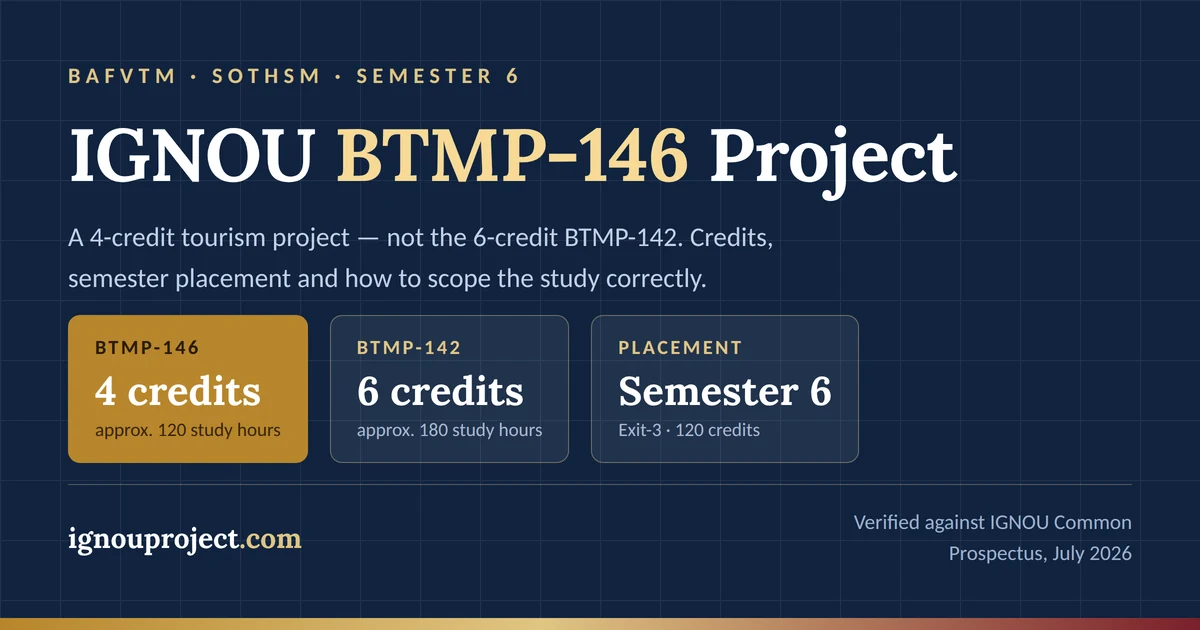
BTMP-146 is the 4-credit project course in IGNOU’s BAFVTM programme, placed in the sixth semester. It is not the older 6-credit BTMP-142. Because it carries four credits, it is built for a tightly focused tourism study — roughly 120 hours of work, not a year-long dissertation.
Verified against the source
Credit weight and semester placement on this page are taken from the IGNOU Common Prospectus (July 2026), section 5.21. Report length, marks split and viva rules are set in the SOTHSM project guide supplied with the course — confirm those with your Programme Coordinator or Regional Centre before you write.
The short answer
BTMP-146 (Project) is the project course of the Bachelor of Arts (Vocational Studies) Tourism Management (BAFVTM) programme, developed by the School of Tourism and Hospitality Service Management (SOTHSM). It carries 4 credits and sits in the Skill Enhancement slot of Semester 6, alongside BTMG-172, BTMC-134 and the sixth Minor course, in a semester worth 20 credits. IGNOU counts one credit as 30 hours of learner study time, so BTMP-146 represents roughly 120 study hours spread across topic selection, a supervisor-approved synopsis, field or desk data collection, and a written report. Clearing Semester 6 completes 120 credits and takes the learner to Exit-3, the UG Degree with Major. Students who mistake BTMP-146 for the older 6-credit BTMP-142 routinely over-build the study and lose time.
Where BTMP-146 sits in your credit ledger
Semester 6 of BAFVTM carries 20 credits in total. BTMP-146 is the 4-credit component — the smallest block in the semester, and the one most often over-scoped.
Definition
What is the IGNOU BTMP-146 project?
BTMP-146 is a project course, which means the learner produces an original piece of applied tourism research instead of sitting a written theory paper. The work runs under an approved guide, begins with a short proposal that the guide signs, and ends in a report that an examiner evaluates.
The course belongs to BAFVTM, IGNOU’s four-year undergraduate tourism programme aligned to the National Education Policy 2020. The programme runs across eight semesters and 160 credits in full, with staged exits: a UG Certificate after Year 1, a UG Diploma after Year 2, a UG Degree with Major after Year 3, and the Honours degree after Year 4. Admission requires 10+2 or its equivalent, and teaching is available in both English and Hindi. Course-level details are published on the official BAFVTM programme page.
In practice, BTMP-146 asks a simple question of the learner: can you take one tourism problem you can actually reach — a temple town, a homestay cluster, a booking counter, a local tour desk — and study it properly? The scale is deliberately small. The rigour is not.
Code clarity
How is BTMP-146 different from BTMP-142?
This is the most expensive confusion in the tourism cluster, because the two codes look almost identical and sit under programmes with the same everyday name. BTMP-142 is the project of the older BAVTM structure. BTMP-146 is the project of the newer BAFVTM structure. They differ in credits, in study hours, and therefore in how much work a finished report should represent.
| Point of difference | BTMP-142 | BTMP-146 |
|---|---|---|
| Programme | BAVTM, the earlier three-year structure | BAFVTM, the current NEP-aligned four-year structure |
| Credits | 6 | 4 |
| Indicative study hours | About 180 | About 120 |
| Placement | Final phase of the older six-semester plan | Semester 6, in the Skill Enhancement slot |
| School | SOTHSM | SOTHSM |
| Exit reached | Bachelor’s degree on completion | Exit-3, UG Degree with Major at 120 credits |
Check the enrolment record before anything else. The code printed against the programme decides which guide, which proforma and which scope applies. A learner sitting in BAFVTM who follows a BTMP-142 project guide will build a study a third larger than the course asks for, and will still have to account for the mismatch at the viva.
Planning
How do you choose a BTMP-146 topic that fits four credits?
A four-credit project rewards depth on a narrow question rather than breadth on a broad one. “Tourism in Rajasthan” cannot be finished in 120 hours. “Why weekday footfall at one stepwell drops after 3 p.m.” can. The sequence below keeps the scope honest.
- Pick the site before the theme. Choose a destination, agency, hotel or transport point you can physically reach more than once. Access decides feasibility, and feasibility decides whether the report gets finished.
- Anchor the topic to a course already studied. Marketing questions map to BTMC-136, operational questions to BTME-143, cultural and heritage questions to BTMG-171 and BTMG-172, and enterprise questions to BTMC-134. A topic with no parent course is hard to defend.
- Write the research question as one sentence. If it needs two sentences, the study is still too wide. Narrow it until a single sentence covers it.
- Fix a sample you can genuinely collect. For a four-credit study, a focused sample of 40 to 60 usable responses, or one well-documented case with records and observations, is more defensible than a claimed 300 responses nobody can verify.
- Confirm the topic with the guide before drafting. Under the SOTHSM project system the supervisor’s approval is what allows work to begin, and once the proposal has gone in, the wording of the topic should not change.
Topic directions that suit a four-credit tourism study
- Visitor satisfaction at a single heritage monument across weekday and weekend slots
- Signage, drinking water and toilet adequacy at one tourist site, set against visitor complaints
- How one homestay cluster prices rooms across peak and lean months
- Which online review factors move booking decisions for budget hotels in one town
- Itinerary design practice at a single tour desk, and where customers ask for changes
- Waste handling at one religious tourism site during a festival week
- Employment profile of a small travel agency and the skills it recruits for
- Local perception of a newly promoted rural tourism circuit
Wider inspiration sits in the general BAFVTM project topic guidance, but every idea still has to be cut down to four-credit size before the synopsis is written.
Proposal
What should the BTMP-146 synopsis contain?
The synopsis, also called the project proposal, is the document approved before research begins. SOTHSM project guides in the tourism family keep it deliberately short — the proposal text runs to roughly 400 words, submitted along with a proposal proforma and the supervisor’s consent. It is a plan, not a summary of findings.
A workable BTMP-146 synopsis sets out the title, a short background to the chosen site or problem, two or three objectives written in plain measurable terms, the method and the data source, the sample and how it will be reached, the significance of the study, and a short reference list. Formatting conventions are covered in detail in the IGNOU synopsis and proposal guide.
Two enclosures decide whether the proposal is considered at all: the proposal proforma, filled and signed by both learner and supervisor, and the bio-data of the guide, signed by the guide. A proposal that reaches the school without a signed guide bio-data is normally not entertained.
An observed pattern worth avoiding. BK Sahni has guided 5,00,000 students till date, and across the tourism codes the most common reason a synopsis comes back is not weak English — it is objectives that cannot be measured. “To study the importance of tourism” gives an examiner nothing to check. “To compare weekday and weekend visitor satisfaction at one site on five service parameters” can be checked line by line.
The second recurring cause is a topic that quietly widens between the proposal and the report. The title on the proforma and the title on the report cover must match exactly.
Report
What does the BTMP-146 project report contain?
IGNOU project reports follow a broadly stable shape across schools, and the tourism codes are no exception. The report opens with a title page, then the certificate of originality signed by the learner and the guide, an acknowledgement, and a table of contents. The body moves through introduction and background, a short review of what is already known, the methodology, the data and its analysis, and finally the conclusion with recommendations. References and annexures — questionnaires, interview notes, photographs, permission letters — close the report.
Length is where learners most often guess. The word count for BTMP-146 is fixed in the SOTHSM project guide issued with the course, and it sits below the counts quoted for six- and eight-credit projects elsewhere on the internet. Rather than copy a number from a forum, read the guide supplied with the course material or ask the Programme Coordinator. The general IGNOU project report format guide explains the standard sections, and the IGNOU project guidelines page covers conventions that apply across programmes.
Study material for the parent courses is free on eGyanKosh, IGNOU’s digital repository, and the tourism project guides for sibling codes sit in the SOTHSM collection there. Reading a sibling guide helps with structure; it does not replace the guide attached to your own code.
Paperwork
Which documents must travel with the report?
Final project reports go through IGNOU’s online project submission portal as a single PDF, and the university is strict about completeness. Four items normally sit inside that file along with the report.
- The approved project proposal proforma, in original, carrying both signatures.
- The approved synopsis, exactly as it was cleared, not a rewritten version.
- Bio-data of the project guide, signed by the guide.
- The originality certificate, signed by both the learner and the guide.
IGNOU has stated that incomplete submissions are not taken up for evaluation and are removed from the portal once the last date passes, which means the work has to be uploaded again in a later session. Reports sent by email are not evaluated. The evaluation fee for the session also has to be paid, with the receipt included. Session timing and the full upload sequence are covered in the IGNOU project submission guide.
One detail slips under deadline pressure: the first page of the PDF must carry the learner’s correct particulars — name, enrolment number, programme code and course code. A file that opens on a chapter heading rather than a title page creates avoidable trouble at the evaluation desk.
Support
Who supervises a BTMP-146 project?
The learner arranges a guide; IGNOU does not allot one automatically. Eligible supervisors are normally academic counsellors at a Study Centre, faculty at a Regional Centre, or qualified professionals and teachers in tourism or a closely allied discipline, meeting the qualification and experience thresholds set out in the project guide. The guide’s signed bio-data establishes that eligibility, which is why it counts as a mandatory enclosure rather than a formality.
For programme-level questions a study centre cannot settle, the BAFVTM Programme Coordinator sits at SOTHSM and can be reached at soniasharma@ignou.ac.in. Rules on report length, marks distribution and viva arrangements should be confirmed there rather than from third-party summaries. Alongside the project, learners preparing for the same term-end cycle usually work through IGNOU study notes and solved assignments for the theory papers running in parallel.
Questions
Frequently asked questions about BTMP-146
How many credits is the IGNOU BTMP-146 project?
BTMP-146 carries 4 credits. Using IGNOU’s stated norm of 30 hours of learner study time per credit, that works out to roughly 120 study hours covering topic selection, the synopsis, data collection and the written report.
Which programme and semester does BTMP-146 belong to?
BTMP-146 is the project course of BAFVTM, the Bachelor of Arts (Vocational Studies) Tourism Management programme run by SOTHSM. It sits in Semester 6, in the Skill Enhancement slot of a 20-credit semester, and completing that semester takes the learner to Exit-3, the UG Degree with Major at 120 credits.
Is BTMP-146 the same as BTMP-142?
No. BTMP-142 is the 6-credit project of the older BAVTM structure, while BTMP-146 is the 4-credit project of the current BAFVTM structure. Both run under SOTHSM and both are tourism projects, but the credit weight and therefore the expected scope differ. Learners should follow the code printed on their own enrolment record.
Do you need a guide before starting the BTMP-146 project?
Yes. The project has to be carried out under an approved supervisor, and the proposal will not be considered without the guide’s signature on the proforma together with the guide’s signed bio-data. Under the SOTHSM project system the supervisor’s approval is what allows work to begin.
How long should the BTMP-146 project report be?
The word count is specified in the SOTHSM project guide supplied with the course and should be taken from there, because a four-credit project is shorter than the six- and eight-credit reports whose word counts circulate online. Confirm the figure with your Programme Coordinator or Regional Centre before drafting.

BK Sahni iD 0009-0005-8092-459X
Founder, Shri Chakradhar Publication Pvt. Ltd. & ignouproject.com — helping IGNOU distance-learning students since 2010 (5,00,000+ students supported across MBA, MCom, MA & more). Author of IGNOU exam guides, solved assignments & project reference books.
Disclosure: Shri Chakradhar Publication Pvt. Ltd. and ignouproject.com are independent third-party study-help services — not the official IGNOU website. Always verify final dates and rules on ignou.ac.in.