MSCIS · Semester IV · SOVET
IGNOU MSEP-38 Project-II: What Changes When Your Project Is Worth Only 2 Credits
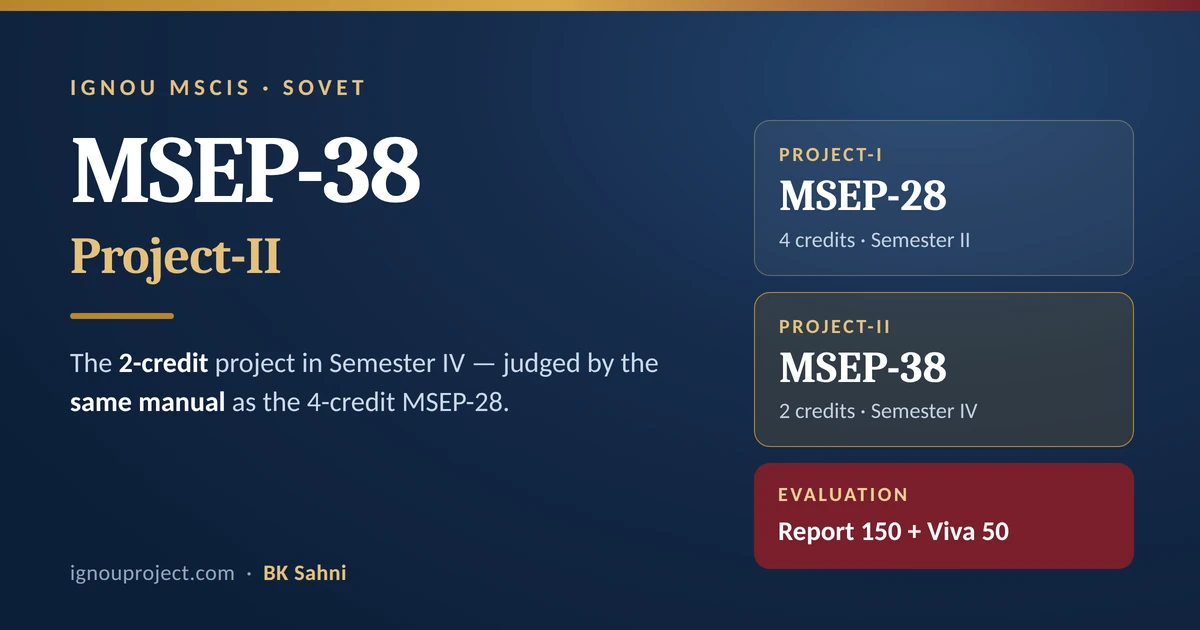
MSEP-38 is Project-II, a compulsory 2-credit course in Semester IV of IGNOU’s M.Sc. (Information Security). It is the smaller of the programme’s two projects. However, IGNOU assesses it under the same manual, the same report standard and the same 200-mark scheme as the 4-credit MSEP-28.
Read this first
Two credits does not mean half a project. The official Project Guidelines for MSEP-028 and MSEP-038 is a single shared document, so the proposal format, the 100 to 125 page report expectation and the 150-plus-50 mark scheme are identical for both codes. Students who plan MSEP-38 as a lighter task are the ones who miss the slot.
MSEP-38 in brief
IGNOU MSEP-38, titled Project-II, is a compulsory 2-credit course in Semester IV of the Master of Science (Information Security) programme, offered through the School of Vocational Education and Training. MSCIS carries 64 credits in total, with a 32-credit PGDIS exit option built in. The programme contains two separate project courses: MSEP-28 (Project-I, 4 credits, Semester II) and MSEP-38 (Project-II, 2 credits, Semester IV). Both are governed by one official document, the Project Guidelines for MSEP-028 and MSEP-038. Under that manual the project report is evaluated for 150 marks and the viva-voce for 50 marks, and a student must secure 50 per cent in each component separately to be declared successful. Proposal approval is mandatory before the work begins, proposals are accepted only in fixed slots, and the report documentation is expected to run to roughly 100 to 125 pages.
Course identity
What Is IGNOU MSEP-38 in the MSCIS Programme?
MSEP-38 refers to Project-II, the second project course in IGNOU’s Master of Science (Information Security). The code is also written as MSEP-038 in official listings, and both forms point to the same course. It appears only in MSCIS. Students in the one-year Post Graduate Diploma in Information Security do not study MSEP-38 at all, because the diploma stops after its own 4-credit project. That single distinction resolves most of the confusion around these two codes.
The course sits with the School of Vocational Education and Training (SOVET), not with a computer science school, which surprises many applicants. SOVET administers the whole information security ladder at IGNOU, from the Advanced Certificate through the PG Diploma up to MSCIS. The official study material for the course is catalogued on eGyanKosh under the MSEP-038 Project-II collection, which is where the guidelines manual itself is published.
Programme position
Where Does MSEP-38 Sit in the 64-Credit MSCIS Structure?
MSCIS runs across four semesters of 16 credits each. MSEP-38 is the last course listed in Semester IV, and it is the smallest single component in the entire degree. The full Semester IV block explains why timing matters so much:
| Course code | Title | Credits |
|---|---|---|
| MSE-33 | Web Application Testing and Audit | 4 |
| MSE-34 | E-commerce and Cyberspace | 2 |
| MSE-35 | IoT Security | 2 |
| MSE-36 | Latest Trends in Information and Cyber Security (OER-based) | 2 |
| MSEL-37 | Practical (Web Application, Audits, E-commerce Security and IoT) | 4 |
| MSEP-38 | Project-II | 2 |
Six components share one semester, and two of them are non-written work: a 4-credit practical and the project. A student who leaves MSEP-38 until the practical is finished has usually already lost the proposal slot, because proposals may only be submitted after entering Semester IV and then have to clear approval before any project work legitimately begins.
Comparison
How Is MSEP-38 Different From MSEP-28?
The two codes differ in credit weight, semester and programme reach, but not in procedure. This is the single most useful table for a Semester IV student to internalise:
| Point of difference | MSEP-28 (Project-I) | MSEP-38 (Project-II) |
|---|---|---|
| Official course title | Project-1 | Project-II |
| Credits | 4 | 2 |
| Notional study hours | 120 | 60 |
| Semester | Semester II (Year I) | Semester IV (Year II) |
| Programmes | MSCIS and PGDIS | MSCIS only |
| Governing manual | Shared MSEP-028 / MSEP-038 guidelines | Shared MSEP-028 / MSEP-038 guidelines |
| Report length expectation | About 100 to 125 pages | About 100 to 125 pages |
| Marks | Report 150 + viva 50 | Report 150 + viva 50 |
Because the procedure is shared, everything a student already learned while clearing the MSCIS project route for MSEP-028 and MSEP-038 carries forward. What does not carry forward is the topic. The manual instructs failed candidates to select a new topic, and the same logic protects honest students: recycling Project-I content into Project-II invites an originality objection. A quick read of how examiners treat duplication in IGNOU project plagiarism checks is worth the time before finalising a Project-II title.
Scope
Why Does a 2-Credit Project Still Demand a 100 to 125 Page Report?
IGNOU defines one credit as 30 hours of learner study covering all learning activities. MSEP-38 therefore represents roughly 60 notional study hours, against 120 for MSEP-28. Some third-party sites quote 180 hours for MSEP-38, which does not match the university’s own credit definition and should be treated with caution.
The mismatch is real and it is the practical heart of this course. The credit weight halves, but the documentation standard in the shared manual does not. The resolution is not padding. It is narrowing:
- Narrow the problem, not the evidence. One firewall ruleset, one small web application, one department’s access-control register. Depth over breadth.
- Let the analysis chapter carry the weight. Generic theory copied from reference books is explicitly discouraged by the manual, so length must come from the student’s own analysis, case study and observation.
- Build the appendices honestly. Logs, screenshots, scan outputs, questionnaires and raw data legitimately extend a report without inflating the argument.
A tightly scoped study with complete evidence reads far better at 100 pages than a sprawling one at 125. The structural conventions in the standard IGNOU project report format apply here without modification.
Proposal
What Must the MSEP-38 Project Proposal Contain?
Approval is mandatory before work starts, and approval runs on slots rather than on request. The manual sets the proposal at 15 to 20 pages and lists eight required elements:
- Title of the project, which must stay identical throughout the work
- Introduction and objectives of the project
- Project category
- Research methodology
- Scope of the solution
- Analysis
- Future scope and further enhancement of the project
- Bibliography and literature survey
The proposal travels with a Proforma for Approval of Project Proposal, filled in completely and signed and dated. The manual is blunt that an incomplete proforma is summarily rejected. The complete set goes to the Study Centre concerned, by hand or by registered insured post, with MSCIS/PGDIS Project Proposal (MSEP-028/MSEP-038) written on the envelope. Supervisor requirements vary across IGNOU schools, so students should confirm with their own Study Centre whether a guide’s counter-signature and biodata are needed before posting; the general position on IGNOU project guide eligibility is a useful starting point, and the conventions in IGNOU synopsis and proposal writing transfer directly.
Stage 01
Enter Semester IV
Proposals are accepted only after the student has entered the fourth semester.
Stage 02
Proposal slot
Approval windows run 1 January to 15 March and 1 July to 15 September.
Stage 03
Project work
Begins only after written approval. Study Centres take about 15 days to process.
Stage 04
Report and viva
Reports go in 1 April to 30 June or 1 October to 31 December; viva follows.
Slot pairing
The slots are linked, not independent. A proposal approved between 1 January and 15 March pairs with report submission between 1 April and 30 June, and a viva in July. A proposal approved between 1 July and 15 September pairs with report submission between 1 October and 31 December, and a viva in January. An approved proposal is valid for its own slot only. Dates can be revised, so verify the current project calendar on the official IGNOU website or with the Study Centre before planning around them.
Evaluation
How Is MSEP-38 Evaluated Out of 200 Marks?
The report carries 150 marks and the viva-voce carries 50, for a 200-mark total. The rule that catches students is not the total. It is the requirement to secure 50 per cent in each component separately. A strong report cannot rescue a weak viva, and the viva is compulsory.
If a candidate is unsuccessful, the manual requires the whole cycle to be redone from proposal stage with a new topic, and a pro-rata fee applies. That makes viva preparation a scope decision rather than an afterthought: a student must be able to defend every claim in the report without notes. Working through a set of IGNOU project viva questions against one’s own methodology chapter is the most efficient rehearsal. The report submitted must be carried to the viva.
Lateral entry
What Should Lateral-Entry PGDIS Students Know About MSEP-38?
IGNOU allows lateral entry into the second year of MSCIS for students who have already passed PGDIS, with credits transferred as per University norms. For that group the project position changes in one important way: their 4-credit project obligation was discharged inside PGDIS as MSEP-28, so MSEP-38 becomes the only project they undertake within MSCIS itself.
Two consequences follow. First, there is no second attempt at the project format inside the degree, which means the Semester IV proposal is also the first and only MSCIS proposal, and the slot discipline matters more. Second, the diploma project cannot be reused. Students who completed the PGDIS project for MSEP-28 should treat Project-II as a genuinely new investigation, ideally moving from the descriptive work typical of a diploma project towards measurement, testing or audit evidence. Credit transfer is decided by the University, so lateral-entry candidates should confirm their own transferred-credit position in writing rather than assuming it.
Planning
How Should Semester IV Students Plan MSEP-38 Alongside MSEL-37?
MSEL-37 is a 4-credit practical in web application testing, audits, e-commerce security and IoT. MSEP-38 sits in the same semester and draws on overlapping skills. Handled well, that overlap is an advantage rather than a clash.
- Choose a Project-II topic adjacent to the practical, not identical to it. If the practical builds web application testing skill, a project auditing one real application’s access controls uses the same toolchain while remaining distinct work.
- Draft the proposal before the practical peaks. The proposal needs only 15 to 20 pages and no findings, so it can be written early in the semester and posted inside the open slot.
- Keep a running evidence file from day one. Screenshots, tool output and dated notes gathered during the semester become the analysis and appendices later, which is how a 60-hour course produces a defensible report.
- Stay inside authorised systems. Security testing must be confined to lab environments or systems the student has written permission to test. An ethics failure ends a project faster than a methodology weakness.
Rejection risks
Which Mistakes Get MSEP-38 Proposals Rejected?
BK Sahni has guided 5,00,000 students till date, and across the information security codes the pattern of MSEP-38 rejections is unusually consistent. Most failures are procedural rather than technical.
- Treating the credit weight as the workload signal. A twelve-page report submitted for a 2-credit project fails against a manual that expects roughly 100 to 125 pages.
- Submitting before entering Semester IV. Eligibility begins on entering the fourth semester, so an early proposal is returned rather than fast-tracked.
- An incomplete proforma. The manual states that incomplete proformas are summarily rejected, with no opportunity to correct within the slot.
- Changing the title mid-way. The approved title must be carried through unchanged to the report and the viva.
- Theory-heavy documentation. Content that could be copied from reference books is explicitly discouraged; the report must be about the student’s own project.
- Submitting a photocopy. A photocopied project report is not accepted.
A rejected proposal is recoverable. The revised proposal must go in the next slot with a fresh proforma, accompanied by a copy of the earlier proposal and the non-approval proforma. Reading the general IGNOU project guidelines alongside the MSEP manual, and checking the correct code on the IGNOU project course code list, removes most of these errors before they cost a slot. The corresponding MSEP-028 Project-I collection on eGyanKosh hosts the same shared manual if the Semester IV listing is slow to load.
Stuck on an MSEP-38 topic or proposal? Scope, methodology and proforma completeness decide most MSEP-38 approvals, and all three are fixable before the slot closes.
Questions
MSEP-38 Frequently Asked Questions
How many credits is IGNOU MSEP-38?
MSEP-38 carries 2 credits. It is the Project-II course placed in Semester IV of MSCIS and is the smallest single component in the 64-credit programme. At IGNOU’s definition of 30 study hours per credit, 2 credits represents about 60 notional study hours.
Is MSEP-38 the same as MSEP-28?
No. MSEP-28 is Project-1, worth 4 credits in Semester II, and it appears in both MSCIS and PGDIS. MSEP-38 is Project-II, worth 2 credits in Semester IV, and it appears only in MSCIS. Both codes are governed by the same shared project guidelines manual and the same 200-mark evaluation scheme.
How many pages should the MSEP-38 project report be?
The shared MSEP-028 and MSEP-038 guidelines state that project documentation may be about 100 to 125 pages. The proposal itself is separate and is set at 15 to 20 pages. Generic textbook theory should be avoided, so the length is expected to come from the student’s own analysis, case study, observation and appendices.
What are the passing marks for MSEP-38?
The project report is evaluated for 150 marks and the viva-voce for 50 marks. A student must secure 50 per cent in each component separately, which means at least 75 of 150 on the report and 25 of 50 in the viva. A high report score cannot compensate for a viva below the minimum.
Do lateral-entry PGDIS students have to do MSEP-38?
Yes. PGDIS pass-outs admitted to the second year of MSCIS have their diploma credits transferred as per University norms, which covers the 4-credit MSEP-28 project. MSEP-38 remains compulsory in Semester IV and becomes the only project such students complete inside MSCIS. The diploma project cannot be resubmitted for it.

BK Sahni iD 0009-0005-8092-459X
Founder, Shri Chakradhar Publication Pvt. Ltd. & ignouproject.com — helping IGNOU distance-learning students since 2010 (5,00,000+ students supported across MBA, MCom, MA & more). Author of IGNOU exam guides, solved assignments & project reference books.
Disclosure: Shri Chakradhar Publication Pvt. Ltd. and ignouproject.com are independent third-party study-help services — not the official IGNOU website. Always verify final dates and rules on ignou.ac.in.