IGNOU CNH HPC 001 Practical: the work from your first session to the exam
The IGNOU CNH HPC 001 Practical is the 10-credit hands-on course of CHBHC, printed by IGNOU as CNS-HCP 001 Skills Related to Home Based Care, and this guide shows how to do its work yourself: the diary, each skill entry, the TPR and BP readings and the 50-mark examination.
CHBHC practical in four lines
To finish the IGNOU CNH HPC 001 Practical, attend at least 90 percent of the 4-hour contact sessions, practise all 16 skills from the two manuals on real patients, write each case in your diary the same day, get the named readings checked, and sit the 50-mark examination at your practical centre.
The certificate has two Semester 1 courses: CNS-HC 001 Home Based Care (theory, 4 credits) and CNS-HCP 001 (practical, 10 credits). For admission details, read our CHBHC programme overview.
On most practical courses, learners who cope with theory still slow down at the hands-on part. CNS-HCP 001 has its own 100 marks, with separate pass marks for diary work and examination.
Some learners notice the practical only mid-session. CHBHC gives 300 study hours to practice and 120 to theory.
Before the first contact session: the CNS-HCP 001 diary format
The programme guide asks every IGNOU CNH HPC 001 Practical learner to record all cases seen in a diary, during self-practice and supervised practice, and the counsellor at your Programme Study Centre evaluates it. No layout is printed, so set one up on day one:
- Use one bound notebook; a name and enrolment page is optional.
- Divide it into supervised days at the centre and self-practice at home, work place or neighbourhood.
- Rule each page: date and time, place, patient code (initials or bed number), skill and activity number, what you did, readings, remarks, signature of whoever checked.
- Keep a running hour total at the foot of each page against 150 supervised and 150 self-practice hours.
- Keep the last pages for a Skill 1 to 16 index.
The written record is where practical marks usually leak, and it is the part you control. Both 25-mark continuous evaluation parts of CNS-HCP 001 are read from this diary.
Most learners we hear from juggle work and home, and missed practical days hurt most. The CHBHC guide ties your examination seat to 90 percent practical attendance; our IGNOU practical attendance and fee guide covers the general rules.
Batches move on without latecomers. Ask your Programme Study Centre for the CHBHC session plan at the first meeting.
Plan the IGNOU CNH HPC 001 Practical hours by where each skill can be done
The guide splits the IGNOU CNH HPC 001 Practical into 150 supervised hours (about 19 days of 4-hour sessions) and 150 self-practice hours. Plan by place, not by skill number:
- Spell days, with a ward or teacher: readings for the supervisor (Skills 4 and 5), chest physiotherapy (7), insulin with the teacher present at least 10 times (8), ward samples and the laboratory visit (9), catheter, suppository and enema (11), oxygen and nebulisation on a written order (12), suction and ward dressings (13).
- Home or neighbourhood, after the demonstration: interviews (1), room observation and hand washing (2), mouth, hair and foot care (3), positions (6), exercises (7), ORS (10), hot and cold applications (14), home visit advice (15), family education (16).
Book ward-only activities onto spell days and spread the home list over evenings from week one; the guide says to use extra hospital chances when they come and otherwise repeat procedures at home.
Plans copied from a friend’s centre often fail. The CHBHC guide leaves one spell or two to your own institution or study centre, so take your dates from there.
Working learners ask whether practice at their job counts. The guide names the work place as a setting for the self-practice diary, beside home and neighbourhood.
In our records, 70 to 80 percent of learners start moving only in the last month before a date. One hundred and fifty home hours cannot fit into one month of evenings.
History taking format for Skill 1, head by head
Skill 1 of the IGNOU CNH HPC 001 Practical prints a full format with a filled sample (sections 1.6 and 1.7). Write each history in this order:
- Identification data: name, age, sex, marital status, family, education, occupation, address, income, religion, habits, diet.
- Chief complaints, in the patient’s words.
- Present illness, with its duration.
- Past illness, injury or surgery, medicines, side effects, allergies, infections.
- Family history of disease.
- Social history: family and neighbours, religious practice, interests.
- Recreation, walking problems, fatigue, sleep and help needed to sleep.
Mark subjective facts (from patient or relatives) apart from objective ones (records, your observation); Manual I leaves physical examination to the doctor, with you assisting. For elderly patients, our MMEL 104 geriatric assessment guide shows a fuller assessment, though your diary needs only these heads.
Write-ups are read in a set order, and a skipped head shows at once. Pencil the seven Skill 1 heads down the margin of each history page.
Five interviews or two? Skill 1 asks five in an activity box and two in its closing list, and seniors add a third version; ask your counsellor.
English case writing is hard for many Hindi-schooled learners, and the reverse holds too. CHBHC runs in both media; settle the diary language with your counsellor.
TPR record sheet format in the IGNOU CNH HPC 001 Practical
Skill 4 of the IGNOU CNH HPC 001 Practical gives a record sheet (Table 4.7): name, age, sex and diagnosis at the top, then date, time, temperature, pulse, respiration and remarks, with a signature line. Take all three readings in one sitting and compare them with the Manual I adult values:
| Reading | Manual I value | Report when |
|---|---|---|
| Oral temperature | 97.6 to 98.6 F (36.5 to 37.5 C) | Outside range or changed |
| Axillary temperature | 96.6 to 98.6 F (36 to 37 C) | As above |
| Rectal temperature | 98.6 to 100.6 F (37.0 to 38.1 C) | As above |
| Pulse, 10 years to adult | 70 to 80 per minute | Outside that band |
| Respiration, adult | 18 to 20 per minute | Below 10 or above 35 |
| Blood pressure | 90 to 120 over 60 to 80 mm Hg | Very high or low, or chest pain |
Babies differ (a newborn’s pulse is 130 to 140); infant nurses can compare our BNSL 115 newborn workbook guide.
With readings, the slips we see are wrong working, wrong reference values and remarks that contradict the number. Table 4.1 sets oral, rectal and axillary bands apart.
Some learners write the reading they expected, not the one they took. Skill 4 Activity 2 asks for 10 patients at three sites, so every figure should come from a thermometer you read.
A worked diary entry for the IGNOU CNH HPC 001 Practical
One supervised-day entry in the IGNOU CNH HPC 001 Practical style, with an invented patient; your diary carries only patients you saw.
Illustrative entry: medical ward, day 6, Bed 4
Bed 4, 64 years, male, chest infection. Skill 4 Activity 3 and Skill 5 Activity 3.
| Time | Temperature | Pulse | Respiration | BP | Remarks |
|---|---|---|---|---|---|
| 10 a.m. | 37.8 C oral (100.0 F) | 92, regular | 22 | 136/88 | All four above Manual I values; told the ward sister; supervisor signed |
Working, with the Celsius to Fahrenheit formula from Skill 4: F = (C x 9/5) + 32 = (37.8 x 9/5) + 32 = 68.04 + 32 = 100.04, written 100.0 F. The reverse is C = (F – 32) x 5/9.
Care given: Fowler’s position with pillow support (Skill 6); patient and position noted.
Two Manual I slips matter here. Under its worked example, a line pairs 101.3 F with 37.8 C; the working starts from 38.5 C, the correct pair. Table 4.3 prints 41.0 C as 105.0 F, where the formula gives 105.8 F; the other rows check out.
Temperature and BP entry checker
Enter one patient’s readings to convert and compare them with Manual I adult values.
Without JavaScript: F = (C x 9/5) + 32 and C = (F – 32) x 5/9; compare with the table above.
How to measure blood pressure manually: the Skill 5 steps
Skill 5 gets 18 of the 150 hours in the IGNOU CNH HPC 001 Practical. With a mercury or dial apparatus and a stethoscope:
- Explain the procedure; rest the patient's arm on a table, or on the bed if lying.
- Tie the cuff firmly, its centre 2 or 4 fingers above the elbow.
- Find the brachial pulse at the elbow, towards the little finger, and place the stethoscope on it.
- Pump until the pulse disappears (above 200 mm Hg).
- Open the screw slowly: the first sound is the systolic (upper) reading; where the sound turns dull and fades is the diastolic (lower) reading.
- Release all the air, repeat if in doubt, and write systolic over diastolic, as 120/80.
For Activity 2, pump the cuff on your own arm to 200 mm Hg and write, in your words, what you felt as it eased. One more slip: section 5.3 describes high pressure with the lower reading "less than 80", while the normal band ends at 80; ask your counsellor how to word a raised lower reading.
Empty supervisor boxes reach our desk often. Activity 3 wants five hospital patients' BP checked by the supervisor, so get that check before you leave the ward.
Writing up care skills in the IGNOU CNH HPC 001 Practical diary
For care skills, the diary entry is your only proof of work in the IGNOU CNH HPC 001 Practical. Give each entry five parts: patient and need, skill and activity, steps followed, what you observed, what you reported. Add what the manuals name:
- Skill 6: patient and position given. Skill 8: medicine, dose, time and route.
- Skill 9: 24-hour urine amount in the intake and output chart.
- Skill 10: diet given by Ryle's tube or gastrostomy, why the patient could not feed himself, the chart.
- Skill 11: suppository or enema outcome. Skill 13: discharge types in two wounds.
Nurses keep heavier versions of this record; see our BNSL 033 ICU record guide and BNSL 034 care plan guide if you plan to study further.
Before: "Helped patient with position." After: "Bed 2, unable to turn after a stroke: side-lying with pillows as comfort devices per Skill 6; skin over bony points checked." Only the second shows a CNS-HCP 001 skill applied.
Diaries written up in one go show repeated lines, holiday dates and no growth; write each CNS-HCP 001 entry that evening.
Diary mistakes and how to fix them
| Mistake | Fix |
|---|---|
| "Temperature 37.8" with no site or unit | Write "37.8 C oral (100.0 F)". |
| Conversion read from the 41.0 C row of Table 4.3 | Use the formula: 105.8 F. |
| Insulin entries without the teacher named | Skill 8 Activity 3 needs the teacher present, at least 10 times; name them. |
| Full name and address on every daily entry | Keep those once on the Skill 1 history; use a code daily. |
| A copied diary where only the learner's details were swapped; matching pages from one centre are obvious to the counsellor marking CNS-HCP 001. | Record only patients from your own ward, locality or work place. |
| Entries produced by an AI tool and pasted in unchanged. | No tool knows your Bed 4; write what you saw. |
| Definitions lifted from websites unchecked. | Use each skill's key words list and your own words. |
Evening diary check for CHBHC learners
Tick this list each night of the IGNOU CNH HPC 001 Practical.
Ten-minute diary check before bed
CHBHC practical exam preparation: the 50-mark day
For the IGNOU CNH HPC 001 Practical examination, you return to your own contact-session centre, before or after the theory paper, and face one external and one internal examiner for 50 marks (25 to pass). No pattern is printed, so prepare for any skill:
- Say each procedure aloud: articles, steps, aftercare, recording.
- Know the conversion formula and the Table 4.1 values without a table.
- Carry the complete diary and your IGNOU student identity card.
- Find your theory paper on the December 2026 date sheet and ask where the practical falls around it.
"Is there a viva?" comes up often. The CHBHC guide describes two examiners and 50 marks and is silent on a viva, so ask your centre.
Learners who do well start early, check their centre's rules, date entries daily, collect signatures on the spot and can explain every page, here every procedure without the manual.
Paying the practical fee on Samarth before 30 November 2026
The IGNOU CNH HPC 001 Practical carries 10 credits, so the prospectus slab above 4 credits applies: Rs 500, paid with the term-end examination form and not refunded. SED's notice for the December 2026 term-end examination makes 30 November 2026 the last date for this fee, payable only through your Samarth login. The guide's older Rs 50 per course figure is out of date. Other fees are in our IGNOU fee structure by course.
Rs 300 and Rs 500 get mixed up. Count credits: CNS-HCP 001 has 10, so Rs 500.
Some learners wait for a second date. This SED notice says no fee is accepted after 30 November 2026.
Have your own diary entries read
Want a second reader for pages you have written? Send photos of a few entries on WhatsApp through our services and charges page; a practical record check is quoted there. We flag missing heads, unit slips and unchecked readings. The entries stay yours, and your counsellor's evaluation decides the marks.
Questions home care learners ask us
Three questions on marks and practice
Does the guide give marks for each skill of the IGNOU CNH HPC 001 Practical?
Its appendix prints marks per skill (4 for 6 hours, 8 for 12, 12 for 18; 100 in all) but not how they become the 25 self-practice and 25 supervised marks, so ask your counsellor.
Can I practise on family members at home?
Yes. The guide has you learn at the centre under a supervisor, clear doubts there, then practise those skills at home. Activities the manuals tie to a supervisor, teacher or doctor's order still need that person.
When will my practical marks show?
Your Programme In-charge compiles the diary marks, and the practical marks transmission status page shows them only once the study centre or Regional Centre transmits them; our grade card status guide covers the grade card. For missing marks, the prospectus lists practicalsed@ignou.ac.in and 011-29572212.
Practical marks usually reach the grade card after theory marks, and the certificate waits for them, including the step where your centre forwards the CNS-HCP 001 diary marks.
Putting the IGNOU CNH HPC 001 Practical together
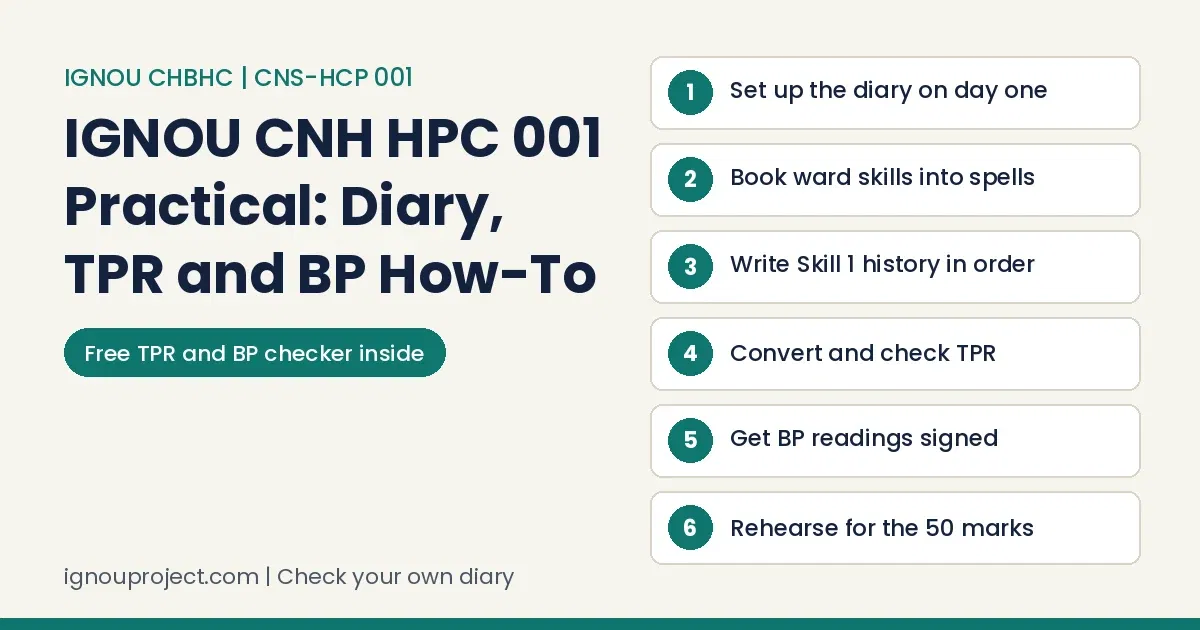
The IGNOU CNH HPC 001 Practical rewards steady work: a diary from day one, ward skills booked into spells, every entry written the same day with its check, and all 16 procedures rehearsed. Theory reading for the certificate is on our publication site.
Three causes recur across programmes: rules arrive late and vary by centre, practicals demand time and travel, and the record is treated as paperwork. In CNS-HCP 001, the diary proves skill.
Where these CHBHC facts come from
- CHBHC Programme Guide, SOHS: hours, attendance, diary, marks, examination
- Manual I (April 2010, Skills 1 to 8) and Manual II (June 2010, Skills 9 to 16) of CNS-HCP 001
- CHBHC page on ignou.ac.in: courses and credits
- July 2026 Common Prospectus: section 11.58, fee slab, contacts
- IGNOU announcements: SED practical fee notice, December 2026 TEE
Written from Manual I and Manual II of CNS-HCP 001, the CHBHC programme guide and programme page, the July 2026 Common Prospectus and the SED December 2026 fee notice, all read in November 2026; drafting was AI-assisted, every rule was checked against those sources, and BK Sahni publishes this guide under his editorial responsibility.
ignouproject.com is not affiliated with IGNOU, and IGNOU has not authorised or endorsed it. We only read and comment on diaries learners have written themselves; you remain the author of every entry and reading.

BK Sahni iD 0009-0005-8092-459X
Founder, Shri Chakradhar Publication Pvt. Ltd. & ignouproject.com — helping IGNOU distance-learning students since 2010 (5,00,000+ students supported across MBA, MCom, MA & more). Author of IGNOU exam guides, solved assignments & project reference books.
Disclosure: Shri Chakradhar Publication Pvt. Ltd. and ignouproject.com are independent third-party study-help services — not the official IGNOU website. Always verify final dates and rules on ignou.ac.in.