The IGNOU BAFJDM Project focuses on the key aspects of event management, including budgeting, marketing, logistics, risk management, and client handling. Students are typically required to select a specific event type, such as corporate events, weddings, exhibitions, or cultural programs. The IGNOU BAFJDM Project involves preparing a detailed report that outlines the event’s objectives, target audience, venue selection, resource allocation, timeline, and contingency planning.
The Four-Year Undergraduate Programme B.A. (Journalism and Digital Media) focuses on four core components – fundamental components of journalistic practices, core dimensions of the emerging digital media, the application of digital media in various media practices, and online and digital research methods with particular reference to big data analytics. This program explores the skill sets that connect journalism media and communication technology. With potential employability in the digital media field, the program aims to provide the required skill sets for the students to explore better career opportunities.
This BAJDM project/dissertation typically checks three core abilities:
- Research skills: selecting a topic, setting objectives, and using a method
- Media understanding: applying concepts from journalism and digital media
- Academic writing: presenting findings in a clear and correct format
Overview: What the IGNOU BAFJDM Project/Dissertation Means
The IGNOU BAFJDM Project/Dissertation is a structured academic project for the BA (Journalism and Digital Media) programme. It checks the ability to plan, research, write, and present a media-based study in a clear and logical format. It also evaluates practical understanding of digital media work, basic research skills, and ethical reporting practices.
A well-prepared dissertation shows:
- Original work with consistent logic
- Clear topic selection and scope
- Valid data collection or content review
- Proper organisation and simple academic writing
- Correct formatting and clean presentation
IGNOU BAFJDM Project/Dissertation Guidelines
Follow these practical guidelines to keep the BAFJDM project acceptable and easy to evaluate.
1) Choose a topic with a clear media link
Select a topic connected to journalism, news, digital platforms, audience behaviour, content production, media ethics, or communication practices.
2) Keep the scope limited and realistic
Avoid topics that need large budgets, expensive tools, or access to restricted data. Prefer topics that allow:
- Small surveys
- Interviews with available respondents
- Content analysis of public posts
- Case studies of accessible media outlets
3) Use simple research methods
Common methods that work well:
- Survey (basic questionnaire)
- Interview (semi-structured questions)
- Content analysis (posts, news items, videos)
- Case study (one platform, one campaign, one outlet)
4) Maintain originality and academic honesty
- Write in original wording.
- Do not copy content from websites or old reports.
- Use consistent writing style across chapters.
- Keep data files and notes safely for checking.
5) Follow ethics and consent
- Take consent for interviews or surveys.
- Avoid collecting private data without permission.
- Do not name individuals in a harmful way.
- Keep responses anonymous where needed.
6) Keep language formal and simple
- Use short paragraphs.
- Prefer active voice.
- Avoid slang and extra decoration.
- Explain terms that may confuse readers.
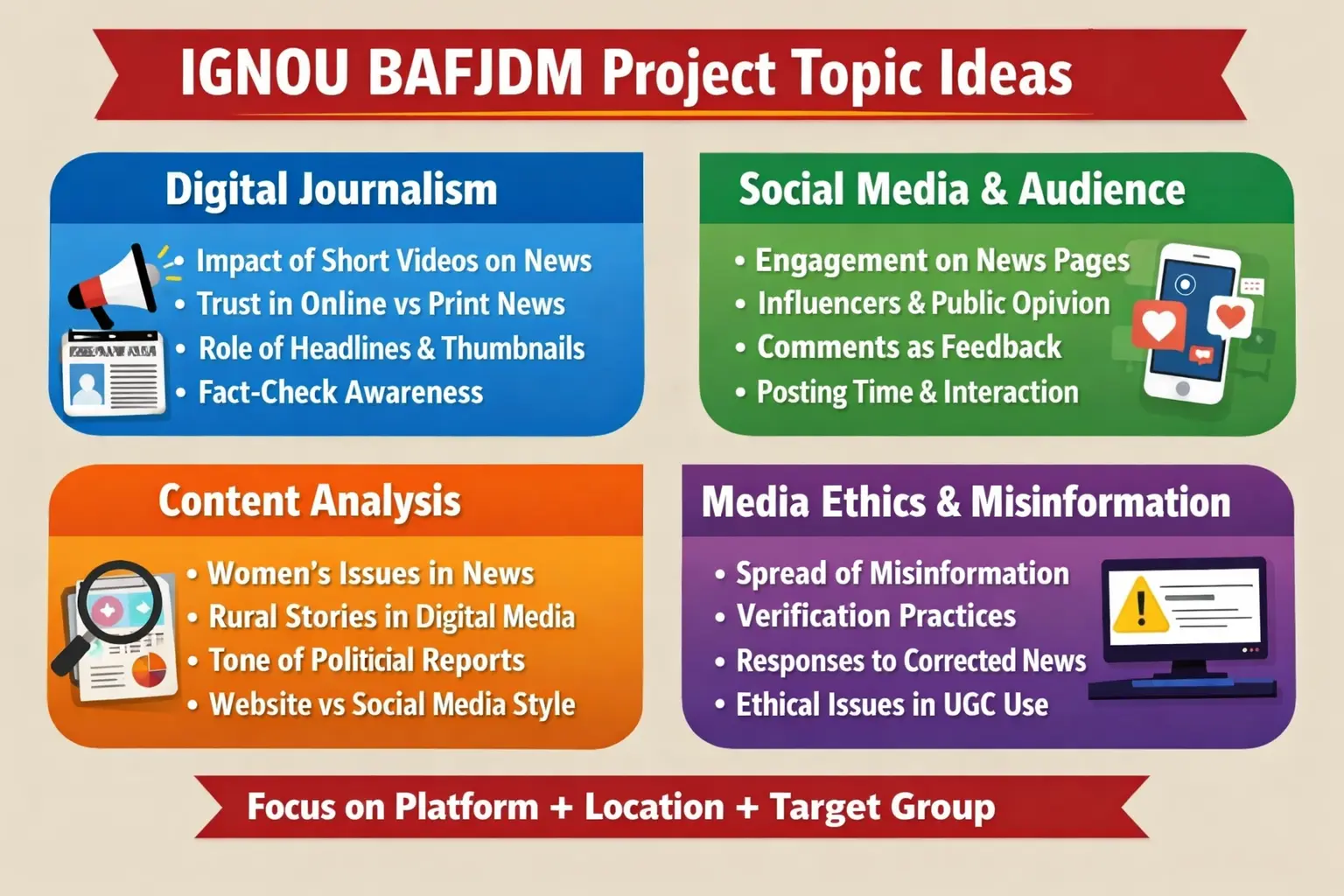
IGNOU BAFJDM Project Topic Ideas
Below are practical topic ideas for BAFJDM project that fit common media research methods. Choose one and narrow it to a city, district, age group, or platform.
Digital Journalism and News Consumption
- Impact of short videos on news understanding among youth
- Trust in online news versus printed news in a local area
- Role of headlines and thumbnails in click decisions
- Fact-check awareness among social media users
Social Media, Audience, and Engagement
- Audience engagement patterns on local news pages
- How influencers shape public opinion on social issues
- Comments as a form of public feedback in digital news
- The link between posting time and engagement in news posts
Content Analysis Topics
- Coverage of women’s issues in online news portals
- Representation of rural stories in digital news platforms
- Tone analysis of political news on digital pages
- Comparison of reporting styles: website vs social media posts
Media Ethics and Misinformation
- Spread of misinformation during events in a community
- Verification practices followed by student journalists
- Public response to corrected news posts
- Ethical issues in using user-generated content
Digital Marketing and Media Business (If Allowed in Scope)
- Effect of sponsored content labels on audience trust
- Local brand storytelling on social platforms
- Role of digital ads in news portal revenue perception

Image: IGNOU BAFJDM Project Topic Ideas
Tip: Convert a broad title into a focused title by adding platform + location + time period + target group.
IGNOU BAFJDM Project Topics Sample List
- Evolution of Indian Cinema: Analyze how film narratives have changed with technological advancements.
- Gender Representation in Indian Films: Examine portrayals of gender roles and their societal impact.
- Impact of Regional Cinema: Explore how regional films contribute to national identity and cultural diversity.
- Role of Film Festivals: Assess how film festivals influence indie filmmakers and the mainstream film industry.
BAFJDM Synopsis Writing: Purpose and Structure
A synopsis acts as a short plan of the dissertation. It tells what will be studied, why it matters, and how it will be done.
What a strong synopsis includes
- Working Title: Clear and specific
- Introduction/Background: What is the issue and context
- Problem Statement: What gap or problem needs study
- Objectives: 3–5 measurable objectives
- Research Questions: 2–4 direct questions
- Methodology: Methods, sample size, tools, and process
- Scope and Limitations: What is included and what is not
- Expected Outcome: What the study may produce
- Chapter Plan: Chapter-wise outline in brief
Sample objective patterns (easy and acceptable)
- To study audience preference for digital news formats
- To analyse engagement metrics of selected posts
- To assess awareness of misinformation and verification habits
- To compare content themes across two digital platforms
Simple synopsis structure (recommended order)
- Title
- Introduction
- Problem statement
- Objectives
- Research questions
- Methodology
- Scope/limitations
- Expected outcome
- Chapter outline
BAFJDM Project Guide/Supervisor: Role and Selection
A supervisor guides the research process and checks whether the work meets academic standards.
What a supervisor typically does
- Helps refine the topic and scope
- Reviews synopsis and tools (questionnaire/interview guide)
- Suggests correct chapter flow and writing discipline
- Checks whether findings match data and objectives
- Confirms that the final report is ready for submission
How to work smoothly with a supervisor
- Share a one-page topic note before writing the synopsis
- Fix deadlines for each stage (tool, data, chapters)
- Send clean drafts with clear questions
- Make changes quickly and track revisions
- Keep records of data collection dates and sample details
Common supervisor expectations
- Clear objectives and matching methodology
- Proper sampling logic and simple analysis
- Consistent formatting and error-free language
- Ethical data handling and honest reporting
IGNOU BAFJDM Project Report Format and Structure
A clean structure improves readability and reduces correction issues. The following format suits most BA (Journalism and Digital Media) dissertations.
Front Pages
- Cover page (title, code, enrolment details as required)
- Declaration (original work statement)
- Certificate (guide approval, if required)
- Acknowledgement (optional, short)
- Table of contents
- List of tables/figures (if used)
Chapter 1: Introduction
Include:
- Background of the topic
- Reason for selecting the topic
- Problem statement
- Objectives
- Research questions
- Scope and limitations
- Key terms (if needed)
Chapter 2: Review of Related Literature
Write a simple, topic-based review:
- Group ideas into themes (not author-by-author storytelling)
- Explain what is already known
- Identify the gap that the project addresses
- Keep it clear and relevant to the study
Chapter 3: Research Methodology
Include:
- Research design (survey/interview/content analysis/case study)
- Study area or platform selection
- Sample size and sampling method
- Tools used (questionnaire/interview schedule/content coding sheet)
- Data collection steps
- Data analysis plan (basic percentage, charts, theme coding)
- Ethical steps (consent, privacy)
Chapter 4: Data Presentation and Analysis
Present findings in a clean order:
- Use tables and simple charts when needed
- Explain each finding in 3–6 lines
- Link analysis to objectives and questions
- Avoid adding opinions without data support
Chapter 5: Findings, Conclusion, and Suggestions
Include:
- Key findings (bullet points work well)
- Conclusion (based on findings, not assumptions)
- Suggestions/recommendations (practical and limited)
- Future scope (optional, 3–4 lines)
Annexures
Add:
- Questionnaire or interview questions
- Consent statement (if used)
- Coding sheet (for content analysis)
- Extra tables (if any)
IGNOU BAFJDM Project Submission Process
The BAFJDM project submission process often fails due to small mistakes. Use a controlled checklist approach.
Step-by-step submission flow
- Finalise topic and synopsis format
- Obtain guide/supervisor approval where required
- Collect data and maintain records (dates, sample details)
- Write chapters and revise based on supervisor feedback
- Check formatting, page order, and required front pages
- Proofread for grammar, spacing, and consistency
- Prepare final print/bind or final file format as instructed
- Submit through the instructed channel with correct code and title
Evaluation and Result Timeline in BAFJDM Project Work
For the BA (Journalism and Digital Media) project/dissertation, results are usually declared within 8–12 weeks after submission. The timeline may extend due to:
- High submission load in the same session
- Multiple checks during evaluation
- Processing delays in records and result updates
If the BA (Journalism and Digital Media) project is rejected or sent for revision
- Written feedback is given with clear issues (common: unclear objectives, weak method, poor analysis, format errors).
- Revision and resubmission is generally allowed within a given deadline.
- Resubmit in the same structure and ensure every feedback point is corrected.
- The revised report goes for final evaluation.
Must Read: Check Your IGNOU Project Status: A Complete Guide
FAQs in IGNOU BAFJDM Project/Dissertation
What is the main aim of the IGNOU BAFJDM Project/Dissertation?
It aims to assess research, writing, and media understanding through a structured study related to journalism and digital media.
Can the topic be changed after the BAFJDM synopsis is prepared?
Topic changes may create approval issues. A stable topic is recommended once the synopsis is finalised.
Which research method suits this BAFJDM dissertation best?
Survey, interview, content analysis, and case study methods usually work well, depending on topic scope and access.
Is content analysis acceptable for digital media topics?
Yes. Content analysis works well for posts, news items, videos, and comments when a clear coding plan is used.
Downloadable Resources
Final Words
The IGNOU BAFJDM Project/Dissertation for BA (Journalism and Digital Media) requires careful planning, a focused topic, simple research methods, and clear academic writing. Strong structure, ethical data handling, and consistent formatting improve the overall quality and reduce rejection risk. A disciplined synopsis-to-report workflow also helps complete the dissertation on time with fewer revisions.
For structured support on topic shortlisting, synopsis drafting, report formatting, and final readiness checks for the IGNOU BAFJDM Project/Dissertation, visit ignouproject.com or WhatsApp us.

BK Sahni iD 0009-0005-8092-459X
Founder, Shri Chakradhar Publication Pvt. Ltd. & ignouproject.com — helping IGNOU distance-learning students since 2010 (5,00,000+ students supported across MBA, MCom, MA & more). Author of IGNOU exam guides, solved assignments & project reference books.
Disclosure: Shri Chakradhar Publication Pvt. Ltd. and ignouproject.com are independent third-party study-help services — not the official IGNOU website. Always verify final dates and rules on ignou.ac.in.