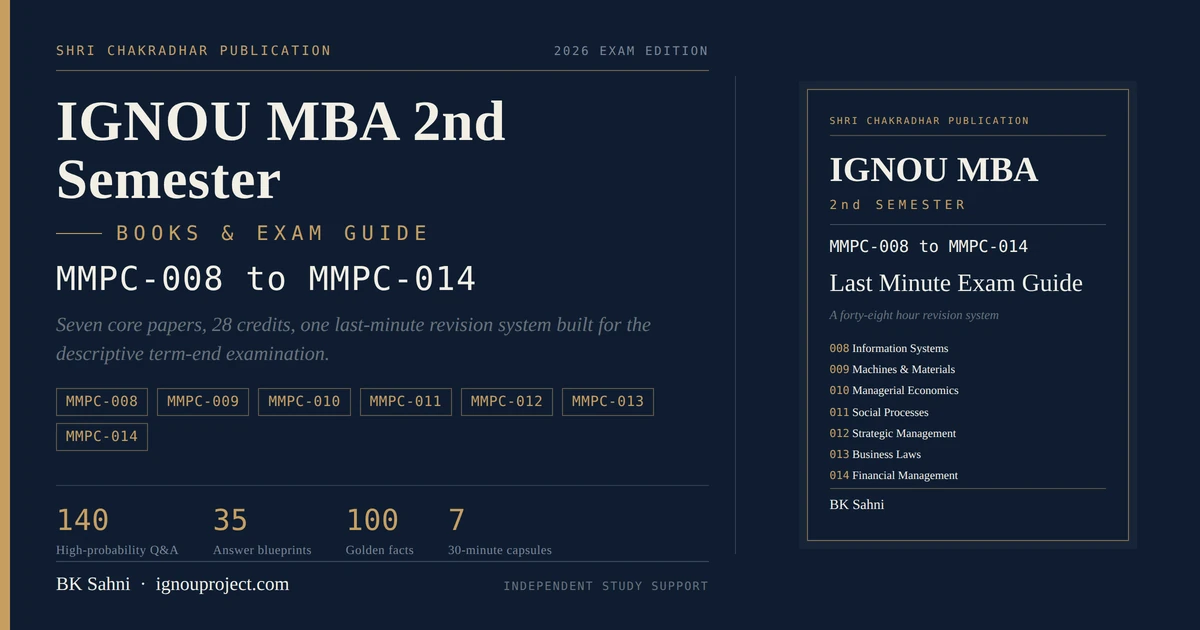
The IGNOU MBA 2nd Semester Book sold here is the IGNOU MBA 2nd Semester Last Minute Exam Guide (2026 MBA Exam Edition) from Shri Chakradhar Publication, priced at ₹249. One volume covers all seven compulsory second-semester courses — MMPC-008, MMPC-009, MMPC-010, MMPC-011, MMPC-012, MMPC-013 and MMPC-014 — four credits each, 28 credits in total. Students search for it as an IGNOU MBA help book, guide book, study guide, exam revision book or MBA 2nd sem notes; these all describe the same category of resource. It contains 35 answer blueprints, 140 high-probability questions with model answers, 119 rated topics, a formulas bank for MMPC-014, an Acts-and-years table for MMPC-013, 100 golden facts, a 70-question self-test and a 48-hour revision plan. It is a companion to the official IGNOU study material, not a replacement for it. Soft copy and hard copy are both ordered on WhatsApp at +91 93546 37830.
What You Get for ₹249
Eight things arrive in one volume, and the counts below were taken off the printed pages rather than estimated. Nothing here is sold separately by subject: MMPC-014 does not cost extra because it is twice the length of the other chapters, and MMPC-013 does not cost extra because it carries six blocks instead of four.
Also inside: a command verb decoder for every paper, 108 thinker and statute entries, 15 comparison tables, a semester-at-a-glance dashboard, a 29-item exam-day checklist and a 48-hour emergency study plan. All in English medium, aligned to the current MMPC-008 to MMPC-014 structure.
The Problem This Book Was Written For
Semester 1 is uniform in shape: read, structure, write. Semester 2 is not, and that is where the marks go missing. Seven papers pull in three different directions, and a habit that scores well in one of them actively costs marks in another.
- MMPC-014 Financial Management is roughly twice the length of any other chapter and the only formula-driven paper of the seven, so revising it last means revising it badly.
- You know the MMPC-013 answer but write it without “Indian Contract Act 1872, Section 10” attached, and a correct idea gets read as a guess.
- You reproduce a motivation model in MMPC-011 accurately and never name Maslow or Herzberg, so the answer scores as recall failure rather than as knowledge.
- You bring MMPC-008 diagram instincts to MMPC-012, or MMPC-012 framework instincts to MMPC-010, and lose marks in both on content you already knew.
- Your term-end examination is close and you genuinely do not know whether to open Unit 1 of MMPC-009 or the capital budgeting unit of MMPC-014 first.
This book answers exactly those five problems: a rated topic order per paper so you know what to open first, a formulas bank for the MMPC-014 and MMPC-010 numericals, an Acts-and-years table for MMPC-013, thinkers tables for MMPC-011 and MMPC-012, reusable answer frameworks so structure stops being a decision, and a finished 48-hour timetable so the last two days plan themselves.
Inside the Book: The Same Six Sections in Every Chapter
Seven papers that reward seven different habits are held together by one repeating chapter shape. Section A always opens MMPC-009 the same way it opens MMPC-012, so the twenty minutes you spend working out where the heatmap sits in one chapter is twenty minutes you never spend again in the other six.
Scroll the table sideways on a small screen.
| Section | What it holds | When you use it |
|---|---|---|
| A — Opener and Topic Heatmap | Course overview with units, blocks and paper type, plus 16 to 18 topics rated by frequency with unit references | First, to decide the order of study |
| B — Command Verb Decoder | What examiners expect from Discuss, Explain, Distinguish, Critically Examine and similar verbs, with an example from that paper | Once, before exam day |
| C — Five Answer Blueprints | Reusable answer frameworks, each stating which questions it covers and roughly how many it solves | While practising written answers |
| D — Twenty High-Probability Q&A | Twenty likely questions per subject with model answers and a closing exam note | Main practice phase |
| E — Revision Toolkit | Thinkers or statutes table, definitions or formulas bank, comparison tables, common mistakes | Final twenty-four hours |
| F — Thirty-Minute Capsule | Must-remember concepts, sure-shot questions, emergency answer starters and golden keywords | Last thirty minutes before the paper |
Wrapped around the seven chapters are the shared sections: a how-to-use page, a semester-at-a-glance dashboard, a 48-hour emergency study plan, 100 golden facts, a 29-item exam-day checklist, and a 70-question self-test with its answer key. That back matter is the part that does the work in the last two days.
Your Seven Papers, and What the Book Does for Each
The IGNOU MBA second semester carries seven compulsory theory courses, four credits each, 28 credits in total. The guide covers every one of them.
Scroll the table sideways on a small screen.
| Code | Official course title | Credits | Units |
|---|---|---|---|
| MMPC-008 | Information Systems for Managers | 4 | 15 across 4 blocks |
| MMPC-009 | Management of Machines and Materials | 4 | 14 across 4 blocks |
| MMPC-010 | Managerial Economics | 4 | 13 across 4 blocks |
| MMPC-011 | Social Processes and Behavioural Issues | 4 | 15 across 4 blocks |
| MMPC-012 | Strategic Management | 4 | 13 across 4 blocks |
| MMPC-013 | Business Laws | 4 | 14 across 6 blocks |
| MMPC-014 | Financial Management | 4 | 15 across 5 blocks |
Course titles above follow the official IGNOU Common Prospectus for July 2026. Three differences are worth stating openly. The prospectus names MMPC-013 as Business Laws in the plural, while the book’s printed cover uses the singular Business Law. The cover also renders MMPC-009 and MMPC-011 with ampersands where the prospectus spells out “and”, although the book’s internal pages already match the prospectus, so only the cover art differs. These are cover labels, not alternative course names. Use the prospectus wording on assignments and examination forms, and confirm your codes against your admission record before ordering. One further point of transparency: the Common Prospectus tabulates these seven courses course-by-course under the sister MBA programmes such as MBAHCHM, MBALS, MBACN and MBAABM, while the flagship MBA entry states only that the programme runs twenty core courses from MMPC-001 to MMPC-020 and refers readers to a separate MBA prospectus.
One prospectus fact matters more in Semester 2 than anywhere else in the programme. The MBA is 28 courses and 116 credits, and the Common Prospectus records that a student who completes the specified courses of the first and second semesters — 56 credits — may, on specific request, exit with the Post Graduate Diploma in Management. Semester 1 is 28 credits and Semester 2 is 28 credits. These seven papers are the half that closes that block, which is why a Semester 2 backlog costs more than a backlog anywhere else.
MMPC-008 Help Book — Information Systems for Managers
MMPC-008 opens the semester and is the most diagram-dependent of the seven. Its 15 units run across four blocks covering IT for managers, information systems, analysis and languages, and support systems. The guide’s heatmap rates 16 topics for this paper and places seven in the very-high band: management information systems with their components and characteristics, decision support systems, the TPS versus MIS versus DSS versus EIS comparison, enterprise resource planning, the systems development life cycle, database management systems, and data warehousing with data mining. What the book gives you here: five blueprints including the definition-components-levels skeleton built around Anthony’s Triangle, plus a fifteen-term golden keyword line for the last half hour. The habit that decides marks in this paper is the diagram — a labelled block diagram, data flow diagram or entity-relationship chart earns two to three marks a purely verbal answer never collects, and an answer written as technology description rather than managerial decision support loses marks even when it is correct. Students searching for MMPC-008 important questions, MMPC-008 notes or an MMPC-008 study guide are usually after exactly this ranking.
MMPC-009 Help Book — Management of Machines and Materials
MMPC-009 is the first genuinely numerical paper of the semester. Fourteen units across four blocks cover facility planning, operation planning and control, design and value engineering, and materials management. Seventeen topics are rated, and the book is blunt about the concentration: economic order quantity, PERT and CPM, plant layouts, total quality management and just-in-time together account for roughly half the marks. What the book gives you here: three comparison tables including PERT against CPM and process layout against product layout, eighteen banked definitions, and nine named exam mistakes specific to operations answers. The habit that recovers the most marks is mechanical — write the formula with its units, then work step by step, because a numerical attempted with the correct formula and a wrong final figure still earns partial credit while a bare answer earns none. Learners hunting MMPC-009 previous year question paper patterns or MMPC-009 revision notes will recognise the layout and network-diagram questions immediately.
MMPC-010 Help Book — Managerial Economics
MMPC-010 covers 13 units in four blocks: introduction, demand and revenue, production and cost, and pricing decisions. Sixteen topics are rated, and four clusters — demand elasticity, market structures, cost concepts and pricing strategies — carry roughly fifty marks between them. This is the paper where a drawn curve is worth the ink: a demand curve, a marginal-revenue-against-marginal-cost sketch, a cost curve or an isoquant converts a competent answer into a scoring one. What the book gives you here: the largest definitions bank of the seven papers at 27 entries, and twenty model answers spanning elasticity, demand forecasting, returns to scale, break-even analysis and the oligopoly models. Numericals want the formula written before the substitution and one interpretation line after the arithmetic. An MMPC-010 study guide earns its place here precisely because the vocabulary has to be exact — Baumol and Williamson appear as short notes far more often than students expect.
MMPC-011 Help Book — Social Processes and Behavioural Issues
MMPC-011 is the most theorist-driven paper in the semester. Fifteen units across four blocks cover introduction to organisational behaviour, intrapersonal processes, interpersonal and group processes, and emerging trends. Seventeen topics are rated, with motivation theories, personality, learning, perception, groups and conflict accounting for around forty-five marks. What the book gives you here: a thinkers table with 18 entries pairing each theorist to their model, two comparison tables, ten named mistakes and a nineteen-item keyword line. The single habit that decides marks is naming the theorist before describing the theory. An answer opening “According to Herzberg” reads as knowledge; identical content opening “there is a theory that” reads as recall failure and is marked that way. This is also the paper where an Indian organisational example is cheapest to add and most reliably rewarded, which is why searches for MMPC-011 important questions or MMPC-011 notes almost always resolve back to the attribution problem rather than to coverage.
MMPC-012 Help Book — Strategic Management
MMPC-012 spans 13 units in four blocks: introduction to strategy, environmental analysis, strategy formulation, and implementation and control. It carries the largest heatmap in the book at 18 rated topics, and six frameworks — SWOT, Porter’s five forces, PESTLE, the generic strategies, the BCG matrix and the Ansoff matrix — are worth roughly fifty marks between them. What the book gives you here: five blueprints built around framework application rather than definition, three comparison tables, and twenty-six banked definitions. The habit that separates scripts is citing the framework’s originator alongside the framework, and drawing the two-by-two where one exists: a BCG matrix described in prose and a BCG matrix drawn and labelled are not marked the same. Indian strategic cases are the natural evidence layer, which is what an MMPC-012 guess paper or an MMPC-012 exam revision pass should be practising against rather than simply reading.
MMPC-013 Help Book — Business Laws
MMPC-013 is structurally unusual: 14 units across six blocks — overview, business forms, contracts, finance regulations, intellectual property and data, and sustainability — more blocks than any other paper in the semester. Eighteen topics are rated, and seven statutory clusters carry roughly fifty marks: the Indian Contract Act 1872, the Companies Act 2013, sale of goods, consumer protection, intellectual property rights, partnership and limited liability partnership, and negotiable instruments. What the book gives you here: an Acts-and-years table in place of the usual thinkers table, twenty model answers running from contract essentials through to bank recovery under SARFAESI, and the longest golden-keyword line in the volume at twenty-four terms. The habit that decides marks is citation discipline — the Act’s full name, its year, and the section number where you know it. That is what an MMPC-013 previous year question paper is actually graded on, and it is why MMPC-013 notes that omit section numbers are close to worthless in the hall.
MMPC-014 Help Book — Financial Management
MMPC-014 covers 15 units in five blocks: overview, cost of capital and investments, financing, dividend, and emerging areas. It is the heaviest chapter in the volume by a clear margin, roughly twice the length of any other paper, and the only one whose revision bank is a formulas bank rather than a definitions bank. Seventeen topics are rated, with capital budgeting, time value of money, weighted average cost of capital, capital structure, dividend theories, working capital and leverage carrying about fifty marks. What the book gives you here: a 22-entry formulas bank, five blueprints for the numerical question types, and fourteen golden facts covering the Modigliani-Miller, Walter and Gordon positions. The rule that recovers the most marks is mechanical: write the formula, substitute, show every step, attach units to every figure, then add one line interpreting the result for a manager. The formula itself carries credit even when the arithmetic slips. The book’s own 48-hour plan schedules this paper first, at hours two to six, and anyone searching MMPC-014 important questions or an MMPC-014 help book should start there too.
Official Study Material or This Guide? You Need Both
Anyone about to spend ₹249 deserves a direct answer to this. IGNOU’s own blocks define the syllabus, cost nothing, and no commercial volume displaces them — the 15 units of MMPC-008 and the 13 units of MMPC-010 are the actual examinable material. You can download IGNOU MBA study material subject-wise free of charge, and the eGyanKosh access guide shows how to pull them by course code.
What separates them is the job each one does. The blocks teach the subject across four months. This volume compresses that into 119 ranked topics and 35 answer shapes you can deploy in the twenty minutes a 20-mark question allows. Treating the guide as a substitute for the blocks leaves you exposed the moment an unrated topic appears. Reading every block and then sitting MMPC-014 without a formula sheet, or MMPC-013 without a single section number in your head, is the failure that happens far more often.
Scroll the table sideways on a small screen.
| What students search for | What it actually is | When it helps | The Semester 2 mistake |
|---|---|---|---|
| IGNOU MBA study material, books PDF | Official block-wise units issued by IGNOU, hosted on eGyanKosh | Throughout the semester, for concepts and assignments | Reading all 15 units of MMPC-014 in the last two days and arriving having practised no formula |
| IGNOU MBA help book, guide book, guidebook, study guide | An independent revision volume condensing the syllabus into exam-ready form — this book | Final weeks, for answer writing and recall | Buying it and skipping the blocks, which works until an unrated topic appears on the paper |
| IGNOU MBA exam revision book, last minute guide | The same category, named by use case rather than by format | Final 48 hours to 7 days | Reaching for it as a first-time learning source rather than as revision |
| IGNOU MBA notes, MMPC notes, revision notes | Short subject summaries, usually thinner than a guide book | Quick recall between longer sessions | Memorising MMPC-011 content without ever attaching a theorist’s name to it |
| IGNOU MBA solved assignment, handwritten assignment | Assignment support, a separate track from the examination | Before the submission deadline | Assuming assignment work has already covered the term-end paper |
| IGNOU MBA previous year question paper, solved question paper | Real term-end papers published by IGNOU, and third-party answers to them | Practice phase, alongside a guide book | Preparing only what appeared last December and ignoring the frequency spread |
| IGNOU MBA guess paper, important questions, most repeated questions | A probability ranking built from topic frequency across sessions | Deciding revision order in the final stretch | Treating a high-probability list as permission to cut the syllabus |
If your real problem sits in one of the last three rows, this is not the page you want: go to IGNOU solved assignments, handwritten assignment, previous year solved question papers or IGNOU guess papers instead. A guide book bought when the assignment deadline is the actual emergency helps nobody. And if your registration reads MMPC-001 to MMPC-007 rather than MMPC-008 to MMPC-014, the IGNOU MBA 1st semester books page covers that volume, with a dedicated MMPC-001 subject page alongside it.
How the Guide Book Maps to the Term-End Examination Pattern
The format below is not inferred. It was read from the December 2025 MMPC-014 Financial Management paper published by IGNOU: three hours, maximum 100 marks, weightage 70 per cent, eight questions printed, attempt any five, all carrying equal marks. That is the shape every one of these seven descriptive papers takes, and the tutor-marked assignment carries the remaining 30 per cent of the course result.
| Element | Verified value | What it means for your revision |
|---|---|---|
| Time | 3 hours | Roughly 36 minutes per answer including reading, planning and any diagram |
| Maximum marks | 100 | 20 marks per question, since all carry equal marks |
| Weightage | 70% | The paper is 70 per cent of the course result; the assignment carries the other 30 per cent |
| Questions printed | 8 | You see eight, so three can be unfamiliar without costing you anything |
| Questions to attempt | Any five | Preparing the high-frequency band thoroughly beats preparing everything thinly |
That last row is the entire argument for a frequency heatmap. With eight printed and five required, you can afford three blind spots per paper. The book rates 48 topics across the seven papers as very high and 52 as high, and each paper’s focus-zone note states that its top seven topics account for roughly 70 per cent of the marks. Covering the very-high band for a subject plus enough of the high band to guarantee five answerable questions is a defensible strategy in a way that skimming fifteen units is not.
The marks logic for a twenty-mark answer is worth internalising even if you never buy the book, and it changes by camp. For MMPC-011 and MMPC-013, open with the attribution — the theorist, or the Act with its year and section — then the framework, then an Indian example, then one line of managerial relevance. For MMPC-008 and MMPC-012, lead with the definition, then draw and label the diagram or matrix, then apply it. For MMPC-009, MMPC-010 and MMPC-014, write the formula, substitute, show every step with units, then interpret the number for a manager — the MMPC-010 curves and the MMPC-009 network diagrams count as working, so draw them rather than describing them. An answer with a slightly wrong final figure but a correct method still scores.
Assignments run on a separate track from the examination and they gate your eligibility to sit the paper. If you are behind, work from the IGNOU solved assignments page or the IGNOU handwritten assignment guide first, then read the submission guide, and verify current dates on ignou.ac.in. Semester 2 has no project component, but if you are planning ahead the IGNOU MBA project report page explains what arrives later in the programme.
Free Tools: Previous Year Question Papers, Guess Papers and Most Repeated Questions
Judge the method before you pay for it. These three tools sit on the three things IGNOU MBA learners search for most — previous year question papers, guess papers and most repeated questions — and every one of them runs on this specific book’s data for MMPC-008 to MMPC-014. Nothing is stored, no account is created, and no data leaves your browser. Tool 1 resolves to IGNOU’s own published PDFs; Tools 2 and 3 read the 119 frequency ratings printed in the volume. What they cannot give you is the part that took longest to build: the 140 model answers, the 35 answer blueprints, the MMPC-014 formulas bank and the definitions banks. Those are in the book. All three tools cover every paper from MMPC-008 to MMPC-014, so you can compare the MMPC-009 topic spread against MMPC-010 or MMPC-012 before deciding where the ₹249 is worth spending your first evening.
How the frequency ratings work
These bands record how frequently the book found each topic recurring across past papers. They are a revision sequence, not a prediction of what your session will print.
Tool 1 — IGNOU MBA Previous Year Question Paper Finder (PYQ)
Select a code and a published session and the finder resolves the official IGNOU file path on ignou.ac.in, with the session listing returned alongside it so a renamed file still leaves you somewhere useful. Nothing is mirrored or re-hosted here. Working through two or three real MMPC-008 to MMPC-014 papers before revision starts will teach you more about how these seven subjects are examined than a week of reading, because the December 2025 MMPC-014 paper alone shows the split between theory questions and the numerical on weighted average cost of capital.
Previous Year Question Paper Finder
Only sessions IGNOU has actually published are listed here.
Results are study-oriented suggestions based on the book’s topic structure and general examination-preparation patterns. They are not guaranteed IGNOU examination questions.
Ask About the Book — ₹249Tool 2 — IGNOU MBA Guess Paper Builder
This builds a practice paper in the exact term-end format IGNOU uses for MMPC papers: three hours, 100 marks, eight questions, attempt any five, all carrying equal marks. Questions are drawn from the book’s rated topics for that paper and weighted towards the higher-frequency bands. Sit one against a clock and it stops being revision and becomes diagnosis — three hours on an MMPC-014 set will tell you within the first question whether your formulas are actually retrievable. For solved IGNOU guess papers across other programmes, see the guess papers page.
Guess Paper Builder
Change the set number to generate a different paper from the same topics.
Results are study-oriented suggestions based on the book’s topic structure and general examination-preparation patterns. They are not guaranteed IGNOU examination questions.
Send the Answer Blueprints — ₹249Tool 3 — Most Repeated Questions and High Probability Topic Analysis
This shows the full frequency picture for a paper: every rated topic, its band, and its unit number in the official blocks, alongside how much of the 100-mark paper the top band can realistically cover. This is the difference between an important-questions list assembled from 119 rated entries with unit references, and one assembled from opinion.
Most Repeated Questions and Topic Analysis
Results are study-oriented suggestions based on the book’s topic structure and general examination-preparation patterns. They are not guaranteed IGNOU examination questions.
Share Order Details — ₹249Using the Study Guide Across a Semester, a Week, or a Final 48 Hours
Marks in Semester 2 are lost less to shortage of hours than to sequence. Open MMPC-011 on day one and MMPC-014 on the last night and you will have revised the paper that survives late revision first and the paper that collapses under it last. The book's 48-hour plan inverts that, and the ordering principle behind it scales to any window you have: numerical papers first, framework papers second, attribution papers last.
Across a full semester the blocks lead and the guide audits. Finish Block II of MMPC-010, then open that paper's 16-row heatmap and test yourself against the seven entries rated very high. Anything you cannot write a paragraph on sends you back into the block, not into the guide. Used this way the volume is an examiner's checklist rather than a teaching text, and the 70-question self-test at the back is the same instrument applied across all seven papers at once.
If you have a week, give MMPC-014 two full days rather than one — it is twice the length of the other chapters and the only formula-driven paper — then one day each to MMPC-010 and MMPC-009, pair MMPC-008 with MMPC-012 on a single day because both are framework-and-diagram papers that reinforce each other, and give the last day to MMPC-011 and MMPC-013 together, since both are pure attribution work and are the two that hold up best when revised late. Reserve the final evening for the 70-question self-test and the seven capsules.
If you have 48 hours, the book’s own plan is reproduced below. It front-loads the numerical papers because formulae decay fastest and recover slowest, and it schedules sleep explicitly rather than pretending nobody needs it.
Scroll the table sideways on a small screen.
| Hours | Paper | Why it sits here |
|---|---|---|
| 0–2 | All seven capsules | Thirty-minute capsules for MMPC-008 through MMPC-014 read end to end, to build a mental map before any deep work |
| 2–6 | MMPC-014 | Financial Management first, because formulas, capital structure and dividend theory decay fastest when left to the end |
| 6–10 | MMPC-010 | Managerial Economics next, while you are still fresh enough to draw curves and work elasticity numericals |
| 10–14 | MMPC-009 | Machines and Materials, for economic order quantity, PERT and CPM, just-in-time and total quality management |
| 14–18 | MMPC-012 | Strategic Management, where the frameworks reward pattern recall more than freshness |
| 18–24 | Break, light revision, sleep | The plan schedules rest rather than assuming none, then continues into the second day with MMPC-008, MMPC-011 and MMPC-013 |
The plan also states plainly what not to do in the final twelve hours: open nothing new. A topic met for the first time the night before an MMPC-013 paper will not survive contact with a section-number question. One further constraint applies at every timescale — hold to two sources. The blocks plus this volume is a set most learners actually finish across seven papers; the blocks plus three downloaded PDFs, a video playlist and a second guide is a set almost nobody does. If you want condensed summaries running alongside the blocks, the IGNOU study notes page is the one supplement worth adding, and the IGNOU guide books online page sets out how guide books differ from official material across other programmes.
Soft Copy or Hard Copy? Same ₹249, Different Study Habits
Identical content, identical ₹249, and no correct answer in the abstract. What decides it is where your revision physically happens, and the two papers that pull hardest in opposite directions are MMPC-014, which wants a page you can write beside, and MMPC-013, which wants a term you can search for.
Scroll the table sideways on a small screen.
| Consideration | Soft copy | Hard copy |
|---|---|---|
| Access speed | Immediate once shared | Depends on courier time to your pin code |
| Best study setting | Commute, office breaks, phone reading | Desk sessions, handwritten answer practice |
| Finding a formula or a section number | Text search finds the MMPC-014 formula or the MMPC-013 Act instantly | Depends on the index and your own tabs |
| Annotation | Depends on your reader app; workings go in a separate notebook | Margin notes beside the formula, which is where MMPC-014 and MMPC-010 students want them |
| Suits the 48-hour plan | Yes, capsules and the self-test work well on a phone | Yes for the MMPC-009 and MMPC-012 blueprints, if it has already arrived |
| Screen fatigue | Real, over long numerical sessions | None |
MMPC-010 and MMPC-012 revise equally well in either format, so let the two extremes decide for you. Two questions settle it. Does your revision happen in fragments — commute, breaks, half an hour before sleep? Then soft copy, because the seven capsules and the 70-question self-test work on a phone. Do you intend to write full 20-mark answers by hand before the exam? Then hard copy, because that is the skill the paper actually measures and it does not transfer from reading. A frequent compromise is the soft copy for the heatmaps and capsules with only the MMPC-014 and MMPC-009 blueprint pages printed, since those are where working needs room beside the formula. And where the session is close and courier times to your area are long, the decision is made for you.
How to Buy the IGNOU MBA 2nd Semester Book at ₹249
One message starts it. The three steps exist so that the code match happens before payment rather than after despatch — MMPC-008 to MMPC-014 is a set several MBA variants share only partially, and a book for the wrong semester is unusable rather than merely inconvenient.
| Step | What you do | What happens |
|---|---|---|
| 1. Send your details | Message +91 93546 37830 with your programme, semester, course codes and term-end examination session | Your codes are matched against MMPC-008 to MMPC-014 |
| 2. Choose your format | Say whether you want the soft copy or the hard copy. For hard copy, add your pin code | You are told what is currently available and, for hard copy, the delivery window to your area |
| 3. Confirm and receive | Complete the ₹249 payment through the option shared with you | Soft copy is shared once the order is confirmed. Hard copy is despatched by courier |
Send four things in the first message and the reply covers everything: programme and semester, the exact codes copied from your admission record or Samarth registration rather than recalled, the term-end session you are sitting, and the format with a pin code if you want the printed copy. The code check carries more weight in Semester 2 than in Semester 1, because the MMPC-008 to MMPC-014 block sits in the second semester of MBAHCHM, MBALS, MBACN and MBAABM as well as the flagship MBA, and learners on those variants sometimes carry the full seven and sometimes carry five or six, most often without MMPC-009 or MMPC-011.
Where else the book is available
Shri Chakradhar Publication also lists this volume on Amazon, Flipkart and Kindle. Those marketplaces set their own prices, despatch windows and return terms, none of which are quoted here, so read the listing itself before ordering that way. The difference with the direct route is continuity: the thread you order on is the thread you can return to when a MMPC-014 numerical or a MMPC-013 section reference stops making sense mid-revision.
How This Guide Was Prepared
Editorial note. The supplied copy of the IGNOU MBA 2nd Semester Last Minute Exam Guide (2026 MBA Exam Edition) was read cover to cover before this page was drafted. The chapter architecture, the six-section format, the counts of blueprints, questions, rated topics, golden facts, self-test questions, banked definitions and named mistakes, the per-subject frequency ratings, and the 48-hour study sequence described here were extracted from that book and checked rather than estimated from a description. The three free tools on this page are driven by the book’s own topic ratings rather than by invented data.
Course codes, official course titles, credit values and the total credit structure of the MBA programme were checked against the IGNOU Common Prospectus for July 2026 rather than against the book, and where the book’s cover labels differ from the prospectus the difference is stated openly above. The 116-credit, 28-course programme structure and the 56-credit Post Graduate Diploma in Management exit provision are prospectus facts, not the book’s.
Examination pattern details — three hours, 100 maximum marks, 70 per cent weightage, eight questions printed and any five to be attempted — were read from the actual December 2025 MMPC-014 question paper published on the IGNOU website, not carried over from memory. The session links in the finder tool were checked against IGNOU’s own published question-paper index, which at the time of writing lists December 2025, June 2025 and December 2024. There is no June 2026 folder yet, so no June 2026 link is offered. For December 2024 the direct file pattern could not be confirmed, so the tool returns the session listing rather than a direct link that might fail. Re-confirm current instructions against the official IGNOU website before you rely on them.
Nothing here forecasts a grade, a result or the contents of your paper. The frequency bands are the book's editorial reading of past examination patterns and are presented as nothing more. No ratings or reviews appear anywhere on this page because none have been supplied. BK Sahni has guided 5,00,000 students till date across IGNOU programmes including MBA, M.Com, MEG, MHD, MPS and BAG.
Questions Students Ask Before Buying
Important Notice About This Website
ignouproject.com is run by Shri Chakradhar Publication Pvt. Ltd. as an independent study-support service. It is not the university’s website, carries no university authority, and nothing published here should be treated as an official notification. Confirm programme structure, the seven MMPC-008 to MMPC-014 course codes, examination dates, assignment instructions and every university notice at ignou.ac.in and the official study material repository at eGyanKosh.
The volume sold here is a privately published revision aid. IGNOU neither issued it nor endorsed it, and the codes MMPC-008, MMPC-009, MMPC-010, MMPC-011, MMPC-012, MMPC-013 and MMPC-014 appear on this page for one reason only: to identify which seven subjects the book covers. The three browser tools are free, unconnected to any purchase, and generate no obligation of any kind.
Syllabus structure, paper patterns and regulations are revised from time to time. No topic, question, frequency band or unit reference on this page is presented as a prediction of what your MMPC-008 to MMPC-014 papers will contain.

BK Sahni iD 0009-0005-8092-459X
Founder, Shri Chakradhar Publication Pvt. Ltd. & ignouproject.com — helping IGNOU distance-learning students since 2010 (5,00,000+ students supported across MBA, MCom, MA & more). Author of IGNOU exam guides, solved assignments & project reference books.
Disclosure: Shri Chakradhar Publication Pvt. Ltd. and ignouproject.com are independent third-party study-help services — not the official IGNOU website. Always verify final dates and rules on ignou.ac.in.