
| Quick answer: This is your complete study-help guide for IGNOU MMPC-004 (Accounting for Managers), a 4-credit core course in MBA Semester 1. It covers all five services — solved assignment, handwritten assignment, exam-focused help book, a solved guess paper, and solved previous year question papers (PYQs). Every section includes one free, fully-worked sample so you can check the quality before you order. All orders are placed on WhatsApp. |
| Free sample inside every section. Want the complete MMPC-004 files (assignment, help book, guess paper, PYQs)? Order on WhatsApp +91 93546 37830 → |
| Disclaimer: ignouproject.com is not the official IGNOU website. This page is a student-guidance and study-help resource only. Always verify exam dates, assignment last dates, and official notices on the official IGNOU website (ignou.ac.in) and the Samarth student portal before relying on them. |
IGNOU MMPC-004 Overview (Accounting for Managers)
IGNOU MMPC-004, titled Accounting for Managers, is a core paper in the first semester of the IGNOU MBA programme. It teaches future managers how to read, prepare, and use accounting information — from basic book-keeping and final accounts to cost accounting, financial-statement analysis, and modern topics like forensic accounting. New to the process? Start with our complete IGNOU assignment guide to understand how assignments fit into your final result.
Course Details
| Detail | Information |
| Subject Code | MMPC-004 |
| Subject Name | Accounting for Managers |
| Programme | MBA (Master of Business Administration) |
| Semester | 1 (First) |
| Credits | 4 |
| Assignment Session | January 2026 / July 2026 |
| Assessment Split | 30% assignment + 70% Term-End Examination |
MMPC-004 Syllabus & Units Covered
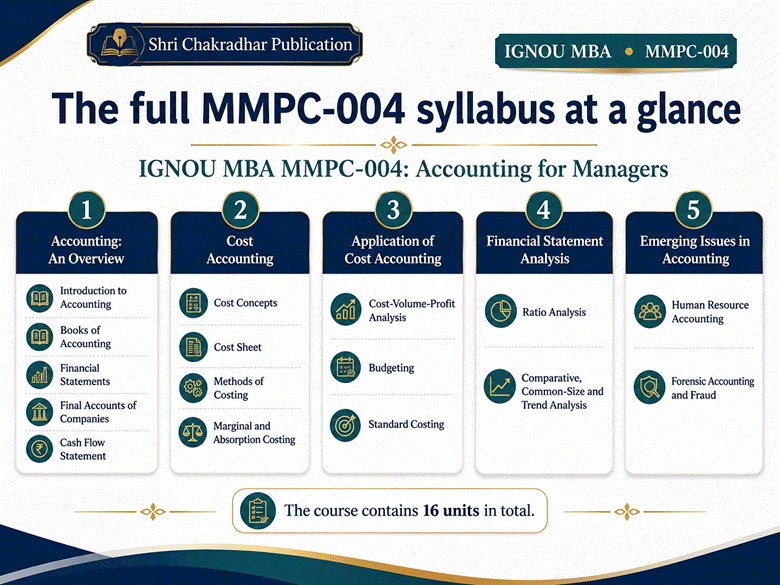
The MMPC-004 syllabus is divided into 5 blocks and 16 units. Knowing exactly which units carry numerical questions and which are theory-based helps you plan both the assignment and the Term-End Examination.
| Block | Units covered |
| Block I — Accounting: An Overview | Unit 1 Introduction to Accounting • Unit 2 Preparation of Books of Accounts • Unit 3 Financial Statements • Unit 4 Preparation of Final Accounts of Companies • Unit 5 Cash Flow Statement |
| Block II — Cost Accounting | Unit 6 Understanding and Classifying Costs • Unit 7 Absorption and Marginal Costing • Unit 8 Activity-Based Costing |
| Block III — Application of Cost Accounting | Unit 9 Cost-Volume-Profit Analysis • Unit 10 Budgeting and Budgetary Control • Unit 11 Variance Analysis |
| Block IV — Financial Statement Analysis | Unit 12 Understanding Annual Reports • Unit 13 Comparative, Common-Size and Trend Statements • Unit 14 Ratio Analysis |
| Block V — Emerging Issues in Accounting | Unit 15 Human Resource Accounting • Unit 16 Forensic Accounting |
IGNOU MMPC-004 Solved Assignment 2026
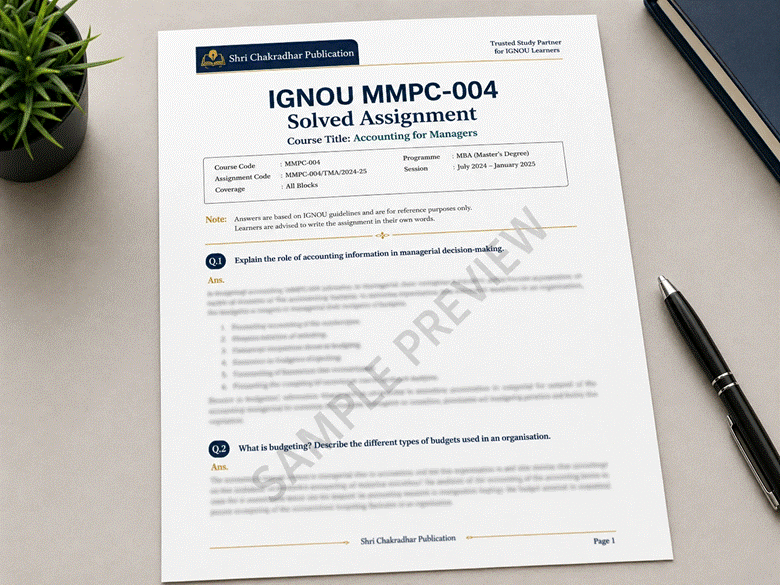
The IGNOU MMPC-004 solved assignment gives you complete, ready-to-submit answers to all five questions for the current session, written in the IGNOU format with proper working and presentation. Below you can see the exact questions and one fully-solved sample. Need other subjects too? See all our IGNOU solved assignments.
MMPC-004 Assignment Questions (January 2026 / July 2026)
These are the questions for the current MMPC-004 assignment session:
- Explain the fundamental accounting concepts that underpin the preparation of financial statements, with suitable examples for each.
- A factory manufacturing fans has the capacity to produce 500 fans per annum. The variable cost of a fan is Rs. 800 and it is sold for Rs. 1,000. Fixed overheads are Rs. 24,000 per annum. Calculate the break-even point for output and sales, and show the profit if output is 90% of capacity.
- Critically evaluate the concept of Zero-Based Budgeting, highlighting its key features, process, advantages and limitations.
- “Ratio analysis is a vital tool in financial statement analysis, used by stakeholders to assess a firm’s performance, liquidity, solvency and profitability.” Discuss this statement with suitable examples and interpretations.
- Define forensic accounting and explain its scope and significance in corporate governance and financial investigations. Illustrate your answer with an example of a real or hypothetical corporate fraud case where forensic accounting techniques are applied.
Free Solved Sample – Question 2 (Break-Even Analysis)
Here is one full model answer (Question 2) so you can judge the quality of the complete file. This is a numerical question, so the answer moves from concept to formula to working to interpretation.
Concept: The break-even point (BEP) is the level of output or sales at which total revenue exactly equals total cost — there is no profit and no loss. It is found using the contribution per unit, where contribution = selling price − variable cost.
Given: Selling price (SP) = Rs. 1,000 per fan; Variable cost (VC) = Rs. 800 per fan; Fixed overheads = Rs. 24,000 per annum; Capacity = 500 fans.
Step 1 – Contribution per unit
Contribution = SP − VC = 1,000 − 800 = Rs. 200 per fan.
Step 2 – P/V ratio
P/V ratio = (Contribution ÷ Sales) × 100 = (200 ÷ 1,000) × 100 = 20%.
Step 3 – Break-even point (output)
BEP (units) = Fixed cost ÷ Contribution per unit = 24,000 ÷ 200 = 120 fans.
Step 4 – Break-even point (sales)
BEP (sales) = Fixed cost ÷ P/V ratio = 24,000 ÷ 0.20 = Rs. 1,20,000 (i.e. 120 fans × Rs. 1,000).
Step 5 – Profit at 90% capacity
Output at 90% = 90% × 500 = 450 fans. Total contribution = 450 × 200 = Rs. 90,000. Profit = Contribution − Fixed cost = 90,000 − 24,000 = Rs. 66,000.
| Final answer: Break-even output = 120 fans • Break-even sales = Rs. 1,20,000 • Profit at 90% capacity (450 fans) = Rs. 66,000. |
Interpretation: The factory must make and sell 120 fans just to cover its costs. Every fan sold beyond 120 adds Rs. 200 of profit, which is why operating at 90% capacity produces a healthy Rs. 66,000 profit. This is the standard format and depth used for all numerical answers in the full file.

This is 1 of 5 questions. The remaining four answers — accounting concepts, Zero-Based Budgeting, ratio analysis, and forensic accounting — are in the complete solved assignment.
How the Theory Answers Are Written (preview)
MMPC-004 also has theory questions. Here is how a theory answer opens and is structured, using Question 1 (accounting concepts) as the example. This is a preview of the opening and the answer plan, not the full essay.
Sample opening: “Accounting concepts are the basic assumptions and rules on which the entire process of recording and reporting business transactions rests. Before any financial statement can be prepared, the accountant must accept a set of agreed ideas — such as treating the business as separate from its owner, recording only transactions that can be measured in money, and assuming the business will continue to operate. These shared concepts make financial statements consistent, comparable and reliable…”
The full answer then defines and illustrates each concept in turn:
- Business Entity, Money Measurement and Going Concern concepts — with a one-line business example for each.
- Cost, Dual Aspect, Accounting Period and Matching concepts — explained with a simple transaction.
- Realisation, Accrual, Conservatism, Consistency and Materiality conventions — each linked to how it affects the final statements.
- A short conclusion linking the concepts back to reliable, comparable financial statements.
Last Date & Marks Weightage
Assignment last date: 31st May for the June 2026 TEE & 31st October for the December 2026 TEE.
Marks weightage: the assignment typically carries 30% and the Term-End Examination 70% of the course result. Submit before the deadline to keep your TEE registration valid.
How to Get the Full MMPC-004 Solved Assignment
| Get the full IGNOU MMPC-004 solved assignment (January 2026 / July 2026) — all 5 answers, IGNOU format, ready to submit, for ₹19. Order on WhatsApp +91 93546 37830 → |
IGNOU MMPC-004 Handwritten Assignment
Prefer to submit a handwritten copy? The IGNOU MMPC-004 handwritten assignment contains the same complete answers, neatly written by hand on ruled sheets and couriered to you, submission-ready. New to this? Read our step-by-step handwritten assignment guide before you begin.
Free Guide: How to Present Your Handwritten Assignment
Presentation carries marks. Follow these free tips whether you write it yourself or order it:
- Use a plain A4 sheet for the cover page and write your name, enrolment number, programme (MBA), course code (MMPC-004), course title (Accounting for Managers), study centre, and session clearly.
- Start each answer on a fresh page, write the question number and the full question, then your answer.
- For numerical answers (like break-even and ratios), show every step and box the final answer — examiners reward clear working.
- Leave a left margin, keep neat spacing, and underline headings and key terms.
- Number all pages and pin or staple them in question order.
Always attach the correct cover sheet — use the IGNOU assignment front page format so your submission is accepted without query.
Dispatch: the handwritten MMPC-004 assignment is dispatched to your postal address within 7 days of payment.
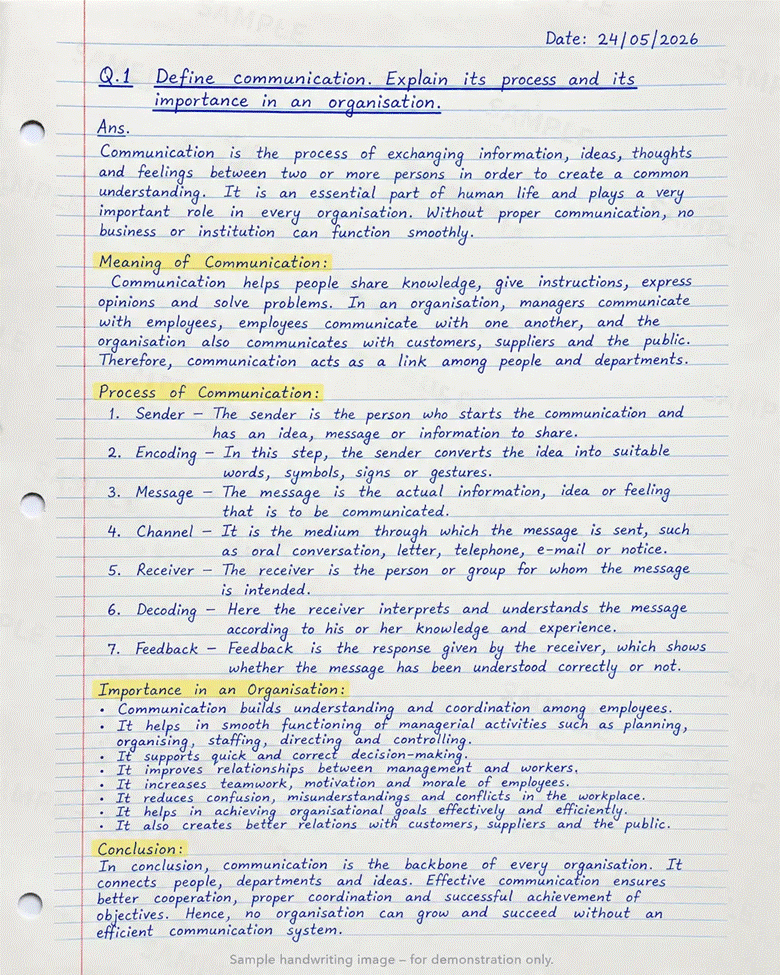
Sample handwriting image:
| Want it handwritten and submission-ready? Order the MMPC-004 handwritten assignment (₹320, 7-day dispatch) on WhatsApp. Order on WhatsApp +91 93546 37830 → |
IGNOU MMPC-004 Help Book, Study Guide & Notes
The IGNOU MMPC-004 help book are exam-focused, unit-wise revision material covering all 16 units — ideal when you don’t have time to read the full IGNOU blocks before the exam. Browse more IGNOU study notes for your other MBA papers.
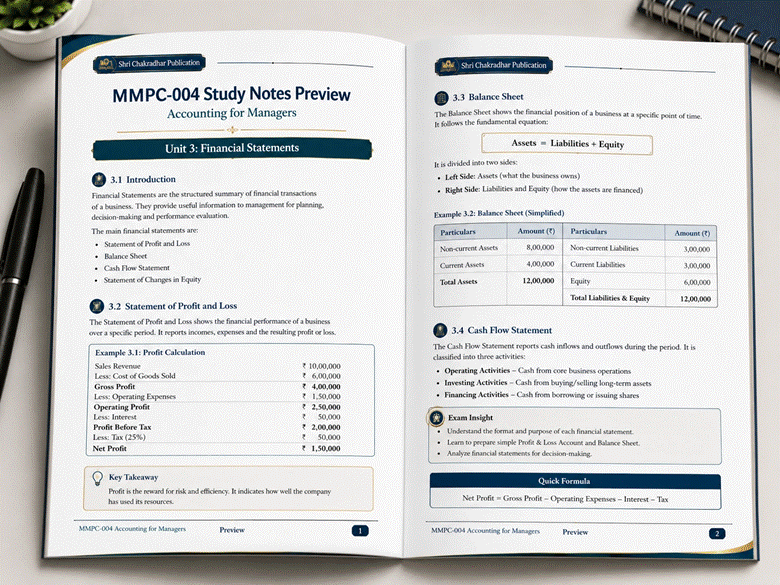
Free Unit Summary – Unit 7: Absorption and Marginal Costing
Here is one complete unit revision note so you can see the depth of the full notes.
What it is: Absorption costing and marginal costing are two ways of charging cost to a product. Under absorption costing, both fixed and variable manufacturing costs are absorbed into product cost. Under marginal costing, only variable cost is treated as product cost, while fixed cost is treated as a period cost and written off against contribution.
Key formulas: Contribution = Sales − Variable cost. Profit (marginal costing) = Contribution − Fixed cost. P/V ratio = (Contribution ÷ Sales) × 100.
Example: If selling price is Rs. 1,000 and variable cost is Rs. 800, contribution is Rs. 200 per unit and the P/V ratio is 20%. This same contribution figure is what drives break-even and profit calculations (see Question 2 above).
Quick comparison:
| Basis | Absorption Costing | Marginal Costing |
| Fixed cost | Charged to products | Treated as period cost |
| Stock valuation | Variable + fixed cost | Variable cost only |
| Main use | External financial reporting | Internal decisions (CVP, pricing) |
Limitation: Marginal costing can understate inventory value because fixed costs are excluded, while absorption costing can distort reported profit when stock levels change between periods.
Exam tip: Expect a numerical asking for contribution, P/V ratio, BEP, or a profit statement under both methods — always present the answer in a clear statement format.
This is 1 of 16 units. The full help book include all 16 unit summaries, 20 high-probability Q&As per unit, key definitions, quick-revision capsules, self-tests, a final exam checklist, and 3 fully solved question papers.
You can also download IGNOU books for related MBA subjects.
| Get the full MMPC-004 Help Book (₹99) on WhatsApp. Order on WhatsApp +91 93546 37830 → Prefer a printed book? Buy the MMPC-004 / MBA book from Shri Chakradhar Publication → |
IGNOU MMPC-004 Solved Guess Paper
The IGNOU MMPC-004 solved guess paper lists the most important and frequently-asked questions for the Term-End Examination, with model answers — so you revise the high-probability topics first. Want other subjects too? Browse all our IGNOU guess papers.
Important and expected questions (based on the syllabus and past exam trends):
- Explain the fundamental accounting concepts and conventions with examples.
- What are the objectives and limitations of financial statements?
- Distinguish between cash basis and accrual basis of accounting.
- Prepare a Cash Flow Statement and explain its importance.
- Explain the classification of costs with examples.
- Differentiate between absorption costing and marginal costing.
- What is Activity-Based Costing? Explain its steps and benefits.
- Explain Cost-Volume-Profit analysis and the break-even point (with a numerical).
- Critically evaluate Zero-Based Budgeting — features, advantages and limitations.
- Distinguish between fixed and flexible budgets.
- Explain variance analysis and compute material / labour variances.
- Classify accounting ratios and give formulas with interpretation.
- Prepare a common-size / comparative statement and interpret it.
- Explain the key components of an annual report.
- What is Human Resource Accounting? Explain its objectives and methods.
- Define forensic accounting and explain its scope and techniques.
Free Mini-Solutions (2 important questions)
Q. Distinguish between absorption costing and marginal costing.
Model answer (short form):
| Point | Absorption Costing | Marginal Costing |
| Treatment of fixed cost | Included in product cost | Charged to P&L as period cost |
| Profit measurement | Affected by changes in stock | Moves directly with sales |
| Best used for | Statutory / external reporting | Managerial decision-making |
Q. List the fundamental accounting concepts.
Model answer (short form): Business Entity (business is separate from owner), Money Measurement (only money-measurable items are recorded), Going Concern (the business will continue), Cost (assets recorded at cost), Dual Aspect (every transaction has two effects), Accounting Period, Matching (match expenses to revenue), Realisation, Accrual, and Conservatism (anticipate losses, not gains).
These are 2 of the 30 questions. Full model answers to all 30 expected questions are in the complete solved guess paper.
| Revise smart — get the full MMPC-004 solved guess paper (30 questions with answers, ₹49) on WhatsApp. Order on WhatsApp +91 93546 37830 → |
IGNOU MMPC-004 Solved PYQs (Previous Year Question Papers)
Solving previous year question papers is the fastest way to understand the MMPC-004 exam pattern. We provide year-wise solved PYQs with full working. Explore more IGNOU solved question papers across subjects.
Available years: the latest 10 MMPC-004 papers, including recent sessions such as December 2025, June 2025 and December 2024.
Free Solved PYQ Sample (Ratio Analysis)
Here is one real exam-style question solved in full, so you can see how PYQ answers are presented.
Question: From the following information, calculate (a) the Current Ratio and (b) the Quick Ratio: Current Assets Rs. 4,00,000; Inventory Rs. 1,00,000; Prepaid Expenses Rs. 20,000; Current Liabilities Rs. 2,00,000.
Step 1 – Current Ratio
Current Ratio = Current Assets ÷ Current Liabilities = 4,00,000 ÷ 2,00,000 = 2 : 1.
Step 2 – Quick (liquid) assets
Quick assets = Current Assets − Inventory − Prepaid Expenses = 4,00,000 − 1,00,000 − 20,000 = Rs. 2,80,000.
Step 3 – Quick Ratio
Quick Ratio = Quick Assets ÷ Current Liabilities = 2,80,000 ÷ 2,00,000 = 1.4 : 1.
| Final answer: Current Ratio = 2 : 1 • Quick Ratio = 1.4 : 1. |
Interpretation: A current ratio of 2 : 1 meets the standard benchmark, and a quick ratio of 1.4 : 1 (well above 1 : 1) shows the firm can meet its short-term liabilities even without selling inventory — a healthy liquidity position.
This is 1 sample question. The full set covers all questions from up to the latest 10 papers, each solved year-wise.
| Get all solved MMPC-004 previous year papers (₹39 per paper) on WhatsApp. Order on WhatsApp +91 93546 37830 → |
MMPC-004 Exam Pattern & Preparation Tips
MMPC-004 is assessed through an assignment and a written Term-End Examination. The paper mixes theory and numerical questions, so a balanced strategy works best.
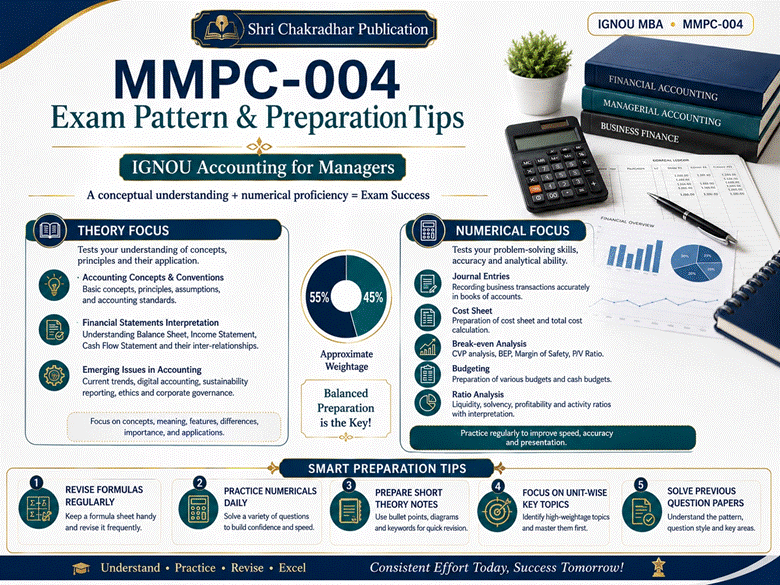
What carries marks:
- Numerical units — Break-even / CVP analysis, ratio analysis, variance analysis, budgeting, cash flow statements, and final accounts. Practice these with full working.
- Theory units — Accounting concepts, types of costing, annual reports, Human Resource Accounting, and forensic accounting. These reward clear definitions and examples.
Preparation tips:
- Memorise key formulas (contribution, P/V ratio, BEP, current and quick ratios) on a single revision sheet.
- Practice at least two numerical problems per costing and ratio topic until the format becomes automatic.
- For theory, prepare comparison-type answers (e.g., absorption vs marginal, fixed vs flexible budget) — they are common and quick to score.
- Solve previous year papers under timed conditions to manage the three-hour exam.
- Always show working and box final answers — examiners award step marks even when the final figure is wrong.
How to Order MMPC-004 Solutions
Ordering is simple: message us on WhatsApp (+91 93546 37830) with your subject code (MMPC-004) and the service you need. We confirm the price and delivery time, you pay, and we send your file (or courier the handwritten copy). Not sure how to submit? Here’s the online and offline assignment submission process. Support: Mon–Sat, 9 AM – 6 PM.
Frequently Asked Questions
Is the MMPC-004 solved assignment available for the January 2026 / July 2026 session?
Yes. The MMPC-004 solved assignment covers the current January 2026 / July 2026 session questions and is delivered ready to submit in the IGNOU format. Always cross-check the question paper on the Samarth portal before submitting, in case your study centre lists a different set.
What is the MMPC-004 assignment last date?
The last date depends on whether you are appearing in the June or December Term-End Examination. 31st May for the June 2026 TEE & 31st October for the December 2026 TEE. Submit early so any re-upload or correction is possible before the deadline.
How many marks is the MMPC-004 assignment?
The assignment generally carries 30% of the course result, with the Term-End Examination carrying 70%. A good assignment score gives you a useful cushion before the written exam.
Is MMPC-004 numerical or theory?
It is a mix of both. Blocks II and III (cost accounting, CVP, budgeting, variance) and ratio analysis are numerical, while accounting concepts, annual reports, Human Resource Accounting and forensic accounting are theory. Prepare both to score well.
Is MMPC-004 available as a handwritten assignment?
Yes. We provide a neatly handwritten, submission-ready copy of the full MMPC-004 assignment, dispatched to your postal address within 7 days of payment for ₹320.
Are the MMPC-004 Help Book enough to pass?
The guide book are designed for focused revision: all 16 unit summaries, 20 high-probability Q&As per unit, key formulas, quick-revision capsules and 3 fully solved papers. Combined with practising numericals and PYQs, they are strong preparation, but you should still read the official IGNOU MMPC-004 blocks for depth.
In which programme and semester is MMPC-004 taught?
MMPC-004 (Accounting for Managers) is a 4-credit core paper in Semester 1 of the IGNOU MBA programme.
After submitting, you can track your marks on the IGNOU assignment result page.
Conclusion & Related MBA Subjects
IGNOU MMPC-004 (Accounting for Managers) rewards students who balance numerical practice with clear theory. Use the free samples on this page to judge the quality, revise the high-probability guess-paper topics, and practise the PYQs under timed conditions — then order whichever services save you the most time.
Related IGNOU MBA subjects:
- IGNOU MBA 1st Semester Books 2026: Complete Guide for MMPC-001 to MMPC-007
- IGNOU MBA Project Report (MMPP-001) Guide & Format Tips
| Ready to save time on MMPC-004? Order your solved assignment, help book, guess paper or PYQs now on WhatsApp. Order on WhatsApp +91 93546 37830 → |

BK Sahni iD 0009-0005-8092-459X
Founder, Shri Chakradhar Publication Pvt. Ltd. & ignouproject.com — helping IGNOU distance-learning students since 2010 (5,00,000+ students supported across MBA, MCom, MA & more). Author of IGNOU exam guides, solved assignments & project reference books.
Disclosure: Shri Chakradhar Publication Pvt. Ltd. and ignouproject.com are independent third-party study-help services — not the official IGNOU website. Always verify final dates and rules on ignou.ac.in.