| What this page gives you: This page covers all five IGNOU MMPC-006 (Marketing Management) study-help services for MBA Semester 1: solved assignment, handwritten assignment, notes/book, solved guess paper, and solved PYQs — all ordered on WhatsApp in minutes. Scroll down for a free solved sample under every section. The paid file gives the complete, submission-ready version. |
| Free Sample Available: Get a free solved answer for MMPC-006 Question 1 — message on WhatsApp +91 93546 37830 and ask for the free MMPC-006 sample. |
| Disclaimer: ignouproject.com is not the official IGNOU website. This page is a student-guidance and study-help resource only. Always verify exam dates, assignment last dates, and official notices on the official IGNOU website and the Samarth student portal before relying on them. |
IGNOU MMPC-006 Overview (Marketing Management)
MMPC-006 is a 4-credit core course in the IGNOU MBA programme (Semester 1). It builds a solid foundation in marketing concepts, consumer behaviour, the marketing mix, and contemporary marketing applications — all essential for the Term-End Examination and for professional practice. A clear grounding in this subject also supports several subsequent MBA electives. New to the process? The complete IGNOU assignment guide explains how assignments fit into your overall MBA evaluation.
MMPC-006 Course Details
| Field | Detail |
| Subject Code | MMPC-006 |
| Subject Name | Marketing Management |
| Programme | Master of Business Administration (MBA) |
| Semester | Semester 1 (First Year) |
| Credits | 4 Credits |
| Assignment Sessions | Jan 2026 / July 2026 |
| Assignment Last Date | 31 May 2026 (for June TEE) | 31 Oct 2026 (for Dec TEE) |
| Marks Weightage | 30% Assignment + 70% Term-End Examination (TEE) |
| Type of Questions | Primarily theory-based (case-based application and analytical) |
MMPC-006 Syllabus & Units Covered
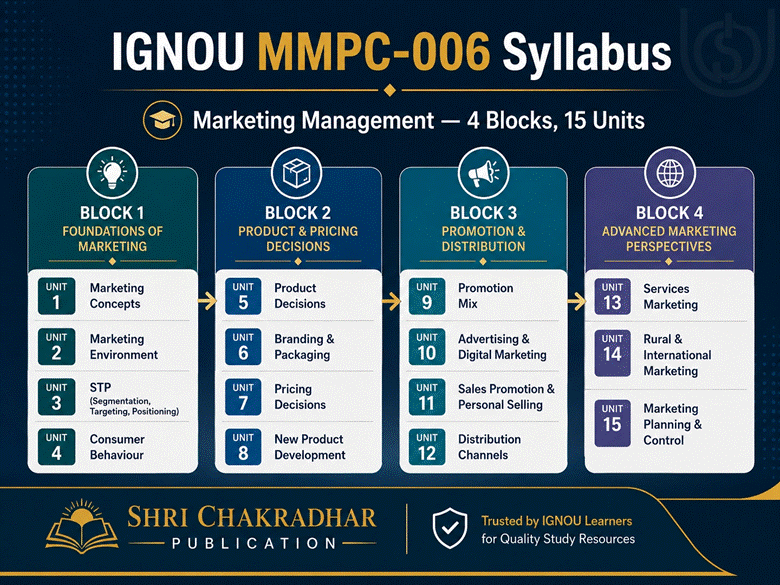
MMPC-006 is divided into four blocks containing fifteen units:
| Block | Block Title | Unit | Unit Title |
| Block I | Introduction to Marketing and Markets | Unit 1 | Marketing: An Overview |
| Unit 2 | Marketing Environment Analysis | ||
| Unit 3 | Market Segmentation, Targeting and Positioning | ||
| Unit 4 | Consumer Behaviour | ||
| Block II | Product and Pricing Decisions | Unit 5 | Product Decisions |
| Unit 6 | Branding and Packaging Decisions | ||
| Unit 7 | Product Life Cycle (PLC) and New Product Development (NPD) | ||
| Unit 8 | Pricing Decisions | ||
| Block III | Distribution and Promotion Decisions | Unit 9 | Integrated Marketing Communication |
| Unit 10 | Advertising and Sales Promotion | ||
| Unit 11 | Personal Selling and Managing Sales Personnel | ||
| Unit 12 | Distribution Management | ||
| Block IV | Sectoral Applications and Emerging Issues | Unit 13 | Marketing of Services |
| Unit 14 | Digital Marketing | ||
| Unit 15 | Other Emerging Issues in Marketing |
IGNOU MMPC-006 Solved Assignment 2026
The MMPC-006 solved assignment for the Jan 2026 / July 2026 session consists of five questions covering market segmentation, the marketing mix, branding, service pricing, and short notes. The complete solved file is formatted to IGNOU’s submission standards and is ready to copy or print. Need other subjects? Browse all the IGNOU solved assignments.
MMPC-006 Assignment Questions (Jan 2026 / July 2026 Session)
- “Market segmentation is important for target markets and target markets are important for product positioning.” Select two products — one each from FMCG and consumer durables of your choice — and discuss the above statement.
- Do you think that Indian marketers are giving the required attention to serve the bottom of the pyramid and try to develop marketing strategies for people with lesser purchasing power? Discuss with a suitable example of your choice.
- Identify the basic factors that prompt a company to brand its products. Select any well-advertised brand of your choice and define the personality of that brand.
- What makes pricing of services a challenging task for marketers? Identify any two service offerings of your choice and propose how to overcome these challenges.
- Write short notes on: (a) Integrated Marketing Communication (b) Digital Marketing (c) Factors determining choice of channels of distribution (d) Marketing Mix at Different Stages of Product Life Cycle (PLC)
Free Solved Sample – Question 1 (Market Segmentation, Targeting & Positioning)
| Free Sample: Opening Paragraph + Answer Structure (1 of 5 questions — the remaining four complete answers are in the paid file) |
Sample Opening Paragraph (model-quality, ready to study from):
| Market segmentation is the process of dividing a broad, heterogeneous market into distinct subgroups — segments — whose members share similar needs, characteristics, or behavioural patterns and who are likely to respond in comparable ways to a given marketing programme. Once meaningful segments are identified, a marketer selects one or more as target markets and concentrates resources accordingly. The third and final step — positioning — involves crafting a distinct, valued place for the product in the target customer’s mind relative to competing offerings. This three-step chain (STP: Segmentation → Targeting → Positioning) is sequential and interdependent: without segmentation, targeting is arbitrary; without a defined target, positioning lacks direction. Two products — Dove soap (FMCG) and Samsung Family Hub refrigerators (consumer durables) — illustrate how this chain drives marketing strategy. |
Full Answer Structure (what the complete paid answer covers — 5 sections):
- Concept of Market Segmentation — definition, importance, and the four major bases (demographic, geographic, psychographic, and behavioural) with marketing-relevant examples.
- Dove Soap (FMCG) — STP analysis: how Unilever segments the soap market by gender, skin-type, and lifestyle; why it targets women aged 18–45 who value skin care over hygiene alone; and how ‘Real Beauty’ positions Dove against cosmetic-brand competitors.
- Samsung Family Hub Refrigerators (Consumer Durables) — STP analysis: segmentation by income, household size, and technology-adoption lifestyle; targeting of urban upper-middle-class dual-income households; and positioning as a connected, smart-home appliance rather than a commodity white good.
- Comparative Linkage — a side-by-side table showing how segmentation criteria differ between FMCG and consumer durables, and why the STP logic still holds for both.
- Conclusion — how a sharply defined target market both enables precise positioning and makes the communication budget more efficient.
| Get the complete MMPC-006 solved assignment (all 5 answers, Jan 2026 / July 2026 session) — Order on WhatsApp +91 93546 37830 | Price: ₹19 |
How the Theory Answers Are Written (Structure Preview)
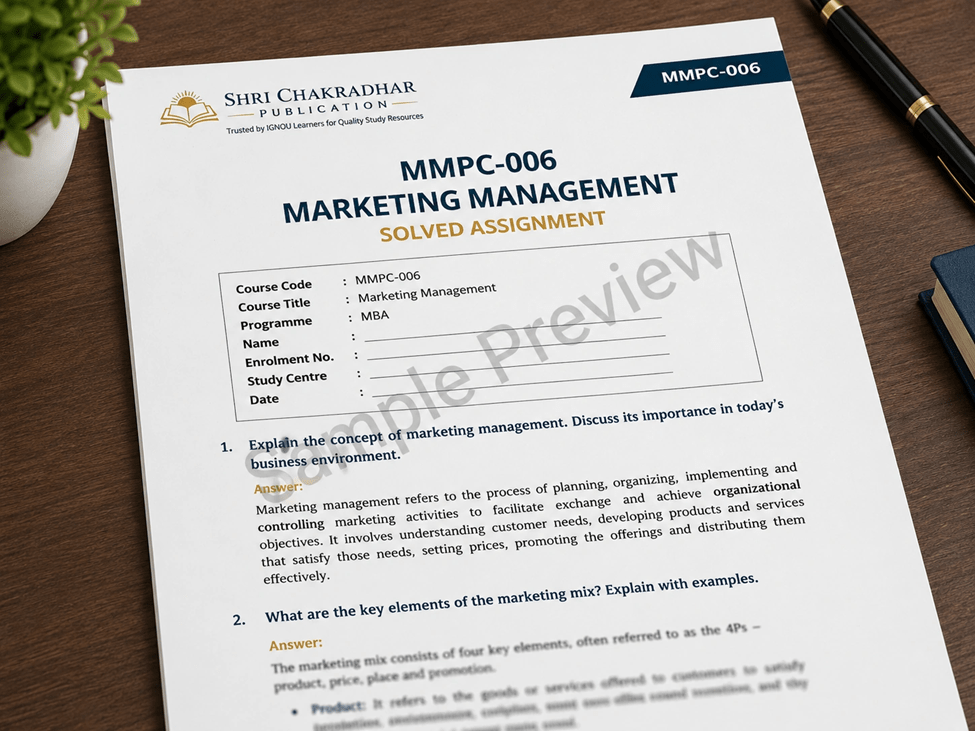
Every answer in the MMPC-006 solved file follows a four-part structure that IGNOU examiners reward:
- Definition & concept — a precise, textbook-aligned definition in the first 2–3 sentences.
- Explanation with examples — each theoretical point backed by a real Indian or global marketing example (companies students recognise).
- Analytical / application layer — how the concept links to a real marketing decision (consistent with question-specific instruction to ‘discuss with a suitable example of your choice’).
- Conclusion — a 3–4 sentence synthesis that restates the central argument clearly.
Short notes (Q5) follow a tighter structure: definition → 4–5 key points → one example → one exam-facing insight.
MMPC-006 Assignment Last Date & Marks Weightage
| Parameter | Detail |
| Last date — June TEE | 31 May 2026 |
| Last date — December TEE | 31 October 2026 |
| Assignment marks weightage | 30% of total marks |
| TEE marks weightage | 70% of total marks |
| Minimum pass marks | As per IGNOU norms |
Always confirm the latest dates on the official IGNOU website before submission.
How to Get the Full MMPC-006 Solved Assignment
- Message us on WhatsApp: +91 93546 37830
- Send your subject code: MMPC-006 and the session (Jan 2026 or July 2026).
- We confirm the price (₹19) and send the file within a few hours.
- Pay after confirmation. Submission-ready format — ready to copy and write.
| ➜ Get the full MMPC-006 Solved Assignment (Jan 2026 / July 2026) at ₹19 — Order on WhatsApp +91 93546 37830 |
IGNOU MMPC-006 Handwritten Assignment
A professionally handwritten MMPC-006 assignment is written by hand on A4 ruled paper and couriered to the student’s postal address — ready to submit directly to the study centre. New to this? Follow the step-by-step handwritten assignment guide to understand the full process.
Free Guide: How to Present Your MMPC-006 Handwritten Assignment
Even if you write the assignment yourself, these presentation rules will protect your marks:
- Use A4 ruled paper and write on one side only (or both sides as directed by your study centre).
- Leave a 1-inch margin on the left for examiner comments.
- Write the assignment code (MMPC-006), enrolment number, name, programme, and study centre code on the front page.
- Use a neat, readable script — do not use pencil or correcting fluid over key text.
- Number each question clearly before the answer (e.g., Q1, Q2…).
- Attach the front page in the correct format. Use the correct
- IGNOU assignment front page format — available at IGNOU assignment front page format PDF.
- Do not use decorative borders or coloured pages.
- Submit before the last date: 31 May 2026 (June TEE) or 31 October 2026 (Dec TEE).
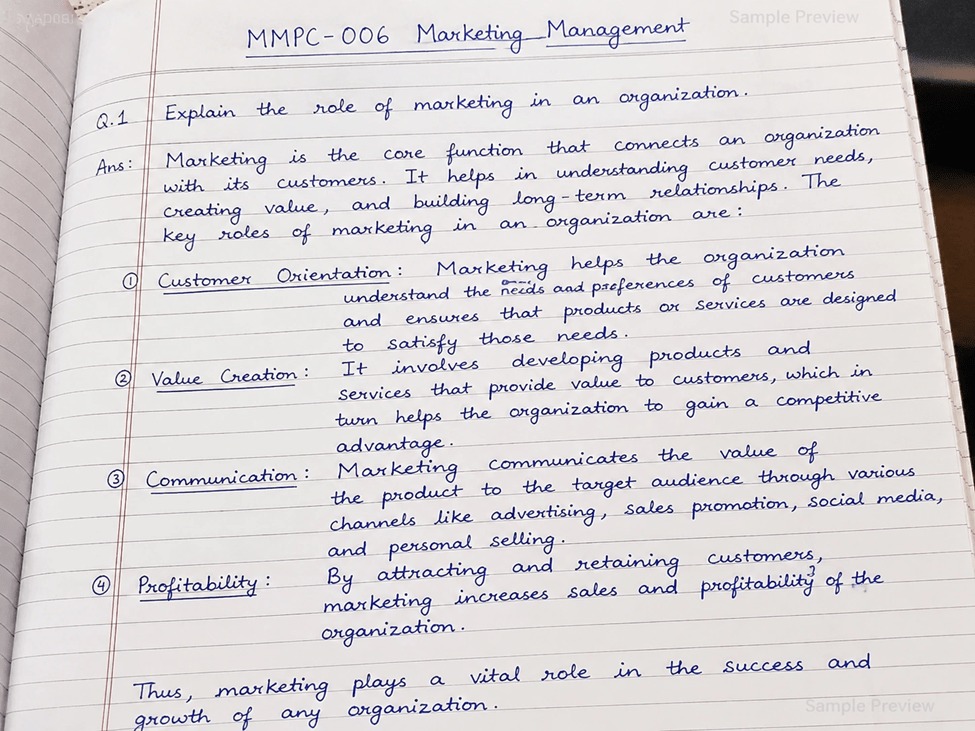
| Feature | Detail |
| Availability | Yes — available for MMPC-006 |
| Format | Handwritten on A4 ruled paper, all 5 questions answered |
| Dispatch time | Dispatched within 7 days of payment by courier to your postal address |
| Price | ₹320 |
| ➜ Want it handwritten and submission-ready? Order MMPC-006 handwritten assignment at ₹320 — Order on WhatsApp +91 93546 37830 |
IGNOU MMPC-006 Book, Study Guide & Notes
The MMPC-006 notes cover all 15 units across 4 blocks in an exam-focused format — unit-wise summaries, key definitions, tables, 20 high-probability Q&As per unit, and a final exam checklist. Browse more subject-wise study notes for your programme. You can also download official free study blocks from IGNOU’s eGyankosh study material.
What’s inside the MMPC-006 Notes/Book:
- 3 Fully Solved Question Papers (Dec 2025, Jun 2025, Dec 2024)
- Block-wise & Unit-wise Notes (all 15 units across 4 blocks)
- Unit-wise 20 High-Probability Q&As per unit
- Key Definitions, Tables & Quick Revision Capsules
- Self-Test Questions and Final Exam Checklist
- Printed book also available — see Shri Chakradhar Publication store
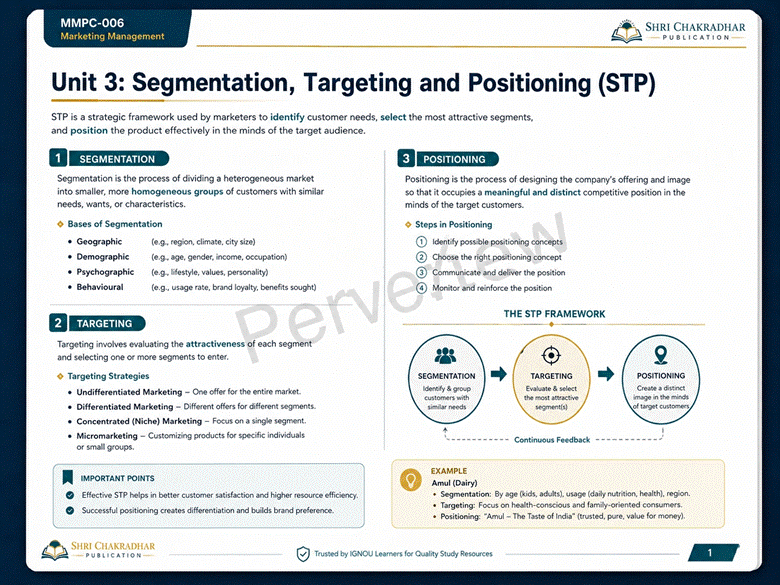
Free Unit Summary – Unit 3: Market Segmentation, Targeting and Positioning
| Free Sample: Complete Unit 3 Revision Note (1 of 15 units — the remaining 14 units with 20 Q&As each are in the paid notes) |
What is Market Segmentation? (Definition)
| Market segmentation is the process of dividing a heterogeneous market into homogeneous subgroups (segments) whose members share similar needs, characteristics, or responses to marketing stimuli — allowing the marketer to design offerings that match each group more precisely than a mass-market approach would. |
Why Does Segmentation Matter?
- Avoids the waste of a one-size-fits-all campaign.
- Allows resources to be focused on the most profitable customers.
- Enables the design of a precise marketing mix (product, price, place, promotion) for each chosen group.
- Provides a basis for competitive differentiation and sustainable positioning.
Bases (Criteria) for Market Segmentation
| Basis | Variables | Example (FMCG) |
| Demographic | Age, gender, income, education, family size | Dove targets women; Horlicks targets children |
| Geographic | Region, city size, climate, urban/rural | Woollen brands target north India; sunscreen brands push south/coastal |
| Psychographic | Lifestyle, personality, values, social class | Harley-Davidson targets ‘freedom seekers’; organic brands target health-conscious consumers |
| Behavioural | Usage rate, loyalty, occasion, benefits sought | Dabur Chyawanprash targets ‘immunity seekers’; airlines segment by frequent-flyer status |
Evaluating Segments — 4 Criteria:
- Measurability — can the size and purchasing power of the segment be measured?
- Accessibility — can the segment be reached and served effectively?
- Substantiality — is the segment large and profitable enough to justify a dedicated strategy?
- Actionability — can effective programmes be designed to attract and serve the segment?
Targeting Strategies
| Strategy | Description | When to Use |
| Undifferentiated (mass) | One offer for the whole market; ignores differences | Commodity markets — salt, sugar, basic utilities |
| Differentiated | Separate offers for multiple segments | Established brands with large budgets — HUL, P&G |
| Concentrated (niche) | One offer focused on one segment | Start-ups or niche players — organic baby food, luxury pens |
| Micro-marketing | Local or individual-level customisation | Personalised online recommendations, hyperlocal food delivery |
Positioning: Creating a Distinct Place in the Customer’s Mind
Positioning is the act of designing the company’s offering and image to occupy a distinctive place in the minds of the target market. A strong position answers: ‘Why should the target customer prefer this product over competing alternatives?’
- Positioning map: a two-axis diagram that plots competing brands on attributes important to the target segment (e.g., price vs. quality, tradition vs. innovation).
- Unique Selling Proposition (USP): the single most compelling reason to buy — e.g., Volvo = safety; Domino’s = 30-minute delivery (historically).
- Repositioning: changing a brand’s existing position — e.g., Tata Motors repositioning from ‘cheap’ to ‘aspirational’ in some segments.
| Exam Tip for Unit 3 STP questions appear almost every session. Always define all three steps (Segmentation → Targeting → Positioning) before applying them to the given product/scenario. Use a table or numbered list structure — examiners reward clarity. A positioning map drawn (even roughly) earns extra credit in the answer book. |
| Service | Detail |
| Notes price | ₹99 (WhatsApp) |
| Printed book | Available — contact WhatsApp for current price and delivery |
Get the full MMPC-006 notes on WhatsApp → https://wa.me/919354637830 | Download IGNOU books for related subjects →
IGNOU MMPC-006 Solved Guess Paper
The MMPC-006 solved guess paper is a curated list of 30 high-probability questions — drawn from PYQ patterns, recent assignment trends, and the full 15-unit syllabus — with model answers for each. Want other subjects too? Browse more IGNOU guess papers for all programmes.
30 Important / Expected Questions for MMPC-006 (Based on Syllabus & PYQ Patterns)
Block I — Introduction to Marketing and Markets
- Define marketing. Explain the core concepts of marketing and how the marketing concept has evolved from a production orientation to a societal orientation.
- Describe the components of the marketing environment. How do micro-environmental and macro-environmental factors affect marketing decisions?
- Explain market segmentation with reference to its bases. Discuss how segmentation, targeting, and positioning are interrelated. Illustrate with an example.
- Describe the consumer decision-making process. What are the factors — cultural, social, personal, and psychological — that influence consumer buying behaviour?
- What is a marketing information system (MIS)? How does it support marketing decision-making?
- Explain the concept of competitive advantage in marketing. How can a firm sustain competitive advantage in a dynamic market?
- Describe the concept of bottom-of-the-pyramid (BOP) marketing. How are Indian firms designing strategies for lower-income consumers?
Block II — Product and Pricing Decisions
- What is a product? Explain the three levels of a product — core benefit, actual product, and augmented product — with examples.
- Explain the product mix decisions a marketing manager must take. What is product line stretching?
- What is branding? Explain the key factors that motivate a company to brand its products. Describe the elements of a brand with an example.
- What is brand equity? Explain its components and describe how a company builds and sustains strong brand equity.
- What is packaging? Explain the functions and importance of packaging in modern marketing.
- Explain the concept of Product Life Cycle (PLC). Describe the marketing strategies appropriate at each of the four stages.
- Describe the new product development (NPD) process. What are the common causes of new product failure?
- Explain the major pricing objectives and the factors that affect pricing decisions. Describe at least four pricing strategies.
Block III — Distribution and Promotion Decisions
- What is Integrated Marketing Communication (IMC)? Explain its elements and the rationale for an integrated approach.
- Explain the advertising decision process. What are the different types of advertising appeals and advertising media?
- What is sales promotion? Explain the consumer-oriented and trade-oriented tools of sales promotion.
- Explain the role and importance of personal selling. Describe the stages in the personal selling process.
- What is a distribution channel? Explain the factors that determine the choice of distribution channels.
- Distinguish between intensive, selective, and exclusive distribution. Give examples of each.
- What is supply chain management? How does it relate to physical distribution and logistics?
- Explain the push and pull promotional strategies with examples. When should each be used?
Block IV — Sectoral Applications and Emerging Issues
- Explain the unique characteristics of services (intangibility, inseparability, heterogeneity, perishability) and describe the extended services marketing mix (7Ps).
- What are the specific challenges in pricing services? How can marketers overcome these challenges?
- Explain the concept of digital marketing. Describe its major tools (SEO, SEM, social media, email, content marketing) and advantages.
- What is social media marketing? How do companies measure the effectiveness of their social media campaigns?
- Explain green marketing / sustainable marketing. Why is it gaining strategic importance for Indian companies?
- What is cause-related marketing (CRM)? How does it differ from corporate social responsibility (CSR)?
- Explain relationship marketing. How does it differ from transactional marketing, and why is it important in a competitive market?
- Discuss three emerging issues in marketing (e.g., experiential marketing, AI in marketing, hyperlocal marketing) with reference to the Indian context.
Free Mini-Solutions — 3 Important Questions
Free Answer 1 — What is IMC? (Q from guess paper list, short-note style)
| Integrated Marketing Communication (IMC) is a strategic approach that co-ordinates and integrates all marketing communication tools — advertising, sales promotion, personal selling, public relations, direct marketing, and digital media — into a seamless, consistent programme designed to maximise the communication impact on target customers. The core rationale is that a consumer receives brand messages from multiple channels simultaneously; if these messages are inconsistent, the brand image is diluted. IMC ensures a unified brand voice across every touch point. Key elements: (1) Advertising — mass-reach paid media; (2) Sales Promotion — short-term incentives (discounts, coupons, contests); (3) Personal Selling — direct human interaction for complex or high-value products; (4) PR / Publicity — earned media, credibility-building; (5) Direct Marketing — personalised communication (email, SMS, catalogues); (6) Digital / Social Media — interactive, two-way communication at scale. Exam Tip: Define → list elements → explain the ‘integration’ rationale → give one Indian example (e.g., Amul integrating outdoor, TV, and social media consistently). |
Free Answer 2 — What is Digital Marketing? (short note)
| Digital marketing refers to the use of digital channels and technologies — the internet, mobile devices, social media platforms, search engines, and email — to reach and engage consumers, build brand awareness, and drive sales. Unlike traditional marketing, digital marketing offers real-time performance measurement, precise targeting, and two-way interaction. Major tools: (1) Search Engine Optimisation (SEO) — organic visibility on Google; (2) Search Engine Marketing (SEM/PPC) — paid search ads; (3) Social Media Marketing — Facebook, Instagram, LinkedIn, YouTube; (4) Content Marketing — blogs, videos, podcasts that attract audiences; (5) Email Marketing — personalised direct communication; (6) Affiliate Marketing — third-party promotion for a commission. Exam Tip: Always mention the advantage of measurability (metrics: impressions, CTR, conversion rate, ROAS) — it differentiates digital marketing from traditional in exam answers. |
Free Answer 3 — Factors Determining Choice of Channels of Distribution (short note)
| The choice of a distribution channel is influenced by a combination of product, market, company, and competitive factors: Product factors: Perishable products (fresh produce) need short, direct channels; bulky or technical products may need specialised intermediaries.Market factors: If the target market is geographically dispersed and large in number, longer channels with wholesalers and retailers are more efficient.Company factors: Financial strength, control preference, and established relationships with intermediaries influence the depth and length of the chosen channel.Competitive factors: A firm may adopt channels already used by competitors (to maintain parity) or choose different channels to gain a distribution advantage.Environmental factors: Legal restrictions, economic conditions, and infrastructure availability (cold chains, logistics networks) constrain channel choices. Exam Tip: Structure your answer using the 4 headings above + one illustrative example (e.g., FMCG brands using 3-tier distribution: manufacturer → C&F agent → distributor → retailer). |
| ➜ Revise smart — get the full MMPC-006 solved guess paper (all 30 Q&As) at ₹49 — Order on WhatsApp +91 93546 37830 |
IGNOU MMPC-006 Solved PYQs (Previous Year Question Papers)
The MMPC-006 solved PYQ set includes the latest 10 previous year question papers with complete model answers — each solved in the exam-style format that matches IGNOU’s marking expectations. Explore more IGNOU solved question papers across subjects.
| Item | Detail |
| PYQ years available | Latest 10 PYQs (Dec 2025, Jun 2025, Dec 2024, Jun 2024 … and earlier) |
| Price | ₹39 per paper | Bundle pricing available — ask on WhatsApp |
| Format | Exam-style model answers, unit/block cross-referenced |
Free Solved PYQ Sample — Product Life Cycle & Marketing Strategy
| Exam-Style Question (representative MMPC-006 PYQ type): “Explain the concept of the Product Life Cycle (PLC). Describe the marketing strategies that are appropriate at each stage of the PLC, with examples.” (1 of 10 papers — the remaining papers with all answers are in the paid PYQ set) |
Model Answer — Product Life Cycle & Marketing Strategies
Concept of the Product Life Cycle
| The Product Life Cycle (PLC) is the progression of a product through four stages — Introduction, Growth, Maturity, and Decline — from its launch in the market to its eventual withdrawal. The PLC concept, popularised by Theodore Levitt (1965), helps marketers anticipate changes in sales, competition, and profitability, and adjust the marketing mix at each stage accordingly. Sales and profit curves follow an S-shaped and bell-shaped pattern respectively across the four stages. |
The Four Stages and Their Marketing Strategies:
| Stage | Characteristics | Marketing Objective | Key Strategies |
| Introduction | Low sales, high costs, little competition, product losses or low profit | Create awareness and trial | Skimming pricing (for tech) or penetration pricing (FMCG); selective distribution; heavy advertising for awareness; free samples and trials |
| Growth | Rapidly rising sales, growing profits, increasing competition, new entrants | Maximise market share | Reduce price slightly to attract broader market; intensive distribution; shift advertising from awareness to preference; add product features/variants |
| Maturity | Peak sales, declining profit margins, intense competition, market saturation | Maximise profit while defending market share | Competitive pricing / price cuts; wider distribution; advertising emphasises brand differentiation; heavy sales promotion; modify product, market or marketing mix |
| Decline | Falling sales and profits, shrinking market, withdrawal of weak competitors | Reduce expenditure and milk the brand | Cut prices; selective distribution; minimal advertising; decide to maintain, harvest, or drop the product |
Examples:
- Introduction stage: Electric vehicles (EVs) in India — high initial price (skimming), selective city-level dealerships, awareness campaigns about range and savings.
- Growth stage: Smartphones in India (2012–2018) — aggressive price cuts, nationwide retail and online distribution, advertising shifting from ‘what is a smartphone?’ to ‘why our brand?’.
- Maturity stage: Traditional cola beverages — intense price competition, heavy promotions (buy-one-get-one, IPL sponsorships), product line extensions (diet, zero-sugar variants).
- Decline stage: Physical DVDs/CDs — harvested by a few manufacturers; most withdrew as streaming made the format obsolete.
Conclusion:
| The PLC is a diagnostic tool, not a deterministic law. Not every product follows the classic S-curve — some skip stages, some enjoy an extended maturity through repositioning (e.g., Maggi’s rapid recovery after the 2015 recall), and technology disruptions can compress an entire cycle. The real managerial value of the PLC is in prompting marketers to ask: ‘Where is my product now, and what does that stage demand from the marketing mix?’ |
| ➜ Get all 10 MMPC-006 solved previous year question papers at ₹39/paper — Order on WhatsApp +91 93546 37830 |
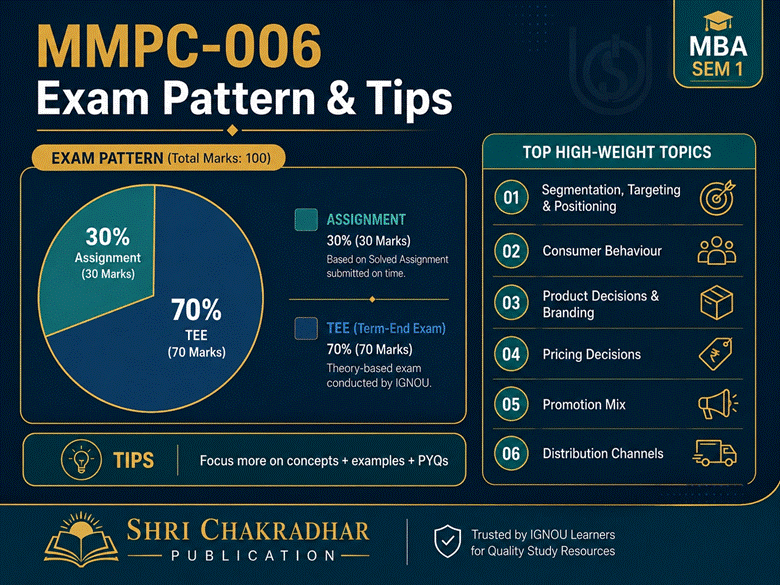
MMPC-006 Exam Pattern & Preparation Tips
| Parameter | Detail |
| Exam type | Theory — written descriptive answers |
| Question pattern | Long-form application questions (define + explain + example) + Short notes (5 marks each) |
| Duration | 3 hours |
| Total marks (TEE) | 70 marks (plus 30 marks from assignment) |
| Key high-weight topics | STP, Consumer Behaviour, PLC/NPD, IMC, Pricing of Services, Digital Marketing |
Preparation Tips for MMPC-006:
- Cover Block I (STP and Consumer Behaviour) first — these topics appear in almost every session.
- For every major concept, prepare: definition → explanation with 3–4 key points → one real Indian marketing example.
- Short notes (Q5-type) appear in most papers — practise IMC, Digital Marketing, PLC, and Channel factors as standalone 300-word answers.
- Use the PYQ set to identify recurring question patterns. Repeat questions across years are high-priority.
- For services marketing, memorise the 7Ps (4Ps + People, Process, Physical Evidence) — IGNOU examiners look for this extension.
- Revise Unit 14 (Digital Marketing) and Unit 15 (Emerging Issues) — these are increasingly tested and many students skip them.
- Write practice answers against a timer to build the habit of structured writing within 3 hours.
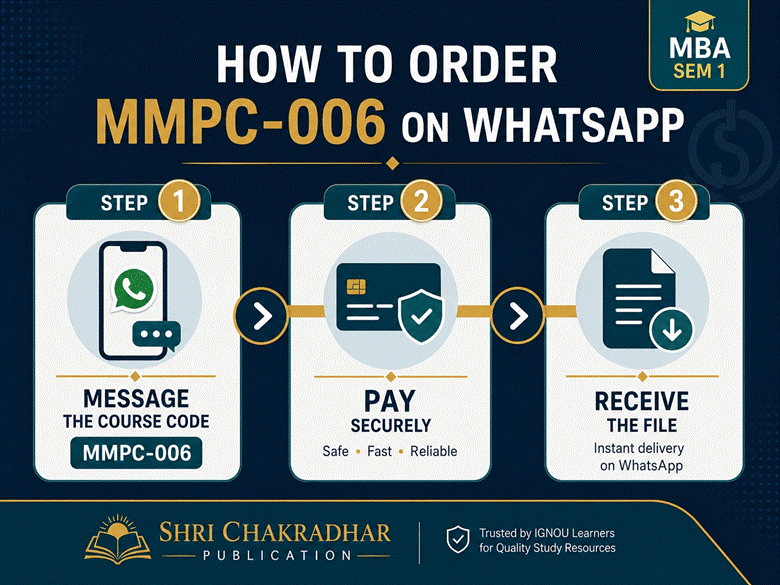
How to Order (MMPC-006 Solutions)
- Message on WhatsApp: +91 93546 37830
- Send your subject code (MMPC-006) and the service you need (assignment / handwritten / notes / guess paper / PYQ).
- We confirm the price and delivery time. Pay after confirmation.
- We send your file (or courier the handwritten copy to your address).
Support: Monday – Saturday, 9 AM – 6 PM.
Not sure how to submit your assignment once you have it? Here’s the online and offline assignment submission process explained step by step.
Frequently Asked Questions
Q1: Is the MMPC-006 solved assignment available for both the Jan 2026 and July 2026 sessions?
Yes. The MMPC-006 solved assignment is prepared for both the Jan 2026 and July 2026 sessions. The question paper is the same for both sessions in IGNOU MBA. Message on WhatsApp with your session to confirm and order.
Q2: What is the MMPC-006 assignment last date?
The assignment last date is 31 May 2026 for the June Term-End Examination and 31 October 2026 for the December TEE. Always confirm the exact date on the official IGNOU website before submission.
Q3: How many marks does the MMPC-006 assignment carry?
The MMPC-006 assignment carries 30% of the total marks for the subject. The remaining 70% comes from the Term-End Examination. Submitting a complete, well-written assignment is therefore essential to securing a good final grade.
Q4: Is MMPC-006 theory-based or does it include numerical questions?
MMPC-006 (Marketing Management) is primarily theory-based and application-oriented. Questions ask students to define concepts, explain frameworks, and illustrate with examples — there are no numerical calculations in the style of accounting or statistics. The 2026 assignment includes case-application questions that require analytical thinking combined with marketing theory.
Q5: Is a handwritten MMPC-006 assignment available, and how long does delivery take?
Yes — a handwritten MMPC-006 assignment is available. It is written by hand on A4 ruled paper and dispatched by courier to the student’s postal address within 7 days of payment. Price: ₹320. Contact WhatsApp +91 93546 37830 to order.
Q6: In which program and semester is MMPC-006 taught?
MMPC-006 (Marketing Management) is a 4-credit core course in the IGNOU Master of Business Administration (MBA) programme, Semester 1 (First Year). It is compulsory for all MBA students and forms the foundation for advanced marketing electives in later semesters.
After submitting your assignment, track your marks on the IGNOU assignment result page.
Conclusion — IGNOU MMPC-006 Study Help
MMPC-006 (Marketing Management) is one of the most application-rich subjects in the IGNOU MBA Semester 1. Mastering the STP framework, the marketing mix, consumer behaviour, and emerging marketing practices is essential not only for the Term-End Examination but for every subsequent MBA marketing elective. This page has provided syllabus details, all five 2026 assignment questions, a free solved sample for Question 1, a free Unit 3 revision note, a 30-question guess paper with three mini-solutions, and a fully solved PYQ sample on the Product Life Cycle.
For the complete solved assignment (₹19), handwritten assignment (₹320), full notes (₹99), solved guess paper (₹49), or any PYQ paper (₹39), message on WhatsApp +91 93546 37830.
| ➜ Order MMPC-006 solutions on WhatsApp now — +91 93546 37830 — Order on WhatsApp +91 93546 37830 |
Related IGNOU MBA Subjects (Semester 1):
- IGNOU MBA 1st Semester Books 2026: Complete Guide for MMPC-001 to MMPC-007
- IGNOU MBA Project Report (MMPP-001) Guide & Format Tips
- MMPC-004 — Accounting for Managerial Decisions

BK Sahni iD 0009-0005-8092-459X
Founder, Shri Chakradhar Publication Pvt. Ltd. & ignouproject.com — helping IGNOU distance-learning students since 2010 (5,00,000+ students supported across MBA, MCom, MA & more). Author of IGNOU exam guides, solved assignments & project reference books.
Disclosure: Shri Chakradhar Publication Pvt. Ltd. and ignouproject.com are independent third-party study-help services — not the official IGNOU website. Always verify final dates and rules on ignou.ac.in.