The IGNOU MSCZOO Project, course MZOP 001 (searched as MZOP 1), is the four-credit Dissertation in Semester IV of IGNOU’s M.Sc. Zoology. This guide follows the January 2025 Handbook stage by stage and adds IGNOU’s December 2026 OPMS upload rules.
MZOP 001 at a glance, from the 2025 Handbook
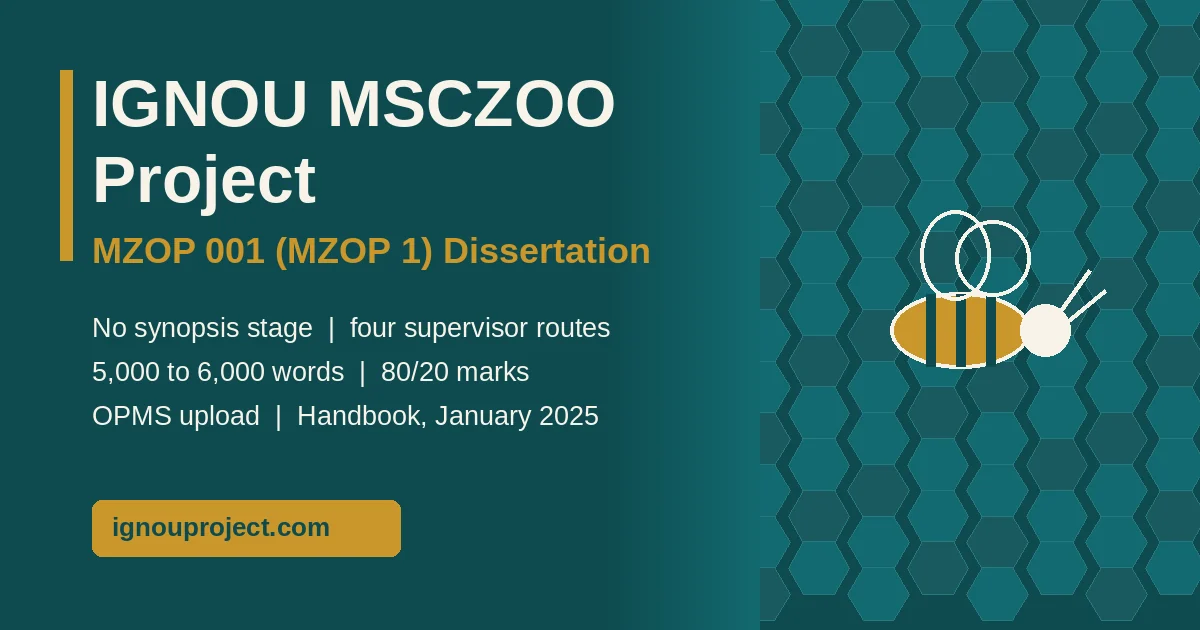
The IGNOU MSCZOO Project is MZOP 001, a 4-credit dissertation in Semester IV worth at least 120 hours of work. The January 2025 Handbook asks for no synopsis: your supervisor is approved through Annexures I and II, you do the research, and you write a 5,000 to 6,000 word report. For December 2026, IGNOU’s OPMS guidelines ask for one PDF upload, after the Rs 300 fee is paid on Samarth, by 30 November 2026. A viva follows, with the report worth 80 marks and the viva 20.
What the IGNOU MSCZOO Project is: MZOP 001, a four-credit dissertation with no synopsis stage
The IGNOU MSCZOO Project is the course MZOP-001, Dissertation/Project Work, placed in Semester IV of the M.Sc. Zoology programme. The Handbook that IGNOU’s Discipline of Life Sciences issued in January 2025 describes it as research in Zoology or any relevant branch of Life Sciences, worth 4 credits. One credit stands for 30 hours of study, so plan for at least 120 hours of your own work.
Three facts shape everything else on this page. The Handbook’s Important Highlights say there is no need to submit a synopsis. Your supervisor is approved through a consent letter and a bio-data form, which go in before the research starts. And the report runs to 5,000 to 6,000 words excluding references: short for a dissertation, so every paragraph has to carry its weight.
The work may begin in the third semester. The Handbook asks that it be completed within six months, and it names three things a project has to balance: time, scope and budget. Treat those three words as the frame for every decision about your topic and your fieldwork.
MZOP 001, MZOP-001, MZOP 1 and MZOP-01: one course, printed five ways
| Printed as | Where | What it tells you |
|---|---|---|
| MZOP-001 | Handbook title; eGyanKosh file MZOP-001.pdf | The form to use on your report and title page |
| MZOP 001 | Common Prospectus, July 2026, MSc Zoology tables | Same course, printed without the hyphen |
| MZOP-01 | Handbook, section 1.10, envelope line for the hard-copy route | A short form inside IGNOU’s own wording; not a different course |
| MZOP-0O1 | Launch Notification No. 127 (16 November 2023), scanned table | A scan or typing slip with a letter O; the course is MZOP-001 |
| Project/Dissertation | MSCZOO programme page, course list | IGNOU uses both words for one course |
MZOP 1 is how many learners type the code into a search box. It is the same course. Project or dissertation? IGNOU uses both words for MZOP 001: the Handbook is titled Handbook on Dissertation/Project Work, the programme page lists it as Project/Dissertation, and the Prospectus prints Dissertation. There is no second track with different rules.
एमएससी जूलॉजी प्रोजेक्ट: पाँच ज़रूरी बातें
- MZOP 001 चार क्रेडिट का डिज़र्टेशन है, जो एमएससी जूलॉजी के सेमेस्टर IV में आता है।
- इस कोर्स में सिनॉप्सिस जमा नहीं करनी होती। सुपरवाइज़र का सहमति पत्र (Annexure I) और बायो-डेटा (Annexure II) रीजनल सेंटर या स्टडी सेंटर में मंज़ूरी के लिए जाते हैं।
- रिपोर्ट रेफ़रेंस छोड़कर 5,000 से 6,000 शब्दों की हो, और समानता 10 प्रतिशत से अधिक न हो।
- दिसंबर 2026 के लिए पहले Samarth पर Rs 300 फ़ीस भरें, फिर OPMS पर एक PDF अपलोड करें। अंतिम तिथि 30 नवंबर 2026 है।
- 100 अंकों में रिपोर्ट के 80 और वाइवा के 20 अंक हैं, और पास होने के लिए 50 प्रतिशत चाहिए। हैंडबुक के अनुसार वाइवा आमने-सामने होता है।
Semester IV of the M.Sc. Zoology, and where MZOP 001 sits
The IGNOU MSCZOO Project is the one course in the 80-credit programme built around your own research. The Handbook counts 9 core courses, 6 electives, 4 lab courses and the dissertation, and says every course is worth 4 credits. IGNOU launched the M.Sc. Zoology for the January 2024 session (Academic Programme Launch Notification No. 127, dated 16 November 2023) as a semester-wise programme of two to four years.
| Semester | Courses |
|---|---|
| I and II | MZO 001 to MZO 005 (core); MZOE 001 Parasitology; MZOE 002 Animal Behaviour and Animal Welfare Ethics; MZOE 003 Aquaculture; MZOL 001 and MZOL 002 (lab) |
| III | MZO 006 Biostatistics and Bioinformatics; MZO 007 Principles of Ecology; MZO 008 Immunology; MZO 009 Research Methodology; MZOL 003 (lab) |
| IV | MZOE 004 Insect Taxonomy and Morphology; MZOE 005 Insect Physiology and Toxicology; MZOE 006 Applied Entomology; MZOL 004 Lab Course IV; MZOP 001 Dissertation (Project, 4 credits) |
Read the table with the project in mind. MZO 009 Research Methodology and MZO 006 Biostatistics and Bioinformatics arrive in Semester III, the same semester in which the Handbook lets you start; your methods chapter will lean on both. The Semester IV electives are all entomology, which is why the Handbook says the programme specialises in Entomology and why most of its suggested titles involve insects.
Under the MSc Zoology special features, the Prospectus adds one line: students have to do project work on any one topic of prescribed courses. The programme fee is Rs 20,000 a year, Rs 40,000 in all, paid semester-wise, with January and July admission sessions (Prospectus, p. 36). For the Programme Coordinators, Prof. Neera Kapoor and Dr. Siya Ram, the Prospectus gives msczo@ignou.ac.in and the numbers 011-29572810 and 011-29572842.
Papers IGNOU issues for the IGNOU MSc Zoology project
What learners call the IGNOU MSc Zoology project guidelines is one document: the MZOP-001 Handbook on Dissertation/Project Work, prepared by the Discipline of Life Sciences, School of Sciences, in January 2025. Its 17 printed pages hold the rules, the steps, the evaluation scheme and three annexures. The programme page says the details reach you in a Project Guide sent with the course material; the January 2025 Handbook is the edition we could read.
Seven things the MZOP-001 Handbook decides
- MZOP-001 carries 4 credits, at least 120 hours, in Semester IV; work may start in Semester III and must be completed within six months.
- No synopsis needs to be submitted. The supervisor’s consent letter (Annexure I) and bio-data (Annexure II) take its place.
- Four supervisor routes, (a) to (d), are printed in section 1.4.
- The report runs to 5,000 to 6,000 words excluding references, with references in APA style, limited to not more than 100.
- The plagiarism level should not exceed 10 per cent, and AI tools are to be avoided while drafting.
- The report carries 80 per cent and the viva 20 per cent; the pass mark is 50 per cent and the viva is face to face.
- A learner who fails repeats the whole cycle, with no separate slot.
Learners who search for an IGNOU MSc Zoology project guide mean one of two things: this Handbook, or a person to supervise them. The IGNOU MSCZOO Project needs both, and the next sections take them in turn.
| Document | Issued by | Use it for |
|---|---|---|
| Issued by IGNOU | ||
| MZOP-001 Handbook on Dissertation/Project Work, January 2025 (eGyanKosh handle 111367) | Discipline of Life Sciences, SOS | Every rule on supervisor, report, marks and viva |
| Annexure I, Consent Letter of Supervisor (Handbook p. 14) | IGNOU form | Your supervisor’s written consent, with the title |
| Annexure II, Bio-data of the supervisor (pp. 15 to 16) | IGNOU form | Approval of the supervisor at your RC or Study Centre |
| Annexure III, Certificate of Originality (p. 17) | IGNOU form | Signed by you and the supervisor, bound into the report |
| MSCZOO programme page | IGNOU | Course list, fee, the project note on collaboration |
| Common Prospectus, July 2026 (pp. 27, 36, 116 to 117) | IGNOU | Course table, programme fee, project fee slabs |
| OPMS guidelines for the December 2026 TEE | IGNOU, Student Evaluation Division | The upload route, file sizes and the 30 November 2026 date |
| Our study files, watermarked and never for upload | ||
| Sample synopsis study plan, 7 pages | ignouproject.com | Seeing how a plan for the supervisor can be laid out |
| Dissertation report format, 6 pages | ignouproject.com | Empty shells in the Handbook’s order, with a word budget |
The MZOP 01 PDF and our two study files
If you searched for the MZOP 01 PDF or an IGNOU MSc Zoology project PDF, the file IGNOU hosts on eGyanKosh is named MZOP-001.pdf, under handle 111367; its section 1.7 holds the 31 suggested titles. Our two files below are study reference only. Each page carries a diagonal watermark that says it is not for submission, and the report file holds empty tables, never results.
Watch the MZOP 001 walkthrough
The video is ours. Where it and this page differ, follow this page and the Handbook: the video’s description mentions an approved synopsis, and MZOP 001 has no synopsis stage.
Where the Handbook, the OPMS notice and the other IGNOU pages disagree
The IGNOU MSCZOO Project rests on papers written at different times for different purposes, and they do not always match. The table sets out each clash, what each paper prints, and the line this page follows. Where the choice is yours, ask your Regional Centre and keep the reply.
| Question | One paper prints | Another prints | Line this page follows |
|---|---|---|---|
| Is there a synopsis? | Handbook, Important Highlights: no need to submit a synopsis of the project | OPMS guidelines: include the approved proforma, synopsis, guide bio-data and originality certificate where applicable | No synopsis. The OPMS list is written for every course; “where applicable” leaves MZOP 001 out |
| How the report travels | Handbook 1.10: one bound copy plus a CD with the PDF, posted to the Registrar, Student Evaluation Division | OPMS: one scanned PDF per course, and no hard copy to SED or the RC after the online submission | For December 2026, the OPMS upload only |
| When the report is due | Handbook step table: slots of 1 July to 30 September and 1 January to 31 March | Handbook Table 1.1: 30 November (January batch), 31 May (July batch); OPMS: 30 November 2026, 11:59 PM, no extension | 30 November 2026 for the December 2026 cycle |
| When the viva happens | Handbook step table: January for July to September submissions, July for January to March | Handbook Table 1.2: January to February, or July to August; OPMS: ask your RC about the viva | Wait for the RC’s intimation; carry the papers listed in 1.11 and 1.12 |
| Where the abstract sits | Handbook 1.9: after the Table of Contents, “placed next to title and table of contents page” | Handbook 1.10 sequence check: the abstract is not named | After the Table of Contents, before Chapter 1 |
| AI tools | Handbook 1.6: avoid ChatGPT or other AI tools while drafting the dissertation | Handbook 1.9, Chapter 3: name the software and AI tools used for data processing | Write the text yourself; name in Chapter 3 any software or AI tool that processed your data |
| Who may supervise | Highlights: approved academic counsellors, IGNOU headquarters faculty and approved experts from SOS | Section 1.4: four routes, (a) to (d), including outside postgraduates and doctorates | Section 1.4, with the bio-data approved by your RC or Study Centre |
| How long the work runs | Introduction and Highlights: six months | Section 1.6: mention the time frame, 6 months or 1 year | Plan for six months; if your mentor’s institution needs a year, say so on the plan and ask your RC |
| Topic range | Programme page: a theme of the programme’s Zoology courses; Prospectus: any one topic of prescribed courses | Handbook 1.2: Zoology or any relevant Life Sciences branch, Botany to Pharmacy, under NEP 2020 | Tie the topic to an MSCZOO course, even when the work sits in a neighbouring branch |
Four supervisor routes, and the bio-data that proves them
Your supervisor is the one appointment the IGNOU MSCZOO Project cannot do without. Section 1.4 of the Handbook allows four kinds of person, and section 1.6 adds that you choose your own supervisor or mentor, who should be a regular employee of a research institute, university, college, hospital, clinic or industry anywhere in India.
| Route | Who | Condition the Handbook prints |
|---|---|---|
| (a) | A postgraduate in any branch of Life Sciences (Botany, Zoology, Microbiology, Biotechnology, Bioinformatics, Biochemistry, Environmental Sciences), Medical Sciences, Pharmacy or an allied discipline | Two years of research, teaching or industry experience |
| (b) | A doctorate in any discipline listed under (a) | Working in a university, college, institute, research organisation or industry |
| (c) | An IGNOU-approved Academic Counsellor for M.Sc. Zoology at a Learner Support Centre, Programme Centre or Study Centre | Relevant experience |
| (d) | A faculty member of the Discipline of Life Sciences at IGNOU headquarters | A limited number of trainees may be taken, and acceptance is not mandatory (section 1.6) |
The Handbook’s step table puts the choice in Semesters III and IV: select the supervisor yourself or with the Coordinator’s help, then submit the supervisor’s bio-data at the Regional Centre, Programme Study Centre or Study Centre for approval. Section 1.5 lists thirteen ways a supervisor supports you, including proposing a deadline for submission; section 1.6 is just as clear that the supervisor is not there to write for you. For how guide rules differ across other courses, see our guide eligibility page.
Collect these before you approach the Regional Centre:
- Annexure I, signed and dated by the supervisor, with the working title
- Annexure II, all twelve items filled, signed and dated
- Self-attested copies of the supervisor’s Master’s degree in Zoology or a related discipline
- Self-attested copies of NET, SLET, SET, M.Phil or PhD, where the supervisor holds them
- Self-attested proof of teaching or research experience
MZOP 001 supervisor route finder
Built from section 1.4 and Annexures I and II of the MZOP-001 Handbook on Dissertation/Project Work (School of Sciences, January 2025), read in November 2026. It reads the Handbook’s words only; your Regional Centre or Study Centre approves the bio-data.
This finder needs JavaScript. Without it, read the four routes in the table above.
How the finder reads your answers
Route (a) needs a postgraduate degree in a listed discipline and at least two years of experience. Route (b) needs a doctorate in a listed discipline and a post in a university, college, institute, research organisation or industry. Routes (c) and (d) follow from the two tick boxes. When nobody matches (c) or (d) and the supervisor holds no regular post, the finder points to section 1.6, because a retired or freelance expert can meet the words of route (a) and still fall outside that line.
Annexures I, II and III, box by box
Three forms travel with the IGNOU MSCZOO Project, each at its own moment: Annexures I and II before the research begins, Annexure III inside the finished report. The map below follows the Handbook’s own boxes.
| Form and box | Who fills it | What to write |
|---|---|---|
| Annexure I, Consent Letter of Supervisor (p. 14) | ||
| Title of the Dissertation/Project Work | Learner, agreed with the supervisor | The working title; keep it the same on your plan and, later, on the title page |
| Mr./Ms. name and Enrolment No. | Learner | Name as on the IGNOU identity card; the enrolment number, not the control number |
| “Partial fulfilment of MSCZOO Programme” | Printed | Leave the printed wording as it is |
| Signature, name, designation, address, date | Supervisor | Ink signature, current designation and the institution’s address |
| Annexure II, Bio-data (pp. 15 to 16) | ||
| 1 to 4: name in block letters, address, contact number, e-mail | Supervisor | Working contact details; IGNOU uses them |
| 5 and 6: present designation; name and address of the organisation | Supervisor | The post that meets route (a) or (b) |
| 7: Academic Counsellor of MSCZOO? Yes or No | Supervisor | If yes, the Study Centre code, name and address (route c) |
| 8: qualifications from graduation onwards | Supervisor | Table of serial number, qualification with subject, full university name, month and year, area of specialisation |
| 9: teaching or research experience in Zoology or Life Sciences | Supervisor | Table of post, full organisation name, from, to, total experience, subject taught |
| 10: MSCZOO students under supervision now | Supervisor | A number; the Handbook prints no ceiling |
| 11 and 12: publications and research; other information | Supervisor | Short and checkable |
| Date, signature, name, and the NOTE | Supervisor | Attach self-attested documents: Master’s in Zoology or related, NET, SLET, SET, M.Phil or PhD, and experience |
| Annexure III, Certificate of Originality (p. 17) | ||
| Project title | Learner | The final title, exactly as on the title page |
| Certificate text | Printed | States the work is original, for the Master of Science (Zoology) of IGNOU, and not submitted earlier anywhere; copy it word for word |
| Signature, place, date | Supervisor and student, each | Both signatures; a missing one leaves the report incomplete |
No synopsis for the IGNOU MSCZOO Project, so write a study plan
The first of the Handbook’s Important Highlights reads: no need to submit synopsis of the Project. Nothing goes to IGNOU for approval of a topic, and there is no approval letter to wait for. The only approval in the IGNOU MSCZOO Project is the supervisor’s bio-data, at your Regional Centre or Study Centre.
A plan still has to exist. Annexure I asks for a title, section 1.6 asks you to state a time frame, and section 1.5 has the supervisor propose a deadline. A short study plan of two or three pages, kept between you and your supervisor, carries all three. The parts below are our suggestion; each is tied to a line the Handbook prints.
| Part of your plan | Why it belongs, in Handbook terms |
|---|---|
| Working title | Annexure I names it; the title page and Annexure III repeat it |
| Question, objectives and hypothesis | Chapter 1 asks for the problem, objectives and hypothesis |
| Study area and season | Chapter 3 asks for the research design; your time frame depends on the season |
| Methods, sample size and sampling pattern | Chapter 3; your lab notebook records them daily (section 1.6) |
| Analysis and any software | Chapter 3 asks you to name the software and AI tools used to process data |
| Permissions and the mentor’s consent for data | Section 1.6: take the mentor’s permission before using data elsewhere |
| Six-month timeline | Introduction and Highlights: complete within six months |
| Budget | Introduction: time, scope and budget |
Our sample synopsis study plan PDF lays these parts out for a pollinator survey on Indian mustard. Read it to see the shape; then write your own plan for your own site.
A second reading before fieldwork or upload
Read by a second pair of eyes, marked, returned to you
Our correction desk reads your own draft against the MZOP-001 Handbook and marks what is missing or out of order. You make every change yourself.
Your study plan, read before fieldwork for
- A title that matches Annexure I
- Objectives your method can answer
- A sampling plan that fits six months
- Permissions and the mentor’s consent
Rs 1,000
Your MZOP 001 report, read before the OPMS upload for
- The Handbook’s order, abstract to references
- 5,000 to 6,000 words, APA, up to 100 references
- Both certificates signed and dated
- Results that match the tables
Rs 2,000
We mark and explain; the learner remains the author of every word, and no approval or marks are promised, and IGNOU’s evaluation decides the result.
See how the correction desk worksMSc Zoology project topics from the Handbook and the Semester IV electives
Section 1.7 of the Handbook prints 31 suggested titles for the IGNOU MSCZOO Project and says the list is not exhaustive. Section 1.2 widens the field: under NEP 2020 the dissertation may sit in Zoology or any relevant branch of Life Sciences, and the Handbook names Botany, Microbiology, Genetics, Biotechnology, Medical Sciences, Pharmacy and Ecology. The table groups the printed titles and pairs each group with the MSCZOO courses that back it.
| Group | Titles the Handbook prints, in short | MSCZOO courses that support it |
|---|---|---|
| Insect diversity and taxonomy | Taxonomic diversity of insects; butterfly diversity under urbanisation; molecular techniques in insect taxonomy | MZOE 004, MZOL 004, MZO 007 |
| Applied and medical entomology | Biological control of mosquitoes by fishes; insect-borne diseases; insect-pathogen interactions; GM crops and non-target insects; beekeeping and pollinator biodiversity | MZOE 006, MZOE 005 |
| Forensic and decomposition studies | Insects in decomposition; forensic entomology | MZOE 006, MZOE 004 |
| Behaviour | Social insects; vocalisations and mate choice; behaviour and the dispersal of invasive species | MZOE 002 |
| Ecology and environment | Climate change and plankton; predator-prey interactions; habitat fragmentation and small mammals; noise and marine invertebrates; invasive freshwater species; urban and rural birds; pollutants and aquatic reproduction | MZO 007, MZO 006 |
| Evolution and animal diversity | Origin of chordates (Garstang, Severtsov); echinoderms; tunicates; cyclostomes; convergent evolution; bird flight adaptations; insect evolutionary ecology | Semester I and II core courses |
| Parasites and genomics | Fish ectoparasites; functional genomics in insects | MZOE 001, MZOE 003, MZO 006 |
A printed title is a theme. Turn it into your own question by adding a place you can reach, a season you can work in and a measure you can take: “butterfly diversity under urbanisation” becomes a count along fixed transects in two wards of your town across one winter. Our general page on choosing a topic covers the reasoning across courses.
Some printed titles are reviews of ideas, such as the origin of chordates. They are allowed on the list, but a review gives Chapter 4 no data of your own; settle with your supervisor how results and discussion will work before you choose one.
Methods, permissions and data you can stand behind
The programme page says you will need to collaborate with institutions or industries to pursue the project, and section 1.6 of the Handbook has you work with a mentor from a research institute, university, college, hospital, clinic or industry. For the IGNOU MSCZOO Project that means three habits from the first day.
- Record daily observations in a laboratory notebook, as section 1.6 asks. Field counts, weather, times and doubts all go in, dated.
- Take your mentor’s permission before you use the data anywhere else, again from section 1.6.
- Name in Chapter 3 the software, and any AI tool, that processed your data, as section 1.9 asks.
Permissions depend on the animals and the place. Collecting or handling wild animals, or working inside a protected area, can need a permit under the Wild Life (Protection) Act, 1972; work on live vertebrates in a laboratory usually goes through the host institution’s animal ethics committee. Ask your supervisor which applies before the first field day, and keep any letter you receive in an appendix.
If your design needs a questionnaire, for example a survey of beekeepers or of pesticide use, our page on questionnaire design explains how to build one. Put a blank copy in the appendix.
Diversity indices from your own field counts
Most field topics on the Handbook’s list end in counts of individuals by species or morphospecies. The IGNOU MSCZOO Project report then needs a few standard indices, worked out the same way for every site, so the discussion compares like with like. MZO 006 Biostatistics and Bioinformatics covers them; the tool below does the arithmetic on your own numbers.
Field count to diversity index
An estimate from standard formulas, not an IGNOU rule. The Handbook names no index; these are textbook choices (as set out in Magurran, 2004) for you to settle with your supervisor.
This calculator needs JavaScript. Without it, use the formulas in the box below it.
How the indices are worked out
S is the number of taxa with at least one individual, and N the total count. With p as each taxon’s share of N: Shannon H’ is minus the sum of p times the natural log of p (Shannon, 1948); Simpson’s index of diversity is 1 minus the sum of p squared (after Simpson, 1949); Pielou’s evenness J is H’ divided by the natural log of S (Pielou, 1966); Margalef’s richness d is S minus 1, divided by the natural log of N. Zero counts are left out, and anything that is not a whole number is ignored and reported.
Two sites compared by H’ need a test as well as two numbers; Hutcheson’s t-test is the usual one for Shannon values. Report the raw counts in a table too, so the reader can check your indices.
The IGNOU MSCZOO Project Report, part by part
Section 1.9 of the Handbook fixes the order of the IGNOU MSCZOO Project Report. Section 1.10 asks you to recheck that order before the report leaves you. Our report format PDF follows the same sequence with empty shells.
| Part | What section 1.9 asks for |
|---|---|
| Title page | Title, your name, enrolment number, Regional and Study Centre, year, supervisor’s name with detailed affiliation and e-mail |
| Supervisor’s certificate | On official letterhead, signed with the date and the official stamp |
| Certificate of Originality | Annexure III, signed by you and your supervisor |
| Acknowledgements | Short and specific |
| Table of Contents | Chapters and page numbers |
| Abstract | About 200 to 300 words in one or two paragraphs; no figure, table or reference |
| Chapter 1, Introduction | Purpose, problem, rationale, significance, objectives and hypothesis |
| Chapter 2, Review of Literature | Earlier work, including the latest |
| Chapter 3, Research Design and Methodology | Design, sample size and sampling pattern, methods, data sources with the website links data came from, and the software and AI tools used for data processing |
| Chapters 4 and 5, Results and Discussion | Findings with tables and figures, then what they mean against earlier work |
| Conclusion | Implications, limitations, suggestions, recommendations and future scope |
| References | APA style, alphabetical, not more than 100 |
The Handbook adds that an ideal report has 7 to 8 chapters. It lists five numbered chapters plus the Conclusion, so our reading is that the count includes the Conclusion and any appendix chapter your design needs; agree the final scheme with your supervisor.
For the December 2026 upload, the OPMS guidelines add their own first-page rule: title, learner name, programme code, enrolment number as on the ID card (not the control or registration number), Regional Centre code and course code. Put both sets of details on one title page and nothing is missed.
5,000 to 6,000 words, up to 100 references and a 10 per cent similarity ceiling
The IGNOU MSCZOO Project report is 5,000 to 6,000 words excluding references (Handbook, section 1.1). The Handbook does not divide the words by chapter. The split below is ours, from the report format PDF; move words between chapters with your supervisor, but keep the total.
| Part | Suggested words (our split) |
|---|---|
| Abstract (counted separately) | 200 to 300 |
| Chapter 1, Introduction | 700 to 850 |
| Chapter 2, Review of Literature | 1,000 to 1,200 |
| Chapter 3, Research Design and Methodology | 900 to 1,000 |
| Chapter 4, Results | 1,100 to 1,250 |
| Chapter 5, Discussion | 900 to 1,100 |
| Conclusion | 400 to 600 |
| Total, Chapter 1 to Conclusion | 5,000 to 6,000 |
References follow APA style, in alphabetical order, and section 1.9 says the number may be limited to not more than 100. Use primary papers and the latest work, which section 1.9 asks for in the review. Plagiarism must not exceed 10 per cent (section 1.6). For word limits on other IGNOU courses, see our word limit comparison.
Two date systems and the IGNOU MSc Zoology project submission last date for December 2026
The Handbook prints two date systems for the IGNOU MSCZOO Project, and IGNOU’s December 2026 notices add a third set. They answer different questions, so read them side by side.
| Paper | What it says about dates |
|---|---|
| Handbook, step table (section 1.8) | Report submission in a slot of 1 July to 30 September or 1 January to 31 March; viva in January or in July |
| Handbook, Table 1.1 | Last date: 30 November for the January batch, 31 May for the July batch |
| Handbook, Table 1.2 | Viva: January to February for the January cycle, July to August for the July cycle |
| OPMS guidelines, December 2026 TEE | Upload by 30 November 2026, 11:59 PM; no extension; late uploads move to the next session |
| IGNOU notice of 18 September 2026 | Project fee for the December 2026 cycle through Samarth by 30 November 2026 |
For December 2026, the IGNOU MSc Zoology project submission last date is therefore 30 November 2026 on OPMS, the same day as the fee deadline. Our suggestion is to work backwards from it: a full draft with your supervisor by the end of October, both certificates signed in the first fortnight of November, and the fee paid well before the upload. Our page on December 2026 dates across courses tracks other programmes.
OPMS upload for December 2026, step by step
The Handbook was written for a posted hard copy. For the December 2026 Term-End Examination, IGNOU’s OPMS guidelines move the IGNOU MSCZOO Project report online. The steps below follow those guidelines in order.
- Check that you are eligible and have not already passed MZOP 001; a passed component is not submitted again.
- Pay the project fee on Samarth first. The upload link appears only after the fee is paid.
- Arrange the report in the Handbook’s order and scan it as one PDF for MZOP 001, no larger than 40 MB.
- Check the first page: title, name, programme code, enrolment number as on the ID card, Regional Centre code and course code.
- Log in with your Samarth credentials and enter NA in any field that does not apply to MZOP 001.
- Upload before 30 November 2026, 11:59 PM, and save or print the screen that confirms the upload.
- Do not post a hard copy to SED or the Regional Centre afterwards. Reports sent by e-mail are not considered.
- Write to projects@ignou.ac.in about the project, to preexamcs@ignou.ac.in about a technical problem, and to your Regional Centre about the viva.
The Handbook’s hard-copy route, one bound copy and a CD posted to the Registrar, Student Evaluation Division, IGNOU, Maidan Garhi, New Delhi-110068, in an envelope marked Dissertation/Project Work Report-MZOP-01 (MSCZOO), applies only when IGNOU does not run an upload. News reports say that hard copies already submitted need no upload; we have not seen that line in an IGNOU notice. For the general route on other courses, see our submission guide.
Rs 300 fee, 80 and 20 marks, and a face-to-face viva
The project evaluation fee depends on credits. Page 27 of the Prospectus sets Rs 300 for a project of up to 4 credits and Rs 500 above that, paid with the Term-End Examination form, from the January 2023 admission cycle. The IGNOU MSCZOO Project is 4 credits, so the fee is Rs 300.
| Component | Weight (Handbook 1.11) |
|---|---|
| Dissertation report | 80 per cent |
| Viva-voce | 20 per cent |
| Total and pass mark | 100 marks; minimum 50 per cent |
Section 1.12 describes the viva. Your Regional Centre, Programme Centre or Study Centre tells you the date, and the project evaluator conducts it face to face; phone, e-mail and teleconferencing are not allowed. The Regional Centre arranges evaluation by an external examiner. Carry a copy of your report, your IGNOU identity card and proof that the project fee was paid.
Expect questions on why you chose the site and season, how you identified specimens, what each index means for your data, and what you would change next time. Our collection of viva questions across courses helps with the general ones.
If the report fails or is not evaluated
The Handbook is plain about the IGNOU MSCZOO Project when things go wrong. A learner who fails repeats the whole cycle, and a new topic is advised. There are no separate slots for failed students. Plagiarism cases go to IGNOU’s unfair means committee, an incomplete report is not evaluated, and violating the guidelines can lead to rejection at any stage.
Repeating the cycle means a fresh plan, fresh data and a fresh report, so the cheapest fix is the one made before submission. To follow your result after the upload, see our page on checking project status.
Questions on MZOP 1 and the IGNOU MZOP 001 Project
What is MZOP 1 in the IGNOU MSc Zoology programme?
MZOP 1 is the way many learners write MZOP-001, Dissertation/Project Work: a 4-credit course in Semester IV of the M.Sc. Zoology, with research in Zoology or a relevant Life Sciences branch and a report of 5,000 to 6,000 words.
Do I need to submit a synopsis for the IGNOU MZOP 001 Project?
No. The IGNOU MSCZOO Project has no synopsis stage; the Handbook’s first Important Highlight says so. What you submit before the research is your supervisor’s consent letter and bio-data, for approval at your Regional Centre or Study Centre.
Who can be my MSCZOO project supervisor?
Anyone who meets one of the four routes in section 1.4: a Life Sciences, Medical Sciences or Pharmacy postgraduate with two years of experience; a doctorate in those fields working in a university, college, institute, research organisation or industry; an approved M.Sc. Zoology Academic Counsellor; or Life Sciences faculty at IGNOU headquarters.
Can my supervisor work in a hospital or clinic?
Section 1.6 lists hospitals and clinics among the places a supervisor may work. Route (b) names universities, colleges, institutes, research organisations and industry, so a hospital-based supervisor usually qualifies through route (a): a postgraduate degree in a listed discipline and two years of experience.
Can I submit the MZOP 001 report online?
For the December 2026 Term-End Examination, yes, and only online: one PDF on OPMS after the fee is paid on Samarth, by 30 November 2026, 11:59 PM. The OPMS guidelines ask you not to send a hard copy afterwards.
Is the IGNOU MSc Zoology dissertation only about insects?
No. The Semester IV electives are entomology and many printed titles involve insects, but section 1.7 also lists birds, small mammals, plankton, fish parasites and the origin of chordates, and section 1.2 opens any relevant Life Sciences branch.
Can I use ChatGPT or another AI tool?
Section 1.6 asks you to avoid AI tools while drafting the dissertation. If software or an AI tool processed your data, Chapter 3 must name it, as section 1.9 asks.
What if I miss 30 November 2026?
The OPMS guidelines say there is no extension and that late submissions go to the next session. Plan for the next cycle’s dates, which IGNOU announces separately.
Where can I get the IGNOU MZOP-001 Handbook?
On eGyanKosh, under handle 111367, as the file MZOP-001.pdf. The link is in the sources below.
Last check before the IGNOU MSCZOO Project leaves your desk
Run these two lists against your own papers. If every line holds, the IGNOU MSCZOO Project is ready for its stage; if a line fails, fix it before anything is signed or uploaded.
Before the research starts
- Supervisor meets route (a), (b), (c) or (d)
- Annexure I signed, with the working title
- Annexure II complete, with self-attested documents
- Bio-data submitted at your RC or Study Centre
- Notebook started, mentor’s data permission agreed
- Any field or animal permission in hand
Before the OPMS upload
- Handbook order, title page to references
- 5,000 to 6,000 words; APA; up to 100 references
- Plagiarism level within 10 per cent
- Supervisor’s certificate on letterhead, signed, stamped
- Annexure III signed by both
- Rs 300 fee paid on Samarth; one PDF under 40 MB; before 30 November 2026
Questions about a box or a date? Ask us on WhatsApp at +91 93546 37830; we answer from the documents listed below.
Sources read for this page
- IGNOU, Discipline of Life Sciences, School of Sciences: MZOP-001 Handbook on Dissertation/Project Work, January 2025, with Annexures I to III (read in full, November 2026)
- IGNOU: M.Sc. Zoology (MSCZOO) programme page (read 8 November 2026)
- IGNOU, Planning and Development Division: Academic Programme Launch Notification No. 127, 16 November 2023
- IGNOU: Common Prospectus, July 2026, pp. 27, 36 and 116 to 117
- IGNOU, Student Evaluation Division: OPMS guidelines for project submission, December 2026 TEE (read 8 November 2026)
- IGNOU announcement of 18 September 2026 on the project, internship and practical fee for the December 2026 cycle
- Hutcheson, K. (1970). A test for comparing diversities based on the Shannon formula. Journal of Theoretical Biology, 29, 151 to 154 (the Shannon comparison test)
- Magurran, A. E. (2004). Measuring Biological Diversity. Blackwell Publishing (formulas for the index calculator)
ignouproject.com is an independent publisher and is not affiliated with IGNOU. Course rules here are taken from IGNOU’s own documents as read on the dates given; IGNOU’s current notices prevail. We do not write, submit or sign any part of a learner’s dissertation.

BK Sahni iD 0009-0005-8092-459X
Founder, Shri Chakradhar Publication Pvt. Ltd. & ignouproject.com — helping IGNOU distance-learning students since 2010 (5,00,000+ students supported across MBA, MCom, MA & more). Author of IGNOU exam guides, solved assignments & project reference books.
Disclosure: Shri Chakradhar Publication Pvt. Ltd. and ignouproject.com are independent third-party study-help services — not the official IGNOU website. Always verify final dates and rules on ignou.ac.in.