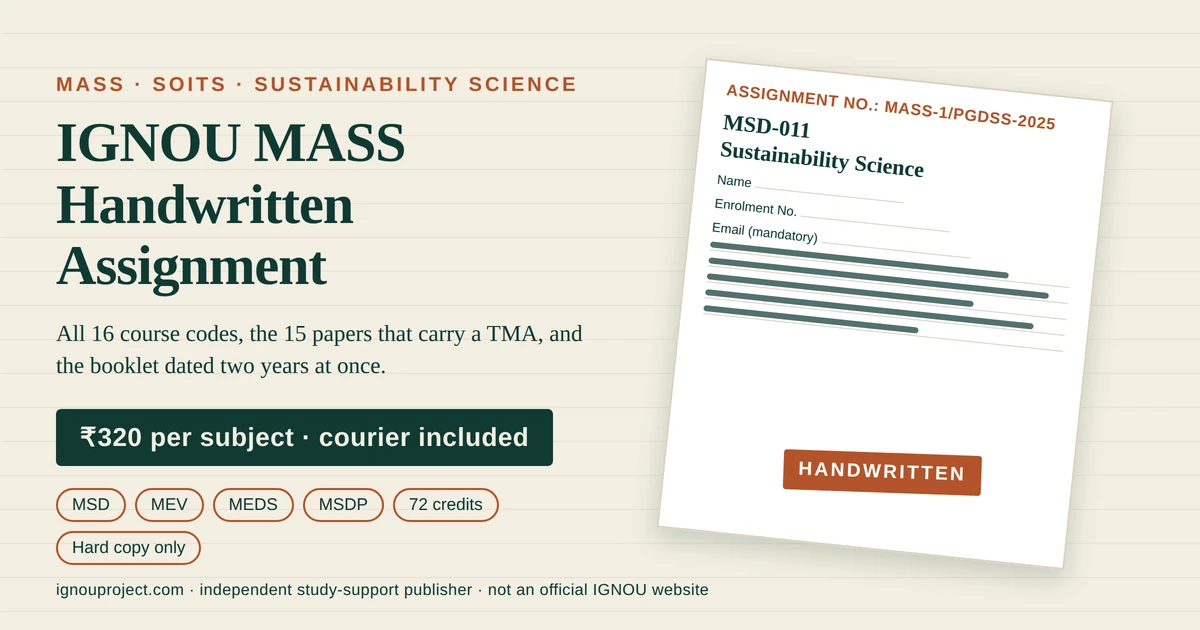
Two MASS papers print a course code that exists in no IGNOU prospectus, the cut-off is 30 March rather than the 31 March half the internet quotes, and the bundle goes to a Regional Centre rather than a Study Centre. A handwritten MASS set is written against the paper as IGNOU actually printed it, and couriered to you as ink on A4.
- 72 credits, 16 courses
- 15 papers carry a TMA
- 100 marks, four of four
- English-medium programme
- 30 March and 30 September
- Courier included
Send the codes as your registration confirmation prints them, whether they sit in the first or the second year, the year printed on your booklet cover, and your pin code. Delivery depends on your pin code and is confirmed for your order before you pay. No figure is promised on this page.
Quick answer. A handwritten assignment is the answer set for IGNOU’s Tutor Marked Assignment questions, written out by hand on A4 and posted or handed in as a hard copy, and for MASS, the Master of Arts (Sustainability Science) run year-wise by the School of Interdisciplinary and Transdisciplinary Studies across 72 credits and 16 courses, in which nine four-credit MSD papers numbered 11 to 17, 19 and 20 make up the first year and a mixed second year holds MSD 21, MSD 22 and MSD 23 beside MEV 25 borrowed from the environment degrees, the six-credit MEDS 51 and MEDS 44 borrowed from the corporate-responsibility and urban-development diplomas, and the eight-credit MSDP 18 project, ignouproject.com prepares that handwritten set one course code at a time. The rate is ₹320 per subject, hard copy only, with courier included in that price and no separate shipping charge. No soft copy or PDF is sold. The service covers all mediums IGNOU issues the TMA paper in, at the same price, which on MASS resolves to the English paper, because the July 2026 Common Prospectus records the medium of instruction as English and no Hindi MASS booklet is published. Any session is accepted, current cycle or older, including backlog courses, at the same ₹320 per subject. Send a photo of a page you have written yourself and the handwritten set is matched to your handwriting at no extra charge. Assignments carry 30 per cent of the final course result and the term-end examination carries the remaining 70 per cent, and every MASS paper opened for this page sets four questions of 25 marks to a 100-mark total with roughly 500 words asked of each, so an order is quoted per code on WhatsApp at +91 93546 37830 rather than per year.
Thirty March, Not Thirty-One: The Pair Printed Inside Your Own Booklet
Both live MASS booklets were opened for this page, and the two of them agree on the submission schedule to the letter. The instruction sits at point four of the instruction list on each, and it is the only calendar statement either file makes.
Printed on both the MASS-1 and MASS-2 booklets as the last date for submitting the assignments for the June Term End Examination. Thirtieth, not thirty-first, on the paper IGNOU serves under MASS.
Printed on both booklets in the same sentence, against the December Term End Examination. The pair belongs to the School of Interdisciplinary and Transdisciplinary Studies, not to the university at large.
That pair is worth reading twice, because a large part of the study-help web publishes something else entirely for this programme. Pages listing MASS submission dates as 30 April for the June examination and 31 October for the December one are quoting the School of Management Studies calendar, which governs the MBA and M.Com family and has nothing to do with Sustainability Science. Two of the most widely linked MASS assignment pages currently carry that pair. The booklet on your own screen carries the other. Where a study-help page and the file IGNOU published disagree, the file wins.
One further caution about the number itself. Thirty March is an unusual figure. Most SOITS and School of Humanities programmes print 31 March, and it is easy to read the MASS instruction as saying that because it is what you expect to see. It does not. It reads thirtieth, on both files, in the same sentence as the thirtieth of September. Write your plan against the earlier date and the difference costs you nothing; write it against the later one and it may cost a whole cycle.
Submission is also what makes you eligible to sit the term-end paper at all, so a missed bundle is not simply thirty marks forgone, it is a paper you are not permitted to attempt. Dates move within a cycle and IGNOU has extended the general figure more than once in recent sessions. Take the figure your own Regional Centre has issued, and read it beside what the university publishes, before any writing plan is built on either. The only real urgency on this page is the date printed on your own paper and whatever your centre has since issued; nothing here is time-limited by ignouproject.com.
Fifteen Papers, Sixty Questions, And A Third Of Every Result
Assignments carry 30 per cent of the final course result and the term-end examination carries the remaining 70 per cent. On MASS that share is collected fifteen times across the degree rather than sixteen, because MSDP 18 is the eight-credit project and IGNOU publishes no Tutor Marked Assignment for it. Nine of the fifteen sit in the first year and six in the second.
The question pattern is the same on every MASS paper read for this page, and it is unusually flat. Each course prints 100 marks, sets exactly four questions, and states that all questions carry 25 marks each. There is no choice: the instruction reads answer all the questions, and the note above them says the assignment is based on the entire course. Four answers multiplied by fifteen papers is sixty separate answers across the whole MA, each one worth a quarter of a paper that itself carries almost a third of a course result.
Unlike its sister environment programmes, MASS does print a word figure. Instruction three on both booklets asks you to write the question with each answer and to answer each question in around 500 words in your own handwriting. Four answers of roughly 500 words is about 2,000 words per course, which at ordinary longhand density is eight to ten sides of A4 for a single code. A learner carrying a full first year is therefore looking at something in the region of seventy to ninety handwritten sides before the second year begins.
These are marks earned at home with the blocks open, which is precisely why they are the ones most often surrendered to a March that arrives sooner than expected. Once the counsellor’s figure is transmitted it attaches itself to that course code and stays there, and the route it takes is set out on the page covering where an assignment score actually surfaces.
Which Of The Two Does The Regional Centre Actually Stamp?
Two different things are asked for in the same WhatsApp message and only one of them can be handed in, so both are defined before anything else is said about either.
A solved assignment is a soft-copy reference file of model answers prepared for one course code and one session, delivered as a document and read on a screen. A handwritten assignment is the physical object IGNOU collects: those answers written out by hand across A4 sheets, filed separately per course code, and sent to the Regional Centre. One is preparation for the writing. The other is the writing. Printing a downloaded file does not turn it into a MASS submission, and the booklet closes the question in its own instruction list, which asks that each question be answered in around 500 words in your own handwriting.
| Solved file for a MSD or MEDS code | Handwritten MASS bundle | |
|---|---|---|
| Format | A document read on a screen | A4 sheets, filed per code, delivered by courier |
| What it is for | Working the answer out before it is written | Reaching the Regional Centre envelope |
| Who it suits | A learner with weeks who wants the reading cut down | A learner facing sixty answers and one March |
| Handwriting | Does not arise | Reproduced from a photo of your own hand |
| Rate on this page | Handled elsewhere, not here | ₹320 per subject, courier included |
On a phone, swipe this comparison across to bring the handwritten column into view.
The distance between the two is wider on Sustainability Science than the price gap suggests, because of what these particular questions ask for. MSD-014 wants the thermodynamic, absolute-scarcity and sustainability interlinkages underlined and the Kyoto Protocol judged as an instrument. MSD-016 wants the Prism model and the Egg model of sustainable development distinguished. MEDS-044 wants the steps in test construction and the methods of probability sampling. MSD-019 wants three targets of SDG 5 with their indicators and India’s progress against two targets of SDG 11. Those are answers with named frameworks, named goals and named numbers inside them, and transcribing one off a screen without following the framework is how a perfectly legible bundle still reads as unlearned. If the answer key is what you actually came for, it sits in the IGNOU solved assignments, arranged by programme and code, and it belongs beside the blocks rather than inside a notebook.
Where a MASS envelope goes, and it is not where most pages say. Instruction five on both booklets reads: submit the assignment responses to the concerned Regional Centre. A note underneath adds that the envelope should be marked with the programme code, PGDSS for the diploma and MASS for the degree. Several widely read study-help pages state that MASS assignments go to the Study Centre in which you registered. IGNOU’s own MASS files say Regional Centre, and they say it twice over by asking you to label the envelope by programme. Confirm the route with your own centre, because Regional Centres do vary their practice, but do not assume the Study Centre counter on the strength of a page that never opened the booklet.
Twelve short statements, six about what goes wrong on a Sustainability Science order and six about what this page declines to promise. Read them before the codes go out.
One rate across four prefixes. The rate is ₹320 per subject, hard copy only, with courier included in that price and no separate shipping charge. A four-credit MSD ecology paper and a six-credit MEDS paper on corporate social responsibility are quoted alike, because both set four questions of 25 marks.
The project code is named, not billed. MSDP 18 is the eight-credit Project Work and carries no Tutor Marked Assignment in either booklet. A list of sixteen comes back priced as fifteen, with the project identified rather than quietly folded into the total.
The MSD-018 header is read as the error it is. Two papers in your set print a course code that belongs to no MASS course. The set is written against the course named at the top of the block, not the code printed under it, and the discrepancy is pointed out in the reply rather than reproduced on your sheets.
Six-credit papers are written as six-credit papers. MEDS 51 and MEDS 44 carry half again the credit weight of an MSD paper while setting the same four questions. The depth follows the course, not the question count, so a corporate-responsibility answer is not trimmed to match a mountain-ecosystem one in the same envelope.
Padding is resolved before pricing. Your prospectus prints MSD 11 with a space and two digits. Your booklet prints MSD-011 with a hyphen and three. The second-year contents page prints MEV 025 with a space and three. Whichever form you send is resolved to the paper.
Ordered by code, never by year. There is no minimum order: one subject or fourteen, same rate. A learner carrying one outstanding MSD-013 into their second year orders that single code, and a lateral entrant ordering MEVE 016 alone is ordinary work.
Matched to the hand you already write in. Send a photo of a page you have written yourself and the handwritten set is matched to your handwriting at no extra charge. Nine bundles in one year and six the next reach one Regional Centre against one enrolment number.
Whatever medium the paper is issued in. The service covers all mediums IGNOU issues the TMA paper in, at the same price. On MASS the prospectus records English and both live booklets are English, so the clause resolves to a single paper rather than a choice between two.
A 2023 backlog code is ordinary work. Any session is accepted, current cycle or older, including backlog courses, at the same ₹320 per subject. IGNOU’s index still serves the 2023 and 2024 MASS files, and a paper left behind then is answered against the questions its own year printed.
Paper only, never a file. No soft copy or PDF is sold. If your Regional Centre asks for an upload, you scan the delivered hard copy yourself, which keeps the original in your hands until the envelope is logged.
No promise about the evaluation. No claim is made about the marks any assignment will receive, about how an evaluator will assess it, or about whether it will be accepted. Assignment evaluation is entirely a matter for IGNOU.
No courier figure, and the declaration stays yours. Delivery depends on your pin code and is confirmed for your order before you pay. No figure is promised on this page. You sign the declaration on the assignment cover page, so you should read and review the content before submitting it, and satisfy yourself that it represents your own understanding of the course.
Send the whole list if that is simpler. The reply names which of your codes carry a live paper, prices only those, states the assignment number each one belongs under, and gives the delivery position for your pin code before anything is charged.
Price My MASS Year At ₹320 A Paper Ask Which Of My Codes Have QuestionsSeventy-Two Credits, Sixteen Courses And Four Code Prefixes
MASS is the programme code printed on your admission record and in the Common Prospectus. MSD is the prefix on the twelve taught Sustainability Science courses, MSDP on the project, and MEV and MEDS on three courses borrowed from neighbouring programmes. MASSOL is the online-mode variant of the same degree. PGDSS is the Post Graduate Diploma you exit with if you stop after the first year, and it is also the award a lateral entrant arrives holding.
Section 3.41 of the IGNOU Common Prospectus for July 2026 places MASS in the School of Interdisciplinary and Transdisciplinary Studies, records the medium of instruction as English, sets eligibility at a graduate degree in any discipline, and gives two years minimum against four years maximum with year-wise examination in the January and July cycles. The fee table in the same document records ₹8,200 per year and ₹16,400 in total. The prospectus also notes that IGNOU was the first university in India to introduce Sustainability Science as a degree, in line with the National Education Policy 2020.
Both tables below were added up before they were trusted. Nine first-year courses at four credits each is thirty-six, which matches the figure the prospectus prints against the year. The second year runs four plus four plus four plus six plus four plus six plus eight, which is also thirty-six, and matches. Thirty-six and thirty-six is the seventy-two the prospectus states as the total. The arithmetic closes in both directions, which is worth saying because it does not on every programme in that document.
Year One: Nine MSD Papers And The Number That Is Missing
| Code | Official title | Type | Credits |
|---|---|---|---|
| MSD 11 | Sustainability Science | Theory | 4 |
| MSD 12 | Ecosystem and Natural Resources | Theory | 4 |
| MSD 13 | Socio-Cultural System | Theory | 4 |
| MSD 14 | Ecological Economics | Theory | 4 |
| MSD 15 | Institutions, Governance and Policies | Theory | 4 |
| MSD 16 | Strategies and models for sustainability | Theory | 4 |
| MSD 17 | Challenges to Sustainable Development | Theory | 4 |
| MSD 19 | Global Strategies to Sustainable Development | Theory | 4 |
| MSD 20 | Population, Health and Sustainability | Theory | 4 |
Drag the table sideways on a narrow screen to reach the credits column.
Nine papers, thirty-six credits, no electives and no choices. Read the code column downward and the sequence runs eleven, twelve, thirteen, fourteen, fifteen, sixteen, seventeen, then nineteen. There is no MSD 18 in the first year, and there is no MSD 18 anywhere in the July 2026 Common Prospectus at all: the string does not occur in the document. The number eighteen is used once in this programme, by MSDP 18, the project, which sits in the second year under a different prefix. That single missing number is the root of the most confusing thing about a MASS assignment set, and it is dealt with under the warning box below.
The same nine courses and the same thirty-six credits are also the whole of PGDSS, the Post Graduate Diploma in Sustainability Science, in section 8.38 of the same prospectus. That is why one assignment booklet serves both awards.
Year Two: Six Written Papers, Three Borrowed Prefixes And One Project
| Code | Official title | Credits | TMA published |
|---|---|---|---|
| MEV 25 | Climate Change and Society | 4 | Yes |
| MSD 21 | Mountain and Hill Ecosystem | 4 | Yes |
| MSD 22 | Aquatic Ecosystem | 4 | Yes |
| MEDS 51 | Fundamentals of CSR | 6 | Yes |
| MSD 23 | Social Ecology, Globalisation and Sustainability | 4 | Yes |
| MEDS 44 | Monitoring and Evaluation of Projects and Programmes | 6 | Yes |
| MSDP 18 | Project Work | 8 | None published |
Drag the table sideways on a narrow screen to reach the TMA column.
Three of the six written second-year courses are not Sustainability Science courses at all in origin. MEV 25 Climate Change and Society is an elective in the MA (Environmental Studies) structure and a first-year core in the MA (Climate Change) one. MEDS 44 is the fourth of four courses in the postgraduate urban-development family whose project code is covered on the MEDSP-45 urban planning project guide and again through the MA Urban Studies route. MEDS 51 Fundamentals of CSR is the taught half of the corporate-responsibility family whose project sits on the MEDSP-51 CSR project page, and it appears again as an either-or elective inside a Home Science second year in section 8 of the same prospectus. MSD 19 runs the other way: it is a MASS first-year course that also appears in MA (Environmental Studies), MA (Climate Change) and the environmental management and law diploma.
Two consequences follow for an order. The first is credit weight: MEDS 51 and MEDS 44 are six-credit courses sitting among four-credit ones, which is why the second year reaches thirty-six credits from only seven entries. The second is that the same course number belongs to a different learner’s paper elsewhere, so name MASS as well as the code on every download and every message. The project itself is covered on the MSDP-18 project and dissertation guide and is not part of a ₹320 assignment order.
Lateral Entry: Three Extra Papers In Place Of One Project
The second-year booklet carries a separate block headed for lateral entry only, meaning learners admitted to the second year after completing PGDSS. The prospectus scopes it more tightly still: learners registered in PGDSS, in either open-and-distance or online mode, between July 2017 and July 2022. Those learners replace MSDP 018 with three taught courses, MSD 19 Global Strategies to Sustainable Development, MSD 20 Population, Health and Sustainability, and MEVE 16 Urban Environment, each of four credits.
Three things are worth pointing out about that substitution before a code list is priced. Twelve credits of taught work stand in place of an eight-credit project, so the routes are not credit-equivalent on their face. MEVE 16 Urban Environment appears in no MASS course table anywhere in the prospectus; it is a course of the MA (Environmental Studies) second semester and of the environmental management and law diploma, and it reaches MASS only through this paragraph. And MSD 19 and MSD 20 sit in both places at once, in the first-year table and in the lateral-entry list, which makes sense only once you know that the earlier PGDSS those learners hold was a shorter one. A lateral entrant therefore writes nine papers in their single year rather than six.
- Both 2025 booklets are dated two different years at once. The cover of the first-year file reads Assignments (ASSIGNMENT NO.: MASS-1/PGDSS-2025) (2025). The running header on every single page of that same file, cover included, reads ASSIGNMENT NO.: MASS-1/PGDSS-2024. The second-year file does exactly the same thing: cover MASS-2/2025, header MASS-2/2024. Reading one file, you would call it a typo. Reading both, it is a template carried forward from the previous year and never updated. The parenthetical on both headers, TEE June 2025 and December 2025, tells you which cycle the questions belong to.
- Two papers print a course code that does not exist. In the first-year booklet, the block headed MSD-019: Global Strategies to Sustainable Development prints Course Code: MSD-018 underneath it. The block headed MSD-020: Population, Health and Sustainability prints Course Code: MSD-018 as well. The same two errors reappear verbatim in the lateral-entry section of the second-year booklet. So one non-existent code is printed four times across two files, against two different courses. MSD-018 occurs nowhere in the July 2026 Common Prospectus and is not a MASS course. Write the code from the heading, MSD-019 or MSD-020, on your cover sheet, and keep the download as evidence of what the paper said.
- One booklet, two programmes. The first-year file is issued jointly for PGDSS and MASS, is filed on IGNOU’s index under a filename combining both, and instructs you to write the programme code on the envelope so the university can tell which award your bundle belongs to. A PGDSS learner and a MASS first-year learner answer identical questions.
- The prospectus pads the project code two ways in one section. The section 3.41 course table prints MSDP 18. The lateral-entry paragraph fourteen lines below prints MSDP 018. One document, one section, one course, two spellings.
- The prospectus pads course codes one way and the booklets the other. Section 3.41 prints MSD 11, MEV 25, MEDS 51 and MEVE 16 with a space and two digits. Both booklets print MSD-011, MEV-025, MEDS-051 and MEVE-016 with a hyphen and three. Inside the second-year booklet the contents list uses a third form again, a space with three digits, as in MEV 025 and MEDS 051. Search a code both ways before concluding a paper is missing.
- The lateral-entry substitution is not credit-neutral. Twelve credits of taught courses replace an eight-credit project. The prospectus states the substitution without reconciling the arithmetic, and the stated programme total of 72 credits is the figure for the direct route.
- MEVE 16 is required of some MASS learners and listed in no MASS table. It appears only inside the lateral-entry paragraph and in the lateral-entry block of the second-year booklet. Its own home is the MA (Environmental Studies) structure.
- Web-wide, the wrong deadlines are in wide circulation for this programme. Several prominent study-help pages give MASS submission dates as 30 April and 31 October, which is the School of Management Studies pair. IGNOU’s own MASS booklets print 30 March and 30 September. Another widely read page states that MASS assignments are submitted to the Study Centre; the booklets say Regional Centre.
- The newest MASS set IGNOU has published is 2025. The Master’s Degree assignment index lists MASS first-year and second-year files for 2025, a first-year file for 2024 and both years for 2023. No 2026 or 2026-27 MASS booklet has appeared there as of this review, while the neighbouring MA (Environmental Studies) index already carries a 2025-26 pair. A blank space is not proof a paper does not exist, but it does mean the 2025 questions are the current ones to answer.
- On this website, pending correction. The MSDP-18 project page carries three faults found during this review: it spells the code MDSP-018 once with the letters transposed, it advises starting the project in Semester 3 when MASS is examined year-wise rather than by semester, and it closes with a line offering 100 per cent accepted project reports. No acceptance claim is made anywhere on this page and none is defensible. All three are logged for correction.
- Also on this website, pending correction. An acceptance-and-refund guarantee is still live on the ignouproject.com homepage; the MMPC-001 course page still promises dispatch within a fixed number of working days; the MCA assignment page still prints submission dates from 2019; and the MEG assignment page still offers a Hindi paper for an English-only programme. None of them appears above, all four are queued, and where any of them disagrees with this page, this page governs.
- And one that touches delivery directly. The sister store shrichakradhar.com advertises a courier window counted in working days. Nothing counted in days appears on this page, since the pin code decides it.
Where this page and your registration confirmation differ, the confirmation is the document that counts, and that holds for every study-help site including this one. Programme structures, course codes, submission dates and rules change, and only ignou.ac.in and your Regional Centre can confirm the current position for your enrolment. The document these tables were read from is indexed on the prospectus archive.
From A MSD Code List To A Tied Bundle On A4
What follows is the whole route from a WhatsApp message to a sealed envelope, in five stages. Stages one and two carry most of the weight on this programme, because MASS work is lost to the wrong file far more often than to a weak answer.
- Each code is checked against the year it belongs to and the booklet that holds it. Nine codes route to the first-year MASS-1/PGDSS file and six to MASS-2, with the three lateral-entry codes sitting in a separate block of the second. MSDP 18 is set aside with a note rather than silently priced, and any code that does not appear in your year is flagged back before anything is written.
- The heading is trusted over the code line where the two disagree. On MSD-019 and MSD-020 the block heading names the course correctly and the line beneath it prints MSD-018. Answers are prepared against the course in the heading, and the correct code goes on the cover sheet. Reproducing IGNOU’s error on your own sheets helps nobody at the evaluation end.
- Four answers of about 500 words each, question text written in. The booklet asks for the question to be written above its answer, and for roughly 500 words in reply. Both are followed, so a 25-mark question on the Prism and Egg models or on India’s progress against SDG 11 is answered at the length the paper actually asks for rather than padded or clipped.
- Answers built from the MASS blocks, not from a general web summary. The counsellor marks against the programme’s own units, so a question on common pool resources or on participatory governance is answered from them. IGNOU publishes the blocks free through the eGyanKosh repository, with a second route into Gyankosh when that is slow, and a wider catalogue at the free study material index.
- Three-page opening, A4 both sides, one file per course, then courier. The MASS booklets set out a cover arrangement no other programme on this site uses, and it is followed exactly. Page one carries the assignment number, your name, enrolment number, email marked mandatory and phone number. Page two is a copy of your IGNOU identity card, marked compulsory. Page three carries the assignment questions themselves, and the answers begin after that. The sheets are A4, written on both sides with a margin as the booklet instructs, and secured. The general layout is illustrated on the cover page walkthrough, with a blank front page to print and the margin, numbering and binding rules covering the rest.
One Hand Across Two Annual MASS Bundles
Send a photo of a page you have written yourself and the handwritten set is matched to your handwriting at no extra charge. A single page of anything you have already written, shot flat in daylight, is enough. Slope, letter height and the joins you make without thinking all read off it, and they carry across a year of answers.
On a year-wise degree the case for it is about volume arriving in one envelope. MASS does not submit three or four papers a semester; it submits nine at once in the first year and six a year later, against one enrolment number, at one Regional Centre, over a registration that may run to four years. Nine bundles in one hand and six arriving twelve months later in a visibly different one is a discrepancy nobody needed in a file that stays open that long. The photograph is used for the order it belongs to and discarded with it.
Writing the MASS set yourself is the better outcome, and none of the method costs anything.
The full sequence is set out in the step-by-step method for writing one yourself. A finished assignment sample shows the depth a 25-mark answer reaches, online against offline submission covers what happens once the files are made up, and learners writing a Devanagari paper for a cognate programme will want the notes on writing in Hindi for a cognate programme, which does not arise on MASS itself. This page is for learners short of weeks, not short of sustainability.
Two MASS Utilities That Cost Nothing
Neither utility below sends anything anywhere; both compute in the page and keep no record. The first exists because MASS delivers its papers in two annual blocks rather than four semester ones, and sixty answers against a March cut-off is easy to misjudge at that scale. The second exists because a MASS code tells you nothing about which year it belongs to, which assignment number governs it, or whether it is one of the two that print the wrong course code.
MASS Paper Count And March Cut-Off Planner
Pick a year block or type how many MASS papers you are short on, choose which term-end examination you are heading into, and this returns the total at ₹320 each, the number of 25-mark answers those papers require, an estimate of the longhand at the booklet’s own 500 words a question, and the days remaining to the cut-off printed on both MASS booklets.
MSDP 18 is excluded from every option, because IGNOU publishes no Tutor Marked Assignment for the project.
A whole number from 1 to 15. Fifteen is the most a direct-entry MASS record can carry. Choosing a block above fills this in for you.
Both dates are read off instruction four of the MASS-1 and MASS-2 booklets. Your Regional Centre may issue an extension.
Pick a block or type a paper count, then select Work Out Cost And Runway.
Confirm This MASS Total On WhatsApp
This tool is guidance from ignouproject.com, not an IGNOU rule. Using it creates no obligation to order anything. The longhand figure is a planning estimate built from the booklet’s own 500-word guidance, and the cut-off shown is the one printed on the MASS booklets rather than a university-wide instruction.
MSD Code Router And Assignment Number Builder
Type any MASS course code in whichever form your record prints it. The router returns the official title, the credits, the year it sits in, the prefix that owns it, the assignment number the booklet files it under, the marks and question pattern, whether that paper is one of the two printing a wrong course code, and the checklist that applies.
Spaces and hyphens are ignored and both paddings resolve, so MSD 11, MSD-011 and msd011 all reach the same paper. Read the code off your registration confirmation.
MASS papers are filed by year on IGNOU’s index, and the newest block published there is 2025.
Type a code such as MSD 22 or MEDS 44, then select Route This MASS Code.
Have This One MSD Paper Written
This tool is guidance from ignouproject.com, not an IGNOU rule. Using it creates no obligation to order anything. Titles and credits follow the July 2026 Common Prospectus and the assignment numbers follow the live 2025 booklets, and both should still be checked against your own paper.
One code or fifteen, the 2025 set or an older year. The papers you intend to work through yourself stay yours. Send the list, the year, the number printed on your booklet cover and one photo of your own writing.
Hand Over The Papers You Cannot ReachPulling The Right MASS Booklet Off The Master-Degree Index
IGNOU charges nothing for the question papers, and they are worth taking from IGNOU rather than from a mirror, whoever ends up filling the sheets. Four steps below, and step two is where Sustainability Science learners usually go wrong.
- Start at IGNOU’s own download service. Open the IGNOU assignment download service or go straight to the assignment portal, choose Master’s Degree Programmes, and find MASS in the listing. Do not type a file address from memory. The MASS entry sits low on that page rather than in the alphabetical run, so use the browser’s find function on the page if scanning does not turn it up.
- Expect two files for a year, not fifteen. MASS does not publish one PDF per course. The whole first year sits inside a single file whose name combines MASS and PGDSS, and the whole second year sits inside another. A learner short of only MSD-014 still downloads the file containing all nine.
- Read the running header, not only the cover. The header on every page carries the assignment number and the examination cycle the questions belong to. On the current set the cover and the header disagree on the year, so note both, and copy the assignment number onto your sheets exactly as your own download prints it.
- Check the second file for the lateral-entry block before deciding a code is missing. MSD-019, MSD-020 and MEVE-016 appear in the second-year booklet only under the heading for lateral entry, well below the six papers everyone else writes. IGNOU also points learners at a programme portal for MASS alongside the assignment index, which is worth checking when a file will not resolve.
Once the questions are in hand, solved term-end papers and previous year papers show what the examination hall asks of a Sustainability Science candidate, which is a noticeably different question from what a 25-mark assignment asks.
Where A MSD Score Goes After The Counter
Handing the envelope over is a checkpoint rather than a finish line. Take a receipt and keep it, and keep a photocopy or a photograph of every page before the bundle leaves you, because a Regional Centre submission passes through more hands than a Study Centre one.
After that the mark travels rather than appears. Your envelope is logged, the counsellor awards a figure, that figure goes up to the Student Evaluation Division, and only at the end of that chain does anything attach to your course code. Logging and scoring show on two separate screens and answer two separate questions, so follow the first through checking whether the marks are posted and the second through how assignment marks reach the grade card, with a code that refuses to appear on the grade card for the stubborn cases and the final grade card once both halves are posted. Each of those lookups opens by asking for the identifier explained on finding your enrolment number, and the counter itself is covered by handing the bundle in and the general assignment hub.
A MASS course showing as incomplete on a year-wise programme usually means one paper out of nine is missing rather than that anything failed, and on this degree the missing one is frequently MEDS 51 or MEDS 44, because a learner searching a MASS index for a MEDS code does not always find it where they expect. When both halves of a course are visible, convert the marks to a percentage or work out the CGPA, and a disputed term-end figure goes through revaluation, which never reaches an assignment. Wider timing sits on result timing, the June 2026 result tracker and postgraduate results.
The Other Lines In A Sustainability Science Message
An assignment order is rarely the only line in a message from a MASS learner. These are the other things asked for, each on its own page.
- The seventy per cent an assignment cannot touch. The term-end script carries the larger share, so MASS guess papers and condensed study notes repay attention faster than any bundle does, with help books for the term-end paper, guide books ordered online and the study material index compressing the sustainability blocks into something revisable.
- MSDP 18, which is a different order entirely. Eight credits of field research written up as a dissertation runs through the synopsis format and the project writing service, with layout on the report format guide, general rules on the project guidelines page and pricing on the wider price list rather than at the ₹320 assignment rate. If you exited with the diploma instead, the PGDSS version of the same project covers it.
- The neighbouring degrees that lend MASS three of its codes. MEV 25 and MEVE 16 belong to the environment family covered by the M.Sc. Environmental Science handwritten page and the environmental and occupational health page, and the MEDS pair belongs to the development-studies family. Name the programme code as well as the course code on every download, because the same number is somebody else’s paper elsewhere.
Medium, year, and why a MASS paper stops being answerable. The service covers all mediums IGNOU issues the TMA paper in, at the same price. On MASS the July 2026 Common Prospectus records the medium of instruction as English and both live booklets are English, so that clause resolves to one paper rather than a choice, and no Hindi MASS set is offered here because none exists to offer. On years: a MASS booklet names the examination cycle its questions belong to in the running header, and the questions are replaced under unchanged course codes when the year turns over. Any session is accepted, current cycle or older, including backlog courses, at the same ₹320 per subject, so name the year from your own cover and the answers are written against the questions that belong to it.
Four Things That Finish A MASS Order
There is no form on this page, no account and no login. Everything happens on WhatsApp at +91 93546 37830, and the order is not finished when the parcel lands. It is finished when your Regional Centre has logged the envelope.
- One message carrying four things. The codes exactly as your registration confirmation prints them; whether each sits in the first or second year, or in the lateral-entry block; the year printed on your booklet cover; and your delivery pin code. One photographed page of your own writing can follow later in the same thread.
- A reply carrying three numbers. How many of your codes have a live paper, the total at ₹320 each with MSDP 18 removed and named, and where your pin code stands for delivery. Delivery depends on your pin code and is confirmed for your order before you pay.
- Files arrive, you complete the opening pages, the envelope goes out. Each code comes as its own file with the three-page opening laid out and left blank. You add the enrolment details, attach the identity-card page, sign, and mark the envelope MASS as the booklet asks, because a declaration is not something anyone can delegate.
Which Facts Came From Where
From the IGNOU Common Prospectus, July 2026. Section 3.41 supplied the School of Interdisciplinary and Transdisciplinary Studies placement, the English medium of instruction, the graduate eligibility, the two-year minimum against a four-year maximum, the year-wise January and July cycles, all sixteen course codes with their official titles, types and credits, the 36-credit year totals, the stated 72-credit total, the PGDSS exit and lateral-entry rules, and the MEVE 16 substitution. The programme-summary table supplied the ₹8,200 annual and ₹16,400 total fee. Both year tables were added up rather than accepted on sight, and both closed against their stated totals. Section 8.38, the PGDSS version of the same first year, confirmed the nine-course, 36-credit structure. Sections 3.42 and the climate-change and urban-development tables supplied the home programmes of MEV 25, MEDS 51, MEDS 44 and MEVE 16.
From live IGNOU assignment booklets. Two were opened rather than one, precisely so that a template carry-over in a single file could not be mistaken for the programme’s format: the first-year MASS-1/PGDSS file and the second-year MASS-2 file, both from the 2025 block on IGNOU’s Master’s Degree assignment index. Between them they supplied the 30 March and 30 September pair, the 100-mark total with four questions of 25, the roughly 500-word guidance, the own-handwriting instruction, the three-page opening with the compulsory identity-card page, the separate-file-per-course rule, the A4 both-sides instruction, the Regional Centre routing, the envelope labelling rule, the assignment number forms MASS-1/PGDSS-2025 and MASS-2/2025, the lateral-entry block, and both the cover-versus-header year discrepancy and the MSD-018 code printed against two different courses. Reading the second booklet is what turned the MSD-018 line from a possible typo into a confirmed template fault, because it recurs there word for word. The published-year position was read off IGNOU’s own MASS index.
From ignouproject.com as publisher. Everything commercial on this page, the price, the physical format, the medium policy, the session policy and the handwriting match, is decided here and nowhere else. The rate is ₹320 per subject, hard copy only, with courier included in that price and no separate shipping charge. No soft copy or PDF is sold. There is no minimum order: one subject or fourteen, same rate. Delivery depends on your pin code and is confirmed for your order before you pay. No figure is promised on this page. The university sets none of it and takes no part in any of it.
Something above wrong, or a MASS code moved since this review? Send it through the contact page. The entry will be opened against the live file again and carry a new review date. The about page names the publisher, and the privacy policy sets out what becomes of anything sent in.
Written and reviewed by BK Sahni, Founder, Shri Chakradhar Publication Pvt. Ltd. and ignouproject.com, who has guided 5,00,000 students till date. ORCID 0009-0005-8092-459X. The BK Sahni profile carries the author details and the editorial method behind this page.
Published 25 August 2026. Last reviewed 25 August 2026. Next scheduled review 1 September 2026, ahead of the 30 September cut-off printed on both MASS booklets for the December examination, and again by 1 March 2027, ahead of the 30 March cut-off for the June examination.
MASS Questions That Arrive Before The Codes Do
The rate is ₹320 per subject, hard copy only, with courier included in that price and no separate shipping charge. One subject is priced the same as fifteen, and a six-credit MEDS paper costs the same as a four-credit MSD one. MSDP 18 is not priced at all, because it is the project and has no Tutor Marked Assignment behind it.
Instruction four on both the MASS-1 and MASS-2 booklets gives 30 March for the June Term End Examination and 30 September for the December one. Note the thirtieth of March rather than the thirty-first. Study-help pages quoting 30 April and 31 October for MASS are using the School of Management Studies calendar, which does not govern this programme. Dates also shift by session and by Regional Centre, so confirm yours on ignou.ac.in.
Because the header was carried forward from the previous year’s file and never updated. The cover of the current first-year file reads MASS-1/PGDSS-2025 and the running header on every page reads MASS-1/PGDSS-2024. The second-year file repeats the pattern. The parenthetical in the header names the cycle the questions actually belong to, June 2025 and December 2025. Copy the number exactly as your own download prints it and keep the file.
It is an error in IGNOU’s own booklet, and a repeated one. The block headed MSD-019 prints Course Code: MSD-018 underneath, and so does the block headed MSD-020. Both errors appear again in the lateral-entry section of the second-year file, so the same wrong code is printed four times across two booklets. Write the code from the block heading on your cover sheet, MSD-019 or MSD-020 as applicable.
No. The string MSD 018 does not occur anywhere in the July 2026 Common Prospectus, and no MASS course table contains it. The first-year sequence runs MSD 11 to MSD 17 and then jumps to MSD 19 and MSD 20. The number eighteen appears in this programme only as MSDP 18, the eight-credit Project Work in the second year, which is a different prefix and a different kind of course.
Fifteen on the direct route: nine in the first year and six in the second. Sixteen courses sit on the record but MSDP 18 has no paper. A lateral entrant who joined the second year after PGDSS writes nine in that year instead of six, because MSD-019, MSD-020 and MEVE-016 are added in place of the project. Every paper sets four questions, so fifteen papers is sixty answers.
No. Neither MASS booklet contains a question block for it. MSDP 18 is eight credits of supervised project work assessed through a synopsis, a report and a viva rather than through a Tutor Marked Assignment, so it is never quoted at the ₹320 assignment rate and never written as part of an assignment order.
Instruction five on both booklets says to submit the assignment responses to the concerned Regional Centre, and a note beneath asks you to write the programme code, PGDSS or MASS, on the envelope. Several study-help pages say Study Centre instead. IGNOU’s own MASS files say Regional Centre. Confirm the route with your own centre, since practice does vary, but start from what the booklet says.
The prospectus prints MSD 11 and the booklet prints MSD-011, and the second-year contents page uses a third form again, MEV 025 with a space and three digits. They are the same courses. Write the form your own booklet prints, because that is the file the evaluator is marking against, and search both ways when a code will not resolve on IGNOU’s index.
Every MASS course prints a maximum of 100 marks and sets four questions carrying 25 marks each, with the instruction to answer all of them. There is no choice of questions and no section split. The note above the questions states that the assignment is based on the entire course, so all blocks are in scope rather than a named range.
Instruction three on both booklets asks for each question to be answered in around 500 words in your own handwriting, with the question written out above its answer. Four answers of about 500 words is roughly 2,000 words a course, which is eight to ten sides of A4 at ordinary longhand density. Unlike the neighbouring environment programmes, MASS does print this figure rather than pointing at one the questions never give.
MASS files an assignment number by year and programme block rather than by course. The current first-year number is MASS-1/PGDSS-2025 on the cover and MASS-1/PGDSS-2024 in the header; the second-year number is MASS-2/2025 on the cover and MASS-2/2024 in the header. That is unlike most programmes, which build a per-course string such as a code followed by TMA and a year. Copy the number from your own download rather than constructing one.
For the first year, yes. IGNOU publishes one file headed for both the Post Graduate Diploma in Sustainability Science and the Master of Arts in Sustainability Science, containing the same nine MSD papers, because the diploma is the first year of the degree. The second-year file is headed for MASS alone. The envelope is what tells IGNOU which award your bundle belongs to, which is why the booklet asks you to write the programme code on it.
The second-year booklet carries a block headed for lateral entry only, holding MSD-019 Global Strategies to Sustainable Development, MSD-020 Population, Health and Sustainability and MEVE-016 Urban Environment. The prospectus scopes it to learners who registered in PGDSS between July 2017 and July 2022, and states that these three replace the MSDP 018 project. MEVE-016 is not listed in any MASS course table; it reaches the programme only through that paragraph.
A solved assignment is a soft-copy reference file of model answers for one course code and one year, read on a screen and used to work out what to write. A handwritten assignment is the physical set: those answers written by hand across A4 sheets, filed per course code and sent to the Regional Centre. One is preparation, the other is the submission, and printing the first does not turn it into the second.
The MASS booklet asks for each question to be answered in around 500 words in your own handwriting, which is an instruction about handwriting rather than about typing. Whether a particular Regional Centre accepts anything else is a matter for that centre, and this page does not encourage guessing at it. What is sold here is a hard copy written by hand, because that is what the instruction describes.
No Hindi MASS paper is published. The July 2026 Common Prospectus records the medium of instruction for MASS as English, and both live booklets are English throughout. The service covers all mediums IGNOU issues the TMA paper in, at the same price, so on this programme that clause resolves to a single English paper rather than a choice.
Any session is accepted, current cycle or older, including backlog courses, at the same ₹320 per subject. IGNOU’s own MASS index still serves the 2024 first-year file and both 2023 files alongside the 2025 pair, so an older paper is answered against the questions its own year printed. Name the year from your cover when you send the codes.
No claim is made about the marks any assignment will receive, about how an evaluator will assess it, or about whether it will be accepted. Assignment evaluation is entirely a matter for IGNOU. You sign the declaration on the assignment cover page, so you should read and review the content before submitting it, and satisfy yourself that it represents your own understanding of the course.
Important Notice
ignouproject.com is an independent IGNOU study-support publisher. It is not the official website of Indira Gandhi National Open University, is not affiliated with, endorsed by or authorised by the university, and no page on this site should be treated as an official IGNOU communication.
Programme structures, course codes, submission dates and rules change, and only ignou.ac.in and your Regional Centre can confirm the current position for your enrolment.
You sign the declaration on the assignment cover page, so you should read and review the content before submitting it, and satisfy yourself that it represents your own understanding of the course.
No claim is made about the marks any assignment will receive, about how an evaluator will assess it, or about whether it will be accepted. Assignment evaluation is entirely a matter for IGNOU.
First year or second, the 2025 set or an older one, each code checked against the block it belongs to and filed separately with the three-page opening laid out and left for you to sign. MSDP 18 is named and removed rather than quietly billed.
Order MASS Papers At ₹320 Each Check Delivery For My Pin CodeWhatsApp +91 93546 37830 · Shri Chakradhar Publication Pvt. Ltd. · Published by ignouproject.com, an independent study-support imprint with no IGNOU affiliation.

BK Sahni iD 0009-0005-8092-459X
Founder, Shri Chakradhar Publication Pvt. Ltd. & ignouproject.com — helping IGNOU distance-learning students since 2010 (5,00,000+ students supported across MBA, MCom, MA & more). Author of IGNOU exam guides, solved assignments & project reference books.
Disclosure: Shri Chakradhar Publication Pvt. Ltd. and ignouproject.com are independent third-party study-help services — not the official IGNOU website. Always verify final dates and rules on ignou.ac.in.