IGNOU Project Guide · SOITS
IGNOU MSCCC Project for MEVP 033: Credits, Synopsis, Report Format and Submission
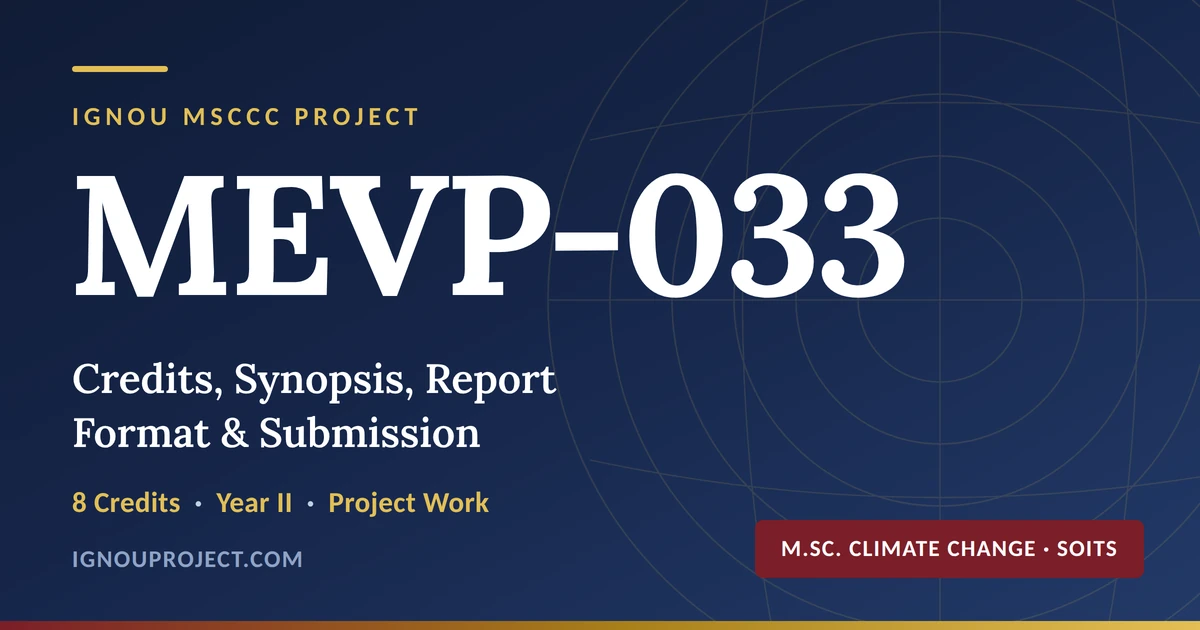
MEVP-033 is the compulsory 8-credit Project Work course in the second year of IGNOU’s M.Sc. in Climate Change (MSCCC). Students complete it in two stages: an approved synopsis first, then a full project report submitted for evaluation and viva-voce.
MSCCC was launched in the July 2026 admission session. Because MEVP-033 sits in Year II, the first regular batch reaches it in the 2027–28 academic year. PGCCC lateral-entry students enter Year II directly and face MEVP-033 much sooner.
Quick answer
MEVP-033 is the Project Work course of IGNOU’s Master of Science in Climate Change (MSCCC), offered by the School of Interdisciplinary and Trans-disciplinary Studies (SOITS). It carries 8 credits and is a compulsory Year II component of the 80-credit programme. The project runs in two stages. First, the student selects a supervisor and a climate-change research topic, then submits a project proposal with the approval proforma and the supervisor’s signed bio-data to the Programme Study Centre or Study Centre coordinator. After written approval, the student carries out the research and prepares the project report. The completed report is uploaded as a single PDF on IGNOU’s online project submission portal, with a project evaluation fee of Rs. 500 paid alongside the term-end examination form. A viva-voce follows.
The basics
What is MEVP-033 in the IGNOU MSCCC programme?
MEVP-033 refers to the compulsory Project Work course in the Master of Science in Climate Change. It is the point where a learner stops answering questions set by the University and starts framing a climate research question of their own — then answers it with evidence.
The Indira Gandhi National Open University introduced MSCCC in the July 2026 session, becoming the first Open University in India to offer a dedicated postgraduate degree in climate change. The programme runs through SOITS in Open and Distance Learning mode, is open to graduates of any discipline, and is examined in annual mode over a minimum of two years and a maximum of four.
Across the 80-credit structure, MEVP-033 is one of only two 8-credit courses in the programme. The other is MEVL-032, the Climate Change Lab Course. Together they carry 16 of the 80 credits, which is why the second year decides a large part of the final result.
| Course code | Title | Type | Credits |
|---|---|---|---|
| MEV-017 | Environmental Legislations | Theory | 4 |
| MEV-019 | Research Methodology for Environmental Science | Theory | 4 |
| MEV-030 | Climate Change, Waste Management and Circular Economy | Theory | 4 |
| MEV-031 | Climate Change and Governance | Theory | 4 |
| MEVL-032 | Climate Change Lab Course | Lab | 8 |
| MEVP-033 | Project Work | Project | 8 |
MEV-019 deserves attention. Research Methodology for Environmental Science is not a box to tick before the project — it is the toolkit the project is built with. Sampling design, questionnaire construction, data treatment and referencing conventions all come from that course, and a synopsis written without them tends to read like an essay rather than a research plan.
Timing
When do MSCCC students actually start MEVP-033?
This is where MSCCC differs from every other IGNOU project code, and the answer depends entirely on how a learner entered the programme.
A student admitted in the July 2026 session begins with Year I — ten theory courses worth 40 credits, from MEV-021 Introduction to Climate Change through to MEV-029 Climate Change and Disaster Risk Reduction. MEVP-033 is not available to them in that first year. On the standard two-year path, the project becomes live in the 2027–28 academic year.
A student holding the Post Graduate Certificate in Climate Change (PGCCC) from IGNOU is in a very different position. The prospectus permits PGCCC holders to take lateral entry into the second year of MSCCC, subject to University guidelines and the credit transfer policy. Those learners land directly in the year that contains MEVP-033.
The lateral-entry gap worth planning for. PGCCC is a 16-credit certificate made up of four theory courses and it contains no project component whatsoever. A learner entering Year II through that route reaches an 8-credit research project without having written a synopsis before, and without having taken MEV-019 Research Methodology in the normal sequence. Reading the MEV-019 material early, before drafting the proposal, closes most of that gap.
Learners who exit after Year I with 40 credits receive the Post Graduate Diploma in Climate Change instead of the degree. That exit route carries no project, so MEVP-033 applies only to those completing the full M.Sc.
MEVP-033 progress tracker
Supervisor
Who can supervise an MEVP-033 project?
SOITS applies a consistent standard across its environment and climate project codes. The supervisor should hold a postgraduate degree, and preferably a doctorate, in climate science, environmental science or a closely related discipline, and should be attached to a recognised university, college, research institute or a government or industry body working in the field.
Two requirements catch students out repeatedly. The proposal must carry the supervisor’s complete, signed bio-data — without it the proposal is not entertained at all, even when the proposed supervisor happens to be an IGNOU academic counsellor. And the student pays the supervisor nothing. The University remunerates the supervisor directly, so any demand for a personal fee is outside the rules. Detailed criteria are covered in the IGNOU project guidelines.
Synopsis
How does the MEVP-033 synopsis get approved?
Approval is a paperwork exercise as much as an academic one. The sequence SOITS follows is straightforward:
- Select the topic and the supervisor together. A supervisor who cannot access the data a topic needs is the wrong supervisor for that topic.
- Draft the proposal. Title, introduction and rationale, objectives, review of literature, methodology, expected outcome and references. Objectives should be specific enough to be tested.
- Fill the approval proforma. Enrolment number, study centre code, regional centre code, contact details, project title, and the supervisor’s name, designation and address.
- Attach the supervisor’s signed bio-data and the supervisor’s signature on the proposal itself.
- Submit to the coordinator of the Programme Study Centre or Study Centre and keep a photocopy of everything.
- Wait for written approval before beginning any data collection.
If the proposal is not approved, the revised version is resubmitted with a fresh proforma along with a copy of the earlier proforma that was rejected. An approved proposal stays valid for one year, covering two submission slots; a learner who misses both must submit an entirely fresh proposal. The IGNOU project proposal and synopsis guide walks through the drafting stage in more detail.
Report
What should the MEVP-033 project report contain?
SOITS project handbooks for its 8-credit environment codes set a working length of roughly 7,000 to 8,000 words, and the chapter skeleton is consistent across the school. A learner should confirm the exact word range against the MEVP-033 programme guide supplied with the study material, since the University issues a project booklet for each code.
| Section | What it carries |
|---|---|
| Title page and certificates | Title, enrolment number, supervisor details, originality certificate |
| Table of contents | Chapters, tables and figures with page numbers |
| Introduction | Climate issue, its local relevance and the rationale for studying it |
| Objectives | Specific, testable aims — the same ones the synopsis promised |
| Methodology | Study area, sampling, tools, instruments and data sources used |
| Results | Observations organised into tables and figures |
| Analysis and interpretation | What the data means against the stated objectives |
| Conclusions and recommendations | Findings plus adaptation or mitigation implications |
| Summary | Condensed account of the whole study |
| Bibliography and appendices | References in a consistent style, plus tools and raw data |
Climate work carries one extra obligation. Where a report leans on secondary data — rainfall series, emissions inventories, land-use figures — the source and the retrieval date belong in the text, not just in the bibliography. Datasets from the India Meteorological Department or the Ministry of Environment, Forest and Climate Change get revised, and an examiner cannot verify an unsourced number.
Submission
How is MEVP-033 submitted, and what does it cost?
IGNOU now accepts final project reports through its online project submission portal. The report is scanned and compiled into a single PDF file for one course and uploaded there; the portal opens for a defined window each term-end examination session and is not available year-round.
Three points are worth fixing in memory. Synopses and assignments must never be uploaded to the project portal — the synopsis goes to the Programme Study Centre coordinator, and assignments have a separate route. The project evaluation fee for project work above 4 credits is Rs. 500, and it is paid along with the term-end examination form, not separately at upload time. And an incomplete upload can be removed after the deadline, which pushes the learner into the next session. The full process is covered in the IGNOU project submission guide.
After evaluation, the result appears against the course code on the grade card. Learners can follow it using the IGNOU project status check. A viva-voce is conducted as intimated by the Programme Study Centre, and the student should carry a copy of the report to it. If a project is declared unsuccessful, the whole cycle restarts from a fresh proposal, and a new topic is usually advised.
Topics
Which topics suit an MEVP-033 project?
The MSCCC syllabus itself is the best topic map. The programme deliberately links climate change to water, energy, agriculture, disaster risk reduction, waste management, the circular economy and governance — and a project anchored to one of those course areas is easier to defend at viva.
- Climate and water: changing rainfall patterns and groundwater dependence in a single block or tehsil.
- Climate and agriculture: shifts in sowing dates reported by farmers over the last decade in one cluster of villages.
- Climate and energy: rooftop solar adoption and the barriers households actually cite.
- Disaster risk reduction: urban flooding hotspots in a ward and the drainage factors behind them.
- Waste and circular economy: segregation compliance in a housing society and its estimated emissions effect.
- Governance and perception: awareness of state climate action plan measures among a defined occupational group.
The common thread is scale. A topic that names a specific place, a specific population and a specific time window can be finished; “Climate Change in India” cannot. Course codes and credit weights for other programmes are listed in the IGNOU project course codes directory.
Common mistakes
Why do climate change synopses get sent back?
BK Sahni has guided 5,00,000 students till date, and across environment and climate project codes the pattern of rejection barely changes. The topic is written broadly enough to cover a doctoral thesis. The objectives are worded so loosely that no method could test them. The methodology names a survey but never says who will be surveyed, how many, or how they will be chosen. Or the file is complete and well written, and the supervisor’s bio-data simply is not attached.
Two habits prevent most of this. Write the objectives before the introduction, because objectives that cannot be stated crisply reveal a topic that is still too wide. And read the methodology aloud asking a single question — could a stranger repeat this study using only these instructions? If not, the coordinator will ask the same thing.
A note on MEVP-033 specifically. MSCCC is a new programme, so a dedicated MEVP-033 project handbook may not yet be circulating on eGyanKosh when a learner begins planning. Until it is, the safest course is to follow the programme guide despatched with the study material and confirm word limits, submission slots and viva arrangements directly with the SOITS programme coordinators or the Regional Centre. Nothing here replaces a written instruction from the University.
Related codes
How is MEVP-033 different from other MEVP codes?
The MEVP prefix runs across several SOITS environment programmes, and students frequently mix them up when searching for guidelines. They are separate courses attached to separate degrees.
| Code | Programme | Credits |
|---|---|---|
| MEVP-033 | M.Sc. Climate Change (MSCCC) | 8 |
| MEVP-011 | M.Sc. Environmental Science (MSCENV) | 8 |
| MEVP-012 | M.A. Environmental Studies (MAEVS) | 6 |
| MEVP-054 | PG Diploma in Waste Management (PGDWAM) | 8 |
| PGDCCC | PG Diploma in Climate Change — no project course | — |
Guidance written for MEVP-011 or MEVP-012 will get the general SOITS process right, but credits, programme name and the envelope label all differ. The project code written on a submission must be MEVP-033, and the programme named must be MSCCC.
Stuck on framing an MEVP-033 topic or objectives that will clear approval the first time? Message the ignouproject.com team on WhatsApp for guidance on structuring the synopsis correctly.
FAQ
Frequently asked questions about MEVP-033
How many credits is the MEVP-033 project worth?
MEVP-033 carries 8 credits. The IGNOU Common Prospectus for July 2026 lists it as Project Work in Year II of the MSCCC programme, alongside MEVL-032, the 8-credit Climate Change Lab Course. The full programme totals 80 credits.
Is MEVP-033 compulsory for MSCCC students?
Yes. MEVP-033 is a compulsory Year II component of the M.Sc. in Climate Change and the degree cannot be completed without it. Learners who exit after the first 40 credits receive the Post Graduate Diploma in Climate Change instead, and that exit route carries no project course.
What is the project evaluation fee for MEVP-033?
Because MEVP-033 is above 4 credits, the project evaluation fee is Rs. 500. The fee is submitted along with the term-end examination form, not at the moment of uploading the report. This structure has applied to IGNOU projects from the January 2023 admission cycle onwards.
Can I start the MEVP-033 project before my synopsis is approved?
No. Data collection should begin only after written approval reaches the student from the Programme Study Centre or Study Centre coordinator. Work carried out before approval risks being disregarded, and an approved proposal remains valid for one year covering two submission slots.
Where is the MEVP-033 project report submitted?
The completed report is uploaded as a single PDF file on IGNOU’s online project submission portal during the window announced for each term-end examination session. Synopses and assignments must not be uploaded there. The synopsis goes to the Programme Study Centre coordinator instead.
Do PGCCC students have to do MEVP-033?
Yes, if they take lateral entry into MSCCC. PGCCC holders from IGNOU may enter the second year of MSCCC subject to University guidelines and the credit transfer policy, and that second year contains MEVP-033. PGCCC itself is a 16-credit certificate with four theory courses and no project component.

BK Sahni iD 0009-0005-8092-459X
Founder, Shri Chakradhar Publication Pvt. Ltd. & ignouproject.com — helping IGNOU distance-learning students since 2010 (5,00,000+ students supported across MBA, MCom, MA & more). Author of IGNOU exam guides, solved assignments & project reference books.
Disclosure: Shri Chakradhar Publication Pvt. Ltd. and ignouproject.com are independent third-party study-help services — not the official IGNOU website. Always verify final dates and rules on ignou.ac.in.