MBAFM Semester 4 · MMPC-017 to MMPF-011
Eight papers, one answer shape, and the one paper nobody else sells you
The closing semester of the finance specialisation asks for five twenty-mark answers in three hours, eight times over. Seven of those papers are written. The eighth, MMPF-004, expects you to compute an expected return and a Sharpe ratio on the page. And MMPF-007 Equity Markets belongs to MBAFM alone, which is exactly why the ready-made finance sets on the market leave it out.
Codes matched to your registration record before payment · English only · +91 93546 37830
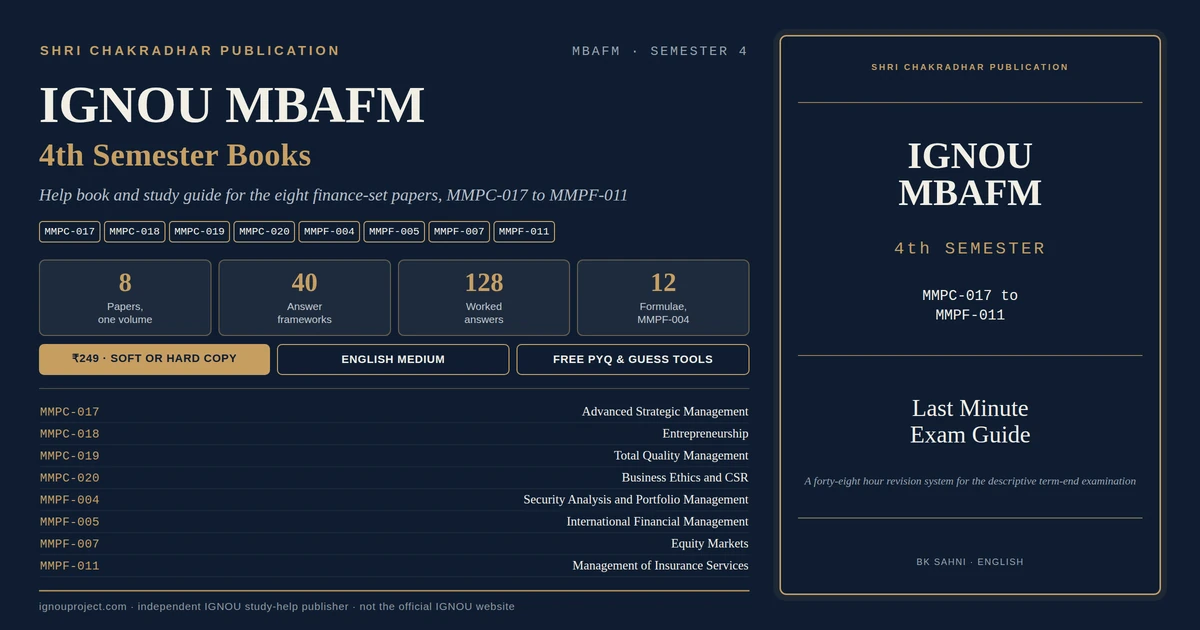
Quick answer. The IGNOU MBAFM 4th Semester Books range MMPC-017 to MMPF-011 is sold here as one volume: the IGNOU MBA (FM) 4th Semester Last Minute Exam Guide from Shri Chakradhar Publication, at ₹249. It covers eight theory papers — MMPC-017 Advanced Strategic Management, MMPC-018 Entrepreneurship, MMPC-019 Total Quality Management, MMPC-020 Business Ethics and CSR, MMPF-004 Security Analysis and Portfolio Management, MMPF-005 International Financial Management, MMPF-007 Equity Markets and MMPF-011 Management of Insurance Services. IGNOU writes the programme code MBAFM; this volume’s inside pages write MBA (FM); marketplaces sell the finance half as an MBA 4th Semester Financial Management combo.
Counted out of the volume rather than read off its cover, it holds forty answer frameworks, 128 worked answers to high-probability questions, 120 rows ranked by how often they recur, 64 named contributors, 88 definitions, 26 comparison tables, a hundred golden facts, an eighty-question self-test and a single twelve-formula table sitting inside the MMPF-004 chapter. The set-size warning matters more here than anywhere else in this programme: the standard finance combo on the market contains three books — MMPF-004, MMPF-005 and MMPF-011 — and omits MMPF-007 entirely, because Equity Markets is registered by MBAFM learners and nobody else. Semester 4 carries no project; MMPP-001 belongs to Semester 3. Soft copy and hard copy are both arranged on WhatsApp at +91 93546 37830, and checking your codes is free.
What You Get for ₹249
Every number below came out of parsing the 104 tables inside this MBAFM volume. The cover was not treated as a source for any of them, and where the two disagree the count is what appears here.
- Forty answer frameworks — five in each of the eight chapters, with the fifth in every chapter built for short notes, since a short-notes question turns up in most papers in this family.
- One hundred and twenty-eight worked answers, sixteen per paper, each tagged to its framework and frequency band. The cover advertises more than that; 128 is the counted figure, and the gap is set out below rather than glossed over.
- 12 formulae in one table, all inside MMPF-004 — holding period return, expected return, variance, beta, the capital asset pricing model, the Gordon growth equation, the Sharpe and Treynor measures, Jensen’s alpha, modified duration, portfolio return and the price-earnings ratio.
- A hundred and twenty frequency-ranked topics — fifteen in every chapter, split with complete regularity into seven at the top band, seven in the middle and one at the bottom.
- 64 named contributors and statutes, from Chandler, Ansoff, Porter and Schumpeter through Deming, Juran and Crosby to Markowitz, Sharpe, Treynor, Jensen, Fama and Gordon, and on to the SEBI Act 1992, the Insurance Act 1938 and the IRDAI Act 1999.
- 88 definitions, eleven per paper, phrased the way an examiner marks without pausing.
- 26 comparison tables, including fundamental against technical analysis, systematic against unsystematic risk, the Sharpe against the Treynor measure, forwards against futures, primary against secondary markets and facultative against treaty reinsurance.
- Eighty verb rows, a hundred golden facts, an eighty-question self-test and eight capsules, the self-test set as one eighty-minute closed-book run rather than eight separate exercises.
Only MMPF-004 carries formulae, and that asymmetry is the whole shape of the semester: seven papers are won on naming and structuring, one is won on working things out correctly and showing the steps. Written in English only, and cut to exactly the MMPC-017 to MMPF-011 registration.
The Problem This Book Was Written For
Semester 4 arrives without a project and without a timetable of its own, which makes it feel lighter than it is. Eight papers of identical weight, roughly forty genuinely examinable topics, and a single quantitative paper sitting in the middle of seven descriptive ones — that combination produces a specific set of failures.
- MMPF-004 is the paper that breaks the pattern. On its June 2025 sitting, two of the eight questions printed were calculations. A learner who has practised only prose can still attempt any five and avoid both, but only if the other six are genuinely ready.
- MMPF-005 and MMPF-004 both talk about risk and both mention parity and pricing, and answers written for one drift into the other unless the exposure types and the parity conditions are kept separate by name.
- MMPF-007 and MMPF-011 are statute papers. SEBI, the Depositories Act 1996, the Insurance Act 1938, the IRDAI Act 1999 and the Malhotra Committee each own a specific provision, and a general description where a named section was wanted scores as background.
- MMPC-019 is an attribution paper. Deming, Juran, Crosby, Ishikawa, Feigenbaum, Shewhart, Taguchi and Shingo each own one contribution, and swapping any two costs the mark outright.
- MMPC-020 splits its questions ten plus ten, which means two separate answers where a single essay would be marked as one.
The volume answers those five directly across its 40 frameworks: a compute-and-interpret shape for MMPF-004 with twelve formulae behind it, a parity-and-exposure map for MMPF-005, a market-segment-plus-regulator shape for MMPF-007, a principle-plus-statute shape for MMPF-011 and a guru-plus-contribution shape for MMPC-019.
Eight papers. One volume. ₹249.
Message the codes and the session; format choices come straight back. Say whether MMPF-007 Equity Markets is on your registration and you will be told plainly whether this eight-paper volume fits you better than the three-book finance sets.
₹249
Choose PDF or print · English only · the eight codes MMPC-017 to MMPF-011
Checking your eight MBAFM codes is free and is answered between 9 am and 6 pm, Monday to Saturday.
Inside the Book: The Same Six Sections in Every Chapter
All eight chapters, MMPC-017 through MMPF-011, run on one internal architecture with no variation whatever: fifteen ranked topics, ten command verbs, five frameworks, sixteen questions, four toolkit tables and four capsule boxes, chapter after chapter. Across the volume that produces the 120 ranked topics, 80 verb rows, 40 frameworks and 128 worked answers the free tools further down operate on.
| Chapter part | Its contents in this volume | Where it fits your revision |
|---|---|---|
| Opener and Topic Heatmap — part A | A course snapshot plus fifteen ranked topics, every one referenced to a block rather than a unit, because block coverage is all this volume records for the eight papers | First, to set the order in which that paper gets opened |
| Command Verb Decoder — part B | Ten verbs with an example taken from that paper, so Compute is demonstrated on a Sharpe measure in MMPF-004 and Distinguish on transaction against economic exposure in MMPF-005 | One pass, before the first twenty-mark answer is attempted |
| Answer Frameworks — part C | Five per chapter, the fifth always a short-note builder. The other four are cut to the subject: a compute-and-interpret shape in MMPF-004, a statute map in MMPF-011, a guru-and-contribution map in MMPC-019 | Once the topic order is fixed and answer writing begins |
| High-Probability Q&A — part D | Sixteen questions per paper with worked answers, each carrying its framework number, frequency band and a closing exam note | The long middle of revision — 128 answers is a great deal of writing |
| Revision Toolkit — part E | Four tables everywhere: contributors, definitions, comparisons and common mistakes. MMPF-004 alone adds a fifth, the twelve-formula table | The day before that paper, and whenever formulae get drilled |
| Thirty-Minute Capsule — part F | Four boxes carrying the concepts to hold, the sure-shot questions, the emergency openers and the golden keywords | The half hour before you are called in, one capsule per subject |
Narrow screen? The chapter-parts table scrolls right to its third column.
That uniformity carries a scheduling consequence. Because all eight chapters weigh exactly the same — fifteen ranked rows apiece, seven of them three-star — nothing in the book front-loads your revision for you. Fifty-six three-star rows spread evenly across MMPC-017 to MMPF-011 is the real syllabus, and whichever paper you leave last gets your tired hours.
The second consequence is where the bulk actually sits. Section E contributes 88 definitions and 26 comparison tables across the eight chapters, Section D contributes the 128 worked answers, and one lone Section E table carries all twelve formulae. So most of this volume by table count is toolkit and question bank rather than the 40 frameworks printed on the cover.
Your Eight Papers, and What the Book Does for Each
Anyone searching IGNOU MBAFM 4th Semester Books or IGNOU MBA Financial Management 4th semester books runs into a real disagreement about how many books the set contains, and it is worth settling first. The finance combo sold across the marketplaces holds three books: MMPF-004, MMPF-005 and MMPF-011. Buy that alongside the four-book core combo and you have seven — with MMPF-007 Equity Markets missing. This volume covers all eight. Each theory course carries four credits, and Semester 4 has no project attached, because MMPP-001 sits in Semester 3.
| Code | Course title printed in the volume | Credits | In the ready-made market sets? |
|---|---|---|---|
| MMPC-017 | Advanced Strategic Management | 4 | Yes, in the four-book core combo |
| MMPC-018 | Entrepreneurship | 4 | Yes, in the four-book core combo |
| MMPC-019 | Total Quality Management | 4 | Yes, in the four-book core combo |
| MMPC-020 | Business Ethics and CSR | 4 | Yes, in the four-book core combo |
| MMPF-004 | Security Analysis and Portfolio Management | 4 | Yes, in the three-book finance combo |
| MMPF-005 | International Financial Management | 4 | Yes, in the three-book finance combo |
| MMPF-007 | Equity Markets | 4 | No — this is the one they leave out |
| MMPF-011 | Management of Insurance Services | 4 | Yes, in the three-book finance combo |
Narrow screen? The course table scrolls right to its last column.
Points where IGNOU and the marketplaces tell different stories. Six differences matter, and the first two decide whether this is your book at all.
One, the MMPF-007 gap, and why it exists. Gyaniversity’s finance combo is three books at ₹540 for the printed set; Shri Chakradhar’s own marketplace listing for the MBA 4th Semester finance combo runs MMPF-001, 002, 003, 004, 005, 006 and 011 — again no 007. The reason is not carelessness. Equity Markets is an MBAFM-only course. Gyaniversity’s own subject page lists MBAFM as its sole programme code, where MMPF-004 and MMPF-005 are shared with PGDIFM and the plain MBA and MMPF-011 is shared with those plus MBF. And MMPF 007 returns no hits at all in the Common Prospectus for July 2026, in either the hyphenated or the spaced form, as does the phrase Equity Markets. So the finance combos are assembled for the plain-MBA elective list. If you are registered on MBAFM, they are missing a paper you must sit.
Two, the PGDIFM clash. The Common Prospectus does tabulate three of your four finance papers — but under PGDIFM, the Post Graduate Diploma in Financial Management, not MBAFM. There, MMPC 004, MMPC 014, MMPF 001, MMPF 002 and MMPF 003 form Semester I, and MMPF 004, MMPF 005, MMPF 006 and MMPF 011 form Semester II, across 36 credits, with the instruction to choose any seven of the electives and English as the medium. If your programme code reads PGDIFM, your finance papers are Semester II papers and this Semester 4 framing is not yours.
Three, and this one corrects a page on this site. Sources disagree about which single core course the specialisation MBAs drop. One widely cited syllabus summary says specialisation learners take nineteen core courses from MMPC-001 to MMPC-020 except MMPC-017. The prospectus evidence leans the same way: MMPC 017 returns no hits in either code form, while MMPC 019 and MMPC 020 each return two. But the market says something else — the seven-book MBAHM Semester 4 combo drops MMPC-019 and keeps MMPC-017, and Gullybaba sells MMPC-19 branded for MBAFM. Our own MBAHM 4th Semester books page reported the omitted course as MMPC-019 on that market evidence; this page’s prospectus evidence points at MMPC-017 instead. Both readings are recorded here because neither source settles it. Only your Samarth registration does.
Four, the course count contradicts itself inside the same documents. The specialisation MBA is described as nineteen core plus eight specialisation courses, totalling 28 courses and 116 credits — and in the same breath as four specialisation courses in Semester 3 and three in Semester 4, which comes to seven. This volume covers four finance papers in Semester 4, not three.
Five, the volume’s dating contradicts itself. Publisher page and copyright notice read 2027 Exam Edition; the printed cover reads 2026. Neither dating affects the eight codes themselves.
Six, hyphens break searches. The Common Prospectus prints the codes unhyphenated, so MMPF-004 finds nothing in it while MMPF 004 finds an entry. Gullybaba drops leading zeros and lists the same papers as MMPC-17 MMPC-18 MMPC-19 MMPC-20 and MMPF-4 MMPF-5 MMPF-11, while the prospectus writes them spaced as MMPC 17 MMPC 18 MMPF 4 MMPF 5 MMPF 11; IGNOU’s own paper files use the MMPF-4 and MMPF-11 style too. Confirm the codes on your registration record rather than from any listing, this page included.
MMPC-017 Help Book — Advanced Strategic Management
MMPC-017 assumes you still hold MMPC-012 from the second year and then asks for more of it. The volume records four blocks — strategy concepts and corporate policy, corporate-level strategies and growth, internationalisation and global strategy, and technology and evaluation — with no unit total, which is true of all eight chapters. Seven of its fifteen ranked rows carry three stars: the three strategy levels, corporate policy and strategic intent, stability against growth against retrenchment, diversification and integration, mergers and acquisitions and alliances, why and how firms internationalise, and competitive advantage read through Porter and the resource-based view. This chapter contributes eight dated names — Chandler (1962), Ansoff (1957), Porter across 1979 to 1985, Prahalad and Hamel (1990), Barney (1991), Mintzberg, Dunning and Bartlett and Ghoshal (1989) — with three comparisons covering related against unrelated diversification, horizontal against vertical integration and cost leadership against differentiation. For a finance learner the trap here is specific: the internationalisation block overlaps with MMPF-005, and an entry-mode question answered with parity conditions rather than with Dunning’s framework loses the attribution. Searches for an MMPC-017 help book, IGNOU MMPC-017 study material or an IGNOU MMPC-017 previous year question paper usually come from learners who hold the models but not the years.
MMPC-018 Help Book — Entrepreneurship
MMPC-018 is the classification paper among the four core subjects. Its four blocks run across entrepreneurship concepts and types, opportunity and business model and feasibility, institutional support and finance and policy, and enterprise launch and growth. Seven rows sit at three stars: the concept, functions and types of entrepreneurship; entrepreneurial competencies and motivation; women entrepreneurship; rural entrepreneurship; opportunity identification and idea generation; business model selection and validation; and feasibility analysis across its technical, market and financial arms. This chapter contributes eight contributors — Schumpeter (1934), McClelland (1961), Drucker (1985), Kirzner, Danhof, Timmons, Osterwalder, and Ries with Blank — plus comparisons of entrepreneur against manager, opportunity-driven against necessity-driven venturing, and debt against equity finance. That last comparison is where finance learners gain and lose most: the debt-versus-equity row here is a general one, and answering it with a weighted average cost of capital treatment from your finance papers over-answers the question. An MMPC-018 help book, IGNOU MMPC-018 study material, an IGNOU MMPC-018 important questions list or an MMPC-018 guess paper that omits Schumpeter’s separation of invention from innovation leaves the opening mark unclaimed.
MMPC-019 Help Book — Total Quality Management
MMPC-019 is scored on attribution more than on argument, and the volume flags that its parts often arrive split into (a) and (b). Its four blocks cover quality concepts and the gurus, TQM principles and customer focus, tools and techniques and Six Sigma, and standards and audit and safety. Seven rows carry three stars: quality concept with dimensions and the cost of quality; the gurus themselves; TQM principles and customer focus; continuous improvement through Kaizen and PDCA; the seven QC tools; Six Sigma with the DMAIC cycle; and ISO 9001 with the integration of management systems. This chapter contributes eight names, each owning one specific contribution — Deming, Juran, Crosby, Feigenbaum, Ishikawa, Shewhart, Taguchi and Shingo — with comparisons of quality control against quality assurance, traditional inspection against the TQM approach, and Kaizen against Six Sigma. The discipline is mechanical: name the guru, state his contribution, then apply it. Fourteen points to Deming, the trilogy to Juran, zero defects to Crosby, the fishbone to Ishikawa. Searches for an MMPC-019 help book or an IGNOU MMPC-019 previous year question paper come overwhelmingly from that confusion — and note that whether MMPC-019 is on your registration at all is one of the open questions set out in the callout above.
MMPC-020 Help Book — Business Ethics and CSR
MMPC-020 has the most distinctive question format in the set: the volume records its parts as frequently arriving split ten plus ten, which means two separate answers where one essay scores as one. Its four blocks run from ethics concepts and theories, through ethical decision-making and organisational factors, to corporate governance and social activism, and finally corporate social responsibility. Seven rows carry three stars: business ethics against law; consequential and non-consequential theories; egoism, utilitarianism and rights-based ethics; ethical dilemmas and their resolution; the Navigation Wheel with Kidder’s nine checkpoints; CSR with Carroll’s pyramid; and Section 135 with the CSR Rules of 2014. This chapter contributes eight contributors — Bentham and Mill, Kant, Aristotle, Rawls (1971), Gilligan (1982), Habermas, Kohlberg and Kidder — and four comparison tables, the joint largest here, covering egoism against utilitarianism, the shareholder against the stakeholder view, ethics against law, and teleological against deontological reasoning. For a finance learner the shareholder-versus-stakeholder row is the one to prepare hardest, because it is where corporate governance and CSR meet. An MMPC-020 help book or IGNOU MMPC-020 study material that treats Section 135 as commentary rather than citing the section is dropping the easiest marks in the paper.
MMPF-004 Help Book — Security Analysis and Portfolio Management
MMPF-004 is the paper this page used to verify the examination format, because its June 2025 term-end paper sits on IGNOU’s servers and was opened and read in full. It is also the only chapter in the volume carrying formulae. Its four blocks cover the investment environment and securities markets, security analysis both fundamental and technical, portfolio theory and selection, and portfolio evaluation and revision. Seven rows carry three stars: the investment environment and securities market constituents; risk and return measurement; fundamental analysis through the economy-industry-company framework; industry analysis and the industry life cycle; equity valuation through dividend discount and growth models; technical analysis with its assumptions, charts and indicators; and portfolio theory through Markowitz and diversification. This chapter contributes eight contributors — Markowitz (1952), Sharpe, Treynor, Jensen (1968), Fama (1970), Gordon, Ross and Dow — three comparisons including fundamental against technical analysis and the Sharpe against the Treynor measure, and the twelve-formula table. The habit that lifts an MMPF-004 script is the one its own exam strategy names: at least two of your five answers here are likely to require working, so write the formula, substitute the figures, box the result and then say in one sentence what it means for the investor. An IGNOU MMPF-004 previous year question paper, an IGNOU MMPF-004 important questions list or IGNOU MMPF-004 study material that prints final answers without the substitution teaches exactly the wrong habit.
MMPF-005 Help Book — International Financial Management
MMPF-005 is an institutional paper with parity relationships threaded through it, and the volume notes that its parts often split into (a) and (b). Four blocks cover the international monetary system and balance of payments, foreign exchange markets and parity conditions, exposure and hedging, and international financing and investment decisions. Seven rows carry three stars: the evolution of the international monetary system; the balance of payments structure and its recording principles; purchasing power parity and its deviations; interest rate parity and covered arbitrage; the foreign exchange market with its participants and quotations; currency futures, forwards and hedging; and foreign exchange exposure with its types and management. This chapter contributes eight anchors — the Bretton Woods Conference (1944), Triffin, the Jamaica Accord (1976), Cassel, Keynes, Fisher, Balassa and Samuelson, and Shapiro — plus comparisons of transaction against economic exposure, forwards against futures, and fixed against floating rate systems. The habit that lifts an MMPF-005 script is dating the institution and then stating the parity relationship as a relationship rather than describing it loosely. An MMPF-005 help book, IGNOU MMPF-005 study material, an IGNOU MMPF-005 previous year question paper or an IGNOU MMPF-005 guess paper that leaves 1944 and 1976 out is doing half the work.
MMPF-007 Help Book — Equity Markets
MMPF-007 is the paper the ready-made sets omit, and the only one of your eight that belongs to MBAFM and to no other programme. Its four blocks cover the financial system with risk and return, raising capital and issue management, the regulatory framework and investor protection, and trading and settlement. Seven rows carry three stars: the financial system and types of financial market; risk, return and volatility; sources and methods of raising capital; the public issue with its advantages, drawbacks and success factors; issue management and book building; SEBI with the regulatory framework and investor protection; and trading, order types and settlement. This chapter is the most statutory in the volume: four of its eight contributor entries are instruments rather than people — the SEBI Act 1992, the Depositories Act 1996, the SEBI ICDR Regulations and the SEBI LODR Regulations — alongside Dow, Markowitz, Sharpe and Fama. Its comparisons cover primary against secondary markets, money against capital markets, and market against limit orders. The habit that lifts an MMPF-007 script is naming the market segment and then the regulator and the regulation that governs it, in that order. Because the market sets skip it, an MMPF-007 help book, IGNOU MMPF-007 study material, an IGNOU MMPF-007 notes PDF or an IGNOU MMPF-007 previous year question paper is genuinely harder to find than for any other code in this set.
MMPF-011 Help Book — Management of Insurance Services
MMPF-011 closes the specialisation and is, above all, a principles-and-statutes paper. Its four blocks cover insurance concepts, principles and the contract; life insurance products and underwriting; general, health and rural insurance; and regulation with the IRDAI. Seven rows carry three stars: the insurance concept with its functions and risk pooling; the principles of insurance and the valid contract; life insurance need and product types; underwriting and risk assessment; the IRDAI with its establishment, composition and functions; micro and rural insurance; and general insurance across fire, marine and motor products. This chapter contributes eight anchors, and like MMPF-007 most of them are instruments and doctrines rather than individuals — the Insurance Act 1938, the Indian Contract Act 1872, the Malhotra Committee (1994), the IRDAI Act 1999, the law of large numbers, and the doctrines of uberrimae fidei, indemnity and subrogation — with four comparisons including conventional against micro insurance and facultative against treaty reinsurance. The habit that lifts an MMPF-011 script runs one way: name the doctrine in its Latin form, state what it requires, then give the claim example. An MMPF-011 help book, IGNOU MMPF-011 study material, an IGNOU MMPF-011 previous year question paper or a set of IGNOU MMPF-011 solved guess papers, or an IGNOU MMPF-011 solved assignment, that describes good faith without naming uberrimae fidei is answering a general question rather than this one.
The whole set, settled in a single message.
Send the eight codes with your session and you get format, courier position and payment details in a single reply.
₹249
Eight chapters in one binding · no per-paper purchase · the MMPP-001 project course sits in Semester 3
Codes are read against MMPC-017, MMPC-018, MMPC-019, MMPC-020, MMPF-004, MMPF-005, MMPF-007 and MMPF-011 before anything ships.
Official Study Material or This Guide? You Need Both
The official IGNOU blocks behind the IGNOU MBAFM 4th Semester Books range cost nothing, they are the source of record, and no revision volume substitutes for them. You can download IGNOU study material subject-wise free, and the eGyanKosh access guide shows how to get from a course code to a block.
What each does differs sharply in a finance semester. Thirty-two blocks of official material build the understanding, including the derivations behind every one of the twelve MMPF-004 formulae. This volume converts that into five twenty-mark answers written in three hours, eight papers over — and, for MMPF-004 alone, into working that has to appear on the script. Read before the blocks it teaches little; used after them in the closing weeks it is what turns recognition into a written answer.
| Typical search | The product behind it | When to use it | How it goes wrong in a finance semester |
|---|---|---|---|
| ignou mbafm study material, ignou mmpf notes pdf free download, ignou books pdf | The university’s blocks and units, free to download from eGyanKosh | Start to finish, for grasping concepts and drafting assignment answers | Also pulling MMPF-001, MMPF-002, MMPF-003 and MMPF-006 — those are Semester 3 for MBAFM, and Semester I or II papers for a PGDIFM learner |
| ignou mbafm help book, guide book, study guide, ignou guide books | A third-party revision volume compressing the syllabus into answer-ready form — the category this book sits in | The last few weeks, once you start writing answers against the clock | Buying the three-book finance combo and discovering MMPF-007 was never in it |
| ignou mbafm exam revision book, ignou mba 4th semester last minute guide | The same product, named by when you use it | Anywhere between ten days out and the last two days | Treating a project-free semester as a light one, when eight equally weighted papers demand more |
| mmpf notes, chapter wise notes, ignou study notes, ignou short notes, ignou exam notes | Condensed topic notes, slimmer than a guidebook and with no answers worked out | Odd twenty minutes when a full session is not possible | Leaning on summaries for MMPF-004, where the marks sit in substituted working that summaries never show |
| ignou mmpf solved assignment, handwritten assignment | Answers for the assignment file, graded by your centre and never seen by an examiner | Before whichever cut-off governs you, 30 April or 31 October | Treating an IGNOU MMPF-011 solved assignment as coverage — it carries 30 per cent of the course, the paper carries 70 |
| ignou mmpf previous year question paper, solved question paper, guess paper, most important questions | Past papers, and practice sets built from what those papers repeat | Once revision turns into rehearsal, beside a guide rather than replacing one | Hunting a June 2026 paper, which IGNOU had still not published when this page was checked on 11 August 2026 |
Narrow screen? The resource comparison scrolls right to its fourth column.
If the bottom two rows are nearer your real problem, the solved assignments, handwritten assignments, previous year solved question papers and guess papers pages are the right destinations. If the project rather than the papers has stalled, that belongs to Semester 3 — see the MBA finance project guide, the project course codes reference and the general MBA project report page. And if Semester 3 itself is still ahead, the MBAFM 3rd Semester books page covers MMPC-015 to MMPF-006, a wholly different set of codes from the eight here.
How the Guide Book Maps to the Term-End Examination Pattern
The weighting is 30 per cent assignment against 70 per cent term-end paper, and passing one does not offset failing the other. A C grade clears, fixed by the specialisation prospectus at 50 to 59.9 per cent, with B at 60 to 79.9 and A from 80. Each theory course costs ₹200 to sit, in either the June or the December window. Semester 4 costs ₹16,000 against Semester 3’s ₹18,000, and the absent project is the reason.
On format this page reports only what was opened and read, and one MMPF paper was retrieved from IGNOU’s own server and read end to end.
The paper that was opened. The June 2025 MMPF-004 paper runs to four printed pages and reads: Time 3 Hours, Maximum Marks 100, attempt any five questions, all questions carry equal marks. Eight questions are printed. Question 2 arrives split into (a) and (b). Question 8 is a short-notes pair. And two of the eight — questions 3 and 6 — are calculations: one asks for an expected return and a standard deviation from a probability distribution of year-end prices, the other for Treynor and Sharpe measures for three mutual funds against a market index, given betas, returns, standard deviations and a risk-free rate.
What that means for your five answers. Because you attempt any five of eight, the numerical questions are avoidable in principle — but only if six descriptive answers are genuinely ready, and on that paper the remaining six included technical-analysis chart patterns and portfolio revision benchmarks. The safer plan, and the one the volume’s own MMPF-004 strategy note assumes, is to prepare to take at least one calculation deliberately rather than to avoid both by default. The arithmetic elsewhere is unchanged across MMPC-017 to MMPF-011: five answers, twenty marks each, three hours, roughly thirty-two minutes and 300 words per written answer.
What was not verified. The volume records all eight papers as printing eight questions with any five attempted. That was confirmed for MMPF-004 on one sitting only. No MMPC paper and no MMPF-005, MMPF-007 or MMPF-011 paper was opened for this page, so their shapes come from the book rather than from a paper read here. The split-part observations for MMPC-019, MMPC-020 and MMPF-005 are the publisher’s, not verified facts. Count the questions and read the mark split on your own paper before you start selecting.
Assignments gate your eligibility to sit, on the 30 April and 31 October cut-offs. Running late? Start at the solved assignments page and verify the current dates on ignou.ac.in.
Free Tools: Previous Year Question Papers, Guess Papers and Most Repeated Questions
Nobody should buy an eight-paper MBAFM volume covering MMPC-017 to MMPF-011 on a description alone, so three of its working parts run free in your browser. The first connects you to IGNOU’s own listings for MMPC-017 to MMPF-011. The other two run on the 120 ranked rows and 80 verb entries lifted out of these eight chapters. Held back is whatever took longest to build: the 128 worked answers, the forty frameworks, the 88 definitions and MMPF-004’s twelve formulae.
Exactly seven in each of the eight chapters. Start here and finish here if time is short.
Seven per chapter again. Reach for these when all 56 three-star rows can be written from memory.
One in each paper. Only if MMPC-017 to MMPF-011 are otherwise finished.
The symmetry is exact: seven, seven and one in each of the eight chapters, so MMPF-004 carries no more ranked weight than MMPC-018. Those bands record how often each topic recurs across past MMPC and MMPF papers as the volume documents it. All they do is decide which of the 32 official blocks you open first. None of the three bands predicts what a June or December paper will contain.
Tool 1 — IGNOU MBAFM Previous Year Question Paper Finder (PYQ)
Name one of MMPC-017 to MMPF-011 and a session, and this points you at the IGNOU listing page where that PDF is filed. Re-checked on 11 August 2026, IGNOU’s downloads page carries exactly three sessions: December 2025, June 2025 and December 2024. June 2026 is not published, so it is left out of the dropdown. One paper was opened directly for this page — the June 2025 MMPF-004 — and the tool says which sessions were and were not checked code by code.
Results are study-oriented suggestions based on the book’s topic structure and general examination-preparation patterns. They are not guaranteed IGNOU examination questions.
Tool 2 — IGNOU MBAFM Guess Paper Builder
This assembles a practice paper in the shape verified on the June 2025 MMPF-004 sitting: three hours, 100 marks, eight questions printed, attempt any five at twenty marks, with a short-notes pair at question eight. Pick MMPF-004 and the builder marks two of the eight as calculation questions, because that is what the real paper did. Pick any of the other seven and every question is written. Every question is pulled from that chapter’s own fifteen rows, with the seven three-star ones appearing most. Guess papers for programmes beyond the MBA live on the guess papers page.
Results are study-oriented suggestions based on the book’s topic structure and general examination-preparation patterns. They are not guaranteed IGNOU examination questions.
Tool 3 — Most Repeated Questions and High Probability Topic Analysis
This sets out the full frequency picture for one of the eight papers — fifteen ranked rows every time, since this volume is uniform — giving each topic with its band and block reference and a question stem paired with a verb that paper’s own decoder actually lists. It is what an MMPF important-questions list looks like when it is built from 120 ranked topics and 80 verb rows instead of from a hunch.
Results are study-oriented suggestions based on the book’s topic structure and general examination-preparation patterns. They are not guaranteed IGNOU examination questions.
Frequency data costs nothing. The worked answers do not.
What the three tools read is limited to the frequency map and the verb rows. Inside the volume sit the 128 worked answers, the forty frameworks, the twelve formulae, the 88 definitions, the 64 attributions, the golden facts, the eighty-question self-test and the 26 comparison tables.
₹249
MMPC-017 to MMPF-011 · a hundred and twenty ranked rows · forty frameworks · PDF or print
Ordering nothing leaves all three tools exactly as available. Nothing you pick is recorded and no request travels off your machine.
Using the Study Guide Across a Semester, a Week, or a Final 48 Hours
The scheduling problem the IGNOU MBAFM 4th Semester Books set creates is one of false comfort. No project competes for your evenings and only one paper requires practice with a pen and a calculator, so nothing external forces a structure. Meanwhile eight papers of identical weight, 120 ranked topics and 128 worked answers sit waiting, and they do not compress the way a six-paper semester does.
Across a full semester, read the 32 official blocks paper by paper and treat the guide as a checkpoint. Finish a block, open that chapter’s Section A, and test whether you can write on all seven of its three-star rows. Fifty-six three-star rows across the semester is your real syllabus. A row you cannot handle sends you back into the official unit, not forward into the capsule. MMPF-004 is the exception to the reading-first rule: start working its twelve formulae by hand from the week you receive the block, because formulae decay faster than prose and cannot be revived in a fortnight.
Across a week, the split that suits this particular set is deliberately uneven. Give MMPF-004 two days, not one, because twelve formulae plus chart patterns plus portfolio evaluation cannot be absorbed in a sitting, and because the June 2025 paper showed two calculations among eight questions. Pair MMPF-007 with MMPF-011 on a single day, since both are statute papers and revising SEBI beside the IRDAI fixes which regulator owns which instrument. Pair MMPC-017 with MMPC-018 on a single day, since the two overlap on growth strategy and venture types, and MMPC-018 rewards the classification habit that MMPC-017 also needs. Give MMPC-019 its own half-day for the eight attributions and MMPC-020 its own half-day for the split-question format. MMPF-005 slots in wherever the parity conditions can get an undisturbed morning.
For the last 48 hours the volume divides the time into a pair of twelve-hour days, naming which papers belong to each. It states plainly that adding a new topic inside the final twelve hours lowers scores, and it treats the sleep rule as fixed rather than advisory. With eight subjects and a quantitative paper among them, the honest warning is that 48 hours is tight here and the plan only works if the blocks were read earlier in the term.
The pairing does not change with the window: the university’s blocks plus this one volume, and no new source inside the closing fortnight. If you want condensed notes alongside the 32 blocks, one supplement is enough and the study notes page is a fair choice, and the guide books online page explains how a guide book differs from official material.
Soft Copy or Hard Copy? Same ₹249, Different Study Habits
Both formats of the IGNOU MBAFM 4th Semester Books volume carry identical content at the same ₹249. Seven of your eight papers — everything except MMPF-004 — are cross-referencing work, where a search box wins. The eighth is not, and that single exception is enough to change the answer for most learners here.
| What you need to do | Printed volume | |
|---|---|---|
| Working a Sharpe or Treynor calculation by hand | Poor — the formula and your working cannot share the screen | The whole argument for print in this set |
| Reaching one of the twelve MMPF-004 formulae mid-question | One search lands on it instantly | Only as fast as the tab you stuck in beforehand |
| Separating SEBI in MMPF-007 from the IRDAI in MMPF-011 | Search a statute name and both chapters answer at once | Two chapters open side by side, which needs desk space |
| Checking which quality guru owns which contribution | A surname search settles it in seconds | A return trip to the contributors table on every check |
| Reading the 128 worked answers straight through | Simple to lose track when eight chapters run together | A ribbon and a pencil hold your place better than any scrollbar |
| The last half hour before you are called in | The capsule fits a phone screen without trouble | Also fine, if the courier beat the paper |
| How you actually receive it | Access opens the instant the ₹249 is confirmed | Whatever transit your pin code takes |
Narrow screen? The format table scrolls right to the paper column.
The compromise most finance learners land on is the PDF for searching plus a printed run of the MMPF-004 chapter and the eight capsules — because the one thing you cannot practise on a screen is the thing the June 2025 paper asked for twice.
How to Buy the IGNOU MBAFM 4th Semester Book at ₹249
One WhatsApp thread on +91 93546 37830 carries this from your first question through to dispatch. The three stages exist so your codes are read back before money moves, and in this semester that check answers a question no other page can: whether Equity Markets is on your registration.
| Step | Sent by you | Returned to you |
|---|---|---|
| 1. Start the conversation | Message +91 93546 37830 with programme code, semester, the exact course codes and your session | Your codes read against all eight, your programme checked as MBAFM rather than PGDIFM, and a direct answer on MMPF-007 |
| 2. Choose PDF or print | Name soft copy or hard copy, and add a pin code if you want the printed volume | What is in stock now, and for print the delivery window into your area |
| 3. Pay and receive | Settle the ₹249 by whichever option is sent to you | The PDF unlocks on confirmed payment; a printed copy is couriered the same working day |
Narrow screen? The three-stage table scrolls right to its third column.
Put four things in that first message: your programme code exactly as your admission record prints it, whether that reads MBAFM or PGDIFM or plain MBA; your course codes read off that record rather than recalled; your term-end session; and your format with a pin code if it is print. The check matters more here than in any other specialisation, for two separate reasons. MMPC-017, MMPC-018, MMPC-019 and MMPC-020 are shared across MBA, MBF, MBAFM, MBAHM, MBAMM and MBAOM, and which of them your specialisation actually drops is genuinely disputed between sources. Meanwhile MMPF-004, MMPF-005 and MMPF-011 belong to PGDIFM as well — where the Common Prospectus places them in Semester II — and MMPF-011 to MBF on top of that, while MMPF-007 belongs to MBAFM alone. If your set does not match this volume, a mismatch gets you a correction rather than a sale.
Order at your own pace; a single message is all it takes.
One message with the eight codes and your session brings back the formats, the courier position for your area and how to pay, plus a straight answer on whether Equity Markets is yours to sit.
₹249
MMPC-017 to MMPF-011 · English medium · the code check comes first
Answered 9 am to 6 pm Monday through Saturday, and the code read-back is free.
Where else this MBAFM volume is listed
Besides the direct WhatsApp route at ₹249, this title is listed on Amazon, Flipkart and Kindle, where rival IGNOU MBAFM guide books sit alongside it. Searching those platforms turns up other publishers’ products titled as an MBA 4th Semester Financial Management IGNOU study guides combo, as a set of 3 books including MMPF-004, MMPF-005, MMPF-011, as an MBA 4th Semester IGNOU study guides combo billed as a set of 4 books including MMPC-017, MMPC-018, MMPC-019, MMPC-020, as an MBA 4th Semester IGNOU study material combo (core courses), as an IGNOU MBA 4th Semester study material combo (financial management), as a Gullybaba IGNOU MBAFM 4th Sem MMPC-19 single title, as an MBA 4th Semester Services Management IGNOU study guides combo pairing MMPF-011 with MMPM-009 and MMPB-005, as an MBAFM 3rd Semester IGNOU study guides combo covering the previous semester, as a chapter wise help book including many solved sample papers, as a set of solved previous year question papers on its own, and as an IGNOU help book with solved previous year’s question papers and important exam notes in its latest edition. This volume is the only set of 8 books among them, and IGNOU MBA FM 4th semester books is the phrase most learners reach it by. Those are different publishers’ volumes, not this one, and their prices are their own: the printed three-book finance combo is listed at ₹540 with a soft copy at ₹427.50, against ₹249 here for eight papers. Amazon, Flipkart and Kindle each set their own dispatch and returns terms too. One check is worth more than any price comparison before you order anywhere, including here: count the codes in the listing against the codes on your registration, because three-book, four-book and seven-book sets for this semester all exist and every one of them is missing something.
How This Guide Was Prepared
Every figure below was counted by software. The supplied MBA (FM) Semester 4 volume covering MMPC-017 to MMPF-011, 56,104 words long, was converted to HTML and parsed with BeautifulSoup, so every figure here came out of its 104 tables rather than off its cover: 40 frameworks, 128 worked answers, 120 ranked topics, 64 attributions, 88 definitions, 26 comparison tables, 80 verb rows, 12 formulae, a hundred golden facts, an eighty-question self-test and eight capsules. The block names, the seven-seven-one frequency split and the 48-hour schedule came from that same parse.
Where the book overstates, and why it matters that this is the second time. The cover advertises 40 answer blueprints and 160-plus high-probability questions. On blueprints the claim is accurate to the number. The question figure does not: counted, this volume carries 128 — and its own contents panel says sixteen per subject, which across eight subjects is 128, not 160. The same 160-plus claim against a counted 128 was found in the MBA (HRM) Semester 4 volume built from this series a day earlier, so the overstatement is a strapline pattern rather than a single slip, and 128 is the figure used throughout this page. Separately, the publisher page dates the volume 2027 Exam Edition where the printed cover says 2026.
Where the MBAFM volume goes quiet. No chapter from MMPC-017 through MMPF-011 states a unit total; each says only that it runs across four blocks. So block coverage is what this page reports for all eight, and the tools cite B1 to B4 rather than unit numbers that the volume never gives.
Which facts came from IGNOU rather than from the publisher. Credit weights, medium, fees, grade bands and submission deadlines all came out of the Common Prospectus for July 2026 and the MBA Specialization Student Handbook and Prospectus. Searching for these codes needs the unhyphenated forms — MMPF-004 returns nothing in that document while MMPF 004 returns an entry. That search also surfaced the PGDIFM table quoted above, established that MMPF 007 and the phrase Equity Markets appear nowhere in the prospectus in any form, and confirmed that MMPC 017 is likewise absent in both code forms.
The university documents opened and read here. IGNOU’s previous-year-papers index was re-opened on 11 August 2026 and carried three sessions and no more. The June 2025 MMPF-004 paper was then retrieved from IGNOU’s own server and read end to end — four printed pages, eight questions, attempt any five at equal marks, three hours, 100 marks, with questions 3 and 6 requiring calculation and question 8 a short-notes pair.
The boundary of what was actually confirmed. No file address for an individual paper is assembled on this page, so the tools stop at the session listing. None of the three published listings was walked code by code for MMPC-017 to MMPF-011. Only one paper from this set was opened, so the shape recorded for the four MMPC courses and for MMPF-005, MMPF-007 and MMPF-011 comes from the book rather than from a paper read here. The split-part notes for MMPC-019, MMPC-020 and MMPF-005 are the publisher’s observation, not facts checked here. And on the disputed question of which core course the specialisation MBAs drop, this page records both readings rather than choosing, including the fact that the MBAHM Semester 4 page on this site reached the other one. Nowhere does this page assert anything about marks, grades or the contents of a future sitting.
- BK Sahni wrote and reviewed this page. He founded Shri Chakradhar Publication Pvt. Ltd. and ignouproject.com. ORCID 0009-0005-8092-459X
- Published and reviewed on 11 August 2026
- See an error? Flag it and we will put it right
- Related pages: the author profile, our contact details, the privacy policy and the terms and FAQ
Questions Students Ask Before Buying
Sixteen questions about the MMPC-017 to MMPF-011 set, answered without a sales voice. At least eight reproduce, word for word, phrasings that surfaced in the MMPF and MBAFM search harvest behind this page.
The IGNOU MBA (FM) 4th Semester Last Minute Exam Guide covering MMPC-017 to MMPF-011 is ₹249, and that same ₹249 buys either format. Nothing is priced per subject here; the eight chapters ship as a single bound volume. Ordering happens on WhatsApp at +91 93546 37830, and your codes are confirmed before any money changes hands. For scale, the printed three-book finance combo sold on the marketplaces lists at ₹540 with a soft copy at ₹427.50, and it covers three of your eight papers.
Nobody sells a complete one but this volume, which is the awkward answer. This is a single book covering eight papers: MMPC-017 Advanced Strategic Management, MMPC-018 Entrepreneurship, MMPC-019 Total Quality Management, MMPC-020 Business Ethics and CSR, MMPF-004 Security Analysis and Portfolio Management, MMPF-005 International Financial Management, MMPF-007 Equity Markets and MMPF-011 Management of Insurance Services. The market offers a four-book core combo and a three-book finance combo. Bought together those come to seven, with Equity Markets absent.
For an MBAFM learner, yes — and it is the one paper in your set that belongs to no other programme, which is precisely why the ready-made combos leave it out. Gyaniversity’s own subject page lists MBAFM as the sole programme code for Equity Markets, where MMPF-004 and MMPF-005 are shared with PGDIFM and the plain MBA. The Common Prospectus for July 2026 does not carry MMPF 007 at all, in either code form. Read your registration: if Equity Markets is on it, no three-book finance set covers you.
No single book is best for everyone, and any page saying otherwise is selling rather than advising. What can be defended is a combination — the university’s blocks for comprehension, one revision volume for written practice. Gyaniversity, Gullybaba, Neeraj, BMA and Shri Chakradhar all publish against these codes. What separates them in this semester is arithmetic — whether the set covers all eight of your papers or only three or four of them, and whether the MMPF-004 chapter actually shows substituted working rather than final answers.
The June 2025 MMPF-004 paper, opened on IGNOU’s own server for this page, reads: Time 3 Hours, Maximum Marks 100, attempt any five questions, all questions carry equal marks, with eight questions printed across four pages. That gives five answers of twenty marks in three hours, about thirty-two minutes each. The volume records the same shape for all eight papers, though only MMPF-004 was verified here. MMPC-019, MMPC-020 and MMPF-005 tend to split parts, so read the mark allocation before you write.
Mostly theory, with one clear exception. On the June 2025 MMPF-004 paper, two of the eight printed questions were calculations: one asked for an expected return and a standard deviation from a probability distribution of year-end prices, the other for Treynor and Sharpe measures across three mutual funds against a market index. MMPF-005, MMPF-007 and MMPF-011 are written papers, as are all four MMPC courses. Because you attempt any five of eight, the calculations can be avoided — but only if six written answers are genuinely ready.
All four MMPF papers and all four MMPC papers are free on eGyanKosh, IGNOU’s own repository, block by block. Reaching them requires nothing from this site. The study material download page gathers the subject-wise routes together and the eGyanKosh access guide shows how to get from a course code to a block. What a free IGNOU study material PDF download or a bundle of free IGNOU notes cannot give you is a compressed revision route across eight subjects.
IGNOU publishes them at no charge on its own downloads page. Re-checked on 11 August 2026, it carries three sessions: December 2025, June 2025 and December 2024. Tool 1 above points at the session listing rather than a constructed file path, because guessed addresses for IGNOU MBAFM previous year question paper PDFs break. There is no June 2026 paper for any of these eight codes, so anything sold as one did not originate with IGNOU.
It changes it substantially. MBAFM is the two-year MBA in Financial Management; PGDIFM is the Post Graduate Diploma in Financial Management. The Common Prospectus for July 2026 tabulates PGDIFM as MMPC 004, MMPC 014, MMPF 001, MMPF 002 and MMPF 003 in Semester I, then MMPF 004, MMPF 005, MMPF 006 and MMPF 011 in Semester II, across 36 credits with English as the medium. So a PGDIFM learner meets three of your four finance papers in a second semester, alongside MMPF-006, and never sits Equity Markets.
The specialisation MBAs are described as nineteen core courses plus eight specialisation courses, totalling 28 courses and 116 credits — though the same sources then say four specialisation courses in Semester 3 and three in Semester 4, which comes to seven rather than eight. Which core course do MBA specialisations drop? Sources genuinely conflict: one widely cited syllabus summary says the nineteen run from MMPC-001 to MMPC-020 except MMPC-017, and the Common Prospectus carries no MMPC 017 entry in either code form, while the market’s seven-book specialisation sets instead omit MMPC-019. Your registration record settles it and nothing else does.
Semester 4 sets no project at all. Does the guide book cover the MMPP-001 project? It does not: the MMPP-001 project course is an eight-credit registration belonging to Semester 3, which is also why Semester 4 costs ₹16,000 against Semester 3’s ₹18,000. If the project is what has stalled, the MBA finance project guide and the project course codes reference are the right places. Only the eight theory papers sit inside it.
It costs the same ₹249, carries the same content, and unlocks once your order is confirmed. It suits seven of your eight papers well: one search for a statute or a surname sweeps every chapter that uses it, which is the check MMPF-007 and MMPF-011 keep demanding. It suits MMPF-004 least, because a formula and your working cannot share a screen. Many finance learners take the PDF and print the MMPF-004 chapter.
Print is available at that same ₹249. How fast it arrives depends on where you are, so include your pin code at the start and the courier window for your area is quoted before you pay rather than after. No countrywide delivery figure is promised here, since inventing one would be dishonest. Should your first sitting land inside that window, the PDF is the safer choice.
Is the MBAFM 4th semester guide available in Hindi medium? The book exists in English and no other medium. Worth knowing: the Common Prospectus lists MBAFM itself as available in English and Hindi, while its PGDIFM entry covering three of these same MMPF codes states English only, so the sources disagree. Hindi medium students ke liye there is still a route — IGNOU issues the official blocks for the MMPC and MMPF papers in Hindi on eGyanKosh — so a learner searching IGNOU MBAFM 4th semester ki kitab in Hindi will find the university’s own material even though this guide is English.
It cannot, and was never designed to. IGNOU’s blocks are the source of record, they cost nothing, and the syllabus derives from them — including the derivations behind every one of the twelve MMPF-004 formulae, which this volume states but does not prove. What it adds is compression: ranked topic orders, forty answer frameworks, 128 worked answers and eight capsules. On its own the volume would be too thin to carry you. Read after the blocks, it is what converts understanding into a twenty-mark answer produced in thirty-two minutes.
No. The 56 three-star, 56 two-star and 8 one-star ratings record how often each topic has recurred in past IGNOU MBAFM question paper sets as the volume documents it, which is all any list of IGNOU MBAFM important questions or IGNOU MBAFM notes can honestly claim. It documents questions already set; it says nothing about questions still to come. Their purpose is to order revision when eight papers compete for one fortnight. Nothing on this page promises anything about a particular June or December paper.
Important Notice About This Website
IGNOUProject.com is owned and operated by Shri Chakradhar Publication Pvt. Ltd. on an entirely independent footing, unconnected to Indira Gandhi National Open University or with the finance faculty of its School of Management Studies. The IGNOU MBAFM 4th Semester Books described here are an independent product. The eight course codes named — MMPC-017, MMPC-018, MMPC-019, MMPC-020, MMPF-004, MMPF-005, MMPF-007 and MMPF-011 — appear for one purpose only, to say which eight subjects the volume covers, and MBAFM appears only to say which specialisation registers them.
The product on sale is a revision aid published privately. No endorsement from the university attaches to it, and IGNOU had no hand in publishing it. Its 120 topic rankings, its 40 frameworks, its twelve-formula table and its 48-hour schedule are the publisher’s editorial work, not university data. Where the cover, the inside pages and IGNOU’s documents disagree — on 160-plus questions against a counted 128, and on the 2026 against the 2027 edition year — each disagreement is printed above rather than settled quietly.
Three warnings sit apart because they decide whether this volume is your set at all. The first is Equity Markets: MMPF-007 is an MBAFM-only course, it appears nowhere in the Common Prospectus, and the finance combos on the market omit it, so count the codes in any listing against your registration before ordering anywhere, here included. The second is the programme: the Common Prospectus places MMPF 004, MMPF 005, MMPF 006 and MMPF 011 in Semester II of PGDIFM, the Post Graduate Diploma in Financial Management, so a PGDIFM learner’s papers are not grouped as they are on this page. The third is the disputed core course — sources conflict over whether the specialisation MBAs drop MMPC-017 or MMPC-019, both readings are set out above, and only your own registration record resolves it.
Those three tools are teaching aids given free and kept separate from any ₹249 enquiry. All of it runs locally on the frequency map and verb rows extracted from the volume; nothing is saved, nothing transmitted, and no IGNOU system is touched. The first tool points only at the three question-paper sessions IGNOU had published on 11 August 2026 and never assembles a file address itself. Using them commits you to nothing. Verify the eight codes, your sitting dates and the applicable assignment cut-off on ignou.ac.in and through Samarth before relying on a word of this.
MMPC-017 to MMPF-011 in one volume, ₹249.
Message the eight codes exactly as your registration record prints them, together with your programme code and your June or December session, and the format options, the courier position for your pin code and the payment step come back in a single reply. If MMPC-017 to MMPF-011 is not your set, that is what you will be told.
₹249
MMPC-017 to MMPF-011 · English medium · soft copy or hard copy
+91 93546 37830 · 9 am to 6 pm, Monday to Saturday · the MMPC-017 to MMPF-011 check is free.

BK Sahni iD 0009-0005-8092-459X
Founder, Shri Chakradhar Publication Pvt. Ltd. & ignouproject.com — helping IGNOU distance-learning students since 2010 (5,00,000+ students supported across MBA, MCom, MA & more). Author of IGNOU exam guides, solved assignments & project reference books.
Disclosure: Shri Chakradhar Publication Pvt. Ltd. and ignouproject.com are independent third-party study-help services — not the official IGNOU website. Always verify final dates and rules on ignou.ac.in.