IGNOU MAAE · December 2026 term-end examination
IGNOU MAAE Guess Paper: Communication Came Up in All Seven MAE-001 Papers, and Networking in All Seven MAE-003 Papers
Twenty-two IGNOU question papers for MAE-001, MAE-002, MAE-003, MAE-004 and MAE-006, from June 2023 to June 2026, compared theme by theme, with the December 2026 dates for all fourteen MAAE theory codes.
- 22 IGNOU papers compared
- Seven sessions, June 2023 to June 2026
- Four questions, equal weightage
- Every MAAE paper in the morning slot
- MAE-006 printed in English only
- Two free planning tools
Ask for an MAE Revision Set on WhatsApp
Independent publisher, not IGNOU. Sets are revision aids; nobody outside IGNOU knows the questions.
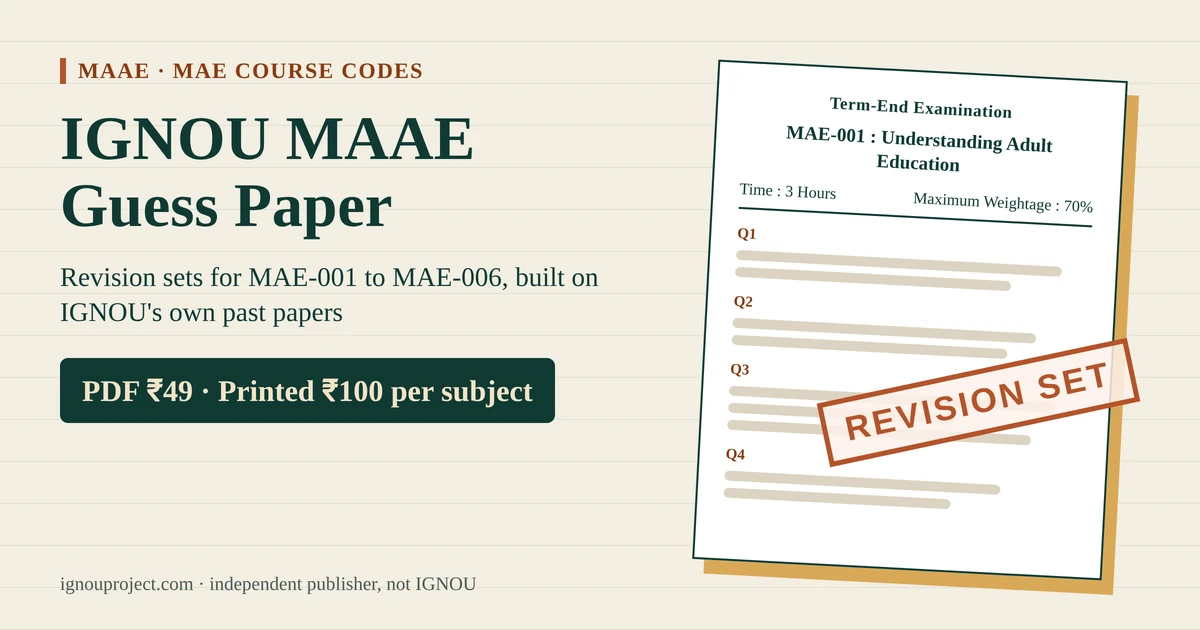
Quick answer. An IGNOU MAAE guess paper is a publisher’s revision set of recurring questions with model answers for one MAE course code, such as MAE-001, built from IGNOU’s past term-end papers and the course blocks. MAAE (M.A. in Adult Education, School of Education) runs MAE-coded courses that IGNOU sets in a fixed format: 3 hours, four compulsory questions of equal weight, and a printed “Maximum Weightage : 70%” in place of marks. On IGNOU’s tentative date sheet of 21 September 2026, MAAE papers run from MAEE-001 on 1 December 2026 to MES-016 on 2 January 2027, all in the 10 AM to 1 PM slot. Across seven MAE-001 papers from June 2023 to June 2026, a communication question appeared every time. Sets cost ₹49 PDF · ₹100 printed, per subject code, with a one-time ₹100 courier charge per printed order; they are prepared in English, and Hindi is confirmed per code on WhatsApp only where IGNOU’s paper carries a Hindi version. No set can tell you which questions IGNOU will ask.
MAAE December 2026 Papers: 1 December to 2 January, All in the Morning Slot
The first MAAE paper of the December 2026 cycle is MAEE-001 on Tuesday 1 December 2026, and the last is MES-016 on Saturday 2 January 2027, per IGNOU’s tentative date sheet dated 21 September 2026. Every one of the fourteen MAAE theory codes sits in the morning session, 10 AM to 1 PM.
December 2026 term-end examination: 25 November 2026 to 13 January 2027 on the 21 September sheet.
First MAAE paper
MAEE-001 · Tue 1 Dec 2026 · morning
Last MAAE paper
MES-016 · Sat 2 Jan 2027 · morning
Tentative · sheet dated 21 September 2026 · IGNOU has also posted a revised tentative sheet dated 5 October 2026
Read the dates in two blocks. Year II papers come first, from 1 December to 23 December. Year I papers start later, with MAE-001 on 10 December, and they end with MES-016 on 2 January, eleven days after MAE-004. The date sheet gives no evening slot to any MAAE code, so a learner holding a full-time job plans leave for mornings only. The IGNOU file itself is the tentative December 2026 date sheet PDF; the publisher’s December 2026 date sheet guide explains how to search it, and the morning and evening exam timings page covers reporting time at the centre.
Year I Runs From MAE-001 on 10 December to MES-016 on 2 January
Six Year I theory papers fall across twenty-four days. MAE-001 is on Thursday 10 December, MAE-006 on Monday 14 December, MAE-002 on Friday 18 December, MAE-003 on Saturday 19 December, MAE-004 on Tuesday 22 December and MES-016 on Saturday 2 January 2027. The long break before MES-016 is real revision time, and it is the only stretch longer than four days.
The Friday and Saturday Pair: MAE-002 Then MAE-003
MAE-002 and MAE-003 sit on consecutive mornings, 18 and 19 December. Both are 600-word essay papers, so the second day is the one that suffers if nothing is revised in advance. Learners carrying a Year II backlog meet longer runs: MLL-001 on 17 December leads straight into MAE-002 and MAE-003, and MES-131 on 9 December sits the day before MAE-001.
Clash check for MAAE, December 2026.
- No two MAAE theory codes share a date on the 21 September sheet, so there is no same-day clash inside the programme.
- Year I back-to-back: MAE-002 (Fri 18 Dec) and MAE-003 (Sat 19 Dec).
- Year II back-to-back: MAE-005 (Thu 3 Dec), MESE-061 (Fri 4 Dec) and MESE-062 (Sat 5 Dec), a three-day run for anyone who picked both MESE electives.
- Backlog runs: MES-131 then MAE-001 (9 and 10 Dec); MLL-001, MAE-002, MAE-003 (17 to 19 Dec); MAE-004 then MAEE-003 (22 and 23 Dec).
Swipe the table sideways on a phone to see every column.
| Code | Date (per the 21 September sheet) | Course | Year | Slot |
|---|---|---|---|---|
| MAEE-001 | Tue 1 Dec 2026 | Sustainable Development | Year II elective | Morning, 10 AM to 1 PM |
| MAE-005 | Thu 3 Dec 2026 | Population and Development Education | Year II | Morning, 10 AM to 1 PM |
| MESE-061 | Fri 4 Dec 2026 | Open and Distance Learning Systems | Year II elective | Morning, 10 AM to 1 PM |
| MESE-062 | Sat 5 Dec 2026 | Vocational Education | Year II elective | Morning, 10 AM to 1 PM |
| MAEE-002 | Mon 7 Dec 2026 | Basics of Legal Awareness | Year II elective | Morning, 10 AM to 1 PM |
| MES-131 | Wed 9 Dec 2026 | Educational Technology: An Overview | Year II | Morning, 10 AM to 1 PM |
| MAE-001 | Thu 10 Dec 2026 | Understanding Adult Education | Year I | Morning, 10 AM to 1 PM |
| MAE-006 | Mon 14 Dec 2026 | Adult Learning and 21st Century Skills | Year I | Morning, 10 AM to 1 PM |
| MLL-001 | Thu 17 Dec 2026 | Lifelong Learning: An Overview | Year II elective | Morning, 10 AM to 1 PM |
| MAE-002 | Fri 18 Dec 2026 | Policy Planning and Implementation of Adult Education in India | Year I | Morning, 10 AM to 1 PM |
| MAE-003 | Sat 19 Dec 2026 | Knowledge Management, Information Dissemination and Networking in Adult Education | Year I | Morning, 10 AM to 1 PM |
| MAE-004 | Tue 22 Dec 2026 | Extension Education and Development | Year I | Morning, 10 AM to 1 PM |
| MAEE-003 | Wed 23 Dec 2026 | Comparative Adult Education | Year II elective | Morning, 10 AM to 1 PM |
| MES-016 | Sat 2 Jan 2027 | Educational Research | Year I | Morning, 10 AM to 1 PM |
IGNOU’s revised tentative sheet of 5 October 2026 extends the cycle to 14 January 2027. Check your own codes against the newest PDF on ignou.ac.in and against your hall ticket before planning travel; a tentative sheet can still move a date.
Why the MAE Term-End Script Settles 70 Per Cent of Each Course
The term-end examination carries 70 per cent of the final course result and assignments carry the remaining 30 per cent. That split is printed in the MAAE Programme Guide, and every MAE paper repeats the 70 per cent on its cover as “Maximum Weightage : 70%”.
The Programme Guide also sets the pass rule. An MAAE learner needs at least a D grade in the assignment and at least a D grade in the term-end examination, separately, and an overall C grade in each theory course. A strong assignment cannot rescue a script below D. On the guide’s scale, D covers 40 to 49.9 per cent and C covers 50 to 59.9 per cent; the percentage from IGNOU grades page shows how grades turn into a figure.
Because all four questions carry equal weight, each one is worth 17.5 per cent of the course result. Question 3, the four short notes, counts exactly as much as a 600-word essay. Skipping one short note costs about a quarter of that question.
Revision Set, IGNOU’s Own Past Paper or a Solved Copy: Which an MAAE Learner Needs
A guess paper is a revision set of important and recurring questions for one course code, such as MAE-001 or MAE-003, with model answers, prepared by a publisher from IGNOU’s past papers and the syllabus; important questions, expected questions and model paper are other names learners use for the same thing.
A previous year question paper is the actual paper IGNOU set in an earlier term-end examination, for example the June 2026 MAE-002 paper, and IGNOU publishes these free on its own question paper archive.
A solved question paper is that actual IGNOU paper with a publisher’s model answers added. The IGNOU solved question papers page explains that lane; the IGNOU guess paper hub covering every programme lists the other courses.
Swipe the table sideways on a phone to see every column.
| Guess paper | Previous year paper | Solved paper | |
|---|---|---|---|
| What it is | Recurring MAE themes with model answers | IGNOU’s own past paper | IGNOU’s past paper plus answers |
| Who makes it | A publisher | IGNOU | A publisher |
| Cost | ₹49 PDF · ₹100 printed, per subject code | Free on IGNOU’s archive | Varies |
| Good for | Revising the themes IGNOU keeps returning to | Seeing the exact layout and wording | Seeing one way to answer a real paper |
| Cannot do | Tell you this December’s questions | Explain how to answer | Cover themes that paper did not ask |
For MAAE the free papers do most of the work for anyone with time: the layout has not changed since at least June 2023. A set earns its place when time is short and the learner wants the recurring themes already answered at 600 and 150 words.
Seven sessions per core code. MAE-001 and MAE-003 themes are counted across seven IGNOU papers, June 2023 to June 2026.
Built for four equal questions. Model answers are sized for the 600-word essays and the 150-word short notes IGNOU asks for.
Question 4 handled separately. The compulsory fourth question has no choice, so its recurring themes get full-length answers.
MAE-006 kept apart. The 21st Century Skills course has only three papers since the January 2024 revision; its set says so.
Hindi checked per code. MAE-001 to MAE-004 papers carry a Hindi version; MAE-006 papers are English only.
December dates included. Each code’s date and morning slot from the 21 September 2026 sheet is printed beside it.
Back-to-back days flagged. MAE-002 and MAE-003 fall on consecutive mornings, and the set order reflects that.
Short-note bank. LIFE, ALADIN, INFLIBNET, Jan Shikshan Sansthan and similar short-note topics are written at note length.
Shared papers covered. PGCAE, PGDAE and MAEDU learners sit the same MAE papers and can order the same sets.
Per subject code. Order one code or all fourteen theory codes; the rate per format does not change.
PDF or printed. PDF on WhatsApp after payment, or a printed copy dispatched the next day after payment.
No accuracy claims. The set is a revision aid; it does not say which questions IGNOU will set.
Revising Year I before 10 December?
Send the MAE codes you are sitting and the format you want. There is no minimum order: one subject or ten, same rate per format.
₹49 PDF · ₹100 printed, per subject code
MAAE Course Codes, Credits and the Four-Question MAE Paper
MAAE is an 80-credit, two-year programme of the School of Education, with 40 credits in each year, per the July 2026 Common Prospectus. Year I has six 6-credit theory courses plus a 4-credit practical component; Year II has two compulsory courses, three electives chosen from six, and a 10-credit dissertation or case study. The total checks: 36 plus 4 in Year I, 12 plus 18 plus 10 in Year II, 80 in all.
Year I: Six Theory Courses Examined in December
Swipe the table sideways on a phone to see every column.
| Code | December 2026 exam | Title | Credits |
|---|---|---|---|
| MAE-001 | Thu 10 Dec 2026 | Understanding Adult Education | 6 |
| MAE-002 | Fri 18 Dec 2026 | Policy Planning and Implementation of Adult Education in India | 6 |
| MAE-006 | Mon 14 Dec 2026 | Adult Learning and 21st Century Skills | 6 |
| MAE-003 | Sat 19 Dec 2026 | Knowledge Management, Information Dissemination and Networking in Adult Education | 6 |
| MAE-004 | Tue 22 Dec 2026 | Extension Education and Development | 6 |
| MES-016 | Sat 2 Jan 2027 | Educational Research | 6 |
The Year I practical component, MAEL-101 Community-based Practical Activities (4 credits), has no term-end paper; the Programme Guide grades it on the compiled report. After MAE-001, MAE-002 and MAE-006 a learner qualifies for the PGCAE certificate, and after all of Year I for the PGDAE diploma.
Year II: Two Compulsory Courses and Three Electives
Swipe the table sideways on a phone to see every column.
| Code | December 2026 exam | Title | Credits | Type |
|---|---|---|---|---|
| MAE-005 | Thu 3 Dec 2026 | Population and Development Education | 6 | Compulsory |
| MES-131 | Wed 9 Dec 2026 | Educational Technology: An Overview | 6 | Compulsory |
| MAEE-001 | Tue 1 Dec 2026 | Sustainable Development | 6 | Elective, any three |
| MAEE-002 | Mon 7 Dec 2026 | Basics of Legal Awareness | 6 | Elective, any three |
| MAEE-003 | Wed 23 Dec 2026 | Comparative Adult Education | 6 | Elective, any three |
| MESE-061 | Fri 4 Dec 2026 | Open and Distance Learning Systems | 6 | Elective, any three |
| MESE-062 | Sat 5 Dec 2026 | Vocational Education | 6 | Elective, any three |
| MLL-001 | Thu 17 Dec 2026 | Lifelong Learning: An Overview | 6 | Elective, any three |
One Layout Across Five MAE Codes
Every MAE paper from June 2023 to June 2026 used the same layout: 3 hours, four compulsory questions of equal weightage, two essay questions with an internal choice, a short-note question and a single compulsory essay. The June 2026 MAE-001 paper, serial B-2112, prints it plainly: Time 3 Hours, Maximum Weightage 70%, “All the four questions are compulsory”.
Swipe the table sideways on a phone to see every column.
| Code | Latest IGNOU paper | Medium of the paper |
|---|---|---|
| MAE-001 | June 2026 | English, with a Hindi version in the same paper |
| MAE-002 | June 2026 | English, with a Hindi version in the same paper |
| MAE-003 | June 2026 | English, with a Hindi version in the same paper |
| MAE-004 | December 2025 | English, with a Hindi version in the same paper |
| MAE-006 | December 2025 | English only |
Swipe the table sideways on a phone to see every column.
| Question | What IGNOU asks | Choice | Length |
|---|---|---|---|
| Cover | Time : 3 Hours · Maximum Weightage : 70% · all four questions compulsory, equal weightage | – | – |
| Q1 | One essay | One of two options, (a) or (b) | About 600 words |
| Q2 | One essay | One of two options, (a) or (b) | About 600 words |
| Q3 | Short notes | Any four of six | About 150 words each |
| Q4 | One essay | No choice | About 600 words |
Weightage Printed Where Marks Usually Are
MAE papers print no marks at all: the cover says “Maximum Weightage : 70%” and the note says all questions carry equal weightage. The arithmetic follows from that. With 10 minutes kept for reading and choosing, the remaining 170 minutes split into four blocks of about 42 minutes. Inside Question 3 that is about 10 minutes per 150-word note.
Swipe the table sideways on a phone to see every column.
| Reading time kept | Minutes per question | Minutes per short note | Share of the course result per question |
|---|---|---|---|
| 0 minutes | 45.0 | 11.3 | 17.5 per cent |
| 10 minutes | 42.5 | 10.6 | 17.5 per cent |
| 15 minutes | 41.3 | 10.3 | 17.5 per cent |
Which Programme Sits Which MAE Paper
Several programmes share each MAE paper, and its cover lists them. That matters when buying a set: the same MAE-001 set serves four programmes.
Swipe the table sideways on a phone to see every column.
| Paper | Programmes printed on the cover | Who orders this set |
|---|---|---|
| MAE-001, MAE-002 | PGCAE / PGDAE / MAAE / MAEDU | MAAE Year I, PGCAE, PGDAE, MAEDU adult education stream |
| MAE-003 | PGDAE / MAAE / MAEDU | MAAE Year I, PGDAE, MAEDU adult education stream |
| MAE-004 | MAAE / MAEDU | MAAE Year I, MAEDU adult education stream |
| MAE-006 | MAAE only | MAAE Year I |
MAEDU learners in the adult education stream can also use the MAEDU guess paper page, which compares the MES papers; this page is the one that counts themes inside the MAE papers. Here MAE is the course-code prefix for adult education, not the abbreviation some sites use for the M.A. English programme.
Where IGNOU’s MAAE Documents Disagree
- MAE-006 and PGCAE. The July 2026 Common Prospectus places MAE-006 inside the PGCAE certificate with MAE-001 and MAE-002, but the December 2024, June 2025 and December 2025 MAE-006 papers name MAAE alone on the cover.
- Archive label. IGNOU’s June 2024 question paper index still describes the adult education set as “MAE-001 to MAE-005 and MAEE-001 to 002”, leaving out MAE-006 and MAEE-003.
- Code padding. The same course is filed as mae-1.pdf (June 2021), MAE-1.pdf (December 2022) and MAE-001.pdf (2023 onwards); the prospectus prints “MAE 001” in the MAAE table and “MAE 1” in the MAEDU table.
- School name. The prospectus lists MAAE under the School of Education; older IGNOU folders and the Programme Guide’s history still mention the School of Extension and Development Studies, which first offered it in 2011.
- Old syllabus. Guess material written before the January 2024 revision has no MAE-006 at all; a Year I set list without MAE-006 is out of date.
- On this site. The December 2026 date sheet guide on ignouproject.com still cites an older sheet version and a 13 January close; it is being corrected, and the dates above come from IGNOU’s own PDF.
Per-code MAE pages are not yet published on this site, so the course tables above link nowhere for individual codes; each code’s format is confirmed against the latest IGNOU paper on WhatsApp.
Twenty-Two MAE Papers Compared: What IGNOU Set Again From June 2023 to June 2026
A communication question appeared in all seven MAE-001 papers from June 2023 to June 2026, and in December 2025 and June 2026 it was the compulsory Question 4. MAE-003 asked about networking and about information dissemination in all seven of its papers over the same sessions.
The tables count themes, not repeated sentences. Inside these seven sessions IGNOU seldom repeats a question word for word; it more often returns to the same block from a different angle. The June 2025 MAE-001 paper asked about the communication process in a short note, and the June 2026 paper asked for a full communication strategy for adults in Question 4.
MAE-001: Communication in All Seven Papers
Swipe the table sideways on a phone to see every column.
| Theme | Count | Jun 2023 | Dec 2023 | Jun 2024 | Dec 2024 | Jun 2025 | Dec 2025 | Jun 2026 |
|---|---|---|---|---|---|---|---|---|
| Communication in adult education: forms, process, factors, strategy | 7 of 7 | Q1(b) | Q3(f) | Q3(e) | Q3(b) | Q3(c) | Q4 | Q3(e), Q4 |
| Concept, nature and significance of adult education | 6 of 7 | Q3(d) | Q3(b) | – | Q1(a) | Q1(a) | Q1(a), Q3(b) | Q1(b) |
| Psychology of learning and theories of learning | 6 of 7 | Q3(c) | – | Q3(c) | Q2(a) | Q2(b) | Q2(b), Q3(c) | Q2(b), Q3(c) |
| Growth of adult education in India and national programmes | 5 of 7 | – | Q1(b) | Q1(b), Q3(b) | Q1(a) | Q1(b) | – | Q1(a), Q3(a) |
| Sociological approaches to adult education | 5 of 7 | Q3(f) | Q2(a), Q3(d) | – | Q2(b) | – | Q3(d) | Q3(d) |
| Teaching and training methods | 5 of 7 | Q2(a) | Q3(e) | – | – | Q3(f) | Q3(e), Q3(f) | Q3(f) |
| Motivation of adult learners | 4 of 7 | Q4 | Q2(b) | Q2(b) | – | Q2(b) | – | – |
| Literacy: types, LIFE, National Literacy Mission | 4 of 7 | Q3(b) | – | Q1(a), Q3(a) | Q1(b) | – | – | Q3(b) |
| Curriculum development | 4 of 7 | Q2(b) | – | Q4 | Q3(a) | Q3(a) | – | – |
| ICTs in adult education | 4 of 7 | Q1(a) | – | Q3(f) | Q3(c) | Q3(d) | – | – |
| Gandhi’s 3Rs and 3Hs | 3 of 7 | – | Q3(c) | – | Q3(d) | Q2(a) | – | – |
| Participatory evaluation | 2 of 7 | – | Q4 | – | – | Q4 | – | – |
| Paulo Freire’s philosophy | 2 of 7 | – | – | Q2(a) | – | – | Q2(a) | – |
Three themes reached six or seven of seven: communication, the concept and significance of adult education, and learning theories. Sociological approaches, teaching methods and the growth of adult education in India followed at five of seven. Participatory evaluation was Question 4 twice, in December 2023 and June 2025, and nowhere else in these sessions.
MAE-003: Networking and Dissemination Every Session
Swipe the table sideways on a phone to see every column.
| Theme | Count | Jun 2023 | Dec 2023 | Jun 2024 | Dec 2024 | Jun 2025 | Dec 2025 | Jun 2026 |
|---|---|---|---|---|---|---|---|---|
| Networking: need, types, benefits, ICT and library networks | 7 of 7 | Q3(c) | Q3(a) | Q2(a), Q3(c), Q4 | Q2(b), Q3(e), Q4 | Q2(a), Q3(c) | Q2(b), Q3(a) | Q1(a) |
| Information dissemination, channels and searching | 7 of 7 | Q1(a) | Q2(a) | Q3(e) | Q1(b), Q2(a) | Q1(a) | Q2(a) | Q1(b), Q2(b) |
| Leadership, motivation, authority and teamwork | 7 of 7 | Q3(a) | Q3(c), Q3(d) | Q2(b), Q3(b) | Q3(c) | Q2(b), Q3(a) | Q3(d), Q3(f), Q4 | Q3(c), Q3(d) |
| Knowledge management: concept, prerequisites, tacit and explicit | 6 of 7 | Q2(a), Q3(b), Q3(f) | Q1(a), Q3(f) | Q1(a) | Q1(a) | – | Q1(a) | Q3(a), Q3(f) |
| Documenting an event or celebration | 5 of 7 | Q4 | Q1(b) | Q3(a) | – | – | Q3(c) | Q3(b) |
| Negotiation: types, process, tactics | 4 of 7 | Q2(b) | – | – | Q3(d) | Q4 | – | Q3(e), Q4 |
| Library organisation, policy and cataloguing | 4 of 7 | – | Q2(b) | Q3(d) | – | Q1(b), Q3(e), Q3(f) | – | Q2(a) |
| ALADIN and INFLIBNET | 4 of 7 | Q3(e) | Q3(b) | – | Q3(a), Q3(b) | – | Q3(b) | – |
| Internet in adult education | 3 of 7 | Q1(b) | – | – | Q3(f) | Q3(b) | – | – |
| Convergence of formal and non-formal education | 2 of 7 | – | Q4 | Q3(f) | – | – | – | – |
Negotiation is the MAE-003 theme to watch for Question 4: it was the compulsory question in June 2025 and again in June 2026. Knowledge management missed only the June 2025 paper.
MAE-002: Continuing Education and Participatory Training in Four of Four
Swipe the table sideways on a phone to see every column.
| Theme | Count | Dec 2024 | Jun 2025 | Dec 2025 | Jun 2026 |
|---|---|---|---|---|---|
| Continuing education and post-literacy | 4 of 4 | Q1(b) | Q1(b) | Q2(b) | Q1(b), Q2(b), Q4 |
| Participatory training and group processes | 4 of 4 | Q2(b) | Q1(a), Q2(a) | Q2(a), Q3(d) | Q3(c) |
| Literacy materials: language, gender, neo-literates | 3 of 4 | – | Q3(c) | Q3(a), Q4 | Q3(f) |
| University departments of adult education and UGC | 3 of 4 | Q3(b) | Q2(b) | – | Q3(e) |
| Resource support structures and Jan Shikshan Sansthan | 2 of 4 | Q1(a), Q3(d) | – | – | Q1(a), Q3(d) |
| National Literacy Mission Authority | 2 of 4 | – | Q3(a) | – | Q2(a) |
| NGOs in adult and continuing education | 2 of 4 | – | Q3(e) | Q3(f) | – |
| Participatory research | 2 of 4 | – | Q4 | Q3(e) | – |
| Monitoring and evaluation of programmes | 2 of 4 | – | Q3(f) | – | Q3(b) |
| Libraries in post-literacy and continuing education | 2 of 4 | Q3(c) | – | – | Q2(b) |
MAE-002 papers lean on implementation: continuing education programmes, the training of adult educators and the literacy materials they write. Each of the four papers from December 2024 to June 2026 touched both continuing education and participatory training.
MAE-006: Three Papers Since the January 2024 Revision
Swipe the table sideways on a phone to see every column.
| Theme | Count | Dec 2024 | Jun 2025 | Dec 2025 |
|---|---|---|---|---|
| Information, media and technology literacy | 3 of 3 | Q2(a), Q2(b) | Q3(d) | Q1(b), Q3(b) |
| Emerging issues in adult learning | 2 of 3 | Q1(a) | – | Q1(a) |
| Non-cognitive skills for democracy, development and peaceful living | 2 of 3 | – | Q4 | Q1(a) |
| Flexibility as a life skill | 2 of 3 | – | Q2(a) | Q2(a) |
| Productivity and efficiency | 2 of 3 | – | Q3(f) | Q2(b) |
| Critical thinking | 2 of 3 | Q1(b) | Q3(a) | – |
| Collaboration skills | 2 of 3 | Q3(a) | Q3(b) | – |
| Methods of developing life skills | 2 of 3 | Q4 | – | Q3(a) |
| Stress and emotional competence | 2 of 3 | Q3(f) | – | Q3(e) |
| Leadership and goal setting | 2 of 3 | Q3(c) | Q2(b) | – |
MAE-006 arrived with the revised programme effective from the January 2024 admission cycle, and IGNOU’s archive holds three of its papers: December 2024, June 2025 and December 2025. Information, media and technology literacy came up in all three. Three papers is a thin base, so the MAE-006 set follows the five blocks of the course rather than the counts alone.
Question 4 Tracker: The Compulsory 600-Word Answer
Swipe the table sideways on a phone to see every column.
| Session | MAE-001 Question 4 | MAE-003 Question 4 |
|---|---|---|
| Jun 2023 | Theories of motivation | Documenting an event |
| Dec 2023 | Participatory evaluation of a training programme | Convergence of formal and non-formal education |
| Jun 2024 | Community participation in curriculum | Networking through ICT |
| Dec 2024 | Community assets and resource mapping | Components of networking |
| Jun 2025 | Participatory evaluation | Negotiation in management |
| Dec 2025 | Effective communication with adults | Motivation and leadership styles |
| Jun 2026 | Communication strategy for adults | Negotiation and decision making |
Question 4 has no internal choice, so a learner who has not prepared its theme loses a quarter of the paper. In both courses the topic has moved around the syllabus, but it has come back to the same few blocks: evaluation and communication in MAE-001, networking and negotiation in MAE-003.
How the Counts Were Made
The counts come from 22 IGNOU term-end papers, each read in full by ignouproject.com on 1 November 2026: seven MAE-001 papers and seven MAE-003 papers (June 2023 to June 2026), four MAE-002 papers (December 2024 to June 2026), one MAE-004 paper (December 2025), and three MAE-006 papers (December 2024 to December 2025). Matching is by theme and is a human judgement; one question that touches two themes counts under both. A theme seen once is reported as seen once.
The theme tables cover MAE-001, MAE-002, MAE-003 and MAE-006. For MAE-004, MAE-005, MES-016, MES-131 and the six electives, the format is confirmed against the latest IGNOU paper on WhatsApp before a set is sent. No June 2026 MAE-006 paper appears in IGNOU’s archive yet.
IGNOU’s files: MAE-001 papers MAE-001 June 2023 paper, MAE-001 December 2023 paper, MAE-001 June 2024 paper, MAE-001 December 2024 paper, MAE-001 June 2025 paper, MAE-001 December 2025 paper, MAE-001 June 2026 paper; MAE-002 papers MAE-002 December 2024 paper, MAE-002 June 2025 paper, MAE-002 December 2025 paper, MAE-002 June 2026 paper; MAE-003 papers MAE-003 June 2023 paper, MAE-003 December 2023 paper, MAE-003 June 2024 paper, MAE-003 December 2024 paper, MAE-003 June 2025 paper, MAE-003 December 2025 paper, MAE-003 June 2026 paper; MAE-006 papers MAE-006 December 2024 paper, MAE-006 June 2025 paper, MAE-006 December 2025 paper; and the MAE-004 December 2025 paper.
Misprints and Archive Slips in IGNOU’s MAE Files
Reading the papers side by side turns up small slips worth knowing, because a learner who meets one in the hall should not lose time over it. The June 2024 MAE-003 paper opens Question 4 with “What is the used for networking ?”, where “use of” is meant. The December 2025 MAE-004 cover prints “(MAAE//MAEDU)” with a doubled slash, and its Hindi half drops the word for maximum from the weightage line and places it inside note (ii). The December 2025 MAE-002 paper asks the learner to reflect on “your role as an adult educators”, and the June 2025 MAE-002 note ends “weightage..”. The December 2024 papers sit in a folder with no session in the file path, so the session printed on page 1 is the only check.
How an MAAE Revision Set Is Put Together
- Start from the latest paper. The June 2026 paper, or December 2025 for MAE-004 and MAE-006, fixes the layout the set is written to: two choice essays, four of six notes, one compulsory essay.
- Count the themes. The theme tables above decide which blocks get full 600-word answers and which get 150-word notes.
- Check the blocks. Every answer is written from the current eGyanKosh units, so revised material such as the 2025 MAE-001 Block 4 on andragogy is used, not an older print.
- Write to length. Essays are kept near 600 words with an introduction, three or four headed points and an Indian example; notes are kept near 150 words.
- Confirm before sending. The code, the medium and the session are checked with the learner on WhatsApp before payment.
A 600-Word Outline on Communication Strategy for Adults
Communication strategy was the June 2026 MAE-001 Question 4 topic, so it makes a fair worked example of the answer shape a set uses. Open with a two-line definition: a planned choice of message, medium and method for a defined group of adult learners. Then take four points of about 120 words each: knowing the audience through a needs assessment, choosing the message in the learners’ language, selecting the medium (face to face, print, radio, mobile phone), and building feedback in. Close with one Indian example, a literacy centre or a Jan Shikshan Sansthan course, and a two-line conclusion tying the strategy to adult learning principles. This is an outline of a topic, not a reproduction of any IGNOU question.
What an MAE Guess Paper Can and Cannot Do Before December
A guess paper is a revision aid built from past IGNOU question papers and the syllabus. No one outside IGNOU knows the questions in advance, and no claim is made that any question in this set will appear in your examination.
Where It Helps
For MAAE, a set helps in three ways. It ranks the blocks by how often IGNOU has returned to them, so MAE-001 communication and MAE-003 networking get revised first. It shows answers already cut to 600 and 150 words, which is the skill this format tests. And it gives Question 4 themes full-length answers, since that question offers no choice.
Where It Stops
A set cannot predict the December 2026 MAE papers, and the counts above are history, not a forecast. It cannot replace the course blocks for MAE-006, where only three papers exist. It cannot cover a theme IGNOU has not yet asked, and it is no use for MAEL-101, MAEP-001 or MAET-001, which have no term-end paper.
Revise MAAE free first. IGNOU’s own blocks are free: the eGyanKosh study blocks page shows where the MAE units sit, the Gyankosh route is an alternative, and IGNOU books download covers printed blocks. The IGNOU study notes page collects shorter revision notes. Past MAE papers are free on IGNOU’s archive, linked in the method section above.
Two Free MAAE Tools: Exam Calendar and Paper Clock
Both tools run in your browser on the dates, layouts and theme counts printed in the tables above; nothing is sent anywhere until you choose to send it on WhatsApp.
Free tool 1
MAAE December Calendar and Revision Splitter
A number between 0.5 and 16, for example 3.
Tick your codes and press the button to see your December calendar.
This tool is guidance from ignouproject.com, not an IGNOU rule. Using it creates no obligation to order anything.
Free tool 2
MAE Paper Clock and Theme Check
Pick the paper you want to time.
A whole number from 0 to 30; 10 is a common choice.
Pick a code to see its paper layout, minutes per question and recurring themes.
This tool is guidance from ignouproject.com, not an IGNOU rule. Using it creates no obligation to order anything.
Year II papers start on 1 December
MAEE-001, MAE-005 and the MESE electives come before any Year I paper. Order the early codes first if you are short of time. Printed copies carry a one-time courier charge of ₹100 per order, whatever the number of subject codes; the PDF has no courier charge.
₹49 PDF · ₹100 printed, per subject code
Finding IGNOU’s MAE Papers and the December 2026 Sheet Yourself
IGNOU’s past MAE papers are free, and from December 2024 onward they sit on ignou.ac.in rather than the older webservices portal. Use these steps:
- Open the question paper section on ignou.ac.in and choose the session; recent MAE files sit under paths such as qpjune2026 and qpdec2025.
- Search by number as well as code: IGNOU has filed the same course as MAE-001, MAE-1 and mae-1.
- Check the session on page 1, because December 2024 files sit in a folder with no session in the path.
- For sessions up to June 2024, use the older School of Education folder named PGCAE-PGDAE-MAAE.
The publisher’s page on last year’s IGNOU papers by session walks through both portals, and the explainer on how IGNOU date sheets are published covers the tentative-to-final sequence. For December 2026, IGNOU has posted a revised tentative date sheet dated 5 October 2026 after the 21 September version; use whichever is newest on ignou.ac.in, never a copy from another site.
Admit Card Before 1 December; Grade Card and Rechecking After the Last Paper
The December hall ticket is issued on ignou.ac.in before the cycle opens; the December hall ticket download steps explain where to find it, and the term-end exam fee and form page covers the form that has to be submitted first. Assignment responses are a prerequisite: the Programme Guide says submission is required before you can sit the term-end examination.
After the papers, the term-end result page covers the December 2026 cycle, and anyone who sat in June can check the June 2026 result. Grade card progress shows on the assignment marks and grade card status page and the MA result status page. If a grade looks wrong, the re-evaluation page explains the request window. The final grade card and the CGPA calculator help once both years are complete.
Other Help MAAE Learners Order With a Set
Most MAAE learners also need assignments for the same codes; the solved assignments lane and the handwritten assignment guide cover that, and the guide books online and help books pages list longer study aids. The MAEP-001 dissertation, the MAET-001 case study and the MAEL-101 practical have no term-end paper; MAEP-001 dissertation and MAET-001 guidance is on a separate page.
English or Hindi for MAE Papers, and the Cycle Each Set Targets
Each set is prepared for the upcoming term-end examination, in every medium IGNOU examines that course in, and the medium for your course code is confirmed on WhatsApp before you pay.
The July 2026 Common Prospectus lists English as the MAAE medium of instruction. IGNOU’s December 2025 papers for MAE-001 to MAE-004, and its June 2026 papers for MAE-001 to MAE-003, print a Hindi version after the English one, because MAEDU learners sit the same papers; the three MAE-006 papers are English only. MAAE sets are therefore prepared in English, and a Hindi set is discussed only for MAE-001 to MAE-004, after the learner has confirmed with the Regional Centre that a Hindi answer script is allowed for the enrolment.
Every set ordered now is written for the December 2026 term-end examination. Sets for the June 2027 cycle are prepared once IGNOU publishes the next date sheet.
Buying MAAE Sets on WhatsApp: Per-Code Rates and the Printed-Copy Charge
The rate is ₹49 per subject code for a solved guess paper as a PDF, or ₹100 per subject code as a printed copy. Printed copies carry a one-time courier charge of ₹100 per order, whatever the number of subject codes; the PDF has no courier charge.
The PDF is shared on WhatsApp once payment is confirmed. A printed copy is dispatched the next day after payment is confirmed, and the courier details are shared on WhatsApp. No arrival date is promised, because transit time depends on the courier and your location.
There is no minimum order: one subject or ten, same rate per format. A Year I learner sitting all six theory codes pays ₹294 for PDFs, or ₹600 plus the one-time ₹100 courier charge, ₹700 in all, for printed copies. The full rate card is on the service charges page.
- Send your codes, year and preferred format on WhatsApp.
- Confirm the medium and the December 2026 session for each code.
- Pay as advised in the chat.
- Receive the PDF on WhatsApp, or the courier details for the printed copy dispatched the next day.
₹49 PDF · ₹100 printed, per subject code
Place an MAAE Order on WhatsApp
Sources, Method and Review Dates Behind the MAAE Analysis
IGNOU documents. Course codes, credits and the programme structure come from the July 2026 Common Prospectus, summarised in the IGNOU prospectus guide; the 70/30 weightage and the pass rule come from the MAAE Programme Guide; dates and slots come from IGNOU’s tentative date sheet of 21 September 2026; paper layouts come from the 22 IGNOU papers listed in the method section. The current MAAE assignment booklet, the 2026 MAE-002 assignment file, prints no weightage figure of its own.
The publisher’s own analysis. The theme tables, the Question 4 tracker, the time budget and the decision table are ignouproject.com’s reading of those papers, compared on 1 November 2026. Theme matching is a judgement, and the counts describe past papers only.
Commercial terms. Prices, courier, dispatch and medium handling are the publisher’s terms, set out in the ordering section, and are separate from anything IGNOU publishes.
Limits. The date sheet is tentative. IGNOU’s revised sheet of 5 October 2026 should be checked for any code. No June 2026 MAE-006 paper was available on IGNOU’s archive, and MAE-004 has one paper in the anatomy table but no theme table.
Written and reviewed by BK Sahni, Founder, Shri Chakradhar Publication Pvt. Ltd. and ignouproject.com, who has guided 5,00,000 students till date. ORCID 0009-0005-8092-459X. Profile: ORCID record.
Published 1 November 2026 · Last reviewed 1 November 2026 · Next review: February 2027, when the June 2027 tentative date sheet is expected.
Questions MAAE Learners Ask About MAE Papers
The IGNOU MAAE papers run from MAEE-001 on 1 December 2026 to MES-016 on 2 January 2027, all in the 10 AM to 1 PM slot, per IGNOU’s tentative date sheet of 21 September 2026. Year I starts with MAE-001 on 10 December. Check the revised 5 October sheet and your hall ticket.
An IGNOU MAAE guess paper is a revision set for one MAE course code, such as MAE-001, with recurring questions and model answers written from IGNOU’s past papers and the course blocks. It is a publisher’s product, not an IGNOU paper, and it does not reveal the actual questions.
An MAAE guess paper costs ₹49 per subject code as a PDF or ₹100 per subject code as a printed copy. Printed orders add a one-time ₹100 courier charge per order, whatever the number of codes. There is no minimum order, and the PDF has no courier charge.
MAAE sets are prepared in English, the medium the July 2026 prospectus lists for MAAE. IGNOU’s MAE-001 to MAE-004 papers also print a Hindi version, so a Hindi set for those four codes is discussed on WhatsApp after the Regional Centre confirms Hindi scripts. MAE-006 papers are English only.
Communication came up in all seven MAE-001 papers from June 2023 to June 2026. The concept of adult education and learning theories each appeared in six of seven, and sociological approaches, methods and the growth of adult education in India in five of seven. Past frequency is not a forecast.
Networking, information dissemination and the leadership and motivation block each appeared in all seven MAE-003 papers from June 2023 to June 2026. Knowledge management appeared in six of seven, and negotiation was the compulsory Question 4 in both June 2025 and June 2026.
No one outside IGNOU knows the MAAE questions in advance, and no claim is made that any question in a set will appear. A set helps you revise the MAE themes IGNOU has returned to most often and practise answers at the 600-word and 150-word lengths.
An MAE paper is 3 hours with four compulsory questions of equal weightage. Questions 1 and 2 give a choice of two 600-word essays, Question 3 asks for four short notes of about 150 words from six, and Question 4 is one 600-word essay with no choice. The layout held from June 2023 to June 2026.
MAE papers print “Maximum Weightage : 70%” because the term-end paper carries 70 per cent of the course result and assignments carry 30 per cent, per the MAAE Programme Guide. No marks are printed per question; the four questions carry equal weightage, about 17.5 per cent each.
An MAAE learner with time should start with IGNOU’s free past papers, since the MAE layout has not changed since June 2023. A guess paper is useful when time is short and you want the recurring MAE themes already answered at exam length.
No. A solved MAE paper is one actual IGNOU paper, such as June 2026 MAE-002, with answers added. A guess paper groups recurring themes across several sessions and answers them for the coming examination, so it covers more themes than any single paper asked.
MAE previous year papers are free on ignou.ac.in. Files from December 2024 onward sit under session folders such as qpjune2026; older ones are on the webservices portal in the PGCAE-PGDAE-MAAE folder. Search by course number, because IGNOU files the code as MAE-001, MAE-1 and mae-1.
To pass an MAAE theory course you need at least a D grade in the assignment and a D grade in the term-end examination separately, and an overall C grade, per the MAAE Programme Guide. D covers 40 to 49.9 per cent and C covers 50 to 59.9 per cent.
Yes. MAE-002 is on Friday 18 December 2026 and MAE-003 on Saturday 19 December 2026, both in the morning, per IGNOU’s tentative date sheet of 21 September 2026. Learners with MLL-001 on 17 December face three papers in three days.
Yes, MAE-006 has three papers on IGNOU’s archive: December 2024, June 2025 and December 2025. The course came with the revised MAAE effective from January 2024. All three papers are English only, and information, media and technology literacy appeared in each.
Yes. The MAE-001 and MAE-002 covers name PGCAE, PGDAE, MAAE and MAEDU, and the MAE-003 cover names PGDAE, MAAE and MAEDU, so the same paper and the same set serve each programme. MAE-006 papers name MAAE alone.
Send your MAE codes, your year and PDF or printed on WhatsApp to +91 93546 37830. The code, medium and December 2026 session are confirmed before payment. The PDF is shared after payment; a printed copy is dispatched the next day after payment.
Check that the set names the current MAE codes including MAE-006, follows the four-question MAE layout, targets December 2026, and answers at 600 and 150 words. A seller that promises a percentage of questions or a score is making a claim nobody outside IGNOU can support.
Important Notice
ignouproject.com is an independent IGNOU study-support publisher. It is not the official website of Indira Gandhi National Open University, is not affiliated with, endorsed by or authorised by the university, and no page on this site should be treated as an official IGNOU communication.
Programme structures, course codes, examination dates, question-paper patterns and rules change, and only ignou.ac.in and your Regional Centre can confirm the current position for your enrolment.
A guess paper is a revision aid built from past IGNOU question papers and the syllabus. No one outside IGNOU knows the questions in advance, and no claim is made that any question in this set will appear in your examination.
Study the official IGNOU material for every course you are sitting; a guess paper supplements that material and does not replace it.
No claim is made about the marks you will receive, about how an evaluator will assess your answers, or about your result. Examination and evaluation are entirely a matter for IGNOU.
MAAE papers start on 1 December 2026
Revise the MAE themes IGNOU keeps returning to, at the length its four-question paper asks for.
₹49 PDF · ₹100 printed, per subject code
Get Your MAE Sets for DecemberAsk an MAAE Question Before Paying
WhatsApp +91 93546 37830 · Serving IGNOU learners since 2010

BK Sahni iD 0009-0005-8092-459X
Founder, Shri Chakradhar Publication Pvt. Ltd. & ignouproject.com — helping IGNOU distance-learning students since 2010 (5,00,000+ students supported across MBA, MCom, MA & more). Author of IGNOU exam guides, solved assignments & project reference books.
Disclosure: Shri Chakradhar Publication Pvt. Ltd. and ignouproject.com are independent third-party study-help services — not the official IGNOU website. Always verify final dates and rules on ignou.ac.in.