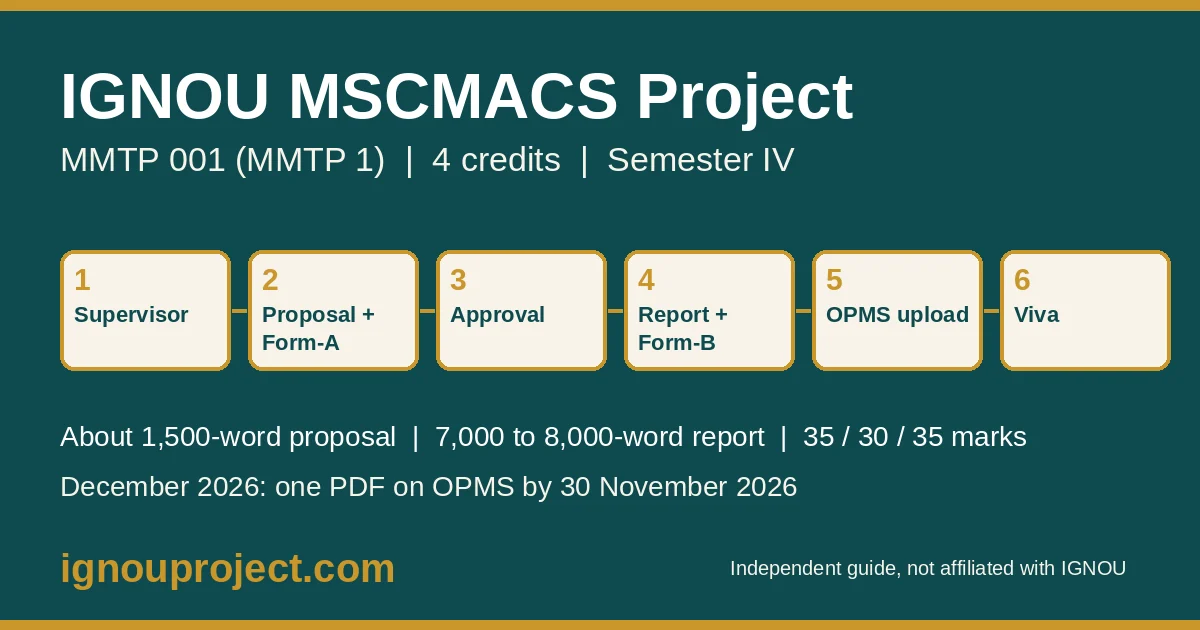
The IGNOU MSCMACS Project is MMTP 001 (also written MMTP 1), a compulsory 4-credit course in Semester IV of the 64-credit M.Sc. (Mathematics with Applications in Computer Science). You choose an eligible supervisor, write a proposal of about 1,500 words in five parts and send it with Form-A to the Programme Facilitator of your Programme Study Centre. After approval you write a report of about 7,000 to 8,000 words. For December 2026 it is uploaded through OPMS by 30 November 2026, followed by a viva.
- The Common Prospectus (July 2026, p. 110) lists MMTP 001 Project as compulsory, 4 credits, in Semester IV of a 64-credit programme.
- The MSCMACS Programme Guide (March 2025, p. 10) says the Project Guide is sent with the fourth-semester material. We found no MMTP-001 guide posted on ignou.ac.in in November 2026.
- The 2010 MMTP-001 guide sends the proposal and Form-A to the Programme Facilitator of your Programme Study Centre, who replies within a month.
- The Programme Guide (p. 16) weights continuous assessment, report and viva at 35, 30 and 35 per cent, with 40 per cent needed in each. The 2010 guide had printed 30, 50 and 20.
- For December 2026, IGNOU’s OPMS guidelines take the report as one PDF upload by 30 November 2026. No hard copy, and no email.
The IGNOU MSCMACS Project is one four-credit course: MMTP 001
Every MSCMACS learner does the same single project course, MMTP 001, so the IGNOU MSCMACS Project has no options and no choice between a project and a theory paper. The Prospectus prints “Project (Compulsory)” against it, and the Programme Guide calls project work compulsory for every learner. It sits in Semester IV alongside MMTE 005 Coding Theory, MMTE 006 Cryptography and MMTE 007 Soft Computing and Applications, four courses of 4 credits each.
The project is small in credit terms, a sixteenth of the degree. It is still the only course where you choose the problem, find the supervisor, gather or download the data and defend the work in a viva. The School of Sciences says the aim is hands-on work in an industry, organisation, R and D establishment or institution, and the Programme Facilitator at your centre may help you find such a place.
Students who reach us in the fourth semester of MSCMACS usually open with the same complaint: no counselling session ever showed them how to write an MMTP 001 proposal or report, and the Project Guide is a booklet they are left to read alone.
Many also ask whether a last date they have seen is for the proposal or for the report. In the 2010 guide the MMTP 001 proposal can go in at any time of the year; the dates IGNOU announces each session, such as 30 November 2026, are for the report.
MMTP full form, MSCMACS full form and four ways the code is printed
There is no official MMTP full form. IGNOU prints the code without expanding it. Inside the MSCMACS table the pattern is plain: MMT 001 to MMT 009 are the core courses, MMTE 001 to MMTE 007 are the electives, and MMTP 001 is the project. Students search for the IGNOU MSCMACS Project under every spelling below, and all of them mean the same course.
The MSCMACS full form is Master of Science (Mathematics with Applications in Computer Science). The Prospectus heading writes “Application” in the singular; the Programme Guide and the project guide write “Applications”. The short form M.Sc. (MACS) appears on the 2010 guide and on its forms.
| Spelling | Where you will see it |
|---|---|
| MMTP 001 | Common Prospectus, July 2026, p. 110 (MSCMACS programme table) |
| MMTP-001 | MSCMACS Programme Guide (March 2025); the 2010 Project Guidelines; Form-A and the envelope line |
| MMTP 1, MMTP-1 | Short form used by students and by most websites, including our earlier page |
| MMTP 01 | A search spelling; the same course |
Purpose of the MMTP 1 Project
The 2010 guide states the purpose of the IGNOU MSCMACS Project in one line: apply your core mathematical knowledge, tools and techniques to a real-life problem connected to an industry, an academic institution, an R and D organisation or a software company. It advises choosing a problem with direct relevance to your day-to-day activities. The Prospectus repeats the industry and R and D aim.
That aim decides what an evaluator looks for first. The guide’s first assessment parameter is the relevance of the problem to the real world, and its third asks how well you explain the theory behind the mathematical tools you used. A report that runs software without explaining the mathematics, or proves theorems with no real problem in sight, misses one half of the purpose.
In the evaluator comments students bring to us, a frequent request is to base the study on the student’s own city or location. The MMTP 001 list itself is built that way: traffic on a route, emissions at chosen points, crime rates in a city.
Many students also plan the whole project on secondary data. The MMTP 001 guide asks for the relevance and source of the data used, if any, and does not rule secondary data out; what it asks is that you explain where the numbers came from.
IGNOU MSCMACS syllabus: 64 credits, and where MMTP 001 sits
The IGNOU MSCMACS syllabus is 64 credits over four semesters of 16 credits each, as the Prospectus prints it. By the Programme Guide’s count that is 34 credits of core courses, 26 of electives and 4 for the project. The table shows why the IGNOU MSCMACS Project usually leans on Semester II and III methods: probability and statistics, modelling, graph theory, algorithms and pattern recognition are where most project problems find their tools.
| Semester | Code | Course | Credits |
|---|---|---|---|
| I | MMT 001 | Programming and Data Structures | 4 |
| I | MMT 002 | Linear Algebra | 2 |
| I | MMT 004 | Real Analysis | 4 |
| I | MMT 005 | Complex Analysis | 2 |
| I | MMT 007 | Differential Equations and Numerical Solutions | 4 |
| II | MMT 003 | Algebra | 4 |
| II | MMT 006 | Functional Analysis | 4 |
| II | MMT 008 | Probability and Statistics | 8 |
| III | MMT 009 | Mathematical Modelling | 2 |
| III | MMTE 001 | Graph Theory | 4 |
| III | MMTE 002 | Design and Analysis of Algorithms | 4 |
| III | MMTE 003 | Pattern Recognition and Image Processing | 4 |
| III | MMTE 004 | Computer Graphics | 2 |
| IV | MMTE 005 | Coding Theory | 4 |
| IV | MMTE 006 | Cryptography | 4 |
| IV | MMTE 007 | Soft Computing and Applications | 4 |
| IV | MMTP 001 | Project (Compulsory) | 4 |
Source: Common Prospectus, July 2026, p. 110. Fee: Rs 7,500 per semester, Rs 30,000 in all, 2 to 4 years (p. 35). The March 2025 Programme Guide still prints Rs 27,600; the Prospectus figure is the later one. Programme details and admission are on our MSCMACS programme overview.
IGNOU MMTP 1 Project Guidelines (MSCMACS)
The IGNOU MSCMACS project guidelines are not one document. Three IGNOU papers carry the rules, and none of them is complete on its own. The MSCMACS Programme Guide (March 2025) covers credits, marks and the report address. The MMTP-001 Project Guidelines carry the proposal, Form-A, the report format and Form-B; the copy in circulation is the School of Sciences booklet with a June 2010 imprint, and the Programme Guide says the Project Guide reaches you with the fourth-semester material. IGNOU’s OPMS guidelines for December 2026 decide how the report is submitted this session.
- MSCMACS Programme Guide, March 2025: pp. 9 to 17 on the project and its marks.
- Common Prospectus, July 2026: p. 27 (project fee), p. 35 (programme fee), pp. 109 to 110 (MSCMACS).
- MMTP-001 Project Guidelines, School of Sciences: the booklet sent with Semester IV material. The edition in circulation carries a June 2010 imprint, and we found no copy on ignou.ac.in, so ask your Programme Study Centre for the edition it issues.
- Form-A, the proforma for approval of the proposal, and Form-B, the certificate of originality: both are printed inside that booklet.
- OPMS guidelines for TEE December 2026: upload rules and file limits.
- Sample proposal on a PM2.5 data topic, laid out in the guide’s five parts, watermarked: Sample synopsis PDF
- Report format template with the eleven parts, empty tables and sentence frames, no results: Report format PDF
- Both are study reference made by our editorial desk with AI assistance. Neither may be submitted, in whole or in part.
Many students ask us what has to travel with the MMTP 001 proposal and whether it should be bound or filed. The 2010 guide names one companion, Form-A signed and dated by you and your supervisor, and it says nothing about binding the proposal.
We also meet students who are unsure what the proforma is, who attach a form from another course, or who leave it out. For MMTP 001 the proforma is Form-A, printed in the Project Guide itself.
Where the 2010 guide, the 2025 Programme Guide and OPMS disagree
Most confusion about the IGNOU MSCMACS Project comes from students reading one paper and missing that a later one changed the rule. The later paper wins for the point it covers; where only the 2010 guide speaks, it is still the guide you were sent.
| Point | 2010 MMTP-001 guide | Later IGNOU paper | What to follow now |
|---|---|---|---|
| Marks | Proposal and continuous assessment 30, report 50, viva 20 | Programme Guide 2025, p. 16: 35, 30, 35 | 35, 30, 35, with 40 per cent in each component |
| Report delivery | One bound copy and a CD with the PDF, by hand or registered post to the Registrar, SED | OPMS, December 2026: one PDF upload, no hard copy to SED or the RC | OPMS upload for December 2026 |
| When reports are taken | Two slots: 1 July to 30 September and 1 January to 31 March | OPMS, December 2026: upload by 30 November 2026, 11:59 PM | The date announced for your session |
| Viva | Face to face at the Programme Study Centre, with the evaluator; not by phone or email | OPMS: where a viva applies it is conducted under the Regional Centre | Ask your Regional Centre for the schedule |
| Fee | Failed students resubmit with a Rs 1,200 demand draft | Prospectus p. 27: Rs 300 project evaluation fee up to 4 credits; OPMS opens only after the fee is paid on Samarth | Rs 300 on Samarth before the upload |
| Binding | “Bound copy” in the report rules; “spiral bound” in the assessment list | OPMS: a scanned PDF of the original report | A clean scan; binding matters only if a hard copy is asked for |
Built from the documents named in each column; the last column is our reading of which rule is current.
A belief we hear every season is that IGNOU will push the last date by a month, so there is no hurry. Dates are sometimes extended and sometimes not; the December 2026 OPMS guidelines state that no further extension will be given.
Some students email the finished MMTP 001 report to an IGNOU address. The same guidelines say reports sent by email will not be considered.
Steps Associated with IGNOU MMTP 1 Project Work M.Sc. (MACS)
The 2010 guide lays out eight steps for the IGNOU MSCMACS Project. The first five can be taken at any time of the year and the sixth as per convenience. Only the report has a fixed window, and that window now comes from each session’s OPMS notice.
Starting the IGNOU MMTP 1 Project in Semester IV
| Step | What happens | When (2010 guide) | December 2026 note |
|---|---|---|---|
| 1 | Choose a supervisor, on your own or with the Programme Facilitator’s help | Any time of the year | Check the eligibility below first |
| 2 | Send the supervisor’s bio-data to the Programme Facilitator for the School of Sciences’ approval | Any time of the year | OPMS also asks for the signed bio-data as a separate file |
| 3 | Identify the topic and prepare the proposal with the supervisor | Any time of the year | About 1,500 words, five parts |
| 4 | Supervisor approves the proposal and signs Form-A | Any time of the year | Both signatures and dates |
| 5 | Proposal and Form-A go to the Programme Facilitator | Any time of the year | Keep a photocopy and a receipt |
| 6 | Do the project | As per convenience | Approval is valid for one year |
| 7 | Submit the report | 1 Jul to 30 Sep, or 1 Jan to 31 Mar | One PDF on OPMS by 30 November 2026 |
| 8 | Viva | January or July, at the Programme Study Centre | Under the Regional Centre, schedule from the RC |
Counting backwards from 30 November 2026 with the one month the guide gives for a reply leaves little room for anyone whose proposal is not yet with the Programme Facilitator. Our December 2026 submission dates tracker lists the session notices as they appear.
In our records, 70 to 80 percent of students become active only in the last month before a submission date. With the December 2026 upload closing on 30 November, most MMTP 001 enquiries reach our desk in October and November.
Many students also hurry the proposal into the final week before a date they have heard about, although the MMTP 001 proposal has no printed last date at all.
Some believe the proposal and the report go in together at the end, without the supervisor’s signature, and the whole packet is turned back. MMTP 001 has two stages: proposal and Form-A first, the report only after approval.
Who can supervise an IGNOU MSCMACS Project
A supervisor for the IGNOU MSCMACS Project needs one of two qualifications and some experience, by the 2010 guide’s own wording. The Programme Guide adds that each Programme Study Centre has project supervisors to guide you and check progress. The 2010 guide says the University pays the supervisor and you should not pay any fee or remuneration yourself.
| Route | Degree | Experience |
|---|---|---|
| A | PhD or Master’s degree in Mathematics or an allied area, such as statistics or operations research | At least 2 years of teaching in a college or university, or of work with an industry, R and D organisation or software company, and an application orientation |
| B | M.Tech in computer science or an allied area, such as industrial or electrical engineering | The same 2 years and application orientation |
An MCA, an MSc in Computer Science or a B.Tech is not on either printed route. If your proposed supervisor holds one of those, ask the Programme Facilitator in writing before Form-A is signed. Our page on guide eligibility across IGNOU courses sets this rule beside other programmes’ rules.
Most students who ask us about a supervisor bring a name before they have read the eligibility line, so the degree and the two years of experience are checked only after Form-A is half filled.
Several MSCMACS students tell us they asked at their centre and were not given a supervisor. The Programme Guide says centres have project supervisors; put the request to the Programme Facilitator in writing and keep the reply.
When a supervisor asks for several rounds of changes, the proposal can slip by weeks. Build those weeks into the plan.
IGNOU MMTP-001 Project Topics for MSCMACS
IGNOU prints seven problems for the IGNOU MSCMACS Project, and calls the list indicative: you may choose any real-world problem with your supervisor. If you start from general lists of MSc maths project topics, test each one against the guide’s real-world aim; a purely theoretical topic sits uneasily with it. The table pairs IGNOU’s own problems with the MSCMACS courses that supply the method.
| IGNOU’s printed problem | Courses to draw on | Method direction | Data route |
|---|---|---|---|
| Stability or performance of a machine over a period of time | MMT 008, MMT 009 | Reliability measures, control charts, time series of readings | Organisation records, with permission |
| Traffic intensity at identified locations on a route in a city | MMT 008, MMT 009, MMTE 001 | Poisson arrivals, queueing model, route as a graph | Your own timed counts |
| Emission levels at selected points in a city | MMT 008, MMT 009, MMTE 003 | Exceedance counts, principal components, forecasting | CPCB monitoring station data |
| Analysis of crime rates in a city | MMT 008, MMTE 003 | Trend, regression, clustering of areas | Published official crime statistics |
| Water pollution levels in potable water | MMT 008 | Sampling design, tests comparing sites | Laboratory measurements or published reports |
| Marketing: brand demand, loyal customers, satisfaction | MMT 008, MMT 009 | Sample survey, chi-square, Markov chain of brand switching | Questionnaire survey |
| Exam data: reducing dimension; what scores measure | MMT 002, MMT 008, MMTE 003 | Principal components or factor analysis | Anonymised records, with permission |
The problems are from section VII of the 2010 MMTP-001 guide; the course and method pairings are our suggestion to discuss with your supervisor.
Problem, course and method matcher
A planning aid, not an IGNOU rule. The seven problems are printed in the MMTP-001 guide and the course list in the Prospectus; the pairings, title frames and word budget are our suggestion.
This matcher needs JavaScript. If this line stays visible after the page loads, the script was blocked.
How the matcher decides. Each of IGNOU’s seven problems is stored with the MSCMACS courses whose methods it needs, a method direction, the data route that usually serves it and a working title frame. Your data route is compared with the routes that fit that problem; a mismatch, such as a survey for emission levels, is flagged because instruments, not opinions, measure emissions. The word budget splits 7,500 words, the middle of the printed 7,000 to 8,000, across the report parts in proportions we use for planning.
Many students believe they must pick one of the seven problems printed in the MMTP 001 guide. The guide itself calls the list only indicative.
Proposals built from widely shared material often carry the same topic as other students’ work, and the guide rejects completely identical proposals and reports.
Some students submit an AI-written proposal or report as it is, which is one more reason the same MMTP 001 titles keep turning up.
The proposal in five parts and about 1,500 words
The IGNOU MSCMACS synopsis is what the 2010 guide calls the project proposal: about 1,500 words, prepared with your supervisor, in five parts. Students also call it the IGNOU MMTP 1 Synopsis. The guide prints no order beyond the list, so keeping its order makes the evaluator’s job easy.
| Part (2010 guide) | What it should hold for MMTP 001 |
|---|---|
| Title of the project | Variable, method, place and period in one line; the same words go into Form-A item 3 |
| Introduction and objectives | The problem, why it matters, work already done, and numbered objectives stated without assuming results |
| Methodology and tools to be used | Data source or collection plan, the mathematical methods for each objective, and the software |
| Utility or scope of the work | Who can use the result, and the limits you already see |
| Future directions for investigation | How the problem could be taken further |
The assessment parameters in the same guide show what the proposal is read for: relevance to the real world, reasons for the problem, work already done, aims, feasibility and planning. A good test is whether a stranger could repeat your method from the methodology paragraph alone. Our note on writing project objectives covers neutral wording.
MMTP 001 supervisor, Form-A and upload check
Built line by line from sections II to V of the MMTP-001 Project Guidelines (School of Sciences, June 2010 imprint) and IGNOU’s OPMS guidelines for the December 2026 TEE, read in November 2026.
This checker needs JavaScript. If this line stays visible after the page loads, the script was blocked.
What the check compares. Supervisor: the two degree routes and the 2 years of experience in section II of the 2010 guide, plus its application-orientation line. Proposal: the five parts and the length of about 1,500 words in section III; counts under 1,100 or over 2,000 are flagged as far from that length. Form-A: every box in section IV, both signatures and dates, and the photocopy section III tells you to keep. Report: the 7,000 to 8,000 words, Form-A original, Form-B, title and numbering rules in section V, and the fee, enrolment number and 40 MB limit in the OPMS guidelines. It cannot judge quality or predict approval.
Many students leave the MMTP 001 proposal so late that there is no time left to write the 1,500 words themselves.
Others draft it with ChatGPT or another AI tool before reading the guide, and the plan then misses parts the course asks for, most often the future directions.
Many proposals we read leave out a core part: the objectives, or the methodology and tools.
Have the IGNOU MSCMACS Project proposal read before Form-A is signed
The 2010 guide is blunt: an incomplete proforma will not be accepted, completely identical proposals are rejected, and the report must carry the approved title word for word. Each of these is easier to fix before the packet leaves you than after a month’s wait for the Programme Facilitator’s reply.
Three faults turn up most in the drafts we read. In many proposals the review of earlier work does not match the reference list. Proposals come back when the methodology part does not say how the data will be gathered: the instrument, the questionnaire if a survey is planned, or the data source. Some proposals and reports run far past the length the guide sets, about 1,500 and 7,000 to 8,000 words, and are returned for that.
Before Form-A reaches your Programme Facilitator, we read
- All five proposal parts present, in the guide’s order
- Objectives that match the methods named for them
- Earlier work cited in the text and listed at the end
- Form-A header boxes and items 1 to 6, with the title identical to the proposal
- Supervisor details against the two printed routes
Before the MMTP 001 PDF goes up on OPMS, we read
- The eleven report parts and a length near 7,000 to 8,000 words
- Original approved Form-A and Form-B with both signatures
- Numbering and titles of every table and figure
- Code and data appendices that support the conclusions
- First-page fields and file sizes the OPMS guidelines ask for
We check your own draft against the guidelines and return it with corrections. You remain the author of the proposal and report and responsible for the data, analysis, certificates and submission. Approval is decided by IGNOU, and no one can promise it.
Form-A, box by box
Form-A is titled “Proforma for approval of M.Sc. (MACS) project proposal (MMTP-001)” and is attached to the proposal you send to the Programme Facilitator. It has five header boxes, six numbered items, two signature blocks and a part for the facilitator. Most returns we see for the IGNOU MSCMACS Project start here.
| Box | Who fills it | What to watch |
|---|---|---|
| Enrolment No. | You | The number on your IGNOU identity card |
| Programme Study Centre name | You | The MSCMACS programme centre you are attached to |
| Regional Centre name | You | Your own Regional Centre |
| E-mail; telephone | You | Ones you read; replies and the viva call come through them |
| 1. Name and address of the student | You | Full postal address |
| 2. Supervisor: name, designation, office address, telephone | You, with the supervisor | Designation and office address are the boxes most often left half filled |
| 3. Title of the project | You | Word for word the proposal title; the report later must match it |
| 4. Subject area(s) | You | For example statistics, graph theory, cryptography |
| 5. Mathematical tools / software used | You | Methods and software both, as in the methodology part |
| 6. Place(s) of doing the project | You | Industry, academic institution, research organisation, software company or elsewhere, as the form’s footnote lists |
| Signature and date of the student | You | Both signature and date |
| Signature and date of the supervisor | Supervisor | This signature must later tally with the one on Form-B |
| Approved or Not approved; signature and stamp; date; suggestions for reformulating | Programme Facilitator | Leave blank; keep the returned original for the report |
Built from section IV of the 2010 MMTP-001 guide.
Many Form-As reach us with the supervisor’s designation or office address missing, and sometimes with the student’s own e-mail or address left blank.
Forms also come back when item 3, the title, is left empty.
We have seen proposals returned when the supervisor’s bio-data carried no stamp or working ID. The MMTP 001 guide asks only that the bio-data go to the Programme Facilitator for the School’s approval and prints no stamp rule, so ask your centre what it accepts.
To the Programme Facilitator, not the Regional Centre
For the IGNOU MSCMACS Project the proposal does not go to the Regional Director or to Maidan Garhi. The 2010 guide sends the proposal and the filled Form-A to the Programme Facilitator of your Programme Study Centre, and tells you to keep a photocopy of the whole packet. That route differs from the MBA project course, MMPP-001, whose synopsis goes to the Regional Director, which is why advice copied from MBA pages misleads MSCMACS students.
Many students forget to take a receipt when they hand in the proposal. Ask the centre to sign and date your photocopy.
Students are often unsure whether the proposal goes to the Study Centre or the Regional Centre, and some carry it to Maidan Garhi. For MMTP 001 the 2010 guide names the Programme Facilitator of your Programme Study Centre.
In our experience approval often arrives later than the one month the guide prints; two to three months is common across the IGNOU courses we see.
One month for a reply, one year of validity
The Programme Facilitator is to tell you within a month whether the proposal of your IGNOU MSCMACS Project is approved. If it is, the report can go in any later submission window. If not, the facilitator sends suggestions for reformulating it, and you send the revised proposal with a new Form-A and a copy of the earlier Form-A that was not approved.
An approved proposal is valid for one year, which the 2010 guide counts as two report slots. Miss both and you need a fresh proposal. Now that submission windows come from session notices, count the year from the date on your approval and plan the report well inside it.
Approval often arrives with comments to be worked into the report, and many students skip them.
Most approvals we see carry correction or modification points.
The correction we see most often is a request to bring the review of earlier work up to date.
Data, software and code in an IGNOU MSCMACS Project
An IGNOU MSCMACS Project may use data, software and code, and the 2010 guide expects you to show them. Form-A item 5 asks for the mathematical tools and software used. The methodology parameter asks for the relevance and source of the data, if any, and for any innovation in coding and testing. Section V tells you to attach relevant data, devices or objects that support your conclusions.
The guide names no software. Python, R, MATLAB or C are all usable; what matters is that the report explains the theory behind each method, names the software and version, and attaches the code so the numbers can be checked. Data downloaded from a public portal should carry the download date and the exact filters used. Data you collect yourself should carry the dates, places and instrument.
Some students write the analysis chapter on assumed numbers without collecting or downloading any real data. Every figure in an MMTP 001 report has to come from your own work.
Many take material from internet sources and submit it without checking it for plagiarism. The 2010 guide sends plagiarism cases to IGNOU’s unfair means committee.
In many reports the analysis chapter is too thin to support the objectives and the methodology promised in the proposal.
The report: eleven parts in 7,000 to 8,000 words
The IGNOU MMTP 1 Report is set at about 7,000 to 8,000 words in the 2010 guide, printed on A-4 paper (the guide writes 29 x 20 cm) with double line spacing. For the IGNOU MSCMACS Project the guide lists eleven contents and three presentation rules: every page, table and figure numbered in sequence; a title on every table and figure; and the approved title used word for word.
| No. | Part | What it carries in an MSCMACS report |
|---|---|---|
| 1 | Table of contents / index | Every part with page numbers |
| 2 | Introduction to the project | Problem, setting, earlier work, gap |
| 3 | Objectives | Copied unchanged from the approved proposal |
| 4 | Methodology | Survey if any, data, tools and techniques, with the theory of each method |
| 5 | Results | Tables and figures, numbered and titled |
| 6 | Analysis / interpretation of the results | One block per objective |
| 7 | Conclusions | Matched to the objectives |
| 8 | Recommendations | Future scope and further enhancement |
| 9 | Summary | Readable on its own |
| 10 | Bibliography | One consistent style; the guide names none |
| 11 | Appendices (if any) | Code, data description, supporting data |
The report format PDF in the document map above lays these parts out with empty tables and sentence frames for a data project. It holds no results, and it is a format to read, not a report to copy.
Many students are unsure of the page order of the report; the eleven parts above, in that order, are the guide’s list.
In many reports the references follow no single format and do not match the data sources used. The MMTP 001 guide names no style, so one consistent format is the rule to keep.
Many students leave the appendix out, though for a mathematics project it is where the code and the data live.
Form-B, the originality line and what goes with the report
Form-B is the certificate of originality. You and your supervisor sign and date it, and it states that the report is your original work under the supervisor’s guidance and has not been submitted elsewhere. The 2010 guide rejects a report that arrives without the original approved Form-A and Form-B, and asks that the supervisor’s signature on Form-B tally with the one on Form-A. For the IGNOU MSCMACS Project a photocopied report is not acceptable either.
The December 2026 OPMS guidelines widen the set. Where applicable the report should include the approved proforma, the synopsis, the guide’s bio-data and the signed originality certificate, and the bio-data, approval copy and proposal are uploaded as separate files.
Some students upload the report without the supervisor’s signature on Form-B.
After approval many students do not know what format the report should follow. For MMTP 001, the guide’s eleven parts are the format.
Many reports come back because a required document is missing. For MMTP 001 that means the original Form-A and Form-B, and on OPMS also the bio-data, approval copy and proposal as separate files.
December 2026: the MMTP 001 report goes up on OPMS by 30 November
The posting rule in the 2010 guide, a bound copy and a CD to the Registrar, SED, does not apply to the IGNOU MSCMACS Project this session. IGNOU’s guidelines for the December 2026 Term-End Examination take every project report through the Online Project Management System (OPMS), opened from your Samarth login, with a final deadline of 30 November 2026, 11:59 PM, and no further extension.
| OPMS rule (December 2026) | Detail |
|---|---|
| Fee first | The upload link appears only after the project fee is paid on Samarth; for MMTP 001, at 4 credits, the Prospectus slab is Rs 300 |
| Report file | A scan of the original report, one PDF per course, up to 40 MB |
| Separate files | Supervisor’s signed bio-data up to 5 MB; approval of the proposal up to 5 MB; proposal up to 10 MB |
| First page | Project title, your name, programme code, enrolment number from your ID card (not the control number), Regional Centre code and course code |
| Not accepted | Hard copies sent to SED or the RC after upload; reports sent by email; incomplete submissions |
| Fields that do not apply | Write NA |
| Queries | projects@ignou.ac.in for projects; your Regional Centre for the viva |
After the upload, our project status guide explains how to follow the result.
Some students keep no record once the upload is done. The OPMS guidelines ask you to keep the fee receipt, the submission records and every uploaded document.
Many ask how many copies to send and where. For December 2026 the answer is one PDF through OPMS and no hard copy.
Many students mix up the Rs 300 and Rs 500 project fees. MMTP 001 carries 4 credits, so the Prospectus slab is Rs 300.
35, 30 and 35: how the IGNOU MSCMACS Project is marked
The March 2025 Programme Guide marks the IGNOU MSCMACS Project on three components: continuous assessment 35 per cent, the project report 30 per cent and the viva 35 per cent. You need at least 40 per cent in each separately and 40 per cent overall. The project is outside early declaration of results, re-evaluation and improvement of division.
| Component | Programme Guide, March 2025 | 2010 MMTP-001 guide | Examiner (2010 guide) |
|---|---|---|---|
| Proposal and continuous assessment | 35 | 30 | Project supervisor |
| Project report | 30 | 50 | Project evaluator |
| Viva-voce | 35 | 20 | Project evaluator, with the facilitator present |
The 2010 guide lists six assessment parameters: selection of topic, introduction and objectives, methodology, presentation, analysis, and conclusions with recommendations. A student who fails redoes the whole cycle from a new proposal, and the guide advises a new topic. For the viva, carry a copy of the report; our project viva questions page has practice questions.
Many students do not know whether a viva applies to them. For MMTP 001 it does, and the Programme Guide gives it 35 per cent of the marks.
Many reports carry an outdated literature review, and in our experience that costs marks.
Questions about the IGNOU MSCMACS Project
Where are the IGNOU MSCMACS project guidelines published?
In three places. The MSCMACS Programme Guide (March 2025) is on ignou.ac.in, the MMTP-001 Project Guidelines booklet reaches you with the Semester IV material, and the OPMS guidelines for each session are on the OPMS portal. We found no copy of the MMTP-001 booklet on ignou.ac.in in November 2026.
What is the MMTP-1 project in IGNOU MSCMACS?
MMTP 001 is the compulsory 4-credit project in Semester IV of the M.Sc. (Mathematics with Applications in Computer Science). It applies the mathematics of the programme to a real-life problem and is marked on continuous assessment, the report and a viva.
How long is the IGNOU MMTP 1 Synopsis?
About 1,500 words in five parts: title, introduction and objectives, methodology and tools, utility or scope, and future directions.
How long is the IGNOU MMTP 1 Report?
The guide sets about 7,000 to 8,000 words, not a page count, printed on A-4 with double line spacing. Tables, figures and appendices come on top of that.
Is a supervisor mandatory, and can a relative be one?
Yes, a supervisor signs Form-A and Form-B. A relative or family friend is judged by the same rule as anyone else, one of the two printed routes: a PhD or Master’s in Mathematics or an allied area, or an M.Tech in computer science or an allied area, with 2 years of teaching or industry experience. Many students tell us IGNOU gave them no supervisor and none was available, so they turned to a relative or an outside contact; that works only after the eligibility check.
Can the proposal be handwritten?
The 2010 guide sets no typing rule for the proposal; it asks for a printed report on A-4. Some students send a handwritten proposal, and we suggest typing it so Form-A, the proposal and the later report read alike. More on handwritten or typed project files.
My proposal was not approved. What do I send again?
A revised proposal, a new Form-A and a copy of the earlier Form-A that was not approved, all to the Programme Facilitator. When asked to resubmit, many students forget that copy of the earlier form.
Does IGNOU allow joint projects for MMTP-1?
No. The 2010 guide says each student must do the project individually and independently, and completely identical proposals or reports are rejected.
Can the MSCMACS project focus only on computer science?
The guide asks you to apply your mathematical knowledge to a real-life problem and to explain the theory of the mathematical tools you use. A software build with no mathematical method behind it does not meet that aim, while a problem solved with algorithms, graphs, coding theory or cryptography from the programme does.
Can software such as Python, R or MATLAB be used?
Yes. Form-A item 5 asks which mathematical tools and software you will use, and the methodology parameter credits innovation in coding and testing. Name the software and version and attach the code.
Is there a viva for the IGNOU MSCMACS Project?
Yes. The Programme Guide gives the viva 35 per cent of the marks, and the December 2026 OPMS guidelines say it is conducted under the Regional Centre, which issues the schedule.
Before the IGNOU MSCMACS Project leaves your desk
Run the checker above once for the proposal and once for the report, then read the IGNOU MSCMACS Project file against this short list: an eligible supervisor on Form-A; five proposal parts near 1,500 words; the approved title repeated word for word; Form-A original and Form-B in the report; code and data attached; Rs 300 paid on Samarth; one PDF under 40 MB on OPMS by 30 November 2026; and the fee receipt and submission record saved.
Most students do not know whom to contact when a month passes with no reply. For MMTP 001 it is the Programme Facilitator who received the proposal.
We have seen cases where no approval letter reached the student and the session ran out. Write to the facilitator in good time, with your enrolment number and the date you handed in the packet.
Questions about your own draft can come to our desk on WhatsApp at +91 93546 37830. ignouproject.com provides customised project guidance, topic refinement, methodology support, review and correction of learner-written synopses and reports, formatting and citation support, reference material, printing and binding, and project status and result guidance. More programme pages are on the IGNOU projects hub.
MSCMACS का प्रोजेक्ट कोर्स MMTP 001 है, जो चौथे सेमेस्टर में 4 क्रेडिट का अनिवार्य कोर्स है। लगभग 1,500 शब्दों का प्रस्ताव पाँच भागों में लिखकर, Form-A के साथ अपने प्रोग्राम स्टडी सेंटर के प्रोग्राम फैसिलिटेटर को दें। स्वीकृति के बाद लगभग 7,000 से 8,000 शब्दों की रिपोर्ट लिखें, जिसमें मूल Form-A और हस्ताक्षरित Form-B लगे हों। दिसंबर 2026 सत्र में रिपोर्ट 30 नवंबर 2026 तक OPMS पर एक PDF के रूप में अपलोड होगी; हार्ड कॉपी या ईमेल स्वीकार नहीं है।
- Programme Guide, M.Sc. (Mathematics with Applications in Computer Science), School of Sciences, IGNOU, March 2025: pp. 9 to 17 (project, marks, fee). Read November 2026.
- IGNOU Common Prospectus, July 2026: p. 27 (project evaluation fee), p. 35 (MSCMACS fee and duration), pp. 109 to 110 (MSCMACS programme). Read November 2026.
- MMTP-001 Project Guidelines, School of Sciences, IGNOU, June 2010 imprint, sections I to VII, Form-A and Form-B. Read in November 2026 from a third-party copy of the printed booklet; no copy was found on ignou.ac.in.
- Guidelines for Submission of Project/Dissertation/Internship etc. for TEE December 2026 through OPMS, IGNOU. Read 6 November 2026.
- M.Sc. (MACS) programme site, IGNOU School of Sciences: project note and contact mscmacs@ignou.ac.in.

BK Sahni is the founder of Shri Chakradhar Publication Private Limited, New Delhi, which has served IGNOU distance learners since 2010 through its own printing press and in-house editorial team. He is the author of Mind Loop. ORCID 0009-0005-8092-459X.
ignouproject.com is an independent service and is not affiliated with or endorsed by Indira Gandhi National Open University (IGNOU). Rules here are taken from the IGNOU documents listed above; where a session notice from your Regional Centre or SED differs, the notice applies.
BK Sahni iD 0009-0005-8092-459X
Founder, Shri Chakradhar Publication Pvt. Ltd. & ignouproject.com — helping IGNOU distance-learning students since 2010 (5,00,000+ students supported across MBA, MCom, MA & more). Author of IGNOU exam guides, solved assignments & project reference books.
Disclosure: Shri Chakradhar Publication Pvt. Ltd. and ignouproject.com are independent third-party study-help services — not the official IGNOU website. Always verify final dates and rules on ignou.ac.in.