IGNOU MA Anthropology • MANP-101 & MANE-106
IGNOU MAANY Project & Dissertation: MANP-101 and MANE-106 Explained
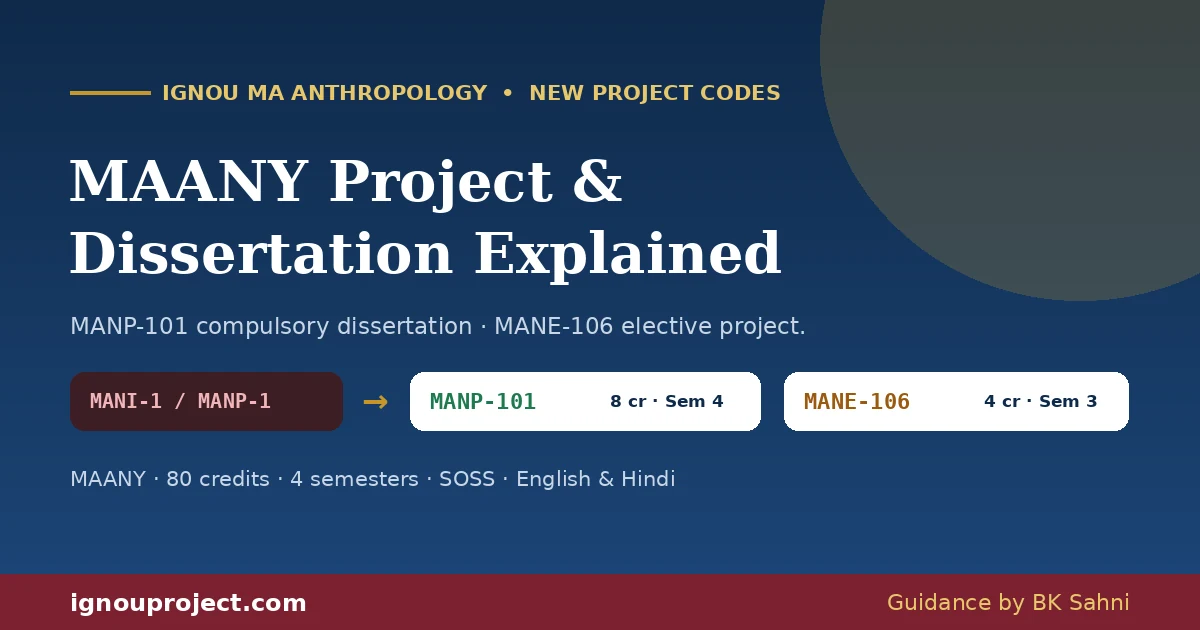
The restructured MA Anthropology programme (MAANY) carries two project-type courses: MANP-101, the compulsory 8-credit Dissertation in the fourth semester, and MANE-106, an optional 4-credit Ethnographic Training project in the third. They are not interchangeable — one is the capstone every learner must complete, the other an elective only some will choose. Here is how both work, and how they replaced the old MAAN codes.
New codes, new programme nameMAANY is the restructured successor of the old MAAN programme, whose project work ran under MANI-001, MANI-003 and MANP-001. If you are still registered under MAAN, those older codes govern you — see the MAAN project and dissertation guide. Always confirm your own course codes against your programme guide and the official IGNOU website before you submit.
What are MANP-101 and MANE-106 in the IGNOU MAANY programme?
MANP-101 and MANE-106 are the two project-type courses of IGNOU’s restructured MA Anthropology programme (MAANY). MANP-101, titled Dissertation, is a compulsory 8-credit course in the fourth semester — every MAANY learner must complete it to earn the degree. MANE-106, titled Ethnographic Training, is a 4-credit elective project in the third semester, offered within Elective Group B alongside Ethnography, Urban Anthropology and Visual Anthropology, from which learners choose any two. The restructured MAANY runs in semester mode — four semesters of 20 credits each, 80 credits in total — under the School of Social Sciences, in English and Hindi, and is open to any graduate. The programme’s two research-methods courses, MAN-108 and MAN-109 in the second semester, provide the methodological foundation for both projects. These codes replaced the earlier MAAN programme’s project courses MANI-001, MANI-003 and MANP-001.
What changed
How did MAAN become MAANY, and what happened to the old codes?
The restructured Master of Arts (Anthropology) — programme code MAANY — is a two-year, 80-credit programme offered semester-wise: four semesters of 20 credits each, under the School of Social Sciences. It keeps the discipline’s integrated approach, drawing on physical, social and archaeological anthropology, and is open to any graduate, in English and Hindi. The earlier MAAN programme carried its research component across three codes — MANI-001 (Anthropology and Methods of Research), MANI-003 (Practicing Anthropology) and the compulsory field-work dissertation MANP-001.
The restructuring redrew that map. Research methods are now taught as two dedicated second-semester theory courses, MAN-108 and MAN-109 (Research Methods in Anthropology I and II). The practical, hands-on project element became MANE-106, Ethnographic Training, an elective. And the capstone became MANP-101, Dissertation — the direct successor of the old MANP-001, still 8 credits, still compulsory, now fixed in the fourth semester alongside an 8-credit practical in physical and biological anthropology (MANL-101).
| Aspect | Earlier MAAN | Restructured MAANY |
|---|---|---|
| Programme code | MAAN | MAANY |
| Dissertation code | MANP-001 | MANP-101 (8 credits, Semester 4) |
| Applied project | MANI-003 (Practicing Anthropology) | MANE-106 (Ethnographic Training, elective, 4 credits) |
| Research methods | Within MANI-001 | MAN-108 + MAN-109, Semester 2 |
| Structure | Year-based | Semester mode: 4 × 20 credits = 80 |
| Medium | English & Hindi | English & Hindi |
If your enrolment record or an older proforma still shows MANI-001, MANI-003 or MANP-001, you are under the earlier structure and should follow the MAAN project and dissertation guide. Learners registered under MAANY follow the new codes on this page. Your re-registration record is the deciding document.
The two codes
MANP-101 vs MANE-106: which one applies to you?
This is the question the new structure raises most often, and the answer is in the course types. Both are project-type courses, but their status in the degree is completely different.
- The capstone of the degree: every MAANY learner completes it.
- Full research study: fieldwork or empirical data, analysed and written up as a dissertation.
- Sits alongside MANL-101, the 8-credit practical, in the final semester.
- Evaluation fee falls in the higher band — Rs. 500 — because it is above 4 credits.
- One of four Group B electives — Ethnography, Ethnographic Training, Urban Anthropology, Visual Anthropology — of which you choose any two.
- A guided field-training project: practising ethnographic methods on a small scale before the dissertation.
- Appears on your record only if you elect it.
- Evaluation fee falls in the lower band — Rs. 300 — for project work up to 4 credits.
The strategic reading is straightforward: choosing MANE-106 in the third semester gives you a supervised rehearsal of exactly the fieldwork skills that MANP-101 will demand a semester later. Learners who take Ethnography (MANE-105) and Ethnographic Training (MANE-106) together effectively build a fieldwork pathway into their electives — the theory of ethnographic description in one course, its practice in the other, and the full dissertation immediately after.
Where they sit
How the dissertation fits the four-semester journey
The MAANY structure is sequenced so that by the time the dissertation arrives, the methods have already been taught twice over. The first year is fully compulsory: the first semester lays the discipline’s foundations — introducing anthropology, physical and biological anthropology, social and cultural anthropology, archaeological anthropology, and tribes in India — and the second semester delivers the two courses that matter most for your project work: MAN-108 and MAN-109, Research Methods in Anthropology I and II, alongside applied, environmental and public-health anthropology.
The third semester is where the electives open: two from Group A (human genetics, human growth and development, physiological anthropology, forensic anthropology), two from Group B (ethnography, ethnographic training, urban anthropology, visual anthropology), and one multidisciplinary course. The fourth semester then pairs the 8-credit dissertation with the 8-credit laboratory practical. The practical consequence is the same one that applies across IGNOU’s restructured programmes: treat the semester before the dissertation as its preparation window. Your topic, field site and method should take shape during the third semester, so the proposal is ready when the fourth opens.
The work itself
What kind of dissertation does MANP-101 expect?
Anthropology’s defining method is fieldwork, and an MA Anthropology dissertation is expected to show it. The programme’s stated aim is to develop professional competence for trained anthropologists in academic and research institutes, NGOs, government organisations, health sectors and applied sciences — and the dissertation is where that competence is demonstrated on a real community, site or bio-social question.
- A defined anthropological question — one community, one site, one practice, one bio-social phenomenon — not a survey of the discipline.
- Field engagement appropriate to the question: participant observation, interviews, genealogies, household schedules, or anthropometric data where the topic is biological.
- A method grounded in MAN-108 and MAN-109 — the design, the field site, the informants or sample, and the analysis plan stated explicitly.
- Ethical care: informed consent, confidentiality of informants, and sensitivity when working with tribal or vulnerable communities.
- Objectives precise enough to answer within one semester of field and desk work, and a bibliography in a consistent style.
Topic directions
What are good MANP-101 dissertation topic directions?
The most reliable guide to what the restructured programme values is its own syllabus. Each elective stream points at researchable dissertation territory, and a topic aligned with the electives you actually took is easier to justify in the proposal and easier to execute in the field.
| Aligned with | Example topic direction |
|---|---|
| Ethnography (MANE-105/106) | An ethnographic study of a weekly market, a fishing village’s occupational life, or a migrant settlement’s social organisation. |
| Urban Anthropology (MANE-107) | Kinship and neighbourhood networks in a resettlement colony, or the social life of an urban informal occupation. |
| Visual Anthropology (MANE-108) | A photo-documented study of a craft community or a ritual cycle, analysed anthropologically. |
| Forensic / Physical (MANE-101–104) | Anthropometric variation in a defined population, or growth patterns among schoolchildren of a community. |
| Tribes in India (MAN-105) | Changing livelihood, health-seeking behaviour, or customary institutions in a specific tribal community. |
| Epidemiology & Public Health (MAN-110) | Health beliefs and practices around a specific condition in one community — a classic bio-social study. |
Whatever direction you choose, apply the standard three-part test before proposing it: is the question narrow enough for one semester, is the field site genuinely reachable, and does it sit inside anthropology rather than drifting into sociology or public policy without an anthropological lens.
Proposal to report
How does the MANP-101 process work?
- Shape the topic during the third semester
Use your electives — especially Ethnographic Training if you chose it — to test the field site and refine the question while coursework is still supporting you.
- Prepare the synopsis with your supervisor
The proposal carries your topic, objectives, methodology and field plan, with the supervisor’s consent. Keep the title definitive — the final dissertation must carry the approved title.
- Submit the synopsis for approval and wait for it
Project work begins only after the proposal is approved. Confirm the current submission route for MAANY with your Regional Centre, since routes are updated as the restructured programme rolls out.
- Do the fieldwork as approved
An 8-credit dissertation justifies genuine field engagement — sustained observation, interviews, or measured data — not a purely desk-based summary.
- Write the report in the standard structure
Introduction, review of literature, objectives and methodology, the field setting, analysis and findings, conclusion, bibliography and annexures — with your declaration and the supervisor’s certification bound in.
- Submit with the evaluation fee
The project evaluation fee is paid along with the Term-End Examination form — Rs. 500 for MANP-101, and Rs. 300 for MANE-106 where taken, under the credit-band structure in force since the January 2023 admission cycle.
The proposal structure common to IGNOU programmes is covered in the IGNOU synopsis and proposal guide, the submission steps in the IGNOU project submission guide, and the code-by-code credit picture in the IGNOU project course codes directory.
Not sure whether MAAN or MAANY codes apply to you?
The MAAN-to-MAANY transition means some learners are unsure whether their dissertation is MANP-001 or MANP-101, and whether Ethnographic Training even appears in their course list. Send your enrolment number and admission year, and we will confirm the correct codes and the current submission route for your session.
Ask on WhatsApp Guidance only. Always confirm the final codes with your Regional Centre.Avoid the common trap
The mistake that delays most anthropology dissertations
BK Sahni, who has guided 5,00,000 students till date, notes that anthropology dissertations run late for a reason peculiar to the discipline: the field site is chosen for its interest rather than its access. A tribal community three districts away, a ritual that occurs once a year, or informants who need months of rapport before they will speak — all make compelling proposals and impossible semesters. The dissertation that finishes on time is almost always studying a community the learner can reach repeatedly, cheaply and soon.
The fix costs one weekend. Before writing the proposal, make a single scouting visit: confirm you can physically reach the site, identify two or three willing informants, and check whether any permission — from a village head, an institution, or a family — will be needed. If the scouting visit works, the fieldwork will work. If it does not, change the site now, while it costs nothing, rather than after approval when a change of topic restarts the approval cycle.
FAQ
Frequently asked questions
Is MANP-101 compulsory in the IGNOU MAANY programme?
Yes. MANP-101, Dissertation, is a compulsory 8-credit course in the fourth semester of MAANY. Every learner must complete it to earn the MA Anthropology degree. It sits alongside MANL-101, the 8-credit practical in physical and biological anthropology.
Is MANE-106 compulsory too?
No. MANE-106, Ethnographic Training, is a 4-credit elective project in the third semester. It belongs to Elective Group B — Ethnography, Ethnographic Training, Urban Anthropology and Visual Anthropology — from which learners choose any two. It appears on your record only if you elect it.
What is the difference between MANP-001 and MANP-101?
MANP-001 is the field-work-and-dissertation course of the earlier MAAN programme; MANP-101 is the dissertation of the restructured MAANY programme. Both are compulsory capstones, but they belong to different programme structures. Your re-registration record shows which code governs you.
Which courses prepare me for the MAANY dissertation?
MAN-108 and MAN-109 — Research Methods in Anthropology I and II — taught in the second semester, provide the methodological foundation. Choosing MANE-105 (Ethnography) and MANE-106 (Ethnographic Training) as third-semester electives adds a supervised rehearsal of fieldwork before the dissertation begins.
What is the evaluation fee for MANP-101 and MANE-106?
Under the credit-band structure in force since the January 2023 admission cycle, project work above 4 credits carries a Rs. 500 evaluation fee and work up to 4 credits carries Rs. 300. MANP-101 (8 credits) therefore falls in the Rs. 500 band and MANE-106 (4 credits) in the Rs. 300 band, each paid with the Term-End Examination form.
Can the MAANY dissertation be done in Hindi?
The MAANY programme is offered in both English and Hindi. Confirm with your Regional Centre and supervisor which medium applies to your dissertation submission, and keep the entire report — proposal, body and annexures — consistent in one medium.

BK Sahni iD 0009-0005-8092-459X
Founder, Shri Chakradhar Publication Pvt. Ltd. & ignouproject.com — helping IGNOU distance-learning students since 2010 (5,00,000+ students supported across MBA, MCom, MA & more). Author of IGNOU exam guides, solved assignments & project reference books.
Disclosure: Shri Chakradhar Publication Pvt. Ltd. and ignouproject.com are independent third-party study-help services — not the official IGNOU website. Always verify final dates and rules on ignou.ac.in.