IGNOU MSc Environmental Science • MEVP-11
IGNOU MSCENV Project Evaluation & Viva: How the 100 Marks Split
The MSCENV dissertation (MEVP-11) is evaluated out of 100 marks on a published scheme — and most students never read it before writing. The scheme’s biggest surprise: the results-and-discussion chapter and the viva voce together carry 60 of the 100 marks, more than the introduction, literature review, methodology and conclusions combined. Here is the full component-by-component breakdown, what each component actually rewards, and how to prepare for the 30-mark viva.
Scope of this pageThis page covers only the evaluation scheme, marks and viva of MEVP-11. For topic selection, synopsis writing, report format and the submission process, see the complete IGNOU MSCENV Project & Dissertation guide. Always verify current rules against the official IGNOU website and the SOITS project handbook.
How is the IGNOU MSCENV project (MEVP-11) evaluated?
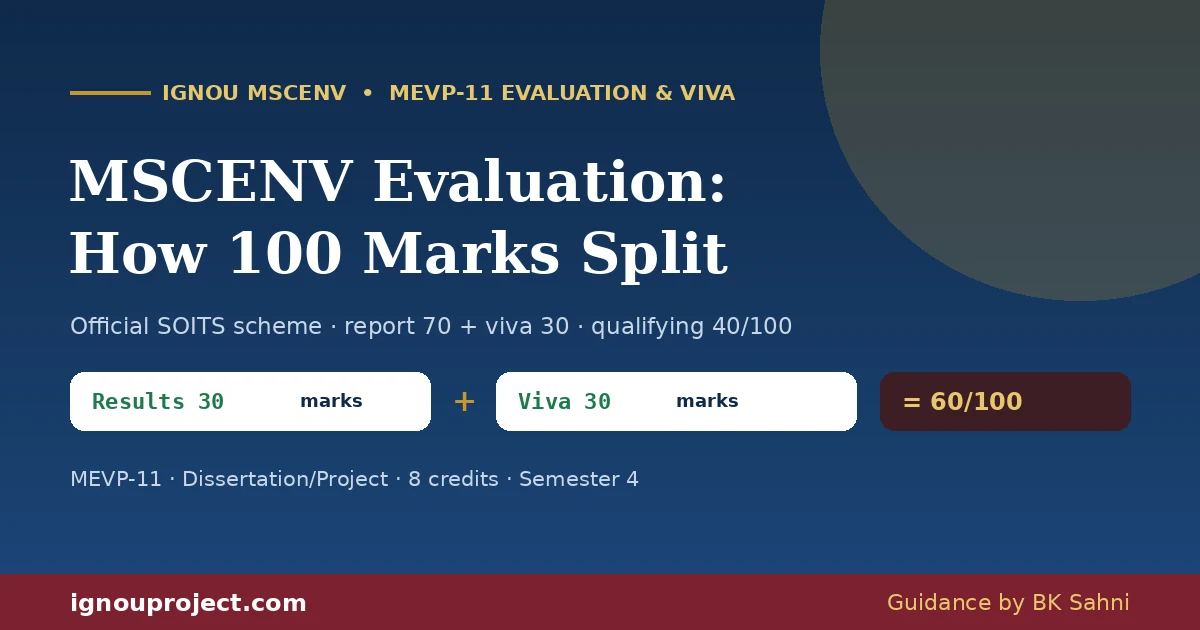
The IGNOU MSCENV project, course code MEVP-11, is evaluated out of 100 marks on the scheme published in the SOITS project handbook: Introduction with objectives and rationale carries 10 marks, review of the literature 10, methodology 10, results and discussion 30, conclusions 10, and the viva voce 30. The written report therefore accounts for 70 marks and the oral defence for 30. MEVP-11 is an 8-credit course — the official title in the Common Prospectus is Dissertation/Project — placed in the fourth semester of the 72-credit MSc Environmental Science programme under the School of Interdisciplinary and Trans-disciplinary Studies. As with IGNOU project courses generally, the qualifying threshold is 40 marks out of 100. The two heaviest components, results-and-discussion and the viva, together carry 60 of the 100 marks, which makes the depth of the data analysis and the student’s ability to defend it the deciding factors in the final grade.
The official scheme
What is the MEVP-11 evaluation scheme?
The SOITS project handbook publishes the marks distribution that the evaluator applies to every MSCENV dissertation. It is short enough to memorise — and important enough that it should shape how you divide your semester:
| Component | Maximum marks |
|---|---|
| Introduction (with objectives & rationale) | 10 |
| Review of the literature | 10 |
| Methodology | 10 |
| Results and discussion | 30 |
| Conclusions | 10 |
| Viva voce | 30 |
| Total | 100 |
Two structural facts follow directly from the table. First, the written report is worth 70 marks and the viva 30 — the oral defence is not a formality, it is nearly a third of the grade. Second, no single writing component except results-and-discussion is worth more than 10 marks, so a report that spends forty pages on introduction and literature review and ten on analysis has its effort exactly backwards.
Component by component
What earns the marks in each section?
The component names tell you what to write; the marks tell you how deeply. Read each weight as the evaluator’s time budget for that section:
| Component (marks) | What the evaluator rewards |
|---|---|
| Introduction & objectives (10) | A clearly stated environmental problem, precise and answerable objectives, and a rationale that says why this study, in this place, now. Two or three tight pages beat ten loose ones. |
| Review of literature (10) | A critical selection of studies that leads to your gap — not a summary of everything ever written on the topic. Every cited study should earn its place. |
| Methodology (10) | An explicit, reproducible design grounded in MEV-19: study area, sampling plan, instruments or data sources, and the analysis approach — stated so another researcher could repeat it. |
| Results and discussion (30) | Real data, honestly presented and genuinely analysed: tables and figures that carry meaning, comparisons against standards or earlier studies, and discussion of what the numbers imply — not just what they are. |
| Conclusions (10) | Findings answered against each objective, stated limitations, and recommendations that follow from the data rather than from general knowledge. |
| Viva voce (30) | Ownership: you can explain why you chose the method, what the data shows, what surprised you, and what you would do differently. Evaluators probe the work’s weakest point — know yours before they find it. |
The strategy
Why results and viva decide your MEVP-11 grade
Results-and-discussion plus the viva carry 60 of the 100 marks — and they are not independent. The viva examiners question you on the same analysis your results chapter presents, so a thin results chapter loses marks twice: once on paper, and again when there is little to defend orally. BK Sahni, who has guided 5,00,000 students till date, notes that most weak MSCENV reports get the balance exactly backwards — long introductions, padded literature reviews, and then a results chapter with two tables and no discussion. The scheme rewards the opposite: a disciplined front half, and an analysis chapter deep enough to sustain thirty minutes of questioning.
The practical rule: plan your semester so that data collection and analysis get at least as much time as all the writing combined. A well-analysed modest dataset scores better than an ambitious study whose data arrived too late to analyse properly — feasibility guidance for choosing such a study is in the main MSCENV project guide.
The oral defence
How does the MEVP-11 viva voce work?
The viva carries 30 marks and is arranged after the report is evaluated — typically through your Regional Centre, which notifies the date and mode; confirm the current arrangement for your session with your RC. It is a structured conversation about your own work, and the evaluation components map directly onto the questions you should expect:
- Why this topic? — your rationale and its environmental significance (introduction component).
- Why this method? — sampling choices, instruments or data sources, and their limitations (methodology component).
- What did you find? — walk through your key tables and figures, and compare them against standards or earlier studies (results component).
- What does it mean? — implications, limitations, and recommendations that follow from the data (conclusions component).
- What would you do differently? — the reflection question that separates memorised reports from owned ones.
Preparation that works: re-read your own report end to end shortly before the viva, rehearse a three-minute summary of the whole study, know the source and units of every number in your tables, and take a marked printed copy with you. The examiners are testing ownership, not memory — a student who says “my dissolved-oxygen readings were lowest downstream of the drain, which matches the BOD pattern” earns the marks that a student who recites the report’s headings does not.
Two facts students get wrong
Credits, fee and the qualifying threshold
Older guides still call MEVP-11 a 4-credit project and treat the viva as a formality. Both undercount the course — and lead to under-planned semesters and unprepared defences.
The Common Prospectus lists MEVP-11 at 8 credits in Semester 4 of the 72-credit programme, and the handbook’s scheme gives the viva 30 of the 100 marks. Both numbers are structural, not optional.
Because MEVP-11 is above 4 credits, its project evaluation fee is Rs. 500 — paid along with the Term-End Examination form under the credit-band structure in force since the January 2023 admission cycle; the full code-by-code picture is in the IGNOU project course codes directory. As with IGNOU project courses generally, the qualifying threshold is 40 out of 100, including the viva. The submission route for the completed report is covered step by step in the IGNOU project submission guide, and the synopsis rules that precede all of this in the IGNOU synopsis and proposal guide.
Preparing your MSCENV report or facing the viva soon?
If you want your results chapter reviewed against the 30-mark standard, or a mock round of viva questions built from your own report, send your topic and current status and we will help you prepare where the marks actually are.
Ask on WhatsApp Guidance only. Always confirm evaluation details with your Regional Centre.FAQ
Frequently asked questions
How many marks is the IGNOU MSCENV project evaluated out of?
100 marks, on the scheme published in the SOITS project handbook: introduction 10, review of literature 10, methodology 10, results and discussion 30, conclusions 10, and viva voce 30. The written report carries 70 marks and the viva 30.
Is there a viva for MEVP-11, and how many marks does it carry?
Yes. The viva voce is part of the official evaluation scheme and carries 30 of the 100 marks. It is arranged after the report is evaluated, typically through the Regional Centre, and examines your understanding and ownership of your own study.
What are the passing marks for the MSCENV project?
As with IGNOU project courses generally, the qualifying threshold is 40 out of 100, including the viva. Confirm your session’s current norms with your Regional Centre.
Which section of the MEVP-11 report carries the most marks?
Results and discussion, at 30 marks — three times the weight of the introduction, literature review, methodology or conclusions, each of which carries 10. Together with the 30-mark viva, the analysis and its defence decide 60 of the 100 marks.
How many credits is MEVP-11 and what is its evaluation fee?
MEVP-11 carries 8 credits — not 4, as some older guides state — in the fourth semester of the 72-credit MSCENV programme. Because it is above 4 credits, its project evaluation fee is Rs. 500, paid with the Term-End Examination form.
What questions are asked in the MSCENV project viva?
Expect questions mapped to the evaluation components: why you chose the topic, why the method fits, what the key findings show, what they imply, the study’s limitations, and what you would do differently. Examiners test ownership of the work — know the source and meaning of every number in your tables.

BK Sahni iD 0009-0005-8092-459X
Founder, Shri Chakradhar Publication Pvt. Ltd. & ignouproject.com — helping IGNOU distance-learning students since 2010 (5,00,000+ students supported across MBA, MCom, MA & more). Author of IGNOU exam guides, solved assignments & project reference books.
Disclosure: Shri Chakradhar Publication Pvt. Ltd. and ignouproject.com are independent third-party study-help services — not the official IGNOU website. Always verify final dates and rules on ignou.ac.in.