MA Migration and Diaspora (MAMIDI) · December 2026 term-end examination
Six of the eight long questions on the June 2026 MDI-008 paper had already appeared on earlier MDI-008 papers. This December, four Semester I MAMIDI papers also fall on four mornings in a row.
Forty-eight IGNOU papers for the twelve MDI and MDIE codes, December 2024 to June 2026, set out theme by theme, with every MAMIDI sitting taken from the date sheet IGNOU issued on 30 October 2026.
- 48 MDI and MDIE papers compared
- MDI-006 opens on Tue 1 Dec
- MDI-002 to MDI-005: 28 to 31 Dec
- Any five answers, 20 marks each
- English and Hindi papers since June 2025
- Free sitting planner and answer clock
Type the codes as the hall ticket shows them, for example MDI-002 or MDIE-001, and mark each one PDF or printed.
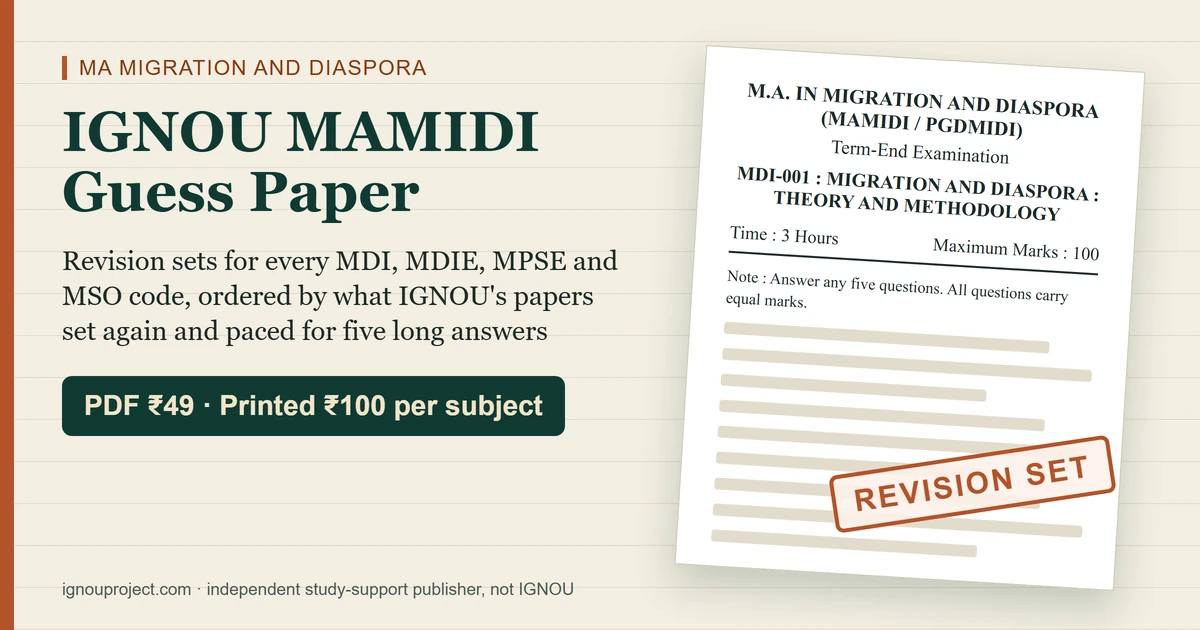
Quick answer. An IGNOU MAMIDI guess paper is a revision set for one course code of the MA in Migration and Diaspora, built around the themes IGNOU keeps setting and answered at exam length; MAMIDI has seventeen written papers, ten MDI codes, two MDIE codes and five borrowed courses (MPSE-001, MPSE-005, MPSE-009, MPSE-011 and MSO-002). IGNOU’s December 2026 term-end examination (TEE) runs from 25 November 2026 to 14 January 2027, and the MAMIDI papers run from MDI-006 on Tuesday 1 December 2026 to MSO-002 on Thursday 7 January 2027, per IGNOU’s date sheet of 30 October 2026. Every MDI and MDIE paper from December 2024 to June 2026 was 3 hours and 100 marks with any five answers at 20 marks each, while the borrowed MPSE papers are 2 hours and 50 marks. The rate is ₹49 per subject code for a solved guess paper as a PDF, or ₹100 per subject code as a printed copy. Printed copies carry a one-time courier charge of ₹100 per order, whatever the number of subject codes; the PDF has no courier charge. Each set is prepared for the upcoming term-end examination, in every medium IGNOU examines that course in, and the medium for your course code is confirmed on WhatsApp before you pay. No one outside IGNOU knows the questions in advance, so a set is a guide to what to revise first, never a forecast.
MAMIDI December 2026 Dates: Tuesday 1 December to Thursday 7 January
The first MAMIDI paper of December 2026 is MDI-006 Indian Diaspora: Socio-Cultural Facets on Tuesday 1 December 2026, 10 AM to 1 PM, and the last is MSO-002 Research Methodologies and Methods on Thursday 7 January 2027, 2 PM to 5 PM, according to IGNOU’s date sheet of 30 October 2026. That sheet gives every MAMIDI code the same date and session as IGNOU’s tentative sheet of 21 September 2026, so the change between the two versions does not move any MDI paper.
Whole IGNOU cycle, every programme: 25 November 2026 (Wednesday) through 14 January 2027 (Thursday), as the 30 October 2026 sheet prints it
First MAMIDI paper
MDI-006 Indian Diaspora: Socio-Cultural Facets, Tuesday 1 December, 10 AM to 1 PM
Last MAMIDI paper
MSO-002 Research Methodologies and Methods, Thursday 7 January 2027, 2 PM to 5 PM
The 30 October 2026 sheet no longer prints the word “tentative” in its heading. IGNOU can still revise it, and the hall ticket is the final word on date, session and centre.
Semester I: MDI-001 in Mid-December, Then Four Mornings in a Row
MDI-001 Migration and Diaspora: Theory and Methodology stands apart on Saturday 12 December, in the afternoon. The other four Semester I courses come sixteen days later and back to back: MDI-002 on Monday 28 December, MDI-003 on Tuesday 29, MDI-004 on Wednesday 30 and MDI-005 on Thursday 31 December, each from 10 AM to 1 PM.
That run is the hardest stretch of the MAMIDI calendar. There is no free evening between those four papers, so MDI-003 to MDI-005 have to be revised before 28 December, not between sittings.
Semester II Stretches From 1 December to 2 January
Semester II is spread thin. MDI-006 opens the programme on 1 December, MPSE-001 India and the World follows on Monday 7 December, MDIE-002 Diasporas in India on Monday 14 December (afternoon), MPSE-005 State and Society in Africa on Saturday 19 December, and MDIE-001 Gender and Diaspora closes the semester on Saturday 2 January 2027.
Semesters III and IV
- Semester III: MDI-007 on Tuesday 8 December, MDI-008 on Thursday 10 December, MPSE-009 on Thursday 24 December, all mornings, and MSO-002 on the afternoon of Thursday 7 January 2027.
- Semester IV: MDI-009 on the morning of Saturday 12 December, MDI-010 on Tuesday 15 December (morning) and MPSE-011 on the afternoon of Saturday 26 December.
Clash checklist for learners carrying codes from two semesters.
- Saturday 12 December holds two MAMIDI papers: MDI-009 from 10 AM to 1 PM and MDI-001 from 2 PM to 5 PM. A Semester IV learner still carrying MDI-001 writes both on one day.
- Monday 7 and Tuesday 8 December are consecutive: MPSE-001 (Semester II) then MDI-007 (Semester III).
- Monday 14 and Tuesday 15 December are consecutive: MDIE-002 (Semester II, afternoon) then MDI-010 (Semester IV, morning), with less than a day between them.
- A learner writing all of Semester I plus MDIE-001 sits on 28, 29, 30 and 31 December and again on 2 January.
Learners in other programmes can find their own codes on the site’s December 2026 date sheet lookup. Reporting times for the two sessions are covered in the explainer on morning and afternoon exam timings, and admit cards in the guide to downloading the IGNOU hall ticket. Centre changes are explained on the exam centre page, while the per-course exam fee and the online payment steps for the exam form cover anyone still to register.
What the MAMIDI Term-End Paper Counts For, and the Figure IGNOU Leaves Out
IGNOU prints no weightage figure for MAMIDI. None of the 48 MDI and MDIE term-end papers from December 2024 to June 2026 carries a weightage line, and neither does the January 2023 MAMIDI assignment booklet or the 2025-26 MDI-001 assignment, which says only that the assignment “will carry 100 marks”. How the term-end mark and the assignment mark combine for MAMIDI is therefore a question for the MAMIDI Programme Guide, and this page does not borrow another programme’s figure.
The documents do make one thing plain: the term-end paper is the larger writing task. The January 2023 MAMIDI assignment booklet asks for each answer “in around 500-700 words” written at home. The 2025-26 MDI-001 assignment uses the same any-five, 20-mark layout as the exam. In the hall, the same five answers must fit into three hours.
Ten minutes of reading leaves 170 minutes, or 34 minutes for each 20-mark MDI answer. A learner who writes 700 words at home will run short in the hall.
The site’s own MAMIDI handwritten assignment page currently states a 30 per cent and 70 per cent split as fact. No MAMIDI document IGNOU publishes prints that figure, and the statement is being corrected. Once results arrive, a MAMIDI grade converts with the IGNOU percentage converter.
Migration and Diaspora Revision Set, IGNOU Paper or Answered Paper: Which One Helps
A guess paper, for one course code such as MDI-009 Human Trafficking: An Overview, is a revision set a publisher prepares from the themes IGNOU has set more than once and from the syllabus, with a model answer for each theme; sellers also call it “important questions”, “expected questions” or a “model paper”.
A previous year question paper for MAMIDI is a paper IGNOU actually set at an earlier term-end examination, such as the June 2026 MDI-009 paper with nine questions, any five to be answered, and IGNOU publishes it free. Put a publisher’s worked answers under such an IGNOU paper and it becomes a solved question paper.
The difference is span. One archive paper, or one solved paper, shows one sitting. A revision set looks across sittings, which is how it becomes visible that MDI-009 asked about the Palermo Protocol in each of its last four papers.
On a phone, swipe the table sideways for every column.
| Point of comparison | Guess paper | Previous year question paper | Solved question paper |
|---|---|---|---|
| Contents | MDI or MDIE themes IGNOU has asked more than once, each answered | One sitting, exactly as IGNOU set it | One IGNOU sitting with answers added |
| Who prepares it | A publisher | IGNOU | A publisher |
| Price | Paid; here ₹49 PDF · ₹100 printed, per subject code | Free on IGNOU’s site | Usually paid |
| Most useful for | Deciding what to revise first and how much to write | A timed three-hour rehearsal | Seeing one complete sitting answered |
| Limit | Cannot say what the next MAMIDI paper holds | Cannot show which themes return | Covers only the sitting it answers |
All 48 MDI and MDIE papers counted on this page are free, and each is linked below its theme table. Worked answers to IGNOU papers in many programmes sit in the site’s collection of solved IGNOU question papers, and the IGNOU guess papers index lists the other programmes.
Five answers, 34 minutes each. Every MDI and MDIE answer is drafted to the length a 20-mark answer allows in a three-hour paper.
Short notes in two halves. The two-part 10-mark notes that close most MDI papers get two compact answers, not one long one.
Repeated questions first. Questions IGNOU has printed word for word in two sittings, as in MDI-008 and MDI-010, open each set.
Conventions with their years. Answers in MDI-001, MDI-009 and MDIE-001 date the 1951 Refugee Convention, the 2000 Palermo Protocol and the 2011 ILO Convention 189 correctly.
Named systems spelled right. MDI-004 answers explain the Kangani and Maistry systems and indenture, the recruitment terms IGNOU’s papers sometimes misprint.
Country cases ready. MDI-003 answers carry short case notes on South Asian, African, French, Dutch and East Asian diasporas.
Labour economics with models. MDI-007 answers set out the Lewis surplus-labour model and the neo-classical view in the order IGNOU asks.
Gender and care work. MDIE-001 answers cover the global care chain, the kafala system and gendered remittances.
Borrowed papers sized correctly. MPSE answers fit a 2-hour, 50-mark paper; MSO-002 answers fit its two-section, 500-word rule.
Sources you can check. Each MDI count below cites a session plus a question number, so IGNOU’s PDF settles any doubt.
Current codes only. No set is sold for a code absent from the July 2026 Common Prospectus or the December 2026 sheet.
PDF or printed copy. A MAMIDI code travels either as a WhatsApp PDF or as a bound booklet by courier.
Seventeen Written MAMIDI Papers Across Four Semesters
MAMIDI is an 80-credit programme of the School of Interdisciplinary and Trans-disciplinary Studies (SOITS), set out in section 3.43 of the July 2026 Common Prospectus with 20 credits in each semester. Semesters I and II carry ten 4-credit courses. Semester III carries MSO-002 at 8 credits plus three 4-credit courses, and Semester IV carries three 4-credit courses plus the 8-credit MDIP-001 project. The four semester totals add to the stated 80. English is the only medium of instruction the prospectus lists. MDIP-001, being a project, never sits in the exam hall, and no table below lists it.
Semester I: Five MDI Theory Courses
On a phone, swipe the table sideways for every column.
| Code | Title (July 2026 Common Prospectus) | Credits | Semester | December 2026 sitting |
|---|---|---|---|---|
| MDI-001 | Migration and Diaspora: Theory and Methodology | 4 | Semester I | Sat 12 Dec 2026, 2 PM to 5 PM |
| MDI-002 | Transnationalism, Diaspora and Citizenship | 4 | Semester I | Mon 28 Dec 2026, 10 AM to 1 PM |
| MDI-003 | Global Diasporas: Case Studies | 4 | Semester I | Tue 29 Dec 2026, 10 AM to 1 PM |
| MDI-004 | Indian Diaspora: An Overview | 4 | Semester I | Wed 30 Dec 2026, 10 AM to 1 PM |
| MDI-005 | Indian Diaspora: Politico-Economic and Policy Aspects | 4 | Semester I | Thu 31 Dec 2026, 10 AM to 1 PM |
Semester II: Two Electives in Name, Both Compulsory Here
On a phone, swipe the table sideways for every column.
| Code | Title (July 2026 Common Prospectus) | Credits | Semester | December 2026 sitting |
|---|---|---|---|---|
| MDI-006 | Indian Diaspora: Socio-Cultural Facets | 4 | Semester II | Tue 1 Dec 2026, 10 AM to 1 PM |
| MDIE-001 | Gender and Diaspora | 4 | Semester II | Sat 2 Jan 2027, 10 AM to 1 PM |
| MDIE-002 | Diasporas in India | 4 | Semester II | Mon 14 Dec 2026, 2 PM to 5 PM |
| MPSE-001 | India and the World | 4 | Semester II | Mon 7 Dec 2026, 10 AM to 1 PM |
| MPSE-005 | State and Society in Africa | 4 | Semester II | Sat 19 Dec 2026, 10 AM to 1 PM |
Semesters III and IV: Labour, Trafficking and Two Borrowed Courses
On a phone, swipe the table sideways for every column.
| Code | Title (July 2026 Common Prospectus) | Credits | Semester | December 2026 sitting |
|---|---|---|---|---|
| MSO-002 | Research Methodologies and Methods | 8 | Semester III | Thu 7 Jan 2027, 2 PM to 5 PM |
| MDI-007 | Theories of Labour and Labour Markets | 4 | Semester III | Tue 8 Dec 2026, 10 AM to 1 PM |
| MDI-008 | Production Process and Labour Markets | 4 | Semester III | Thu 10 Dec 2026, 10 AM to 1 PM |
| MPSE-009 | Canada: Politics and Society | 4 | Semester III | Thu 24 Dec 2026, 10 AM to 1 PM |
| MPSE-011 | The European Union in World Affairs | 4 | Semester IV | Sat 26 Dec 2026, 2 PM to 5 PM |
| MDI-009 | Human Trafficking: An Overview | 4 | Semester IV | Sat 12 Dec 2026, 10 AM to 1 PM |
| MDI-010 | Law, Policies and Institutional Response to Human Trafficking and Migration | 4 | Semester IV | Tue 15 Dec 2026, 10 AM to 1 PM |
PGDMIDI, the PG Diploma in Migration and Diaspora described in section 8.39 of the prospectus, is the MAMIDI first year on its own. MPSE-001, MPSE-005, MPSE-009 and MPSE-011 are MA Political Science courses, and the site’s MAPS revision page with the MPSE theme tables covers them in depth; MSO-002 belongs to MA Sociology and is treated on the MASO page with its MSO-002 themes. Admission rules for every programme start from the Common Prospectus explainer.
Which MAMIDI Codes a Given Learner Writes
On a phone, swipe the table sideways for every column.
| Learner | Written codes on the December 2026 sheet | Sitting days |
|---|---|---|
| PGDMIDI learner taking the electives in place of the project | MDI-001 to MDI-006, MDIE-001, MDIE-002 | 1, 12, 14 and 28 to 31 December, then 2 January |
| MAMIDI Semester I | MDI-001 to MDI-005 | 12 December, then 28 to 31 December |
| MAMIDI Semester II | MDI-006, MDIE-001, MDIE-002, MPSE-001, MPSE-005 | 1, 7, 14 and 19 December, then 2 January |
| MAMIDI Semester III | MSO-002, MDI-007, MDI-008, MPSE-009 | 8, 10 and 24 December, then 7 January |
| MAMIDI Semester IV | MDI-009, MDI-010, MPSE-011 (MDIP-001 is a project) | 12, 15 and 26 December |
The PGDMIDI row follows the prospectus note that MDIE-001 and MDIE-002 may be taken “in lieu of project MDIP-001”. In MAMIDI the same two MDIE courses are simply Semester II theory courses, and MDIP-001 moves to Semester IV.
How IGNOU Set Each MAMIDI Paper in June 2026
Every MDI and MDIE paper IGNOU set in June 2026 was 3 hours long, carried 100 marks and asked for any five answers with all questions carrying equal marks, so each answer is worth 20 marks, per the June 2026 papers for all twelve codes. The papers offered between eight and ten questions. The four borrowed MPSE papers of June 2026 were 2 hours and 50 marks, and MSO-002 was 3 hours and 100 marks with at least two answers from each of its two sections.
On a phone, swipe the table sideways for every column.
| Code | Latest IGNOU paper | Time and marks | Answer rule | Printed in |
|---|---|---|---|---|
| MDI-001 | June 2026 | 3 hours, 100 marks | Any 5 of 8, 20 marks each; last question: two short notes at 10 marks each | English and Hindi |
| MDI-002 | June 2026 | 3 hours, 100 marks | Any 5 of 8, 20 marks each; no short-note question | English and Hindi |
| MDI-003 | June 2026 | 3 hours, 100 marks | Any 5 of 9, 20 marks each; last question: two short notes at 10 marks each | English and Hindi |
| MDI-004 | June 2026 | 3 hours, 100 marks | Any 5 of 10, 20 marks each; last question: two short notes at 10 marks each | English and Hindi |
| MDI-005 | June 2026 | 3 hours, 100 marks | Any 5 of 9, 20 marks each; last question: two short notes at 10 marks each | English and Hindi |
| MDI-006 | June 2026 | 3 hours, 100 marks | Any 5 of 8, 20 marks each; last question: two short notes at 10 marks each | English and Hindi |
| MDIE-001 | June 2026 | 3 hours, 100 marks | Any 5 of 9, 20 marks each; last question: two short notes at 10 marks each | English and Hindi |
| MDIE-002 | June 2026 | 3 hours, 100 marks | Any 5 of 8, 20 marks each; last question: two short notes at 10 marks each | English and Hindi |
| MDI-007 | June 2026 | 3 hours, 100 marks | Any 5 of 9, 20 marks each; last question: two short notes at 10 marks each | English and Hindi |
| MDI-008 | June 2026 | 3 hours, 100 marks | Any 5 of 9, 20 marks each; last question: two short notes at 10 marks each | English and Hindi |
| MDI-009 | June 2026 | 3 hours, 100 marks | Any 5 of 9, 20 marks each; last question: two short notes at 10 marks each | English and Hindi |
| MDI-010 | June 2026 | 3 hours, 100 marks | Any 5 of 9, 20 marks each; last question: two short notes at 10 marks each | English and Hindi |
| MPSE-001 | June 2026 | 2 hours, 50 marks | Any 5 of 10, at least 2 from each of two sections, 10 marks each; about 400 words an answer | English and Hindi |
| MPSE-005 | June 2026 | 2 hours, 50 marks | Any 5 of 10, at least 2 from each of two sections, 10 marks each; about 400 words an answer | English and Hindi |
| MPSE-009 | June 2026 | 2 hours, 50 marks | Any 5 of 10, at least 2 from each of two sections, 10 marks each; about 400 words an answer | English and Hindi |
| MPSE-011 | June 2026 | 2 hours, 50 marks | Any 5 of 10, at least 2 from each of two sections, 10 marks each; about 400 words an answer | English and Hindi |
| MSO-002 | June 2026 | 3 hours, 100 marks | Any 5 of 10, at least 2 from each of two sections, 20 marks each; about 500 words an answer | English and Hindi |
Question Counts From December 2024 to June 2026
The answer rule has not moved in four sessions: any five, equal marks. What moves is the choice. Most papers print nine questions, the last of them two short notes at 10 marks each, but IGNOU has printed eight and ten as well, and three papers had no short-note question at all.
On a phone, swipe the table sideways for every column.
| Code | December 2024 | June 2025 | December 2025 | June 2026 |
|---|---|---|---|---|
| MDI-001 | 9 | 9 | 9 | 8 |
| MDI-002 | 9 | 9 | 9 | 8 (no short notes) |
| MDI-003 | 9 | 9 | 9 | 9 |
| MDI-004 | 9 | 9 | 9 | 10 |
| MDI-005 | 9 | 10 | 9 | 9 |
| MDI-006 | 9 (no short notes) | 9 | 9 | 8 |
| MDIE-001 | 9 | 9 | 9 | 9 |
| MDIE-002 | 9 (no short notes) | 9 | 8 | 8 |
| MDI-007 | 9 | 10 | 10 | 9 |
| MDI-008 | 9 | 10 | 9 | 9 |
| MDI-009 | 9 | 9 | 9 | 9 |
| MDI-010 | 9 | 9 | 9 | 9 |
| Printed in | English only | English and Hindi | English and Hindi | English and Hindi |
MDI Papers Against the Borrowed MPSE and MSO Papers
MAMIDI learners write two different paper lengths for courses of the same 4 credits: an MDI or MDIE paper of 3 hours and 100 marks, and an MPSE paper of 2 hours and 50 marks, per the June 2026 MDI and MPSE papers. Both ask for five answers, so an MPSE answer gets about 22 minutes against about 34 for an MDI answer. The MPSE papers also ask for “about 400 words” an answer and at least two from each section.
On a phone, swipe the table sideways for every column.
| Codes | Paper | Time per answer |
|---|---|---|
| MDI-001 to MDI-010, MDIE-001, MDIE-002 | 3 hours, 100 marks, 5 answers | about 34 min for each 20-mark answer; 17 min for each 10-mark short note |
| MPSE-001, MPSE-005, MPSE-009, MPSE-011 | 2 hours, 50 marks, 5 answers | about 22 min for each 10-mark answer of about 400 words |
| MSO-002 | 3 hours, 100 marks, 5 answers | about 34 min for each 20-mark answer of about 500 words |
The borrowed papers behind these figures, each headed for the MA programme that owns the course: MPSE-001 June 2026, MPSE-005 June 2026, MPSE-009 June 2026, MPSE-011 June 2026 and MSO-002 June 2026.
One programme, several names on IGNOU’s files. IGNOU heads MDI-003 and MDIE-001 for the PG Diploma (PGDMIDI) only, heads most Semester III and IV papers for the MA (MAMIDI) only, and by June 2026 printed both names on MDI-001, MDI-002, MDI-004, MDI-005, MDI-006 and MDIE-002 (MDIE-002 already in December 2025). The December 2024 MDI-006 paper prints the diploma’s name as “PGDDIMI”. The December 2024 archive files MDI-002 as “MDI-2” and MDIE-002 as “MDIE-02”, the December 2026 date sheet prints MDI01 to MDI06 but MDI007 to MDI010, and the 2025-26 MDIE-001 assignment is filed as “MIDE-01”. Search IGNOU’s pages by course number, not by programme name.
Where IGNOU’s MAMIDI documents contradict each other, plus one slip of this site’s own.
- The prospectus lists English as the only MAMIDI medium of instruction, yet every MDI and MDIE paper since June 2025 has been printed in English and Hindi.
- Section 8.39 of the prospectus calls MDIE-001 and MDIE-002 electives taken in place of the project, while section 3.43 lists them as ordinary Semester II theory courses for MAMIDI.
- Section 8.39 prints the PGDMIDI total as 32 credits although its listed courses add to 40; the 32 holds only because the electives replace the 8-credit project. It also truncates the MDI-1 title to “Methodolog”.
- The site’s MAMIDI handwritten assignment page states a 70 per cent term-end weightage that no MAMIDI document prints; it is being corrected.
For a code outside the theme tables, the format is confirmed on WhatsApp against the latest IGNOU paper before a set is sent.
What 48 MDI and MDIE Papers Asked, and What They Asked Twice
MAMIDI papers repeat whole questions: six of the eight long questions on the June 2026 MDI-008 paper had appeared on the December 2024 or December 2025 MDI-008 papers in the same or almost the same words, and four of the eight long questions on the June 2026 MDI-010 paper had appeared before. Across the twelve MDI and MDIE codes, 43 themes appeared in all four papers from December 2024 to June 2026.
The counts below come from the twelve MDI and MDIE codes in four sessions, December 2024, June 2025, December 2025 and June 2026, 48 IGNOU papers in all, each reviewed in full by ignouproject.com on 4 November 2026. A theme is counted when a question or a short-note option asks about the same idea, whatever the wording; that grouping is a human judgement, so each cell gives the question number for checking against IGNOU’s file. A count is written as n of 4 papers. It describes what IGNOU has asked, and says nothing about what IGNOU will ask in December 2026.
Questions IGNOU Printed Again, Word for Word
On a phone, swipe the table sideways for every column.
| Code | Question topic | Set in |
|---|---|---|
| MDI-008 | Impacts of the Industrial Revolution on manufacturing industries | Dec 2024 Q2, Dec 2025 Q2, Jun 2026 Q2 |
| MDI-008 | “The first industrial divide” and its significance | Dec 2025 Q4, Jun 2026 Q3 |
| MDI-008 | New key terms of contemporary globalisation | Dec 2024 Q6, Jun 2026 Q4 |
| MDI-008 | “Jobless growth” in India in the late 2000s | Dec 2025 Q6, Jun 2026 Q5 |
| MDI-008 | How global production has been organised since the 1970s | Dec 2025 Q7, Jun 2026 Q6 |
| MDI-008 | How the contract worker has changed the nature of jobs | Dec 2025 Q8, Jun 2026 Q7 |
| MDI-010 | Best practices for trafficking in persons, and why they are needed | Jun 2025 Q3, Dec 2025 Q4, Jun 2026 Q4 |
| MDI-010 | Role of communities and civil society against trafficking | Jun 2025 Q6, Dec 2025 Q7, Jun 2026 Q6 |
| MDI-009 | How historical context explains trafficking in persons | Dec 2025 Q7, Jun 2026 Q6 |
| MDI-009 | How the internet changed the way trafficking is done | Jun 2025 Q1, Dec 2025 Q6 |
| MDI-003 | Old and new South Asian diasporas and their challenges | Dec 2024 Q1, Jun 2025 Q1, Dec 2025 Q1 |
| MDI-003 | India’s initiatives to engage its diaspora | Jun 2025 Q7, Dec 2025 Q7 |
| MDI-002 and MDI-003 | US diaspora organisations behind the Indian software industry | MDI-002 Dec 2024 Q8, then MDI-003 Dec 2025 Q6 |
| MDI-004 | Challenges faced by skilled migrants | Jun 2025 Q2, Dec 2025 Q6 |
| MDI-005 | How diaspora entrepreneurs contribute to the homeland | Dec 2024 Q5, Jun 2025 Q6 |
| MDI-001 | Features of South Asian labour migration | Dec 2024 Q8, Dec 2025 Q8 |
The cross-course row is the oddest: a question first set in MDI-002 Transnationalism, Diaspora and Citizenship came back, unchanged, on the MDI-003 Global Diasporas paper a year later. Revising only the code on the hall ticket would have missed that it had been asked before.
MDI-001 Theory and Methodology: Governance and Law Return Most
On a phone, swipe the table sideways for every column.
| Theme | December 2024 | June 2025 | December 2025 | June 2026 | n of N |
|---|---|---|---|---|---|
| Migration governance: meaning, principles and present-day challenges | Q3 | Q3 | – | Q4 | 3 of 4 |
| Economic determinants of migration, including income inequality | Q1 | Q9(b) | – | Q6 | 3 of 4 |
| International legal frameworks and the rights of migrant workers | Q6 | Q7 | – | Q7 | 3 of 4 |
| South Asian labour migration and labour market policies | Q8 | Q8 | Q8 | – | 3 of 4 |
| Globalisation, transnationalism and migration | Q4 | Q2, Q9(a) | – | Q3 | 3 of 4 |
| How the idea of diaspora is defined, typed and approached | Q2 | – | Q2 | Q1 | 3 of 4 |
| Diaspora’s part in home-country development | Q5 | Q6 | Q7 | – | 3 of 4 |
| Ageing, gender and the demography of migration | Q9(b), Q9(c) | Q5 | – | Q8(c) | 3 of 4 |
| Refugees, asylum seekers and the 1951 Convention | Q9(a) | Q9(c) | – | Q8(e) | 3 of 4 |
| Global migration regime and its instruments | – | – | Q5 | Q5 | 2 of 4 |
| Diaspora and the nation-state | Q7 | – | Q6 | – | 2 of 4 |
The four MDI-001 papers behind these counts are free on IGNOU’s site: MDI-001 December 2024, MDI-001 June 2025, MDI-001 December 2025 and MDI-001 June 2026.
MDI-002 Transnationalism, Diaspora and Citizenship: Definitions Every Time
On a phone, swipe the table sideways for every column.
| Theme | December 2024 | June 2025 | December 2025 | June 2026 | n of N |
|---|---|---|---|---|---|
| Defining diaspora: Safran and later scholars | Q2 | Q1, Q9(b) | Q1 | Q1 | 4 of 4 |
| The Jewish diaspora as the prototype | Q5 | Q4 | Q9(d) | Q6 | 4 of 4 |
| Citizenship, transnationalism and globalisation | Q9(b) | Q9(c) | Q2, Q9(b) | Q2 | 4 of 4 |
| Diaspora networks and skilled networks | Q7 | – | Q3, Q9(c) | Q4 | 3 of 4 |
| Human rights and diaspora communities | – | Q7 | Q7 | Q8 | 3 of 4 |
| Indian diaspora: history, programmes and policy influence | – | Q2 | Q5, Q8 | Q3, Q5 | 3 of 4 |
| Diaspora as soft power and in foreign policy | – | Q3 | Q4 | Q5 | 3 of 4 |
| African and Black diasporas | Q9(a) | Q5 | – | Q7 | 3 of 4 |
| Homeland development, remittances and diaspora investment | Q3, Q6 | Q9(a) | Q3 | – | 3 of 4 |
| European diaspora | Q9(c) | Q6 | – | – | 2 of 4 |
IGNOU files, the first of them listed as MDI-2: MDI-002 December 2024, MDI-002 June 2025, MDI-002 December 2025 and MDI-002 June 2026.
MDI-003 Global Diasporas: Regions Rather Than Theories
On a phone, swipe the table sideways for every column.
| Theme | December 2024 | June 2025 | December 2025 | June 2026 | n of N |
|---|---|---|---|---|---|
| Old and new South Asian diasporas and their challenges | Q1, Q3 | Q1 | Q1 | Q3 | 4 of 4 |
| African diasporas: West, East and North | Q2, Q9(a) | Q2, Q8, Q9(c) | Q2, Q9(c) | Q4, Q5, Q9(b) | 4 of 4 |
| European emigration: British, Italian, Dutch, Spanish and the second wave | Q7 | Q9(e) | Q4, Q9(d) | Q7, Q9(a), Q9(c), Q9(d), Q9(e) | 4 of 4 |
| French diaspora and France’s engagement policy | Q4 | Q4 | – | Q6 | 3 of 4 |
| How states engage their diasporas: India, the UK and Asian governments | Q6 | Q7, Q9(a) | Q7, Q8 | – | 3 of 4 |
| Citizenship, dual citizenship and transnationalism | Q9(b) | Q5, Q9(b) | Q9(a), Q9(e) | – | 3 of 4 |
| East Asian diasporas: Chinese, Vietnamese and Korean | – | – | Q3 | Q1, Q2, Q8 | 2 of 4 |
Papers: MDI-003 December 2024, MDI-003 June 2025, MDI-003 December 2025 and MDI-003 June 2026.
MDI-004 Indian Diaspora: An Overview, With Five Themes in All Four Papers
On a phone, swipe the table sideways for every column.
| Theme | December 2024 | June 2025 | December 2025 | June 2026 | n of N |
|---|---|---|---|---|---|
| Early Indian emigration to South-East Asia, its trade and culture | Q1 | Q1, Q9(iii) | Q1 | Q1, Q10(v) | 4 of 4 |
| Brain drain and brain gain | Q3, Q9(a) | Q6 | Q9(a) | Q6 | 4 of 4 |
| The indentured labour system | Q4 | Q3, Q9(i) | Q5 | Q4, Q10(iii) | 4 of 4 |
| Kangani and Maistry recruitment systems | Q9(c) | Q9(ii), Q9(v) | Q9(b) | Q5 | 4 of 4 |
| Return and reverse migration | Q2 | Q4 | Q8 | Q8 | 4 of 4 |
| Indian migration to West Asia and the Gulf | Q5 | – | Q3, Q7 | Q3, Q7, Q10(iv) | 3 of 4 |
| Push and pull factors | Q8 | Q7 | Q9(c) | – | 3 of 4 |
| Indian labour migration to Burma (Myanmar) | – | Q8 | Q4 | – | 2 of 4 |
| Challenges faced by skilled migrants | – | Q2 | Q6 | – | 2 of 4 |
| Indian diaspora in Central Asia | – | – | Q2 | Q2 | 2 of 4 |
To check the Kangani and Maistry counts, open IGNOU’s MDI-004 files: MDI-004 December 2024, MDI-004 June 2025, MDI-004 December 2025 and MDI-004 June 2026.
MDI-005 Politico-Economic and Policy Aspects
On a phone, swipe the table sideways for every column.
| Theme | December 2024 | June 2025 | December 2025 | June 2026 | n of N |
|---|---|---|---|---|---|
| Cultural diplomacy and diaspora as soft power | Q1 | Q3, Q10(a) | Q4 | Q3, Q9(b) | 4 of 4 |
| Diaspora entrepreneurship | Q2, Q5, Q7 | Q6 | Q6 | Q5, Q9(c) | 4 of 4 |
| Remittances: formal, informal and social | Q4 | Q5 | Q5, Q9(a) | Q4, Q9(d) | 4 of 4 |
| Diaspora philanthropy | Q9(e) | Q9 | Q8 | Q8 | 4 of 4 |
| India’s diaspora policy and schemes | – | Q1 | Q2 | Q1 | 3 of 4 |
| Diaspora organisations and homeland development | – | Q7 | Q1 | Q6 | 3 of 4 |
| Immigration policy and visas: H-1B, Canada | Q9(a), Q9(b) | Q2 | – | – | 2 of 4 |
| Human trafficking: meaning and causes | – | Q8 | – | Q7 | 2 of 4 |
| Host-country pressures: Malaysia and the Gulf | Q8 | – | – | Q2 | 2 of 4 |
| Migration and technology transfer | Q6 | – | Q7 | – | 2 of 4 |
Sources: MDI-005 December 2024, MDI-005 June 2025, MDI-005 December 2025 and MDI-005 June 2026.
MDI-006 Socio-Cultural Facets: Six Themes in Every Paper
On a phone, swipe the table sideways for every column.
| Theme | December 2024 | June 2025 | December 2025 | June 2026 | n of N |
|---|---|---|---|---|---|
| Caste and social stratification in the Indian diaspora | Q1 | Q3, Q9(b) | Q4, Q9(a) | Q4 | 4 of 4 |
| Social mobility | Q7 | Q5 | Q6, Q9(b) | Q5 | 4 of 4 |
| Marriage, family and kinship | Q4 | Q9(d) | Q3 | Q3 | 4 of 4 |
| Multiculturalism | Q9 | Q9(c) | Q2 | Q8(a) | 4 of 4 |
| Ethnicity, sub-ethnicity and identity | Q3 | Q4, Q6 | Q1 | Q1 | 4 of 4 |
| Media, cinema and digital activism | Q6 | Q1 | Q8, Q9(c), Q9(d) | Q8(e) | 4 of 4 |
| Diasporic literature and writers | – | Q7 | Q7 | Q6 | 3 of 4 |
| Religious identity | – | Q2, Q8, Q9(a) | – | Q2 | 2 of 4 |
| Freedom struggle, Gandhi and the Ghadar movement | – | – | Q5 | Q8(b), Q8(c) | 2 of 4 |
The MDI-006 papers, the earliest headed PGDDIMI: MDI-006 December 2024, MDI-006 June 2025, MDI-006 December 2025 and MDI-006 June 2026.
MDIE-001 Gender and Diaspora
On a phone, swipe the table sideways for every column.
| Theme | December 2024 | June 2025 | December 2025 | June 2026 | n of N |
|---|---|---|---|---|---|
| Gender and migration, and the feminisation of migration | Q1, Q4 | Q1 | Q1, Q2 | Q1, Q2 | 4 of 4 |
| Women as bearers and transmitters of culture | Q7 | Q6 | Q3 | Q3 | 4 of 4 |
| Remittances seen through gender | Q5 | Q7 | Q7 | Q7 | 4 of 4 |
| Domestic and care work: care chains, kafala, ‘disposable domestics’ | Q3, Q9(a) | Q9(b) | Q5, Q9(a) | Q9(a), Q9(d) | 4 of 4 |
| ILO conventions protecting women migrant workers | Q9(c) | Q5 | Q9(c) | Q9(c) | 4 of 4 |
| Chinese female migration | Q6 | Q2 | Q6 | – | 3 of 4 |
| Sexuality, identity and marginality in the diaspora | – | Q4 | Q4 | Q5 | 3 of 4 |
| Indian women and an ‘Indian identity’ abroad | Q8 | – | Q8 | – | 2 of 4 |
| Gendered migration policy in South Asia | – | Q8 | – | Q6 | 2 of 4 |
IGNOU files: MDIE-001 December 2024, MDIE-001 June 2025, MDIE-001 December 2025 and MDIE-001 June 2026.
MDIE-002 Diasporas in India: Communities by Name
On a phone, swipe the table sideways for every column.
| Theme | December 2024 | June 2025 | December 2025 | June 2026 | n of N |
|---|---|---|---|---|---|
| The inclusion and exclusion debate | Q6 | Q6 | Q1 | Q8(c) | 4 of 4 |
| Chinese migrants and the Chinese diaspora in India | Q5 | Q8 | Q5 | Q7 | 4 of 4 |
| Portuguese diaspora in India | Q9 | Q2 | – | Q3 | 3 of 4 |
| Tibetan Rehabilitation Policy 2014 and Tibetan exile | Q7 | Q7, Q9(v) | – | Q8(b) | 3 of 4 |
| Identity, religious identity and diaspora formation | Q3 | Q4, Q9(iv) | Q7, Q8(a) | – | 3 of 4 |
| Citizenship in the Indian context | – | Q5, Q9(ii) | Q2 | – | 2 of 4 |
| Refugee communities in India | Q4 | – | – | Q6, Q8(d) | 2 of 4 |
| Armenian trade diaspora | Q8 | – | – | Q4 | 2 of 4 |
| Jewish diaspora in India | – | – | Q4 | Q5 | 2 of 4 |
| Plural society and diasporas | – | Q1 | – | Q2 | 2 of 4 |
The MDIE-002 papers, the first filed as MDIE-02: MDIE-002 December 2024, MDIE-002 June 2025, MDIE-002 December 2025 and MDIE-002 June 2026.
MDI-007 Theories of Labour and Labour Markets
On a phone, swipe the table sideways for every column.
| Theme | December 2024 | June 2025 | December 2025 | June 2026 | n of N |
|---|---|---|---|---|---|
| Human development, its indicators, and growth versus development | Q1 | Q1 | Q1 | Q9(a) | 4 of 4 |
| Labour market flexibility, rigidity and subcontracting | Q7 | Q7 | Q9 | Q5 | 4 of 4 |
| Surplus labour, the Lewis model and disguised unemployment | Q9(c) | Q8 | Q4, Q5 | Q7 | 4 of 4 |
| Theories of wages and employment | Q2 | Q10(b) | Q10(b) | Q9(d) | 4 of 4 |
| The neo-classical approach to labour | Q8 | Q5 | Q3 | – | 3 of 4 |
| Trade, technology transfer and employment | Q4, Q9(d) | Q9 | – | Q3, Q4 | 3 of 4 |
| Labour process and labour power | – | Q4 | Q8 | Q6 | 3 of 4 |
| Underdevelopment, structuralism and unequal exchange | Q3 | Q10(c) | Q10(c) | – | 3 of 4 |
| Institutional approaches to labour markets | – | Q6, Q10(a) | Q7 | – | 2 of 4 |
| Formal and informal workers | – | – | Q10(d) | Q2 | 2 of 4 |
Files: MDI-007 December 2024, MDI-007 June 2025, MDI-007 December 2025 and MDI-007 June 2026.
MDI-008 Production Process and Labour Markets: The Most Repeated Paper
On a phone, swipe the table sideways for every column.
| Theme | December 2024 | June 2025 | December 2025 | June 2026 | n of N |
|---|---|---|---|---|---|
| Outsourcing and offshoring | Q9(a) | Q10(c) | Q9(c) | Q9(b) | 4 of 4 |
| The Industrial Revolution and manufacturing | Q2, Q3 | – | Q2, Q3 | Q2 | 3 of 4 |
| Medieval guilds and the putting-out system | Q1 | – | Q1 | Q1 | 3 of 4 |
| Taylorism and Ford’s four changes of 1914 | Q4, Q7 | Q2 | Q9(a), Q9(b) | – | 3 of 4 |
| Labour process and surplus value | Q9(c), Q9(d) | – | Q9(d) | Q9(c), Q9(d) | 3 of 4 |
| Contract work and contractualisation | – | Q4 | Q8 | Q7 | 3 of 4 |
| Global production since the 1970s and the new economy | Q5, Q6 | – | Q7 | Q4, Q6, Q9(a) | 3 of 4 |
| Informal employment | – | Q5, Q10(a) | – | Q8 | 2 of 4 |
| Estimating India’s workforce | Q8 | – | Q5 | – | 2 of 4 |
| Jobless growth in India | – | – | Q6 | Q5 | 2 of 4 |
| The first industrial divide | – | – | Q4 | Q3 | 2 of 4 |
Read the December 2025 and June 2026 MDI-008 papers side by side to see the repeats: MDI-008 December 2024, MDI-008 June 2025, MDI-008 December 2025 and MDI-008 June 2026.
MDI-009 Human Trafficking: An Overview
On a phone, swipe the table sideways for every column.
| Theme | December 2024 | June 2025 | December 2025 | June 2026 | n of N |
|---|---|---|---|---|---|
| Forms of trafficking, including UNODC subtypes and forced labour | Q5, Q9(a) | Q8, Q9(ii), Q9(v) | Q1 | Q1, Q5 | 4 of 4 |
| What makes people and migrants vulnerable | Q1, Q9(c) | Q3, Q9(i) | Q3 | Q2 | 4 of 4 |
| Identifying victims and trafficking indicators | Q3, Q4 | Q6, Q7 | Q9(d) | Q3, Q9(a), Q9(c) | 4 of 4 |
| The Palermo Protocol | Q9(d) | Q5 | Q2 | Q9(d) | 4 of 4 |
| Demand and how to address it | Q7 | Q2, Q9(iv) | Q9(b) | Q8 | 4 of 4 |
| How traffickers recruit, target and control victims | Q1 | Q4 | Q8 | Q7 | 4 of 4 |
| The internet and trafficking | Q2 | Q1 | Q6 | – | 3 of 4 |
| Globalisation and trafficking | Q6 | Q9(iii) | Q9(a) | – | 3 of 4 |
| Gender, culture and women’s roles in trafficking | – | – | Q4, Q5, Q9(c) | Q4, Q9(b) | 2 of 4 |
| Historical context of trafficking in persons | – | – | Q7 | Q6 | 2 of 4 |
| Immoral Traffic (Prevention) Act | – | – | Q9(e) | Q9(e) | 2 of 4 |
Sources: MDI-009 December 2024, MDI-009 June 2025, MDI-009 December 2025 and MDI-009 June 2026.
MDI-010 Law, Policies and Institutional Response
On a phone, swipe the table sideways for every column.
| Theme | December 2024 | June 2025 | December 2025 | June 2026 | n of N |
|---|---|---|---|---|---|
| Conventions, protocols and legislation, international and Indian | Q6, Q9(a), Q9(e) | Q1, Q7 | Q1 | Q2, Q9(d) | 4 of 4 |
| Legal aid for trafficking victims | Q8 | Q8 | Q2 | Q5 | 4 of 4 |
| Communities, civil society and NGOs | Q5 | Q6 | Q7 | Q6, Q9(b) | 4 of 4 |
| India’s challenges and its global, regional and bilateral efforts | Q3 | Q2 | Q3 | Q7 | 4 of 4 |
| Victim rights and protection | Q7 | Q5 | – | Q1, Q2 | 3 of 4 |
| Best practices for trafficking in persons | – | Q3 | Q4 | Q4 | 3 of 4 |
| Anti-trafficking cell and anti-human trafficking units | Q9(d) | Q9(iii) | Q9(iv), Q9(v) | – | 3 of 4 |
| Attitudinal barriers in identifying victims | – | Q9(iv) | Q9(ii) | Q9(a) | 3 of 4 |
| ILO and UNHCR roles | Q2 | Q9(ii), Q9(v) | – | Q8 | 3 of 4 |
| Standard operating procedures | – | Q4 | Q6 | – | 2 of 4 |
The four MDI-010 papers on IGNOU’s site: MDI-010 December 2024, MDI-010 June 2025, MDI-010 December 2025 and MDI-010 June 2026.
Three MAMIDI papers dropped the short-note question. Most MDI and MDIE papers end with a question asking for two short notes at 10 marks each. The December 2024 MDI-006 and MDIE-002 papers and the June 2026 MDI-002 paper did not: every question on them was a full 20-mark essay, per those three IGNOU papers. A learner who had planned one answer as two quick notes had to write a fifth essay instead.
An Answer Plan Built on a Theme Set Four Times
The Palermo Protocol appeared in each of the four MDI-009 papers, once as a full question and three times as a short-note option. A 20-mark answer on it can be planned in five parts, each about six or seven minutes of writing:
- What it is: the 2000 UN protocol on trafficking in persons, especially women and children, which supplements the UN Convention against Transnational Organized Crime.
- Its definition: the act, the means and the purpose that together make up trafficking under its Article 3.
- What it requires: prevention, protection of victims and prosecution of traffickers.
- What it achieved: a shared international definition and a basis for national laws, with India’s own law as the example.
- Where it falls short: weak victim protection in practice and uneven enforcement, the point IGNOU’s “What does this protocol achieve?” invites.
As a 10-mark short note, the same answer keeps points 1, 2 and 4 and drops to about 15 minutes.
Programme-wise paper lists for other courses are kept on the site’s IGNOU last year papers page.
How a MAMIDI Revision Set Is Put Together
- The code is checked first. The code on the order is matched to the July 2026 Common Prospectus and to the December 2026 date sheet, so no set is made for a retired or misread code.
- Four sessions are laid side by side. The December 2024 to June 2026 papers for the code are grouped by theme, as in the tables above, and word-for-word repeats are marked.
- The order follows the counts. Themes set in four of four papers come first, then three of four, then the rest of the syllabus blocks.
- Each answer is written to the paper’s clock. MDI and MDIE answers are sized for 34 minutes, MPSE answers for about 22 and MSO-002 answers for 34, with short-note versions where IGNOU asks them.
- The medium is agreed before payment. English, or Hindi where IGNOU prints the paper in Hindi, is confirmed on WhatsApp.
What a MAMIDI Guess Paper Can Settle and What It Cannot
A guess paper is a revision aid built from past IGNOU question papers and the syllabus. No one outside IGNOU knows the questions in advance, and no claim is made that any question in this set will appear in your examination. MAMIDI shows both sides of that. IGNOU reran six MDI-008 questions in June 2026, yet the June 2026 MDI-003 paper turned to Chinese, Vietnamese and Korean diasporas, which only one earlier paper had touched.
Where a MAMIDI Set Helps
It decides an order. The Palermo Protocol in MDI-009, legal aid in MDI-010, caste and social mobility in MDI-006 and women as bearers of culture in MDIE-001 come first because IGNOU set them in every recent paper. It also fixes a length, five answers of about 34 minutes, and keeps convention names, dates and recruitment systems accurate where a slip is easy to spot.
Where It Stops
It cannot forecast the December 2026 papers or stand in for the eGyanKosh blocks. Nor can it cover a theme IGNOU has never set, such as the June 2026 MDI-003 turn to East Asian diasporas, except through the course blocks themselves.
Free ways to revise MAMIDI. All 53 IGNOU papers linked on this page cost nothing, and writing the June 2026 paper of a code against a three-hour timer is the closest free rehearsal. The MDI and MDIE course blocks are free through the site’s eGyanKosh walkthrough, with the Gyankosh search route as a second way in. The site also keeps programme-wise IGNOU book downloads and condensed IGNOU study notes.
Free MAMIDI Planner and Answer Clock
The sequencer puts the ticked MAMIDI codes in date and session order, counts the days between sittings, flags a shared date or consecutive days, and prices the order. The answer clock shows how IGNOU set a chosen code in June 2026, how many questions it printed in each session, the minutes per answer and the themes IGNOU asked most often.
Free tool 1
MAMIDI December Paper Sequencer
Type 0.5 up to 16, in steps of half an hour if needed.
This tool is guidance from ignouproject.com, not an IGNOU rule. Using it creates no obligation to order anything.
Free tool 2
MDI Answer Clock and Paper Profile
Ten minutes are kept for reading and choosing; the rest of the paper’s time is split equally across the five answers.
This tool is guidance from ignouproject.com, not an IGNOU rule. Using it creates no obligation to order anything.
Every date the sequencer shows is in the course tables above, and every paper profile matches the June 2026 pattern table and the question-count table, so the facts stay readable with the tools switched off.
Finding MDI Papers and the December Sheet on IGNOU’s Own Site
IGNOU’s question papers sit on its Student Service pages, one page per session. For the newest set, the June 2026 question paper list on ignou.ac.in names every MDI and MDIE file, and the same pages hold the earlier sessions: the December 2025 list, the June 2025 list and the December 2024 list.
- Open ignou.ac.in, then Student Service, Downloads and Question Papers.
- Choose the session, for example June 2026.
- Search the list for “MDI”, not “MAMIDI”: the files are listed by course code.
- Confirm the month and year on the PDF’s first page, because IGNOU stored the December 2024 MDI files under a generic “downloads” address without any session in it.
MAMIDI dates on this page follow IGNOU’s December 2026 date sheet of 30 October 2026 and match the earlier tentative December 2026 sheet of 21 September 2026. The sheet prints codes without hyphens and pads them unevenly, so search it for “MDI” rather than for a hyphenated code. Every cycle’s notices are summarised on the IGNOU date sheet page.
Hall Ticket Before, Grade Card After: The MAMIDI Calendar Beyond the Hall
Before the first paper on 1 December, the hall ticket confirms which MAMIDI codes IGNOU has accepted for the cycle and where each is written. After the last one on 7 January, the steps move to results.
- Term-end results are published by session; the IGNOU result checker explains where each appears, and the June 2026 result page covers learners still waiting on a June paper.
- Assignment marks show on the grade card, traced through the assignment marks status guide.
- A disappointing MDI mark can be re-checked; the revaluation process and fee sets out the window.
- At the end of the programme, the final grade card guide and the CGPA calculator help read the overall result.
Other MAMIDI Requests That Come With a Code List
MAMIDI learners often ask for assignment help in the same message. Handwritten MDI and MDIE assignments are explained on the MAMIDI handwritten assignment page, typed answers on the solved assignments page, and printed study aids on the IGNOU help books page and the online guide books catalogue. The MDIP-001 project has its own guidance on the MAMIDI project and synopsis page and, for diploma learners, the PGDMIDI project guidelines.
Which Language a MAMIDI Set Comes In, and Which Sitting It Targets
Each set is prepared for the upcoming term-end examination, in every medium IGNOU examines that course in, and the medium for your course code is confirmed on WhatsApp before you pay.
Every MDI and MDIE paper IGNOU set from June 2025 to June 2026 was printed in English followed by a Hindi version of the same questions, per the 36 papers of those three sessions, while the December 2024 papers were in English only. The July 2026 Common Prospectus still lists English as the only MAMIDI medium of instruction. The four MPSE papers and the MSO-002 paper of June 2026 also carry a Hindi version.
In practice, every MAMIDI code is prepared in English, and a Hindi set is prepared for codes whose papers IGNOU prints in Hindi. Whether a Hindi answer script is accepted for a particular enrolment is a question for the Regional Centre; it is worth settling before the first paper on 1 December. The sets on offer now target the December 2026 sitting; after that, sets move to June 2027 once IGNOU publishes the next sheet.
Ordering MAMIDI Sets on WhatsApp, Step by Step
The rate is ₹49 per subject code for a solved guess paper as a PDF, or ₹100 per subject code as a printed copy.
Printed copies carry a one-time courier charge of ₹100 per order, whatever the number of subject codes; the PDF has no courier charge.
The PDF is shared on WhatsApp once payment is confirmed. A printed copy is dispatched the next day after payment is confirmed, and the courier details are shared on WhatsApp. No arrival date is promised, because transit time depends on the courier and your location.
There is no minimum order: one subject or ten, same rate per format.
- Send the codes on WhatsApp +91 93546 37830, for example “MDI-002, MDI-003, MDIE-001”.
- Say PDF or printed against each code; a mixed order is fine.
- Confirm the medium for each code.
- Pay the quoted total. For a printed order, send the full postal address with PIN code.
Four MDI codes as PDFs come to ₹196. The same four printed come to ₹400 plus ₹100 courier, ₹500 in all. Assignment, project and book rates sit apart from these, on the publisher’s rate card.
Sources, Review Dates and Limits Behind This MAMIDI Page
IGNOU documents. Course codes, titles, credits and the medium of instruction come from the July 2026 Common Prospectus, sections 3.43 and 8.39. Paper patterns and every theme count come from 48 MDI and MDIE papers (December 2024 to June 2026) and the June 2026 MPSE-001, MPSE-005, MPSE-009, MPSE-011 and MSO-002 papers. Every sitting was taken from the sheet IGNOU dated 30 October 2026 and compared code by code with its 21 September 2026 predecessor. Assignment details come from the January 2023 MAMIDI booklet and the 2025-26 MDI-001 and MDIE-001 assignments, including the 2025-26 MDIE-001 assignment filed as MIDE-01.
The publisher’s own analysis. Theme grouping, the n of 4 counts, the repeat table and the minutes per answer are ignouproject.com’s reading of those papers, reviewed in full on 4 November 2026. The theme tables cover the twelve MDI and MDIE codes; MPSE and MSO-002 sets are prepared against their own latest IGNOU papers, and the format for any code is confirmed on WhatsApp.
Commercial terms. Prices, formats, courier and dispatch are the publisher’s terms, not IGNOU’s.
Limits. Theme matching is a judgement. No MDI paper newer than June 2026 is on IGNOU’s site yet. The date sheet can still be revised. IGNOU prints no weightage figure for MAMIDI.
Written and reviewed by BK Sahni, Founder, Shri Chakradhar Publication Pvt. Ltd. and ignouproject.com, who has guided 5,00,000 students till date. ORCID 0009-0005-8092-459X.
Published 4 November 2026 · Last reviewed 4 November 2026 · Next review: March 2027, when IGNOU is expected to issue the June 2027 date sheet.
MAMIDI Guess Paper Questions Learners Ask
For MAMIDI, every subject code is ₹49 in PDF form, or ₹100 when printed. Printed orders add a one-time courier charge of ₹100 per order, however many codes it holds, and the PDF carries no courier charge.
In the four MDI and MDIE papers from December 2024 to June 2026, 43 themes appeared every time, among them the Palermo Protocol in MDI-009, legal aid in MDI-010, caste and social mobility in MDI-006 and women as bearers of culture in MDIE-001. MDI-008 even reran six long questions word for word in June 2026.
The first MAMIDI paper of December 2026 is MDI-006 Indian Diaspora: Socio-Cultural Facets on Tuesday 1 December 2026, 10 AM to 1 PM, per IGNOU’s date sheet of 30 October 2026. The last is MSO-002 on Thursday 7 January 2027, 2 PM to 5 PM. Semester I runs MDI-002 to MDI-005 from 28 to 31 December.
MDI and MDIE papers from December 2024 to June 2026 were all 3 hours and 100 marks, with any five questions to be answered and all carrying equal marks, so 20 marks each. Papers printed eight to ten questions, and most ended with a question asking for two short notes at 10 marks each.
Yes, every MAMIDI term-end paper is free on IGNOU’s Student Service question paper pages, listed by session and by course code such as MDI-004. The 48 MDI and MDIE papers from December 2024 to June 2026 are linked on this page under their theme tables for checking.
Neither replaces the other for MDI codes. A previous year paper shows one IGNOU sitting exactly and is ideal for a timed rehearsal; a guess paper groups themes across several sittings and gives model answers, which helps decide what to revise first. Using both works well for MAMIDI.
IGNOU has printed every MDI and MDIE paper in English and Hindi since June 2025, although the July 2026 Common Prospectus lists English as the only MAMIDI medium of instruction. Whether a Hindi answer script is accepted for your enrolment is for the Regional Centre to confirm. Hindi sets are prepared for codes whose papers IGNOU prints in Hindi.
Nobody can promise that: MAMIDI questions stay with IGNOU until the hall, and no set claims its questions will be asked. A set orders revision by what IGNOU has asked before, such as the Palermo Protocol in all four MDI-009 papers, but new themes also appear, as the June 2026 MDI-003 paper showed.
MDI-002, MDI-003, MDI-004 and MDI-005 fall on four consecutive mornings from 28 to 31 December 2026, so all four need revising before 28 December. Start with the themes set in four of four papers for MDI-004 and MDI-005 and keep a one-page outline per code.
No. The June 2026 MPSE-001, MPSE-005, MPSE-009 and MPSE-011 papers were 2 hours and 50 marks, with five answers of about 400 words and at least two from each section, while MDI papers are 3 hours and 100 marks. An MPSE answer therefore gets about 22 minutes, against about 34 for an MDI answer.
One 20-mark MDI or MDIE answer should take about 34 minutes. A three-hour MAMIDI paper asks for five answers, and after ten minutes of reading and choosing, 170 minutes remain. A short-note question splits into two 10-mark notes of about 17 minutes each, and an MPSE answer gets about 22 minutes.
A PGDMIDI learner taking the electives instead of the project writes MDI-001 to MDI-006, MDIE-001 and MDIE-002 in December 2026, on 1, 12 and 14 December, 28 to 31 December and 2 January 2027, per IGNOU’s date sheet of 30 October 2026. The same MDI and MDIE codes form most of the first MAMIDI year.
IGNOU prints no weightage figure for MAMIDI. None of the 48 MDI and MDIE papers from December 2024 to June 2026 carries a weightage line, and the January 2023 booklet and the 2025-26 MDI-001 assignment state none either. The MAMIDI Programme Guide and the Regional Centre settle how marks combine.
No. MDIP-001 is the 8-credit MAMIDI project in Semester IV, assessed as a project report rather than a written paper, so it has no date on IGNOU’s December 2026 sheet and no guess paper. The project is covered on the site’s MAMIDI project and synopsis page.
Any MAMIDI guess paper is worth checking on five points: it uses the current MDI code and title, matches the any-five, 20-mark pattern, names the session it targets, answers at exam length, and makes no accuracy claim. A seller promising sure questions or a percentage of the paper is a reason for caution.
A printed MAMIDI set is dispatched the next day after payment is confirmed, and the courier details are shared on WhatsApp. No arrival date is promised, because transit time depends on the courier and the delivery address. The one-time ₹100 courier charge covers the whole printed order, however many codes it holds.
Most MDI and MDIE papers do, but three did not: the December 2024 MDI-006 and MDIE-002 papers and the June 2026 MDI-002 paper asked only full 20-mark essays. A MAMIDI learner should be ready to write five long answers, and treat the two-part short-note question as a bonus when it appears.
Important Notice
ignouproject.com is an independent IGNOU study-support publisher. It is not the official website of Indira Gandhi National Open University, is not affiliated with, endorsed by or authorised by the university, and no page on this site should be treated as an official IGNOU communication.
Programme structures, course codes, examination dates, question-paper patterns and rules change, and only ignou.ac.in and your Regional Centre can confirm the current position for your enrolment.
A guess paper is a revision aid built from past IGNOU question papers and the syllabus. No one outside IGNOU knows the questions in advance, and no claim is made that any question in this set will appear in your examination.
Study the official IGNOU material for every course you are sitting; a guess paper supplements that material and does not replace it.
No claim is made about the marks you will receive, about how an evaluator will assess your answers, or about your result. Examination and evaluation are entirely a matter for IGNOU.

BK Sahni iD 0009-0005-8092-459X
Founder, Shri Chakradhar Publication Pvt. Ltd. & ignouproject.com — helping IGNOU distance-learning students since 2010 (5,00,000+ students supported across MBA, MCom, MA & more). Author of IGNOU exam guides, solved assignments & project reference books.
Disclosure: Shri Chakradhar Publication Pvt. Ltd. and ignouproject.com are independent third-party study-help services — not the official IGNOU website. Always verify final dates and rules on ignou.ac.in.