MAANY · Master of Arts (Anthropology) · School of Social Sciences
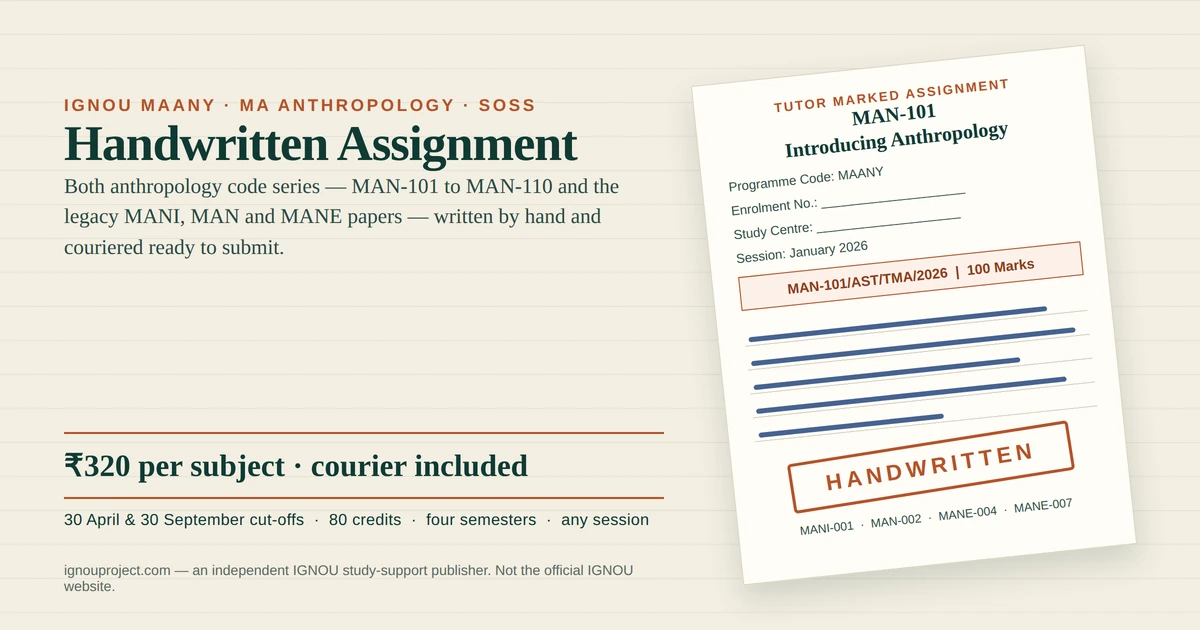
Two Anthropology Code Series Are Live at Once. We Write Whichever One Is Printed on Your Own Paper.IGNOU is currently circulating the legacy MAAN booklets — MANI-001, MANI-002, MAN-001, MAN-002, MANI-003 and the MANE-001 to MANE-007 electives — alongside the renumbered MAANY booklets that run MAN-101 to MAN-110. The two handwritten assignment series carry different questions, different assignment codes and different counts per cycle. Read the code off your admission record, send it, and the handwritten set comes back in your own handwriting, subject-wise.
- ₹320 per subject
- MAAN and MAANY series
- Hard copy, courier included
- Matched to your handwriting
- Any session, backlog included
- 80 credits, four semesters
Send your course codes and your session on WhatsApp. Nothing is charged until the codes on your admission record are confirmed against the live booklet.
Quick answer. An IGNOU MAANY handwritten assignment is a hand-written answer set for the Tutor Marked Assignment (TMA) paper IGNOU issues for each course in the Master of Arts (Anthropology) programme, which the School of Social Sciences runs over 80 credits and four semesters; ignouproject.com prepares that set for the current MAANY codes MAN-101 to MAN-110, the elective block MANE-101 to MANE-108, and the legacy MAAN codes still in circulation — MANI-001, MANI-002, MANI-003, MAN-001, MAN-002 and MANE-001 to MANE-007 — at ₹320 per subject, hard copy only, with courier included in that price and no separate shipping charge, in whichever medium IGNOU has issued that paper, for any session, current cycle or older, including backlog courses; send a photo of a page in your own handwriting and the handwritten set is matched to your handwriting at no extra charge; assignments carry 30 per cent of the final course result and the term-end examination carries the remaining 70 per cent, each MAANY and MAAN paper is marked out of 100 with a Section A and a Section B, and orders are placed on WhatsApp at +91 93546 37830 by sending the course codes and the session printed on your booklet.
MAANY Cut-Off Dates IGNOU Actually Prints on the Booklet
The Faculty of Anthropology in SOSS prints its own pair of handwritten assignment cut-offs, and that pair changed between the 2024-25 and the 2025-26 booklets.
The MAAN first-year booklet for July 2025 and January 2026 prints 30 April 2026 for the July 2025 cycle and 30 September 2026 for the January 2026 cycle. The MAANY booklet for MAN-101 prints 30 September 2026 for the January 2026 cycle. The previous MAAN booklet, for July 2024 and January 2025, printed 31 March 2025 and 30 September 2025 — so the July-cycle date moved by a month between two consecutive booklets. This is why anthropology dates cannot be copied from any other page: 31 October and 30 April belong to the School of Management Studies, and even inside the School of Social Sciences the Faculty of Economics prints 31 March on the MAEC booklet while the Faculty of Anthropology now prints 30 April. A school name is not a deadline. The booklet is.
July cycle
30 April
Printed as 30 April 2026 for the July 2025 cycle on the MAAN first-year booklet. Feeds the June term-end examination.
January cycle
30 September
Printed as 30 September 2026 on both the MAAN and the MAANY booklets for the January 2026 cycle. Feeds the December term-end examination.
Dates shift by session and by Regional Centre, and IGNOU has extended assignment cut-offs mid-cycle before. Confirm the date on your own booklet and with your Regional Centre on ignou.ac.in before you plan around it.
Where Thirty Marks a Paper Quietly Disappear
Assignments carry 30 per cent of the final course result and the term-end examination carries the remaining 70 per cent. In the Master of Arts (Anthropology) that 30 per cent is not a rounding error. A MAANY learner sits five papers a semester, twenty theory papers across four semesters, and each one carries its own 100-mark TMA and its own handwritten assignment. A legacy MAAN learner sits four papers in the first year and a compulsory MANI-003 plus electives in the second. Miss a submission and the course line on your grade card reads as not completed, whatever you score in the December or June examination hall.
These are also the most predictable marks in the programme. The MAAN and MAANY papers publish their questions months in advance, they are open-book by nature, and the word limits are printed beside each question — 500 words for a 20-mark answer and 250 words for a 10-mark answer on almost every paper in the handwritten set. Nothing is being guessed at. The only real cost is the hours of legible handwriting, and assignment writing at that length is exactly the part this page is about. Twenty papers of assignment writing is not a weekend. If you want to know how the marks eventually surface, the assignment result and grade card walkthrough covers the reporting side in full.
Two anthropology courses are outside this arithmetic. MANL-101, the eight-credit practical in physical and biological anthropology, and MANP-101, the eight-credit dissertation, are assessed through practical work and a supervised report rather than a Tutor Marked Assignment. No handwritten assignment paper exists for either, and nobody should sell you one. The dissertation route is covered separately on the MA Anthropology project and dissertation guide.
Twelve things anthropology learners tell us they were actually worried about when they sent their codes.
Both series, one rate. MAN-101 to MAN-110 from the MAANY booklet and MANI-001, MANI-002, MANI-003, MAN-001, MAN-002 from the legacy MAAN booklet are all written as handwritten assignments at ₹320 per subject, subject-wise. Which series you are on is decided by your admission record, not by us.
Elective papers included. MANE-001 Human Genetics through MANE-007 Tribes in India on the legacy set, and MANE-101 to MANE-108 on the MAANY set, are ordered as handwritten assignments the same way as compulsory papers. Two learners in the same semester can be short of six completely different codes.
Five a semester or four a year. The MAANY booklet states that five assignments are required in the first semester. The MAAN booklet states four in the first year. We write the handwritten assignment count your own booklet asks for rather than a fixed bundle.
Section A and Section B respected. Every anthropology TMA splits into two sections and asks for five answers with at least two drawn from each. A handwritten set that answers five questions from Section A alone is written to the wrong instruction, however good the content is.
Word bands kept honestly. Twenty-mark answers run to the printed 500 words and ten-mark answers to 250. Those printed limits, not a page number count, decide how long an anthropology handwritten answer should be.
The MANE-004 exception handled. Gender and Society is the one paper in the live MAAN set that prints a five-mark band at 125 words and asks for four short notes at 4×5. Writing that handwritten assignment to the usual 10+10 pattern loses marks on a technicality.
The right assignment code on the cover. The live booklets print four different formats. Your handwritten assignment gets the one your booklet prints, not the one the previous cycle used.
Diagrams drawn, not described. Archaeological and biological papers ask for tool-making techniques, cell-division stages and somatotyping with suitable diagrams. Those are drawn by hand into the handwritten answer where the assignment question calls for them.
Practical and dissertation left alone. MANL-101 and MANP-101 are not TMA papers and are not sold here. Anyone offering you a handwritten MANP-101 assignment is selling something IGNOU does not issue.
Cross-listed codes recognised. MAN-105 Tribes in India and MAN-107 Environmental Anthropology also appear as discipline-specific electives inside the MA Sociology structure. If your grade card shows an anthropology code under a sociology programme, that is why.
Old cycles still written. A MANE-006 handwritten assignment from a 2022 booklet is written at the same ₹320 per subject as a MAN-101 handwritten assignment from the current one. Any session is accepted, current cycle or older, including backlog courses.
Your hand, not a stranger’s. Send a photo of a page you have written yourself and the handwritten set is matched to your handwriting at no extra charge. Nothing about the finished handwritten set announces that somebody else held the pen.
Send the anthropology codes from your admission record and we will confirm them against the live booklet
Message the course codes exactly as your record prints them — MAN-101, MANI-002, MANE-004 — plus the session. We check them against the booklet IGNOU has actually published for that cycle and tell you if a code has been renumbered before anything is written.
₹320 per subject · hard copy only · courier included · no minimum order
Send Your MAAN or MAANY Codes on WhatsAppBoth Anthropology Code Lists, Read Off IGNOU’s Own Documents
The Common Prospectus for July 2026 describes MAANY as a two-year, 80-credit programme delivered over four semesters of 20 credits each. Every code, title and credit value in the first table below is taken from that document. The second table is taken from the Tutor Marked Assignment booklets IGNOU has actually published, which still run the older MAAN numbering. Both are live. Neither replaces the other on your grade card.
MAANY Structure in the July 2026 Common Prospectus
| Code | Title of the course | Type | Credits |
|---|---|---|---|
| Semester I | All five courses compulsory | Theory | 20 |
| MAN 101 | Introducing Anthropology | Theory | 4 |
| MAN 102 | Physical/Biological Anthropology | Theory | 4 |
| MAN 103 | Social and Cultural Anthropology | Theory | 4 |
| MAN 104 | Archaeological Anthropology | Theory | 4 |
| MAN 105 | Tribes in India | Theory | 4 |
| Semester II | All five courses compulsory | Theory | 20 |
| MAN 106 | Applied Dimensions in Anthropology | Theory | 4 |
| MAN 107 | Environmental Anthropology | Theory | 4 |
| MAN 108 | Research Methods in Anthropology-I | Theory | 4 |
| MAN 109 | Research Methods in Anthropology-II | Theory | 4 |
| MAN 110 | Epidemiology and Public Health | Theory | 4 |
| Semester III | Two from Group A, two from Group B, one multidisciplinary | Elective | 20 |
| MANE 101 | Human Genetics — Group A | Theory | 4 |
| MANE 102 | Human Growth and Development — Group A | Theory | 4 |
| MANE 103 | Physiological Anthropology — Group A | Theory | 4 |
| MANE 104 | Forensic Anthropology — Group A | Theory | 4 |
| MANE 105 | Ethnography — Group B | Theory | 4 |
| MANE 106 | Ethnographic Training — Group B | Project | 4 |
| MANE 107 | Urban Anthropology — Group B | Theory | 4 |
| MANE 108 | Visual Anthropology — Group B | Theory | 4 |
| MPA 033 | Introduction to Disaster Management — choose one | Theory | 4 |
| MED 008 | Globalisation, Environment and Development — choose one | Theory | 4 |
| Semester IV | Two compulsory plus one multidisciplinary | Mixed | 20 |
| MANL 101 | Practical in Physical/Biological Anthropology | Practical | 8 |
| MANP 101 | Dissertation | Project | 8 |
| MGS 109 | Gender, Entrepreneurship and Financial Inclusion — choose one | Theory | 4 |
| MED 002 | Sustainable Development: Issues and Challenges — choose one | Theory | 4 |
| Total | Four semesters of 20 credits each | — | 80 |
Swipe sideways to read the full table on a phone. Twenty credits a semester, four semesters, 80 credits in total — the four semester blocks add up to the stated programme total.
Legacy MAAN Codes Still Printed on Live TMA Booklets
| Code | Title on the booklet | Booklet position | Assignment code as printed |
|---|---|---|---|
| MANI-001 | Anthropology and Methods of Research | First year, compulsory | MANI-001/ASST/TMA/2025-2026 |
| MANI-002 | Physical Anthropology | First year, compulsory | MANI 002/AST/TMA/2024-25 |
| MAN-001 | Social Anthropology | First year, compulsory | MAN 001/AST/TMA/2024-25 |
| MAN-002 | Archaeological Anthropology | First year, compulsory | MAN 002/AST/TMA/2024-25 |
| MANI-003 | Practicing Anthropology | Second year, compulsory | MANI-003/ASST/TMA/2024-2025 |
| MANE-001 | Human Genetics | Second year, optional | MANE-001/ASST/TMA/2024-2025 |
| MANE-002 | Human Growth and Development | Second year, optional | MANE 002/AST/TMA/2024-25 |
| MANE-003 | Comparative Ethnography | Second year, optional | MANE 003/AST/TMA/2024-25 |
| MANE-004 | Gender and Society | Second year, optional | MANE-004/ASST/TMA/2024-2025 |
| MANE-005 | Environmental Anthropology | Second year, optional | MANE 005/AST/TMA/2024-25 |
| MANE-006 | Social Stratification | Second year, optional | MANE-006/ASST/TMA/2024-2025 |
| MANE-007 | Tribes in India | Second year, optional | MANE 007/AST/TMA/July 2024- January 2025 |
| MAN-101 | Introducing Anthropology | MAANY semester I | MAN-101/AST/TMA/2026 |
Swipe sideways to read the full table on a phone. The right-hand column is copied character for character off IGNOU’s own booklets, spacing and all.
Syllabus and code conflicts found while preparing this page — read this before you order
- Two live series at once. The Common Prospectus for July 2026 lists MAN 101 to MAN 110, MANE 101 to MANE 108, MANL 101 and MANP 101. IGNOU’s published assignment booklets for July 2025 and January 2026 still carry MANI-001, MANI-002, MAN-001, MAN-002 and the MANE-001 to MANE-007 electives. Both are current. Your admission record decides which applies to you.
- Two programme codes on IGNOU’s own site. The university publishes a programme page under MAANY and another under MAAN. MAANY is the code in the July 2026 Common Prospectus; MAAN is the programme code printed at the top of the assignment booklets; MAN, MANI, MANE, MANL and MANP are course-code prefixes, not programme codes.
- Four assignment-code formats in circulation. Inside a single MAAN booklet you will find MANI-001/ASST/TMA/2025-2026, MANE 002/AST/TMA/2024-25 and MANE 007/AST/TMA/July 2024- January 2025. The MAANY booklet uses a fourth, MAN-101/AST/TMA/2026. Copy the one printed above your own paper.
- A template carry-over in the second-year booklet. The second-year MAAN booklet repeats the first-year sentence about four assignments being required in the first year. Second-year learners should count the papers listed on their own booklet cover instead.
- Question numbering slips. The MANE-007 paper in the July 2024 and January 2025 booklet numbers its ten questions 11 to 20. Answer them in the order they appear and number your answers to match the paper you were given.
- A medium disagreement inside IGNOU. The July 2026 Common Prospectus lists the medium of instruction for MAANY as English and Hindi. The MAANY programme page on ignou.ac.in lists English only. The published booklets carry an English-medium file marker. We do not resolve this for you — we write the handwritten set in whichever medium IGNOU has actually issued your paper, and every medium carries the same rate.
- An older credit figure still circulating. Several third-party syllabus pages state 64 credits for this programme. The July 2026 Common Prospectus states 80 credits across four semesters, and the four semester blocks sum to 80.
- Deadline claims that contradict the booklet. Several widely-read assignment sites publish 31 October and 30 April for MAAN. IGNOU’s own MAAN booklet for July 2025 and January 2026 prints 30 April and 30 September, and the previous booklet printed 31 March and 30 September.
- Our own pages under correction. The MA Anthropology programme overview on this site still describes the older MAAN structure and has not yet been rewritten around the MAANY semester scheme. The MMPC-001 course page still promises a dispatch window in working days, which no page on this site should do, and the homepage still carries an acceptance-and-refund claim that we do not repeat here. All three are queued for correction. Where they disagree with the tables above, the tables above are the ones drawn from IGNOU’s current documents.
Codes are also checked against the Common Prospectus reference page maintained here, and the project and dissertation codes for this programme are set out on the programme-wise project course code list.
What Happens Between Your Message and the Courier
Five steps, and only the first one needs anything from you beyond a photograph.
Read the codes off your admission record before ordering a handwritten assignment
Anthropology is the programme where guessing costs the most, because MANE-006 Social Stratification on the legacy set and MANE-106 Ethnographic Training on the MAANY set are entirely different courses. Send the codes exactly as your record prints them, together with the session — July 2025, January 2026, or an older cycle you are clearing.
We pull the booklet IGNOU published for that code and cycle
Every handwritten set is written against the actual Tutor Marked Assignment paper, with its own two sections, its own printed word limits and its own assignment code. If the code you sent has been renumbered between series, you hear about it before anything is written rather than after the courier has gone.
Send one handwriting sample photo of a page in your own handwriting
A page from a notebook is enough, and it does not have to be assignment writing. That handwriting sample is used to match letterforms, slant and spacing so the finished anthropology handwritten assignment reads as yours. There is no extra charge for this and no minimum number of subjects attached to it.
The handwritten assignment is answered in the order the booklet asks for
Five answers, at least two from Section A and two from Section B, 500 words behind each 20-mark question and 250 behind each 10-mark one, with diagrams drawn in where the archaeological and biological papers call for them. The cover page carries your enrolment number, programme code, course code, assignment code and study centre, with the declaration and signature line left for you.
The handwritten hard copy is couriered to your address, no binding charged
The rate is ₹320 per subject, hard copy only, with courier included in that price and no separate shipping charge. Delivery depends on your pin code and is confirmed for your order before you pay. No figure is promised on this page.
Matching the Set to Your Own Hand
Send a photo of a page you have written yourself and the handwritten set is matched to your handwriting at no extra charge. Your own handwriting is what an evaluator has already seen on your examination script, and this matters more in anthropology than in most programmes, because a MAANY learner submitting five papers a semester hands the same study centre coordinator a stack of handwritten sets in one visit. Twenty papers across the degree, all in a hand that does not resemble your own handwriting on your practical record or your examination script, is a difference somebody eventually notices.
One handwriting sample covers every handwritten assignment you order, now or later. The handwriting sample stays on file for your enrolment number, so a MANE elective handwritten assignment ordered a year after your first-semester set comes back in the same hand as the first. No extra charge applies to the matching, and there is no minimum order: one subject or fourteen, same rate.
If you would rather do the assignment writing yourself
That is the cheaper option and this site publishes the whole method free. The step-by-step handwritten assignment guide covers paper, pen colour, margins and page order. The front page format PDF and the cover page instructions give you the sheet that goes on top of every paper, and the assignment format and structure notes explain the layout an evaluator expects. Worked examples sit on the sample assignments page, and the choice between handing a handwritten set in at the centre and online submission of a scan is set out under online and offline assignment submission. Hindi-medium learners will find the medium-specific notes on the Hindi assignment page. Nothing on this page is a reason to skip those.
Anthropology Planners You Can Use Without Ordering
Both tools run entirely in your browser, store nothing and require no order. The first works out what a handwritten assignment order costs and how long you have left; the second tells you which of the two anthropology code series a course code belongs to.
Free tool 1
MAANY Order Total and Last-Date Planner
Enter a paper count and choose your cycle to see the total, the next cut-off and an estimate of the longhand hours involved.
Confirm This Total With Us at ₹320 a Subject
This tool is guidance from ignouproject.com, not an IGNOU rule. Using it creates no obligation to order anything.
Free tool 2
MAAN or MAANY Code Series Identifier
Enter a course code to see which series it belongs to, where it sits in the structure, its credits and the assignment code format its booklet prints.
Order the Paper You Just Checked
This tool is guidance from ignouproject.com, not an IGNOU rule. Using it creates no obligation to order anything.
One semester of anthropology is five papers. Hand them over in one message.
Send all five MAANY codes together, or the four first-year MAAN codes, or a single MANE elective you are clearing from an older cycle. The rate does not change with the size of the order and nothing is bundled.
₹320 per subject · five papers is ₹1,600 · courier included · no separate shipping charge
Book Your Anthropology Set NowGetting the Correct MAAN or MAANY Question Paper
The questions are free and they come from IGNOU, not from any publisher. The handwritten assignment service on this page writes answers to them; it does not supply the assignment question papers themselves at a price.
Open the official assignment portal
Start at the university’s own download page at ignou.ac.in student services. Master’s degree programmes are indexed by programme code, and Master of Arts (Anthropology) is filed there under MAAN.
Check which cycles have actually been published
The programme index on the assignment portal lists MAAN booklets up to the July 2024 and January 2025 pair. The newer July 2025 and January 2026 booklets, and the separate MAANY booklets, are published on the university’s own file paths rather than on that index. If your cycle is not on the index, it has not necessarily gone missing.
Open the cover page before you trust the link label
IGNOU’s index links have been mislabelled before. The cover page states the programme code, the year courses covered, the session pair and the last date. If the cover says MAAN and your record says MAANY, or the reverse, that is the thing to sort out first.
Copy the assignment code exactly as printed
The line above each paper reads Assignment Code and then a string such as MAN-101/AST/TMA/2026 or MANI-001/ASST/TMA/2025-2026. It goes on your cover sheet character for character, including the spacing IGNOU used.
Blocks and units for these courses are free on eGyanKosh, reachable through the eGyanKosh access guide or its alternate route page, and the combined subject files are collected under IGNOU books download and study material by programme. Reference answers for comparison sit on the solved assignments library and the free-PDF assignment index.
After the Set Reaches Your Study Centre
Submission and evaluation are two different events, and the gap between them is where most anthropology queries start. Hand the handwritten set to the coordinator of your study centre or learner support centre, and take the acknowledgement receipt as proof before you leave. Some centres now accept assignments by email or through a Google form; the January 2026 MAANY booklet says so in as many words and tells learners to follow their own Regional Centre’s instruction. Keep a photocopy of every handwritten paper either way, as proof of what you handed in.
Marks travel from the centre to the Student Evaluation Division and only then to your grade card, which is why a paper can be submitted, evaluated and still invisible online for weeks. Status first appears on the intermediate portal, covered on the assignment marks status page, before it reaches the assignment entry on the grade card. The consolidated view is explained on the final grade card guide and the grade card status walkthrough, and the letter-grade bands themselves are set out under IGNOU grading. If a paper stays missing well past the usual window, the grievance route is described on the iGRAM complaint guide — and your acknowledgement receipt is the document that settles it.
Two small mechanics catch anthropology learners in particular. A course line reading not completed usually means one component is pending rather than failed, and for MANL-101 or MANP-101 that component is the practical or the dissertation rather than any TMA. And your enrolment number has to match on every cover sheet in the stack; if you are unsure of the format, the enrolment number guide shows where it appears on your identity card. Converting the eventual result is handled by the percentage calculator and the CGPA calculator.
Beyond the Thirty Per Cent: The Other Seventy
A handwritten assignment closes the 30 per cent weightage. The other 70 per cent sits in the December or June examination hall, and most learners who order a handwritten set are working on both at once.
For the term-end paper, the solved question paper archive and the previous year paper collection show how MANI-001 and MAN-001 question papers have actually been examined, and the guess paper set narrows the reading. Condensed revision notes are gathered under study notes, and printed companions to the official blocks are listed under help books and guide books online.
Second-year and fourth-semester learners have a second front. MANP-101 is a supervised dissertation and MANE-106 is an ethnographic training project, both of which need a proposal before anything else happens — the synopsis and proposal formats apply, and the wider project service page and anthropology dissertation guide cover the rest. Pricing for project work is separate from the ₹320 assignment rate and is listed on the services and charges page. Assignments and projects are also submitted to different people at different times, which the assignment submission guide sets out.
Three Messages, Five Details, One Courier
Medium, Session and Backlog Anthropology Papers
The service covers all mediums IGNOU issues the TMA paper in, at the same price. Any medium, every medium, same ₹320 handwritten assignment. For this programme that scope is worth stating plainly, because IGNOU’s own documents disagree: the July 2026 Common Prospectus lists MAANY as English and Hindi, while the MAANY programme page on ignou.ac.in lists English only. Whether your Regional Centre issued an English medium paper or a Hindi medium one, that is what gets written as a handwritten assignment, at ₹320 per subject either way.
Any session is accepted, current cycle or older, including backlog courses, at the same ₹320 per subject. Anthropology produces more backlog orders than most programmes because the elective block changed numbering: a learner clearing MANE-006 Social Stratification from a 2022 booklet and a learner starting MANE-106 Ethnographic Training this semester are on the same handwritten assignment rate and the same process. Send the cycle along with the code and the correct booklet is the one that gets used.
The Three Messages and the Five Details
Message one — the codes and the session
Course codes as your admission record prints them, the cycle, your medium if you know it, your enrolment number and your delivery pin code. Those five details price the handwritten assignment order. Those are the five details. Nothing is charged at this stage.
Message two — the handwriting photo and the confirmation
One photograph of a page in your own hand. You get back a confirmed handwritten assignment count, the total at ₹320 per subject, and a delivery estimate for your pin code rather than a fixed promise.
Message three — the dispatch note
The handwritten set is written, checked against the printed word limits and couriered as a hard copy. No soft copy or PDF is sold. If your Regional Centre wants an upload, you scan the delivered hard copy yourself.
Where Each Fact on This Page Came From
Three kinds of statement appear on this page and they are kept apart deliberately.
From the IGNOU Common Prospectus, July 2026. The MAANY programme structure, the four-semester layout, the 80-credit total, every course code and title in the first table, the credit values, the elective grouping, the multidisciplinary options and the English-and-Hindi medium listing. The MAN 105 and MAN 107 cross-listing inside the MA Sociology structure is taken from the same document.
From live IGNOU Tutor Marked Assignment booklets. The two submission dates, the assignment code formats, the marks and question pattern, the Section A and Section B instruction, the printed word limits, the cover-page fields, the count of papers per cycle and the note about centres accepting assignments digitally. Four MAAN handwritten assignment booklets were read for this page: the MAAN first-year and second-year booklets for July 2024 and January 2025, the MAAN first-year booklet for July 2025 and January 2026, and the MAANY MAN-101 booklet for January 2026. The booklet defects described in the warning box above — the template carry-over, the question numbering and the code-format variation — were read off those files rather than reported second hand.
From ignouproject.com as the publisher. The rate of ₹320 per subject, hard copy only with courier included, the handwriting matching at no extra charge, the absence of a minimum order, the acceptance of older and backlog sessions, and the WhatsApp contact route. These are commercial terms set by this publisher and are not IGNOU rules.
Written and reviewed by BK Sahni, Founder, Shri Chakradhar Publication Pvt. Ltd. and ignouproject.com, who has guided 5,00,000 students till date. ORCID 0009-0005-8092-459X.
Anthropology Assignment Doubts, Answered One by One
A MAAN handwritten assignment is a hand-written answer set for the Tutor Marked Assignment paper IGNOU issues for a Master of Arts (Anthropology) course, prepared by ignouproject.com and couriered to you. The rate is ₹320 per subject, hard copy only, with courier included in that price and no separate shipping charge. There is no minimum order: one subject or fourteen, same rate.
Both codes are live on IGNOU’s own site. MAANY is the code used for Master of Arts (Anthropology) in the Common Prospectus for July 2026 and on the newer assignment booklets. MAAN is the programme code printed at the top of the older assignment booklets, including the ones published for July 2025 and January 2026. Your admission record decides which one applies to you. MAN, MANI, MANE, MANL and MANP are course-code prefixes and are not programme codes at all.
The MAAN first-year booklet for July 2025 and January 2026 prints 30 April 2026 for the July 2025 cycle and 30 September 2026 for the January 2026 cycle. The MAANY booklet for MAN-101 prints 30 September 2026 for the January 2026 cycle. The earlier booklet, for July 2024 and January 2025, printed 31 March 2025 and 30 September 2025. Dates shift by session and by Regional Centre, so confirm against your own booklet and on ignou.ac.in.
Because two series are running at once. The July 2026 Common Prospectus lists MAN 101 to MAN 110, MANE 101 to MANE 108, MANL 101 and MANP 101. The assignment booklets IGNOU published for July 2025 and January 2026 still carry MANI-001, MANI-002, MAN-001, MAN-002, MANI-003 and MANE-001 to MANE-007. Neither list is wrong. Order your handwritten assignment against the codes printed on the booklet your own record points you to.
The MAANY booklet for January 2026 states that five assignments are required in the first semester, which matches the five compulsory four-credit courses in that semester. The legacy MAAN booklet states four in the first year. Semesters three and four mix electives with a practical and a dissertation, so the TMA count there depends on which electives you registered for. Count the papers listed on your own booklet cover rather than assuming a fixed number.
No, and neither should anyone else offer one. MANL-101 is an eight-credit practical in physical and biological anthropology and MANP-101 is an eight-credit dissertation. IGNOU does not issue a Tutor Marked Assignment paper for either, so there is no handwritten assignment to write. Project and dissertation work is a separate service with separate pricing on the services and charges page.
No soft copy or PDF is sold. The service is hard copy only, couriered to your address, with courier included in the ₹320 per subject. If your Regional Centre or study centre asks for an upload, you scan the delivered hard copy yourself and submit that scan under your own name.
The service covers all mediums IGNOU issues the TMA paper in, at the same price. For this programme IGNOU’s own documents disagree with each other: the July 2026 Common Prospectus lists the medium of instruction as English and Hindi, while the MAANY programme page on ignou.ac.in lists English only, and the published booklet files carry an English-medium marker. Tell us which medium your Regional Centre issued your paper in — English medium or Hindi medium — and the handwritten assignment is written to match it.
That is a Regional Centre decision, not ours and not a matter of preference. Your registered medium is recorded against your enrolment, and evaluators at your study centre are allocated on that basis. Ask your Regional Centre before switching, because a medium change usually has to be recorded formally. Whichever medium is confirmed for you, the rate stays ₹320 per subject.
Whichever one is printed above your own paper, copied character for character. The live anthropology booklets use four different formats: MANI-001/ASST/TMA/2025-2026, MANE 002/AST/TMA/2024-25, MANE 007/AST/TMA/July 2024- January 2025 and, on the MAANY booklet, MAN-101/AST/TMA/2026. Do not standardise them and do not carry a format across from another programme’s paper.
Each MAAN and MAANY paper is marked out of 100. There are two sections, A and B, and you attempt five questions in total with at least two from each section. Twenty-mark questions carry a printed limit of 500 words and ten-mark questions 250 words. MANE-004 Gender and Society is the exception in the live set: it prints a five-mark band at 125 words and asks for four short notes at 4×5. Those printed limits, not your own judgement, decide the length.
Send a photo of a page you have written yourself and the handwritten set is matched to your handwriting at no extra charge. One handwriting sample covers every anthropology handwritten assignment you order, now or later, so a MANE elective ordered a year after your first-semester set comes back in the same hand.
Yes. Any session is accepted, current cycle or older, including backlog courses, at the same ₹320 per subject. This comes up constantly in anthropology because the elective block was renumbered, so a MANE-006 paper from a 2022 booklet and a MANE-106 paper from the current one are both ordered the same way. Send the cycle along with the code so the correct booklet is used for the handwritten assignment.
To the coordinator of the study centre or learner support centre allotted to you at admission, and take the acknowledgement receipt before you leave. The January 2026 MAANY booklet adds that some centres now accept assignments by email, through a Google form or by other digital means, and tells learners to follow the instruction from their own Regional Centre or study centre. Keep a photocopy of every paper whichever route you use.
Delivery depends on your pin code and is confirmed for your order before you pay. No figure is promised on this page. Any site quoting you a fixed number of working days before knowing your pin code is quoting a marketing figure rather than a courier estimate.
Marks pass from your study centre to the Student Evaluation Division and only then to the grade card, so a gap of several weeks after submission is normal. Check the intermediate assignment status portal first, then the grade card. If a paper is still missing well past that window, raise it with your study centre and Regional Centre with your acknowledgement receipt, and escalate through iGRAM if it is not resolved. A line reading not completed usually means one component is pending — for MANL-101 or MANP-101 that component is the practical or the dissertation, not a TMA.
Because the July 2026 Common Prospectus cross-lists two of them. In the fourth semester of MA Sociology, MAN 107 Environmental Anthropology appears as an alternative to Sociology of Food and MAN 105 Tribes in India as an alternative to Sociology of Health, both as discipline-specific electives. If you registered for one of those, the anthropology code is correct on your record.
No. No claim is made about the marks any assignment will receive, about how an evaluator will assess it, or about whether it will be accepted. Assignment evaluation is entirely a matter for IGNOU. What is offered here is a legible, complete handwritten assignment written against the printed paper, its sections and its word limits.
ignouproject.com is an independent IGNOU study-support publisher. It is not the official website of Indira Gandhi National Open University, is not affiliated with, endorsed by or authorised by the university, and no page on this site should be treated as an official IGNOU communication. Programme structures, course codes, submission dates and rules change, and only ignou.ac.in and your Regional Centre can confirm the current position for your enrolment.
Important Notice
Independent publisher, and what remains your responsibility
ignouproject.com is an independent IGNOU study-support publisher. It is not the official website of Indira Gandhi National Open University, is not affiliated with, endorsed by or authorised by the university, and no page on this site should be treated as an official IGNOU communication. Programme structures, course codes, submission dates and rules change, and only ignou.ac.in and your Regional Centre can confirm the current position for your enrolment.
You sign the declaration on the assignment cover page, so you should read and review the content before submitting it, and satisfy yourself that it represents your own understanding of the course. No claim is made about the marks any assignment will receive, about how an evaluator will assess it, or about whether it will be accepted. Assignment evaluation is entirely a matter for IGNOU.
Delivery depends on your pin code and is confirmed for your order before you pay. No figure is promised on this page. No soft copy or PDF is sold.
Send the anthropology codes off your admission record with the session, and a handwriting sample photo of a page in your own handwriting. We confirm the codes against the booklet IGNOU actually published, write the handwritten assignment to its two sections and its printed word limits, and courier it to you.
₹320 per subject · hard copy only · courier included in that price · any session, backlog included
WhatsApp +91 93546 37830 · Shri Chakradhar Publication Pvt. Ltd. · ignouproject.com · contact · about us · privacy policy

BK Sahni iD 0009-0005-8092-459X
Founder, Shri Chakradhar Publication Pvt. Ltd. & ignouproject.com — helping IGNOU distance-learning students since 2010 (5,00,000+ students supported across MBA, MCom, MA & more). Author of IGNOU exam guides, solved assignments & project reference books.
Disclosure: Shri Chakradhar Publication Pvt. Ltd. and ignouproject.com are independent third-party study-help services — not the official IGNOU website. Always verify final dates and rules on ignou.ac.in.