How this page was researched: from the IGNOU Common Prospectus July 2026, the MRDP-001 handbook Part I “Field Work and Dissertation” on eGyanKosh, the projects table on the IGNOU Regional Centre Chandigarh website, the MARD programme page on ignou.ac.in and the MARDOL course page on IGNOU’s LMS, all checked in September 2026. The eGyanKosh handbook and the Regional Centre table block automated readers, so their points are taken from the passages IGNOU’s own files show in search; where your printed handbook says something different, your handbook wins.
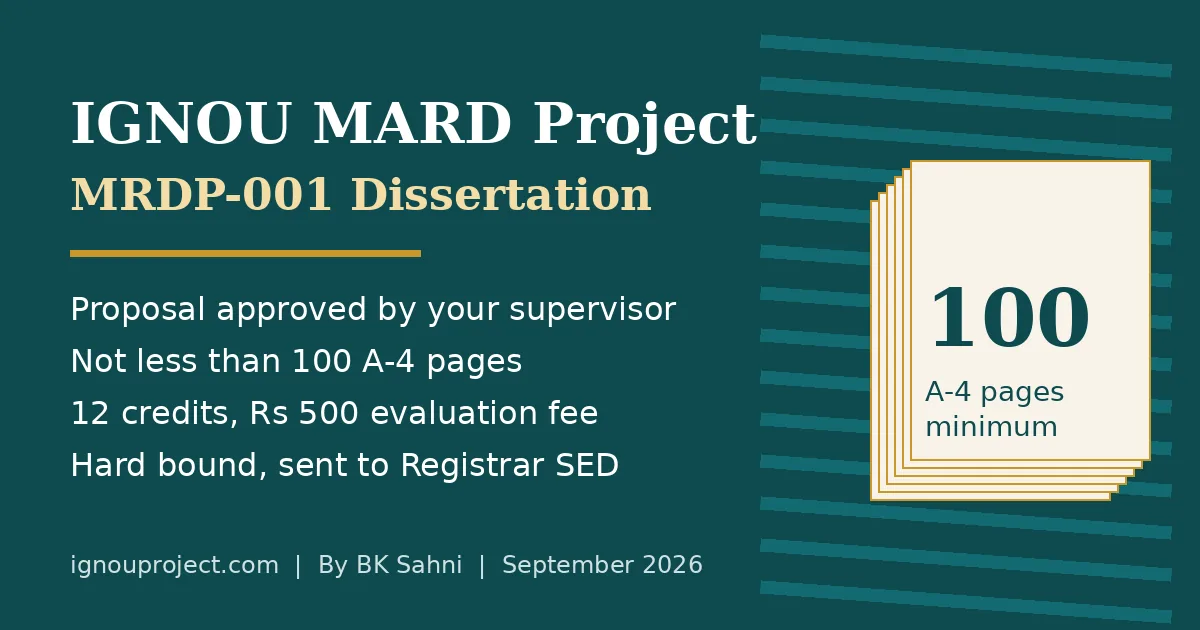
The IGNOU MARD project is MRDP-001 (also written MRDP 1), a 12-credit dissertation based on field research in a rural area and compulsory for the MA in Rural Development. Your supervisor, usually an M.A.(RD) academic counsellor, approves your project proposal; you do not send it to the Regional Centre or IGNOU Headquarters. The finished dissertation must run to not less than 100 A-4 pages, typed and hard bound with the original approved proposal inside, and goes to the Registrar, Student Evaluation Division, IGNOU, New Delhi.
Understanding the IGNOU MARD Project Dissertation (MRDP 1)
MRDP-001 is the dissertation course of the MA (Rural Development) programme, offered by IGNOU’s School of Continuing Education (SOCE). IGNOU calls a dissertation based on empirical research in rural areas an essential component of the programme. It has no term-end paper and it is not a long assignment: you choose a rural development problem, study it in the field, and report what you found.
| Item | What the prospectus says |
|---|---|
| School | School of Continuing Education (SOCE) |
| Eligibility | Bachelor’s degree or higher, any stream |
| Medium | English and Hindi |
| Duration | Minimum 2 years, maximum 4 years |
| Programme fee | Rs 8,000 per year, Rs 16,000 in total (exam fees extra) |
| Total credits | 66 |
| Where MRDP 1 sits | I Year compulsory courses, with MRD 201, MRD 202, MRD 203 and MRD 004 Research Methods in Rural Development |
That last row changes how you should plan. Because the prospectus lists MRDP 1 among the first-year courses, you do not need to wait for the second year. Picking a topic while you study MRD 004 gives your field work the longest runway, and field work is the part that cannot be rushed.
If you study the online version, MARDOL, the “MRDP-001: Project Work” course runs on IGNOU’s learning platform (lms.ignouonline.ac.in) under the Student Evaluation Division. Follow the instructions posted there; they can differ from the distance-learning route described on this page.
Moving up from PGDRD? The prospectus allows credit transfer from PGDRD to MARD for every course except MRDP-205, the PGDRD project. A PGDRD project therefore does not stand in for MRDP 1. The details are in our note on PGDRD to MARD credit transfer and MRDP-205.
Facts most MARD project pages miss
- The MRDP-001 proposal goes only to your supervisor, not to the Regional Centre and not to IGNOU Headquarters. (MRDP-001 handbook, Part I)
- The length rule is a page floor: not less than 100 A-4 pages. The 8,000 to 15,000 word figures on other sites trace to no IGNOU document. (RC Chandigarh projects table)
- MRDP 1 is printed in the I Year compulsory list, so you can begin in your first year. (Common Prospectus July 2026)
- The evaluation fee is Rs 500, not Rs 300, because MRDP 1 carries 12 credits and the higher slab applies above 4 credits. (Common Prospectus July 2026)
- Your dissertation is not returned after evaluation, which takes about 4 to 6 months, so the copy you keep is the only one you will have. (MRDP-001 handbook, Part I)
Your Supervisor Approves the Proposal, Not the Regional Centre
For MRDP-001, the project proposal goes to your supervisor and to nobody else. The MRDP-001 handbook says one of the Academic Counsellors of M.A.(RD) usually acts as supervisor, and that the same person approves your proposal, guides you through the dissertation and certifies the work. It tells learners not to mail the proposal to IGNOU Headquarters. The approved proposal then travels with you: its original is bound into the dissertation.
So much MARD advice online gets this wrong because most IGNOU project pages are written for other courses, where the route really is different, and the text is copied across. One MARD page that has been copied onto several sites even says the synopsis goes to the “Discipline of Tourism Management”. Set the routes side by side and the difference is plain.
| Course | Proposal goes to | Who approves | Source |
|---|---|---|---|
| MRDP-001 (MARD) | Your supervisor | Your supervisor; the signed original is bound into the dissertation | MRDP-001 handbook Part I; RC Chandigarh projects table |
| MMPP-001 (MBA) | Regional Director of your Regional Centre | An evaluator at the Regional Centre, in writing | MMPP-001 guidelines, School of Management Studies |
| MLIP-002 (MLIS) | Programme Coordinator, MLIS, SOSS, New Delhi | Faculty at headquarters, in writing | MLIS Programme Guide 2022 |
In practice this means there is no Project Proposal number to wait for and no approval letter from a Regional Centre for MRDP-001. Nor did we find a fixed synopsis deadline in any official MARD document. The 30 March and 30 September dates that this page used to show have been removed for that reason. What you need is your supervisor’s signed approval on the proposal, kept in original. If your study centre has given you a different written instruction, follow it and keep it in your project file.
For how approval works on courses that do route through a Regional Centre, see our explainer on the IGNOU synopsis approval process.
Choosing an IGNOU MARD Project Topic From Your Own Course Blocks
The handbook asks for a topic of your own choice, preferably drawn from the course material, and suggests relating it to your field of work. The fastest way to find one is to work backwards: start from a course you understood well, then pick a place you can actually reach for field work.
| Course (prospectus code) | What it gives you | A topic seed to narrow with your supervisor |
|---|---|---|
| MRD 201 Rural Development: Indian Context | Rural society, social change, agrarian issues and institutions | How landholding and occupation have shifted in one village over ten years |
| MRD 202 Rural Development Programmes | Design and delivery of rural schemes | How MGNREGA work is allotted and paid in one gram panchayat |
| MRD 203 Rural Development Planning and Management | Planning, administration, local bodies | Who attends the gram sabha, and whose demands reach the panchayat plan |
| MRDE 201 Rural Social Development | Education, gender, social groups | Reasons girls leave school after class 8 in two villages of one block |
| MRDE 202 Rural Health Care | Rural health services and their use | Use of the nearest primary health centre by pregnant women in one block |
| MRDE 203 Communication and Extension in Rural Development | Extension methods and media | Where farmers in one village get crop advice: extension staff, input dealers or phones |
| MRDE 002 Voluntary Action in Rural Development | NGOs and people’s organisations | The work of one NGO in one district, as its members describe it |
| MRDE 003 Land Reforms and Rural Development | Tenancy, ceilings, land records | Land-record problems small farmers face when seeking crop loans in one tehsil |
| MRDE 004 Entrepreneurship and Rural Development | Rural enterprise and self-employment | Non-farm enterprises run by self-help group women in one block |
These are starting points, not approved titles. MRD 004 is left out on purpose: it supplies the method for all of them. To turn a seed into a title, fix four things: what you are studying, among whom, where, and over which period. For example: “Functioning of NRLM Self-Help Groups among Women in One Development Block, 2025 to 2026”, with your real block and district named.
Writing the MRDP-001 Project Proposal
Treat the proposal as the agreement between you and your supervisor about what you will study and how. The MRDP-001 handbook gives step-by-step directions for preparing it and a complete worked example in its Part IV. Use that example as your model, not a proposal format from an MBA or MCom page. The handbook asks for a title that states the type and nature of the study and is clear, brief and specific. It also suggests preparing a draft and discussing it with your supervisor before finalising.
A proposal built on the usual research sequence covers the points below. Check each against the Part IV example in your own handbook.
- Title: the variable, the people, the place and the period.
- Introduction and the problem: why this issue matters in this area, in a page or two.
- Objectives: three to five, written neutrally (“to study”, “to examine”), so they do not assume your findings.
- Area and sample: which villages or panchayats, how many households or respondents, and how you will choose them.
- Tools: interview schedule, questionnaire, observation or focus group, and why each suits an objective.
- Analysis: how the data will be tabulated and interpreted.
- Chapter plan and time plan: the chapters you expect and when the field work will happen.
- References: the course units and studies you have already read.
Once your supervisor approves the proposal, make sure it is signed and dated, and keep the original safe. You will bind it into the dissertation, so it must not be lost, stapled into a file or sent anywhere.
Have Your MRDP-001 Draft Checked Before It Is Bound
MARD drafts usually go wrong quietly. A proposal gets modelled on a management-course format, a dissertation stops at 70 pages, or the approved proposal is left out of the binding. The evaluator does not send the report back for a fix, because it is not returned. A second reading against the MRDP-001 requirements, while the draft is still yours to change, is the cheapest point to catch these.
What we check in your proposal
- A title that states the type and nature of the study, clear, brief and specific
- A topic you can trace to MARD course material or your own field of work
- Objectives, study area, sample and tools that match one another
- A layout following the handbook’s Part IV example, not another programme’s format
What we check in your dissertation
- Length measured against the 100 A-4 page minimum
- Original approved proposal and supervisor’s certificate placed at the front
- Chapters that deliver what the approved proposal promised
- Numbered, referenced tables and a file ready for hard binding, not spiral
You remain the author of your proposal and dissertation. We return your own draft with corrections against the MRDP-001 requirements; your supervisor approves the proposal and IGNOU’s evaluators assess the dissertation.
One Hundred Pages, Not Ten Thousand Words
The projects table on the IGNOU Regional Centre Chandigarh website sets the MRDP-001 dissertation at not less than 100 pages on A-4 paper. That is a floor measured in pages, and it is much longer than the figures that circulate. We found MARD pages quoting 8,000 to 10,000 words and others quoting 10,000 to 15,000 words; neither traces to an IGNOU document. At double spacing, 10,000 words fill only about 36 pages.
The documents read for this page do not fix a font, margin or line spacing for MRDP-001, and they do not say whether front matter and appendices count toward the 100 pages. Plan conservatively: reach 100 pages with your chapters and full-page tables alone, and treat everything else as extra. The planner below does that arithmetic for you.
PLANNING-AIDMARD 100-Page Chapter Budget
Set your page target and layout. The planner shows how many pages and words each chapter needs to reach it.
What Goes Inside the Bound MRDP-001 Dissertation
Each paper in your MARD project file has one destination, and most mistakes come from sending the right paper to the wrong place.
| Document | Where it goes | Source |
|---|---|---|
| Project proposal | To your supervisor for approval; the approved original is later bound into the dissertation | MRDP-001 handbook; RC Chandigarh table |
| Supervisor's certification of your work | Bound at the front of the dissertation | MRDP-001 handbook |
| Final draft | Shown to your supervisor before binding | MRDP-001 handbook |
| Dissertation, typed, 100 or more A-4 pages, hard bound | One copy to the Registrar, Student Evaluation Division, IGNOU, Maidan Garhi, New Delhi 110068, by registered post | RC Chandigarh table; handbook (no loose or spiral binding) |
| Rs 500 project evaluation fee | Paid with the term-end examination form | Common Prospectus July 2026 |
| Your own copy, with a copy of the approved proposal | Kept by you; IGNOU does not return the submitted report | MRDP-001 handbook |
Inside the covers, a clear order helps the evaluator: a title page that identifies you (name, enrolment number, programme, address and supervisor), the approved proposal, the supervisor's certificate, acknowledgement, contents with page numbers, lists of tables, then the chapters, references and appendices with your interview schedule. That order is common practice; the handbook's own instructions take precedence if your copy lists another sequence.
OFFICIAL-RULEMRDP-001 Bind-Ready Checker
Built only from the MRDP-001 handbook, the RC Chandigarh projects table and the Common Prospectus July 2026. Tick what is already true of your file.
IGNOU MARD Project Submission Process
Send one typed, hard-bound copy of your MRDP-001 dissertation, with the original approved proposal bound in, to the Registrar, Student Evaluation Division (SED), IGNOU, Maidan Garhi, New Delhi 110068. Older MARD documents call this office the SR&E or SR&ED Division; the address is the same. Use registered post or speed post and keep the receipt with your copy.
- Fill the term-end examination form for the session you are aiming at, include MRDP 1, and pay the Rs 500 project evaluation fee with it. The prospectus says exam fees, once paid, are neither refundable nor adjustable.
- Show the final draft to your supervisor and get the certification signed.
- Bind in hard cover, with the approved proposal and certificate at the front.
- Post it to the Registrar, SED, or upload it if SED has opened an online project window for your term-end examination.
- Keep your own copy, the postal receipt or upload acknowledgement, and your fee receipt together.
When SED opens an online upload window, its portal instructions (read September 2026) ask for one PDF per course. That PDF includes the approved proforma or proposal, the synopsis, the guide's bio-data and the originality certificate wherever applicable. Incomplete uploads are not evaluated, and reports sent by email are not considered. For MRDP-001, the item that must never be missing is your supervisor-approved proposal.
IGNOU does not publish a separate MARD calendar; each cycle follows the SED notice for that term-end examination. As of September 2026, an announcement on ignou.ac.in gives 30 November 2026 as the last date for the project fee for the December 2026 TEE; confirm it on the notice itself. Current dates for all programmes are kept on our page on the IGNOU project submission last date for December 2026, and the general steps are in the IGNOU project submission guide.
After Submission: Four to Six Months, No Returned Copy
The MRDP-001 handbook says the University needs about 4 to 6 months to evaluate a dissertation before grades are declared, because the work goes to a pool of experts drawn from across the country. The submitted report is not returned. If anything is questioned later, your retained copy and receipts are your evidence.
To follow your dissertation after posting it, use the steps in our guide to check your IGNOU project status. A viva is not a standard MRDP-001 step in the handbook passages read for this page, which describe evaluation by experts. If IGNOU ever asks you to appear for one, the instruction will come in writing; do not delay your submission waiting for it.
Where ignouproject.com Fits Into Your MARD Project
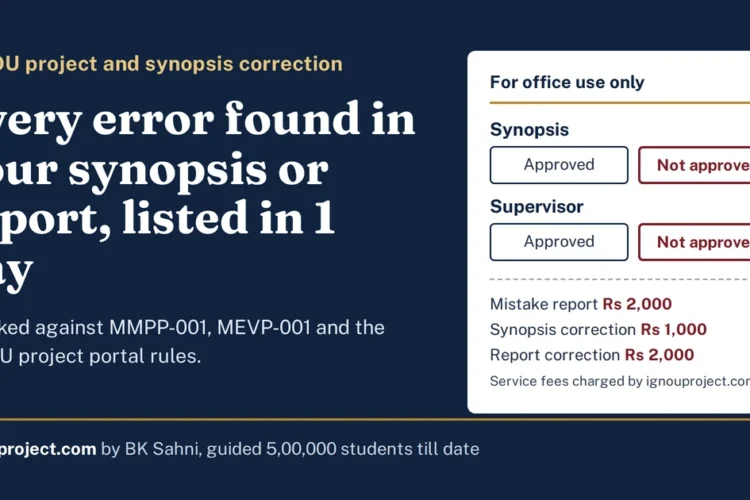
ignouproject.com provides customised project guidance, topic refinement, methodology support, review and correction of learner-written synopses and reports, formatting and citation support, reference material, printing and binding, and project status and result guidance. For MRDP-001, that means help narrowing a course-block topic to a village or block you can reach, checking your proposal before it goes to your supervisor, checking your dissertation against the 100-page and binding rules, and hard binding the final copy.
Your field data, your analysis and your supervisor's signatures stay yours; we never supply them or submit on your behalf. To start, send your enrolment number, your topic idea and the stage you are at on WhatsApp: +91 93546 37830.
Studying the diploma instead? The PGDRD project is a separate course, covered on our PGDRD MRDP-205 project page. Other programmes are listed on the IGNOU projects hub.
MRDP-001 Questions Students Ask
What is MRDP-001 in IGNOU MARD?
MRDP-001, printed as MRDP 1 in the Common Prospectus July 2026, is the 12-credit dissertation of the MA (Rural Development) programme. It is based on your own empirical field research in a rural area, and it is compulsory.
Who approves the IGNOU MARD synopsis?
Your supervisor. The MRDP-001 handbook says the supervisor, usually an M.A.(RD) academic counsellor, approves the proposal, and that it should not be mailed to IGNOU Headquarters. The signed original is bound into your dissertation.
How many pages should the MARD dissertation have?
Not less than 100 pages on A-4 paper, according to the projects table on the IGNOU Regional Centre Chandigarh website. Word limits quoted on other sites do not come from an IGNOU document.
Where do I send the MRDP-1 dissertation?
One typed, hard-bound copy goes to the Registrar, Student Evaluation Division, IGNOU, Maidan Garhi, New Delhi 110068, by registered post, or through the online portal when SED opens one for your term-end examination.
Is there a viva for the MARD project?
The MRDP-001 handbook passages read for this page describe evaluation by a pool of experts and do not describe a viva as a standard step. Plan your submission without waiting for one.
Can I start the MRDP-1 project in the first year?
Yes. The Common Prospectus July 2026 lists MRDP 1 among the I Year compulsory courses, so you can choose a topic and approach your supervisor during your first year.
Can the MARD project be written in Hindi?
MARD is offered in English and Hindi, according to the prospectus. The handbook passages read for this page do not state the language of the dissertation, so confirm with your supervisor before you start writing.
Does my PGDRD project count toward MARD?
No. The prospectus allows PGDRD to MARD credit transfer for every course except MRDP-205, the PGDRD project, so you write a fresh MRDP-001 dissertation.
Official IGNOU Sources Used
- IGNOU Common Prospectus, July 2026: MARD section 3.29, PGDRD section 8.1, project evaluation fees. Read September 2026.
- MRDP-001 handbook, Part I: Field Work and Dissertation (eGyanKosh): supervisor approval, binding, evaluation time. Passages read via search, September 2026.
- eGyanKosh collection: MRDP-001 Dissertation.
- Projects and practicals table, IGNOU Regional Centre Chandigarh: 100-page minimum, approved proposal bound in, report to the Registrar. Passages read via search, September 2026.
- MARD programme page, ignou.ac.in. Read September 2026.
- MRDP-001: Project Work (MARDOL), IGNOU LMS. Read September 2026.
ignouproject.com is an independent service and is not affiliated with or endorsed by Indira Gandhi National Open University (IGNOU). Rules and dates change; always confirm with your supervisor, your Regional Centre or the official IGNOU notice before acting.

BK Sahni iD 0009-0005-8092-459X
Founder, Shri Chakradhar Publication Pvt. Ltd. & ignouproject.com — helping IGNOU distance-learning students since 2010 (5,00,000+ students supported across MBA, MCom, MA & more). Author of IGNOU exam guides, solved assignments & project reference books.
Disclosure: Shri Chakradhar Publication Pvt. Ltd. and ignouproject.com are independent third-party study-help services — not the official IGNOU website. Always verify final dates and rules on ignou.ac.in.