Research note: built from the 14-page MEVP-012 Handbook on Project Work (School of Interdisciplinary and Trans-disciplinary Studies, IGNOU, May 2024) read page by page, the IGNOU Common Prospectus July 2026, the official MAEVS programme page and the Student Evaluation Division’s online project portal, all checked on 08 October 2026.
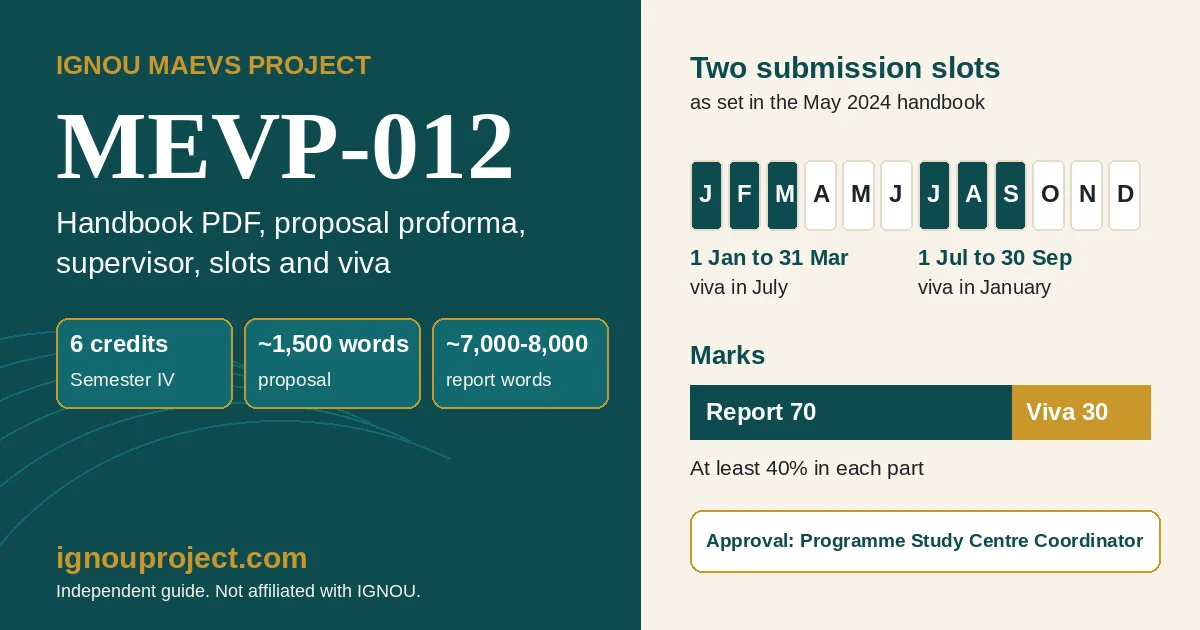
The IGNOU MAEVS project is MEVP-012 Project Work, a 6-credit Semester IV course of the MA (Environmental Studies). You write a proposal of about 1,500 words and send it, with the Annexure I proforma and your supervisor’s signed bio-data, to the Coordinator of your Programme Study Centre or Study Centre. The report, about 7,000 to 8,000 words, goes in bound with a CD between 1 July and 30 September or 1 January and 31 March. Report 70 marks, viva 30.
Facts most MEVP-012 pages miss
- The proposal is not sent to the Student Evaluation Division or approved by your supervisor. It goes to the Coordinator of your Programme Study Centre or Study Centre, who communicates approval or non-approval within a month (handbook 3.6, 3.7).
- An approved proposal is valid for one year, that is two slots. Miss both and you need a fresh proposal (handbook 3.7).
- Annexure IV gives 10 marks to a review of the literature, although the report contents list in section 4.1 does not name one. Write the chapter anyway.
- The supervisor’s complete, signed bio-data is compulsory even when the supervisor is an MAEVS academic counsellor, and the supervisor’s signature on the Certificate of Originality must tally with the one on the proforma (Annexure I note; handbook 4.2).
- The report goes in as one bound copy plus a CD carrying the PDF, in an envelope marked “M.A. (Environmental Studies) MAEVS Project Report (MEVP-012)” (handbook 4.2, 4.3).
- IGNOU pays the supervisor Rs 300 per student through the Annexure III bill. You pay the supervisor nothing (handbook 4.2 point 10).
Understanding the IGNOU MAEVS Project (MEVP-012)
MEVP-012 Project Work is the only project course in the Master of Arts (Environmental Studies), MAEVS, offered by IGNOU’s School of Interdisciplinary and Trans-disciplinary Studies (SOITS). It carries 6 credits and sits in Semester IV, next to MEVE-012 Environmental Management, MEVE-015 Disaster Management and MEDS-042 Issues and Challenges in Urban Planning and Development. The whole programme is 80 credits, runs 2 to 4 years in English, admits in January and July, and costs Rs 7,000 per year as listed in the Common Prospectus July 2026.
The handbook opens by assuming you have already studied research formulation and design, data collection and data analysis. In MAEVS that is MEV-019 Research Methodology for Environmental Science in Semester III, so keep its blocks open while you plan. Two other points shape the year: learners who exit after year one receive the Post Graduate Diploma in Environmental Studies (PGDEVS), whose 40 credits contain no project; and the second-year assignment booklet (valid January 2025 to December 2026) sets no assignment for MEVP-012, because the project is assessed only through the report and the viva (theory-course assignments are covered on our MAEVS handwritten assignment page).
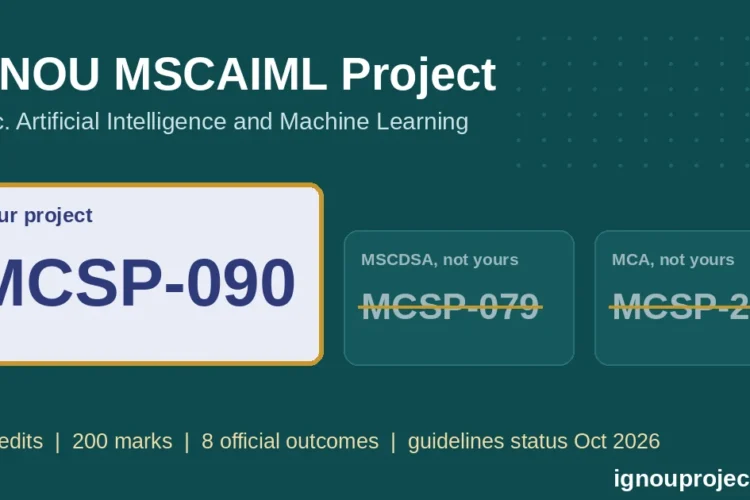
The MEVP prefix is shared by several SOITS programmes, which is why “mevp 12” searches often land on the wrong course. Check the code on your own registration before you download anything.
| Code | Programme | Credits (Prospectus July 2026) | Guide on this site |
|---|---|---|---|
| MEVP-012 | MA (Environmental Studies), MAEVS | 6, Semester IV | This page |
| MEVP-011 | M.Sc. (Environmental Science), MSCENV | 8, Dissertation/Project, Semester IV | MSCENV dissertation guide |
| MEVP-001 | MA (Environmental and Occupational Health), MAENOH | Compulsory project, credits not printed in the table | MAENOH project guide |
| MEVP-033 | M.Sc. in Climate Change, MSCCC | 8 | MSCCC project guide |
| MEVP-054 | PG Diploma in Waste Management, PGDWAM | 8 | PGDWAM project guide |
The official MAEVS programme page labels MEVP-012 as “Theory (6 Credits)”. The handbook and the prospectus both treat it as project work, and the handbook’s rules are the ones applied to your report.
Video: MEVP-012 explained
BK Sahni’s walkthrough of the course on the Shri Chakradhar Education YouTube channel covers topic narrowing, approval, format, supervisor, submission and viva. Where the video and this page differ on a date or rule, follow the handbook figures given here.
Four Annexures, One Handbook: Your MEVP-012 Document Map
The “MEVP 12 project PDF” that students look for is the MEVP-012 Handbook on Project Work, a 14-page SOITS booklet dated May 2024. It carries the rules and all four annexures. Everything else is either the University’s general paperwork or study reference material. Keep the two kinds apart: only the official forms go into your envelope.
| Type | Document | Who uses it | Where to get it |
|---|---|---|---|
| OFFICIAL | MEVP-012 Handbook on Project Work (SOITS, May 2024), 14 pages | You and your supervisor | eGyanKosh record; direct PDF |
| OFFICIAL | Annexure I: Proforma for Approval of Project Proposal (MEVP-012) | You and your supervisor fill it; the Coordinator decides | Handbook page 11 |
| OFFICIAL | Annexure II: Certificate of Originality | Signed by you and your supervisor; bound into the report | Handbook page 12 |
| OFFICIAL | Annexure III: Remuneration Bill for Guidance of Project Work | Your supervisor, after or with the report; Rs 300 per student paid by IGNOU | Handbook page 13 |
| OFFICIAL | Annexure IV: Evaluation Scheme for Project Work | The examiner; read it to see where the marks sit | Handbook page 14 |
| OFFICIAL | Common Prospectus July 2026 (programme structure; project fee on page 27) | Reference | ignou.ac.in |
| STUDY REFERENCE | Sample synopsis: heat exposure and coping practices among street vendors, built on the five components of handbook 3.5 | To study the layout. Not for submission | Download PDF |
| STUDY REFERENCE | Report format template: page order, cover, certificate layout, empty table shells, marks map, envelope and CD labels | To plan your report. Contains no results | Download PDF |
MEVP-012 sample synopsis (PDF, 8 pages)
About 1,500 words once your own place, counts and studies replace the [brackets]. Watermarked, not for submission: the handbook rejects identical proposals.
Download sample synopsisMEVP-012 report format template (PDF, 10 pages)
Page order, Certificate of Originality layout, table shells, word budget by Annexure IV marks, packet checklist. No data, no findings.
Download report templatePrinted reference projects for MAEVS are sold separately on our sister site as MAEVS reference project hard copies at Shri Chakradhar. Like the PDFs above, they are study material: the handbook requires you to do the project individually and independently.
IGNOU MAEVS Project Guidelines (MEVP-012) & Requirements
Every rule below is taken from the May 2024 handbook, with the section so you can check it yourself. Where the handbook is silent, the table says so rather than filling the gap.
| Topic | What the MEVP-012 handbook says | Section |
|---|---|---|
| Proposal length | Approximately 1,500 words | 3.5 |
| Proposal contents | Title; introduction and objectives; methodology and tools; utility or scope of the work; future directions or perspectives | 3.5 |
| Where the proposal goes | Coordinator of your Programme Study Centre or Study Centre, with the Annexure I proforma signed by you and your supervisor | 3.6 |
| What must be enclosed | Project proposal and the supervisor’s complete, signed bio-data; otherwise the proposal will not be entertained | Annexure I note |
| Incomplete proforma | “Will not be accepted” | 3.6 |
| Decision | Approval or non-approval communicated within a month of receipt | 3.7 |
| If not approved | Revised proposal, a new proforma, and a copy of the earlier proforma that was not approved | 3.7 |
| Validity of approval | One year (two slots); after that, a fresh proposal | 3.7 |
| When you can start | Once approved; supervisor selection, bio-data and proposal can be done any time of the year | 3.2; page 5 |
| Report length | Approximately 7,000 to 8,000 words | 4.1 |
| Report contents | Table of contents, introduction, objectives, methodology, results, analysis or interpretation, conclusions, recommendations, summary, bibliography, appendices (if any) | 4.1 |
| Bound into the report | Original approved proforma and the Certificate of Originality; a report without them is rejected | 4.1; 4.2 point 3 |
| Paper and spacing | A-4 size, double line spacing (the handbook prints the size as “29 x 20 cm”; standard A4 sheets are what students use) | 4.2 point 1 |
| Numbering | All pages, tables and figures numbered in sequence; tables and figures titled | 4.2 point 2 |
| Copies | One bound copy of the original report plus a CD with the PDF; a photocopy is not acceptable; keep your own photocopy for the viva | 4.2 points 5, 7; 4.3 |
| Title | Same as in the approved proposal | 4.2 point 4 |
| Originality | Work individually and independently; completely identical proposals or reports are rejected; plagiarism goes to the Unfair Means Committee | 4.2 point 8; 5.2 |
| Supporting material | Attach relevant data, device or object that supports your conclusions | 4.2 point 9 |
| Supervisor’s fee | Do not pay the supervisor; the University pays | 4.2 point 10 |
| Font, margins, referencing style | Not specified anywhere in the handbook | None |
For the general IGNOU rules that apply across programmes, see the IGNOU project guidelines overview.
Three Routes to an Eligible MEVP-012 Supervisor
Section 3.3 of the handbook lists who can supervise an MAEVS project. Your supervisor must fit one route, and the Coordinator approves the supervisor separately from the proposal on the proforma.
| Route | Who qualifies | Experience |
|---|---|---|
| (a) IGNOU counsellor | Academic counsellor at a Learner Support Centre for the MA (Environmental Studies) | Relevant experience |
| (b) Teacher or researcher with a Ph.D. | Ph.D. in Environmental Science, Environmental Studies or a related discipline | 2 years of teaching or research experience |
| (b) Teacher or researcher with an M.Sc. | M.Sc. in Environmental Science, Environmental Studies or a related discipline | 5 years of teaching or research experience |
| (c) IGNOU faculty | Faculty of the School of Interdisciplinary and Transdisciplinary Studies at IGNOU headquarters | As faculty |
- If the supervisor is not accepted, you are told so, change the supervisor and resubmit. A new supervisor means a new proposal on a new proforma signed by the new supervisor, and the same applies if you change supervisor later for any reason.
- Academic counsellors must clearly mention the courses they counsel, since when, and the name and code of the study centre they are attached to.
- What the supervisor does (handbook 3.4): helps you focus the topic, points you to literature and data settings, encourages original work, and gives a letter of authorisation for data collection (the study centre or Regional Centre can also give it).
- Money: the supervisor submits the Annexure III remuneration bill after or with your report and receives Rs 300 per student from IGNOU. You pay nothing.
Supervisor bio-data checklist
The handbook asks only for “complete and signed” bio-data and, for counsellors, the three details above. A bio-data that lets the Coordinator check the route usually shows: full name, designation and office address; highest degree with subject, university and year; years of teaching or research experience; for counsellors, the courses counselled, since when, and the study centre name and code; the supervisor’s original signature and date.
More on guide choice across programmes: IGNOU project guide eligibility.
Choosing IGNOU MEVP 012 Project Topics
The handbook gives two tests for a topic: it should have “a direct relevance to your day-to-day activities” (3.2), and the evaluator checks the “relevance of the problem to the real world” (5.1). You may frame the problem yourself or with your supervisor. The directions below tie each idea to a MAEVS course you have already studied, so the theory chapter writes itself from your own course blocks. They are directions, not titles: add your place, people and period.
| PLANNING-AID MAEVS course | Topic direction | Data you can realistically collect |
|---|---|---|
| MEV-015 Environmental Pollution, Control and Management | Household segregation of wet and dry waste in [ward] under the Solid Waste Management Rules, 2016 | Household survey; collection-point observation |
| MEV-017 Environmental Legislations | Shopkeepers’ awareness of and compliance with the Plastic Waste Management Rules, 2016 in [market] | Structured interviews; observation checklist |
| MEVE-016 Urban Environment | Use of neighbourhood parks and green cover by residents of [colony] | Visitor counts by time slot; resident questionnaire |
| MEV-025 Climate Change and Society | Heat exposure and coping practices of street vendors in [market] (worked in our sample synopsis) | Interview schedule; stall observation; station temperature records |
| MEVE-011 Global Climate Change | Farmers’ perception of rainfall change compared with recorded rainfall in [block] | Farmer interviews; official rainfall series |
| MEV-014 Sustainable Natural Resource Management | Working condition and use of rooftop rainwater harvesting structures in [housing society or schools] | Site inspection checklist; caretaker interviews |
| MEVE-014 Biodiversity Conservation and Management | Tree species diversity and local uses in [campus, grove or park] | Tree inventory with identification; user interviews |
| MEVE-015 Disaster Management | Household preparedness for floods or heat waves in [locality] | Preparedness checklist survey |
| MEV-018 Environmental Health and Ecotoxicology | Pesticide handling and storage practices among farmers in [village] | Interview schedule; observation of storage |
| MED-003 Energy and Environment | Cooking fuel choices and indoor smoke concerns in [village or slum cluster] | Household survey |
A workable title names the issue, the people or site, the place and the design, for example “Household Segregation of Waste in [Ward], [City]: A Descriptive Survey”. Settle the wording before you sign the proforma: the report must carry the approved title word for word. For a fuller method of narrowing a theme, read how to choose an IGNOU project topic.
How to Write IGNOU MAEVS Project Synopsis/Proposal (MEVP-012)?
For MEVP-012, the “synopsis” is what the handbook calls the project proposal: about 1,500 words prepared in consultation with your supervisor, covering five components. The split below is a planning suggestion; the handbook fixes only the total and the components.
| Component (handbook 3.5) | What to put in it | PLANNING-AID Share of 1,500 words |
|---|---|---|
| Title of the project | Issue, people or site, place, design | One line |
| Introduction and objectives | Background from sources you read, the local context, why it matters, three to five neutral objectives | About 550 |
| Methodology and tools | Design, study area, population and sample with method, tools (schedule, checklist, records), data collection, analysis linked to each objective, time plan | About 600 |
| Utility or scope of the work | Who can use the result; what the study covers and what it does not | About 200 |
| Future directions or perspectives | What a later study could add | About 130 |
Write objectives that do not presume the result (“to study”, “to examine”, “to identify”); our guide to writing project objectives has more examples, and the general IGNOU synopsis format page covers cover pages used across programmes. Then assemble the packet: proposal, Annexure I proforma with every entry filled and both signatures with place and date, and the supervisor’s signed bio-data, addressed to the Coordinator of your Programme Study Centre or Study Centre. Keep a photocopy of all of it.
MEVP-012 Proposal Packet Checker
This tool needs JavaScript. If you still see this line after the page has loaded, use the checklist under the tool.
Tick what is already true of your packet. The checker lists every gap against the MEVP-012 Handbook (May 2024). It cannot predict approval.
Before the Coordinator Reads It: MEVP-012 Synopsis and Report Correction
The MEVP-012 handbook names its own reasons for turning work away: an incomplete proforma “will not be accepted”, a proposal without the supervisor’s signed bio-data “will not be entertained”, a report without the original proforma and Certificate of Originality “will be rejected”, and “violation of the project guidelines can lead to rejection of the project at any stage”.
Send us the proposal or report you have written. We check it line by line against those clauses and the Annexure IV marking heads, and return it with corrections for you to make.
What we check in your synopsis
- All five components of section 3.5, near the 1,500-word guide
- Objectives worded neutrally and matched to the method
- Sample, tools and analysis that can actually answer each objective
- Every Annexure I entry, both signatures, place and date
- Supervisor route and bio-data contents against section 3.3
- Title wording you can live with, since it will be locked
What we check in your report
- The eleven items of section 4.1 plus a literature review for its 10 marks
- Results and discussion that answer every approved objective (30 marks)
- Conclusions that match the objectives, as section 5.1 requires
- Sequential numbering and titled tables and figures
- Title identical to the approved proposal; signatures that tally
- Original proforma and certificate bound in; CD and envelope text
Synopsis correction Rs 1,000. Report correction Rs 2,000.
See how synopsis and project correction works
You remain the author of your proposal and report. We correct and format what you wrote; we do not write assessed work, supply data or sign any form. Approval rests with the Coordinator of your Programme Study Centre or Study Centre, and marks with the Project Evaluator.
Seventeen Boxes on Annexure I: The MEVP-012 Proforma, Box by Box
The Proforma for Approval of Project Proposal (MEVP-012) is on page 11 of the handbook and is “to be attached with the proposal submitted to the Coordinator, Programme Study Centre/Study Centre”. It has seventeen boxes. Here is who fills each one and what to watch.
| # | Box | Who fills it | What to watch |
|---|---|---|---|
| 1 | Project Proposal No. | Office | Leave blank; note it once allotted and quote it later |
| 2 | Enrolment No. | You | Exactly as on your identity card |
| 3 | Study Centre Code | You | The centre whose Coordinator will decide |
| 4 | You | One you read: approval or suggestions come back to you | |
| 5 | Regional Centre Code | You | Your own Regional Centre |
| 6 | Mobile No. | You | Reachable during the decision month |
| 7 | Name and Address of the Student | You | The form asks you to write the address clearly |
| 8 | Title of the Project | You | Becomes the locked title; the report must carry it unchanged |
| 9 | Name, Designation and Address of the Supervisor | You, with the supervisor | Must match the bio-data |
| 10 | Is the Supervisor an Academic Counsellor of MAEVS? Yes/No | You | “Yes” does not remove the need for bio-data |
| 11 | If Yes, Name and Code of the Study Centre | You | Leave blank only if box 10 is No |
| 12 | Signature of Student, Place, Date | You | All three parts |
| 13 | Signature of Supervisor, Place, Date | Supervisor | This signature must tally with the Certificate of Originality later |
| 14 | Office use: Project Proposal, Approved or Not approved | Coordinator | Decided separately from box 15 |
| 15 | Office use: Supervisor, Approved or Not approved | Coordinator | A sound proposal can still need a new supervisor, which means a new proposal |
| 16 | Comments or Suggestions on the Project Proposal | Coordinator | If not approved, revise and resend with a new proforma and a copy of this one |
| 17 | Signature of Coordinator, Programme Study Centre or Study Centre | Coordinator | The original approved form is bound into your report |
The printed note under the signatures reads, in substance: enclose the proposal and the supervisor’s bio-data; if the complete and signed bio-data is not enclosed, even for an MAEVS counsellor, the proposal will not be entertained. For how approvals are communicated across IGNOU programmes, see the IGNOU synopsis approval process.
Step-by-Step Guide to Writing Your IGNOU MAEVS Project Report
Write the report after approval and inside your two-slot validity. The handbook’s contents list and its marking scheme do not match exactly, so build the report to satisfy both.
- Keep the approved title word for word on the cover, the certificate and the contents page.
- Collect your own data with the tools and sample in the approved proposal, carrying the supervisor’s or centre’s authorisation letter.
- Draft the chapters in the order of section 4.1, adding a review of literature after the introduction because Annexure IV marks it.
- Number everything: pages, tables and figures in sequence, every table and figure with a title.
- Show the final draft to your supervisor before binding, as section 3.6 advises, and attach copies of your approved proposal.
- Bind and burn: one bound copy on A-4 paper in double line spacing, plus a CD with the full report as a PDF.
- Sign the Certificate of Originality with your supervisor, and bind it with the original approved proforma.
| Annexure IV head | Marks | Report chapters that earn them |
|---|---|---|
| Introduction (with objectives and rationale) | 10 | Introduction; Objectives |
| Review of the literature | 10 | Review of Literature (add it; 4.1 does not list it) |
| Methodology | 10 | Methodology: survey, data, tools and techniques used |
| Results and discussion | 30 | Results; Analysis and interpretation of the results |
| Conclusions | 10 | Conclusions; Recommendations; Summary |
| Viva voce | 30 | Not written; see the viva section |
Section 5.1 adds the general parameters the evaluator applies: relevance of the topic, clarity of aims and feasibility, methodology, presentation (organisation, correct language, referenced tables and diagrams, proper binding, which it describes as spiral bound), precise analysis, and conclusions that match the objectives. The report format template in the document map lays all of this out with empty tables. For length questions across courses, see IGNOU project word limits; for the general report layout, the IGNOU project report format page.
IGNOU MEVP 12 Project Submission Process
The MEVP-012 handbook sets two submission slots, each followed by a viva month:
| Slot | Submission window | Viva |
|---|---|---|
| January slot | 1 January to 31 March | July |
| July slot | 1 July to 30 September | January |
Post or hand in one bound copy of the original report with the CD to either office named in section 4.3:
- The Registrar, Student Evaluation Division, IGNOU, Maidan Garhi, New Delhi 110068 (by hand or registered post), or
- The Regional Director of your concerned Regional Centre.
Write “M.A. (Environmental Studies) MAEVS Project Report (MEVP-012)” on the top of the envelope. Keep a photocopy of the whole report: you may be asked to produce it before the examiner at the viva. Your supervisor sends the Annexure III remuneration bill after or along with your report.
Fee. The Common Prospectus July 2026 (page 27) sets a project evaluation fee of Rs 500 for project work above 4 credits, paid with the Term-End Examination form, from the January 2023 admission cycle. MEVP-012 has 6 credits. The SED portal for the June 2026 cycle stated that a report is not considered if this fee was not paid with the TEE form. Check the amount on the exam form for your cycle.
Generic IGNOU project dates and the posting method are covered in the IGNOU project submission guide and the December 2026 project last-date page. After you submit, track it with the IGNOU project status guide.
MEVP-012 Slot, Validity and Word Planner
This tool needs JavaScript. If you still see this line after the page has loaded, use the slot table above.
Enter your proposal date. The planner shows when to expect a decision, your two valid slots with their viva months, the date your approval lapses, and a chapter word budget.
Preparing for IGNOU MEVP 012 Project Viva
The viva carries 30 of the 100 marks, and you need at least 40 per cent in it separately, as well as in the report and overall. It is conducted by the Project Evaluator in the presence of the Coordinator of the Programme Study Centre or Study Centre, on a date the Coordinator fixes and tells you well in time. It tests your subject knowledge of the project and your presentation and communication. Bring a copy of your report: the photocopy you kept is the one to carry.
Regional Centres publish their own MEVP-012 viva schedules; for example, IGNOU RC Ranchi posted a “Schedule of Project Viva-Voce for MSCENV (MEVP-011)/MAEVS (MEVP-012) for Dec-2025 TEE” on its news page. Watch your Regional Centre’s notices and e-mail around January and July.
Questions to rehearse, by marking head
| Annexure IV head | Likely questions |
|---|---|
| Introduction and rationale | Why this problem, here, now? Which MAEVS course does it draw on? |
| Review of literature | Which two studies shaped your design, and what did they leave open? |
| Methodology | Why this sample size and selection method? How did you pre-test the tool? What would you change? |
| Results and discussion | What is your main finding for each objective? Which table shows it? Does it agree with the literature? |
| Conclusions | Which recommendation is practical for a local body to adopt? What are the limits of your conclusions? |
More practice questions for any IGNOU project are on the IGNOU project viva questions page.
If the project is not passed
The handbook says a learner declared unsuccessful must redo the whole cycle from the proposal stage, and advises choosing a new topic with a fresh proposal. There are no separate slots for failed learners. The May 2024 handbook prints a pro-rata fee of Rs 1,200 by demand draft in favour of IGNOU payable at Delhi, sent with the resubmitted report; confirm the current mode with your Regional Centre, because the July 2026 prospectus now collects the project evaluation fee with the online TEE form. Plagiarism in a proposal or report goes before the IGNOU Unfair Means Committee.
Stuck between two environmental themes? Send them on WhatsApp and we will help you narrow one into a researchable MEVP-012 proposal you write yourself. Guidance only: confirm final rules with your Programme Study Centre.
WhatsApp +91 93546 37830IGNOU MAEVS Project FAQ
What is MEVP 012 in IGNOU?
MEVP-012 is the course code for Project Work in IGNOU’s MA (Environmental Studies), MAEVS. It is a 6-credit Semester IV course of the 80-credit programme, assessed by a project report (70 marks) and a viva (30 marks).
Where can I download the MEVP 12 project PDF?
The official PDF is the MEVP-012 Handbook on Project Work (SOITS, May 2024) on eGyanKosh, linked in the document map above. It contains the proforma, the Certificate of Originality, the remuneration bill and the evaluation scheme. The sample synopsis and report template on this page are study reference only.
Is MEVP-012 the same as MEVP-011?
No. MEVP-011 is the 8-credit Dissertation/Project of the M.Sc. (Environmental Science), MSCENV, with its own handbook. MEVP-012 belongs to the MA (Environmental Studies). Check the code on your registration.
How many words is the MAEVS project report?
Approximately 7,000 to 8,000 words, as section 4.1 of the MEVP-012 handbook states. The proposal is approximately 1,500 words.
Who approves the MAEVS synopsis?
The Coordinator of your Programme Study Centre or Study Centre, who communicates approval or non-approval within a month and separately approves or rejects the supervisor. Your supervisor signs the proforma but does not approve it.
Is synopsis approval required before writing the MEVP 12 report?
Yes. Section 3.2 says that once the proposal is approved you can start work on it, and section 4.1 requires the original approved proforma to be attached to the report; a report without it is rejected.
What are some good MAEVS project topics?
Topics with direct relevance to your day-to-day surroundings, as the handbook advises, built on a MAEVS course you have studied: waste segregation, plastic rules compliance, urban green space, heat and street vendors, rainfall perception, rainwater harvesting, tree diversity, disaster preparedness, pesticide handling or cooking fuels. The topic table above pairs each with the data you can collect.
Can I submit the MEVP-012 report in May or November?
The handbook’s slots are 1 January to 31 March and 1 July to 30 September. May and November fall outside both. If an SED online portal is open with a later date, confirm with your Programme Study Centre before relying on it.
Can I get an extension for the MAEVS project?
The handbook provides no extension. Your approval stays valid for two slots; if you miss both, you submit a fresh proposal for approval.
Can ignouproject.com make my synopsis and project for me?
No. You remain the author, and the handbook requires individual and independent work. We provide customised project guidance, topic refinement, methodology support, review and correction of learner-written synopses and reports, formatting and citation support, reference material, printing and binding, and project status and result guidance.
Official Sources for MEVP-012
- IGNOU, School of Interdisciplinary and Trans-disciplinary Studies. MEVP-012 Handbook on Project Work, Master of Arts (Environmental Studies), May 2024. eGyanKosh record 107425. Sections 1 to 5, Annexures I to IV.
- IGNOU. Common Prospectus July 2026: MAEVS programme row and section 3.42; PGDEVS section 8.41; project evaluation fee, page 27. ignou.ac.in. Read 08 October 2026.
- IGNOU. MAEVS programme page. ignou.ac.in/schools/programme/MAEVS. Read 08 October 2026.
- IGNOU Student Evaluation Division. Online project submission portal, June 2026 cycle. onlineproject.ignou.ac.in/PROJECTJUN26. Read 08 October 2026.
- IGNOU. MAEVS second-year assignment booklet, valid January 2025 to December 2026. webservices.ignou.ac.in.
- IGNOU Regional Centre Ranchi. “Schedule of Project Viva-Voce for MSCENV (MEVP-011)/MAEVS (MEVP-012) for Dec-2025 TEE”. rcranchi.ignou.ac.in.

BK Sahni, founder of Shri Chakradhar Publication Pvt. Ltd., New Delhi, and ignouproject.com.
Serving IGNOU distance learners since 2010 as a publisher of IGNOU help books and guess papers, with its own printing press and an in-house editorial team. Author of Mind Loop. ORCID 0009-0005-8092-459X.
ignouproject.com is an independent service run by Shri Chakradhar Publication Pvt. Ltd. It is not affiliated with or endorsed by Indira Gandhi National Open University. Rules, fees and dates on this page come from the official documents listed above as read on 08 October 2026; confirm them with your Programme Study Centre, Regional Centre and the current handbook before you act. More IGNOU project guides are on the IGNOU projects hub.
BK Sahni iD 0009-0005-8092-459X
Founder, Shri Chakradhar Publication Pvt. Ltd. & ignouproject.com — helping IGNOU distance-learning students since 2010 (5,00,000+ students supported across MBA, MCom, MA & more). Author of IGNOU exam guides, solved assignments & project reference books.
Disclosure: Shri Chakradhar Publication Pvt. Ltd. and ignouproject.com are independent third-party study-help services — not the official IGNOU website. Always verify final dates and rules on ignou.ac.in.