Research note: built from a full reading of the IGNOU Project Manual for this course (School of Humanities, May 2009, 25 pages, printed as MFCI-005), the IGNOU Common Prospectus July 2026, the official MAFCS and PGDFCS programme pages, and the SED online project guidelines for the June 2026 cycle, all checked in October 2026.
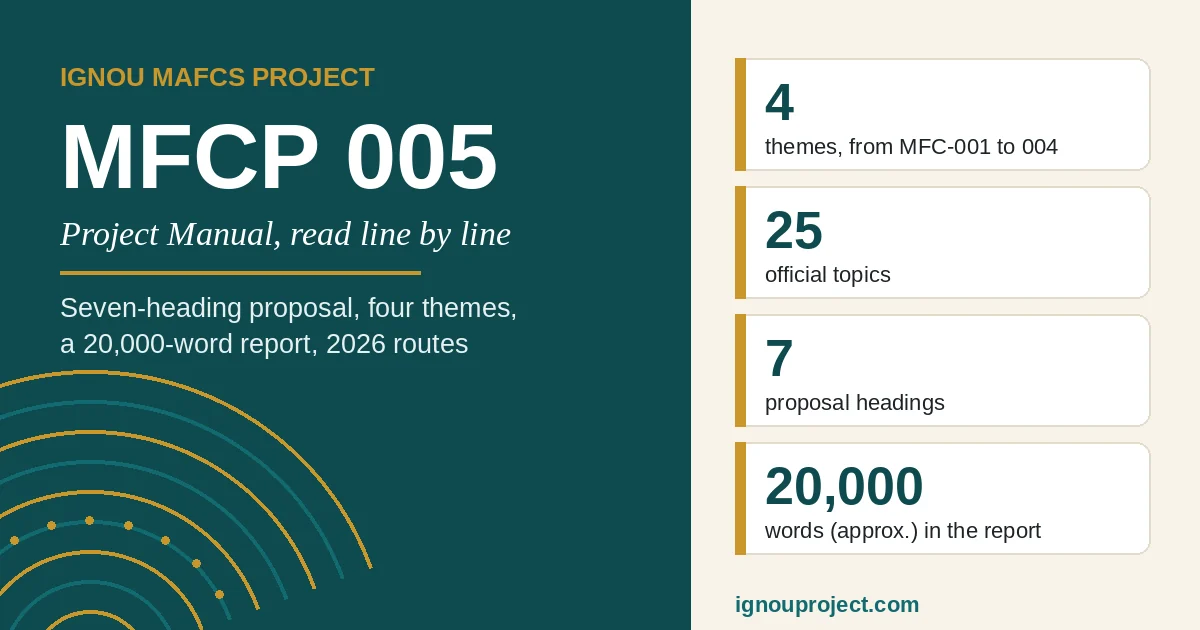
The IGNOU MAFCS project is MFCP 005, an 8-credit first-year course in the MA (Folklore and Culture Studies). You choose one topic from one of the four themes in the Project Manual and send a proposal of about two pages under seven headings, with your local guide’s signed resume, for the Programme Coordinator’s approval. You then write a term paper of approximately 20,000 words in English, with the theme and topic number on the cover. Fieldwork is optional.
Six facts most MFCP 005 pages miss
- The manual on eGyanKosh is the 2009 manual printed as MFCI-005. The 2026 prospectus prints MFCP 005 at 8 credits for MAFCS but MFCI 5 at 6 credits for PGDFCS, so write the code on your own registration.
- The manual asks for approximately 20,000 words and leaves the page count blank. Figures such as “60 to 80 pages” or “8,000 words” do not come from it.
- Your cover must carry the theme and the topic number you chose (manual p.9).
- Fieldwork is optional: the manual accepts content analysis of already collected or available material, with full references (manual p.5).
- Your local guide can be any academic counsellor or a teacher with interest or expertise in folklore and culture studies. The guide gets academic credit and is not paid by the University (manual p.3).
- The address printed in the manual (Room 30, School of Humanities, a rediffmail ID) dates from 2009. MAFCS now sits in the School of Interdisciplinary and Trans-disciplinary Studies.
IGNOU MAFCS Syllabus: Where MFCP 005 Sits in Year One
MAFCS is IGNOU’s Master of Arts in Folklore and Culture Studies, run by the School of Interdisciplinary and Trans-disciplinary Studies (SOITS). Any graduate can join; the medium is English; it takes 2 to 4 years; the fee is Rs 7,500 a year (the programme page adds Rs 300 registration), with January and July sessions and year-wise exams. The first year is the PG Diploma in Folklore and Culture Studies (PGDFCS, 32 credits), and the IGNOU MAFCS project, MFCP 005, is part of that first year.
| Code | Course | Credits | Year | What it covers (programme page) | Project theme |
|---|---|---|---|---|---|
| MFC-001 | Folklore and Culture: Conceptual Perspectives | 6 | 1 | Folklore: issues and methods; culture studies; folklore and culture studies in India; approaches, documentation, preservation and conservation of culture | Theme One |
| MFC-002 | Tradition, Identity and Cultural Production | 6 | 1 | Tradition, identity, cultural production, market and cultural property | Theme Two |
| MFC-003 | Cultural and Societal Transformation | 6 | 1 | Folk forms and their transformations; translation; societal transformation; the “folk” and modern narratives | Theme Three |
| MFC-004 | Tribes of India: Identity, Culture and Lore | 6 | 1 | Tribes of India; typology; economic and cultural strategies of survival; tribal cosmogonies | Theme Four |
| MFCP 005 | Project Manual (project work) | 8 | 1 | A term paper on one topic from one of the four themes | All four |
| MFC-006 | Folklore: Canon, Multimediality, Interdisciplinarity and Social Epistemology | 8 | 2 | Contemporary issues of folklore; multimediality; interdisciplinarity; social epistemology | None |
| MFC-007 | Theories and Pedagogy of Folklore | 8 | 2 | Polygenetic and monogenesis theories; Indian thought; folk movements | None |
| MFC-008 | Folk Representations | 8 | 2 | Folk poetry; short fiction and fiction; folk theatre; world folklore | None |
| MFC-009 | Approaches to Folklore | 8 | 2 | Structural and post-structural, psychological, functional and semiotic approaches | None |
| MFC-010 | Translation work | 2 | 2 | Listed on the programme page. The prospectus describes a 2-credit translation coursework for PGDFCS holders of 2009 to 2020 who join the second year, with e-mail approval of the folk texts by the Programme Coordinator. | None |
Why this matters for the project: the four project themes carry the same titles as the four first-year courses, so your MFC-001 to MFC-004 books are the first reading for your proposal. The prospectus gives a total of 64 credits for MAFCS. For the assignments of these courses, see the MAFCS handwritten assignment page.
One Manual, Two Codes: MFCP 005 or MFCI 5?
Write the course code shown on your own registration and fee receipt, and use it the same way on the proposal, the report cover and the upload. Official sources print the project under different codes and credits:
| Official source | Code printed | Credits | For |
|---|---|---|---|
| Project Manual cover (School of Humanities, May 2009) | MFCI-005 | Not stated | Written when the course belonged to PGDFCS |
| Common Prospectus July 2026, MAFCS (p.93) | MFCP 005 | 8 | MAFCS, year one |
| Common Prospectus July 2026, PGDFCS (p.294) | MFCI 5 | 6 | PGDFCS (30 credits in that table) |
| MAFCS programme page, ignou.ac.in | MFCP-005 | 8 | MAFCS, year one |
| PGDFCS programme page, ignou.ac.in | MFCP-005 | 8 | PGDFCS |
| MAFCS and PGDFCS assignment files, 2023-24 to 2026-27 | “MFC-005 being a project paper” | Not stated | Both |
The fee is the same either way: both 6 and 8 credits are above 4 credits, so the project evaluation fee is Rs 500, paid with the term-end examination form (Common Prospectus July 2026, p.27, for the January 2023 admission cycle onwards). If you are in PGDFCS only, the PGDFCS project (MFCI 005) guide covers that programme. If you are moving from PGDFCS into the second year of MAFCS, read what the prospectus says about PGDFCS to MAFCS credit transfer.
Document Map: What Is Official and What Is Study Reference
OFFICIAL Issued by IGNOU
- Project Manual (MFCI/MFCP 005), School of Humanities, May 2009, 25 pages: themes, topics, proposal headings, length, local guide. eGyanKosh
- MAFCS programme page: courses, credits, duration, fee. ignou.ac.in
- Common Prospectus July 2026: pp.27 (fee), 93 (MAFCS), 293 to 294 (PGDFCS). PDF
- SED online project guidelines: report upload rules and the fee receipt, published for each TEE cycle. June 2026 cycle page
- Proposal proforma: none is printed in the MFCP 005 manual. Use a proforma only if SOITS or your Regional Centre gives you one.
STUDY REFERENCE Made by ignouproject.com, not for submission
- Sample synopsis on Theme One, topic (f): cradle songs and language shift, laid out under the manual’s seven headings, with [brackets] for your own facts.
Download sample synopsis (PDF) - Report format template: cover specimen, page order, declaration frames, empty table shells and a 20,000-word budget. No results.
Download report format (PDF) - Course books for MFC-001 to MFC-004 are on eGyanKosh; see how to download IGNOU books.
Four Themes, Twenty-Five Topics: The Official MFCP 005 List
The manual asks you to “choose any one topic from one of the theme listed” and to mention the theme and the topic number on the cover of the report (p.9). It also allows flexible topics on the folk traditions of any part of the world, and independent projects with the prior approval of the Programme Coordinator through your study centre or regional centre (p.3). The list below follows the manual’s wording, lightly shortened.
| Theme | No. | Topic as listed in the manual |
|---|---|---|
| One: Conceptual Perspectives | (a) | Folklore Studies: Its Uniqueness and Relevance in India |
| One | (b) | Folklore Studies and Inter-disciplinary Approach |
| One | (c) | Palace Paradigm |
| One | (d) | Sanskritization |
| One | (e) | Archiving and Ethics |
| One | (f) | Language Death and Language Preservation |
| One | (g) | Any case study or special report on the culture and folklore of any region of India or outside where you belong or in which you are interested |
| Two: Tradition, Identity and Cultural Production | (a) | A case study of the process of identity formation in history |
| Two | (b) | A case study of tribe and identity formation in India |
| Two | (c) | A case study of the role of politics in identity formation in India in recent times |
| Two | (d) | A case study of commodification of culture in India |
| Two | (e) | A case study of copyright and commodification of culture in India |
| Two | (f) | Any case study or special report (as in One (g)) |
| Three: Cultural and Societal Transformation | (a) | A case study analysis of any textual performance in India |
| Three | (b) | A case study analysis of translation and politics of language in India |
| Three | (c) | A case study analysis of how a particular folklore can be classified into a genre |
| Three | (d) | A case study analysis of any folk music in India and its role in the community it belongs to |
| Three | (e) | A case study analysis of any katha tradition in India |
| Three | (f) | Any case study or special report (as in One (g)) |
| Four: Tribe, Identity Culture and Lore | (a) | A case study analysis of any origin myth of an Indian tribe |
| Four | (b) | Identify a nomadic tribe and analyse its strategies of survival |
| Four | (c) | Identify a tribe and explain its relation to electoral politics in India |
| Four | (d) | Identify a region and compare the economic strategies of two different tribes from the region |
| Four | (e) | Identify any tribe from north east India and discuss its Human Development Index |
| Four | (f) | Any case study or special report (as in One (g)) |
The manual’s own FAQs as topic starters
Section 1.4 of the manual answers thirteen questions on folklore. Several of them open researchable questions that sit inside a numbered topic. These are planning ideas, not IGNOU suggestions.
| Idea in the manual | Page | A question you could study | Theme and topic |
|---|---|---|---|
| Palace paradigm (Jawaharlal Handoo): written culture shaped by court elites, folklore by common people | 14 | How does the courtly or temple version of a local legend in [district] differ from the version told in its villages? | One (c) |
| Sanskritization (M.N. Srinivas), and its limits | 14 to 15 | Have the wedding songs of [community] in [place] changed in language or ritual reference over three generations? | One (d) |
| Language death and five levels of endangerment | 17 to 18 | Are lullabies still sung in [mother tongue] by the youngest caregivers in [ward]? (our sample synopsis) | One (f) |
| Genre is hard to fix in India (Joyce Flueckiger’s Bhojali songs of Chhattisgarh) | 12 | Can the [song form] of [region] be classed by gender, region, community or performance? Which criterion holds? | Three (c) |
| Ramayana and katha traditions move between court and people | 11 to 12 | How does a [katha form] performance in [town] adapt its episode to its audience? | Three (e) |
| Folk forms as protest (Holi, Bakhtin’s carnival) | 15 to 16 | Which social roles are inverted during [festival] in [place], and what returns to normal after it? | One (g) |
| Preservation, commodification and copyright of culture | 16 | Who decides how a [craft or performance] of [region] is sold, credited and copied? | Two (d) or (e) |
For general advice on narrowing a topic, see how to choose an IGNOU project topic.
The Two-Page Proposal: Seven Headings the Manual Asks For
The IGNOU MAFCS project proposal (synopsis) is sent “within approximately two pages” for the approval of the Programme Coordinator, and work on the project starts only after that approval (manual p.3). The manual prints no proforma for MFCP 005, so the field map below follows its seven headings, plus the cover line and the details the SED asks for later.
| Box | Heading as printed | What the manual says | What to write | Who fills | Watch |
|---|---|---|---|---|---|
| 0 | Cover line | Theme and topic number on the cover (p.9) | Programme MAFCS, your course code, theme, topic number, title, name, enrolment number, centre | Learner | Use the code on your registration |
| 1 | Introduction | The basis of the study, the logic, the rationale | What you will study, where, and why it matters to folklore and culture studies | Learner | Keep it to a short paragraph or two |
| 2 | Objectives | Specific objectives of the study, the research point | Three or four precise aims; see how to write project objectives | Learner | Do not assume your findings in the wording |
| 3 | Methodology | Qualitative or quantitative data techniques | Your route: survey, qualitative from available material, or both | Learner | Fieldwork is not required |
| 4 | Case Study | Justify the sampling procedure (printed as “samping”) | Who or what you will study, how many, and why those | Learner | The “ten per cent” in the manual is an example; small groups can be covered in full (p.6) |
| 5 | Data Analysis | Description of the tool, questionnaire, interview schedule, ranking schedule | Each tool and how you will analyse what it gives you; see questionnaires and data collection | Learner | Name the tool for every objective |
| 6 | Chapterization | The number and titles of the chapters | Chapter list, usually five to seven | Learner | Often left out of proposals |
| 7 | Local Guide | Resume of the local guide with his or her signature and readiness to guide | Attach the signed resume with one line of readiness | Local guide | Signature and readiness line both needed |
| Approval | Programme Coordinator | Prior approval, through the study centre or regional centre for independent projects | Keep the approval with your report | IGNOU | Start only after approval |
MFCP 005 Proposal Check and Cover Line Builder
Built line by line from the MFCI/MFCP 005 Project Manual (pp.3, 5, 6 and 9). Nothing you type leaves this page.
This tool needs JavaScript. If you can read this line after the page has loaded, use the table above as your checklist.
Check your Samarth registration or fee receipt.
The manual asks for approximately two pages.
How it decides: the checker builds your cover line from the theme and topic number (manual p.9), then compares your draft with the seven headings on page 3 of the manual and its length of approximately two pages. If you choose the survey route it insists on the Case Study heading, because that is where the manual asks you to justify sampling, and it reminds you that the report must give sampling and quantification details (p.5). If you choose the qualitative route it asks for named sources and a bibliography (p.5). An own topic is flagged for prior approval (p.3). It never predicts approval: the Programme Coordinator decides.
Get Your MFCP 005 Proposal Checked Before It Goes to SOITS
Generic synopsis templates online include sections the MFCP 005 manual never asks for, such as a hypothesis section and an APA rule, and leave out two that it does ask for: Chapterization and the guide’s readiness line. Our editorial team reads your own draft against the manual and returns it with corrections.
What we check in your synopsis
- All seven headings, in the manual’s order
- About two pages, with nothing generic left in
- Theme and topic number match your title
- Objectives that are specific and neutral
- Sampling justified for the route you chose
- Every tool named and matched to an objective
- Guide resume signed, with a readiness line
- Course code matches your registration
What we check in your report
- About 20,000 words, in English
- Title identical to the approved proposal
- Theme and topic number on the cover
- Sampling and quantification details for survey work
- Full references and bibliography for qualitative work
- Page order, declaration and SED first-page details
- One citation style used throughout
Synopsis correction Rs 1,000; report correction Rs 2,000.
See how synopsis and report correction worksYou remain the author of your proposal and report. We correct your own draft against the official manual; we do not write it for you, and approval is decided by IGNOU’s Programme Coordinator, MAFCS.
Fieldwork Is Optional: Three Routes the Manual Accepts
The manual says the project “can be quantitative research as well as qualitative research, or a combination of both” (p.9). If the report rests on a survey, it must give the sampling and quantification details with the findings; if it rests on qualitative analysis, “content analysis of already collected or available data”, it must give proper references and a bibliography (p.5). So a library or archive project is acceptable for MFCP 005.
| Route OFFICIAL-RULE | What the manual describes | Tools | What your report must show |
|---|---|---|---|
| Survey (quantitative) | A universe, a sample taken as representative, tables, percentages and graphs (pp.6 to 7). The “ten per cent” sample is an illustration. A very small universe is covered in full (p.6). | Questionnaire, interview schedule, focussed group discussion (the manual counts all three as statistical tools) | Sampling and quantification details with the findings (p.5) |
| In-depth interviews | Each person interviewed is treated as a universe in itself; a schedule may run to forty or fifty questions and an interview may take hours or days (p.7) | Detailed interview schedule; transcripts | How people were chosen, and the compared and collated accounts |
| Qualitative from available material | Archival texts, oral traditions, interviews to record memory, diaries, and reading texts against the grain (pp.8 to 9) | Source register; content analysis | Proper references and a bibliography (p.5) |
| Integrated | Most disciplines combine both; folklore studies lean towards the qualitative (p.9) | Any of the above | Both sets of evidence |
A choice that saves time: pick the route first, then the topic. A survey needs people you can actually reach in your session, while an archive or published-text study needs material you can actually read in a library or online.
Your Local Guide: Any Qualified Teacher, Unpaid, One Signed Resume
For MFCP 005 you take a local guide. The manual says the academic counsellors of the study centres, “or any other teacher having interest/expertise in folklore and culture studies”, may be taken as local guides; they are given academic credit and are not entitled to any payment from the University (p.3). The proposal carries the guide’s resume, signed, with a statement of readiness to guide you.
| Common claim | What the MFCP 005 manual says |
|---|---|
| IGNOU assigns your guide | You take a local guide yourself (p.3) |
| The guide must hold a set degree or years of experience | No degree or years are stated; interest or expertise in folklore and culture studies, or being an academic counsellor, is the test (p.3) |
| The guide’s seal or stamp is needed | Not mentioned; the manual asks for the resume with signature and readiness (p.3) |
| IGNOU pays the guide an honorarium | Not for MFCP 005: local guides get academic credit and no payment (p.3) |
When you upload the final report, the SED guidelines ask for the guide’s bio-data and an originality certificate signed and dated by you and your guide. For a general view of guide rules across IGNOU courses, see IGNOU project guide eligibility.
Approximately 20,000 Words: Report Format and Page Order
The MFCP 005 report is a term paper of approximately 20,000 words, in English, covering one topic from one theme, with the theme and topic number on its cover (manual pp.3 and 9). The manual’s line on pages reads “20,000 words or …… pages of A4 size paper”, with the number left blank, and it sets no font, margin, spacing or citation style. A4, 12 point and double spacing are common practice; follow your guide if they ask otherwise. For how word counts turn into pages, see IGNOU project word limit and page count.
| No. | Page or section | Signed or filled by | Source |
|---|---|---|---|
| 1 | Cover: title, programme MAFCS, course code, theme and topic number, name, enrolment number, Regional Centre code, mobile, e-mail, guide | Learner | Manual p.9; SED first-page rule |
| 2 | Approved proposal with the approval communication (and a proforma only if one was issued) | Programme Coordinator | Manual p.3; SED guidelines |
| 3 | Local guide resume or bio-data, signed | Local guide | Manual p.3; SED guidelines |
| 4 | Originality certificate, signed and dated | Learner and guide | SED guidelines |
| 5 | Contents, list of tables and figures | Learner | Common practice |
| 6 | Chapters, in the order of your approved Chapterization | Learner | Manual p.3 |
| 7 | Bibliography and appendices (tools, texts with English translation, consent notes) | Learner | Manual p.5 |
| 8 | Copy of the project evaluation fee receipt | Learner | SED guidelines |
20,000-Word Chapter Budget and Method Route Planner
Splits the manual’s 20,000 words across your chapters and lists the evidence your route must show. IGNOU does not prescribe a split.
This tool needs JavaScript. If you can read this line after the page has loaded, use the page order table above.
How it decides: the planner keeps the manual’s total of about 20,000 words and gives 10 per cent to the introduction, 15 per cent to the review of literature, 10 per cent to the method chapter, 10 per cent to the conclusion, and shares the remaining 55 per cent equally among your analysis chapters (chapters minus four), rounded to the nearest 50 words. Pages are words divided by the words-per-page figure for your spacing, an estimate only. The evidence list follows page 5 of the manual: sampling and quantification details for survey work, references and a bibliography for qualitative work. It warns when a survey is paired with archive-only material.
Want the full page order, declaration frames and empty table shells? Download the MFCP 005 report format template (study reference, no results).
Where the Proposal and the Report Go in 2026
The proposal goes to the Programme Coordinator, MAFCS, at SOITS, directly or through your study centre or Regional Centre. The final report goes through the SED online project portal opened for each term-end examination cycle, with the Rs 500 fee paid on the TEE form.
| Stage | Where | What to send or do | Source |
|---|---|---|---|
| Proposal | Programme Coordinator, MAFCS, School of Interdisciplinary and Trans-disciplinary Studies (SOITS), Block 15, IGNOU, Maidan Garhi, New Delhi 110068; the prospectus lists soits@ignou.ac.in. Confirm the current recipient with SOITS or your Regional Centre. | Two-page proposal with the guide’s signed resume | Manual p.3; Prospectus July 2026, p.93; IGNOU Telephone Directory, Nov 2025; SED guidelines |
| Do not use | The 2009 address in the manual: Block F, Room 30, School of Humanities, and a rediffmail ID | Outdated | Manual p.3 |
| Approval | Programme Coordinator | Start the project only after approval | Manual p.3 |
| Fee | Term-end examination form | Rs 500 project evaluation fee (above 4 credits); keep the receipt | Prospectus July 2026, p.27; SED guidelines |
| Report upload | SED online project portal for your TEE cycle (onlineproject.ignou.ac.in) | One PDF for the course; first page with title, name, programme code, enrolment number from your ID card, Regional Centre code, course code, mobile and e-mail; approved proposal, guide bio-data, signed originality certificate and fee receipt. Reports sent by e-mail are not considered. | SED guidelines, June 2026 cycle |
| Last date | Shown on each cycle’s portal page | 15 June 2026 for the June 2026 cycle; earlier cycles closed on 31 May and 30 November. The December 2026 page was not yet open on 8 October 2026. | SED portal pages |
| Hard copy | Only if your Regional Centre or SOITS asks for it | The manual does not describe a hard-copy route; follow the notice you receive | Manual (silent) |
| Viva and status | Regional Centre (viva, where held); SED Project Cell, projects@ignou.ac.in (status) | The manual describes no viva for MFCP 005. Track status as explained in how to check IGNOU project status. | SED guidelines; IGNOU Telephone Directory |
For the general upload steps that apply to every programme, read the IGNOU project submission guide.
हिंदी में सारांश
इग्नू MAFCS प्रोजेक्ट का कोर्स कोड MFCP 005 है, जो पहले वर्ष का 8 क्रेडिट का कोर्स है। प्रोजेक्ट मैनुअल के अनुसार आपको चार थीम में से किसी एक थीम का एक टॉपिक चुनना होता है और लगभग दो पेज का प्रस्ताव (सिनॉप्सिस) सात शीर्षकों में, अपने लोकल गाइड के हस्ताक्षरित रिज़्यूमे के साथ, प्रोग्राम कोऑर्डिनेटर की स्वीकृति के लिए भेजना होता है। स्वीकृति के बाद लगभग 20,000 शब्दों का टर्म पेपर अंग्रेज़ी में लिखना होता है, और कवर पर थीम तथा टॉपिक नंबर लिखना ज़रूरी है। फील्डवर्क अनिवार्य नहीं है; पहले से उपलब्ध सामग्री का कंटेंट एनालिसिस भी मान्य है, बशर्ते पूरे संदर्भ और ग्रंथसूची दी जाए। प्रोजेक्ट मूल्यांकन शुल्क 500 रुपये है, जो टर्म-एंड परीक्षा फॉर्म के साथ जमा होता है।
Watch: IGNOU MAFCS Project (MFCP 005) Video Guide
This video walks through how an MFCP 005 project takes shape, from choosing a tradition to the final report. One correction to keep in mind while you watch: the video calls MFCP 005 a fieldwork project, but the manual also accepts content analysis of already collected or available material (p.5), so fieldwork is one route among three.
Still choosing a tradition? Send your region and the practice or material you can reach, and we will help you narrow it to a theme and topic number.
Ask on WhatsApp: +91 93546 37830
IGNOU MAFCS Project (MFCP 005): Questions Students Ask
What is the word limit for the IGNOU MAFCS project report?
Approximately 20,000 words. The MFCP 005 manual says so twice (pp.3 and 9) and leaves the page count blank, so page targets quoted elsewhere are not IGNOU rules.
Is fieldwork compulsory for MFCP 005?
No. The manual accepts survey work, qualitative analysis of already collected or available data, or a combination (pp.5 and 9). A survey report must give its sampling and quantification details; a qualitative report must give proper references and a bibliography.
Does IGNOU assign a guide for the MAFCS project?
No. You take a local guide: an academic counsellor of a study centre or any other teacher with interest or expertise in folklore and culture studies. The guide gets academic credit and no payment from the University, and signs a resume with a readiness line for your proposal (manual p.3).
Can I study a classical form, such as thumri, a Ramayana katha or a temple dance?
The manual’s own FAQs say the line between classical and folk is hard to draw in India: thumri is traced to Gangetic folk music, and the Ramayana tradition moves between court and people (pp.11 to 13). The prospectus adds that all classical art and literary forms have a folk background. A study of such a form fits, for example, Theme Three (a) or (e), if it looks at the folk roots, performance or context. The Programme Coordinator approves the topic.
Can I write the MAFCS project in Hindi?
The manual sets English as the medium of the term paper (p.3). Folk texts in Hindi or any other language can be quoted in the original with an English translation.
Which code do I write, MFCP 005 or MFCI 005?
The code on your own registration and fee receipt. The 2026 prospectus prints MFCP 005 (8 credits) for MAFCS and MFCI 5 (6 credits) for PGDFCS; the manual’s cover says MFCI-005. Use one code consistently.
Can I change my topic after approval?
The manual does not deal with topic changes. The SED guidelines say the report must be based on the approved proposal, so write to the Programme Coordinator and get the new topic approved before you start writing on it.
What if my proposal is not approved?
The manual does not describe a resubmission procedure. Revise the proposal against the comments you receive, check it against the seven headings, and send it again to the Programme Coordinator. You can also have your draft checked against the manual before you resend it.
Which citation style should I use?
The manual names none. Pick one recognised style and use it the same way throughout the text and the bibliography.
Can I include photographs, audio or video recordings?
Photographs with captions and permission notes can go in an appendix. The online upload takes one PDF per course, so list audio and video recordings in an appendix (what, who, where, when, consent) and keep the files yourself.
What is the last date for the MFCP 005 report?
Each term-end examination cycle has its own portal page and last date: 15 June 2026 for the June 2026 cycle, and 31 May or 30 November in earlier cycles. The December 2026 page was not open on 8 October 2026; check onlineproject.ignou.ac.in. The manual sets no deadline for the proposal.
How many credits is MFCP 005 and what is the fee?
MFCP 005 carries 8 credits in the first year of MAFCS (Prospectus July 2026, p.93). The project evaluation fee for projects above 4 credits is Rs 500, paid with the term-end examination form (p.27).
Official Sources Used on This Page
- IGNOU, School of Humanities. Course 5: Project Manual (printed as MFCI-005), May 2009, 25 pages, read in full. eGyanKosh handle 123456789/39146
- IGNOU. Common Prospectus July 2026, pp.27, 39, 93, 293 to 294, read October 2026. ignou.ac.in
- IGNOU. MAFCS programme page, read 8 October 2026. ignou.ac.in/schools/programme/MAFCS
- IGNOU. PGDFCS programme page, read 8 October 2026. ignou.ac.in/schools/programme/PGDFCS
- IGNOU, Student Evaluation Division. Guidelines for online submission of project reports, June 2026 TEE, read 8 October 2026. onlineproject.ignou.ac.in
- IGNOU. Telephone Directory, 11 November 2025 (SOITS, SED Project Cell). ignou.ac.in
- IGNOU, SOITS. MFC-001 assignment, July 2026 and January 2027. ignou.ac.in
ignouproject.com is an independent education service run by Shri Chakradhar Publication Pvt. Ltd. It is not affiliated with or endorsed by IGNOU. Rules and dates change: confirm with your Regional Centre, SOITS or the official IGNOU website before you act.

BK Sahni iD 0009-0005-8092-459X
Founder, Shri Chakradhar Publication Pvt. Ltd. & ignouproject.com — helping IGNOU distance-learning students since 2010 (5,00,000+ students supported across MBA, MCom, MA & more). Author of IGNOU exam guides, solved assignments & project reference books.
Disclosure: Shri Chakradhar Publication Pvt. Ltd. and ignouproject.com are independent third-party study-help services — not the official IGNOU website. Always verify final dates and rules on ignou.ac.in.