IGNOU MLIS · December 2026 term-end examination
Seven MLIS papers between 2 and 9 December, and the themes IGNOU keeps setting
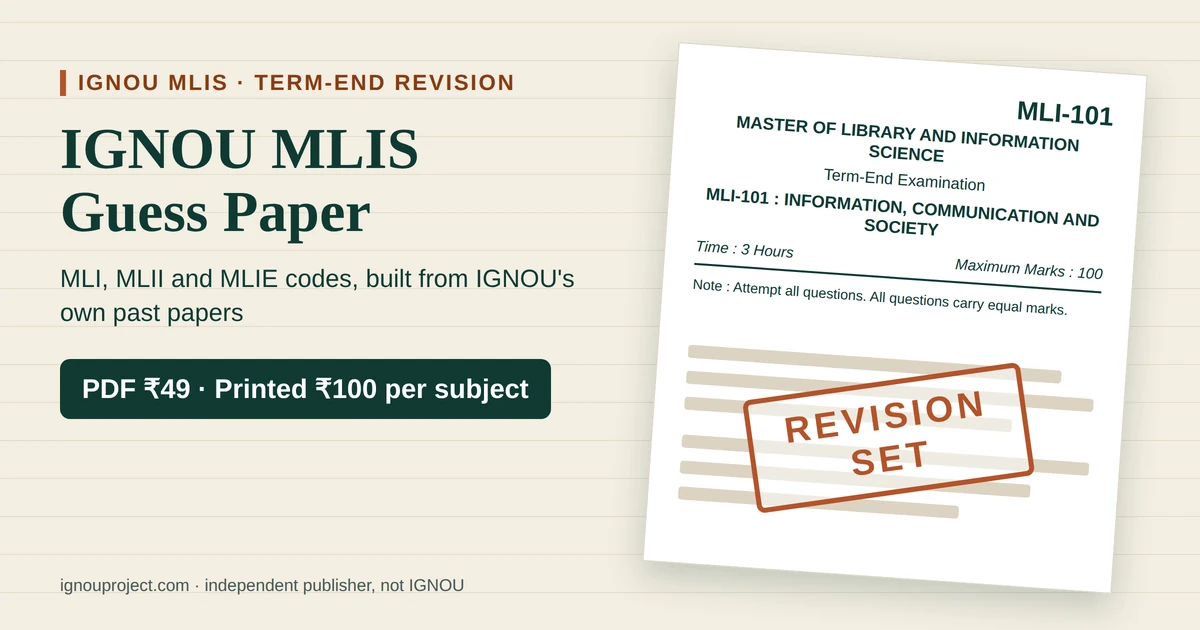
Revision sets for each MLI, MLII and MLIE code, built from IGNOU’s own term-end papers and ranked by what returned across sessions.
- 12 theory codes
- 3 hours, 100 marks
- 4 either-or questions plus short notes
- English or Hindi answers
- First paper 2 Dec 2026
- Per subject code
WhatsApp +91 93546 37830 · PDF shared after payment is confirmed · printed copy dispatched the next day
Quick answer. An IGNOU MLIS guess paper is a revision set of recurring questions for one MLIS course code, such as MLI-101, with model answers, prepared by a publisher from IGNOU’s past term-end papers and the syllabus. IGNOU’s tentative December 2026 date sheet, dated 21 September 2026, runs from 25 November 2026 to 13 January 2027, and the MLIS papers fall between 2 December (MLI-101) and 23 December (MLIE-106). Each of the ten MLIS papers from June 2022 to June 2025 compared here is 3 hours and 100 marks: four either-or questions of 20 marks and a fifth question of three short notes. Sets cost ₹49 as a PDF or ₹100 as a printed copy per subject code, with a one-time ₹100 courier charge per printed order, in English or Hindi. No one outside IGNOU knows the questions, so a set ranks what has returned rather than predicting the paper.
IGNOU MLIS December 2026 Exam Dates: Seven Papers Between 2 and 9 December
The first MLIS paper is MLI-101 on Wednesday 2 December 2026 and the last is MLIE-106 on Wednesday 23 December 2026, per IGNOU’s tentative date sheet for the December 2026 term-end examination.
Tentative · sheet dated 21 September 2026 · whole cycle 25 Nov 2026 to 13 Jan 2027
The six compulsory theory papers sit on six exam days in a row: 2, 3, 4 and 5 December, then 7 and 8 December, with Sunday 6 December free. A learner whose electives include MLIE-101 sits it on 9 December, which makes seven papers in eight calendar days. The other five electives run from 18 to 23 December, again with only Sunday 20 December free. Between 10 and 17 December no MLIS paper is set, and that gap is the one real revision window in the cycle.
The sheet lists MLIE-106 in its second block of 23 December, the 2 PM to 5 PM session, while every other MLIS code is in the 10 AM to 1 PM block of its day. The sheet prints the two sessions as columns, so check the session on your hall ticket once it is issued. The sheet is tentative, and IGNOU’s final version can move a date; the site’s December 2026 date sheet finder tracks revisions, and the IGNOU exam timing guide explains the two daily sessions.
The December Run, Code by Code
Swipe sideways to see every column.
| Date | Code | Session (per the sheet) | Gap before the next MLIS paper |
|---|---|---|---|
| Wed 2 Dec | MLI-101 | 10 AM to 1 PM | next day |
| Thu 3 Dec | MLII-101 | 10 AM to 1 PM | next day |
| Fri 4 Dec | MLI-102 | 10 AM to 1 PM | next day |
| Sat 5 Dec | MLII-102 | 10 AM to 1 PM | one day (Sunday) |
| Mon 7 Dec | MLII-103 | 10 AM to 1 PM | next day |
| Tue 8 Dec | MLII-104 | 10 AM to 1 PM | next day (MLIE-101) |
| Wed 9 Dec | MLIE-101 | 10 AM to 1 PM | eight days |
| Fri 18 Dec | MLIE-102 | 10 AM to 1 PM | next day |
| Sat 19 Dec | MLIE-103 | 10 AM to 1 PM | one day (Sunday) |
| Mon 21 Dec | MLIE-104 | 10 AM to 1 PM | next day |
| Tue 22 Dec | MLIE-105 | 10 AM to 1 PM | next day |
| Wed 23 Dec | MLIE-106 | 2 PM to 5 PM | end of the MLIS papers |
Two practical matters sit alongside the theory dates. The MLIL practical examinations are listed for PGDLAN, BLIS and MLIS together, and the sheet tells learners to ask their Regional Centre for the date and venue. Hall tickets and the exam centre are covered in the hall ticket guide and the exam centre page.
Why the MLIS Term-End Paper Carries 70 Per Cent of Every Course
The term-end examination carries 70 per cent of the final course result and assignments carry the remaining 30 per cent. For MLIS, IGNOU’s 2026-27 assignment booklet splits that 30 per cent into two pieces of continuous evaluation per course: a tutor marked assignment and a seminar or practical, each set out of 50 marks, in all six core courses and both chosen electives. The MLIS assignment booklet for July 2026 and January 2027 also says a learner must complete the assignment and take part in the seminar or practical to qualify for the term-end examination.
None of the ten MLIS question papers compared here prints a weightage line on its first page, so the 70 per cent figure comes from the booklet, not from the papers. The booklet adds one warning that matters for revision too: answers reproduced from the units score zero in the assignment. Exam answers written in your own words, with the paper’s own diagrams, are the habit a set should train. The IGNOU percentage calculator shows how the two parts combine into a course percentage.
Guess Paper, IGNOU Past Paper or Solved Paper: Which One an MLIS Learner Needs
A guess paper for MLIS is a publisher’s revision set for one course code, such as MLI-101, that collects the important and recurring questions, sometimes called expected questions or a model paper, and gives model answers. It is built from IGNOU’s earlier term-end papers and the syllabus, and it is not an IGNOU document.
A previous year question paper is the actual paper IGNOU set for a course in an earlier term-end examination, such as the June 2025 MLI-102 paper, and IGNOU publishes it free on its archive. A solved question paper is that same IGNOU paper with a publisher’s model answers added; the site’s solved question papers section carries those.
Swipe sideways to see every column.
| Guess paper | IGNOU past paper | Solved past paper | |
|---|---|---|---|
| What it is | Recurring MLIS themes for one code, with answers | The real paper of one session | The real paper with model answers |
| Who makes it | A publisher | IGNOU | A publisher |
| Cost | ₹49 PDF or ₹100 printed per code | Free | Varies by publisher |
| Good for | Ranking themes across sessions, answer length | Seeing the exact wording and choice structure | Checking one session’s answers |
| Cannot do | Predict the December 2026 paper | Show which themes return | Show patterns beyond one session |
Most MLIS learners need both kinds. Start with two or three of IGNOU’s own papers for your code to see the either-or layout, then use a set to cover the themes that came back across sessions.
What an MLIS set from ignouproject.com contains, code by code.
Current codes only. Sets for the twelve MLI, MLII and MLIE theory codes in the July 2026 prospectus, nothing older.
Twenty-mark answers. Main answers sized for a 20-mark either-or question, about 34 minutes of writing.
Short-note bank. Question 5 offers five topics and asks for three, so each set carries more notes than you need.
300-word notes. Notes written to the length the paper itself asks for, not to essay length.
English or Hindi. IGNOU lets MLIS learners write the term-end examination in Hindi, and every set is available in both.
Ordered by your dates. Sets for the 2 to 9 December run can be sent first, in exam order.
Themes counted, not guessed. Topics are ranked by how many IGNOU papers carried them, with sessions named.
Diagrams included. The papers ask for diagrams wherever necessary; answers show where one earns its place.
Look-alike codes checked. Each order is checked against your hall ticket so a PGDLAN MLI-001 set never replaces MLI-101.
Both alternatives answered. Questions 1 to 4 each have an alternative, and both sides are answered.
One code or all twelve. No minimum order, same rate per code.
PDF or printed booklet. PDF on WhatsApp, or a printed copy dispatched the next day after payment.
Sitting the 2 to 9 December run? Order the compulsory codes first.
₹49 PDF · ₹100 printed, per subject code
Send my six compulsory codesPrinted orders add a one-time ₹100 courier charge.
MLIS Course Codes, Credits and the Shape of Each Paper
The MLIS has twelve theory codes with a term-end paper: six compulsory courses and six electives, of which a learner takes two. The July 2026 Common Prospectus lists every course at 4 credits and a total of 40 credits; the total also counts MLIP-002 Project and MLII-105 Internship, which have no term-end paper, so 32 compulsory credits plus 8 elective credits make 40.
MLIS Theory Codes and Their December 2026 Dates
Swipe sideways to see every column.
| Code | Course title | Credits | Type | December 2026 paper |
|---|---|---|---|---|
| MLI-101 | Information, Communication and Society | 4 | Compulsory | Wed 2 Dec 2026, 10 AM to 1 PM |
| MLII-101 | Information Sources, Systems and Services | 4 | Compulsory | Thu 3 Dec 2026, 10 AM to 1 PM |
| MLI-102 | Management of Library and Information Centres | 4 | Compulsory | Fri 4 Dec 2026, 10 AM to 1 PM |
| MLII-102 | Information Processing and Retrieval | 4 | Compulsory | Sat 5 Dec 2026, 10 AM to 1 PM |
| MLII-103 | Fundamentals of Information Communication Technologies | 4 | Compulsory | Mon 7 Dec 2026, 10 AM to 1 PM |
| MLII-104 | Information Communication Technologies: Applications | 4 | Compulsory | Tue 8 Dec 2026, 10 AM to 1 PM |
| MLIE-101 | Preservation and Conservation of Library Materials | 4 | Elective | Wed 9 Dec 2026, 10 AM to 1 PM |
| MLIE-102 | Research Methodology | 4 | Elective | Fri 18 Dec 2026, 10 AM to 1 PM |
| MLIE-103 | Academic Library System | 4 | Elective | Sat 19 Dec 2026, 10 AM to 1 PM |
| MLIE-104 | Technical Writing | 4 | Elective | Mon 21 Dec 2026, 10 AM to 1 PM |
| MLIE-105 | Informetrics and Scientometrics | 4 | Elective | Tue 22 Dec 2026, 10 AM to 1 PM |
| MLIE-106 | Public Library System and Services | 4 | Elective | Wed 23 Dec 2026, 2 PM to 5 PM |
The prospectus prints MLIE-105 as “Informatrics and Scientometrics”; IGNOU’s assignment booklet and the course itself use “Informetrics”, and that is the spelling to search eGyanKosh with.
Paper Anatomy: The Latest IGNOU Paper for Three Codes
Swipe sideways to see every column.
| Code | Latest IGNOU paper | Time and marks | Questions 1 to 4 | Question 5 | Medium on the paper |
|---|---|---|---|---|---|
| MLI-101 | June 2025 | 3 hours, 100 marks | Answer one of two alternatives, 20 marks each | Three short notes of five, about 300 words each | English and Hindi in one paper |
| MLI-102 | June 2025 | 3 hours, 100 marks | Answer one of two alternatives, 20 marks each | Three short notes of five, about 300 words each | English and Hindi in one paper |
| MLII-101 | June 2025 | 3 hours, 100 marks | Answer one of two alternatives, 20 marks each | Three short notes of five, about 300 words each | English and Hindi in one paper |
Every MLIS paper compared here, ten papers from June 2022 to June 2025, follows the same frame: 3 hours, 100 marks, “Attempt all questions. All questions carry equal marks.” Only the numbering changed. The June 2022 MLI-102 paper numbers its alternatives 1.1 and 1.2 with “OR” between them; from December 2022 onward the papers number questions 1 to 5 and print “Or” between the alternatives. The structure underneath, five questions of 20 marks, did not move.
Look-Alike Codes: MLI-001 Is Not MLI-101
MLI-001 to MLI-007 are PGDLAN courses, not MLIS courses, and each one sits in the same session as an MLIS paper. The July 2026 prospectus lists MLI-001 as Introduction to Computers for the PG Diploma in Library Automation and Networking, while MLI-101 is Information, Communication and Society. On the December 2026 sheet MLI-001 and MLI-101 share the morning of 2 December, MLI-002 shares 3 December with MLII-101, and the pattern continues to MLI-007 alongside MLIE-101 on 9 December. A search for “MLI 1 guess paper” can return the wrong course, so match the full code on your hall ticket.
Conflicts and Misprints Worth Knowing
IGNOU’s own MLIS documents disagree in small ways, and none of it changes what you study. The December 2023 MLI-101 paper is headed “MASETR OF LIBRARY AND INFORMATION SCIENCE”. The June 2024 MLI-101 paper prints “Wersing” for Wersig and “Neelameghau” for Neelameghan. The June 2024 MLII-101 paper prints “Indrices and considered” and “All questions equal marks”. The June 2025 MLI-102 paper is headed “Master’s Degree in Library and Information Science” while its sister papers say “Master of Library and Information Science”. The 2026-27 booklet labels the MLII-102 tutor marked assignment “AST/SEM” and numbers its first alternative “1.1 OR 1.1”.
One in-house problem belongs here too. Older guess material sold on several sites, including product pages on a sister property, describes AI-based forecasting of MLIS questions; no such forecast is possible, and those descriptions are being corrected. Use only sets built on the current codes and the current either-or pattern.
What MLI-101, MLI-102 and MLII-101 Papers Have Actually Asked
Barriers to information appeared in four of the five MLI-101 papers from December 2022 to June 2025, including every paper from December 2023 onward. It moved between a short note and a full 20-mark question, which is why a set prepares it both ways.
MLI-101: Barriers to Information Came Back Four Times
Five MLI-101 papers were compared: December 2022 MLI-101, December 2023 MLI-101, June 2024 MLI-101, December 2024 MLI-101 and June 2025 MLI-101. A cell shows the question that carried the theme; “alt” means the alternative of that question.
Swipe sideways to see every column.
| Theme | Dec 2022 | Dec 2023 | Jun 2024 | Dec 2024 | Jun 2025 | n of N |
|---|---|---|---|---|---|---|
| Barriers to information | Q5(e) | Q5(iv) | Q2 | Q5(b) | 4 of 5 | |
| Post-industrial society and knowledge workers | Q4 alt | Q2 alt | Q3 | 3 of 5 | ||
| Nature and definitions of information (Belkin, Wersig, Brookes) | Q1 | Q1 alt | Q5(d) | 3 of 5 | ||
| Digital information and legality of digital documents | Q3 alt, Q5(d) | Q3 alt | Q4 | 3 of 5 | ||
| Knowledge: definition, nature and types | Q1 alt | Q2 | Q1 | 3 of 5 | ||
| Communication: definition and types | Q2 alt | Q3 | Q2 alt | 3 of 5 | ||
| Ranganathan’s modes of formation of knowledge | Q2 | Q1 alt | 2 of 5 | |||
| Ranganathan’s five laws in information studies | Q1 alt | Q1 | 2 of 5 | |||
| Shannon and Weaver model | Q2 alt | Q5(b) | 2 of 5 | |||
| Diffusion of information | Q4 | Q3 | 2 of 5 | |||
| National information policy | Q4 alt | Q4 | 2 of 5 | |||
| Information entropy | Q5(b) | Q5(c) | 2 of 5 | |||
| Freedom of Information Act | Q5(d) | Q5(a) | 2 of 5 |
MLI-102: Five Management Themes in All Three Papers
Three MLI-102 papers were compared: June 2022 MLI-102, December 2024 MLI-102 and June 2025 MLI-102. Total Quality Management, leadership, marketing and e-marketing, change management and budgeting each appeared in all three.
Swipe sideways to see every column.
| Theme | Jun 2022 | Dec 2024 | Jun 2025 | n of N |
|---|---|---|---|---|
| Total Quality Management | Q2.1 | Q1 alt | Q5(a) | 3 of 3 |
| Leadership | Q3.2 | Q5(b) | Q3 | 3 of 3 |
| Marketing and e-marketing of library services | Q4.2 | Q4 alt, Q5(d) | Q5(e) | 3 of 3 |
| Change management | Q5(b) | Q5(a) | Q5(b) | 3 of 3 |
| Budgets, cost analysis and financial estimation | Q4.1, Q5(d) | Q4, Q5(c) | Q4 | 3 of 3 |
| Modern management theory | Q1.1 | Q1 | 2 of 3 | |
| Maslow and motivation | Q3.1 | Q3 | 2 of 3 | |
| Operations research | Q2 alt | Q5(c) | 2 of 3 |
MLII-101: Both June Papers Shared Four Themes
Two MLII-101 papers were compared: June 2024 MLII-101 and June 2025 MLII-101. E-journal consortia, IFLA, media persons as sources of information and database intermediaries appeared in both, three of them switching between a full question and a short note.
Swipe sideways to see every column.
| Theme | Jun 2024 | Jun 2025 | n of N |
|---|---|---|---|
| E-journal consortia | Q3 alt | Q3 | 2 of 2 |
| IFLA | Q5(c) | Q3 alt | 2 of 2 |
| Media persons as sources of information | Q5(d) | Q2 alt | 2 of 2 |
| Database intermediaries | Q4 | Q5(d) | 2 of 2 |
How These Counts Were Made
The counts come from ten IGNOU MLIS question papers, each reviewed in full by ignouproject.com on 7 October 2026: five MLI-101 papers (December 2022 to June 2025), three MLI-102 papers (June 2022, December 2024, June 2025) and two MLII-101 papers (June 2024 and June 2025). Matching is done at topic level and is a human judgement: “types of communication systems” and “types of communication” count as one theme, while text mining and data mining are kept apart. A count says how often a theme was set in those sessions and nothing about December 2026. IGNOU’s June 2026 question paper list already carries all twelve MLIS codes, and those papers join the tables at the next refresh. The theme tables cover MLI-101, MLI-102 and MLII-101; for the other nine codes, the format is confirmed against the latest IGNOU paper on WhatsApp.
Hindi and English halves do not always ask the same thing. Every MLIS paper compared here except the December 2023 MLI-101 file prints a Hindi version after the English one. In the June 2024 MLII-101 paper, the English alternative to question 1 asks for the difference between data centres and data banks and the structure, functions and services of data centres; the Hindi version asks only for the difference. Read the version you are answering in, and answer what it asks.
How an MLIS Revision Set Is Put Together
Code check. Your code is matched against the July 2026 prospectus and the December 2026 sheet, and look-alike PGDLAN codes are ruled out.
Paper comparison. IGNOU’s past papers for the code are set side by side and every question is tagged to a block and unit.
Theme ranking. Themes that returned across sessions come first, then the units the papers have touched once, then the units never set.
Answers in exam shape. Main answers are planned for a 20-mark, 34-minute question; short notes are held near 300 words, with diagrams where the topic needs one.
Medium and dispatch. The set goes out in English or Hindi as you confirm on WhatsApp: the PDF after payment, or a printed copy dispatched the next day.
What an MLIS Guess Paper Can Do, and What It Cannot
A guess paper is a revision aid built from past IGNOU question papers and the syllabus. No one outside IGNOU knows the questions in advance, and no claim is made that any question in this set will appear in your examination.
Where a Set Helps an MLIS Learner
A set helps with ordering. Six compulsory papers on six exam days leave little time between them, and knowing that barriers to information came back four times in five MLI-101 papers tells you where an evening is best spent. It also trains answer size: four 20-mark answers and three 300-word notes in three hours.
Where It Cannot Help
It cannot tell you what IGNOU will set in December 2026, and a theme seen twice can be absent. It cannot replace the blocks for MLII-103 and MLII-104, whose themes are not counted in the tables above. It cannot cover the MLIL practicals or the seminar, which are assessed at your study centre. The publisher makes no claim of coverage, prediction or marks.
Revise free first. The official MLIS blocks are free on eGyanKosh; the eGyanKosh guide and the Gyankosh search route show where each course sits. IGNOU’s own past papers cost nothing (see the next sections), and the IGNOU study notes and free book downloads pages list other routes before you buy anything.
Two Free MLIS Tools: December Run Planner and Answer Clock
Both tools run in your browser and read only the dates and patterns printed in the tables above.
Free tool 1
MLIS December Run Planner
Between 0.5 and 16, for example 3
Get the planned codes on WhatsApp (₹49 PDF · ₹100 printed, per subject code)This tool is guidance from ignouproject.com, not an IGNOU rule. Using it creates no obligation to order anything.
Free tool 2
MLIS Answer Clock
The clock assumes 10 minutes of reading time
Ask for this code’s set (₹49 PDF · ₹100 printed, per subject code)This tool is guidance from ignouproject.com, not an IGNOU rule. Using it creates no obligation to order anything.
Swipe sideways to see every column.
| Part of the paper | Marks | Minutes |
|---|---|---|
| Reading and choosing alternatives | 10 | |
| Question 1 | 20 | 34 |
| Question 2 | 20 | 34 |
| Question 3 | 20 | 34 |
| Question 4 | 20 | 34 |
| Question 5, three short notes | 20 | 34, about 11 per note |
Electives on 18 to 23 December? Order them with the time the gap gives you.
₹49 PDF · ₹100 printed, per subject code
Order my two MLIE electivesOne code or several, no minimum.
Where to Find IGNOU’s Own MLIS Papers and the Date Sheet
IGNOU’s previous year question papers page lists sessions from December 2024 to June 2026; open a session and search the list by code. IGNOU files MLIS papers in three places: session folders on webservices.ignou.ac.in, session folders such as qpjune2025 on ignou.ac.in, and a “downloads” folder with no session in its path, which held the December 2024 MLI-101 and MLI-102 papers. Check the session printed under “Term-End Examination” on page one before you rely on a file.
The tentative December 2026 date sheet (PDF) is the only source for dates; third-party pages have disagreed about this cycle. The site’s IGNOU date sheet hub collects each cycle, and the IGNOU last year paper guide explains the archive by programme.
Before and After the MLIS Exam: Hall Ticket, Result, Revaluation
Before the exam, the term-end examination form and fee decide whether you sit at all; the IGNOU exam fee guide has the current amounts. After it, results appear course by course: the term-end result guide covers December results, the June 2026 result page helps a learner carrying a backlog paper, and the assignment status and grade card guide shows whether your TMA and seminar marks have reached the grade card. A disputed mark goes through IGNOU revaluation; the final grade card guide and the CGPA calculator come in at the end of the programme.
Other MLIS Material Learners Order Alongside
The site’s MLIS handwritten assignment guide covers the TMA side of the 30 per cent. Reference material for every programme sits in IGNOU solved assignments, IGNOU help books and guide books online, and all guess paper codes outside MLIS are on the IGNOU guess papers hub. Learners on the project side of the programme have separate guides for the MLIP-002 project and the MLII-105 internship report.
Hindi or English: MLIS Medium and Session Note
Each set is prepared for the upcoming term-end examination, in every medium IGNOU examines that course in, and the medium for your course code is confirmed on WhatsApp before you pay. The July 2026 prospectus offers MLIS in English and lets learners write assignments and the term-end examination in Hindi, and the MLIS papers compared here print a Hindi version after the English one, so sets exist in both. Every set targets the December 2026 cycle; a June 2027 learner receives a set prepared for June 2027.
Ordering an MLIS Set on WhatsApp: Steps, Prices, Dispatch
₹49 PDF · ₹100 printed, per subject code. The rate is ₹49 per subject code for a solved guess paper as a PDF, or ₹100 per subject code as a printed copy. Printed copies carry a one-time courier charge of ₹100 per order, whatever the number of subject codes; the PDF has no courier charge.
Send your MLIS codes, exactly as printed on your hall ticket or registration record, to WhatsApp +91 93546 37830.
Say English or Hindi, and PDF or printed copy.
Pay the confirmed total; for printed copies that is ₹100 per code plus ₹100 courier once.
Receive the PDF on WhatsApp, or the courier details once the printed copy is dispatched.
The PDF is shared on WhatsApp once payment is confirmed. A printed copy is dispatched the next day after payment is confirmed, and the courier details are shared on WhatsApp. No arrival date is promised, because transit time depends on the courier and your location. There is no minimum order: one subject or ten, same rate per format. The full price list for every service is on the services and charges page.
How This MLIS Page Was Researched and Who Reviewed It
IGNOU documents. The July 2026 Common Prospectus (MLIS section 3.23 and PGDLAN section 8.10), the tentative December 2026 date sheet dated 21 September 2026, IGNOU’s question paper pages, ten MLIS term-end papers from June 2022 to June 2025, and the MLIS assignment booklet for July 2026 and January 2027. Prospectus questions in general are covered in the IGNOU prospectus guide.
The publisher’s own analysis. The recurrence tables, the topic matching behind them, the minutes per question and the run planner are ignouproject.com’s work, not IGNOU’s. The limits are stated where they apply: the date sheet is tentative, the June 2026 papers are not yet in the counts, and the theme tables cover three of the twelve codes.
Commercial terms. Prices, formats, dispatch and medium belong to the publisher alone.
MLIS Guess Paper Questions Learners Ask
An IGNOU MLIS guess paper is a publisher’s revision set for one MLIS course code, such as MLI-101 or MLIE-102, holding the themes IGNOU has set more than once, with model answers. It is built from past term-end papers and the syllabus. It is not an IGNOU document and it does not predict the December 2026 paper.
An IGNOU MLIS guess paper costs ₹49 per subject code as a PDF or ₹100 per subject code as a printed copy. Printed orders add a one-time ₹100 courier charge per order, whatever the number of codes; the PDF has no courier charge. There is no minimum order.
The IGNOU MLIS papers run from 2 December 2026 (MLI-101) to 23 December 2026 (MLIE-106), per the tentative date sheet dated 21 September 2026. The six compulsory papers fall on 2, 3, 4, 5, 7 and 8 December. Confirm each date on your hall ticket, because the sheet is tentative.
In MLI-101, barriers to information appeared in four of five papers from December 2022 to June 2025. In MLI-102, Total Quality Management, leadership, marketing, change management and budgeting appeared in all three papers compared. Repetition in past sessions is a reason to revise a theme, not a promise that it returns.
No one can say that. Only IGNOU knows the December 2026 MLIS questions, and no claim is made that any question in a set will appear. A set ranks the themes IGNOU has already set across sessions so that limited revision time goes to them first.
Yes. IGNOU lets MLIS learners write the term-end examination in Hindi, and the MLIS papers print a Hindi version after the English one, so each set is prepared in English and in Hindi. Confirm your medium on WhatsApp before you pay.
The MLI-101 paper is 3 hours and 100 marks, with five questions of 20 marks each. Questions 1 to 4 each offer two alternatives, and question 5 asks for short notes on any three of five topics in about 300 words each, per the June 2025 paper.
An MLIS learner gains from both. IGNOU’s past papers, free on its archive, show the exact wording and the either-or layout. A guess paper adds the count of which themes returned across sessions and gives answers sized for 20-mark questions and 300-word notes.
No. A solved question paper is one real IGNOU paper, such as June 2025 MLII-101, with a publisher’s answers. A guess paper collects recurring themes from several sessions of one code. The first shows one session; the second shows what kept returning.
Yes. IGNOU publishes MLIS term-end papers free on ignou.ac.in under previous year question papers, by session and course code. Sessions from December 2024 to June 2026 are listed there, and older MLIS papers sit in session folders on webservices.ignou.ac.in.
The MLIS compulsory papers are on consecutive exam days because the December 2026 sheet places them on 2, 3, 4, 5, 7 and 8 December, with Sunday 6 December free. Learners who chose MLIE-101 sit a seventh paper on 9 December, so revision has to be done before 2 December.
MLI-001 is Introduction to Computers in the PGDLAN diploma, while MLI-101 is Information, Communication and Society in the MLIS, per the July 2026 prospectus. Both sit on the morning of 2 December 2026, so check the full code on your hall ticket before ordering a set.
The MLIS term-end examination carries 70 per cent of each course result and continuous evaluation carries 30 per cent, per the 2026-27 MLIS assignment booklet. Continuous evaluation has two parts in each course: a tutor marked assignment and a seminar or practical, each out of 50.
No, per the 2026-27 MLIS assignment booklet. It says each candidate must complete the assignments and take part in the seminars or practicals to qualify for the term-end examination. Ask your study centre for the seminar and practical schedule well before December.
Send your MLIS codes, the medium and the format to WhatsApp +91 93546 37830. The PDF is shared on WhatsApp once payment is confirmed. A printed copy is dispatched the next day after payment is confirmed, and the courier details are shared on WhatsApp.
Judge any MLIS seller, this one included, on five checks. Does the set name current codes such as MLIE-105? Does it follow the either-or pattern? Does it name the session it targets? Are answers written in exam format? Does the seller claim accuracy or marks? A claim of accuracy is a reason for caution.
Important Notice
ignouproject.com is an independent IGNOU study-support publisher. It is not the official website of Indira Gandhi National Open University, is not affiliated with, endorsed by or authorised by the university, and no page on this site should be treated as an official IGNOU communication.
Programme structures, course codes, examination dates, question-paper patterns and rules change, and only ignou.ac.in and your Regional Centre can confirm the current position for your enrolment.
A guess paper is a revision aid built from past IGNOU question papers and the syllabus. No one outside IGNOU knows the questions in advance, and no claim is made that any question in this set will appear in your examination.
Study the official IGNOU material for every course you are sitting; a guess paper supplements that material and does not replace it.
No claim is made about the marks you will receive, about how an evaluator will assess your answers, or about your result. Examination and evaluation are entirely a matter for IGNOU.

BK Sahni iD 0009-0005-8092-459X
Founder, Shri Chakradhar Publication Pvt. Ltd. & ignouproject.com — helping IGNOU distance-learning students since 2010 (5,00,000+ students supported across MBA, MCom, MA & more). Author of IGNOU exam guides, solved assignments & project reference books.
Disclosure: Shri Chakradhar Publication Pvt. Ltd. and ignouproject.com are independent third-party study-help services — not the official IGNOU website. Always verify final dates and rules on ignou.ac.in.