IGNOU MAPY guess paper · December 2026 term-end examination
MAPY papers keep one five-question frame and keep returning to the same thinkers. Revise those first.
Twenty-one IGNOU MA Philosophy papers from five courses, February 2021 to December 2025, set side by side by question number, with every MPY and MPYE date from IGNOU’s date sheet of 30 October 2026.
- 21 IGNOU MAPY papers compared
- First paper: MPY-001, Wed 2 Dec
- Five questions, thirteen answers
- Answers in English or Hindi
- Logic sets with worked proofs
- Free revision calendar and answer timer
List the codes as the hall ticket prints them, and say whether answers will be written in English or Hindi.
Quick answer. An IGNOU MAPY guess paper is a revision set of important and recurring questions for one MA Philosophy course code, such as MPY-001 Indian Philosophy or MPYE-003 Epistemology, with model answers, prepared by ignouproject.com from IGNOU’s past term-end papers and the syllabus. IGNOU’s date sheet of 30 October 2026 runs the December 2026 term-end examination from 25 November 2026 to 14 January 2027; the first MAPY paper is MPY-001 on Wednesday 2 December and the last is MPYE-012 on Saturday 26 December 2026. Every one of the 21 MAPY papers compared, February 2021 to December 2025, uses one frame: 3 hours, 100 marks, five questions worth 20 marks each, thirteen answers in all. Sets cost ₹49 PDF · ₹100 printed, per subject code, plus a one-time ₹100 courier charge on printed orders; they are prepared in English and in Hindi, because IGNOU prints MAPY papers in English but lets learners write the answers in Hindi, and the medium is confirmed on WhatsApp before payment. No one outside IGNOU knows the questions in advance.
MAPY December 2026 Dates: Seven Year I Papers Inside Eight Days
The MAPY papers run from Wednesday 2 December to Saturday 26 December 2026, according to IGNOU’s date sheet for the December 2026 term-end examination dated 30 October 2026, which replaced the tentative sheet of 21 September 2026 without moving any MPY, MPYE or MGP-005 date.
December 2026 cycle: 25 November 2026 to 14 January 2027 (IGNOU date sheet, 30 October 2026)
First MAPY paper
MPY-001 Indian Philosophy, Wed 2 Dec 2026, morning
Last MAPY paper
MPYE-012 Tribal Philosophy, Sat 26 Dec 2026, evening
The 30 October sheet drops the word “tentative”. The hall ticket still decides the centre and session.
A Year I learner sits MPY-001 plus six of the eight Year I electives, and IGNOU has placed seven of those nine papers on 2, 3, 4, 5, 7, 8 and 9 December, with only Sunday 6 December free. MPYE-007 follows on 15 December and MGP-005 on 19 December. The practical consequence is simple: Year I revision has to be finished, not started, by the last week of November.
Year II is spread wider. Four electives (MPYE-015, MPYE-014, MPYE-016 and MPYE-013) come on 10, 11, 14 and 16 December, the compulsory MPY-002 Western Philosophy sits in the middle on Friday 18 December, and four more electives run Monday to Thursday, 21 to 24 December, before MPYE-012 closes the programme on 26 December.
The Two Evening Papers and the 17-Hour Turnaround
Seventeen of the nineteen MAPY codes are in the morning column of the sheet, 10 AM to 1 PM. MPYE-010 Philosophy of Religion (Wednesday 23 December) and MPYE-012 Tribal Philosophy (Saturday 26 December) are in the evening column, 2 PM to 5 PM. A learner taking both MPYE-010 and MPYE-011 leaves the hall at 5 PM on 23 December and is back for MPYE-011 at 10 AM on 24 December, about 17 hours later, so MPYE-011 revision belongs before the 21 December run begins. The two session timings are set out on the IGNOU exam timing guide.
No two MAPY codes share a date, so a learner carrying a Year I paper into Year II faces runs rather than clashes: 7 to 11 December joins the last three Year I electives to the first two Year II electives on five straight weekdays. The day-by-day list for every programme is on the December 2026 date sheet page, the admit card on the hall ticket guide, and the venue rules on the exam centre page. Learners who have not yet paid can check the per-course exam fee and the steps to pay the exam fee online.
Why Each MAPY Paper Carries the Course: Credits and Sitting Conditions
Each MAPY course ends in one 3-hour term-end paper, and the term-end examination (TEE) is where the 64 credits of the programme are actually earned: 32 in Year I through seven papers, 32 in Year II through seven more. MPY-001 and MPY-002 carry 8 credits each, so a weak compulsory paper costs twice the credit of a weak elective.
IGNOU prints no weightage figure for MAPY: none of the 21 MAPY papers compared here, from the February 2021 MPYE-001 paper to the December 2025 set, carries a weightage line, and IGNOU’s MAPY First Year assignment booklet for TEE December 2025 and June 2026 prints none either. The split between assignments and the TEE for a given batch is set out in the MAPY Programme Guide, which is the document to check before relying on any figure quoted elsewhere.
The date sheet adds a condition that matters more than any percentage. IGNOU’s 30 October 2026 sheet says permission to sit is provisional on valid registration, assignments submitted by the due date, the minimum study period completed and the exam fee paid, and that the result of a course is not declared when a condition is not met. A MAPY learner who has missed an MPYE assignment should sort that out with the Regional Centre before spending revision time on the paper. The IGNOU percentage calculator converts final grades into a percentage once results are out.
Guess Paper, Previous Year Question Paper or Solved Paper for MPY Codes
A guess paper is a publisher’s revision set for one course code, such as MPY-001 Indian Philosophy: the themes that keep coming back in IGNOU’s papers, answered in exam format and checked against the syllabus, and sold under names like important questions, expected questions or model paper. A previous year question paper is a paper IGNOU really set in an earlier term-end examination, the December 2025 MPY-001 paper being one, and IGNOU’s archive gives it away free.
Add a publisher’s model answers to one of those IGNOU papers and it becomes a solved question paper. The three overlap in content but do different jobs, and the cheapest of them is the one IGNOU gives away.
Swipe sideways on a phone to see every column.
| Item | Guess paper | Previous year question paper | Solved question paper |
|---|---|---|---|
| What it is | Recurring themes for one code, answered | IGNOU’s own past paper, no answers | IGNOU’s past paper plus model answers |
| Who makes it | A publisher | IGNOU | A publisher |
| Cost | Paid (here ₹49 PDF · ₹100 printed, per subject code) | Free | Usually paid |
| Good for | Ordering revision by what came back, answers sized to IGNOU’s word guidance | Seeing the real frame and practising under time | Checking how one past paper could be answered |
| Cannot do | Tell anyone the next paper’s questions | Show which themes repeat across sessions | Cover themes that paper did not ask |
For MAPY the free option is unusually strong, because the frame has not moved in any paper compared since February 2021: an MPYE-002 paper from June 2021 trains the same answer lengths as the December 2025 one. Learners who want answers to particular past sessions can use the solved IGNOU papers collection, and the full list of programmes with sets is on the IGNOU guess papers hub.
Counted, not claimed. Each theme in a MAPY set is tied to the sessions where IGNOU asked it, written as n of N papers.
Sized to the frame. Answers follow IGNOU’s printed guidance: about 500 words for Q1 and Q2, 250 for Q3, 150 for Q4, 100 for each short note.
Indian Philosophy first. MPY-001 carries 8 credits and opens the cycle on 2 December, so its themes get the deepest treatment.
Worked Logic. MPYE-001 sets carry solved proofs, truth tables and Venn tests, the parts of the Logic paper that are solved rather than written.
Indian and Western sides. MPYE-003 sets pair khyativada and pramana answers with truth, justification and Wittgenstein, because IGNOU mixes both in every paper.
Hindi answers. Sets are available in Hindi for learners who will write in Hindi, which IGNOU permits for MAPY.
All nineteen codes. MPY-001, MPY-002, MPYE-001 to MPYE-016 and MGP-005, each sold per code.
Short-note banks. Q5 offers eight notes and asks for five; sets cover the concept names IGNOU keeps choosing for that slot.
Run-aware. Year I papers fall on seven of eight days; the free revision calendar below lays out revision hours between them.
No old-series surprises. Every code sold is on IGNOU’s current MAPY list and on the December 2026 sheet.
Two formats. Each code comes as a PDF over WhatsApp or as a printed booklet sent by courier.
One code at a time. No bundle is forced; a learner short of one elective orders that one.
MPY and MPYE Codes, With the Frame Every MAPY Paper Uses
MAPY has 19 examined codes for December 2026: two 8-credit compulsory courses and seventeen 4-credit electives, listed in section 3.37 of IGNOU’s July 2026 Common Prospectus. Sixteen compulsory credits plus forty-eight elective credits (six electives in each year) make the 64 credits the prospectus states for the degree. MAPY is run by the School of Inter-disciplinary and Trans-disciplinary Studies (SOITS); the programme overview is on the IGNOU MA Philosophy programme page.
Year I: MPY-001 and Eight Electives
Swipe sideways on a phone to see every column.
| Code | Course title (July 2026 Common Prospectus) | Credits | December 2026 paper |
|---|---|---|---|
| MGP-005 | Introduction to Peace and Conflict Resolution | 4 | Sat 19 Dec 2026, morning |
| MPY-001 | Indian Philosophy | 8 | Wed 2 Dec 2026, morning |
| MPYE-001 | Logic | 4 | Thu 3 Dec 2026, morning |
| MPYE-002 | Ethics | 4 | Fri 4 Dec 2026, morning |
| MPYE-003 | Epistemology | 4 | Sat 5 Dec 2026, morning |
| MPYE-004 | Philosophy of Human Person | 4 | Mon 7 Dec 2026, morning |
| MPYE-005 | World Religions | 4 | Tue 8 Dec 2026, morning |
| MPYE-006 | Dalit Philosophy | 4 | Wed 9 Dec 2026, morning |
| MPYE-007 | Research Methodology in Philosophy | 4 | Tue 15 Dec 2026, morning |
Year II: MPY-002 and Nine Electives
Swipe sideways on a phone to see every column.
| Code | Course title (July 2026 Common Prospectus) | Credits | December 2026 paper |
|---|---|---|---|
| MPY-002 | Western Philosophy | 8 | Fri 18 Dec 2026, morning |
| MPYE-008 | Metaphysics | 4 | Mon 21 Dec 2026, morning |
| MPYE-009 | Philosophy of Science and Cosmology | 4 | Tue 22 Dec 2026, morning |
| MPYE-010 | Philosophy of Religion | 4 | Wed 23 Dec 2026, evening |
| MPYE-011 | Philosophy of Art (Aesthetics) | 4 | Thu 24 Dec 2026, morning |
| MPYE-012 | Tribal Philosophy | 4 | Sat 26 Dec 2026, evening |
| MPYE-013 | Philosophy of Technology | 4 | Wed 16 Dec 2026, morning |
| MPYE-014 | Philosophy of Mind | 4 | Fri 11 Dec 2026, morning |
| MPYE-015 | Gandhian Philosophy | 4 | Thu 10 Dec 2026, morning |
| MPYE-016 | Philosophy of Sri Aurobindo | 4 | Mon 14 Dec 2026, morning |
MGP-005 Introduction to Peace and Conflict Resolution is a MAPY Year I elective but belongs to the peace and conflict studies programme, and IGNOU’s MAPY assignment booklet sends learners to the MGPS booklet for it; the MGPS revision guide covers that course’s papers.
Paper Anatomy: Five Questions, Thirteen Answers
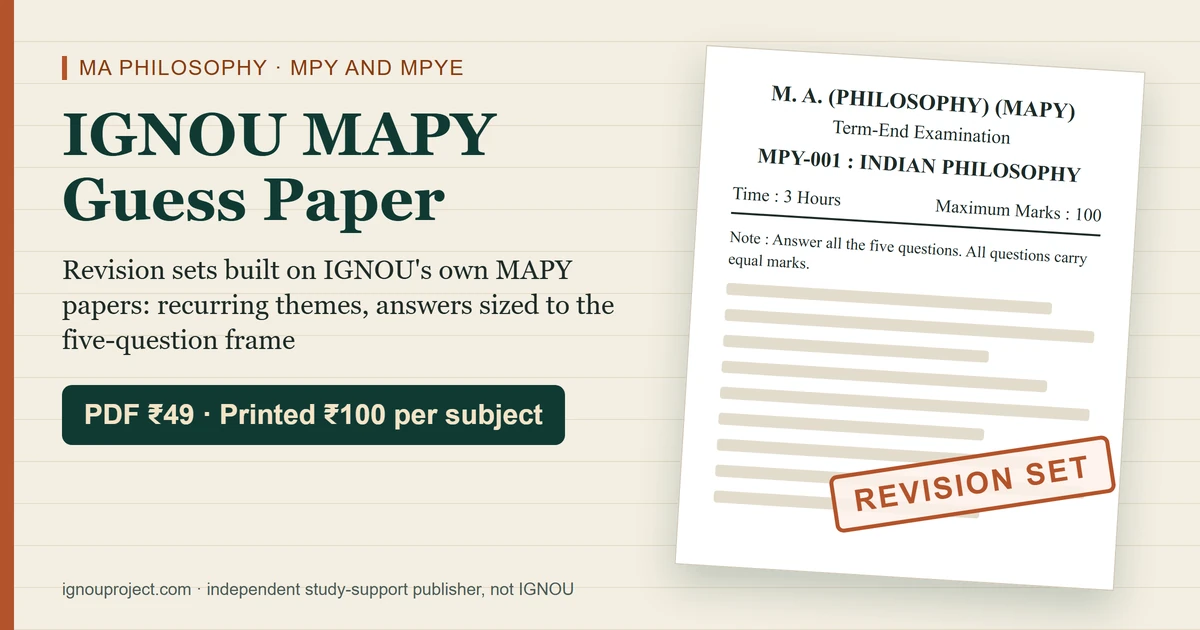
The MPY-001 Indian Philosophy paper is 3 hours and 100 marks, and the December 2025 paper asks all five questions: Q1 and Q2 are 20-mark essays of about 500 words, each with an internal “Or”; Q3 asks any two of four at 10 marks; Q4 asks any four of six at 5 marks; Q5 asks short notes on any five of eight at 4 marks. That is thirteen separate answers in 180 minutes, and the same frame appears in all 21 MAPY papers compared, across five courses.
Swipe sideways on a phone to see every column.
| Question | Choice | Marks | Words (IGNOU guidance) | Minutes on the timer |
|---|---|---|---|---|
| Q1 | Essay: one of two (Or) | 20 | about 500 | about 34 |
| Q2 | Essay: one of two (Or) | 20 | about 500 | about 34 |
| Q3 | Any two of four | 2 x 10 | about 250 each | about 17 each |
| Q4 | Any four of six | 4 x 5 | about 150 each | 8 to 9 each |
| Q5 | Short notes: any five of eight | 5 x 4 | about 100 each | about 7 each |
The timer column keeps 10 minutes for reading and choosing, then gives 1.7 minutes a mark. Every code below follows this frame in its latest IGNOU paper.
Swipe sideways on a phone to see every column.
| Code | Latest IGNOU paper | Time, marks, frame | Medium | Note |
|---|---|---|---|---|
| MPY-001 | December 2025 | 3 hours, 100 marks, frame above | English paper; answers in English or Hindi | June 2024 alone printed “attempt any five questions” and dropped the Or in Q2 |
| MPY-002 | December 2025 | 3 hours, 100 marks, frame above | English paper; answers in English or Hindi | Same frame in June 2022 |
| MPYE-001 | December 2025 | 3 hours, 100 marks, frame above | English paper; answers in English or Hindi | Proofs, truth tables and Venn tests inside Q3 to Q5 |
| MPYE-002 | December 2025 | 3 hours, 100 marks, frame above | English paper; answers in English or Hindi | December 2022 asked 200 words in Q3; June 2024 offered seven short notes |
| MPYE-003 | December 2025 | 3 hours, 100 marks, frame above | English paper; answers in English or Hindi | June and December 2023 asked 200 words in Q3 |
The one MAPY paper that broke its own frame is the June 2024 MPY-001 paper: its note says “Candidates are required to attempt any five questions” although the paper has only five questions, Question 2 is printed without its usual “Or” alternative, and Question 5 offers “Shaiva concept of soul”, already asked as Question 3(c), and “Religion for Vivekananda”, already asked as Question 4(f). Every other MPY-001 paper from December 2022 to December 2025 says “Answer all the five questions”.
Word guidance drifts in Question 3 even when the frame does not. The MPYE-003 papers of June 2023 and December 2023, and the MPYE-002 paper of December 2022, asked for about 200 words there; the other papers compared ask for 250. The marks stayed at 10 each, so a 250-word answer is the safe target.
Conflicts and outdated material to watch for.
- IGNOU’s MAPY programme page says the 64 credits can be earned “over a period of 2 to 5 years” and, on the same page, gives a maximum duration of 48 months; the July 2026 Common Prospectus says 2 to 4 years. The Regional Centre settles which applies to a given enrolment.
- The prospectus titles MPYE-011 “Philosophy of Art (Aesthetics)”; IGNOU’s programme page prints “Philosophy of Art”. The code is the same.
- IGNOU’s own papers print “Tiruppural” for the Tirukkural in the June 2024 and December 2024 MPY-001 papers, after the December 2022 paper spelt it “Tirukkural”. The topic is the same text.
- The December 2025 MPYE-002 Ethics paper carries the serial of the Logic paper, “A–376/MPYE–001”, on its third page, and the June 2024 MPYE-002 paper lists seven short notes instead of eight while still asking for five.
- IGNOU’s archive files the February 2021 MPYE-001 paper under “December 2020”, stores the December 2024 MPY-001 paper in a folder with no session in its address, and names the same course both “MPY-2” and “MPY-002”. The session printed on page 1 is the one to trust.
- In-house: the site’s own December 2026 date sheet page still describes a tentative sheet of 19 August 2026 ending on 13 January 2027, while IGNOU’s current sheet is dated 30 October 2026 and ends on 14 January 2027. The owned store’s MAPY category also describes guess papers as solved past papers, which they are not. Both are being corrected; the IGNOU sheet and the definitions above are the ones to use.
- Free “MAPY guess paper” downloads circulating online carry session labels from 2023 and 2024. A set built before the December 2025 papers cannot reflect what IGNOU asked last.
Themes IGNOU Repeated Across 21 MAPY Papers
Samkhya’s Prakriti and Purusha, and a Gandhi theme (non-violence, Satyagraha or Sarvodaya), each appeared in all six IGNOU MPY-001 Indian Philosophy papers from December 2022 to December 2025, and Arthapatti with Anupalabdhi appeared in five of the six.
The method is stated so the counts can be checked. ignouproject.com compared IGNOU’s own term-end papers question by question on 3 November 2026: six MPY-001 papers (December 2022 to December 2025), five MPYE-003 papers (June 2022 to December 2025), four MPYE-002 papers (June 2021 to December 2025) and four MPYE-001 papers (the February 2021 sitting to December 2025), plus two MPY-002 papers for the frame. A theme counts in a session when a question or short note in that paper names the same doctrine or the same thinker and concept; that matching is a human judgement, not a string search. The tables cover MPY-001, MPYE-001, MPYE-002 and MPYE-003; for other MAPY codes, the format is confirmed against the latest IGNOU paper on WhatsApp. Cells give the question number; “n of N” counts sessions, never questions.
MPY-001 Indian Philosophy: Six Papers, December 2022 to December 2025
Swipe sideways on a phone to see every column.
| Theme | Dec 2022 | Dec 2023 | Jun 2024 | Dec 2024 | Jun 2025 | Dec 2025 | n of N |
|---|---|---|---|---|---|---|---|
| Samkhya: Prakriti, Purusha, the gunas | 5(b) | 3(a), 5(a) | 4(b) | 5(f) | 3(c) | 3(a) | 6 of 6 |
| Gandhi: non-violence, Satyagraha, Sarvodaya | 5(h) | 5(f) | 4(c) | 4(d) | 2 Or, 4(e), 5(b) | 4(e), 5(e) | 6 of 6 |
| Arthapatti and Anupalabdhi | 4(d) | 3(d) | 5(a) | 4(b) | – | 5(g), 5(h) | 5 of 6 |
| Carvaka: ethics or the attack on inference | 4(f) | 4(a) | 3(d) | 4(a) | 4(c) | – | 5 of 6 |
| Vivekananda on religion | 5(g) | 5(h) | 4(f), 5(c), 5(f) | 5(c) | 3(b) | – | 5 of 6 |
| Tagore on God or the human person | 5(e) | 5(g) | 4(e) | 4(c) | – | 2 | 5 of 6 |
| Jaina knowledge, Syadvada, karma | 3(c) | 3(b), 5(b) | 4(a) | – | 1 Or | 3(b), 4(b), 5(d) | 5 of 6 |
| Bhagavad Gita, Nishkama Karma | 3(a) | 1 | 3(a) | 3(c) | – | – | 4 of 6 |
| Advaita: Maya, Avidya, ultimate reality | 3(d) | 4(c) | – | 3(b) | 3(d) | – | 4 of 6 |
| Aurobindo | – | – | 5(e) | 5(h) | 4(d) | 5(f) | 4 of 6 |
| Tirukkural (“Tiruppural” in 2024) | 1 | – | 1 Or | 2 Or | – | – | 3 of 6 |
| Orthodox and heterodox schools | 2 Or | – | 1 | 2 | – | – | 3 of 6 |
| Nyaya pramanas: perception, inference, sabda | – | 4(d), 4(e) | – | – | 4(f), 5(c) | 2 Or, 4(f) | 3 of 6 |
| Bharata’s Rasa theory | – | 5(d), 5(e) | – | – | 5(d) | 1 | 3 of 6 |
| Ambedkar | 1 Or | 2 Or | 5(d) | – | – | – | 3 of 6 |
The December 2024 MPY-001 paper returned to the December 2022 paper almost prompt for prompt: 20 of its 22 prompts (both choices in Q1 and Q2 and every option in Q3 to Q5) name a doctrine or thinker-and-concept that December 2022 had set, from the Vaibhasika school and Madhva’s two realities to Panikkar’s cosmotheandric vision. June 2024 did the same with 19 of 21. The 2025 papers moved away: by the same rule, only 4 of the 22 prompts in December 2025 repeat a December 2022 prompt, as the paper turned to Bharata’s Rasa, Vaisesika creation, Nyaya inference, Abhava and Purushartha.
What follows for revision is a two-layer plan. The six-of-six and five-of-six themes are the floor for MPY-001. The December 2025 shift towards Nyaya-Vaisesika, Rasa and Purushartha says the Nyaya pramanas and the Vaisesika categories deserve essay-length preparation, not just short notes, because IGNOU has started to set them at 20 marks.
IGNOU’s MPY-001 papers behind this table: MPY-001 December 2022 paper, MPY-001 December 2023 paper, MPY-001 June 2024 paper, MPY-001 December 2024 paper, MPY-001 June 2025 paper, MPY-001 December 2025 paper.
MPYE-003 Epistemology: Five Papers, June 2022 to December 2025
Five MPYE-003 Epistemology themes appeared in all five IGNOU papers from June 2022 to December 2025: Indian theories of error, perception, hermeneutics, theories of truth, and Wittgenstein on meaning, with justification also present in every paper once coherentism is counted.
Swipe sideways on a phone to see every column.
| Theme | Jun 2022 | Jun 2023 | Dec 2023 | Jun 2024 | Dec 2025 | n of N |
|---|---|---|---|---|---|---|
| Indian theories of error (khyativada) | 1 | 1 | 3(a) | 3(a) | 4(b) | 5 of 5 |
| Perception: Nyaya, savikalpa, alaukika | 1 Or, 5(e) | 2, 4(b) | 3(b) | 2 | 1 Or, 4(a) | 5 of 5 |
| Hermeneutics | 2 Or, 4(e) | 2 Or | 1 Or, 3(c), 5(d) | 4(b) | 5(d) | 5 of 5 |
| Theories of truth | 3(c), 4(c), 5(f) | 3(d), 4(f), 5(h) | 4(f), 5(a) | 1, 4(c) | 2 Or | 5 of 5 |
| Wittgenstein: picture theory, language games | 4(d), 5(c) | 3(c) | 4(c) | 4(e) | 3(b) | 5 of 5 |
| Justification: foundationalism, coherentism, JTB | 4(a), 5(h) | 4(d) | 2 Or, 4(d), 5(c) | 5(d) | 2, 3(c), 5(b) | 5 of 5 |
| Indian theories of meaning: Dhvani, Apoha, Anvitabhidhana | 3(b), 5(d) | 4(e), 5(a), 5(b) | 4(b), 5(f) | – | 3(d), 5(c) | 4 of 5 |
| Arthapatti and Upamana | 4(b), 5(g) | – | 4(e) | 2 Or | 4(e) | 4 of 5 |
| Quine: holism, naturalised epistemology | 3(a), 4(f), 5(b) | 1 Or, 5(c) | 4(a), 5(h) | – | 3(a), 5(g) | 4 of 5 |
| Certitude | 2 | – | 1, 5(b) | – | 1 | 3 of 5 |
| Paradigm and incommensurability | – | 5(d) | 5(e) | 5(f) | – | 3 of 5 |
The pattern inside MPYE-003 is a pairing. Each paper sets an Indian question (khyativada, a pramana, a theory of meaning) against a Western one (truth, justification, Quine or Wittgenstein), often as the two halves of one “Or”. A learner who prepares only one tradition loses the choice in Q1 and Q2.
IGNOU’s MPYE-003 papers behind this table: MPYE-003 June 2022 paper, MPYE-003 June 2023 paper, MPYE-003 December 2023 paper, MPYE-003 June 2024 paper, MPYE-003 December 2025 paper.
MPYE-002 Ethics: Four Papers, June 2021 to December 2025
Swipe sideways on a phone to see every column.
| Theme | Jun 2021 | Dec 2022 | Jun 2024 | Dec 2025 | n of N |
|---|---|---|---|---|---|
| Human rights and the right to life | 5(e) | 3(b), 5(b) | 2 | 4(a) | 4 of 4 |
| Environmental ethics | 3(b) | 3(a), 4(e) | 5(d) | 5(b), 5(c) | 4 of 4 |
| Indian ethical ideals: Swadharma, Ashramas, Purushartha, Nishkama Karma | 3(c), 5(d) | 3(c), 5(h) | 1, 3(c), 4(a) | 2 | 4 of 4 |
| Virtue: Aristotle, eudaimonia, MacIntyre | 4(a), 4(e) | 3(d) | 4(c), 5(g) | 3(a) | 4 of 4 |
| Kant: categorical imperative, good will | 4(d) | 2 | 4(f) | – | 3 of 4 |
| Moore: non-naturalism, intuitionism | – | 4(d) | 3(b) | 1 Or, 3(d) | 3 of 4 |
| Hedonism and utilitarianism | – | 1 | 5(c) | 3(b) | 3 of 4 |
| Habermas: discourse ethics | 3(d) | 5(d) | 4(e) | – | 3 of 4 |
| Absolute ethics, the absolute should, relativism | 5(c) | 5(e), 5(f) | – | 1, 4(d) | 3 of 4 |
| Justice and social institutions | 1 Or, 4(c), 5(f) | – | 4(b) | 4(c), 5(a) | 3 of 4 |
| Media: freedom of press, speech, information | 4(b) | – | 5(f) | 4(b), 5(d) | 3 of 4 |
Ethics papers recycle applied topics more than theorists. Human rights, environmental ethics, the virtue tradition and an Indian ethical ideal appeared in all four papers, while Kant, Moore, hedonism and Habermas each appeared in three. The December 2025 paper also asked about the “Absolute Should”, which December 2022 had set as a short note.
IGNOU’s MPYE-002 papers behind this table: MPYE-002 June 2021 paper, MPYE-002 December 2022 paper, MPYE-002 June 2024 paper, MPYE-002 December 2025 paper.
MPYE-001 Logic: Four Papers, February 2021 to December 2025
Swipe sideways on a phone to see every column.
| Theme | Feb 2021 | Dec 2021 | Jun 2024 | Dec 2025 | n of N |
|---|---|---|---|---|---|
| Venn diagram tests | 4(e) | 1 | 3(d) | 4(f) | 4 of 4 |
| Formal proofs of validity or invalidity | 2, 4(c), 5(f) | 2, 4(e) | 3(b) | 3(d) | 4 of 4 |
| Truth tables and connectives | 4(b) | 3(b), 4(d) | 2 Or, 4(a), 4(f) | 4(a), 5(d) | 4 of 4 |
| Syllogism: mood, figure, reduction | 1, 4(f) | 4(b), 4(c) | 2 | 3(a), 4(d) | 4 of 4 |
| Fallacies | 5(c), 5(d) | 1 Or, 5(d) | 3(a), 4(e), 5(b) | 1, 5(a), 5(b) | 4 of 4 |
| Quantification and instantiation | 5(g) | 3(d), 5(f), 5(g) | 4(c) | 4(b) | 4 of 4 |
| Boolean algebra, gates, fuzzy logic | 3(c), 5(h) | 2 Or, 4(f), 5(h) | 4(d), 5(e), 5(f) | 5(h) | 4 of 4 |
| Deductive and inductive inference | 1 Or | 3(a) | 2 | 4(e) | 4 of 4 |
| Dilemma | – | 5(b) | 1 Or | 2 | 3 of 4 |
| Connotation and denotation | – | 4(a) | 4(b) | 5(g) | 3 of 4 |
| Square of opposition, existential import | 4(a) | – | 3(c) | 3(b) | 3 of 4 |
Logic is the one MAPY paper where part of the marks can come from working rather than writing. Every paper compared asked for a Venn diagram test, a formal proof of validity or invalidity, and truth-table work, usually in Q3 and Q4 where the choice is wide. Practising proofs pays more than rereading a unit on the history of symbolic logic.
IGNOU’s MPYE-001 papers behind this table: MPYE-001 February 2021 paper, MPYE-001 December 2021 paper, MPYE-001 June 2024 paper, MPYE-001 December 2025 paper.
IGNOU’s two MPY-002 Western Philosophy papers checked for the frame: MPY-002 June 2022 paper, MPY-002 December 2025 paper. Free collections of older MAPY papers are listed on the IGNOU last year papers page.
Five Steps From IGNOU’s MAPY Papers to a Revision Set
- The latest IGNOU paper for the code is checked first. For the December 2026 cycle that is the December 2025 paper; the set follows its frame and word guidance.
- Themes are counted across sessions. Each theme carries the sessions where IGNOU set it, so a learner can see which answers are backed by six papers and which by one.
- Answers are written to length. Essays are planned for about 500 words, Q3 answers for 250, Q4 for 150 and short notes for 100, so the thirteen answers fit in 3 hours.
- Course-specific parts are added. MPYE-001 sets include worked proofs and Venn tests; MPY-001 sets cover both the classical darsanas and the modern Indian thinkers IGNOU keeps setting.
- The medium is matched. Answers are prepared in English or Hindi as the learner confirms on WhatsApp, with Sanskrit terms kept as IGNOU’s papers print them.
Limits of a MAPY Guess Paper, Stated Plainly
A guess paper is a revision aid built from past IGNOU question papers and the syllabus. No one outside IGNOU knows the questions in advance, and no claim is made that any question in this set will appear in your examination.
Where a MAPY Set Helps
It puts the MPY-001 themes IGNOU set in six of six papers ahead of the ones set once, gives answer structures sized to IGNOU’s word guidance, and shows how thirteen answers fit into 180 minutes. For MPYE-001 it gives worked proofs to practise against.
Where It Cannot Help
It cannot predict the December 2026 paper, and the December 2025 MPY-001 paper shows why: after two papers that repeated December 2022, IGNOU changed direction. It does not replace the blocks, which carry the arguments examiners expect, and it cannot cover a changed frame if IGNOU alters the five-question layout seen in every paper compared since February 2021.
Plan the December Run and Time Thirteen Answers, Free
The calendar turns the ticked MAPY codes into dated revision windows with run and turnaround warnings; the timer turns one code’s paper into minutes per answer. Neither tool knows anything the tables on this page do not already show.
Free tool 1
MAPY Paper-Run Revision Calendar
Between 0.5 and 16. Half hours are fine.
This tool is guidance from ignouproject.com, not an IGNOU rule. Using it creates no obligation to order anything.
Free tool 2
MPY and MPYE Thirteen-Answer Timer
The timer keeps 10 minutes for reading the paper and choosing, then splits the remaining 170 minutes by marks.
This tool is guidance from ignouproject.com, not an IGNOU rule. Using it creates no obligation to order anything.
The timer’s arithmetic, for any code on the five-question frame: 170 minutes over 100 marks is 1.7 minutes a mark, so about 34 minutes for each 20-mark essay, 17 for each 10-mark answer, 8 to 9 for each 5-mark answer and about 7 for each short note. Writing Q5 first, while the concept names are fresh, keeps the essays from eating the short-note time.
Getting the Official MPY Papers and the 30 October Date Sheet
- Open IGNOU’s question-paper page for a session; the December 2025 session list shows every MPY and MPYE file IGNOU published for that cycle.
- Open the code and check page 1 for the session printed under “Term-End Examination”; IGNOU’s file names do not always carry it.
- For dates, use IGNOU’s December 2026 date sheet dated 30 October 2026, which supersedes the tentative sheet of 21 September 2026.
- Match the date with the hall ticket, which names the session and the centre.
On 3 November 2026 IGNOU’s portal listed no June 2026 MAPY papers, so December 2025 is the latest session available. The general IGNOU date sheet guide explains how tentative and revised sheets differ, and IGNOU’s MAPY programme page lists the current course titles.
Once MPYE-012 Is Over: Results, Revaluation and the Final Grade
Results for the December 2026 cycle are published by IGNOU after evaluation, and the steps to find them are on the IGNOU term-end result guide; the IGNOU MA result page covers the master’s programmes in particular. Learners still waiting on June 2026 marks can track them through the June 2026 result update.
Assignment marks are posted separately, and the assignment result checker shows whether each MPY or MPYE assignment has been recorded. A doubtful paper can be sent for revaluation of the answer script, and the grade for every completed course appears on the final grade card. The CGPA calculator works out the overall figure from those grades.
Assignments, Guide Books and the Dissertation Route
MAPY learners who also need assignment support can use the MAPY handwritten assignment service or the solved assignments section. Course-wise reading support is available as IGNOU guide books online and as IGNOU help books. The 4-credit MPYP-001 dissertation, which the prospectus lists among the Year II choices, is covered on the separate MAPY dissertation guide.
Hindi Answers to an English Paper: The MAPY Medium Rule
Each set is prepared for the upcoming term-end examination, in every medium IGNOU examines that course in, and the medium for your course code is confirmed on WhatsApp before you pay.
For MAPY that means two languages with one catch. IGNOU’s July 2026 Common Prospectus says the programme “is offered only in English. However, a student is permitted to write the exam in Hindi”, and the 30 October 2026 date sheet repeats that learners may attempt a course in Hindi whatever their registration medium. The question paper itself stays English: all 21 MAPY papers compared are English-only, and IGNOU’s December 2025 list carries no Hindi file for any MPY or MPYE code. A Hindi set therefore keeps the English question wording beside Hindi answers, with terms such as Arthapatti or Syadvada left as IGNOU prints them.
The sets described here target December 2026. They are revised for June 2027 once IGNOU issues that cycle’s date sheet and publishes the June 2026 papers.
Ordering MAPY Sets on WhatsApp: Steps, Prices and Dispatch
- Send the MPY, MPYE or MGP codes on WhatsApp to +91 93546 37830.
- Say whether answers will be written in English or Hindi, and whether a PDF or a printed copy is wanted.
- Pay after the codes, medium and total are confirmed.
The rate is ₹49 per subject code for a solved guess paper as a PDF, or ₹100 per subject code as a printed copy. Printed copies carry a one-time courier charge of ₹100 per order, whatever the number of subject codes; the PDF has no courier charge. The PDF is shared on WhatsApp once payment is confirmed. A printed copy is dispatched the next day after payment is confirmed, and the courier details are shared on WhatsApp. No arrival date is promised, because transit time depends on the courier and your location. There is no minimum order: one subject or ten, same rate per format.
As an example, a Year I learner ordering MPY-001 and six electives pays 7 × ₹49 = ₹343 for PDFs, or 7 × ₹100 + ₹100 courier = ₹800 for printed copies. Other services and their rates are listed under services and charges.
Where Each MAPY Fact Comes From, and Who Reviewed It
IGNOU documents. The July 2026 Common Prospectus (section 3.37), IGNOU’s MAPY programme page, the 21 MAPY term-end papers linked in the theme tables, IGNOU’s date sheet of 30 October 2026 and the tentative sheet of 21 September 2026, and the MAPY First Year assignment booklet for TEE December 2025 and June 2026. A plain guide to the prospectus is on the IGNOU prospectus page.
The publisher’s own analysis. The theme tables, the n of N counts, the December 2022 comparison and the time arithmetic are ignouproject.com’s work, compared on 3 November 2026. They cover MPY-001, MPYE-001, MPYE-002 and MPYE-003, with MPY-002 checked for the frame only. Topic matching is a judgement, and a different reader could group a theme more widely or more narrowly.
Commercial terms. The ordering section carries ignouproject.com’s own terms on price, format, dispatch and medium; none of them comes from IGNOU.
Published 3 November 2026 · Last reviewed 3 November 2026 · Next review: when IGNOU issues the tentative date sheet for June 2027. Serving IGNOU learners since 2010.
Short Answers on MAPY Sets, Dates and Papers
An IGNOU MAPY guess paper is a revision set of recurring questions with model answers for one MPY or MPYE code. Each code is ₹49 PDF · ₹100 printed, per subject code; a printed order adds one ₹100 courier charge, a PDF adds nothing, and one code is enough.
The first MAPY paper is MPY-001 Indian Philosophy on Wednesday 2 December 2026, morning session, per IGNOU’s date sheet dated 30 October 2026. The last is MPYE-012 on Saturday 26 December, evening. IGNOU’s whole December cycle spans 25 November 2026 to 14 January 2027.
Samkhya’s Prakriti and Purusha, and a Gandhi theme such as Satyagraha or Sarvodaya, appeared in all six MPY-001 papers from December 2022 to December 2025. Arthapatti, Carvaka, Vivekananda, Tagore and Jaina epistemology each appeared in five. That counts past papers; it is not a forecast.
Every MAPY paper compared, February 2021 to December 2025, is 3 hours and 100 marks with five compulsory 20-mark questions: two essays with an internal Or, any two of four 10-mark answers, any four of six 5-mark answers and any five of eight short notes. That is thirteen answers.
Yes, IGNOU’s July 2026 Common Prospectus says MAPY is offered only in English but a student may write the exam in Hindi. The question paper stays in English. MAPY sets exist in both languages, and the learner names one on WhatsApp before paying.
No, a MAPY guess paper is a publisher’s revision set for one code, while a previous year question paper is the actual paper IGNOU set in an earlier session, such as the December 2025 MPY-001 paper. IGNOU’s past papers are free; a guess paper is paid and answered.
A MAPY learner can prepare from IGNOU’s free past papers alone, because the five-question frame has not changed since February 2021. A guess paper adds model answers sized to IGNOU’s word guidance and ranks themes by how often they returned. Many learners use both.
A solved question paper answers one actual IGNOU paper, such as the June 2025 MPY-001 paper, question by question. A MAPY guess paper is built across several sessions and organised by the themes that came back, not by a single past paper.
No one outside IGNOU knows the December 2026 MAPY questions, and no set can promise them. After two MPY-001 papers that reused December 2022 themes, the December 2025 paper moved to Rasa, Vaisesika and Nyaya. A set orders revision by evidence; it does not forecast.
Five MPYE-003 Epistemology themes appeared in all five IGNOU papers from June 2022 to December 2025: Indian theories of error (khyativada), perception, hermeneutics, theories of truth and Wittgenstein on meaning. Justification also appears in every paper once coherentism is counted.
MPYE-001 Logic needs practice as well as reading. All four IGNOU Logic papers compared, February 2021 to December 2025, asked for a Venn diagram test, a formal proof, truth-table work and fallacies. Working solved proofs against the clock prepares Q3 and Q4 best.
Yes, IGNOU’s 30 October 2026 date sheet puts MPY-001 and MPYE-001 to MPYE-006 on 2, 3, 4, 5, 7, 8 and 9 December 2026, so a Year I learner may sit seven papers in eight days. MPYE-007 follows on 15 December and MGP-005 on 19 December.
Only two MAPY papers are in the evening session, 2 PM to 5 PM: MPYE-010 Philosophy of Religion on Wednesday 23 December and MPYE-012 Tribal Philosophy on Saturday 26 December 2026. The other seventeen are in the morning, per IGNOU’s 30 October 2026 sheet.
Official MAPY question papers are free on IGNOU’s question-paper pages, sorted by session; the December 2025 list carries every MPY and MPYE code. Older sessions sit on IGNOU’s webservices archive under SOITS and MAPY. Check the session printed on page 1.
IGNOU prints no weightage figure for MAPY, on any of the 21 MAPY papers compared or in the 2025-26 MAPY First Year assignment booklet. The MAPY Programme Guide sets out the split. The date sheet does say a result is withheld if required assignments were not submitted.
A printed MAPY set is dispatched the next day after payment is confirmed, and the courier details are shared on WhatsApp. Whether the order holds one code or ten, printed copies add a single one-time ₹100 courier charge. No arrival date is given, since courier transit varies by location.
Yes, MGP-005 Introduction to Peace and Conflict Resolution is a MAPY Year I elective, and a set is available at the same per-code rate. Its December 2026 paper is on Saturday 19 December in the morning, per IGNOU’s 30 October 2026 sheet.
Any MAPY guess paper is worth checking on five points: current MPY or MPYE codes, IGNOU’s five-question frame, the December 2026 session, answers sized to IGNOU’s word guidance, and whether the seller claims accuracy. A promise of predicted questions is a reason for caution.
Important Notice
ignouproject.com is an independent IGNOU study-support publisher. It is not the official website of Indira Gandhi National Open University, is not affiliated with, endorsed by or authorised by the university, and no page on this site should be treated as an official IGNOU communication.
Programme structures, course codes, examination dates, question-paper patterns and rules change, and only ignou.ac.in and your Regional Centre can confirm the current position for your enrolment.
A guess paper is a revision aid built from past IGNOU question papers and the syllabus. No one outside IGNOU knows the questions in advance, and no claim is made that any question in this set will appear in your examination.
Study the official IGNOU material for every course you are sitting; a guess paper supplements that material and does not replace it.
No claim is made about the marks you will receive, about how an evaluator will assess your answers, or about your result. Examination and evaluation are entirely a matter for IGNOU.

BK Sahni iD 0009-0005-8092-459X
Founder, Shri Chakradhar Publication Pvt. Ltd. & ignouproject.com — helping IGNOU distance-learning students since 2010 (5,00,000+ students supported across MBA, MCom, MA & more). Author of IGNOU exam guides, solved assignments & project reference books.
Disclosure: Shri Chakradhar Publication Pvt. Ltd. and ignouproject.com are independent third-party study-help services — not the official IGNOU website. Always verify final dates and rules on ignou.ac.in.