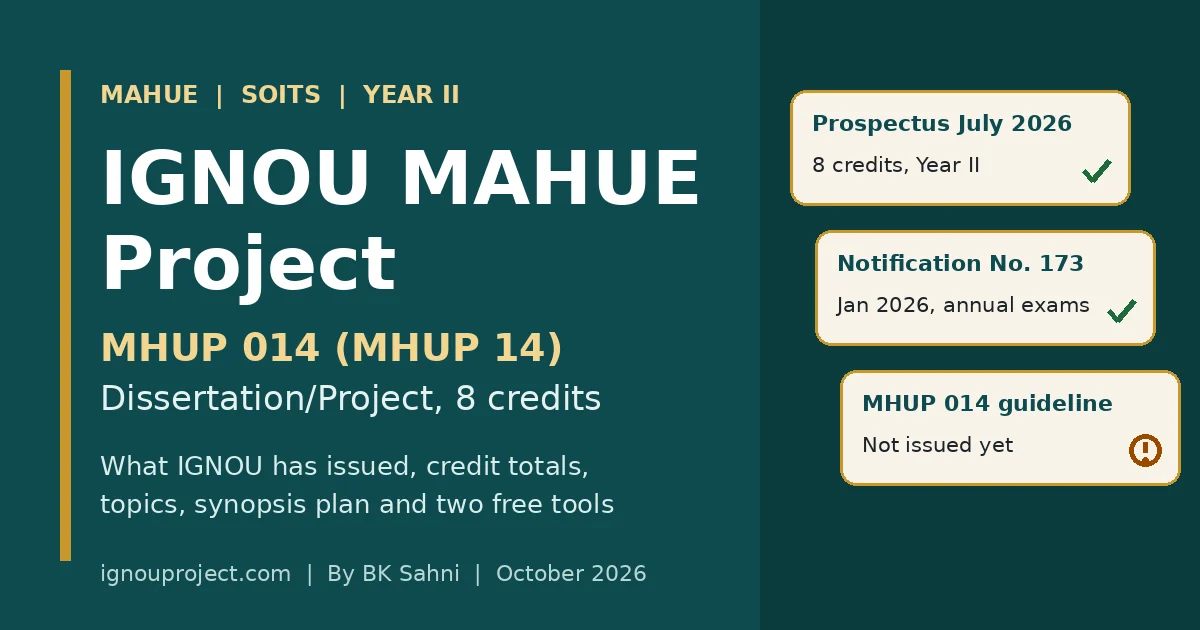
The IGNOU MAHUE Project is MHUP 014, the 8-credit Dissertation/Project in the second year of the MA in Human Values and Ethics, which IGNOU’s School of Interdisciplinary and Trans-disciplinary Studies has offered since the January 2026 session. It equals about 240 study hours and carries a Rs 500 evaluation fee. As of 19 October 2026 IGNOU had issued no MHUP 014 guideline, proforma, topic list or length; the first batch reaches the course in its second year.
- MAHUE is offered in ODL mode from the January 2026 session (Notification No. 173, 6 February 2026).
- Examinations are annual, and the programme runs for a minimum of 2 and a maximum of 4 years (Notification No. 173; Common Prospectus, p. 40).
- The project course is titled Dissertation/Project, typed Project, worth 8 credits and placed in Year II (Notification No. 173; Prospectus, p. 100).
- Notification No. 173 prints MHU-003 Philosophy of Human Being at 4 credits, and No. 168’s 40-credit first-year table agrees; that is how the course table reaches IGNOU’s printed total of 80, while the programme page shows 6 and adds up to 82.
- Dr. Abhishek Mishra, Assistant Professor, SOITS, is named as programme coordinator in Notification No. 173.
IGNOU MAHUE Project in 2026: one course, and no guideline yet
An IGNOU MAHUE Project means one thing only: MHUP 014, the single project course in the Master of Arts in Human Values and Ethics. Every other MAHUE course, MHU-001 to MHU-013, is a theory course with assignments and a term-end paper. MHUP 014 is the one place in the programme where the learner researches a question and writes it up.
The programme is new. IGNOU’s Planning and Development Division launched the PG Diploma (PGDHUE, minimum one year) from the July 2025 session and the full master’s degree from the January 2026 session. Because MHUP 014 sits in the second year, the first MAHUE batch, admitted in January 2026, is still in its first year, and SOITS has not published the manual that other SOITS courses have. No MHUP 014 manual appeared among the SOITS project manuals we could open, on the MAHUE programme page or on the SOITS school page when we checked on 19 October 2026.
So this page does two jobs. It sets out what IGNOU has already fixed for MHUP 014, with the document for each fact, and it gives a working plan for the parts IGNOU has not fixed yet, marked as our planning so it is never mistaken for a rule. When SOITS issues the guideline, the guideline wins.
Across IGNOU programmes, students tell us topic choice is where they feel most lost, and many say nobody ever showed them how a synopsis or report is written. MAHUE learners meet that gap with even less help, because MHUP 014 has no manual to read yet.
Another pattern from other courses: a synopsis drafted with ChatGPT or a similar tool before the learner has read the course guidelines, so the plan follows the tool’s idea of a dissertation rather than the course’s. For MHUP 014 that risk is sharper, since any AI draft written today has no guideline to follow and will fill the gaps with rules from other programmes.
The parent programme is the MA in Human Values and Ethics, and an MA Human Values and Ethics project is the same MHUP 014 course under a longer name. If you only need the course list, it is on IGNOU’s MAHUE programme page.
IGNOU MHUP 014 Project, MHUP-014 or MHUP 14: one course, three spellings
Searches for the IGNOU MHUP 014 Project, MHUP 14, MHUP-014 and the IGNOU MAHUE Project all point to the same course. IGNOU prints the code as “MHUP 014” in the Common Prospectus and as “MHUP-014” on the programme page; the launch notification’s scan reads close to “MHUP-014” but is hard to read at that line. A short form such as MHUP 14 is how students write it, not how IGNOU prints it.
| Document | Code as printed | Title as printed | Type and credits |
|---|---|---|---|
| Common Prospectus, July 2026, p. 100 | MHUP 014 | Dissertation/ Proiect (misprint of Project) | Project, 8 |
| MAHUE programme page, read 19 October 2026 | MHUP-014 | Dissertation/ Proiect | Project, 8 |
| Notification No. 173, 6 February 2026 | Scan unclear; reads close to MHUP-014 | Dissertation/Project | Project, 8 |
On your forms, write the code exactly as your admission record and the term-end examination form show it. The word “Proiect” in two IGNOU documents is a typing slip for “Project”; it does not change the course. Codes for every other IGNOU project course are in our project course codes directory.
Watch the MHUP 014 walkthrough
BK Sahni’s own video takes the course in the order a learner meets it: the topic, the synopsis, the chapters and the final report. Where the video and this page differ on a rule, follow this page, which was rechecked against IGNOU’s documents in October 2026.
80 credits or 82? Where the MAHUE tables disagree
Anyone adding up the IGNOU MAHUE Project’s parent programme from the programme page gets 82 credits, while IGNOU prints 80. The difference is one course. Notification No. 173 prints MHU-003 Philosophy of Human Being at 4 credits, and No. 168 gives the first year a 40-credit total that only works at 4; the programme page and the prospectus table print it at 6.
| Item | Notifications No. 168 and 173 | Programme page and Prospectus table |
|---|---|---|
| MHU-003 Philosophy of Human Being | 4 credits | 6 credits |
| Year I (MHU-001 to MHU-007) | 40 | 42 |
| Year II (MHU-008 to MHU-013 and MHUP 014) | 40 | 40 |
| Printed total | 80 | 80 in the Prospectus; the page itself prints no total |
| MHUP 014 | 8 credits, Year II | 8 credits, Year II |
Built from the documents named in the column heads, read in October 2026. The arithmetic is ours.
For MHUP 014 itself nothing is in dispute: every document gives it 8 credits. The disagreement matters only for the first-year total and for anyone checking a grade card against 80. If your grade card shows MHU-003 with a different credit value from the one you expected, ask the programme coordinator rather than your study centre, because the difference begins in IGNOU’s own tables.
Students on many IGNOU courses mix up the Rs 300 and Rs 500 project fees. The Prospectus slab is simple: up to 4 credits, Rs 300; above 4 credits, Rs 500. MHUP 014 has 8, so it falls in the Rs 500 slab.
What IGNOU has issued for the IGNOU MAHUE Project so far
For the IGNOU MAHUE Project, IGNOU’s own paperwork so far is a set of programme documents that mention MHUP 014, not documents written for it. The map below keeps the two kinds of file apart: on the left what IGNOU itself has published, on the right the practice files our desk made, which must never go into a submission.
- Common Prospectus, July 2026: MAHUE structure (pp. 99 to 100), fee row (p. 40), project fee slab (p. 27), credit rule (section 1.9).
- MAHUE programme page: courses, 24 to 48 months, Rs 8,000 per year for national students.
- Notification No. 168, PGDHUE, 1 September 2025: Year I courses and the July 2025 start.
- Notification No. 173, MAHUE, 6 February 2026: January 2026 start, annual exams, 80 credits (read from a copy hosted by a college; see the sources).
- MHU assignment booklets, SOITS: the questions behind the topic table on this page.
- MHUP 014 guideline and approval proforma: not issued as of 19 October 2026.
- Sample synopsis (PDF, 7 pages): an AI-in-coursework ethics topic, with square brackets wherever your own facts belong.
- Report format template (PDF, 4 pages): page order, an empirical track and a conceptual track, empty tables and sentence frames.
- Both are watermarked as study reference, and both say on their first page which IGNOU documents they were built from.
Sample synopsis, MHUP 014
Ethical reasoning about generative AI in coursework among undergraduates: a descriptive survey plan.
Report format template, MHUP 014
Front matter, five empirical chapters or six conceptual ones, and empty table shells.
Many students we see are unsure what a proforma even is; some forget to attach one, others attach the wrong one. With MHUP 014 the temptation is to download another programme’s proforma because MAHUE has none. Wait for the SOITS form instead; a borrowed form names another course code.
The same uncertainty covers the rest of the packet: which documents go with the synopsis, and whether it is bound or simply filed. For MHUP 014 no list exists yet, so treat any list you read elsewhere, including ours, as provisional.
When MHUP 14 reaches your batch
The timing of an IGNOU MAHUE Project follows from three printed rules: exams are annual, the programme needs at least 2 years and at most 4, and MHUP 014 is a second-year course. A learner admitted in January 2026 therefore writes first-year papers in December 2026 at the earliest and reaches the second-year exam cycle, MHUP 014 included, in December 2027 at the earliest. These dates are our arithmetic from the annual exam mode and the minimum-time rule, not dates IGNOU has printed.
For a first-year learner asking when the IGNOU MHUP 14 project begins, the checker below works it out for each admission session, and the table under it gives the same answer without JavaScript.
MAHUE year and MHUP 14 checker
Built from the Common Prospectus (July 2026, section 1.9 and pp. 27, 40, 99 and 100) and IGNOU launch notifications No. 168 and No. 173, read in October 2026.
This checker needs JavaScript. If this line stays after the page loads, use the table under the checker instead.
What the checker reads. It assumes one year of study for each MAHUE year, our reading of the annual exam mode in Notification No. 173 and the minimum-time condition for sitting a term-end exam (Prospectus, p. 27), and places the first possible exam in the next June or December cycle. It adds the 4-year maximum from the Prospectus fee table (p. 40), the Rs 500 slab for projects above 4 credits (p. 27) and the PGDHUE exit after Year I (p. 99). It does not predict results or approval, and the exact last session of your registration is the Regional Centre’s to confirm.
| Admitted | Year I papers, earliest | Year II exams and MHUP 014, earliest | 4-year maximum reaches |
|---|---|---|---|
| January 2026 | December 2026 | December 2027 | December 2029 |
| July 2026 | June 2027 | June 2028 | June 2030 |
| January 2027 | December 2027 | December 2028 | December 2030 |
| July 2027 | June 2028 | June 2029 | June 2031 |
In our records, 70 to 80 percent of project students across IGNOU courses become active only in the last month before a submission date; when the date falls in November, most begin in October. MHUP 014 has no published date yet, which makes a last-month start even riskier.
Many students hand in the synopsis in the final week before a last date, and many wait for the extension they expect IGNOU to announce. Nobody can tell you whether a future MHUP 014 date will be extended, so plan to the first date printed.
IGNOU MAHUE dissertation or project: what the title Dissertation/Project allows
IGNOU titles the course Dissertation/Project, so an IGNOU MAHUE dissertation and a MAHUE project are the same piece of work. The title matters for one practical reason. A human values course can be answered in two quite different ways, and the slash leaves room for both until SOITS says otherwise.
| If your question asks | The study is | Evidence comes from | Example question |
|---|---|---|---|
| What people believe or do | Empirical: survey, interviews, case study | Your own questionnaire or interviews | How do school teachers in one district handle value conflicts in classroom discipline? |
| Whether a practice is right by a stated principle | Normative: argument tested against cases | Policies, codes of conduct, reports, court or regulator documents | Does a published CSR policy meet the duties studied in MHU-011? |
| How two traditions differ on one question | Comparative textual study | Primary texts in a stated translation, with commentaries | How do Jain anekantavada and the Buddhist Middle Path frame disagreement? |
Pick the kind of study before the topic hardens. A synopsis that promises a survey and a report built from books alone will be read as a mismatch whatever the final guideline says.
Many students build the synopsis and report on secondary data only. Nothing published for MHUP 014 rules that out, and a normative or textual study rests on documents by design. Say in the synopsis which kind of study it is, so a reader sees that the sources match the plan.
MAHUE dissertation topics drawn from IGNOU’s own MHU questions
No topic list exists for the IGNOU MAHUE Project, so the safest starting points are the questions IGNOU itself sets in MAHUE courses. A topic that grows from an MHU question already sits inside the programme’s reading, and your supervisor can see the link at once.
| Course and booklet | What IGNOU asks about | A direction for MHUP 014 |
|---|---|---|
| MHU-002, TEE December 2026 | Buddhist and Jain ethics, dharma in the Bhagavad Gita, the Preamble as a source of values, equality in Bhakti and Sufi traditions | A comparative study of how two of these traditions treat one present-day question, such as truthfulness at work |
| MHU-004, TEE December 2026 | Value conflict in AI, steps in ethical decision-making, social problems in India, compassionate leadership | How students or employees in one setting reason about using generative AI (the topic of our sample synopsis) |
| MHU-005, TEE June 2026 | Professional codes of conduct, human rights and duties, bioethics, environmental ethics | A normative reading of one profession’s published code against the duties the course sets out |
| MHU-008 to MHU-013 (Year II) | Education and media, dilemmas, governance, business ethics and CSR, professions, cross-cultural values | Second-year booklets were not yet published when we checked; use the course titles until they are |
Built from the MHU-002 and MHU-004 booklets for TEE December 2026 and the MHU-005 booklet for TEE June 2026 (SOITS), read in October 2026. The directions in the last column are ours.
Ethics question shaper
Our pairing, not an IGNOU rule: IGNOU has published no MHUP 014 topics or methods yet. The course links come from IGNOU’s MHU assignment questions; the design advice is ours, to discuss with your supervisor.
This shaper needs JavaScript. If this line stays after the page loads, use the table under the shaper instead.
Why it suggests that design. A describing claim needs evidence from people, so the shaper points to a survey or interviews. A judging claim needs a principle and a practice set side by side, so it points to documents and a normative case analysis. A comparing claim needs texts read on their own terms, so it points to a textual study with a stated translation. It joins your value and setting into a working title and a question; the result is a starting point to rewrite with your supervisor, never a finished title.
On other IGNOU courses, many students believe they must choose one of the topics printed in the guidelines, word for word. MHUP 014 has no printed list at all, so there is nothing to copy and every topic has to be argued for.
Synopses built from widely shared material or the same outside source tend to carry the same topic as other students’ work, and duplicate topics are a common reason for return. A topic tied to your own city and your own setting is far less likely to collide.
Evaluators on other courses often send synopses back asking that the study be based on the student’s own city or locality. It is an evaluator’s comment rather than a rule. Build it in from the start anyway.
Choosing a supervisor before SOITS names the rule
No supervisor rule for the IGNOU MAHUE Project has been published: no qualification, no limit on students per guide, no bio-data format. Other SOITS manuals take different routes. The MDIP 001 manual, for instance, has mentorship by IGNOU faculty at the New Delhi campus, while other IGNOU schools allow approved academic counsellors or outside postgraduate teachers.
Until MHUP 014’s rule appears, approach someone who would pass a reasonable test in any of those schemes: a postgraduate teacher in philosophy, ethics, education, social sciences or management with research supervision behind them. Ask before you finalise the topic, not after. If SOITS later names a different rule, a guide chosen this way is the one most likely to fit it. The general eligibility patterns are collected on our guide eligibility page.
Most students we meet on other courses do not know the guide eligibility criteria and pick a guide who does not meet them. For MHUP 014, read the guideline’s supervisor clause first, the day it appears.
Students often ask their study centre coordinator for a guide and find that none is allotted, so they have to find an eligible person themselves. Some then approach a relative or an outside contact without checking any criteria. Check first; a guide who does not qualify can sink an otherwise sound proposal.
Planning the IGNOU MAHUE Project synopsis
A synopsis for the IGNOU MAHUE Project can be planned now, even though MHUP 014 has no list of parts. The closest official model is the MDIP 001 Project Manual of the same School, which lists eight parts, one of them optional, and sets the proposal at 1,200 to 1,500 words including references. Our sample synopsis follows those parts and adds research ethics, because MHU-007 Research and Innovation Ethics is a MAHUE first-year course.
| Part (MDIP 001 manual) | What it does in an ethics synopsis | Common weak spot |
|---|---|---|
| Title page | Exact working title, programme, MHUP 014, your details, proposed supervisor | A subject area instead of a title |
| Topic statement | The value question, why it matters now, which MHU course it grows from | No reason given for the study |
| Research aims and objectives | Three to five objectives in neutral verbs: to study, to identify, to examine, to explore | Objectives that assume the answer |
| Review of the literature | Themes leading to a gap, using sources you have read | A list of authors with no gap |
| Study design | Empirical, normative or comparative, and why | Design and objectives that do not match |
| Research methods | Tool, sample or texts, analysis plan | No tool, or a questionnaire not attached |
| Research ethics (added for MAHUE) | Consent, anonymity, permissions, honest citation | Left out of a study about ethics |
| Tentative chapter outline (optional in MDIP 001) | Chapter headings for the planned report | None |
| References | One consistent style, matching every citation | Sources cited that were never read |
The full sample is in the document map above; read it for structure and wording, then write your own. Our pages on writing project objectives and IGNOU synopsis structure cover the generic parts in more depth.
Many students do not know the structure of a synopsis and leave out core parts such as the methodology, the objectives or, where the design needs them, hypotheses. A descriptive or normative MHUP 014 study may not need hypotheses at all; say so rather than inventing them.
In many synopses the literature review does not match the reference list. Every author you discuss should appear in the references, and nothing should appear there that you have not read.
Synopses also come back when the rationale is missing, or when a survey is promised but the questionnaire is not attached.
A second reading for your MHUP 014 draft
Because MHUP 014 has no published return list yet, our reading of your draft uses the reasons proposals and reports come back on other IGNOU courses, applied to an ethics study. You stay the author; we return your draft with corrections and you make them. Approval is decided by IGNOU’s evaluator, never by us.
- A title that names the value, the setting and the kind of study
- Objectives written in neutral verbs, each matched to a method
- A review whose authors all appear in the references
- Design and evidence that fit: people for a survey, documents for a normative study, texts for a comparison
- A research ethics section with consent and anonymity
- Your contact details and the supervisor’s details, complete
- The title exactly as approved
- Approval comments worked into the chapters
- An analysis chapter strong enough to answer each objective
- One reference style, matching every citation
- A blank questionnaire or interview schedule in the appendix
- Declaration and supervisor’s certificate signed and dated
See how the synopsis and report correction works
Many students leave the synopsis so late that there is no time left to write it properly themselves. Some submit an AI-written synopsis or report as it is, which is one reason the same topics keep reappearing. And when a guide asks for several rounds of changes, a synopsis can slip by weeks; build that time in.
Correction fees as of October 2026: Rs 1,000 for a synopsis and Rs 2,000 for a report. The learner remains the author of the synopsis, the data and the report, and is responsible for the analysis, the certificates and the submission.
The approval form: boxes IGNOU forms print, before MHUP 14 has its own
There is no MHUP 014 proforma yet, but every IGNOU approval form we have read asks for much the same facts. Collecting them now saves a scramble when the SOITS form for the IGNOU MAHUE Project appears. The map compares three forms we have read: the SOITS MDIP 001 approval form, the MESP-001 (MA Education) proforma and the MMPP-001 (MBA) proforma.
| Box | Printed on | Who fills it | What to watch |
|---|---|---|---|
| Title of the study | MDIP 001, MESP-001 | Learner | The exact title; it becomes the title the report must carry |
| Short description | MDIP 001 (two or three paragraphs) | Learner | Written by you, consistent with the synopsis |
| Enrolment number | MDIP 001, MESP-001 | Learner | As on your ID card, without a typing slip |
| Name and address, e-mail, telephone | MESP-001 | Learner | Often left blank; complete every line |
| Study centre and Regional Centre | MESP-001 | Learner | Your current centres, not the admission-time ones if you moved |
| Supervisor’s name and address | MESP-001 | Learner, checked by supervisor | Full designation and institution |
| Signatures and dates | MDIP 001 (learner); MESP-001 and MMPP-001 (learner and supervisor) | Each signs personally | Never signed by anyone on another’s behalf |
| Approved or not approved | MESP-001, MMPP-001 | IGNOU’s evaluator | Leave blank; MMPP-001 marks synopsis and supervisor separately |
| Proposal number for office use | MESP-001 | IGNOU office | Leave blank; quote it in every later letter |
| Office stamp and counter-signature | MESP-001, MMPP-001 | Regional Director or office | Leave blank |
| Place | MDIP 001 | Learner | Town where you sign |
Built from the MDIP 001 Project Manual (SOITS, read October 2026) and our verified records of the MESP-001 and MMPP-001 proformas. When SOITS issues the MHUP 014 form, its own boxes replace this map.
On every course, many students fill the proforma incompletely: the guide’s details partly missing, and sometimes even their own name, address or e-mail left blank.
A blank title box is a common reason a synopsis comes back. Write the title in full, identical to the synopsis.
Sending the synopsis and waiting for an answer
The route for an IGNOU MAHUE Project synopsis has not been announced. SOITS courses do not all use the same desk: the MDIP 001 manual sends proposals by e-mail to its programme coordinator or by post to SOITS, Block 15, at Maidan Garhi, while courses in other schools go to the Regional Director. Do not copy a route from another course. Ask the MAHUE programme coordinator named in Notification No. 173 how and where to send the MHUP 014 synopsis, and keep the reply.
On waiting, other courses give some sense of scale: the MMPP-001 guidelines state that approval or non-approval is communicated within two to three months. The generic steps of approval are on our synopsis approval page.
Many students forget to keep proof when they send a synopsis: a postal receipt, a courier slip or the sent e-mail. Keep it until the result is on your grade card.
Students are often unsure whether a synopsis goes to the study centre or the Regional Centre, and some hand it in at Maidan Garhi when their course routes it elsewhere, which leads to rejection. For MHUP 014, the right desk is whichever SOITS names; for some SOITS courses that is Maidan Garhi itself.
We have also seen cases on other courses where no approval letter reached the student and the session ran out. If two months pass without a word, write to the coordinator with your enrolment number and the date you sent the synopsis.
Research ethics inside an ethics dissertation
An IGNOU MAHUE Project is judged on two levels at once: what it says about values, and how honestly it was done. MHU-007 Research and Innovation Ethics sits in the first year for that reason, and a reader will expect its ideas in your methods chapter.
- Consent: every respondent reads what the study is and may refuse or stop.
- Anonymity: no names, roll numbers or phone numbers on questionnaires or in the report.
- Permission: the head of an institution agrees before you approach its students, staff or patients.
- Honest citation: every quotation and idea is credited, including what an AI tool suggested to you.
- Own data: findings come only from the people you surveyed or the texts you read.
The UGC’s 2018 regulations on academic integrity already treat passing off another’s work as one’s own as plagiarism, and IGNOU expects an original report from the learner. Our page on questionnaires and data collection covers building the tool itself.
Some students write the analysis chapter on assumed data without running a real survey. In a dissertation about ethics that is the one mistake no wording can repair.
Many take material from internet sources and submit it without checking it for plagiarism. Check your own draft, and rewrite rather than paraphrase line by line.
Some reports go in without the guide’s signature on the certificate of originality. Check every signature page before you scan.
After the approval letter: turning comments into chapters
Once the IGNOU MAHUE Project synopsis is approved, the letter becomes your brief. On other IGNOU courses the approved title is locked; the MMPP-001 guidelines, for example, require the final report to carry it unchanged. Expect the same discipline for MHUP 014 until SOITS says otherwise, and treat any comments on the letter as instructions for the report. Our page on changing a topic after approval explains why late changes cost so much.
Approval often comes with comments the student must work into the report, and many students skip them. Keep the letter beside you while you write each chapter.
The correction we see most often is in the review of literature: students are asked to bring it up to date. In our experience an outdated review also costs marks at the report stage, so refresh it before Chapter 2 is final.
Report format: empirical or conceptual, chapter by chapter
For an IGNOU MAHUE Project report, IGNOU has fixed no page order, length, font or binding yet. Our report format template sets out the order most IGNOU postgraduate dissertations follow, in two tracks, so the draft can start now and be adjusted when the guideline appears.
| Part | Empirical track | Conceptual track |
|---|---|---|
| Front matter | Cover page, declaration, supervisor’s certificate, approval documents if asked for, acknowledgement, contents, lists | |
| Chapter 1 | Introduction, problem, objectives, research questions | The question and the claim you will defend |
| Chapter 2 | Review of literature and framework | Sources and how each will be read |
| Chapter 3 | Design, sample, tool, ethics | First line of argument |
| Chapter 4 | Analysis and interpretation | Second line of argument or the comparison |
| Chapter 5 | Findings, conclusions, suggestions, limitations | Objections and replies |
| Chapter 6 | None | Conclusion |
| End matter | References, then appendices | |
On length, the MHUP 14 dissertation carries 8 credits, roughly 240 hours of work under IGNOU’s credit rule, but no MHUP 014 word count has been printed; treat any figure you read elsewhere as another course’s rule. Our word limit page lists what other courses set, and general layout conventions are on our project guidelines page.
After approval, many students do not know what format the report should follow, and many are unsure of the page order. The template exists for exactly that moment.
In many reports the analysis chapter is too thin to carry the objectives and the methodology. In the empirical track, each objective needs its own table and interpretation; in the conceptual track, its own argument.
References, appendices and the originality line
Three small parts of an IGNOU MAHUE Project report cause a large share of trouble: the reference list, the appendices and the signed declaration. None of them needs an MHUP 014 rule to get right.
- References: one consistent style throughout, matching every citation in the text.
- Appendices: a blank copy of the questionnaire or interview schedule, the consent statement and any permission letters.
- Declaration and certificate: your own signed declaration that the work is yours, and the supervisor’s signed certificate.
In many reports the references follow no single format and do not match the sources used in the chapters. Since MHUP 014 sets no style yet, choose one and keep it.
Many students leave the questionnaire or appendix out entirely, and some attach filled-in questionnaires instead of a blank copy. A blank copy is common practice; keep the filled ones safe in case the evaluator asks.
Fee, upload and the SED project portal
Two parts of IGNOU MAHUE Project submission are already settled by all-programme rules. The project evaluation fee is Rs 500 for MHUP 014, paid with the term-end examination form (Prospectus, p. 27). And when SED opens its online project portal for a session, its standing instructions apply: one PDF per course, incomplete uploads removed after the last date, and reports sent by e-mail not considered.
What is not settled is whether MHUP 014 will use the portal, a postal route or both, and which documents the PDF must carry. Session dates change every cycle and are tracked on our December 2026 project dates page; the portal steps are on our submission guide.
Some students skip saving the confirmation when they submit a report. Save the on-screen confirmation and the acknowledgement e-mail.
Some e-mail the report instead of using the course’s route. SED’s portal instructions say e-mailed reports are not considered, so wait for the MHUP 014 route rather than sending a copy anywhere.
Reports also come back when a required document is missing: the approved proforma, the signed synopsis, the guide’s bio-data or the signed originality certificate, wherever a course asks for them. List what the MHUP 014 guideline asks for, the week it appears.
Viva, marks and result: what is not yet known
IGNOU has not said whether the IGNOU MAHUE Project will have a viva, how marks will be split, or which office will evaluate it. Rules elsewhere vary widely. The MDIP 001 manual of the same School describes evaluation by external examiners and no viva, while RC Cochin’s briefing for MESP-001 (MA Education, another School) weights the report and viva 70 and 30. Prepare as if you will have to explain your choices aloud, because that preparation also strengthens the report.
After evaluation, status queries go through IGNOU’s project status channels, explained on our project status guide; general practice questions are on our viva questions page.
Many students do not know whether a viva applies to them at all. For MHUP 014 the honest answer today is that IGNOU has not said; we will update this page when it does.
MAHUE dissertation questions, answered from the documents
What is the IGNOU MAHUE Project?
It is MHUP 014, the 8-credit Dissertation/Project in the second year of IGNOU’s MA in Human Values and Ethics, offered by SOITS. It is the only project course in the programme.
Is MHUP 14 the same as MHUP 014?
Yes. IGNOU prints the code as MHUP 014 in the Prospectus and MHUP-014 on the programme page; MHUP 14 is the short form students search for.
How long should the MHUP-014 dissertation be?
IGNOU had not printed a length for the MHUP-014 dissertation as of 19 October 2026. Its 8 credits mean about 240 hours of study; follow the word count in the guideline once SOITS issues it.
Has IGNOU published MHUP 014 guidelines?
Not as of 19 October 2026: none appeared on the MAHUE programme page, on the SOITS school page or among the SOITS project manuals we could open. The first MAHUE batch reaches MHUP 014 in its second year.
Does a last date apply to the synopsis or the report?
No MHUP 014 date of either kind has been published. On other courses we see many students unsure which of the two a printed last date refers to; when MHUP 014’s dates appear, read which stage each one names.
Whom do I ask about MHUP 014 if I hear nothing?
Notification No. 173 names Dr. Abhishek Mishra, Assistant Professor, SOITS, as programme coordinator. Most students we hear from on other courses do not know how long approval takes or whom to contact after one or two months of silence. In our experience approval on other courses takes two to three months, the same window the MMPP-001 guidelines state.
What fee is paid for the MAHUE project?
Rs 500, because MHUP 014 carries more than 4 credits; it is paid with the term-end examination form (Common Prospectus, July 2026, p. 27).
Can I leave after the first year?
Yes. A learner who completes the first year can receive the PG Diploma in Human Values and Ethics (PGDHUE); MHUP 014 is a Year II course, so a learner who stops there never reaches it (Prospectus, p. 99).
Before you write a word of the IGNOU MAHUE Project
The IGNOU MAHUE Project rewards learners who use the waiting time well. Before SOITS issues the MHUP 014 guideline, you can settle the kind of study, a topic grown from an MHU course, a willing supervisor and a reading list; after it appears, you adjust the details rather than start again.
- Decide: describing, judging or comparing.
- Choose the MHU course your question grows from, and read its unit on the topic.
- Draft a working title with the shaper, then rewrite it yourself.
- Ask a supervisor early and note their qualifications.
- Collect the approval form facts in the map above.
- Check this page and the MAHUE programme page each month for the guideline.
Most approvals we see on other courses come with correction or modification points, so expect at least one round of changes and leave room for it.
Need a hand with the plan? ignouproject.com provides customised project guidance, topic refinement, methodology support, review and correction of learner-written synopses and reports, formatting and citation support, reference material, printing and binding, and project status and result guidance. Message us on WhatsApp at +91 93546 37830 or see our service charges page. Assignment help for the theory courses is on our MAHUE handwritten assignment page.
Documents behind this guide
Every rule on this IGNOU MAHUE Project page comes from one of these, all read in October 2026.
- IGNOU Common Prospectus, July 2026: section 1.9 (credit rule), p. 27 (TEE and project fee), p. 40 (MAHUE row), pp. 99 to 100 (MAHUE structure).
- MAHUE programme page, IGNOU, read 19 October 2026.
- PGDHUE programme page, IGNOU, read 19 October 2026.
- SOITS school page, IGNOU, read 19 October 2026.
- Academic Programme Launch Notification No. 168, PGDHUE, Planning and Development Division, 1 September 2025 (scanned).
- Academic Programme Launch Notification No. 173, MAHUE, Planning and Development Division, 6 February 2026, read from a copy hosted at vcfw.org; we found no readable copy on ignou.ac.in.
- MDIP 001 Project Manual, SOITS: proposal parts, length and approval form.
- MHU assignment booklets, SOITS: MHU-002 (TEE December 2026), MHU-004 (TEE December 2026), MHU-005 (TEE June 2026).
- SED project and practical fee page: the Rs 300 and Rs 500 slabs.
ignouproject.com is an independent service and is not affiliated with or endorsed by IGNOU. Course codes, credits and fees are quoted from IGNOU’s documents with their dates; the IGNOU MAHUE Project guideline, when SOITS issues it, overrides anything on this page.

BK Sahni iD 0009-0005-8092-459X
Founder, Shri Chakradhar Publication Pvt. Ltd. & ignouproject.com — helping IGNOU distance-learning students since 2010 (5,00,000+ students supported across MBA, MCom, MA & more). Author of IGNOU exam guides, solved assignments & project reference books.
Disclosure: Shri Chakradhar Publication Pvt. Ltd. and ignouproject.com are independent third-party study-help services — not the official IGNOU website. Always verify final dates and rules on ignou.ac.in.