IGNOU MSCENV guess paper · December 2026 term-end examination
Ten answers in three hours, nine core papers after 2 PM, and themes IGNOU set again and again. Revise MSCENV from the papers themselves.
Thirty-eight IGNOU M.Sc. (Environmental Science) papers, June 2022 to December 2025, compared question by question, with every MEV and MEVE date from IGNOU’s 30 October 2026 date sheet.
- 38 IGNOU MSCENV papers compared
- First paper: MEV-011, Wed 2 Dec
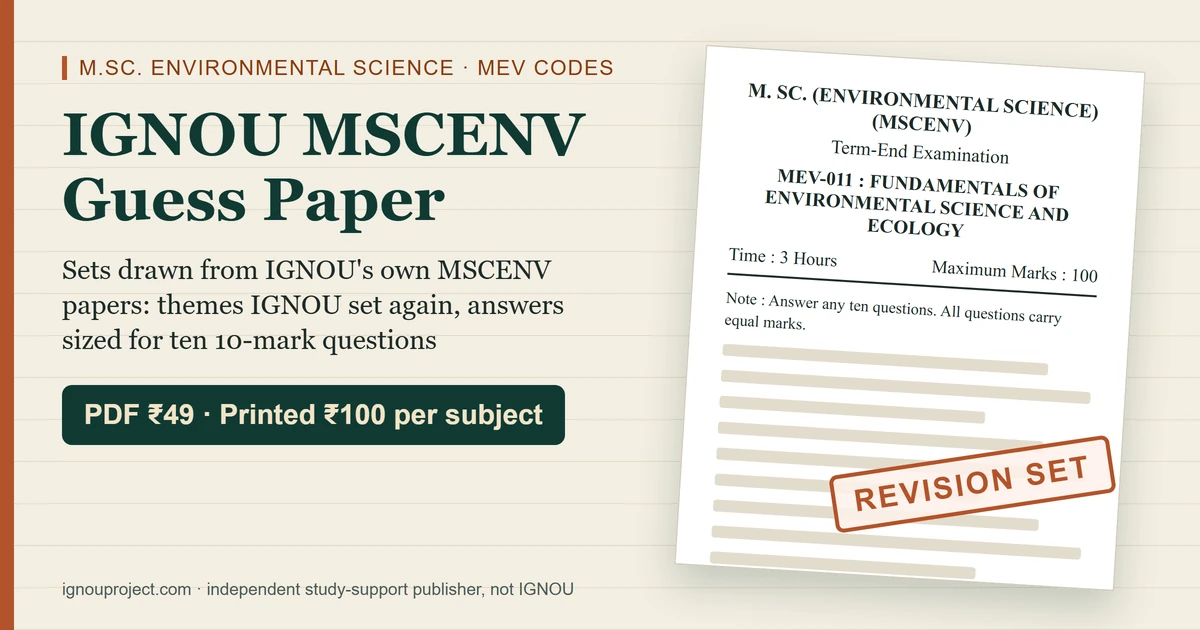
- Any ten questions, 10 marks each
- All nine MEV papers at 2 PM
- English-medium sets
- Free exam-run planner and answer clock
Type each code the way the hall ticket shows it, add PDF or printed, and the reply prices the list code by code.
Quick answer. An IGNOU MSCENV guess paper is a publisher’s set of the questions IGNOU keeps returning to in a single M.Sc. (Environmental Science) course code, each answered in exam form; the programme’s theory codes carry the MEV prefix (MEV-011 to MEV-019) and its electives carry MEVE (MEVE-011 to MEVE-019). The December 2026 term-end examination (TEE) runs from 25 November 2026 to 14 January 2027, and the MSCENV papers fall between Wednesday 2 December (MEV-011) and Wednesday 30 December (MEV-017), all nine MEV papers in the 2 PM to 5 PM session, per IGNOU’s date sheet of 30 October 2026. Every MSCENV paper compared here is 3 hours and 100 marks: any ten questions, 10 marks each, from twelve to fifteen printed. Sets cost ₹49 PDF · ₹100 printed, per subject code, and printed orders carry a one-time ₹100 courier charge; MSCENV sets are prepared in English, the programme’s only medium. A guess paper is a revision aid built from past IGNOU question papers and the syllabus. No one outside IGNOU knows the questions in advance, and no claim is made that any question in this set will appear in your examination.
Nine MEV Papers, All After 2 PM: The December 2026 MSCENV Calendar
The MSCENV December 2026 papers start with MEV-011 Fundamentals of Environmental Science and Ecology on Wednesday 2 December 2026 and end with MEV-017 Environmental Legislations on Wednesday 30 December 2026, according to IGNOU’s date sheet dated 30 October 2026. All nine MEV core papers sit in the evening session, 2 PM to 5 PM. The cycle as a whole runs from 25 November 2026 to 14 January 2027, one day longer than the tentative sheet of 21 September 2026, though no MSCENV date moved between the two versions.
IGNOU’s December 2026 term-end window runs Wednesday 25 November 2026 to Thursday 14 January 2027, per the sheet issued on 30 October 2026
First MSCENV paper
MEV-011, Wed 2 Dec 2026, evening
Last MSCENV paper
MEV-017, Wed 30 Dec 2026, evening
Revised sheet of 30 October 2026. Its heading no longer carries the word “tentative”, but IGNOU can still change a date; the hall ticket is the final word.
The first-year codes come as a block. MEV-011, MEV-012 and MEV-013 run on 2, 3 and 4 December; MEV-014, MEV-015 and MEV-016 follow on 5, 7 and 8 December. Sunday 6 December is the only gap. A learner who is carrying a Semester I paper into the Semester II cycle therefore writes six three-hour papers in seven days, every one of them starting at 2 PM.
Semester III is quieter but arranged back to front. MEV-019 Research Methodology comes first on Monday 28 December, MEV-018 Environmental Health and Ecotoxicology on Tuesday 29, and MEV-017 on Wednesday 30. Revising in code order would leave the first paper of the run for last.
Elective Dates and the Two Morning Papers
The nine electives are spread from MEVE-014 on 9 December to MEVE-012 on 26 December. Two of them break the evening habit: MEVE-019 Environmental Issues on Wednesday 23 December and MEVE-012 Environmental Management on Saturday 26 December are in the morning column, 10 AM to 1 PM. The guide to IGNOU exam session timings explains the two slots and the reporting time.
No two MSCENV codes share a date, so there is no clash inside the programme. There are runs, though. A Semester II learner whose elective is MEVE-014 Biodiversity Conservation and Management writes on 5, 7, 8 and 9 December. A Semester III learner who picked MEVE-012 sits it on the morning of Saturday 26 December and then has three evening papers on 28, 29 and 30 December. The full programme-wide schedule is on the site’s December 2026 date sheet lookup; the admit card itself is covered by the IGNOU hall ticket guide, and venue rules by the exam centre allotment page. Learners who have not yet cleared the fee can check the per-course examination fee and the steps to pay that fee online.
Seventy Per Cent of Every MEV Grade Rests on One Three-Hour Sitting
The term-end examination carries 70 per cent of the final course result and assignments carry the remaining 30 per cent. For MSCENV that split is printed in IGNOU’s MEV-011, MEV-012 and MEV-013 assignment booklet for January 2025 to July 2026, which says the assignments “have 30% weightage in the final grading”; no MSCENV question paper prints a weightage line of its own.
The booklet adds a condition that comes before any percentage: assignments have to be submitted within the stipulated time to be eligible to sit the term-end examination at all. IGNOU’s 30 October date sheet repeats the point in its conditions for appearing.
The two halves are also written differently. The assignment asks for any five of eight questions at 20 marks each, so an assignment answer runs long. The MEV term-end paper asks for any ten at 10 marks each. Answers practised at assignment length will not fit the hall, where each one has roughly 17 minutes. Once results are out, the IGNOU percentage calculator converts grades into a percentage.
Revision Set, IGNOU’s Own Old Paper or a Solved Copy: Sorting the Three for MEV Codes
A guess paper is a publisher’s collection of the questions that keep recurring in one course code, such as MEV-016 Environmental Impact Assessment, each with a model answer, assembled from IGNOU’s past papers and the syllabus; sellers also call it “important questions”, “expected questions” or a “model paper”. A previous year question paper is what IGNOU actually set at an earlier term-end examination, for instance the December 2025 MEV-016 paper, and IGNOU posts it free of charge.
Put a publisher’s model answer under every question of one such IGNOU paper and the result is a solved question paper. It follows one sitting question by question, while a guess paper is arranged by theme across several sittings.
On a phone, swipe the table sideways for every column.
| Question | Guess paper | Previous year question paper | Solved question paper |
|---|---|---|---|
| What is it | Themes from several MEV sessions, answered | One IGNOU paper exactly as set | One IGNOU paper plus model answers |
| Made by | A publisher | IGNOU | A publisher |
| Price | Paid (here ₹49 PDF · ₹100 printed, per subject code) | Free on IGNOU’s site | Usually paid |
| Best use | Deciding what to revise first and how long a 10-mark answer runs | Timed practice in the real any-ten format | Checking how one sitting could be answered |
| Limit | Cannot know the next paper | Shows one sitting, not what repeats | Silent on themes that sitting skipped |
For MSCENV the free half of this choice is generous: IGNOU has published every MEV paper from December 2024 onwards on its own site, and the links under each table below go straight to them. Answered versions of past IGNOU papers are listed in the collection of solved IGNOU question papers, and sets for other programmes sit on the main IGNOU guess paper page.
Built for ten answers. Each answer is drafted for 10 marks and about 17 minutes, the length the any-ten rule allows.
Counts you can check. Themes carry the sessions and question numbers where IGNOU set them, written as n of N papers.
Diagram-ready. Carbon and nitrogen cycles, hydrosere and lithosere stages and ecological pyramids are drawn the way MEV-011 asks for them.
EIA method by name. MEV-016 sets cover screening, scoping, checklists, SEA and the clearance chain in the order the process runs.
Statistics in short form. MEV-019 sets keep paired short notes on ANOVA, chi-square and Type I and II errors to half-answer length.
Acts with years. MEV-017 sets list each Act, Rule and convention with the year IGNOU prints on the paper.
Climate short notes. MEVE-011 sets match the 2025 shift to six paired short-note questions per paper.
All eighteen theory codes. MEV-011 to MEV-019 and MEVE-011 to MEVE-019, each sold on its own.
Evening-run aware. The free planner lays out the 2 to 8 December run and the reversed 28 to 30 December run.
Current codes only. Every code sold appears in the July 2026 Common Prospectus and on the December 2026 sheet.
English throughout. MSCENV is taught and examined in English, and the sets follow.
PDF or print. Any one code can come as a WhatsApp PDF or as a couriered printed booklet.
MSCENV Theory Codes and the Any-Ten Rule Behind Each Paper
MSCENV has eighteen examined theory codes in December 2026: nine compulsory MEV courses and nine MEVE electives, of which a learner takes four (one in Semester II, one in Semester III and two in Semester IV). Section 3.38 of the July 2026 Common Prospectus sets the total at 72 credits, and the arithmetic holds: 36 credits of MEV theory, 16 of electives, 12 of laboratory courses and 8 for the dissertation. IGNOU’s MSCENV programme page gives the same English medium and a duration of 24 to 48 months. Course and fee basics for all programmes are summarised on the IGNOU prospectus overview.
Semester I and II Codes With Their December Dates
On a phone, swipe the table sideways for every column.
| Code | Title (July 2026 Common Prospectus) | Credits | Semester | December 2026 paper |
|---|---|---|---|---|
| MEV-011 | Fundamentals of Environmental Science and Ecology | 4 | Semester I | Wed 2 Dec 2026, evening |
| MEV-012 | Earth Processes | 4 | Semester I | Thu 3 Dec 2026, evening |
| MEV-013 | Environmental Chemistry | 4 | Semester I | Fri 4 Dec 2026, evening |
| MEV-014 | Sustainable Natural Resource Management | 4 | Semester II | Sat 5 Dec 2026, evening |
| MEV-015 | Environmental Pollution, Control and Management | 4 | Semester II | Mon 7 Dec 2026, evening |
| MEV-016 | Environmental Impact Assessment | 4 | Semester II | Tue 8 Dec 2026, evening |
Semester III and the Nine Electives
On a phone, swipe the table sideways for every column.
| Code | Title (July 2026 Common Prospectus) | Credits | Semester | December 2026 paper |
|---|---|---|---|---|
| MEV-017 | Environmental Legislations | 4 | Semester III | Wed 30 Dec 2026, evening |
| MEV-018 | Environmental Health and Ecotoxicology | 4 | Semester III | Tue 29 Dec 2026, evening |
| MEV-019 | Research Methodology for Environmental Science | 4 | Semester III | Mon 28 Dec 2026, evening |
| MEVE-011 | Global Climate Change | 4 | Elective | Thu 24 Dec 2026, evening |
| MEVE-012 | Environmental Management | 4 | Elective | Sat 26 Dec 2026, morning |
| MEVE-013 | Environmental Biotechnology | 4 | Elective | Wed 16 Dec 2026, evening |
| MEVE-014 | Biodiversity Conservation and Management | 4 | Elective | Wed 9 Dec 2026, evening |
| MEVE-015 | Disaster Management | 4 | Elective | Fri 18 Dec 2026, evening |
| MEVE-016 | Urban Environment | 4 | Elective | Sat 19 Dec 2026, evening |
| MEVE-017 | Environment and Society | 4 | Elective | Mon 21 Dec 2026, evening |
| MEVE-018 | Instrumentation Techniques for Environmental Monitoring | 4 | Elective | Tue 22 Dec 2026, evening |
| MEVE-019 | Environmental Issues | 4 | Elective | Wed 23 Dec 2026, morning |
The prospectus prints the codes without padding (MEV 11, MEVE 11), while IGNOU’s papers and booklets print MEV-011 and MEVE-011. They are the same courses. The three laboratory courses and the dissertation have no written term-end paper and no revision set.
Paper Anatomy: Ten Answers From Twelve to Fifteen Questions
The MEV-011 Fundamentals of Environmental Science and Ecology paper is 3 hours and 100 marks, and the December 2025 paper prints fourteen questions with the instruction to answer any ten, each carrying 10 marks. All ten MSCENV codes reviewed here follow the same rule in their December 2025 papers. There is no section, no compulsory question and no case study; a question may be split 2+8 or 5+5, or set as two short notes.
On a phone, swipe the table sideways for every column.
| Code | Latest IGNOU paper | Time and marks | Rule | Medium | What differs |
|---|---|---|---|---|---|
| MEV-011 | December 2025 | 3 hours, 100 marks | Any ten of 14, 10 marks each | English | 15 questions in June and December 2024, 14 in the other four papers since June 2023 |
| MEV-012 | December 2025 | 3 hours, 100 marks | Any ten of 14, 10 marks each | English | The December 2025 paper prints no marks beside its questions; the instruction line gives 10 each |
| MEV-013 | December 2025 | 3 hours, 100 marks | Any ten of 14, 10 marks each | English | Descriptive chemistry: no numerical problem in the December 2024, June 2025 or December 2025 paper |
| MEV-014 | December 2025 | 3 hours, 100 marks | Any ten of 14, 10 marks each | English | Up to two paired short-note questions per paper |
| MEV-015 | December 2025 | 3 hours, 100 marks | Any ten of 14, 10 marks each | English | December 2024 printed only 12 questions, so ten of twelve had to be answered |
| MEV-016 | December 2025 | 3 hours, 100 marks | Any ten of 14, 10 marks each | English | 14 questions in all six papers from June 2022 to December 2025 |
| MEV-017 | December 2025 | 3 hours, 100 marks | Any ten of 14, 10 marks each | English | Act-by-act paper: six paired short-note questions in December 2024 and June 2025, three in December 2025 |
| MEV-018 | December 2025 | 3 hours, 100 marks | Any ten of 14, 10 marks each | English | 12 questions in December 2024 and June 2025, back to 14 in December 2025 |
| MEV-019 | December 2025 | 3 hours, 100 marks | Any ten of 14, 10 marks each | English | Statistics short notes: five, four and three paired short-note questions, December 2024 to December 2025 |
| MEVE-011 | December 2025 | 3 hours, 100 marks | Any ten of 14, 10 marks each | English | Paired short-note questions rose from one per paper in 2024 to six per paper in 2025 |
IGNOU printed only twelve questions in the December 2024 MEV-015 paper and in the December 2024 and June 2025 MEV-018 papers, so a learner could leave out just two, while the printed count elsewhere changes the margin the other way: the June 2024 and December 2024 MEV-011 papers printed fifteen, leaving five to skip.
Ten Minutes, Then Seventeen Per Answer
The arithmetic is simple. Keep 10 minutes to read the paper and choose; 170 minutes remain for ten answers, about 17 minutes each. A 5+5 short-note question gets 8 to 9 minutes per note. On a twelve-question paper, the choosing takes less time but the risk is higher, because two weak topics already use up the whole margin.
MEV-013 Environmental Chemistry looks as though it should carry numericals, and learners often prepare for them. None of the three latest papers (December 2024, June 2025, December 2025) set a calculation; the marks went to mechanisms, effects and instrumentation such as gas-liquid chromatography. MEV-019, by contrast, is the closest thing MSCENV has to a technical paper, with regression, correlation and test statistics written out in words.
Conflicts and outdated material to watch for.
- The prospectus names MEVE 17 “Environment and Society” in the MSCENV list but prints “Environmental and Society” for the same code in its PGDESD table. The MSCENV title is the one used on this page.
- The prospectus summary table gives MSCENV eligibility as “Graduation in Science”, while section 3.38 lists science, engineering, agricultural science, forestry and veterinary science degrees.
- IGNOU’s own files are inconsistent: the June 2022 MEV-016 paper is filed as MEV-16.pdf, MEVE-13 and MEVE-14 are filed unpadded in the December 2024 to December 2025 lists while every other code is padded, and the June 2024 index describes MSCENV as “MEV-11 TO 16” although MEV-017 to MEV-019 are Semester III codes.
- Misprints in IGNOU papers: “Radioactive forcing” for radiative forcing (June 2025 MEVE-011), “impact production” for impact prediction (June 2024 MEV-016), “Biosefety” (June 2025 MEV-017) and “Spearmen’s” (December 2025 MEV-019). The December 2024 MEV-015 and MEV-016 files also end with a stray “A-1/BAM-001” footer from an unrelated course.
- Older papers and some current ones still name superseded rule-sets, such as the Hazardous Wastes (Management and Handling) Rules, 1989 (MEV-017, December 2024 and December 2025); answers should use the name the paper uses.
- In-house: the site’s own December 2026 date sheet page still describes the 19 August tentative sheet ending 13 January 2027; IGNOU’s 30 October sheet ends on 14 January 2027. A sister store also lists “MHV” Hindi sets under MSCENV, but MHV codes are not MSCENV codes and MSCENV is examined in English. Both are being corrected.
Themes the MEV and MEVE Papers Kept Setting, June 2022 to December 2025
Biogeochemical cycles and ecological succession were each set in all six MEV-011 papers from June 2023 to December 2025, and in every one of those papers question 1 asked about environment or environmental science itself. Strategic Environmental Assessment appeared in all six MEV-016 papers from June 2022 to December 2025.
The counts on this page come from 38 IGNOU MSCENV term-end papers, each reviewed in full by ignouproject.com on 4 November 2026: six each for MEV-011 and MEV-016, five for MEVE-011, and three (December 2024, June 2025 and December 2025) for each of MEV-012 to MEV-015 and MEV-017 to MEV-019. A theme is counted once per paper when at least one question, or one half of a paired question, asks for it; grouping questions into themes is a human judgement, so the question numbers are printed for checking. The theme tables cover MEV-011, MEV-016, MEVE-011 and MEV-019. Formats for the remaining codes are checked against IGNOU’s latest paper once the code arrives on WhatsApp.
MEV-011 Fundamentals of Environmental Science and Ecology: Six Papers
On a phone, swipe the table sideways for every column.
| Theme | Jun 2023 | Dec 2023 | Jun 2024 | Dec 2024 | Jun 2025 | Dec 2025 | n of N |
|---|---|---|---|---|---|---|---|
| Opening question on environment or environmental science: definition, scope, structure | 1 | 1 | 1 | 1 | 1 | 1 | 6 of 6 |
| Biogeochemical cycles: carbon, nitrogen, water | 9 | 11 | 8 | 11 | 14 | 13 | 6 of 6 |
| Ecological succession: hydrosere, lithosere, climax | 6 | 10 | 6 | 8 | 7 | 8 | 6 of 6 |
| Ecosystem structure, energy flow, pyramids | 8 | 11 | 7 | 10 | 8, 9 | 10 | 6 of 6 |
| Major environmental issues of the present time | 2 | 4 | 2 | 3 | 3 | 3 | 6 of 6 |
| Community organisation and species interactions | – | 6 | 5 | 5, 7 | 6 | 7 | 5 of 6 |
| Environmental education and education for sustainable development | 12 | 13 | 12 | 14 | – | 12 | 5 of 6 |
| Restoration ecology and habitat restoration | – | 12 | 10 | 13 | 10 | 14 | 5 of 6 |
| Environmental management, auditing, policy | 13 | 14 | 14 | – | 12 | 11 | 5 of 6 |
| Population: density, natality, mortality, regulation | 5 | 9 | – | 6 | – | 6 | 4 of 6 |
| Sustainable development, SDGs, sustainability indicators | – | 5, 7 | 3 | 4 | 4 | – | 4 of 6 |
| Green technologies and solutions to the environmental crisis | 14 | – | 15 | 15 | 13 | – | 4 of 6 |
| Major biomes of the world | 7 | – | – | 9 | – | 9 | 3 of 6 |
| Environmental economics and total economic value | – | – | 13 | – | 11 | 11 | 3 of 6 |
MEV-011 is the most predictable MSCENV paper in shape. The same concepts come back in a recognisable order: environment and its scope at question 1, issues and sustainability early, ecology and population in the middle, ecosystems and cycles after that, and education, restoration and management near the end. The December 2024 and December 2025 papers both set “Describe major biomes of the world” as question 9, word for word.
That does not make the paper narrow. Fourteen themes cover the six papers, and five of them appeared every time. A learner who prepares the six-of-six and five-of-six rows first, then the rest, has covered the ground IGNOU has actually used.
The six MEV-011 papers in the table, on IGNOU’s archive: MEV-011 June 2023, MEV-011 December 2023, MEV-011 June 2024, MEV-011 December 2024, MEV-011 June 2025 and MEV-011 December 2025.
MEV-016 Environmental Impact Assessment: Six Papers
On a phone, swipe the table sideways for every column.
| Theme | Jun 2022 | Dec 2023 | Jun 2024 | Dec 2024 | Jun 2025 | Dec 2025 | n of N |
|---|---|---|---|---|---|---|---|
| Strategic Environmental Assessment: screening, scoping, post-monitoring | 4 | 10 | 7 | 4 | 6 | 11, 13 | 6 of 6 |
| Checklists: descriptive and Threshold of Concern | 6 | – | 6 | 5 | 8 | 2 | 5 of 6 |
| Risk assessment and ecological risk assessment | 5, 11 | 3 | 3 | – | 10 | 12 | 5 of 6 |
| Single window clearance and the clearance procedure | 13 | 2 | 9 | 14 | 2 | – | 5 of 6 |
| EIA laws and notifications, 2006 and after | 14 | 5, 7 | 8 | 7 | – | 3, 4 | 5 of 6 |
| Capacity building in EIA | 10 | 8 | – | 1 | 4 | – | 4 of 6 |
| Baseline study and environmental setting | – | 9 | 4 | 6 | 12 | 5, 6 | 5 of 6 |
| Public participation: objectives and plan | 8 | – | 5 | 13 | 7 | – | 4 of 6 |
| Methods of impact prediction | 3 | – | 5, 11 | 3 | 3 | – | 4 of 6 |
| Cost-benefit analysis | – | 4 | 2 | – | 5 | 2 | 4 of 6 |
| Screening and scoping of EIA | – | 6 | 1 | – | 1 | – | 3 of 6 |
| Environmental Appraisal Committee | 12 | – | 10 | – | 9 | – | 3 of 6 |
| Structure and elements of the EIA report | 7 | – | – | 11 | 11 | – | 3 of 6 |
| Development of EIA in India | 2 | – | – | 9 | – | 14 | 3 of 6 |
The June 2025 MEV-016 paper repeated the June 2024 paper unusually closely: ten of its fourteen questions took up themes already set in June 2024, including screening and scoping, single window clearance, cost-benefit analysis, checklists, the Environmental Appraisal Committee, ecological risk assessment and the baseline study. The December 2025 paper then moved away again, adding fault tree analysis, site planning and life cycle assessment.
The lesson for revision is to treat MEV-016 as a process course. IGNOU asks about each stage of an EIA in turn, from screening through baseline, prediction, public participation and review to clearance, and the same stages return in SEA form. A set that follows the process in order is easier to recall under time than one arranged by question.
IGNOU’s MEV-016 files behind these counts: MEV-016 June 2022, MEV-016 December 2023, MEV-016 June 2024, MEV-016 December 2024, MEV-016 June 2025 and MEV-016 December 2025.
MEVE-011 Global Climate Change: Five Papers and a Change of Shape
The MEVE-011 Global Climate Change paper turned towards short notes in 2025. Paired short-note questions numbered three in December 2023 and one each in June 2024 and December 2024, then six of fourteen in both June 2025 and December 2025, while the rule stayed at any ten questions for 10 marks each.
On a phone, swipe the table sideways for every column.
| Theme | Dec 2023 | Jun 2024 | Dec 2024 | Jun 2025 | Dec 2025 | n of N |
|---|---|---|---|---|---|---|
| Drivers of climate change, natural and human | 1, 2, 3 | 3 | 1, 3 | 1, 3 | 11, 12, 13 | 5 of 5 |
| Ocean change: physical, chemical, biological, acidification | 9 | 8 | 9 | 10 | 10 | 5 of 5 |
| Climate change and agriculture | 4, 8 | 4 | 8 | 5 | 2 | 5 of 5 |
| Urbanisation, urban heat island, green buildings | 13 | 6 | 4 | 6 | 6, 8 | 5 of 5 |
| Palaeoclimatic data and proxy records | 5, 6 | 5 | 10 | – | 7 | 4 of 5 |
| Glacier melting and glacial lake floods | 10 | 12 | – | 10 | 3 | 4 of 5 |
| Adaptation: mainstreaming, ecosystem- and community-based | 12 | 13 | – | 12 | 3 | 4 of 5 |
| Bioenergy and biofuels | 13 | – | 12 | 12 | 5 | 4 of 5 |
| Climate policy: National Action Plan, state governments | – | 11 | 11 | 9 | 4 | 4 of 5 |
| Climate models and Representative Concentration Pathways | 7 | 9 | 6 | – | 9 | 4 of 5 |
| Deforestation and desertification | 1 | 7 | 7 | 7, 14 | – | 4 of 5 |
| Paris Agreement on Climate Change | – | 14 | 13 | – | 1 | 3 of 5 |
| Greenhouse effect, greenhouse gases, energy budget | – | 1, 2 | – | 2 | 14 | 3 of 5 |
The Paris Agreement question, “salient features of the Paris Agreement on Climate Change”, was set in 5 of the 7 MEVE-011 and MEV-017 papers from June 2024 to December 2025: MEVE-011 in June 2024, December 2024 and December 2025, and MEV-017 Environmental Legislations in June 2025 and December 2025.
The five MEVE-011 papers, as IGNOU publishes them: MEVE-011 December 2023, MEVE-011 June 2024, MEVE-011 December 2024, MEVE-011 June 2025 and MEVE-011 December 2025.
MEV-019 Research Methodology: Three Papers, Heavy Reuse
On a phone, swipe the table sideways for every column.
| Theme | Dec 2024 | Jun 2025 | Dec 2025 | n of N |
|---|---|---|---|---|
| Research design | 3 | 10 | 7 | 3 of 3 |
| Correlation: Spearman, Karl Pearson, scatter diagram | 6 | 7, 14 | 11 | 3 of 3 |
| Structure of a research paper | 11 | 4 | 5 | 3 of 3 |
| Analysis of variance | 14 | 3 | 3 | 3 of 3 |
| GIS, remote sensing, geospatial mapping | 7 | 8 | 8, 9 | 3 of 3 |
| Type I and Type II errors, hypothesis testing | 10, 14 | 1 | 4 | 3 of 3 |
| Research ethics, IPR, plagiarism | 12, 13 | 1, 5 | 1, 3 | 3 of 3 |
| Central tendency and dispersion | 8 | 6 | 10 | 3 of 3 |
| Data tabulation and diagrams | 5 | 9 | 13 | 3 of 3 |
| Types of research: descriptive, analytical, applied, qualitative | 1 | 12 | 14 | 3 of 3 |
| Sampling design | 4 | – | 12 | 2 of 3 |
| Regression coefficients | – | 2 | 2 | 2 of 3 |
| Selection of a research topic | 2 | – | 6 | 2 of 3 |
Eleven of the fourteen questions in the December 2025 MEV-019 paper took up themes from the December 2024 paper, several in nearly the same words: research ethics and reproducibility, the factors in choosing a research topic, Spearman’s rank correlation and sampling design. Statistics arrives mostly as paired short notes, so definitions with one worked illustration each serve better than long derivations.
MEV-019 papers used here: MEV-019 December 2024, MEV-019 June 2025 and MEV-019 December 2025.
The Other Six Core Papers
MEV-012 to MEV-015, MEV-017 and MEV-018 follow the same any-ten rule; their December 2024, June 2025 and December 2025 papers were compared for format and are summarised in the pattern table above.
- MEV-012 Earth Processes: MEV-012 December 2024, MEV-012 June 2025 and MEV-012 December 2025.
- MEV-013 Environmental Chemistry: MEV-013 December 2024, MEV-013 June 2025 and MEV-013 December 2025.
- MEV-014 Sustainable Natural Resource Management: MEV-014 December 2024, MEV-014 June 2025 and MEV-014 December 2025.
- MEV-015 Environmental Pollution, Control and Management: MEV-015 December 2024, MEV-015 June 2025 and MEV-015 December 2025.
- MEV-017 Environmental Legislations: MEV-017 December 2024, MEV-017 June 2025 and MEV-017 December 2025.
- MEV-018 Environmental Health and Ecotoxicology: MEV-018 December 2024, MEV-018 June 2025 and MEV-018 December 2025.
Older MSCENV papers collected by learners are pointed to from the IGNOU last year paper page.
From IGNOU Archive to MSCENV Revision Set in Five Steps
- The latest IGNOU paper fixes the format. For December 2026 that is the December 2025 paper of each code, which sets the any-ten rule and the share of short notes.
- Earlier sessions are compared theme by theme. Each theme is marked with the sessions and question numbers where it appeared, so the set opens with what IGNOU has set most often.
- Answers are written for 10 marks. Each runs to the length a 17-minute answer allows, with a labelled diagram wherever the course uses one: cycles, successions, EIA flow charts, the atmosphere’s layers.
- Course-specific material is added. MEV-017 answers carry Act names and years as IGNOU prints them; MEV-019 answers keep formulas and test names; MEVE-011 sets carry pairs of short notes.
- The current code list is checked. Every code is matched against the July 2026 Common Prospectus and the December 2026 date sheet before a set goes out.
Where an MSCENV Guess Paper Helps and Where It Stops
A guess paper is a revision aid built from past IGNOU question papers and the syllabus. No one outside IGNOU knows the questions in advance, and no claim is made that any question in this set will appear in your examination.
What a Set Does for an MEV Learner
It puts the themes IGNOU set in six of six MEV-011 papers ahead of the ones set once, gives a 10-mark answer that fits the 17-minute slot, and keeps the diagrams that environmental science answers lose marks without. For a learner facing six evening papers in seven days, that ordering is most of the value.
What It Cannot Do
It cannot predict the December 2026 paper. The June 2025 MEV-016 paper reused ten June 2024 themes, but the December 2025 paper introduced several new ones; MEVE-011 changed its share of short notes without warning. A set also cannot replace the course blocks for a learner who has skipped them, and it cannot cover a format change IGNOU has not yet made.
Free MSCENV Planners: Evening Exam Run and Ten-Answer Clock
The first tool turns the ticked MEV and MEVE codes into dated revision windows, flags back-to-back days and prices the order. The second shows the format of a chosen code, the minutes per answer and the themes IGNOU set again.
Free tool 1
MSCENV Evening Run Planner
Any value from 0.5 to 16; half hours are accepted.
This tool is guidance from ignouproject.com, not an IGNOU rule. Using it creates no obligation to order anything.
Free tool 2
MEV Ten-Answer Clock
The clock keeps 10 minutes for reading and choosing, then divides the remaining 170 minutes across ten 10-mark answers.
This tool is guidance from ignouproject.com, not an IGNOU rule. Using it creates no obligation to order anything.
Both tools read the same dates and formats as the tables on this page and run entirely in the browser; nothing typed is sent anywhere.
Pulling MEV Papers and the Date Sheet Straight From ignou.ac.in
- Open IGNOU’s previous-year question paper list for a session. The December 2025 session list, the June 2025 session list and the December 2024 session list each show every MEV and MEVE file IGNOU published; older sessions sit in the June 2024 question paper index and its siblings.
- Open the code and read page 1: the session printed under “Term-End Examination” is the one that counts, because the December 2024 files sit in a general downloads folder with no session in the address.
- Take dates only from the December 2026 sheet IGNOU issued on 30 October 2026; it superseded the tentative sheet of 21 September 2026. Look in the evening column for MEV codes.
- Check the date against the hall ticket, which names the session and the centre.
On 4 November 2026 IGNOU’s June 2026 list was still empty, so December 2025 is the latest MSCENV session available. How tentative and revised sheets differ is explained on the IGNOU date sheet explainer.
Hall Ticket Before, Grade Card After: The MSCENV Exam Sequence
Results for the December 2026 cycle are published by IGNOU after evaluation; the steps are on the term-end result guide, and learners still waiting on the previous cycle can follow the June 2026 result update.
Assignment marks are recorded separately, and the assignment marks checker shows whether each MEV or MEVE assignment has reached the record. A doubtful script can go for revaluation of the answer script, every completed course appears on the final grade card, and the CGPA calculator turns those grades into an overall figure.
Material MSCENV Learners Add to a Revision Order
Assignment work is a separate order: the MSCENV handwritten assignment service covers the MEV and MEVE assignment booklets, and the solved assignment library covers other programmes. Course-by-course reading support comes as IGNOU guide books online and IGNOU help books, and every service rate is listed on the services and charges page. The 8-credit MEVP 11 dissertation and its viva are separate work, covered by the MEVP 11 dissertation guide and the MEVP 11 evaluation and viva page.
English Only: The MSCENV Medium and the December 2026 Session
Each set is prepared for the upcoming term-end examination, in every medium IGNOU examines that course in, and the medium for your course code is confirmed on WhatsApp before you pay.
For MSCENV that medium is English. The July 2026 Common Prospectus lists English as the medium of instruction, IGNOU’s programme page says the same, and all 38 MSCENV papers compared here were printed in English only, with no Hindi half. IGNOU’s 30 October date sheet does carry a general clause letting learners in non-language programmes attempt a course in Hindi; anyone planning to rely on it for an MEV paper should confirm the arrangement with the Regional Centre first, because the study material, papers and sets are all in English.
The session is December 2026. Sets ordered now follow the December 2025 papers, the latest IGNOU has published, and the dates above.
Placing an MSCENV Order: Codes, Format, Payment, Dispatch
- Send the MEV and MEVE codes on WhatsApp to +91 93546 37830, copied from the hall ticket or the registration slip.
- Choose PDF or printed for each code.
- Pay the quoted amount; the price is fixed per code.
- The PDF arrives in the same WhatsApp chat; for print, the courier details come there instead.
The rate is ₹49 per subject code for a solved guess paper as a PDF, or ₹100 per subject code as a printed copy. Printed copies carry a one-time courier charge of ₹100 per order, whatever the number of subject codes; the PDF has no courier charge. The PDF is shared on WhatsApp once payment is confirmed. A printed copy is dispatched the next day after payment is confirmed, and the courier details are shared on WhatsApp. No arrival date is promised, because transit time depends on the courier and your location. There is no minimum order: one subject or ten, same rate per format.
A worked example: a Semester II learner ordering MEV-014, MEV-015, MEV-016 and the elective MEVE-014 pays ₹196 for four PDFs, or ₹400 plus the one-time ₹100 courier charge, ₹500 in all, for four printed copies.
Sources, Review and Limits Behind This MSCENV Page
IGNOU documents. Course codes, titles, credits and the English medium come from section 3.38 of IGNOU’s Common Prospectus for July 2026. Dates come from IGNOU’s date sheet of 30 October 2026, checked against the tentative sheet of 21 September 2026. Formats and themes come from 38 IGNOU MSCENV term-end papers, June 2022 to December 2025, each linked once on this page. The 30 per cent assignment weightage comes from IGNOU’s MSCENV Semester I assignment booklet for January 2025 to July 2026, which repeats the wording of the earlier January 2023 to July 2024 booklet.
ignouproject.com analysis. The theme tables, counts and minute budgets are this site’s own reading of those papers, done on 4 November 2026. Theme grouping is a judgement, and the question numbers are shown so any count can be checked against IGNOU’s file. The tables cover MEV-011, MEV-016, MEVE-011 and MEV-019; formats for MEV-012 to MEV-015, MEV-017 and MEV-018 come from their three latest papers, and electives other than MEVE-011 are confirmed against the latest IGNOU paper on WhatsApp. June 2026 papers were not yet published when this page was written.
Commercial terms. Prices, formats, dispatch and ordering are the publisher’s own terms, stated in the ordering section above.
Written and reviewed by BK Sahni, Founder, Shri Chakradhar Publication Pvt. Ltd. and ignouproject.com, who has guided 5,00,000 students till date. ORCID 0009-0005-8092-459X. Serving IGNOU learners since 2010.
Published 4 November 2026. Last reviewed 4 November 2026. Next review: May 2027, when IGNOU is expected to issue the June 2027 date sheet.
MSCENV Revision Questions, Answered
The IGNOU MSCENV guess paper is a revision set of recurring questions with model answers for one MEV or MEVE code. Each code costs ₹49 PDF · ₹100 printed, per subject code. Printed orders add a one-time ₹100 courier charge; PDFs add none, and one code can be ordered alone.
December 2026 MSCENV papers run from Wednesday 2 December (MEV-011) to Wednesday 30 December 2026 (MEV-017), per IGNOU’s date sheet of 30 October 2026. Every MEV core paper is in the evening session, 2 PM to 5 PM. The hall ticket confirms the centre.
Ten. Every MSCENV theory paper compared here, June 2022 to December 2025, is 3 hours and 100 marks with any ten questions at 10 marks each. The printed choice varies: usually 14 questions, but 12 in some MEV-015 and MEV-018 papers and 15 in two MEV-011 papers.
Biogeochemical cycles and ecological succession were each set in all six MEV-011 papers from June 2023 to December 2025. Environmental education and restoration ecology appeared in five of six. Question 1 always asked about environment or environmental science itself. Sessions and question numbers are in the MEV-011 table above.
Both have a job. IGNOU’s previous year papers for MEV codes are free and show the real ten-answer format; a guess paper groups the themes those papers kept setting and supplies answers. Writing one full MEV paper from IGNOU’s archive against the clock is worth doing before the hall.
A guess paper for an MSCENV code collects recurring themes from several sessions and answers them. A solved question paper is one actual IGNOU paper, for example December 2025 MEV-016, with a publisher’s model answers. The first is organised by theme; the second follows one paper question by question.
No, the MSCENV set is paid. What is free, and worth using, is IGNOU’s own archive of MEV and MEVE papers and the official course blocks on eGyankosh. The links on this page point to the IGNOU papers behind every count shown in the theme tables.
Nobody outside IGNOU can say. The set is built on themes IGNOU has set before, counted as n of N papers, and it makes no claim that any question will appear. The June 2025 MEV-016 paper reused ten June 2024 themes; other papers repeat far less.
MSCENV sets are prepared in English. The July 2026 Common Prospectus lists English as the MSCENV medium, and all 38 IGNOU MSCENV papers compared here were printed in English only. A learner who plans to use the date sheet’s general Hindi-answer clause should confirm it with the Regional Centre first.
The MEVE-011 paper moved towards short notes. The June 2024 and December 2024 papers each printed one paired short-note question; June 2025 and December 2025 each printed six of fourteen. The rule stayed the same: any ten questions, 10 marks each, 3 hours.
Strategic Environmental Assessment appeared in all six MEV-016 papers from June 2022 to December 2025. Checklists, risk assessment, single window clearance and EIA notifications each appeared in five of six. In June 2025, ten of the fourteen questions took up themes already set in June 2024.
No. The MSCENV assignment asks for any five of eight questions at 20 marks each, while the MEV term-end paper asks for any ten questions at 10 marks each. A term-end answer is therefore about half the length of an assignment answer, at roughly 17 minutes each.
About 17 minutes per answer. Ten answers at 10 marks each, after 10 minutes of reading and choosing, leave 170 minutes, so 17 minutes per question and 8 to 9 minutes for each half of a paired short note. The free answer clock above shows it per code.
Yes, nearly. MEV-011 to MEV-016 fall on 2, 3, 4, 5, 7 and 8 December 2026, all at 2 PM, per the 30 October 2026 date sheet, with only Sunday 6 December free. A learner sitting both first-year semesters faces six papers in seven days.
MSCENV sets travel two ways. The PDF is shared on WhatsApp once payment is confirmed. A printed copy is dispatched the next day after payment is confirmed, and the courier details are shared on WhatsApp. No arrival date is promised, because transit time depends on the courier and your location.
Check five things with any seller, this one included: the current MEV or MEVE code, the any-ten format, the December 2026 session, answers sized for 10 marks, and whether the seller claims accuracy. A percentage of questions promised is a reason for caution, because no outsider can know it.
IGNOU publishes MSCENV term-end results for the December 2026 cycle after evaluation, and assignment marks appear separately. Revaluation is applied for within IGNOU’s notified window after the result. The result, revaluation and grade card steps are linked in the after-the-exam section above.
Important Notice
ignouproject.com is an independent IGNOU study-support publisher. It is not the official website of Indira Gandhi National Open University, is not affiliated with, endorsed by or authorised by the university, and no page on this site should be treated as an official IGNOU communication.
Programme structures, course codes, examination dates, question-paper patterns and rules change, and only ignou.ac.in and your Regional Centre can confirm the current position for your enrolment.
A guess paper is a revision aid built from past IGNOU question papers and the syllabus. No one outside IGNOU knows the questions in advance, and no claim is made that any question in this set will appear in your examination.
Study the official IGNOU material for every course you are sitting; a guess paper supplements that material and does not replace it.
No claim is made about the marks you will receive, about how an evaluator will assess your answers, or about your result. Examination and evaluation are entirely a matter for IGNOU.

BK Sahni iD 0009-0005-8092-459X
Founder, Shri Chakradhar Publication Pvt. Ltd. & ignouproject.com — helping IGNOU distance-learning students since 2010 (5,00,000+ students supported across MBA, MCom, MA & more). Author of IGNOU exam guides, solved assignments & project reference books.
Disclosure: Shri Chakradhar Publication Pvt. Ltd. and ignouproject.com are independent third-party study-help services — not the official IGNOU website. Always verify final dates and rules on ignou.ac.in.