IGNOU MA Environmental Studies (MAEVS) · December 2026 term-end examination
Not one MAEVS question paper prints the word MAEVS. Each is set under another programme’s name, and they do not share one answer rule.
The 21 MAEVS theory codes come from five code families: MEV, MEVE, MSD, MED and MEDS. Their papers carry the headings of MSCENV, PGCCC, PGDEOH, MASS, PGDESD and PGDUPDL. Twenty-eight of those papers, June 2023 to June 2026, are compared below for six MAEVS courses, together with every December 2026 date and the answer rule each code used in June 2026.
- 21 theory codes, 74 of 80 credits
- MED-003: 2 hours, 50 marks
- MEDS-042: five answers of 20
- MEV-024: nine themes in 4 of 4
- 2 to 30 December 2026
- English medium
Printed orders add one courier charge of ₹100 per order, however many codes. The PDF carries none.
Quick answer. An IGNOU MAEVS guess paper is a revision set for one MAEVS course code, built from IGNOU’s past term-end papers and the syllabus, with model answers. MAEVS draws its 21 theory papers from the MEV, MEVE, MSD, MED and MEDS families, and IGNOU’s 30 October 2026 date sheet places them between Wednesday 2 December and Wednesday 30 December 2026. In June 2026, eighteen codes asked for any ten 10-mark answers in 3 hours, MEDS-042 for five 20-mark answers, and MED-003 for five answers in a 2-hour, 50-mark paper. Sets cost ₹49 per code as a PDF or ₹100 per code printed, plus a one-time ₹100 courier charge on a printed order, and are prepared in English, the medium IGNOU teaches MAEVS in. No one outside IGNOU knows the questions in advance.
When Each MAEVS Paper Falls In December 2026
The first MAEVS paper of the December 2026 cycle is MEV-024 on Wednesday 2 December 2026 at 10 AM, with MEV-011 the same afternoon, and the last is MEV-017 on Wednesday 30 December 2026, according to IGNOU’s date sheet headed 30 October 2026. That sheet runs the whole term-end examination from 25 November 2026 to 14 January 2027, so the last MAEVS paper is over fifteen days before the cycle closes.
MAEVS papers on the December 2026 sheet
First MAEVS paper
Wed 2 Dec 2026, MEV-024 (morning) and MEV-011 (evening)
Last MAEVS paper
Wed 30 Dec 2026, MEV-017 (evening)
Sheet dated 30 October 2026. The word “tentative” no longer appears in its heading, but IGNOU can still revise it. The 21 September 2026 tentative sheet gave the same MAEVS dates.
One Real Clash On 24 December
MEVE-011 Global Climate Change and MEDS-042 Issues and Challenges in Urban Planning and Development are both printed for Thursday 24 December 2026 in the 2 PM to 5 PM column of the 30 October 2026 sheet. MEVE-011 belongs to Semester II and MEDS-042 to Semester IV, so the clash only touches a second-year learner still carrying MEVE-011. That learner should raise it with the Regional Centre as soon as the hall ticket shows both codes, because only IGNOU can move one of the two sittings.
Where The Sitting Days Bunch Up
Semester I is the gentlest run: MEV-011, MEV-015, MSD-019, MEVE-017 and MEVE-019 fall on 2, 7, 11, 21 and 23 December, with no two papers on consecutive days. Semester II is similar, opening with MEV-014 on 5 December and closing with MEV-017 on 30 December.
The squeeze is in Semester III. Three of the six electives sit on three consecutive mornings: MEV-024 on 2 December, MEV-002 on 3 December and MED-003 on 4 December. A learner who picks all three has the hardest opening week in the programme, then MEVE-014 on 9 December. At the other end, MEV-019 on 28 December is followed by MEV-018 on 29 December, so anyone taking MEV-018 as an elective sits two evenings back to back.
Semester IV has three papers: MEVE-015 on Friday 18 December, MEDS-042 on Thursday 24 December and MEVE-012 on Saturday 26 December, the last in the morning.
Times Printed On The Sheet
IGNOU splits every exam day into a 10 AM to 1 PM sitting and a 2 PM to 5 PM sitting. The sheet’s own first instruction adds that the actual duration of each paper is printed on the question paper, which matters for MED-003: it is a 2-hour paper, so it finishes before the 3-hour slot closes.
- Morning papers for MAEVS: MEV-024, MEV-002, MED-003, MEVE-019 and MEVE-012.
- Evening papers: the other sixteen codes.
- The slot column is not labelled in the sheet’s text layer, so each slot above is taken from the column position, per the sheet.
The site’s searchable December 2026 date sheet by course code covers other programmes, and the note on IGNOU morning and evening exam timings explains the two sessions. The December hall ticket fixes the centre, any late change of exam centre comes through the Regional Centre, and the per-course exam fee must already be paid for each code, through the online exam form and payment.
The 70 Per Cent Stake In Every MAEVS Course
In MAEVS, the term-end paper decides most of each course result: IGNOU’s MAEVS Programme Guide gives the term-end examination a weightage of 70 per cent and assignments 30 per cent, and the current First Year assignment booklet repeats the 30 per cent figure. The term-end examination carries 70 per cent of the final course result and assignments carry the remaining 30 per cent.
The same MAEVS Programme Guide on eGyanKosh sets the qualifying rule: at least 40 per cent in the assignment and at least 40 per cent in the term-end examination, separately, for each theory course. A strong assignment therefore cannot carry a weak paper. None of the 28 papers compared further down prints its own weightage line, so the figure here comes from the guide and the booklet, not from the papers. To see how a grade turns into the percentage employers ask about, the IGNOU percentage calculator does the conversion.
Which Kind Of MAEVS Revision Material Fits The Need
A guess paper, for a MAEVS code such as MEVE-019, is a publisher’s set of the questions that keep recurring in IGNOU’s past papers, each with a model answer and checked against the syllabus; sellers also call it important questions, expected questions or a model paper. It is not an IGNOU document and it does not contain the coming paper.
A previous year question paper is the actual paper IGNOU set for a code in an earlier term-end examination, such as the June 2026 MEV-024 paper, and IGNOU publishes it free. Add a publisher’s model answers to that real IGNOU paper and it becomes a solved question paper.
For MAEVS the difference has a practical edge. A previous year paper shows the exact layout IGNOU used, and MAEVS layouts differ by code family. A guess paper groups what recurs across several of those papers and supplies answers written to the right length, which matters when one code wants a 17-minute answer and another a 34-minute one.
On a phone, swipe the table sideways for every column.
| Item | Guess paper | Previous year paper | Solved paper |
|---|---|---|---|
| What it is | Recurring themes for one code, with answers | One real IGNOU paper | One real IGNOU paper with answers |
| Who makes it | A publisher | IGNOU | A publisher, on IGNOU’s paper |
| Cost | Paid | Free on IGNOU’s site | Usually paid |
| Best use | Ranking themes, answer length | Seeing the exact layout and wording | Checking one paper’s answers |
| Limit | Cannot know the coming questions | No answers; one session at a time | Covers one session only |
Solved versions of IGNOU papers are collected on the IGNOU solved question papers page, and the site’s general IGNOU guess papers hub lists sets for other programmes.
Built per code family. A MEDS-042 set is written for five 20-mark answers; a MEVE set for ten answers of 10.
MED-003 on its own clock. Answers are sized for a 2-hour, 50-mark paper, not a 3-hour one.
June 2026 layout. The MED-003 set follows the any-five rule IGNOU used in June 2026.
Seven MEVE-019 sessions. Its themes are ranked across June 2023 to June 2026.
Biology inside sociology. MEVE-017 sets cover Darwin and speciation, which appeared in all four recent papers.
Diagrams where IGNOU asks. MED-003 has asked for labelled power-plant and wind diagrams.
Short notes in pairs. Two 5-mark notes per question, as MEV-024 prints them.
Elective-aware. Order only the three Semester III electives actually chosen.
Clash flagged. MEVE-011 and MEDS-042 learners are told about 24 December before ordering.
English sets. Prepared in the medium IGNOU teaches MAEVS in.
One code is enough. No bundle is required; each code is priced on its own.
Two formats. Choose the WhatsApp PDF or a printed booklet, which leaves by courier the day after payment.
21 MAEVS Codes Across Five Families, And Their Layouts
MAEVS has 21 theory codes worth 74 credits, and the remaining 6 of its 80 credits carry no term-end paper. Section 3.42 of the July 2026 Common Prospectus lists the codes below; the date beside each comes from the 30 October 2026 sheet. The 4-credit totals add up as stated: 20 credits in each of Semesters I, II and III (two core courses plus three electives in III), and 14 theory credits in Semester IV, where MEDS-042 alone is worth 6.
Semester I
On a phone, swipe the table sideways for every column.
| Code | Title (July 2026 Common Prospectus) | Credits | December 2026 paper |
|---|---|---|---|
| MEV-011 | Fundamentals of Environmental Science and Ecology | 4 | Wed 2 Dec 2026, evening |
| MEVE-019 | Environmental Issues | 4 | Wed 23 Dec 2026, morning |
| MEV-015 | Environmental Pollution, Control and Management | 4 | Mon 7 Dec 2026, evening |
| MEVE-017 | Environmental and Society | 4 | Mon 21 Dec 2026, evening |
| MSD-019 | Global Strategies to Sustainable Development | 4 | Fri 11 Dec 2026, evening |
Semester II
On a phone, swipe the table sideways for every column.
| Code | Title (July 2026 Common Prospectus) | Credits | December 2026 paper |
|---|---|---|---|
| MEV-016 | Environmental Impact Assessment | 4 | Tue 8 Dec 2026, evening |
| MEVE-011 | Global Climate Change | 4 | Thu 24 Dec 2026, evening |
| MEV-017 | Environmental Legislations | 4 | Wed 30 Dec 2026, evening |
| MEVE-016 | Urban Environment | 4 | Sat 19 Dec 2026, evening |
| MEV-014 | Sustainable Natural Resource Management | 4 | Sat 5 Dec 2026, evening |
Semester III, Two Core Courses And Three Electives
On a phone, swipe the table sideways for every column.
| Code | Title (July 2026 Common Prospectus) | Credits | December 2026 paper |
|---|---|---|---|
| MEV-019 | Research Methodology for Environmental Science | 4 | Mon 28 Dec 2026, evening |
| MEVE-014 | Biodiversity Conservation and Management | 4 | Wed 9 Dec 2026, evening |
| MEV-024 | Climate Change Assessment Tools (elective) | 4 | Wed 2 Dec 2026, morning |
| MEV-002 | Environmental and Occupational Hazards (elective) | 4 | Thu 3 Dec 2026, morning |
| MEV-025 | Climate Change and Society (elective) | 4 | Mon 14 Dec 2026, evening |
| MSD-023 | Social Ecology, Globalisation and Sustainability (elective) | 4 | Thu 17 Dec 2026, evening |
| MEV-018 | Environmental Health and Ecotoxicology (elective) | 4 | Tue 29 Dec 2026, evening |
| MED-003 | Energy and Environment (elective) | 4 | Fri 4 Dec 2026, morning |
Semester IV
On a phone, swipe the table sideways for every column.
| Code | Title (July 2026 Common Prospectus) | Credits | December 2026 paper |
|---|---|---|---|
| MEVE-012 | Environmental Management | 4 | Sat 26 Dec 2026, morning |
| MEVE-015 | Disaster Management | 4 | Fri 18 Dec 2026, evening |
| MEDS-042 | Issues and Challenges in Urban Planning and Development | 6 | Thu 24 Dec 2026, evening |
Neighbouring programmes share many of these codes, which is why their papers carry other names. The PG Certificate in Climate Change is the home of MEV-024 and MEV-025, the PG Diploma in Environment and Sustainable Development of MED-003, the PG Diploma in Environmental and Occupational Health of MEV-002, and the PG Diploma in Sustainability Science of the MSD family. The full prospectus is summarised on the IGNOU Common Prospectus page.
Which Programme Name Each Paper Prints
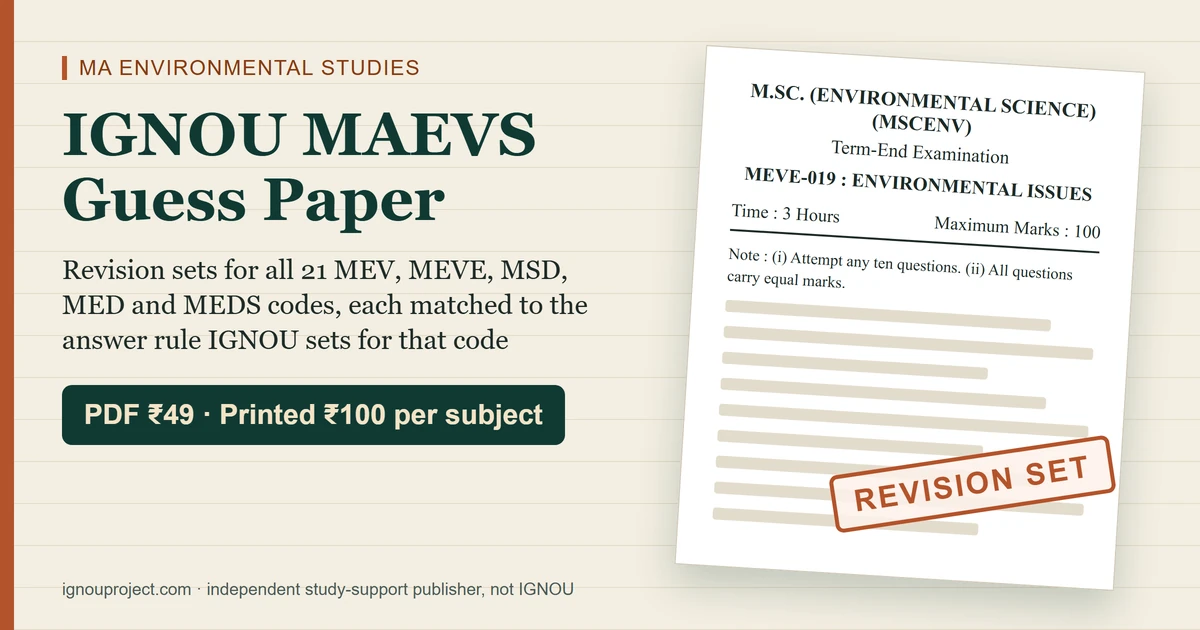
Every MAEVS term-end paper from June 2023 to June 2026 compared here prints another programme’s name in its heading: the MEV-011 to MEV-019 and MEVE papers say M.Sc. (Environmental Science) (MSCENV), MEV-024 and MEV-025 say PGCCC, MEV-002 says PGDEOH, MSD-019 and MSD-023 say MASS, MED-003 says PGDESD, joined by MSCRWEE from June 2025, and MEDS-042 has said PGDUPDL, then PGDUPDL/MADVS, then PGDUPDL/MAUS. A MAEVS learner holding a paper headed MSCENV is holding the right paper.
The Answer Rule On The Latest IGNOU Paper
On a phone, swipe the table sideways for every column.
| Code | Heading on the paper | Latest IGNOU paper | Time and marks | Answer rule | Medium |
|---|---|---|---|---|---|
| MEV-011 | MSCENV | June 2026 | 3 hours, 100 marks | Any ten questions, 10 marks each | English |
| MEVE-019 | MSCENV | June 2026 | 3 hours, 100 marks | Any ten questions, 10 marks each | English |
| MEV-015 | MSCENV | June 2026 | 3 hours, 100 marks | Any ten questions, 10 marks each | English |
| MEVE-017 | MSCENV | June 2026 | 3 hours, 100 marks | Any ten questions, 10 marks each | English |
| MSD-019 | MASS | June 2026 | 3 hours, 100 marks | Any ten questions, 10 marks each | English |
| MEV-016 | MSCENV | June 2026 | 3 hours, 100 marks | Any ten questions, 10 marks each | English |
| MEVE-011 | MSCENV | June 2026 | 3 hours, 100 marks | Any ten questions, 10 marks each | English |
| MEV-017 | MSCENV | June 2026 | 3 hours, 100 marks | Any ten questions, 10 marks each | English |
| MEVE-016 | MSCENV | June 2026 | 3 hours, 100 marks | Any ten questions, 10 marks each | English |
| MEV-014 | MSCENV | June 2026 | 3 hours, 100 marks | Any ten questions, 10 marks each | English |
| MEV-019 | MSCENV | June 2026 | 3 hours, 100 marks | Any ten questions, 10 marks each | English |
| MEVE-014 | MSCENV | June 2026 | 3 hours, 100 marks | Any ten questions, 10 marks each | English |
| MEV-024 | PGCCC | June 2026 | 3 hours, 100 marks | Any ten questions, 10 marks each | English |
| MEV-002 | PGDEOH | June 2026 | 3 hours, 100 marks | Any ten questions, 10 marks each | English |
| MEV-025 | PGCCC | June 2026 | 3 hours, 100 marks | Any ten questions, 10 marks each | English |
| MSD-023 | MASS | June 2026 | 3 hours, 100 marks | Any ten questions, 10 marks each | English |
| MEV-018 | MSCENV | June 2026 | 3 hours, 100 marks | Any ten questions, 10 marks each | English |
| MED-003 | PGDESD/MSCRWEE | June 2026 | 2 hours, 50 marks | Any five of seven questions, 10 marks each, most split 5 + 5 | English |
| MEVE-012 | MSCENV | June 2026 | 3 hours, 100 marks | Printed: answer all twelve questions, each marked 10 | English |
| MEVE-015 | MSCENV | June 2026 | 3 hours, 100 marks | Any ten questions, 10 marks each | English |
| MEDS-042 | PGDUPDL/MAUS | June 2026 | 3 hours, 100 marks | Any five of eight questions, 20 marks each | English and Hindi in one paper |
The June 2026 papers behind the rows outside the theme tables are on IGNOU’s site: MEV-011 June 2026, MEV-014 June 2026, MEV-015 June 2026, MEV-016 June 2026, MEV-017 June 2026, MEV-018 June 2026, MEV-019 June 2026, MEV-002 June 2026, MEV-025 June 2026, MSD-019 June 2026, MSD-023 June 2026, MEVE-011 June 2026, MEVE-012 June 2026, MEVE-014 June 2026, MEVE-015 June 2026 and MEVE-012 December 2025.
Minutes For Each Answer, By Layout
Ten minutes for reading the paper and choosing questions is taken off first in every row; what is left is split evenly.
On a phone, swipe the table sideways for every column.
| Paper | Layout | Time per answer |
|---|---|---|
| 18 codes (MEV, MEVE, MSD) | 3 hours, 100 marks, any ten | about 17 minutes per 10-mark answer |
| MEDS-042 | 3 hours, 100 marks, any five of eight | about 34 minutes per 20-mark answer |
| MED-003 (June 2026) | 2 hours, 50 marks, any five of seven | about 22 minutes per 10-mark answer |
| MED-003 (June 2024 to December 2025) | 2 hours, 50 marks, compulsory Q1 plus any three | about 44 minutes for Q1, then about 22 per answer |
| MEVE-012 (June 2026, as printed) | 3 hours, 100 marks, all twelve | about 14 minutes per answer if all twelve are attempted |
MED-003 changed its layout in June 2026. From June 2024 to December 2025, the MED-003 Energy and Environment paper made Question 1 compulsory, four 5-mark parts worth 20 marks, and then asked for any three of Questions 2 to 6 at 10 marks each, inside 2 hours and 50 marks. The June 2026 paper dropped the compulsory question and printed seven questions with the note “Attempt any five questions”. A MED-003 set built on the old layout trains a 20-mark opening answer that the latest paper no longer asks for.
The June 2026 MEVE-012 instruction does not add up. IGNOU’s June 2026 MEVE-012 Environmental Management paper prints “Answer all the questions” above twelve questions, each marked 10, under a maximum of 100 marks; twelve answers of 10 make 120. The December 2025 MEVE-012 paper said “Answer any ten questions” over fourteen. Whatever the December 2026 paper prints is what counts, so its first instruction line is worth reading twice.
Question Counts Move, So The Skip Margin Moves
The any-ten rule does not fix how many questions appear. MEVE-019 printed fourteen in all seven sessions from June 2023 to June 2026. MEVE-016 printed twelve in December 2024 and again in June 2026, leaving only two to skip, and fourteen in between. MEVE-017 printed fourteen three times and thirteen in June 2026. MEV-024 has held at fourteen. The thinner the paper, the more themes a learner needs ready.
Old MAEVS material to treat with care. Guess sets and notes built for the MED-003 compulsory-question layout, for a 3-hour MED-003 paper, or for MEDS-042 as a ten-answer paper do not match what IGNOU set in June 2026. Material listed only under MSCENV can still be the right MAEVS material, because the code and paper are shared; what matters is the code, not the programme name on the cover.
Where IGNOU’s own documents disagree, including on this site.
- The July 2026 Common Prospectus prints MEVE 017 as “Environmental and Society”; every MEVE-017 paper, the MAEVS First Year booklet and the Programme Guide say “Environment and Society”.
- The MAEVS Programme Guide lists the fifth Semester I course as “MSD 023 Global Strategies to Sustainable Development”. The prospectus and booklet give that title to MSD-019; MSD-023 is the Semester III elective Social Ecology, Globalisation and Sustainability. The code on the hall ticket decides.
- The same guide heads the Environment and Society syllabus “MEV 017”, a code that belongs to Environmental Legislations.
- MEV-015 is a Semester I course in MAEVS but sits in Semester II of the MSCENV table; the paper is the same.
- IGNOU filed MED-003 as a joint “MED-003/MED-009” paper in December 2024 and June 2025, and as MED-003 alone in June 2024 and from December 2025. MEVE-014 was filed as “MEVE-14” from December 2024 to December 2025.
- On this site, the MAEVS handwritten assignment page describes assignment layouts, which differ from the term-end layouts above; the two should not be confused.
Themes IGNOU Keeps Setting In Six MAEVS Courses
MEV-024 Climate Change Assessment Tools repeated more of itself than any other MAEVS course compared here: nine themes appeared in all four papers from December 2024 to June 2026, including vulnerability assessment, early warning systems, life cycle assessment, crop simulation models and soil carbon sequestration. Its 14-question, any-ten paper leaves room to skip four, yet most of a recent MEV-024 paper keeps returning to the same blocks.
The counts on this page come from 28 IGNOU term-end papers for six MAEVS courses: seven MEVE-019 papers from June 2023 to June 2026, five MED-003 papers from June 2024 to June 2026, and four papers each for MEVE-017, MEVE-016, MEV-024 and MEDS-042 from December 2024 to June 2026. ignouproject.com compared each paper in full on 4 November 2026. A theme is counted when a question asks about the same topic, however it is worded, so matching is a human judgement rather than a word search. A cell shows the question number; a letter marks a part or a short note. “n of N” means the theme appeared in n of the N papers listed for that course.
The theme tables cover MEVE-019, MEVE-017, MEVE-016, MEV-024, MED-003 and MEDS-042. For the other fifteen MAEVS codes, the latest answer rule is in the table above, and the themes are confirmed against the latest IGNOU paper on WhatsApp.
MEVE-019 Environmental Issues, Seven Sessions
MEVE-019 Environmental Issues set three themes in all seven papers from June 2023 to June 2026: biomass and crop residue burning, persistent organic pollutants, and biodiversity loss and conservation. Stratospheric ozone depletion went the other way, asked in June 2023, December 2023 and June 2024 and absent from the four papers since. Short-note questions shrank as well, from five in June 2023 to none in June 2025 and one in June 2026.
On a phone, swipe the table sideways for every column.
| Theme | June 2023 | December 2023 | June 2024 | December 2024 | June 2025 | December 2025 | June 2026 | n of N |
|---|---|---|---|---|---|---|---|---|
| Biomass and crop residue burning | 8 | 8 | 7 | 9 | 2 | 13 | 6 | 7 of 7 |
| Persistent organic pollutants | 4 | 5 | 4 | 12 | 3 | 14 | 3 | 7 of 7 |
| Biodiversity loss and conservation | 6, 7 | 6, 7 | 5, 6a | 10 | 1 | 12 | 5 | 7 of 7 |
| Soil pollution | 9 | – | 10 | 2 | 7 | 3 | 9 | 6 of 7 |
| Causes and impacts of climate change | 2 | 3 | 2 | – | 4 | 7, 10 | 2 | 6 of 7 |
| Eutrophication | 12 | – | – | 3 | 12 | 5 | 12 | 5 of 7 |
| Arsenic pollution | 13a | – | 14 | 8a | 9 | – | 10 | 5 of 7 |
| Agricultural intensification and fertiliser use efficiency | 13b | – | 12 | 6 | 11, 13 | – | 11, 14 | 5 of 7 |
| Sustainable development and the SDGs | – | 14 | 9 | 1, 8b | – | 8 | 13a | 5 of 7 |
| Food security and malnutrition | – | 13a | 13a | 7a | – | 6a | 13b | 5 of 7 |
| Tropospheric ozone | 1b | – | – | 11 | 5 | – | 1 | 4 of 7 |
| Land degradation | – | 10 | – | 14a | 8 | 4 | – | 4 of 7 |
| Marine pollution | – | 11b | – | 4 | – | 1 | 8 | 4 of 7 |
| Sustainable urbanisation | – | – | 8 | – | 10 | 9 | 7 | 4 of 7 |
| Radioactive waste | 5a | – | 4 | 12 | – | – | 4 | 4 of 7 |
| Stratospheric ozone depletion | 3 | 4 | 3 | – | – | – | – | 3 of 7 |
| Fluoride pollution | – | 12 | – | 5a | – | 2b | – | 3 of 7 |
| Green and sustainable buildings | – | 13b | – | 7b | 6 | – | – | 3 of 7 |
The seven MEVE-019 papers behind this table, each headed for MSCENV, open from IGNOU’s archive: MEVE-019 June 2023, MEVE-019 December 2023, MEVE-019 June 2024, MEVE-019 December 2024, MEVE-019 June 2025, MEVE-019 December 2025 and MEVE-019 June 2026.
MEVE-017 Environment And Society
MEVE-017 reads like a sociology paper until the evolution questions arrive: Darwin, natural selection or speciation appeared in all four papers, often as two separate questions. Technology and the environment was also 4 of 4. The June 2026 paper leaned hard on the June 2025 one, with its questions on how environment and society interrelate and on eco-spiritualism returning almost word for word.
On a phone, swipe the table sideways for every column.
| Theme | December 2024 | June 2025 | December 2025 | June 2026 | n of N |
|---|---|---|---|---|---|
| Technology and the environment | 11 | 8 | 10 | 6 | 4 of 4 |
| Darwin, evolution and speciation | 9, 10 | 10, 11 | 13, 14 | 8, 9 | 4 of 4 |
| Types and characteristics of society | 1 | 4 | – | 1 | 3 of 4 |
| Environmental justice and inequality | 6 | – | 8 | 4, 11 | 3 of 4 |
| Social ecology and deep ecology | – | 12 | 6b | 12 | 3 of 4 |
| Environmental movements (Silent Valley, Green Belt) | – | 1, 9 | 12 | – | 2 of 4 |
| How environment and society interrelate | – | 7 | – | 5 | 2 of 4 |
| Eco-spiritualism | – | 13 | – | 3 | 2 of 4 |
| Women, eco-feminism and conservation | 3, 4 | 2 | – | – | 2 of 4 |
| Population structure and theory | 8, 14 | 5, 14 | – | – | 2 of 4 |
| Society, culture and its elements | 13 | – | 2 | – | 2 of 4 |
| Migration, resettlement and rehabilitation | – | 6 | 11 | – | 2 of 4 |
IGNOU’s MEVE-017 files for these four sessions: MEVE-017 December 2024, MEVE-017 June 2025, MEVE-017 December 2025 and MEVE-017 June 2026.
MEVE-016 Urban Environment
Three MEVE-016 themes appeared in every paper from December 2024 to June 2026: urban wetlands, urban forests and low-carbon or urban transport. The December 2025 and June 2026 papers both asked how cities adapt to climate change and how adaptation differs from adaptive capacity, in the same 5 + 5 split.
On a phone, swipe the table sideways for every column.
| Theme | December 2024 | June 2025 | December 2025 | June 2026 | n of N |
|---|---|---|---|---|---|
| Urban wetlands | 7 | 8 | 9 | 7 | 4 of 4 |
| Urban forests | 3 | 6 | 13 | 5 | 4 of 4 |
| Low-carbon and urban transport | 12 | 14 | 1 | 11 | 4 of 4 |
| Cities adapting to climate change | 6, 9 | – | 8 | 8 | 3 of 4 |
| Green infrastructure | 4 | – | 2 | 12 | 3 of 4 |
| Causes and consequences of urbanisation | 1 | 2 | – | 2 | 3 of 4 |
| Land use and urban planning | – | 10 | 7 | 9 | 3 of 4 |
| Housing and slum redevelopment | 2 | – | 4, 10 | 10a | 3 of 4 |
| Life-support resources and ecosystem services | 5 | 3 | 11 | – | 3 of 4 |
| Characteristics of urban settings | – | 1 | – | 1 | 2 of 4 |
| Urban water supply, drainage and sanitation | – | 4 | – | 4 | 2 of 4 |
| Urban biodiversity | – | 7 | – | 6 | 2 of 4 |
Sources: MEVE-016 December 2024, MEVE-016 June 2025, MEVE-016 December 2025 and MEVE-016 June 2026.
MEV-024 Climate Change Assessment Tools
Nine of the twelve MEV-024 themes below are 4 of 4. The paper’s short notes come in pairs worth 5 + 5, and the December 2025 paper printed four laws of radiation (Kirchhoff, Planck, Stefan-Boltzmann and Wien) in one question marked “2 × 4 = 10”, an arithmetic slip worth knowing about before the exam.
On a phone, swipe the table sideways for every column.
| Theme | December 2024 | June 2025 | December 2025 | June 2026 | n of N |
|---|---|---|---|---|---|
| Climate change vulnerability: approaches and index | 1, 2, 3 | 1, 2, 3 | 11 | 11 | 4 of 4 |
| Early warning systems | 7 | 13b | 8 | 3 | 4 of 4 |
| Life cycle assessment | 11 | 9 | 1 | 5 | 4 of 4 |
| Crop simulation models | 4, 14 | 4 | 12 | 12, 14 | 4 of 4 |
| Soil carbon sequestration | 12 | 14a | 2 | 8 | 4 of 4 |
| Geoinformatics in climate change studies | 8 | 6 | 9 | 1 | 4 of 4 |
| Remote sensing and electromagnetic radiation | 9, 10b | 8, 11, 12 | 4, 5, 7b | 4, 9 | 4 of 4 |
| Vector, raster and spatial data | 5a | 5, 14b | 6a, 10a | 6 | 4 of 4 |
| Disaster risk reduction and risk assessment | 6a, 10a | 7, 13a | 10b | 2 | 4 of 4 |
| Climate and modelling types (GCM, RCM) | 6b, 13 | 10a | 6b, 13 | – | 3 of 4 |
| Greenhouse gas inventories | – | – | 3 | 10 | 2 of 4 |
| Carbon isotopes | – | 10b | – | 7 | 2 of 4 |
MEV-024 papers, each headed for the PG Certificate in Climate Change: MEV-024 December 2024, MEV-024 June 2025, MEV-024 December 2025 and MEV-024 June 2026.
MED-003 Energy And Environment
Biomass and solar questions appeared in all five MED-003 papers from June 2024 to June 2026. The June 2026 paper reused the June 2025 Question 2 in both its parts, on direct-combustion biomass technologies and on a wind energy system with a labelled diagram, and asked “What is energy planning?” twice, as Question 2(a) and Question 4(b).
On a phone, swipe the table sideways for every column.
| Theme | June 2024 | December 2024 | June 2025 | December 2025 | June 2026 | n of N |
|---|---|---|---|---|---|---|
| Biomass and biogas technologies | 2a | 3a | 2a | 3a | 3a | 5 of 5 |
| Solar thermal and photovoltaic systems | 6a | 6d | 6d | 5a | 7d | 5 of 5 |
| Hydropower plants and their environmental issues | 2b, 5b | 1b | 6b | 5b | – | 4 of 5 |
| Wind energy systems | – | 5a | 2b | 6c | 3b | 4 of 5 |
| Sustainable energy policy objectives | 6b | 1a | – | 1a | 2b | 4 of 5 |
| Energy planning and its benefits | 6c | 6c | 6c | – | 2a, 4b | 4 of 5 |
| Energy for the urban poor | 3a | – | – | 1c | 6b | 3 of 5 |
| Governance and finance for energy | 1a | – | – | 3b | 1a | 3 of 5 |
| Energy demand, industrialisation and population | 3b | – | 4a | – | 5a | 3 of 5 |
| Energy economics, demand and price | – | 4b | 5a | – | 6a | 3 of 5 |
| CO2 emissions from fossil fuels | – | 4a | 4b | – | 5b | 3 of 5 |
| Scenarios of future energy use | – | 6a | – | 6d | 4a | 3 of 5 |
| Energy efficiency in buildings | 6d | – | – | 6a | 7a | 3 of 5 |
To see the June 2026 change of layout for yourself, compare the MED-003 papers in order: MED-003 June 2024, MED-003 December 2024, MED-003 June 2025, MED-003 December 2025 and MED-003 June 2026.
MEDS-042 Issues And Challenges In Urban Planning And Development
MEDS-042 asks for five long answers from eight questions, so a single theme carries 20 marks. Six themes appeared in three of the four papers, with municipal solid waste set as Question 3 in December 2024, June 2025 and June 2026. The December 2024 paper asked about the informal sector twice, as Questions 7 and 8.
On a phone, swipe the table sideways for every column.
| Theme | December 2024 | June 2025 | December 2025 | June 2026 | n of N |
|---|---|---|---|---|---|
| Municipal solid waste | 3 | 3 | – | 3 | 3 of 4 |
| Phases of industrial development | 6c | 1 | – | 5b | 3 of 4 |
| Sustainable urban energy planning | – | 4 | 8 | 5a | 3 of 4 |
| Urban paradox, crime and violence | – | 2, 6 | 5c | 2 | 3 of 4 |
| Urban land markets | 6b | 5c | 3 | – | 3 of 4 |
| Urban health care | – | 5a | 6 | 5c | 3 of 4 |
| Urban poverty and the informal sector | 6a, 7, 8 | – | 1, 2 | – | 2 of 4 |
| Water and sanitation | – | – | 4, 7 | 6 | 2 of 4 |
| Urban education | – | 7 | – | 4 | 2 of 4 |
| Urban unemployment | – | 8 | – | 8 | 2 of 4 |
| Urban housing | – | 5b | – | 1 | 2 of 4 |
Bilingual MEDS-042 files: MEDS-042 December 2024, MEDS-042 June 2025, MEDS-042 December 2025 and MEDS-042 June 2026.
Questions IGNOU Has Reprinted Almost Word For Word
On a phone, swipe the table sideways for every column.
| Code | Topic phrase | Earlier paper | Later paper |
|---|---|---|---|
| MED-003 | Biomass technologies based on direct combustion | June 2025, Q2(a) | June 2026, Q3(a) |
| MED-003 | Population growth and industrialisation driving energy demand | June 2025, Q4(a) | June 2026, Q5(a) |
| MEVE-017 | How environment and society are interrelated | June 2025, Q7 | June 2026, Q5 |
| MEVE-017 | Allopatric and sympatric speciation | December 2025, Q13 | June 2026, Q8 |
| MEVE-016 | Adaptation and adaptive capacity in cities | December 2025, Q8 | June 2026, Q8 |
| MEV-024 | Spectral signatures of common earth surface features | December 2024, Q9 | June 2025, Q11 |
| MEVE-019 | Anthropogenic causes of climate change | June 2024, Q2 | June 2025, Q4 |
A reprint in one session is no promise of another. These rows show that IGNOU does reuse questions in these courses, which is a reason to revise the recurring themes properly, not to memorise a list. The site’s IGNOU last year papers guide explains where older sessions sit.
How A MAEVS Revision Set Is Put Together
- Code first, programme name second. The set starts from the code on the hall ticket, so a MEVE-016 learner gets the MEVE-016 set whatever programme name the paper prints.
- Latest layout. The June 2026 paper for that code fixes the answer count and length: ten answers of about 17 minutes, five of about 34 for MEDS-042, or five of about 22 for MED-003.
- Recurring themes ranked. Themes seen in the most sessions come first, then those seen twice; a theme seen once is treated as seen once.
- Answers written to the marks. A 2 + 8 question gets a two-line definition and an eight-mark body; a 5 + 5 short-note pair gets two balanced notes.
- Checked against the syllabus blocks. Every answer is checked against the IGNOU course blocks, so a theme that has not yet been asked is not left out just because it is new.
Limits Of A MAEVS Set, Stated Plainly
A guess paper is a revision aid built from past IGNOU question papers and the syllabus. No one outside IGNOU knows the questions in advance, and no claim is made that any question in this set will appear in your examination.
Where A Set Helps
It puts the themes MEV-024, MEVE-019 or MED-003 keep returning to at the front of the revision queue, shows how long a MEDS-042 answer has to be to fill 20 marks, and turns 17 minutes per MEVE answer into a writing habit before exam day.
Where A Set Cannot Help
It cannot tell which twelve or fourteen questions IGNOU will print in December 2026, it cannot replace the course blocks for a theme IGNOU has not asked before, and it cannot protect a learner from a layout IGNOU changes, as MED-003 did in June 2026, until the new paper is published. Study the official IGNOU material for every course you are sitting; a guess paper supplements that material and does not replace it.
Revising on no budget? Every MAEVS block is free through the eGyanKosh course material guide or the Gyankosh download route, the printed books are explained under IGNOU books download, and summary notes sit on the IGNOU study notes page. The IGNOU papers linked in the theme tables above are free too.
Free Sequencer And Layout Checker For MAEVS
The first tool turns the MAEVS codes on a hall ticket into a dated December 2026 sequence; the second shows the answer rule and minutes for one code. Both read the same facts as the tables above.
Free tool 1
MAEVS Sitting Sequencer
Any figure from 0.5 to 16. It is used to turn the gap before each paper into revision hours.
This tool is guidance from ignouproject.com, not an IGNOU rule. Using it creates no obligation to order anything.
Free tool 2
MAEVS Layout And Minutes Check
Shows the programme name printed on the paper, the June 2026 answer rule, minutes per answer and, for six codes, the most frequent themes.
This tool is guidance from ignouproject.com, not an IGNOU rule. Using it creates no obligation to order anything.
Neither tool sends anything anywhere: the dates, rules and themes are built into the page and match the course, pattern and theme tables.
Locating MAEVS Files In IGNOU’s Archive
IGNOU publishes each session’s papers on a single index page, and MAEVS papers are filed under their code, not under MAEVS. The indexes for June 2026, December 2025, June 2025 and December 2024 hold every paper in the theme tables from December 2024 on.
- Load the session’s index, then use the browser’s find box to look for the code, MEVE-016 for instance.
- Confirm the session on page 1, just below “Term-End Examination”; the December 2024 files live in a folder whose name gives no session.
- Expect another programme’s name in the heading, as explained in the course section.
- For dates, use IGNOU’s own PDF: the December 2026 date sheet of 30 October 2026, which replaced the tentative sheet of 21 September 2026.
The current MAEVS First Year assignment booklet, valid to December 2026, sets five 20-mark answers per course, half the answer count of most term-end papers. Older date-sheet versions and their changes are tracked on the site’s IGNOU date sheet page.
After 30 December: Marks, Rechecks And Grade Cards
After the last MAEVS paper on 30 December, results arrive course by course. The IGNOU term-end result page and the IGNOU MA result guide show where marks appear, and the most recent cycle’s notes are on the June 2026 result page.
Assignment marks, which carry 30 per cent, are checked through the IGNOU assignment result status. A disputed term-end mark goes to IGNOU revaluation; the full record later appears on the final grade card, and the IGNOU CGPA calculator converts grade points.
Beyond The MAEVS Term-End Paper
Assignment help for the same codes is on the MAEVS handwritten assignment page and the wider IGNOU solved assignments catalogue, guidebooks on IGNOU help books and IGNOU guide books online, and learners on the Semester IV project are directed to the MEVP-012 project guide.
English, Hindi And The Session Each MAEVS Set Targets
Each set is prepared for the upcoming term-end examination, in every medium IGNOU examines that course in, and the medium for your course code is confirmed on WhatsApp before you pay.
For MAEVS that means English for every code: the July 2026 Common Prospectus and the Programme Guide give English as the medium of instruction, and every MEV, MEVE, MSD and MED paper compared here is printed in English only. MEDS-042 is the exception on paper. Each of its four papers from December 2024 to June 2026 prints the English questions followed by a Hindi version with the same eight questions and the same 20-mark split, so a learner who wants MEDS-042 in Hindi can raise it on WhatsApp before paying.
The date sheet’s fourth instruction allows answers in Hindi even when a learner registered in English, outside language programmes. That is an IGNOU rule about answer scripts; it does not change the medium in which the other MAEVS question papers are printed. Sets ordered now target December 2026. For June 2027, sets are revised once IGNOU publishes its December 2026 papers.
Four Steps From Hall Ticket To Set
- Send the codes from the hall ticket, with PDF or printed for each.
- Receive the total, with the courier line if any code is printed.
- Confirm English, or Hindi for MEDS-042 if wanted, and pay.
- The PDF then arrives in the same WhatsApp chat; for print, the courier’s tracking details follow dispatch.
The rate is ₹49 per subject code for a solved guess paper as a PDF, or ₹100 per subject code as a printed copy. Printed copies carry a one-time courier charge of ₹100 per order, whatever the number of subject codes; the PDF has no courier charge. The PDF is shared on WhatsApp once payment is confirmed. A printed copy is dispatched the next day after payment is confirmed, and the courier details are shared on WhatsApp. No arrival date is promised, because transit time depends on the courier and your location. There is no minimum order: one subject or ten, same rate per format.
A full Semester III selection is five codes, so its PDF total is ₹245 and its printed total ₹600 including the single courier charge. The publisher’s other rates are set out in its services and charges list.
₹49 PDF · ₹100 printed, per subject code
Who Compiled This, From Which IGNOU Documents
IGNOU documents. The July 2026 Common Prospectus (section 3.42), the MAEVS Programme Guide on eGyanKosh, the MAEVS First Year assignment booklet for January 2025 to July 2026, IGNOU’s December 2026 date sheets of 21 September and 30 October 2026, and the term-end papers linked in the course and theme sections.
ignouproject.com’s own analysis. The theme tables, the n of N counts, the repeated-wording table, the minutes per answer and the heading list. These are judgements made by comparing IGNOU’s papers on 4 November 2026; IGNOU has not reviewed them.
Commercial terms. The prices, formats, courier charge and dispatch rule belong to ignouproject.com and Shri Chakradhar Publication Pvt. Ltd., not to IGNOU.
Written and reviewed by BK Sahni, Founder, Shri Chakradhar Publication Pvt. Ltd. and ignouproject.com, who has guided 5,00,000 students till date. ORCID 0009-0005-8092-459X. Serving IGNOU learners since 2010. ORCID record of BK Sahni.
Published 4 November 2026. Last reviewed 4 November 2026. Next review: May 2027, when IGNOU’s June 2027 date sheet is expected. Limits: the December 2026 sheet can still change, the theme counts cover six of the 21 codes, and the June 2026 papers are the latest IGNOU has published.
MAEVS Questions, Answered Briefly
Yes. ignouproject.com prepares a separate December 2026 guess paper for each of the 21 MAEVS theory codes, from MEV-011 to MEDS-042. Each set follows the answer rule IGNOU used for that code in June 2026, so the MED-003 and MEDS-042 sets differ in shape from the MEV and MEVE sets.
Each MAEVS code costs ₹49 as a PDF and ₹100 as a printed copy. A printed order adds one courier charge of ₹100, however many codes it holds; the PDF has no courier charge. There is no minimum order, so one code can be bought alone.
In MEV-024, nine themes appeared in all four papers from December 2024 to June 2026, including early warning systems and life cycle assessment. In MEVE-019, biomass burning, persistent organic pollutants and biodiversity loss appeared in all seven papers from June 2023 to June 2026. Past repetition does not fix the coming paper.
Eighteen of the 21 MAEVS codes used one rule in June 2026: 3 hours, 100 marks, and any ten questions worth 10 each. MEDS-042 asks for any five of eight at 20 marks. MED-003 is a 2-hour, 50-mark paper that asked for any five of seven in June 2026.
MAEVS shares its codes with other IGNOU programmes, and IGNOU heads each paper with one of them. MEV and MEVE papers print MSCENV, MEV-024 prints PGCCC, MSD codes print MASS, MED-003 prints PGDESD and MEDS-042 prints PGDUPDL. The code decides whether the paper is the right one, not the programme name.
The MAEVS December 2026 papers start on Wednesday 2 December 2026, with MEV-024 in the morning and MEV-011 in the evening, and end with MEV-017 on Wednesday 30 December 2026. These dates come from IGNOU’s date sheet of 30 October 2026, which IGNOU can still revise before the examination.
No. A previous year question paper is the real paper IGNOU set for a code in an earlier session, free on IGNOU’s site. A guess paper is a publisher’s revision set for one code, grouping themes that recur across several past papers and adding model answers. It is not an IGNOU document.
Yes. IGNOU publishes MAEVS papers free on its session index pages, filed under each course code such as MEVE-019 or MED-003 rather than under MAEVS. The June 2026 index is the latest session IGNOU has published.
Solving IGNOU’s own previous papers is free and shows the exact MAEVS layouts. A guess paper saves the sorting work by ranking recurring themes across sessions and supplying answers sized to the marks. Many learners use both: the free papers for practice under time, the set for the answers.
Yes. MED-003 Energy and Environment is a 2-hour paper for 50 marks, while most MAEVS papers run 3 hours for 100. Until December 2025 its first question was compulsory and worth 20 marks; the June 2026 paper asked for any five of seven questions instead, each worth 10 marks.
MAEVS is taught in English, and every MEV, MEVE, MSD and MED paper is printed in English only. IGNOU’s December 2026 date sheet lets learners answer in Hindi even if registered in English, outside language programmes. MEDS-042 is printed in both English and Hindi, so a Hindi MEDS-042 set can be requested.
A MAEVS theory course needs at least 40 per cent in the assignment and at least 40 per cent in the term-end examination, each counted separately, according to IGNOU’s MAEVS Programme Guide. Of the course result, 70 per cent rides on the term-end paper and 30 per cent on the assignment.
No one outside IGNOU knows the December 2026 questions, so no MAEVS guess paper can promise any of them. A set ranks the themes IGNOU has set most often, such as the nine MEV-024 themes seen in four of four papers, and gives answers of the right length.
Check the session first. MEV-024 and MEV-011 share Wednesday 2 December 2026, but one is in the morning and one in the evening, so both can be sat. MEVE-011 and MEDS-042 share Thursday 24 December in the same evening session; a learner with both should contact the Regional Centre.
Yes. Every MAEVS set is available as a printed copy at ₹100 per subject code, plus a one-time ₹100 courier charge per order. The printed copy is dispatched the next day after payment is confirmed, and the courier details are shared on WhatsApp; arrival depends on the courier and location.
Message the MAEVS codes from the hall ticket to WhatsApp +91 93546 37830, with PDF or printed for each code. The total comes back with any courier line, the medium is confirmed, and after payment the PDF arrives on WhatsApp or the printed copy is dispatched the next day.
No single answer fits every learner. A sound MAEVS set names the current code, follows the latest layout for that code, such as the June 2026 MED-003 any-five rule, says which session it targets, and writes answers to the marks. Any seller quoting a share of questions that will come should be treated with caution.
Important Notice
ignouproject.com is an independent IGNOU study-support publisher. It is not the official website of Indira Gandhi National Open University, is not affiliated with, endorsed by or authorised by the university, and no page on this site should be treated as an official IGNOU communication.
Programme structures, course codes, examination dates, question-paper patterns and rules change, and only ignou.ac.in and your Regional Centre can confirm the current position for your enrolment.
A guess paper is a revision aid built from past IGNOU question papers and the syllabus. No one outside IGNOU knows the questions in advance, and no claim is made that any question in this set will appear in your examination.
Study the official IGNOU material for every course you are sitting; a guess paper supplements that material and does not replace it.
No claim is made about the marks you will receive, about how an evaluator will assess your answers, or about your result. Examination and evaluation are entirely a matter for IGNOU.

BK Sahni iD 0009-0005-8092-459X
Founder, Shri Chakradhar Publication Pvt. Ltd. & ignouproject.com — helping IGNOU distance-learning students since 2010 (5,00,000+ students supported across MBA, MCom, MA & more). Author of IGNOU exam guides, solved assignments & project reference books.
Disclosure: Shri Chakradhar Publication Pvt. Ltd. and ignouproject.com are independent third-party study-help services — not the official IGNOU website. Always verify final dates and rules on ignou.ac.in.