IGNOU MA Economics (MAEC), December 2026 term-end examination
IGNOU set three MEC-101 questions in December 2025 that it had already asked, almost word for word, six months earlier.
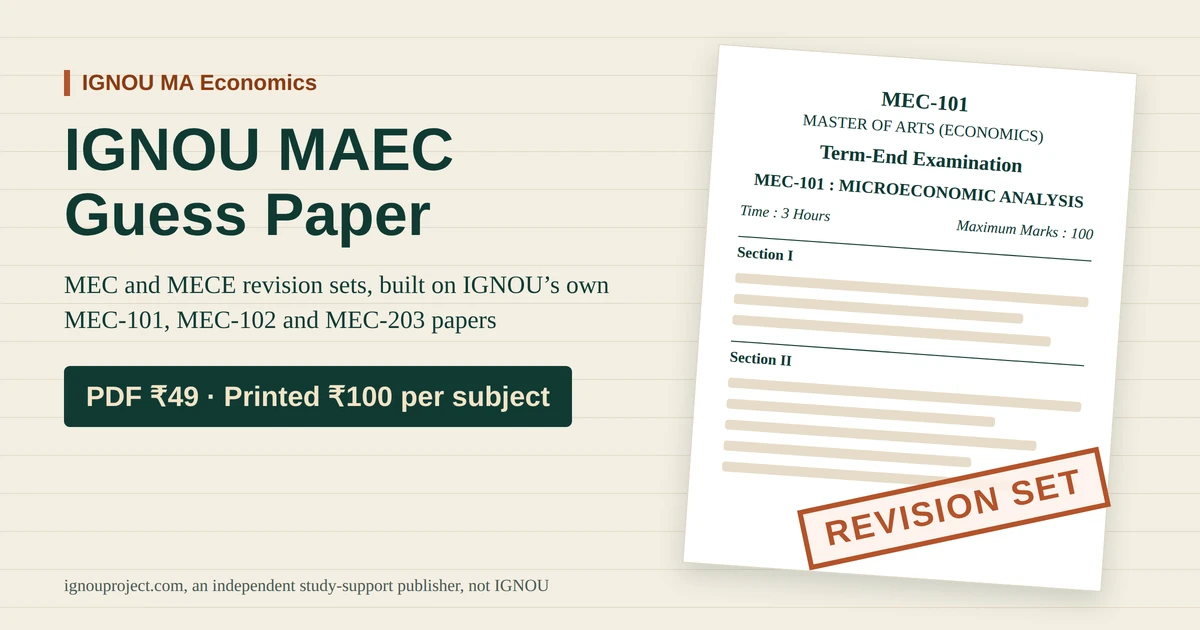
Revision sets for each MEC, MECE and adopted elective code, built on twelve IGNOU MEC question papers from June 2022 to December 2025 and the tentative December 2026 date sheet printed on 21 September 2026.
- 12 IGNOU MEC papers reviewed
- MEC-102 opens on 1 December
- MEC-110 closes on 4 January 2027
- Two from Section I, five from Section II
- English and Hindi in one paper
- PDF or printed copy
₹49 PDF · ₹100 printed, per subject code
Send my MEC codes on WhatsAppTell us the codes and the medium you write in; each set is matched to IGNOU’s latest paper for that code before you pay.
Quick answer. An IGNOU MAEC guess paper is a revision set of important and recurring questions, with model answers, for one MA Economics course code such as MEC-101 or MEC-203, and ignouproject.com prepares it for the December 2026 term-end examination. IGNOU’s tentative date sheet printed on 21 September 2026 runs the cycle from 25 November 2026 to 13 January 2027; the compulsory MEC papers start with MEC-102 on 1 December and end with MEC-110 on 4 January 2027. The MEC-101, MEC-102 and MEC-203 papers from 2024 and 2025 are all 3 hours and 100 marks: two 20-mark questions from Section I or A and five 12-mark questions from Section II or B, printed in English and Hindi. The rate is ₹49 per subject code as a PDF or ₹100 per subject code as a printed copy, and printed orders carry a one-time ₹100 courier charge. MEC codes are examined in English and Hindi, and your medium is confirmed on WhatsApp. No one outside IGNOU knows the questions in advance.
MAEC Papers in December 2026: MEC-102 on 1 December, MEC-110 on 4 January
The compulsory MEC papers run from Tuesday 1 December 2026 (MEC-102) to Monday 4 January 2027 (MEC-110), per IGNOU’s tentative date sheet printed on 21 September 2026. Group B learners start earlier: MMPC-014, the Financial Management course MAEC borrows from the MBA, sits on 25 November, the first day of the whole cycle.
Tentative, printed 21 September 2026
IGNOU’s December 2026 term-end date sheet (tentative) spans 25 November 2026 to 13 January 2027. Learners had until 25 September 2026 to email datesheet@ignou.ac.in about errors; from then on only IGNOU can move a date, by issuing a fresh sheet. The sheet prints codes without hyphens and does not label its two columns inside each date; a code’s session here is the column it sits in, the left column being the 10 AM to 1 PM paper.
First-semester learners get almost no gap at the start. MEC-102 on Tuesday 1 December is followed by MEC-101 the next morning, and MEC-203, the 8-credit quantitative paper, follows on Friday 4 December with one free day in between.
Back-to-back days and same-day papers for MAEC, per the sheet.
- Semester I: MEC-102 (1 Dec) and MEC-101 (2 Dec) on consecutive days; MEC-203 on 4 Dec.
- Semester III: MEC-106 (8 Dec) and MEC-107 (9 Dec) on consecutive days; MEC-110 waits until 4 Jan 2027.
- A backlog learner carrying Semester I and Semester III sits five papers between 1 and 9 December, with two consecutive pairs.
- Group B: MECE-101 in the morning and MMPF-006 in the evening, both on Monday 28 December. Different sessions, same day.
- Group A: MECE-101, MCS-226 and MECE-102 fall on 28, 29 and 30 December, three days running.
- Group C: MGSE-009 (23 Dec) and MGPE-006 (24 Dec) on consecutive days.
Session clock times are explained on the IGNOU exam timing page, and the whole cycle can be searched by code on the December 2026 date sheet lookup. No paper can be sat without the exam form and its fee, set out on the IGNOU exam fee explainer with payment steps on the online fee payment guide; the centre you are allotted is covered on the exam centre allotment page.
Exam Paper or Assignment: Where Most MEC Marks Are Won
The term-end examination carries 70 per cent of the final course result and assignments carry the remaining 30 per cent.
None of the twelve MEC papers reviewed prints a weightage line, so the split above is IGNOU’s general scheme for theory courses rather than a figure taken from an MEC cover page. What the papers do print is length. Since December 2024 an MEC-102 Section A answer is asked for in about 600 words. A learner who writes 250 words per answer leaves most of each 20 marks on the table, and a good assignment grade cannot recover that. The IGNOU percentage calculator shows how the two components combine once both marks are known.
No pass mark is stated here, because section 3.21 of the July 2026 Common Prospectus does not print one for MAEC.
Guess Paper, IGNOU Past Paper or Solved Paper for an MEC Course
For an MAEC learner, a guess paper is a publisher’s revision set for one course code such as MEC-102: the questions that have kept coming back or carry most weight, each with a model answer, drawn from IGNOU’s earlier papers and the syllabus. Learners also search for it as important questions, expected questions or a model paper. A previous year question paper is the paper IGNOU itself set in an earlier term-end examination, such as the June 2025 MEC-203 paper, and it is free on ignou.ac.in. A solved question paper takes one of those real IGNOU papers and adds a publisher’s answer beneath every question.
| Item | Guess paper | Previous year question paper | Solved question paper |
|---|---|---|---|
| What it is | Recurring and important questions with model answers, per MEC code | IGNOU’s own paper from an earlier session | IGNOU’s earlier paper with answers |
| Who makes it | A publisher | IGNOU | A publisher, on IGNOU’s paper |
| Cost | ₹49 PDF · ₹100 printed, per subject code | Free on ignou.ac.in | Varies |
| Good for | Ranking themes and rehearsing worked numericals | Seeing the exact layout and marks | Checking one complete paper against answers |
| Cannot do | Predict the paper | Explain the answers | Cover themes that paper did not ask |
On a phone, slide the table sideways to see all four columns.
For MEC-101 the order of use matters more than usual. Because IGNOU reused three June 2025 questions in December 2025, an MEC-101 learner should work through the two 2025 papers first, then a guess paper for themes that came back across five sessions, then the blocks. Worked answers to IGNOU’s own papers are collected on the IGNOU solved question papers collection, and sets for other programmes sit on the IGNOU guess paper hub.
What an MEC set covers, course by course.
One code, one set. A Semester III learner pays for MEC-106, not for the six first-year courses.
MEC-101 numericals worked. Utility, production and duopoly problems are solved step by step, as IGNOU sets them.
Section I sized for 20 marks. Long answers are built to the length a 20-mark MEC question carries.
MEC-102 at 600 and 300 words. Answers follow the word guidance IGNOU has printed since December 2024.
MEC-203 by method. Matrices, Taylor series, optimisation, integrals and hypothesis tests, each with worked steps.
Distinguish-between questions. MEC-101’s four-part comparison question is answered as four short, separate contrasts.
Short notes kept short. MEC-102 and MEC-101 notes stop where the marks stop.
Hindi or English. Each set comes in one medium, the one you write the exam in.
Current codes only. MEC-101 to MEC-110 and the MECE electives on the 21 September 2026 sheet.
December 2026 target. Themes weighted towards the 2024 and 2025 papers.
No minimum. One code or nine, the rate per code stays the same.
Checked on WhatsApp first. Code, medium and latest paper layout are confirmed before payment.
Sitting MEC-102 and MEC-101 on 1 and 2 December?
Send the three Semester I codes and your medium. Each set follows IGNOU’s latest paper layout for that code.
₹49 PDF · ₹100 printed, per subject code
Get my Semester I MEC setsMAEC Course Codes, Credits and How Each MEC Paper Is Set
MAEC is an 80-credit programme of four 20-credit semesters, per section 3.21 of the July 2026 Common Prospectus: nine compulsory MEC courses across Semesters I to III, then 20 credits chosen from Group A, B or C. The credits printed for Semesters I, II and III add to 20 each, so the 80 checks.
Semesters I to III: Nine Compulsory MEC Courses
| Code | Title in the July 2026 Common Prospectus | Credits | Semester | December 2026 paper |
|---|---|---|---|---|
| MEC-101 | Microeconomic Theory and Analysis | 6 | I | Wed 2 Dec 2026, morning |
| MEC-102 | Macroeconomic Theory and Analysis | 6 | I | Tue 1 Dec 2026, morning |
| MEC-203 | Quantitative Methods | 8 | I | Fri 4 Dec 2026, morning |
| MEC-104 | Economics of Growth and Development | 8 | II | Fri 11 Dec 2026, morning |
| MEC-109 | Research Methods in Economics | 6 | II | Sat 19 Dec 2026, morning |
| MEC-205 | Indian Economic Policy | 6 | II | Mon 7 Dec 2026, morning |
| MEC-106 | Public Economics | 6 | III | Tue 8 Dec 2026, morning |
| MEC-107 | International Trade and Development | 6 | III | Wed 9 Dec 2026, morning |
| MEC-110 | Money, Financial Institutions and Markets | 8 | III | Mon 4 Jan 2027, morning |
Drag the table left on a narrow screen to reach the date column.
Semester IV: Groups A, B and C
| Code | Title in the July 2026 Common Prospectus | Credits | Group | December 2026 paper |
|---|---|---|---|---|
| MECE-101 | Introductory Econometric Methods | 4 | A, B, C | Mon 28 Dec 2026, morning |
| MECE-102 | Advanced Econometric Methods | 4 | A, B | Wed 30 Dec 2026, morning |
| MCS-226 | Data Science and Big Data | 4 | A | Tue 29 Dec 2026, evening |
| MCS-224 | Artificial Intelligence and Machine Learning | 4 | A | Mon 21 Dec 2026, evening |
| MGG-011 | Geographical Information System-I | 4 | A | Fri 18 Dec 2026, morning |
| MECE-203 | Actuarial Economics | 4 | B | Not on the 21 September 2026 sheet |
| MMPC-014 | Financial Management | 4 | B | Wed 25 Nov 2026, evening |
| MMPF-005 | International Financial Management | 4 | B | Thu 24 Dec 2026, evening |
| MMPF-006 | Management of Financial Services | 4 | B | Mon 28 Dec 2026, evening |
| MECE-204 | Economics of Social Sector and Environment | 4 | C | Not on the 21 September 2026 sheet |
| MGPE-006 | Gandhi’s Economic Thoughts | 4 | C | Thu 24 Dec 2026, morning |
| MWG-111 | Women in the Economy | 8 | C | Sat 2 Jan 2027, morning |
| MGSE-009 | Gender Issues in Work, Employment and Productivity | 4 | C | Wed 23 Dec 2026, morning |
| MECP-301 | Project Work | 4 | A, B, C | No term-end paper |
Fourteen rows; slide sideways for the dates.
The prospectus prints Group A at 24 credits and Groups B and C at 28 each; a learner completes 20 credits from one group, or 20 credits drawn from across the groups without a specialisation. All Group A courses, and MMPC-014, MMPF-005 and MMPF-006 in Group B, are offered in English only. MECE-203 and MECE-204 do not appear on the 21 September 2026 sheet; it carries MECE103 on 22 December and MECE104 on 30 November instead, the codes under which IGNOU’s 2024-25 fourth-semester files list Actuarial Economics and the environment and social-sector course. A learner whose registration shows MECE-203 or MECE-204 should confirm the paper date with the Regional Centre before planning around it.
Paper Layout of MEC-101, MEC-102 and MEC-203
The December 2025 MEC-101 paper is 3 hours and 100 marks: answer any two of four questions in Section I at 20 marks each, and any five of seven in Section II at 12 marks each. MEC-102 and MEC-203 use the same 40 plus 60 frame; MEC-102 adds word guidance and MEC-203 is almost entirely worked problems.
| Code | Latest IGNOU paper | Time and marks | Sections and attempt rule | Per question | Notes |
|---|---|---|---|---|---|
| MEC-101 | December 2025 | 3 hours, 100 | Section I: any two of four. Section II: any five of seven | 20 marks; 12 marks | Q3 asks four differences at 5 marks each; Q11 is three short notes at 4 marks each, all compulsory within the question |
| MEC-102 | June 2025 | 3 hours, 100 | Section A: any two of four, about 600 words each. Section B: any five of eight, about 300 words each | 20 marks; 12 marks | Q12 is two short notes, both required |
| MEC-203 | June 2025 | 3 hours, 100 | Section A: any two of four. Section B: any five of seven | 20 marks; 12 marks | Matrices, calculus, optimisation and statistics, mostly worked numerically |
Six columns; move the table sideways on a phone.
Every one of the twelve papers prints the English paper first and the Hindi version after it, in the same file. None prints a weightage line.
Minutes per Answer on an MEC Paper
Ten minutes to choose, 170 minutes to write, 1.7 minutes per mark. On a 100-mark, three-hour MEC paper, a 20-mark Section I answer earns 34 minutes and a 12-mark Section II answer about 20. Two long answers and five short ones use exactly 170 minutes. On MEC-203 the arithmetic is unforgiving: a 12-mark Lagrange problem that takes 30 minutes steals the time of half another answer. On MEC-102 the same 34 minutes must carry about 600 words, which is roughly 18 words a minute with a diagram.
Which set to start with, by what you are sitting.
| If you are sitting | Start with | Why |
|---|---|---|
| Semester I only | MEC-102, then MEC-101 | They fall on 1 and 2 December with no day between them |
| Semester I and III as backlog | MEC-102, MEC-101, MEC-106, MEC-107 | Five papers between 1 and 9 December, two consecutive pairs |
| Semester II | MEC-205 (7 Dec), MEC-104 (11 Dec) | MEC-109 is last, on 19 December, with eight clear days before it |
| Group B | MMPC-014 first | It is on 25 November, before any MEC paper |
| Group A | MECE-101, MCS-226, MECE-102 | Three days running, 28 to 30 December |
Three columns; slide sideways if needed.
Where IGNOU’s MAEC documents disagree, and old MEC material to avoid.
- Two titles for the same two courses. The July 2026 Common Prospectus names MEC-101 and MEC-102 “Microeconomic Theory and Analysis” and “Macroeconomic Theory and Analysis”. Every MEC-101 and MEC-102 paper from June 2022 to December 2025 prints “Microeconomic Analysis” and “Macroeconomic Analysis”, and the December 2025 MEC-101 paper splits it as “MICRO ECONOMIC ANALYSIS”. Same course, same code.
- Three groups or four. Section 3.21 of the prospectus speaks of “four groups” in one note, names three in another, and prints Groups A, B and C only. It also bars taking both MECP 201 and MECP 202, neither of which is in its own table, which lists MECP 301.
- Semester or year. The programme description says semester mode; the fee table in the same prospectus lists MAEC’s mode of examination as year-wise.
- One programme, three names on the paper. The MEC-203 papers head the programme “Master of Arts (Economics) (MAEC)” in June 2024, “Master’s Degree in Economics (MAEC)” in December 2024 and “M. A. (Economics) (MAEC)” in June 2025, while MEC-101 prints “(MEC/MAEC)” and MEC-102 “(MEC)”.
- Misprints in IGNOU’s own papers. December 2023 MEC-101 prints “Shepard’s lemma”; June 2025 MEC-101 prints “Stackleberg”; December 2023 MEC-102 prints “disequibrium” and “Ramsey-Cass-Koopman’s”.
- Old MEC codes are still examined. The December 2026 sheet places MEC002 beside MEC102, MEC001 beside MEC101 and MEC103 beside MEC203, in the same session. These are the earlier MA Economics courses, still set for learners on the older structure. A guess paper written for MEC-002 or MEC-103 is not a MEC-102 or MEC-203 set; check the code printed on your hall ticket.
- ignouproject.com’s own pages. The site’s December 2026 date sheet page cites an earlier version of the sheet, and some older guess paper listings in the estate describe a fixed number of questions per set or promise marks. This guide does neither, and those pages are being corrected.
A plain-language summary of the prospectus itself is on the IGNOU prospectus guide.
Twelve MEC Papers Compared: Repeats, Rewordings and Two Format Shifts
Three of the eleven questions in the December 2025 MEC-101 paper repeat questions from June 2025 almost word for word: the Cobweb model, the risk-averse gamble with a square-root utility function and the efficiency wage. A fourth, quasi-concavity of the utility function, came back reworded. Across MEC-102, IS-LM appeared in all four papers reviewed; across MEC-203, the December 2024 and June 2025 papers set the same 2 by 2 matrix for eigen values and the same three-variable function to test for a maximum.
MEC-101: Three Questions Returned Almost Word for Word
| Theme | Jun 2022 | Dec 2023 | Jun 2024 | Jun 2025 | Dec 2025 | n of N |
|---|---|---|---|---|---|---|
| Consumer optimisation: utility, indirect utility or expenditure function | Q1 | Q1 | Q1 | Q1 | Q1 | 5 of 5 |
| Risk and expected utility | Q3(b), Q9 | Q6(b) | Q9 | Q8 | Q8 | 5 of 5 |
| Welfare economics and Pareto efficiency | Q2 | Q6(a) | Q8 | Q10 | Q7 | 5 of 5 |
| Game theory: Nash, dominant strategy, Bayesian or Bertrand | Q10, Q11 | Q9(b), Q10 | Q10, Q11 | Q2 | Q10 | 5 of 5 |
| Oligopoly: Cournot, Stackelberg or Bertrand | Q5(a) | Q7 | Q12 | Q7 | Q10 | 5 of 5 |
| Slutsky equation | Q12(a) | Q11(i) | – | Q6 | Q1(c), Q5 | 4 of 5 |
| Production function and returns to scale | Q4 | Q3 | Q4 | – | Q2 | 4 of 5 |
| Asymmetric information: adverse selection, signalling, pooling | Q11(b) | Q2(a), Q4(iv) | – | Q4(d) | Q3(b), Q3(d) | 4 of 5 |
| Long-run competitive equilibrium | Q5(b) | Q5(b) | Q5 | – | – | 3 of 5 |
| Cobweb model and dynamic stability | – | – | Q2 | Q3 | Q4 | 3 of 5 |
| Efficiency wage | – | Q9(a) | – | Q11 | Q9 | 3 of 5 |
| Homogeneous and homothetic functions | – | Q4(ii) | – | Q4(c) | Q2(a) | 3 of 5 |
| Quasi-concavity of utility | – | – | – | Q5 | Q6 | 2 of 5 |
| Shephard’s lemma | – | Q3(b) | – | Q9 | – | 2 of 5 |
| Rawls on justice | Q8(b) | Q11(iv) | – | – | – | 2 of 5 |
| Theory of second best | Q12(d) | Q2(b) | – | – | – | 2 of 5 |
A dash means the theme did not appear in that paper. Slide sideways on a phone.
Side by side, the repeats in December 2025. June 2025 Q3 and December 2025 Q4 both ask the learner to “critically examine dynamic equilibrium and stability of a competitive market using Cobweb model”. June 2025 Q8 and December 2025 Q8 set the same risk-averse gamble: initial wealth of ₹100, a half chance of winning ₹156 and a half chance of losing ₹100. June 2025 Q11 and December 2025 Q9 ask why a firm profits from paying an efficiency wage when workers know more about their productivity than the firm. Repeats this close are real, but they say nothing certain about December 2026; they show which answers are worth rehearsing in full.
MEC-102: IS-LM in Every Paper, Longer Answers Since December 2024
| Theme | Dec 2023 | Jun 2024 | Dec 2024 | Jun 2025 | n of N |
|---|---|---|---|---|---|
| IS-LM model: derivation, shifts, adjustment | Q7 | Q2 | Q5 | Q4 | 4 of 4 |
| Lucas supply function and rational expectations | Q11 | Q5 | – | Q2 | 3 of 4 |
| Fiscal policy under a flexible exchange rate | Q9 | Q3 | Q6 | – | 3 of 4 |
| Real business cycle theory | Q3 | – | Q2 | Q6 | 3 of 4 |
| Real rigidities | Q4 | Q12(a) | – | Q7 | 3 of 4 |
| Business cycle indicators or dating | Q12(b) | Q12(b) | Q7 | – | 3 of 4 |
| Monetary policy instruments or transmission | – | Q4, Q9 | Q3 | Q12(a) | 3 of 4 |
| Classical theory, alone or against Keynes | Q1 | Q1 | – | – | 2 of 4 |
| Ramsey-Cass-Koopmans model | Q2 | – | – | Q3 | 2 of 4 |
| Dynamic inconsistency | Q5 | – | – | Q8 | 2 of 4 |
| Phillips curve and expectations | Q10 | – | – | Q10 | 2 of 4 |
| Life cycle hypothesis | – | Q6 | Q4 | – | 2 of 4 |
| Samuelson multiplier-accelerator | – | Q7 | – | Q1 | 2 of 4 |
| Debt-GDP ratio | – | Q11 | Q11 | – | 2 of 4 |
| Measures of money supply | Q12(c) | – | Q9 | – | 2 of 4 |
Scroll sideways for every session column.
Format shift in MEC-102 between June 2024 and December 2024. The December 2023 and June 2024 papers ask for about 500 words per Section A answer and about 250 per Section B answer. The December 2024 and June 2025 papers ask for about 600 and about 300. Over the same change, the closing short-notes question went from “any two” of three topics to two topics that must both be answered. A set written to the old limits trains answers that are a sixth too short.
MEC-203: The Same Matrix and the Same Function Twice
| Theme | Jun 2024 | Dec 2024 | Jun 2025 | n of N |
|---|---|---|---|---|
| Matrix algebra: eigen values, linear dependence, consistency, Cramer’s rule | Q1 | Q1 | Q2 | 3 of 3 |
| Taylor’s theorem and polynomial approximation | Q2 | Q2 | Q3(b) | 3 of 3 |
| Hypothesis testing: Type I and II errors, tails, standard error | Q9(b) | Q3, Q5 | Q11 | 3 of 3 |
| Improper integrals: convergence | Q8 | Q8(b) | Q10(a) | 3 of 3 |
| Concave, convex and quasi-concave functions | Q6(b) | Q10(b), Q11(b) | Q9(b) | 3 of 3 |
| Limits and continuity | Q7 | Q6(a) | Q5 | 3 of 3 |
| Constrained optimisation: Lagrange, envelope, Kuhn-Tucker | – | Q4, Q11(a) | Q1, Q6 | 2 of 3 |
| Maximum or minimum of a three-variable function | – | Q10(a) | Q9(a) | 2 of 3 |
| Maclaurin series of cos x or sin x | – | Q6(b) | Q3(a) | 2 of 3 |
| Sample survey, sampling design and bias | Q3 | – | Q4 | 2 of 3 |
| Vectors: norm, inner product, linear independence | Q5 | Q9 | – | 2 of 3 |
| Homogeneous and homothetic functions | – | Q7(c) | Q7 | 2 of 3 |
| Definite and indefinite integrals | – | Q8(a) | Q10(b) | 2 of 3 |
| Mean value theorem | Q10(b) | Q4(b) | – | 2 of 3 |
Slide sideways for the session columns.
MEC-203 rewards practice, not recall. The eigen-value question in December 2024 Q1(c) and June 2025 Q2(c) uses the same 2 by 2 matrix, and December 2024 Q10(a) and June 2025 Q9(a) ask whether the same three-variable function has a maximum or a minimum. The system of equations tested for consistency is also shared between the two papers. A learner who has worked those problems once, by hand, under a 20-minute limit, has rehearsed exactly what was asked.
Where the MEC Counts Come From
The counts come from twelve IGNOU question papers, each reviewed in full by ignouproject.com on 2 October 2026: five MEC-101 papers from June 2022 to December 2025, four MEC-102 papers from December 2023 to June 2025 and three MEC-203 papers from June 2024 to June 2025. Matching is by topic, not identical wording, and it is a human judgement. A theme counts once per paper even when the paper asks it twice, and a theme seen in one paper is reported as seen once, never as important. The theme tables cover MEC-101, MEC-102 and MEC-203; for MEC-104, MEC-109, MEC-205, the Semester III courses and the electives, the format is confirmed against IGNOU’s latest paper for the code on WhatsApp. IGNOU’s question paper list for June 2026 already shows files for MEC-101, MEC-102 and MEC-203; those papers join the tables at the next review.
The papers are free to download: June 2022 MEC-101, December 2023 MEC-101, June 2024 MEC-101, June 2025 MEC-101, December 2025 MEC-101, December 2023 MEC-102, June 2024 MEC-102, December 2024 MEC-102, June 2025 MEC-102, June 2024 MEC-203, December 2024 MEC-203 and June 2025 MEC-203. Older MA Economics sessions are gathered on the IGNOU last year paper archive guide.
How an MEC Revision Set Is Put Together
- Code confirmed against the sheet. Your code is matched to the July 2026 Common Prospectus and the 21 September 2026 sheet, so an old MEC-002 or MEC-103 registration, or an MECE code the sheet prints differently, is caught first.
- Layout taken from the latest paper. Two of four at 20 marks, five of seven or eight at 12, and for MEC-102 the 600 and 300 word guidance printed since December 2024.
- Themes ranked by recurrence. Themes that returned across sessions lead; a theme seen once stays in and is marked as seen once.
- Numericals worked in full. MEC-101 and MEC-203 problems are solved line by line, with the formula stated before the arithmetic.
- Medium fixed last. English or Hindi, confirmed on WhatsApp before the set is prepared.
What a 20-mark MEC-102 answer on IS-LM looks like in outline. IS-LM is the one MEC-102 theme found in all four papers. At about 600 words it has room for five moves: derive the IS curve from goods-market equilibrium, with one diagram; derive the LM curve from money-market equilibrium; show the joint equilibrium; explain how the economy moves from a point off both curves, which December 2023 Q7 and June 2024 Q2 asked directly; and close with what shifts each curve. Spending 34 minutes on it leaves room for the diagram without cutting the last move.
What an MEC Guess Paper Can Do, and Where It Stops
A guess paper is a revision aid built from past IGNOU question papers and the syllabus. No one outside IGNOU knows the questions in advance, and no claim is made that any question in this set will appear in your examination.
What It Does Well for MEC Learners
It puts five sessions of MEC-101 into one order of revision, so the three days between 1 and 4 December go to the themes IGNOU has kept returning to. It shows answer shapes the papers reward: a 20-mark numerical laid out in steps, a four-part comparison kept to four short contrasts, a 600-word MEC-102 answer that still has room for the diagram.
What It Cannot Do
It cannot tell you which four Section I questions IGNOU will print in December 2026; a theme found in five of five papers can still be absent. It does not replace the MEC blocks, and MEC-203 in particular is learnt by solving problems, not by reading solutions. If IGNOU changes a paper’s layout after the latest paper reviewed, or examines an MECE code under a number the sheet does not yet show, a set built on the older paper will not reflect that until it is revised.
Revise MAEC free first. IGNOU’s MEC blocks are free on eGyanKosh; the route is set out on the eGyanKosh access guide, with a second path on the Gyankosh route explainer. Complete MEC course books can be downloaded through the IGNOU books download page, and shorter revision notes are listed in the IGNOU study notes range.
Two Free MAEC Tools: December Planner and Answer-Minutes Checker
Nothing typed here leaves your browser. Every date and paper layout the tools use is printed in the tables earlier in this guide.
MAEC December Paper Planner
Free tool 1
A number from 0.5 to 16, for example 3.
Share my MAEC plan on WhatsApp₹49 PDF · ₹100 printed, per subject code
This tool is guidance from ignouproject.com, not an IGNOU rule. Using it creates no obligation to order anything.
MEC Answer-Minutes Checker
Free tool 2
Choose the code whose paper you want to plan for.
Confirm my MEC paper format on WhatsApp₹49 PDF · ₹100 printed, per subject code
This tool is guidance from ignouproject.com, not an IGNOU rule. Using it creates no obligation to order anything.
Semester III or Group electives later in December?
MEC-106 and MEC-107 fall on consecutive days, and Group A learners face three days running from 28 December. One set per code, in English or Hindi.
₹49 PDF · ₹100 printed, per subject code
Order my MEC-106 to MECE setsDownloading IGNOU’s MEC Papers and the December Date Sheet
IGNOU publishes every MEC paper free on ignou.ac.in, one list per session, and the June 2026 list already carries MEC-101 to MEC-110 and the MECE codes.
- On ignou.ac.in, open Student Services, then Downloads, then Question Papers, and pick the session.
- Search the course number rather than the full code, because the archive files the same course under different names and folders.
- Check the session printed on page 1. Some files sit in a general downloads folder with no session in the address; the December 2024 MEC-102 and MEC-203 papers are two of them.
- The Hindi paper is not a separate file: it starts after the last English page of the same PDF.
- For dates, use only the newest date sheet PDF and check the date in its first line, which on the version used here is 21 September 2026.
Other websites gave three different release dates for this sheet; the date printed on IGNOU’s own PDF is the one to trust. How tentative and final sheets differ is explained on the IGNOU date sheet overview.
Before and After the MEC Exams: Hall Ticket, Result, Revaluation
The hall ticket is released before the first paper; its timing is tracked on the IGNOU hall ticket tracker and the login is shown on the hall ticket download steps. After the papers, the most recent declared cycle is on the June 2026 term-end result page, MA results on the IGNOU MA result guide and the general route on the IGNOU result overview. MEC assignment marks show on the assignment result and grade card page, the degree record on the final grade card explainer, and a paper you believe was under-marked can go to the IGNOU revaluation process. Grade points convert on the IGNOU CGPA calculator.
Other MAEC Help Learners Ask For
Assignments usually come up in the same message as the guess paper. MEC handwritten sets are on the MAEC handwritten assignment page, typed reference answers in the solved assignments catalogue, and Hindi-medium assignment rules on the IGNOU assignment in Hindi guide. Printed course books are listed on the IGNOU help books range, the guide books sold online and the Chakradhar Publication book list. The MAEC project is a separate piece of work, covered on the MECP-201 and MECP-202 project guide and the MECP-301 project page; it is not part of a guess paper set.
Hindi or English: Which Medium Each MEC Paper Allows
Section 3.21 of the July 2026 Common Prospectus offers MAEC in English and Hindi, and every MEC paper reviewed prints the English paper followed by the Hindi version in one file. The same section marks all Group A courses, and the adopted MBA courses MMPC-014, MMPF-005 and MMPF-006, as available only in English; sets for those codes are therefore English only.
Each set is prepared for the upcoming term-end examination, in every medium IGNOU examines that course in, and the medium for your course code is confirmed on WhatsApp before you pay.
Every MAEC set sold until the next date sheet targets December 2026. When IGNOU issues its tentative June 2027 sheet, this guide is revised and the June 2026 MEC papers join the theme tables.
Placing an MAEC Order on WhatsApp
- Send your MEC or MECE codes and the medium you write in.
- Each code is checked against the 21 September 2026 sheet and IGNOU’s latest paper for it, and the total is quoted.
- Choose PDF or printed copy, and pay.
- The PDF arrives on WhatsApp; a printed copy goes out by courier.
The rate is ₹49 per subject code for a solved guess paper as a PDF, or ₹100 per subject code as a printed copy. Printed copies carry a one-time courier charge of ₹100 per order, whatever the number of subject codes; the PDF has no courier charge. The PDF is shared on WhatsApp once payment is confirmed. A printed copy is dispatched the next day after payment is confirmed, and the courier details are shared on WhatsApp. No arrival date is promised, because transit time depends on the courier and your location. There is no minimum order: one subject or ten, same rate per format.
₹49 PDF · ₹100 printed, per subject code
All service rates on the site are listed on the services and charges page.
Start my MAEC orderSources, Review Dates and Limits of This MAEC Guide
Written and reviewed by BK Sahni, Founder, Shri Chakradhar Publication Pvt. Ltd. and ignouproject.com, who has guided 5,00,000 students till date. ORCID 0009-0005-8092-459X.
IGNOU documents. Codes, titles, credits, groups and medium come from section 3.21 of the July 2026 Common Prospectus. Every date on this page is taken from IGNOU’s tentative December 2026 sheet, dated 21 September 2026. Paper layouts come from twelve MEC question papers from June 2022 to December 2025, and the June 2026 file list from IGNOU’s question-paper list for that session.
ignouproject.com’s analysis. The n of N figures, theme tables, minutes per answer and the planner’s revision split are ignouproject.com’s own reading of those documents. Topic matching is a judgement, and the theme tables cover MEC-101, MEC-102 and MEC-203.
Commercial terms. ignouproject.com alone decides the prices, the two formats, when printed copies leave and how the medium is checked; IGNOU has no part in any of it.
Limits. IGNOU may still revise the tentative sheet. IGNOU lists June 2026 MEC papers that are not yet in the tables, and the latest MEC-102 and MEC-203 papers in the tables are from June 2025. Sessions are taken from the column each code sits in on the sheet.
Published 2 October 2026. Last reviewed 2 October 2026. Next review: March 2027, when IGNOU is expected to issue its tentative June 2027 sheet.
MAEC Guess Paper Questions From Learners
Yes. ignouproject.com prepares an MAEC guess paper for each MEC and MECE code for the December 2026 term-end examination, matched to IGNOU’s latest paper for that code. Each set costs ₹49 as a PDF or ₹100 as a printed copy, per subject code.
MEC-101 is on Wednesday 2 December 2026, in the morning session, per IGNOU’s tentative date sheet printed on 21 September 2026. MEC-102 is the day before, on 1 December, and MEC-203 follows on Friday 4 December.
The December 2025 MEC-101 paper is 3 hours and 100 marks. Section I asks any two of four questions at 20 marks each; Section II asks any five of seven at 12 marks each. It is printed in English with the Hindi version in the same file.
Yes. Three December 2025 MEC-101 questions repeat June 2025 questions almost word for word: the Cobweb model, the risk-averse gamble with initial wealth of ₹100, and the efficiency wage. Quasi-concavity also returned, reworded. Repeats do not mean December 2026 will follow.
IS-LM appeared in all four MEC-102 papers from December 2023 to June 2025. The Lucas supply function, fiscal policy under flexible exchange rates, real business cycles, real rigidities, business cycle indicators and monetary policy each appeared in three of the four.
Since December 2024, MEC-102 papers ask for about 600 words per 20-mark Section A answer and about 300 words per 12-mark Section B answer. The December 2023 and June 2024 papers asked for about 500 and 250 words.
Largely, yes. The MEC-203 papers from June 2024 to June 2025 set matrix algebra, Taylor series, integrals, optimisation and hypothesis testing as worked problems. December 2024 and June 2025 even reused the same eigen-value matrix and the same function to test for a maximum.
An MAEC guess paper costs ₹49 per subject code as a PDF or ₹100 per subject code as a printed copy. Printed orders add a one-time ₹100 courier charge per order, whatever the number of codes. The PDF has no courier charge.
No one outside IGNOU knows the December 2026 MEC questions, and no claim is made that any question in a set will appear. A set ranks themes by how often IGNOU has asked them and shows how to answer them at the right length.
Start with IGNOU’s own MEC papers, which are free, especially the two 2025 MEC-101 papers. Then use a guess paper to rank recurring themes and practise answers at the printed word limits, and keep the MEC blocks as the base.
IGNOU publishes MEC papers free on ignou.ac.in under Student Services, Downloads, Question Papers, one list per session. The June 2026 list already includes MEC-101, MEC-102 and MEC-203. Search by course number, because file names vary.
Yes, for MEC codes. MAEC is offered in English and Hindi, and every MEC paper reviewed prints both. Group A courses and MMPC-014, MMPF-005 and MMPF-006 are English only, so their sets are English only. Medium is confirmed on WhatsApp.
MAEC is the programme code for the semester-based MA Economics in the July 2026 Common Prospectus; MEC is the course-code prefix and also the code of the older yearly programme. Both appear on the December 2026 date sheet, and MEC-101 papers print “(MEC/MAEC)”.
Both names refer to the same course. The July 2026 Common Prospectus calls MEC-101 Microeconomic Theory and Analysis, while every MEC-101 paper from June 2022 to December 2025 prints Microeconomic Analysis. The code, MEC-101, is what matters.
MEC-102 and MEC-101 fall on 1 and 2 December, and MEC-106 and MEC-107 on 8 and 9 December, per the tentative sheet printed on 21 September 2026. Group A learners also sit MECE-101, MCS-226 and MECE-102 on 28, 29 and 30 December.
Yes. Sets are prepared for MECE-101, MECE-102 and the other Group A, B and C codes. MECE-203 and MECE-204 are not on the 21 September 2026 sheet, which lists MECE103 and MECE104 instead, so the code is confirmed on WhatsApp first.
A printed MAEC set is dispatched the next day after payment is confirmed, and the courier details are shared on WhatsApp. No arrival date is promised, because transit time depends on the courier and your location. The PDF is shared on WhatsApp once payment is confirmed.
Important Notice
ignouproject.com is an independent IGNOU study-support publisher. It is not the official website of Indira Gandhi National Open University, is not affiliated with, endorsed by or authorised by the university, and no page on this site should be treated as an official IGNOU communication.
Programme structures, course codes, examination dates, question-paper patterns and rules change, and only ignou.ac.in and your Regional Centre can confirm the current position for your enrolment.
A guess paper is a revision aid built from past IGNOU question papers and the syllabus. No one outside IGNOU knows the questions in advance, and no claim is made that any question in this set will appear in your examination.
Study the official IGNOU material for every course you are sitting; a guess paper supplements that material and does not replace it.
No claim is made about the marks you will receive, about how an evaluator will assess your answers, or about your result. Examination and evaluation are entirely a matter for IGNOU.
MEC-102 is on 1 December; MEC-110 closes the compulsory papers on 4 January.
One set per MAEC code, in English or Hindi, matched to IGNOU’s latest paper for that code.
₹49 PDF · ₹100 printed, per subject code
Message for an MAEC setAsk about a printed MEC copyWhatsApp +91 93546 37830. Serving IGNOU learners since 2010.

BK Sahni iD 0009-0005-8092-459X
Founder, Shri Chakradhar Publication Pvt. Ltd. & ignouproject.com — helping IGNOU distance-learning students since 2010 (5,00,000+ students supported across MBA, MCom, MA & more). Author of IGNOU exam guides, solved assignments & project reference books.
Disclosure: Shri Chakradhar Publication Pvt. Ltd. and ignouproject.com are independent third-party study-help services — not the official IGNOU website. Always verify final dates and rules on ignou.ac.in.