- 10 assignments, not 19
- Elective codes checked first
- 8 credits per course
- Year-wise, not semester-wise
- Lateral entry handled
- Handwritten in your own hand
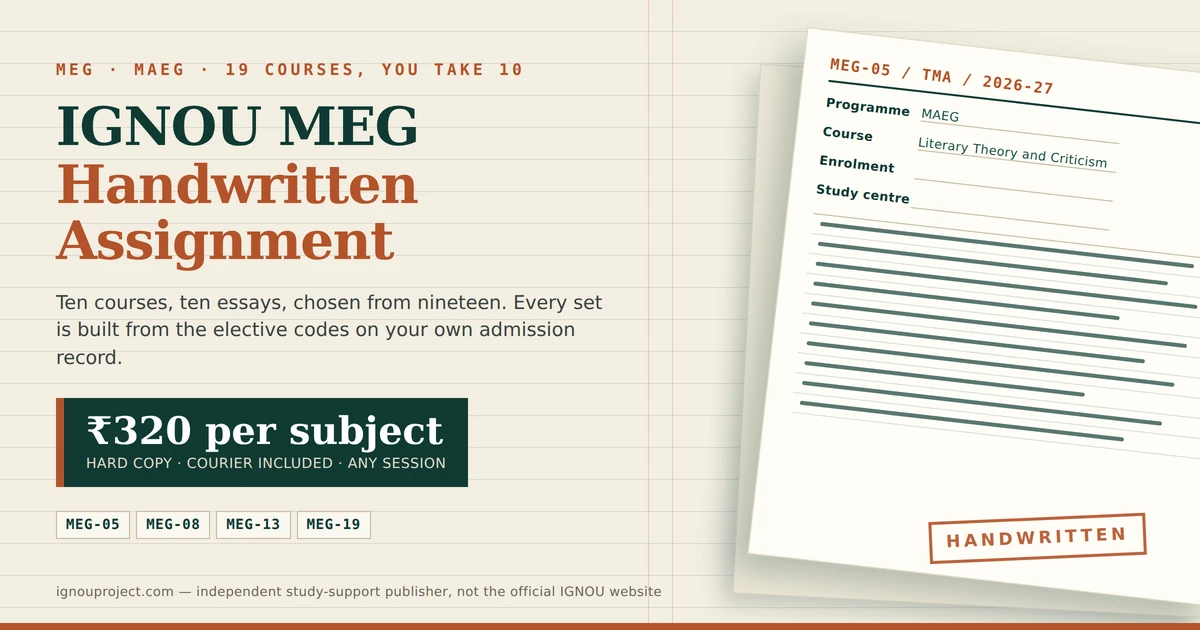
Quick answer. An IGNOU MEG handwritten assignment is a neatly written hard copy of the answers to the official Tutor Marked Assignment questions for one MA English course, prepared in IGNOU’s prescribed format and submitted at your Study Centre or Regional Centre. The instruction sits on the paper itself — IGNOU tells MEG learners plainly that they should write the assignment in their own handwriting — and typed or printed pages are generally refused. The programme code on your admission record is MAEG and every course code inside it begins with MEG. It runs 80 credits over two years, examined year-wise, and it holds 19 courses of which you complete only 10 — MEG-05 plus any four in the first year, then any five in the second, each worth 8 credits. This service prepares handwritten assignments for any of those MEG course codes at ₹320 per subject, hard copy with courier included, and no soft copy or PDF is sold; each handwritten set is written by hand on A4 paper in blue or black ink with the front page filled and left for your signature. Assignments are prepared in any medium IGNOU issues the paper in — for MAEG the medium of instruction is English, so the TMA is issued in English — and for any session including older cycles, at the same rate, with lateral-entry learners and part-completed years handled the same way. Sets can be written to match your own handwriting at no extra charge if you send a sample photo. Assignments carry 30 per cent of your course result while the term-end examination carries 70 per cent, and they must be submitted before the deadline printed on your own paper — for MEG that is 31 March for July-session learners and 30 September for January-session learners, which is later than the October and April dates most IGNOU programmes use. To order a handwritten set, message +91 93546 37830 with your course codes, session and pin code.
Two Cut-Offs a Year, and Ten Essays Between You and Them
MEG works differently from most IGNOU programmes here, in two ways worth knowing before you plan anything. One assignment booklet covers both sessions — the current paper is issued “for July 2026 and January 2027 Sessions” — and the two cohorts then get different deadlines from that same document. Those deadlines are also later than the ones quoted on most IGNOU pages. Miss yours and you do not sit the term-end examination for that course, however well you have read the texts.
If your MEG registration is a July one. The paper for the July 2026 session is due 31 March 2027.
If you registered in a January cycle. The January 2027 session paper is due 30 September 2027.
Both are the last date for your session and both are printed on the MEG booklet itself, so read yours rather than trusting any page including this one. Note they are not the 31 October and 30 April dates most IGNOU programmes use; the School of Management Studies prints those on MBA and MCOM papers, while the School of Humanities prints March and September on MEG. IGNOU also extends deadlines in some sessions and for some Regional Centres, so confirm the current notice on ignou.ac.in or with your Study Centre before planning around it. The planner further down computes the next cut-off from today’s date rather than printing a figure that may already have gone.
MAEG is examined year-wise, not semester-wise, which changes the shape of the pressure. Instead of four papers spread across a semester you face five eight-credit literature courses landing on one date, then five more the following year. Every answer is an essay rather than a short note, so a single MEG assignment routinely runs longer than an entire four-credit paper in a management programme. Five of those in one sitting is not a weekend job.
Thirty Per Cent of Every MEG Course Is Decided Before You Reach the Exam Hall
In IGNOU’s evaluation scheme the tutor marked assignment carries 30 per cent of each course’s final result and the term-end examination carries the remaining 70. In a literature degree those thirty marks are the most winnable on the programme, because you write them with the text open, the criticism to hand and no three-hour clock running.
They are also the marks most often lost by default. A learner skips MEG-05, misses the cut-off, or writes five essays in the final week, and then finds the course sitting incomplete on the grade card whatever the examination produced. At eight credits a course, one abandoned assignment costs more credits than an entire paper in most other IGNOU programmes.
There is a second problem specific to MAEG, and it is not carelessness. The elective structure means your ten courses are yours alone. A friend in the same batch may share three codes with you and differ on seven. Lists copied from a blog or a senior are close to useless, four PG diplomas issue their own TMAs against the same MEG codes, and the prospectus itself spells the compulsory course three different ways. Ordering starts with reading your admission record, not with paying.
Handwritten, never printed. Ten essays in ink on A4, which is the only form IGNOU treats as a valid submission. A typed MEG assignment is a rejected MEG assignment.
Your electives, not a template. Each handwritten set is built from the exact MEG codes on your admission record. Nothing is assumed from the year you are in.
Essays, not bullet points. Literature questions get argued handwritten answers with a position, textual support and a conclusion, sized to the marks on your TMA.
Texts named, not gestured at. Answers cite the primary works and critics your course actually prescribes rather than talking around them.
Matched to your question paper. Prepared against the official TMA for your course code and your session, not an older cycle’s paper reused.
One course, one price. Every MEG course is eight credits and every one costs ₹320. There is no premium for the longer papers.
Lateral entry welcome. Came in from a PG diploma with credits already cleared? Order handwritten sets for only the courses still outstanding.
One course, one bundle. MEG-05 does not travel stapled to MEG-13. Every course arrives tied on its own, ready to hand across the counter separately.
Courier inside the ₹320. The figure you are quoted is the figure you pay. Nothing for postage, packing or distance is added once the essays are written.
Written in your own handwriting. Send a photo of a page you wrote and the handwritten essays are matched to your own handwriting, at no extra charge.
Any session, current or older. Handwritten sets are prepared for current cycle papers and earlier session papers alike, which is what a pending course actually needs.
No minimum order. One handwritten course or all ten, the rate stays ₹320 each. No bundle and no order value to reach.
Send your MEG course codes and your session. You will get the total, the delivery window for your pin code, and the next step in one reply. If a code you send belongs to a PG diploma rather than MAEG, you will be told that before anything is written.
₹320 per subject · hard copy · courier included · no soft copy
All Nineteen MEG Course Codes, and Which Ten Are Yours
MA English is offered by the School of Humanities under the programme code MAEG. It carries 80 credits across two years, examined year-wise, with 40 credits in each year and every course worth 8 credits. Eligibility is any bachelor’s degree or higher from a recognised university, the medium of instruction is English, and the duration is a minimum of two years and a maximum of four. Nineteen courses are listed. You complete ten of them, and only the ten on your admission record carry an assignment you have to submit.
| Year 1 code | Course title | Nature | Credits |
|---|---|---|---|
| MEG-05 | Literary Theory and Criticism | Compulsory | 8 |
| MEG-01 | British Poetry | Elective | 8 |
| MEG-02 | British Drama | Elective | 8 |
| MEG-03 | British Novel | Elective | 8 |
| MEG-07 | Indian English Literature | Elective | 8 |
| MEG-08 | New Literatures in English | Elective | 8 |
| MEG-12 | A Survey Course in 20th Century Canadian Literature | Elective | 8 |
| MEG-06 | American Literature | Elective | 8 |
| MEG-09 | Australian Literature | Elective | 8 |
Scroll the table sideways on a small screen. MEG-05 is compulsory and you choose any four of the eight electives, giving five courses and 40 credits.
| Year 2 code | Course title | Nature | Credits |
|---|---|---|---|
| MEG-04 | Aspects of Language | Elective | 8 |
| MEG-10 | English Studies in India | Elective | 8 |
| MEG-11 | American Novel | Elective | 8 |
| MEG-13 | Writing from the Margins | Elective | 8 |
| MEG-14 | Contemporary Indian Literature in English Translation | Elective | 8 |
| MEG-15 | Comparative Literature | Elective | 8 |
| MEG-16 | Indian Folk Literature | Elective | 8 |
| MEG-17 | American Drama | Elective | 8 |
| MEG-18 | American Poetry | Elective | 8 |
| MEG-19 | Australian Novel | Elective | 8 |
Scroll sideways if the columns are cut off. You choose any five of these ten, giving the second 40 credits and completing the 80 the degree requires.
Ten courses, ten assignments, and no project or dissertation anywhere in the programme — MAEG is unusual in having no project course at all, so the assignment list is simply the course list. The syllabus also carries no specialization streams: unlike a management degree there is no finance or marketing branch to declare, and your ten electives are chosen course by course rather than as a package. Each course breaks into blocks and units in the study material, and most MEG assignment questions map onto one or two units within a block. If you are weighing the wider MA English structure, the MA English programme overview sets out eligibility and duration, and MA result and grade card timing covers what happens after the papers are marked.
These are disclosed rather than quietly worked around, because ordering against a wrong list means paying for an assignment you cannot submit. All five were checked in August 2026 against the Common Prospectus for July 2026.
One. The prospectus cannot decide between MAEG and MEG. Section 3.8 titles the programme Master of Arts (English) (MAEG) and the programme table lists it as MAEG. Two other sections of the same document call it the “MA (English) (MEG) programme”. Both codes refer to the same degree. Your admission record is the one that settles it for you.
Two. The compulsory course is spelled three ways in one section. The notes print it as MEG–5, the table two lines below prints MEG 05, and learners search for MEG-05. Search the official assignment portal for more than one spelling before concluding your paper is missing.
Three. Four PG diplomas issue TMAs against the same MEG codes. PGDNOV covers MEG-05, MEG-03, MEG-11 and MEG-19. PGDNLEG covers MEG-05, MEG-08, MEG-09, MEG-12 and MEG-19. If you are registered in a diploma rather than MAEG, quote the diploma so the correct paper is used.
Four. The older MEG assignment page on this site offers Hindi. The page at the MEG assignment format and submission guide says assignments are provided in both Hindi and English. The prospectus states the medium of instruction for MAEG is English, so the MEG tutor marked assignment is issued in English and there is no separate Hindi MEG paper to answer. That page is being corrected. Until it is, treat the medium line here as the accurate one.
Five. A typographic error in the prospectus itself. MEG-17 is printed as “American Drama l” with a trailing stray character. The course title is American Drama.
| Code | Also issued by | Spellings in circulation |
|---|---|---|
| MEG-05 | PGDNOV, PGDNLEG, PGDWM | MEG-05 · MEG 05 · MEG–5 · MEG5 |
| MEG-03 | PGDNOV | MEG-03 · MEG 03 · MEG3 |
| MEG-08 | PGDNLEG | MEG-08 · MEG 08 · MEG8 |
| MEG-09 | PGDNLEG | MEG-09 · MEG 09 · MEG9 |
| MEG-11 | PGDNOV | MEG-11 · MEG 11 |
| MEG-12 | PGDNLEG | MEG-12 · MEG 12 |
| MEG-19 | PGDNOV, PGDNLEG | MEG-19 · MEG 19 |
Scroll sideways for the full table. Sharing a code does not make you a diploma student or a diploma student an MAEG student — the programme on your admission record decides which paper you answer.
Lateral entry changes the count. Learners who finish PGDNOV, PGDNLEG or PGDWM can enter MA English under the university’s lateral entry scheme, arriving with credits already cleared. If that is you, the ten-course figure does not apply and you order only the courses still outstanding. Read your codes off your admission record or re-registration confirmation rather than from any list, including this one. If the record and this page disagree, the record wins and the order is written to the record.
How a MEG Set Is Written, Step by Step
No template, no stockpile, nothing pulled off a shelf. Every handwritten MEG assignment order runs through the same five stages.
- Your elective list is confirmed. Before a handwritten page exists, each code is matched against the nineteen MEG courses and against the year it belongs to. If a code you sent is issued only by a PG diploma, or if your five-per-year count does not add up, you hear about it before you pay.
- Your session’s paper is located. MEG questions rotate, and a 2025 question on Romantic criticism is not the 2026 one. The code stamped on the booklet, such as MEG-05/TMA/2026-27, is the reference point everything else is built from.
- The essay is planned before it is written. A MEG paper carries 100 marks across ten questions of roughly 500 words each, worth ten marks apiece, and IGNOU’s own instruction is explicit that it wants critical appreciation rather than chunks reproduced from the study material. So each answer gets a position stated in the introduction, textual evidence from the prescribed works, engagement with the critics the course sets, and a conclusion that summarises the view taken. Length follows the figure printed against your own questions.
- The essays go onto paper by hand. A4, ink in blue or black so the evaluator’s red and green stay legible against it, four centimetres of margin left free, quotations indented rather than run into the paragraph, and page numbers on every sheet. A handwriting sample, if you sent one, is worked from at this stage.
- Course-wise binding and despatch. Each handwritten course is tied or stapled separately, never mixed. The set is couriered to your address with the assignment cover page fields explained so you can complete and sign them yourself.
Notice what that sequence does not contain: a promise about your grade. An IGNOU evaluator reads the essay and applies their own criteria, and no outside party sits inside that judgement. The undertaking here is narrower and checkable — a complete, legible, correctly formatted handwritten set answering your paper, for your course, in your session.
Want It in Your Own Handwriting? One Photo Is Enough.
Send a clear photo of a page you have written — rough notes, an old assignment, half a sheet of practice writing — and the handwritten set is prepared to match your hand, its letter shapes, slant and spacing, rather than being written in a stranger’s script.
It matters more in MAEG than in most programmes for a simple reason: you submit ten long essays to the same Study Centre across two years, and literature coordinators read a great deal of handwriting. Consistency across a handwritten MEG-05 in the first year and MEG-19 in the second keeps that record coherent, particularly if you are writing some courses yourself and ordering the rest. There is no extra charge for matching your own handwriting and the rate stays ₹320 per subject for every handwritten course.
Rather write them yourself? That is a good decision whenever the hours exist, and everything needed is published free: the step-by-step handwritten assignment guide, the assignment front page format, the assignment format and structure rules, a sample IGNOU assignment to model yours on, what an IGNOU assignment is for, and the online and offline submission process. This page is for learners short of time, not short of ability.
Two Free Tools: Price Your Year and Validate Your Elective Combination
Everything below happens on your own device. No code you type leaves the page, nothing is saved, and no sign-in is asked for. Use them freely whether you buy a handwritten set here, buy one elsewhere, or write all ten essays yourself — the combination check in particular is worth running before money changes hands anywhere.
Tool 1 — MEG Assignment Cost and Cut-Off Planner
Pick your year or enter how many courses are pending, choose your session, and this returns your total at ₹320 per subject, your next submission cut-off computed from today’s date, the days remaining, and roughly how many hours of essay writing you would be taking on yourself.
This planner is guidance for your own budgeting, not an IGNOU rule and not a quotation. Deadlines are set by the university and must be confirmed on ignou.ac.in or with your Regional Centre.
Tool 2 — MEG Elective Combination Validator
Paste the MEG codes from your admission record and this checks the combination rather than one code at a time: whether MEG-05 is present, whether each year has five courses, whether the credits reach 80, and whether any code you entered is issued only by a PG diploma. It also returns the assignment code to expect on each paper, in MEG’s two-year format.
This validator reflects the MAEG structure in the Common Prospectus for July 2026 and is guidance, not an IGNOU rule. Your admission record is the authority on what you are registered in.
Codes verified against the prospectus, essays written, courses bound separately, parcel sent. What remains on your side is the cover page and your signature.
₹320 per subject · written by hand · couriered to your address
Where to Get the Official MEG Assignment Questions
No essay can be planned without the questions in front of you, and IGNOU gives them away. Each MEG course has its own booklet on the university site at no cost. Fetch yours before anything else happens, whether you intend to write the ten by hand yourself or order a handwritten set — it is the only document that proves which session and which code you are answering.
- Go to the university’s own assignment download page. This page deliberately links the portal rather than any individual file, since those addresses are rewritten between cycles and a dead link helps nobody.
- Search by the programme code MAEG or MEG, then by exact course code. If one spelling returns nothing, try the others from the table above before assuming your paper is missing.
- Read the session span off the booklet cover. It is baked into the assignment code itself, and MEG uses a two-year span rather than a single year: MEG-08/TMA/2026-27 is the paper for July 2026 and January 2027, and answers no other cycle.
- Note the marks and word limit printed against each question. Those limits, not your own judgement, set the length of each essay.
The prescribed texts and critical material are free too: you can download IGNOU MEG study material course-wise, and the eGyanKosh access guide explains how to reach the blocks by course code, with repository browsing by school covered separately. Answering an expired paper is the most frequent avoidable rejection there is, and in MA English it happens easily because the essay topics look similar year to year. If the booklet code and your admission record disagree, resolve that before a single sentence is drafted. For reference answers to study from, the IGNOU solved assignments page covers current-session files, and the MEG assignment format and question-pattern guide covers how MEG papers are structured.
After You Submit: Tracking MEG Assignment Status and Marks
Handing the essays in ends your work, not the process. The status flips only after the Study Centre passes your record upward, and the marks surface on the grade card later still. Follow both, because on the university’s screen a set lost in transit and a set never written look exactly alike.
- Hold on to whatever the counter or the portal gave you — stamped slip, acknowledgement, upload confirmation. That scrap is the only evidence you ever had ten essays in your hands.
- Look again about a month to six weeks on. Entries land course by course rather than together, so seeing MEG-05 posted while MEG-12 is still blank means nothing has gone wrong.
- Two months of silence on one course is the point to act. Take the receipt to your Regional Centre; these entries rarely repair themselves unattended.
The full process, including what each status message means, is explained on the IGNOU assignment result and status page, with assignment marks shown against each course code and the assignment grade card covered separately. If the card has not moved at all, a grade card stuck without updates sets out why that happens, and at the end of the programme the final grade card issued on completion consolidates all 80 credits. Assignment weightage is 30 per cent of each course, so these marks sit on your grade card permanently.
What Else MEG Learners Order Alongside
A handwritten assignment covers the 30 per cent. The other 70 comes from the term-end paper, and most learners handling one are handling both. Free and paid material for both sits on this site: IGNOU guess papers and previous year solved question papers for practice on courses like MEG-05 and MEG-15, the previous year paper for your course to see how the essay pattern repeats, IGNOU study notes for quick recall of movements and critics, help books and a condensed study guide ordered online for revision. Learners in the management schools use the MBA handwritten assignment service and the MCOM handwritten assignment service, both on identical terms with their own code sets. If a dissertation or project sits elsewhere in your studies, synopsis format and project guidance are handled separately — MAEG itself has no project course. Mention what else you need in the same WhatsApp message and it is all handled on one thread; rates for anything outside assignment writing are on the pricing and procedures page.
Medium and session. IGNOU issues the MAEG tutor marked assignment in the programme’s medium of instruction, which the prospectus states is English — so MA English is an English medium programme and there is no Hindi medium MEG paper to answer. Handwritten preparation is available in every medium IGNOU issues a paper in, at the same ₹320, so tell us your programme and the set is matched to the paper you actually receive. Older session papers are handled as well as the current cycle, which matters here because elective choices and lateral entry leave many learners with courses pending from an earlier year. Send the session the course belongs to, not the session you are currently in, and if the university is no longer issuing a paper for that code you will be told rather than sold something unusable. Learners who need the answers in Hindi should check the Hindi medium assignment guide for the programmes where a Hindi paper genuinely exists.
Ordering: Three Steps and Five Details
- One message, five facts. Programme (MAEG, or the diploma if that is your registration), the MEG codes themselves, which year they sit in, your session, and your pin code. Copy the codes from the record rather than recalling them — elective lists are exactly the thing memory gets wrong. Attaching a photo of your handwriting costs nothing and takes a second.
- See the number before you commit. ₹320 times however many courses you named, courier already inside it, plus how long the parcel realistically takes to reach your pin code. Weigh that against your cut-off while no money has moved.
- Say yes, then wait for the parcel. The essays are written out, tied course by course and sent. Filling and signing the cover page is yours to do, after which you hand the set in at your Study Centre, or scan and upload it where your centre works that way.
Leave room. Longhand literature essays are slow to produce and couriers move at their own pace, and neither speeds up because a deadline is near. A parcel landing on 1 November is worth nothing at all. Inside the last two weeks, lead with the date in your first message so the timing can be judged plainly rather than optimistically.
How This Page Was Prepared
Editorial note. Course codes, titles, credit values and the programme structure on this page were checked against the IGNOU Common Prospectus for July 2026, section 3.8 for the MAEG structure and the summary programme table for eligibility, medium, duration and examination mode. The PG diploma overlaps in the third conflict came from sections 8.48 to 8.52 of the same document, and the MAEG-versus-MEG naming conflict was found by comparing section 3.8 with those diploma sections. Older material still circulating online disagrees with the current prospectus in several places; each disagreement is named openly in the warning box above rather than smoothed over, and that includes the one published on this site.
Assignment weightage, the submission dates, the 100-mark ten-question pattern and the formatting rules are taken directly from the MEG assignment booklet IGNOU publishes for the July 2026 and January 2027 sessions, not from the prospectus and not from third-party summaries. That booklet states the deadlines as 31 March 2027 and 30 September 2027 — five months later than the October and April dates the School of Management Studies prints on its own papers, which is why programme-specific verification matters more than a general rule. No word count is quoted for any MEG question, because those are printed on each session’s own paper and vary by course; the page tells you to read them off your TMA instead. Deadlines and rules change between sessions and sometimes between Regional Centres, so every date here should be re-confirmed against the current notice on the official IGNOU website before you rely on it.
Service facts — the ₹320 per subject rate, hard copy only, courier included, all mediums, any session, free handwriting matching, no minimum order — are the published terms of the handwritten assignment writing service operated by Shri Chakradhar Publication Pvt. Ltd. through ignouproject.com. No delivery time is stated anywhere on this page because it varies by pin code and is confirmed per order. No claim is made here about marks, grades or evaluation outcomes. Where a fact could not be verified against the prospectus it is not stated: nothing on this page invents a course title, a credit value, a deadline or an availability claim.
Questions MEG Learners Ask Before Ordering
₹320 per subject. That is the full price for a handwritten hard copy of one MEG course assignment, courier included, and the same handwritten rate applies to every course on the list. There is no separate shipping charge, no packing fee and no surcharge for the longer literature papers. A full year of five courses comes to ₹1,600 and all ten MEG assignments come to ₹3,200, both at the same ₹320 per subject rate.
Ten, not nineteen. MA English lists nineteen courses but you complete only ten of them: MEG-05 plus any four electives in the first year, then any five electives in the second. Each is worth 8 credits, giving 80 credits in total. You submit a handwritten assignment only for the courses on your own admission record, which is why no two MEG learners necessarily have the same list. There is no project or dissertation course in the programme, so the assignment list is simply your course list.
Both, unhelpfully. The Common Prospectus titles section 3.8 Master of Arts (English) (MAEG) and lists the programme as MAEG in its summary table, while two other sections of the same document refer to the “MA (English) (MEG) programme”. They are the same degree. MAEG is the programme code that appears on your admission record; MEG is the prefix on every course code inside it, which is why most learners and most search results use MEG. Quote whichever appears on your own record when you order.
MEG-05 Literary Theory and Criticism is the only compulsory course in the programme. Everything else is elective: any four of eight in the first year and any five of ten in the second. Note that the prospectus prints this course three different ways within one section — as MEG–5 in the notes and MEG 05 in the table — so search the assignment portal for more than one spelling before concluding your paper is missing.
No, and this is worth being precise about. The prospectus states the medium of instruction for MA English is English, so IGNOU issues the MEG tutor marked assignment in English and there is no separate Hindi MEG paper to answer. Handwritten preparation is available in every medium IGNOU actually issues a paper in, at the same ₹320, but for this English medium programme that resolves to English. Older pages elsewhere on this site that offer Hindi MEG assignments are being corrected. If your programme is not MAEG and your paper does come in Hindi, say so and it is written in Hindi at the same rate.
Generally not. The MEG assignment booklet states it directly: you should write the assignment in your own handwriting. A printed or typed submission sits on the published list of reasons a set comes back unaccepted. That single rule is why handwritten assignment writing exists as a service at all. Even where a Regional Centre has moved online, the file you upload is a scan of paper you wrote on, not a document you formatted.
No. Only the handwritten hard copy is sold, and no soft copy or PDF of the handwritten set is sold at the ₹320 rate or at any other rate. If your Regional Centre requires an upload rather than a physical hand-in, you scan the delivered hard copy yourself and upload the scan. The scan preserves a genuine handwritten submission; a printed file would not.
Yes, free. Photograph one page in your own handwriting, send it with the codes, and the essays are shaped to that hand. In MA English it earns its keep more than elsewhere: ten long subject-wise sets reach the same Study Centre over two years, often the same reader, and a hand that changes between MEG-05 and MEG-19 is noticeable. It matters most for learners writing part of the syllabus themselves and ordering the remainder.
Only the courses still outstanding. Learners who complete PGDNOV, PGDNLEG or PGDWM can enter MA English under the university’s lateral entry scheme with credits already cleared, so the ten-course figure does not apply to you. Send the codes shown as pending on your admission record and the handwritten total is calculated on those alone. The validator on this page will flag if the combination you send does not add up to a full year, which is normal for lateral entry and not a problem.
The one issued for the programme you are registered in. PGDNOV, PGDNLEG and PGDWM all run MEG-05 and several other MEG courses, and each issues its own tutor marked assignment against them. Sharing a code does not make a diploma student an MA English student or the reverse. Quote your programme along with the course code when you order so the correct paper is used.
Yes, at the same rate, however far back it goes. Quote the session the course itself belongs to, not the one you are sitting in now — for a backlog course those almost never match. Only one thing can block it: the university has to still be publishing a paper for that code. Where it is not, you get told plainly rather than sold an essay set with nowhere to go.
No minimum order. One handwritten course set is charged at ₹320 and ten courses are charged at ₹320 each. This matters in MA English because elective choice and lateral entry mean very few learners need a clean full year: a typical order is two or three courses someone has run out of time for, not a whole year’s set.
Delivery sits inside the ₹320 and no further charge appears. How many days it takes is a function of where you live, which is why this page prints no number — any single figure would be wrong for most of India. Your window is confirmed in the WhatsApp thread before payment. Deadline close? Put the date in the first message and it gets weighed against the courier time openly.
The tutor marked assignment carries 30 per cent of the result in each MEG course and the term-end examination carries the remaining 70 per cent. Submission is compulsory, so an unsubmitted assignment leaves the course showing as incomplete on your grade card regardless of how the examination answer sheet was marked. At 8 credits a course, one abandoned assignment costs more credits in MA English than in most other IGNOU programmes.
No. Anyone promising a grade on a literature essay is selling you something they cannot deliver. The evaluator marks against IGNOU’s criteria and their own reading, and no outside party reaches into that. What is actually promised is narrower: a complete, legible, correctly formatted handwritten set answering your official paper for the right course and session. Your signature goes on the declaration, so read the essays first.
No. The MAEG structure in the Common Prospectus lists nineteen taught courses and no project or dissertation course, which makes it unusual among IGNOU master’s programmes. Everything you submit is a tutor marked assignment followed by a term-end paper. If you have seen a dissertation requirement quoted for MA English, check it against your own admission record before acting on it.
A4 paper only, with every page tagged together, written in blue or black ink with a clear left margin for the evaluator, the question number written against each answer, quotations set off cleanly and no spiral notebook. MEG specifies the first page precisely: enrolment number, name, full address and date at the top right, and course title, assignment number and the name of your Study Centre in the centre. Those fields come filled; you add your signature. Answers are sized to the marks printed on your own paper, which for MEG is ten marks and about 500 words per question.
On the grade card, one course at a time, generally a month to six weeks after your centre forwards the record. Hold the stamped slip or upload acknowledgement: an empty row against a course you know you submitted is usually a typing delay at the centre, and that slip is what closes the argument. Past two months with nothing showing, take it to your coordinator first and then the Regional Centre, receipt attached.
No. ignouproject.com is an independent study-support publisher operated by Shri Chakradhar Publication Pvt. Ltd. It is not affiliated with, endorsed by or authorised by Indira Gandhi National Open University. Programme details, course codes, assignment questions, submission deadlines and university notices should always be verified through the official IGNOU website and your own Regional Centre.
Important Notice
IGNOUProject.com is an independent educational-support website and is not the official website of Indira Gandhi National Open University. Programme details, course codes, assignment questions, submission deadlines and university notices should always be verified through the official IGNOU website and your own Regional Centre.
MEG handwritten assignment preparation is a paid writing and reference service provided independently by Shri Chakradhar Publication Pvt. Ltd. It is not affiliated with, endorsed by or connected to IGNOU. What is submitted to the university remains the responsibility of the learner submitting it: review the content of any handwritten set you receive before you sign the declaration on the cover page, satisfy yourself that it answers your question paper for your session, and correct anything you disagree with. No claim is made or implied about the marks, grade or evaluation outcome any assignment will receive.
The course codes, titles and credits on this page were read from the Common Prospectus for July 2026 and are correct to the best of the publisher’s knowledge on the review date shown above. Programme structures are revised between intakes, so verify your own codes against your admission record before acting on anything here. The free tools on this page are offered without charge and are separate from any order. Using them creates no obligation to buy anything.
Programme, MEG course codes, year, session, pin code — five lines and you are done. If a code you send belongs to a PG diploma rather than MA English, or your combination does not add up to the year you named, you will be told that instead of being sold something you cannot submit.
₹320 per subject · hard copy with courier included · no soft copy
+91 93546 37830 · Monday to Saturday · Elective combination checks are free. Written and reviewed by BK Sahni, Founder of Shri Chakradhar Publication, ORCID 0009-0005-8092-459X, who has guided 5,00,000 students till date. Independent publisher, not IGNOU.

BK Sahni iD 0009-0005-8092-459X
Founder, Shri Chakradhar Publication Pvt. Ltd. & ignouproject.com — helping IGNOU distance-learning students since 2010 (5,00,000+ students supported across MBA, MCom, MA & more). Author of IGNOU exam guides, solved assignments & project reference books.
Disclosure: Shri Chakradhar Publication Pvt. Ltd. and ignouproject.com are independent third-party study-help services — not the official IGNOU website. Always verify final dates and rules on ignou.ac.in.