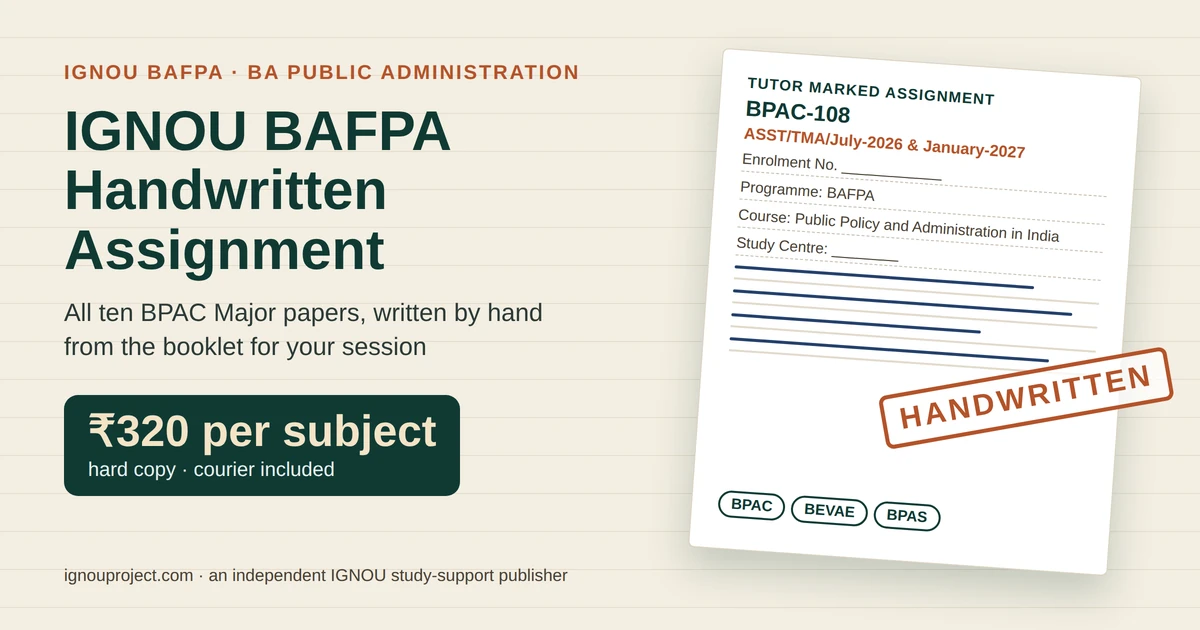
BAFPA borrows its Major papers from BA (Honours) Public Administration, so a learner downloads booklets labelled BAPAH, BAFPA or both, on two calendars and three code formats. ignouproject.com reads your record against the July 2026 Common Prospectus first, then writes each BPAC paper by hand from the booklet that belongs to your session.
- 10 BPAC Major papers
- 31 Oct and 30 Apr cut-offs
- English or Hindi booklet
- BAPAH covers checked
- Your handwriting matched
- Backlog sessions accepted
Delivery depends on your pin code and is confirmed for your order before you pay. No figure is promised on this page.
Quick answer. An IGNOU BAFPA handwritten assignment is the Tutor Marked Assignment for one course of the Bachelor of Arts (Public Administration) Major, answered in ink on paper and handed to the Study Centre as a hard copy; the BAFPA Major, which the School of Social Sciences runs under the four-year undergraduate framework, holds ten BPAC papers of 6 credits each (BPAC-101 to BPAC-106, BPAC-108, BPAC-109, BPAC-110 and BPAC-112) inside a 120-credit degree, and ignouproject.com writes each one by hand at ₹320 per subject with courier included, in the English or Hindi medium IGNOU issues, for the current session or an older backlog one, matched free of charge to a photo of your own handwriting; each BPAC assignment is a 100-mark paper that decides 30 per cent of that course’s result, IGNOU’s January 2026 BPAC-108 booklet sets 31 October 2026 as the last date for January 2026 learners while the July 2026 booklets set 30 April 2027, and orders go to WhatsApp +91 93546 37830 with the codes, the session and a pin code.
BPAC Submission Dates: 31 October for January Learners, 30 April for July Learners
31 October 2026 is the last date IGNOU’s BAFPA-labelled BPAC-108 booklet prints for a learner admitted in the January 2026 session, and 30 April 2027 is the date the BPAC-103 and BPAC-108 booklets print for the July 2026 session.
Printed on the January 2026 BPAC-108 booklet and on the July 2025 and January 2026 BPAC-104 booklet. It feeds the December 2026 examination.
Printed on the July 2026 and January 2027 BPAC-103 and BPAC-108 booklets, which give January 2027 learners 31 October 2027.
The 31 March and 30 September pair does not belong to the BAFPA Major papers. That pair is printed on IGNOU’s 2025-26 BPSC booklets for the Political Science Major (BAFPS) and on the MPA booklets for the MA, both run by the same School of Social Sciences, and a study-centre rules sheet circulating online states it as the rule for every IGNOU assignment. The BPAC booklets read for this page, issued by the Discipline of Public Administration, print 30 April for July learners and 31 October for January learners instead. So a BAFPA learner with a BAFPS friend can hold two correct IGNOU booklets a month apart; plan each BPAC paper to the date on its own cover.
Two older BPAC files break their own pattern. The July 2024 and January 2025 BPAC-101 booklet gives January 2025 learners 31 October 2024, a date that falls before that session began. The January 2025 BPAC-105 booklet, labelled BAFPA, prints 31 March 2025. Neither error changes the 2026 dates, but both explain why a classmate’s older PDF can mislead.
Careers360 reports 31 October 2026 as the December 2026 assignment date. For a January 2026 BAFPA learner that matches the booklet already, so the extension story changes nothing here. Dates still shift by session and by Regional Centre, and only ignou.ac.in and your Study Centre confirm the position for your enrolment.
What a Missing BPAC Assignment Costs: 30 Per Cent and the Exam Seat
A BPAC assignment left unsubmitted costs the 30 per cent and, by the booklet’s own rule, the seat in that course’s term-end examination. Assignments carry 30 per cent of the final course result and the term-end examination carries the remaining 70 per cent. The BPAC-103 and BPAC-108 booklets for 2026 tell learners to submit all assignments within the stipulated time to be eligible to appear in the term-end examination, so each BPAC code is its own gate.
Each BPAC paper is 100 marks in three parts. The first holds two descriptive questions of 20 marks, answered in about 500 words each with an introduction and a conclusion, and it is where most of the writing time goes. Three 10-mark answers of about 250 words follow. Then five short ones: about 100 words, 6 marks apiece. Written to those bands, one paper runs near 2,250 words.
Here MCQ means Middle Category Questions. Nothing is ticked.
The year matters as much as the paper. The summary table of the July 2026 Common Prospectus lists BAFPA’s examination mode as year wise, while the structure template on the same pages lays the 120 credits out as six semesters of 20. Read together, a BAFPA year holds eight courses and 40 credits: two BPAC papers, the interdisciplinary and value-added courses, two vocational minors, one skill course and Environmental Studies in the first year. Because the booklets set three TMAs for a six-credit course and two for a four-credit one, that first year alone comes to 20 TMAs across eight booklets.
Solved BPAC Reference File or Handwritten BPAC Pages: Which One a BAFPA Study Centre Collects
The Study Centre collects the handwritten pages. The solved file stays on your phone.
A solved assignment is a soft-copy reference file of model answers for one IGNOU course code and one session, such as BPAC-108 for the July 2026 and January 2027 sessions. A BAFPA learner reads it to see how a 20-mark answer on policy formulation is planned. It carries no enrolment number, no signature and no line in the learner’s hand, which is why a printout of it is not a submission: section 14.7 of the July 2026 Common Prospectus permits typed assignments only for students holding a valid disability certificate.
A handwritten assignment is the same BPAC questions answered by hand on A4 sheets, one course code per bundle, with the cover page completed and signed, and handed to the coordinator of the learner’s Study Centre against a receipt. The 2026 BPAC booklets ask for answers written in your own words, within the approximate word limit, and each answer written neatly in the final version. That bundle is what the coordinator logs and later returns after evaluation.
| Point | Solved assignment | Handwritten assignment |
|---|---|---|
| Format | Soft-copy file for one BPAC code and one session | Hard copy in ink, one BPAC code per bundle |
| What the learner does with it | Reads it while planning answers | Reads it, signs the cover and submits it |
| Taken at the Study Centre | No, typed work is outside the rule | Yes, against the coordinator’s receipt |
| Who it suits | A learner who will write every answer personally | A learner short of writing hours before 31 October or 30 April |
| Price on ignouproject.com | Listed with the reference files | ₹320 per subject, courier included |
On a phone, slide the table sideways to see the third column.
Anyone after the reading copy will find the BPAC reference files among the IGNOU solved assignments. Everything below concerns the bundle that gets submitted.
Twelve Checks a BAFPA Set Passes Before It Is CourieredTen codes, not fourteen. A BPAC-107, 111, 113 or 114 on an order is raised with you first, because section 5.9 keeps those four in BAPAH only.
BPAC-101, never BPAC-131. The two share a title. The 131 series belongs to BA Multidisciplinary, and the answers are written to the code your record prints.
Booklet chosen by session. January 2026 learners get the single-session BAFPA file; July 2026 learners get the two-session file, whatever its cover says.
Code string copied as printed. ASST/TMA/January-2026 and ASST/TMA/July-2026 & January-2027 differ, and the cover field takes the one on your booklet.
Labels I, II, III kept. The January 2026 BPAC-108 paper heads its parts I to III while its instructions say A to C; the set follows the question page.
500, 250 and 100 words. The bands printed beside each part set the length, so a 6-mark answer stays a short answer.
Essays open and close. The descriptive answers get the introduction and conclusion the booklet asks for in its instructions.
Indian institutions named exactly. NITI Aayog, the Finance Commission, the Cabinet Secretariat and MGNREGA are written in full the first time they appear.
Interdisciplinary choice checked. BPAG-171 Disaster Management on a BAFPA record is queried, because the prospectus keeps the interdisciplinary course outside the Major discipline.
Common-pool papers alike. BEVAE-181, BPAS-184, BPAS-186 or a minor from another discipline is written from its own booklet at the same rate.
Signature left for you. Page one arrives with your details in place and the declaration unsigned until you have read the answers.
Four papers, ₹1,280. The total is plain multiplication; postage is already inside each ₹320.
Send the codes exactly as your Samarth record prints them, the session on that record and a delivery pin code. The total comes back in the same chat. The rate is ₹320 per subject, hard copy only, with courier included in that price and no separate shipping charge.
₹320 per BPAC code · hard copy · courier already paid
Quote My BAFPA PapersWhich BPAC Codes a BAFPA Learner Writes: Ten of Fourteen, 60 of 120 Credits
A BAFPA learner writes assignments for ten BPAC Major courses of 6 credits each, 60 credits in all, inside a 120-credit Major degree that becomes a 160-credit Honours degree after a fourth year. Section 5.9 of the July 2026 Common Prospectus lists the ten codes, and section 5 fixes the rest of the degree: 24 credits of minor courses, 8 of ability enhancement, 16 of skill enhancement, 6 interdisciplinary and 6 value-added. Those six figures sum to 120, the total the prospectus states, and the table below was used only after that check held.
| Code | Official title | Credits | Cover label seen |
|---|---|---|---|
| BPAC-101 | Perspectives on Public Administration | 6 | BAPAH (July 2024 and January 2025, read in full) |
| BPAC-102 | Administrative Thinkers | 6 | BAFPA (January and July 2024 cover) |
| BPAC-103 | Administrative System at Union Level | 6 | BAPAH (July 2026 and January 2027, read in full) |
| BPAC-104 | Administrative System at State and District Levels | 6 | BAPAH/BAFPA (July 2025 and January 2026 cover) |
| BPAC-105 | Personnel Administration | 6 | BAFPA (January 2025, read in full) |
| BPAC-106 | Understanding Public Policy | 6 | Not seen |
| BPAC-108 | Public Policy and Administration in India | 6 | BAFPA (January 2026, read in full); BAPAH (July 2026 and January 2027 cover) |
| BPAC-109 | Public Systems Management | 6 | Not seen |
| BPAC-110 | Urban Local Governance | 6 | Not seen |
| BPAC-112 | Rural Local Governance | 6 | Not seen |
| Total | Ten Major courses | 60 | Matches the 60-credit Major in section 5 |
Slide sideways for the cover column. The prospectus prints codes as BPAC 101; booklets print BPAC-101. They are the same course.
BPAC-107 Comparative Public Administration, BPAC-111 Public Finance and Administration, BPAC-113 Development Administration and BPAC-114 Contemporary Issues and Concerns in Indian Administration are BA (Honours) Public Administration cores. The BAPAH table in the same prospectus runs BPAC 101 to 114 without a gap; the BAFPA table stops at ten. Booklets for all four are live for July 2026 and January 2027, which is how they end up in BAFPA download folders.
The prospectus gives no semester for any BPAC code. Its template allows one Major paper in each of the first two semesters and two in each of semesters three to six, and IGNOU’s own BAFPA web page marks every course Year 1. Your Samarth record is the document that says which BPAC papers fall due this session.
| Category | Credits each | Codes in the prospectus | For a BAFPA learner |
|---|---|---|---|
| Interdisciplinary | 6 | BEGG 171, BHDG 175, BPAG 171, BPCG 171, BPYI 101, BMDG 171, BABG 171, BDIG 171, BSOG 171, BSKG 178 | One, outside the Major and Minor disciplines, so BPAG 171 Disaster Management is not the choice |
| Ability enhancement | 4 | BEVAE 181, then one of BEGAE 182, BHDAE 182, BSKAE 182, BUDAE 182 | Two, in semesters two and three |
| Value-added | 6 | BEDSV 101, BNME 001 | One |
| Vocational minor | 4 | BECS 184, BPAS 184, BHDS 184, BCOS 185, BCOS 186 | Three over three years, plus one more for an early exit |
| Skill enhancement | 4 | Twenty-four codes, BPAS 186 Stress and Time Management among them | Four, in semesters one, four, five and six |
| Discipline minor | 4 | Three codes each in eleven disciplines; none in Public Administration | Three, all from one discipline |
Slide sideways for the last column.
IGNOU’s BPAC booklets print the assignment code in 3 different shapes, so the string a BAFPA learner copies is the one on their own file. The BAFPA-labelled January 2026 BPAC-108 booklet prints ASST/TMA/January-2026, a single session. The July 2026 and January 2027 BPAC-103 and BPAC-108 booklets print ASST/TMA/July-2026 & January-2027, both sessions on one line. The Honours-only BPAC-113 and BPAC-114 booklets put the course code first, as BPAC-113/Asst/TMA/July 2026 – January 2027. A BAFPA learner never needs the third shape, and seeing it is a sign the wrong booklet was opened.
- Ten codes against fourteen. Section 5.9 of the prospectus lists ten BPAC Major codes for BAFPA; the BAPAH table later in the same prospectus lists BPAC 101 to 114.
- IGNOU’s BAFPA web page. It lists BPAC-131 to BPAC-134 beside BPAC-101, 102 and 104, omits BPAC-103, 105 and 106, adds BAPAH electives BPAE-141 to 144, three psychology cores, a BAPC-103 with no title and a BPAM-164 spelt Organiztional, marks everything Year 1 and leaves the coordinator blank. Section 5.9 names Prof. Pankaj Deep.
- Three cover labels for one Major. BAFPA on BPAC-102 (2024), BPAC-105 (January 2025), BPAC-108 (January 2026) and BPAG-172 (2026-27); BAPAH/BAFPA on BPAC-104 (2025-26); BAPAH alone on BPAC-101 (2024-25), BPAC-103 and BPAC-108 (2026-27).
- A date before its own session. The July 2024 and January 2025 BPAC-101 booklet gives January 2025 learners 31 October 2024.
- March against October. The January 2025 BPAC-105 booklet prints 31 March 2025; the January 2026 BPAC-108 booklet prints 31 October 2026. The 2026-27 BPAC-107 booklet prints 31 March 2027 where its siblings print 30 April 2027.
- A, B, C or I, II, III. The January 2026 BPAC-108 booklet describes Assignments A to C and heads its question page I to III.
- Year wise or semester wise. The prospectus summary table lists BAFPA’s examination mode as year wise; its template lays the programme out in semesters.
- On this website, pending correction. The BAFPS page published on 30 September 2026 calls the 30 April and 31 October pair on the BAM page contradicted by the BPSC booklets; for public administration that pair is exactly what the BPAC booklets print, so the School of Social Sciences runs two calendars by discipline and both pages are being reconciled. The home page’s acceptance assurance with a refund and the dispatch promise on the MMPC-001 page are also queued for correction; this page makes neither promise.
Where two documents disagree, the booklet printed for your own code and a written answer from your Study Centre outrank this page. Per-code question papers for the first course sit on the BPAC-101 previous papers page.
Writing a BAFPA Set: Booklet Choice, Section Order, Signature Space
Five stages turn a code list into a bundle. You act at the first and the last.
- The record is matched to section 5.9. Each code you send is compared with the ten BPAC Major codes and the common pool. A BPAC-113 or BPAC-131 comes back to you as a question, before payment.
- The booklet for your session is opened. A January 2026 learner’s BPAC-108 is written from the single-session BAFPA file with its 31 October 2026 date; a July 2026 learner’s comes from the two-session file, even where the cover reads BAPAH.
- Pages are budgeted by marks. The two 20-mark answers get the most sheets, the three 10-mark answers a page or so each, and the five 6-mark answers stay short, so the paper reads in proportion to its 100 marks.
- The fair copy is written in your matched hand. Blue or black ink on ruled A4, question numbers and part labels copied from the question page, and the fields set out in the IGNOU assignment cover page layout filled except the signature. The enrolment number as IGNOU prints it goes at the top.
- The bundle is couriered, and you finish it. You read every answer, sign the declaration and hand the set over as the Study Centre submission walkthrough describes. The receipt stays with you.
Matching the Set to the Way You Write
Send a photo of a page you have written yourself and the handwritten set is matched to your handwriting at no extra charge.
Public administration answers carry acronyms and article numbers: UPSC, NITI Aayog, Article 243, the 73rd Amendment. A sample showing how you write capitals and figures gives more to match than a page of lowercase prose. One ordinary page, photographed flat in daylight, is enough.
Why bother? Over three years a BAFPA learner hands in about two dozen bundles at one Study Centre. A consistent hand across them is simply what the coordinator expects to see.
Writing the BPAC papers yourself? When the hours exist, that is the better route, and the free material here covers it: the step-by-step handwritten assignment method, a blank and filled front page in PDF, a finished IGNOU assignment to compare spacing against, the rules on introductions, headings and margins, and the difference between offline and online submission routes.
Free BAFPA Tools: October Countdown and BPAC Booklet Finder
Tool 1 prices your papers and counts the days to the BPAC date that applies to your session. Tool 2 says whether one code belongs on a BAFPA record and which code string its booklet uses. Neither tool leaves this page, and nothing typed into them is sent or stored.
BAFPA Paper Total and Cut-Off Counter
BPAC papers plus any common-pool course. A whole number from 1 to 24.
The session sits on your admission or re-registration record, not on the booklet.
Book These Papers at ₹320 EachThis tool is guidance from ignouproject.com, not an IGNOU rule. Using it creates no obligation to order anything.
BPAC Code and Booklet-Label Finder
For example BPAC-108, BPAC 131, BPAG171 or BEVAE-181. Spaces and hyphens do not matter.
Write This Code at ₹320This tool is guidance from ignouproject.com, not an IGNOU rule. Using it creates no obligation to order anything.
Paste either result into WhatsApp with your pin code. Any session is accepted, current cycle or older, including backlog courses, at the same ₹320 per subject.
One BPAC paper or ten, ₹320 each · courier inside · your hand matched free
Send My Tool ResultFinding a BPAC Booklet When the Cover Names Another Programme
Search IGNOU’s assignment page by course code, not by BAFPA. The booklet that comes back may say BAPAH, BAFPA or both, and any of the three is the right paper if its session line matches your record.
- Open the official search. Go to IGNOU’s current assignments page and type a code such as BPAC-108.
- Pick the file for your session. Names such as BPAC-108-Eng-Jan-2026 and BPAC-108-Eng-26-27 carry the medium and the session; the first is the January 2026 BAFPA file, the second the July 2026 and January 2027 file.
- Read page one and the submission table. The session line and the last date sit before the questions. A BAPAH cover with your session on it is still your paper.
- Check the code against section 5.9. If the file is BPAC-107, 111, 113 or 114, or a BPAC-131 series file, stop: it belongs to another programme.
A booklet still missing close to the date is raised through iGRAM, IGNOU’s grievance portal, with a screenshot of the empty search. The course blocks are free on eGyanKosh, through the older Gyankosh route when that is slow, and on the official study material download page.
After Submission: The Receipt, the Status Line and the BPAC Marks Column
The coordinator’s receipt comes first, the online status second and the marks last. The BPAC booklets ask learners to obtain that receipt, keep a photocopy of the assignment, and expect the evaluated set back once the Study Centre has sent the marks to the Student Evaluation Division in New Delhi.
Receipt of a BPAC code shows on the IGNOU assignment status and result page. The guide to assignment marks entries explains what appears, and the assignment column of the grade card is where the 30 per cent lands. Bachelor’s learners read the record through the BDP grade card view, and the final grade card lists every BPAC code at the end.
For the arithmetic, the grade-to-percentage converter and the CGPA calculator help. Blank status for a few weeks is normal; blank for a whole cycle is when the receipt matters.
Exam Preparation and Other Orders That Travel With a BAFPA Set
The 70 per cent paper is the other half of every BPAC result. The December 2026 term-end date sheet shows when each paper is examined, and practice comes from IGNOU guess papers for the December cycle, solved term-end question papers and the last year paper for each course.
Revision comes in three sizes: condensed IGNOU study notes, help books by course code and guide books ordered online. The fourth-year option of a 12-credit project or dissertation is a different kind of work, handled on the IGNOU project reports page, with proposals on the synopsis and proposal page and rates under charges for project and synopsis work.
Neighbouring programmes have their own pages: the BAFPS page for the Political Science Major, the BA Multidisciplinary page for BPAC-131 learners, the older BA General programme of the School of Social Sciences, and, for a BAFPA graduate moving on, the MPA handwritten page for MA Public Administration.
Medium, session and the BAFPA name.
BAFPA is offered in English and Hindi: the July 2026 Common Prospectus and IGNOU’s BAFPA web page both give English and Hindi as the medium of instruction. The booklets read for this page were English files, so a Hindi-medium learner confirms the Hindi file for the same code and session on ignou.ac.in before writing. The service covers all mediums IGNOU issues the TMA paper in, at the same price. For Devanagari layout, the guide to presenting an IGNOU assignment in Hindi applies.
Any session is accepted, current cycle or older, including backlog courses, at the same ₹320 per subject. A paper belongs to the session on its cover, and a learner returning after a gap usually completes the IGNOU re-registration form first, or the readmission process where the enrolment has lapsed.
On names: BAFPA is the programme code of the four-year BA (Public Administration) Major; BPAC is the prefix on its Major papers; BAPAH is the older BA (Honours) Public Administration that shares most BPAC codes.
Placing a BAFPA Order on WhatsApp: Three Moves and the Facts They Need
- Write once, with everything. Message +91 93546 37830 with the details listed below.
- Check the quote. The reply states the total, ₹320 for each code, and whether your pin code is served. There is no minimum order: one subject or fourteen, same rate.
- Pay, receive, submit. The bundle is couriered to the address you gave; handing it to the coordinator is the last step, and it is yours.
Five facts make the first message complete:
- Each code as your Samarth record prints it, BPAC and common-pool alike.
- The session on that record: January 2026, July 2026 or older.
- English or Hindi, as your booklet is.
- A photo of one page of your own handwriting.
- The delivery address with its pin code.
No soft copy or PDF is sold. If your Regional Centre asks for an upload, the scan is made by you from the couriered hard copy. Delivery depends on your pin code and is confirmed for your order before you pay. No figure is promised on this page.
Documents Read for This BAFPA Page, and What They Did Not Settle
From the July 2026 Common Prospectus: the ten BPAC Major codes, titles and credits in section 5.9 and its coordinator line; the four-year structure template and the 60, 120 and 160 credit figures in section 5; the common-pool lists and the rule keeping the interdisciplinary course outside the Major; the fourteen-code BAPAH table; the summary-table row giving English and Hindi, Rs 5,500 a year and a year-wise examination mode; and the typed-assignment provision in section 14.7. A plain guide to the document is on the IGNOU prospectus explainer.
From IGNOU’s own files, read on 2 October 2026: the BPAC-108 booklet for January 2026, the BPAC-103 booklet for July 2026 and January 2027, the BPAC-105 booklet for January 2025 and the BPAC-101 booklet for July 2024 and January 2025, all read in full; the covers and submission tables of the 2026-27 BPAC-107, 108, 113 and 114 booklets, the 2025-26 BPAC-104 booklet, the 2024 BPAC-102 booklet and the 2026-27 BPAG-172 booklet, seen in search results; and IGNOU’s BAFPA programme page. Dates, word bands, part labels and code strings come from these files.
The publisher’s own commercial terms: the ₹320 rate, courier inside it, hard copy only, every medium and session, handwriting matching at no charge, no minimum order and no promised delivery time. Those terms are ignouproject.com’s; IGNOU sets none of them.
What this research could not settle. Booklets for BPAC-106, 109, 110 and 112 were not found, so no date or cover is stated for them. No Hindi BPAC booklet was opened. None of the booklets read prints a cover-page field layout, and the BAFPA Programme Guide was seen only as a third-party upload, not opened. The prospectus places no BPAC code in a semester. Why one January 2025 booklet prints 31 March, when the January 2026 one prints 31 October, is not explained in any document read.
Written and reviewed by BK Sahni, Founder, Shri Chakradhar Publication Pvt. Ltd. and ignouproject.com, who has guided 5,00,000 students till date. ORCID 0009-0005-8092-459X.
BAFPA Assignment Questions, Most Frequent First
31 October 2026 for a learner admitted in the January 2026 session, and 30 April 2027 for the July 2026 session. The first date is printed on IGNOU’s January 2026 BPAC-108 booklet labelled BAFPA; the second on the July 2026 and January 2027 BPAC-103 and BPAC-108 booklets, which give January 2027 learners 31 October 2027. Confirm on ignou.ac.in and with your Study Centre, because dates shift by session and Regional Centre.
No, not for most learners. Section 14.7 of the July 2026 Common Prospectus allows typed assignments only for students with a valid disability certificate, and Study Centre submission notices online accept handwritten work only. A printed answer file is typed work in that sense.
Ten BPAC Major codes, BPAC-101 to BPAC-106, BPAC-108, BPAC-109, BPAC-110 and BPAC-112, each of 6 credits, plus the common-pool courses on the learner’s record. Section 5.9 of the July 2026 Common Prospectus lists the ten; BPAC-107, 111, 113 and 114 belong to BA (Honours) Public Administration, and BPAC-131 to 134 to BA Multidisciplinary.
Yes, if the code is one of the ten BAFPA Major codes and the session line matches your record. IGNOU labels the same BPAC booklets BAPAH, BAFPA or BAPAH/BAFPA; the July 2026 and January 2027 BPAC-103 booklet, for instance, names BAPAH alone.
On IGNOU’s current assignments page at ignou.ac.in, searched by course code such as BPAC-108 rather than by the word BAFPA. Open the file whose session line matches your record and read the submission table before the questions.
No. A solved assignment is a soft-copy file of model answers for one BPAC code and session, used for reading; a handwritten assignment is the answer set written by hand, signed and submitted at the Study Centre against a receipt.
No. A printout carries no handwriting, no enrolment details and no signed declaration, and IGNOU’s rule allows typed work only for learners with a disability certificate. Read the file, then write the answers.
Ten questions for 100 marks: two of about 500 words for 20 marks each, three of about 250 words for 10 marks each, and five of about 100 words for 6 marks each. That is close to 2,250 words per BPAC paper on the 2026 booklets.
That course loses its 30 per cent assignment component, and the BPAC booklets make timely submission a condition of eligibility for that course’s term-end examination. The rule applies paper by paper.
BAFPA is offered in English and Hindi under the July 2026 Common Prospectus. The booklets read for this page were English files, so a Hindi-medium learner should confirm the Hindi file for the same code and session on ignou.ac.in; the handwritten set is written in whichever medium IGNOU issues.
Through IGNOU’s assignment status service with the enrolment number and programme code BAFPA, after the Study Centre has logged the set. Status, marks and the grade card entry arrive in that order, often weeks apart, so keep the coordinator’s receipt.
A scan of the handwritten set, made by you from the hard copy. No soft copy or PDF is sold. Follow the file naming and cover rules your Regional Centre publishes, and keep the confirmation it sends.
Not under the prospectus rule. Section 5 of the July 2026 Common Prospectus requires the interdisciplinary course to sit outside the Major and Minor disciplines, and BPAG-171 is the Public Administration one, even though IGNOU’s BAFPA web page lists it. Check what your own record shows.
No. Both are titled Perspectives on Public Administration, but BPAC-131 is the BA Multidisciplinary code and BPAC-101 the BAFPA Major code, with separate booklets. Write the one your record prints.
Yes. Any session is accepted, current cycle or older, including backlog courses, at the same ₹320 per subject. The set is written from that session’s own booklet, with its own code string and date.
Each BAFPA paper costs ₹320, hard copy only, with courier included and no separate shipping charge. There is no minimum order, so one BPAC paper costs ₹320 and four cost ₹1,280.
No fixed figure is given. Delivery depends on your pin code and is confirmed for your order before you pay.
Five things, whoever the seller is: that the codes and session are asked for and checked, that the booklet and its last date are named, that the price states whether courier is included, that the signature is left to you, and that no marks or acceptance are promised. A seller who skips the first two is writing to a guess.
Important Notice
ignouproject.com is an independent IGNOU study-support publisher. It is not the official website of Indira Gandhi National Open University, is not affiliated with, endorsed by or authorised by the university, and no page on this site should be treated as an official IGNOU communication.
Programme structures, course codes, submission dates and rules change, and only ignou.ac.in and your Regional Centre can confirm the current position for your enrolment.
You sign the declaration on the assignment cover page, so you should read and review the content before submitting it, and satisfy yourself that it represents your own understanding of the course.
No claim is made about the marks any assignment will receive, about how an evaluator will assess it, or about whether it will be accepted. Assignment evaluation is entirely a matter for IGNOU.
Send the codes on your BAFPA record, the session and one page of your writing. Each paper is written from the booklet that serves your session, whatever programme its cover names.
₹320 per subject · hard copy · courier included · no minimum order
Start My BAFPA Order Check My Booklet FirstWhatsApp +91 93546 37830 · Shri Chakradhar Publication Pvt. Ltd. · ignouproject.com, an independent IGNOU study-support publisher

BK Sahni iD 0009-0005-8092-459X
Founder, Shri Chakradhar Publication Pvt. Ltd. & ignouproject.com — helping IGNOU distance-learning students since 2010 (5,00,000+ students supported across MBA, MCom, MA & more). Author of IGNOU exam guides, solved assignments & project reference books.
Disclosure: Shri Chakradhar Publication Pvt. Ltd. and ignouproject.com are independent third-party study-help services — not the official IGNOU website. Always verify final dates and rules on ignou.ac.in.