Twelve SOET Papers On Foolscap, One Regional Centre, And A Booklet Year That Is Not In The File Name
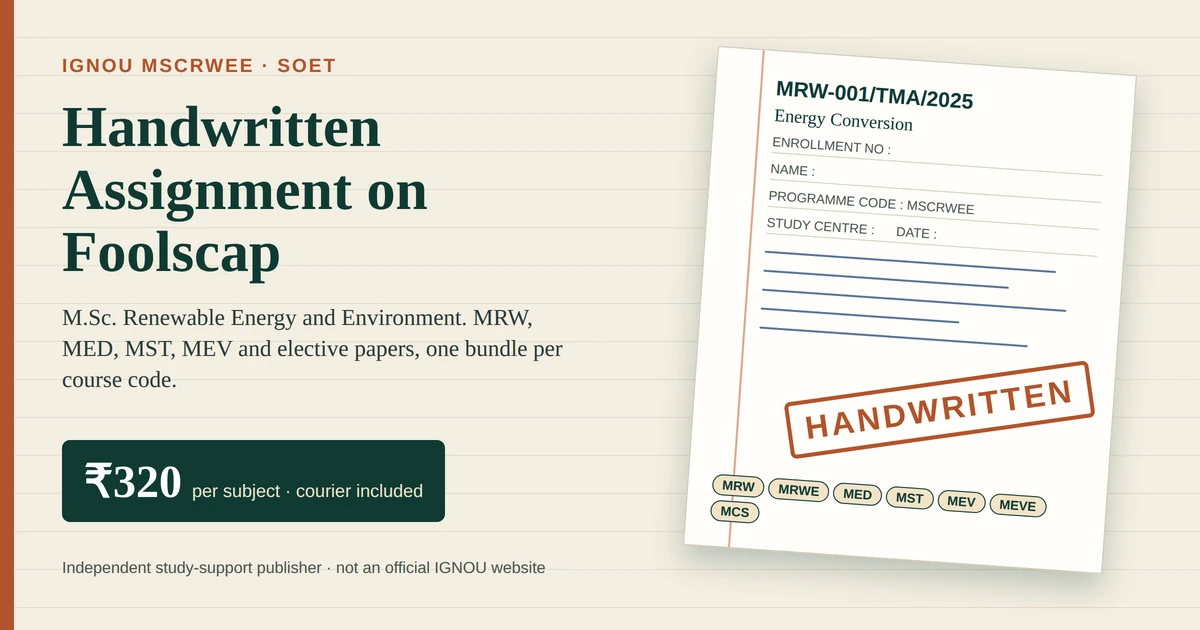
The School of Engineering and Technology asks for foolscap sheets, a 4 cm margin on three sides and delivery to your Regional Centre, while the file called MRWE-001 on ignou.ac.in still opens the January 2025 paper. A handwritten MSCRWEE set is written against the booklet year your own code needs, one MRW, MED, MST, MEV, MEVE or MCS paper at a time.
- 66 credits
- 12 papers with a TMA
- Foolscap, 4 cm margin
- English medium
- Semester wise
- Any booklet year
Delivery depends on your pin code and is confirmed for your order before you pay. No figure is promised on this page.
Quick answer. An IGNOU MSCRWEE handwritten assignment is the answer script for one Tutor Marked Assignment of the Master of Science (Renewable Energy and Environment), inked by hand on foolscap and delivered as paper to your Regional Centre, and the School of Engineering and Technology (SOET) runs that 66-credit, four-semester programme with twelve papers per learner that carry a TMA: MRW-001 to MRW-007, MED-003, MST-001, MEV-003 and two electives chosen from MRWE-001, MRWE-002, MEV-021, MEVE-001, MCS-224, MCS-226, MCS-227 and MCS-231. The rate is ₹320 per subject, hard copy only, with courier included in that price and no separate shipping charge. The paper is English, because section 3.70 of the July 2026 Common Prospectus lists English as the only medium, and the service covers all mediums IGNOU issues the TMA paper in, at the same price. Any session is accepted, current cycle or older, including backlog courses, at the same ₹320 per subject. Send a photo of a page you have written yourself and the handwritten set is matched to your handwriting at no extra charge. Assignments carry 30 per cent of the final course result and the term-end examination carries the remaining 70 per cent; the SOET booklets print 30 April for the June term-end examination and 30 September for the December one. Orders run on WhatsApp at +91 93546 37830.
MSCRWEE Cut-Offs: 30 April And 30 September, Printed By SOET
MSCRWEE assignments are due by 30 April to sit the June term-end examination and by 30 September to sit the December one. Both dates are printed twice on each SOET booklet read for this page: once in instruction 6, and again beside every assignment code as the last date of submission. The January 2026 booklet names them as 30 April 2026 and 30 September 2026, and the January 2025 booklets carry the same pair for 2025, so a July 2026 learner writing for December 2026 is working to 30 September 2026. Confirm the operative date on ignou.ac.in and with your Regional Centre before planning, because IGNOU does extend dates by notice.
Two dates, keyed to the examination you want to sit, not to your admission month.
Several popular pages give a different answer. One syllabus site lists 31 October 2026 for the July 2026 session, and a news-style page announces a general extension to 15 September 2026. Neither date appears on an MSCRWEE booklet. The 31 October habit comes from School of Management Studies papers, which is a different school with a different calendar.
Instruction 6 adds a line that changes the stakes. You cannot fill the examination form without submitting the assignments. A missing MRW bundle is therefore not a low mark. It is a paper you are not allowed to sit.
What The Thirty Per Cent Buys On An Energy Paper
Assignments carry 30 per cent of the final course result and the term-end examination carries the remaining 70 per cent. The SOET booklets for MSCRWEE describe that 30 per cent weightage as continuous evaluation made up of one tutor-marked assignment per course, each marked out of 100, so a learner with twelve TMA-bearing courses writes twelve separate 100-mark scripts across the programme. The practical meaning is simple: every one of those twelve scripts is both a score and an entry ticket.
MSCRWEE papers are harder to write quickly than most. MRW-001 Energy Conversion asks for the slip of a six-pole induction motor running at 980 rpm, the theoretical air needed to burn a coal of stated composition, and the power a hydro station can develop from a 102 square kilometre catchment. Each of those is a worked numerical. MRW-002 Heat Transfer wants derivations for conduction through a cylinder and for lumped capacitance. MST-001 wants a box plot, a stem-and-leaf display and a histogram with a frequency polygon drawn on the same graph.
Handwriting a derivation is slow. Handwriting one with a figure beside it is slower still.
A Solved File Or A Foolscap Bundle: Which One The Regional Centre Takes
A solved assignment is a soft-copy reference file of model answers for a course code and session, such as MRW-005 for 2026, read on a screen while a learner works out an answer. It is study material, and for MSCRWEE it helps most on the numerical papers, where seeing a method laid out saves hours.
A handwritten assignment is those answers written out by hand and submitted in hard copy, which for MSCRWEE means foolscap sheets with a 4 cm margin on the left, top and bottom, taken to the Regional Centre as instruction 7 of the SOET booklet directs. That object is what IGNOU evaluates. A printed solved file does not become one, because instruction 5 of the same booklet states that the assignments submitted should be hand written.
| Point of difference | Solved file for an MRW code | Handwritten MSCRWEE script |
|---|---|---|
| Format | PDF on a phone or laptop | Foolscap sheets, 4 cm margin on three sides |
| What the learner does with it | Reads it while drafting | Fills the cover fields, signs and submits |
| Who it suits | A learner stuck on a derivation or numerical | A learner short of writing time |
| Accepted at the Regional Centre | No, a printout is not hand written | Yes, subject to IGNOU’s evaluation |
| Price | Sold on a separate page | ₹320 per subject, courier included |
Scroll the table sideways on a narrow screen.
Reference files by code live on the IGNOU solved assignment files listed programme by programme. Typed pages get asked about often, usually as “typed assignment reject hota hai kya”. On this programme the booklet answers it directly, so plan on ink.
Foolscap, as SOET prints it. Instruction 2 asks for foolscap paper that is not of a very thin variety. Sellers quoting A4 with 1.5 cm margins for MSCRWEE are not reading this booklet.
Three margins, not one. Instruction 3 wants 4 cm clear on the left, the top and the bottom. Each sheet is ruled off that way before a word goes on it.
Numericals shown in full. Slip, air-fuel ratio and hydro output questions on MRW-001 are worked line by line, with units carried, not reduced to a final figure.
Figures drawn by hand. The composite wall on MRW-002, the box plot on MST-001 and any sketch an MRWE paper asks for are pencil-drawn and labelled on the sheet.
Word limits read per paper. Most SOET papers print 200 words for 5 marks and 350 for 10. MST-001 says a 20-mark answer runs above 500. The printed line on your paper wins.
Choice lines respected. The 2025 MEV-021 paper said attempt any five of six. The MRW papers say all questions are compulsory. The script follows the line on its own paper.
Project codes left out. MRWP-001 and MRWP 002 carry 18 credits and no TMA. Send either one and the quote simply leaves it off, with a note saying why.
No minimum order. There is no minimum order: one subject or fourteen, same rate. MSCRWEE tops out at twelve papers, so a single elective is as welcome as a full year.
Any booklet year. Any session is accepted, current cycle or older, including backlog courses, at the same ₹320 per subject. The year in your assignment code decides which questions get answered.
English, the only medium. The service covers all mediums IGNOU issues the TMA paper in, at the same price. For MSCRWEE that resolves to English alone.
Cover block left blank. The eight SOET cover fields are set out on top of each script and left unfilled, because the enrolment number and signature are yours.
Paper, never a file. No soft copy or PDF is sold. If an upload is ever demanded, the scan is made by you from the pages that arrive.
Paste the codes from your registration slip. Get back only the papers that exist.
Each code is checked against section 3.70 and the SOET booklets. MRWP codes are named and dropped, electives are matched to the year printed on your paper, and the total comes back in one reply.
₹320 per subject · hard copy · courier included · no soft copy
Sixty-Six Credits, Twelve Answerable Papers, Eighteen Credits Of Project
MSCRWEE totals 66 credits in section 3.70 of the IGNOU Common Prospectus for July 2026, and the table adds up: 16 credits in Semester I, 18 in Semester II, 16 in Semester III and 16 in Semester IV. The first year alone is 34 credits, which matches the prospectus statement that a learner may exit after year one with a PG Diploma in Renewable Energy and Environment. Twelve four-credit courses carry a TMA, making 48 credits of assignment work; the other 18 credits are MRWP-001 at 6 and MRWP 002 at 12, which carry no TMA.
MSCRWEE is the programme code. The course codes beneath it come from six prefixes: MRW for the core energy papers, MRWE for the two SOET electives, MED for Energy and Environment, MST for the mathematics and statistics foundation, MEV and MEVE for the environment papers, and MCS for four computing electives. The programme runs semester wise, admits in January and July, lasts two to four years, and asks for a graduate degree in engineering, science, architecture, computer application or a B.Voc in renewable energy.
Semesters I And II: Eight Rows, Seven Papers
| Semester | Code as printed | Title in section 3.70 | Credits | TMA |
|---|---|---|---|---|
| I | MRW 001 | Energy Conversion | 4 | Yes |
| I | MRW 002 | Heat Transfer | 4 | Yes |
| I | MED 003 | Energy and Environment | 4 | Yes |
| I | MST 001 | Foundation of Mathematics and Statistics | 4 | Yes |
| II | MRW 003 | Renewable Energy Systems | 4 | Yes |
| II | MRW 004 | Energy Management | 4 | Yes |
| II | MEV-003 | Environment law and Management | 4 | Yes |
| II | MRWP-001 | Industrial Training/Minor Project | 6 | No |
Semester I sums to 16 credits and Semester II to 18. Scroll sideways on a small screen.
Semesters III And IV: Three Core Papers, Two Electives, One Major Project
| Semester | Code as printed | Title in section 3.70 | Credits | TMA |
|---|---|---|---|---|
| III | MRW 005 | Solar Energy and its Application | 4 | Yes |
| III | MRW 006 | Bioenergy Conversion and its Utilization | 4 | Yes |
| III | MRW 007 | Energy Economics and Planning | 4 | Yes |
| III | Elective 1 | One course from the list below | 4 | Yes |
| IV | Elective 2 | One course from the list below | 4 | Yes |
| IV | MRWP 002 | Major Project | 12 | No |
Semesters III and IV sum to 16 credits each, bringing the programme to 66.
Eight Electives Offered By Three Schools
| Code | Title in the elective list | Offered by | Credits |
|---|---|---|---|
| MRWE 001 | Nanotechnology in Energy and Environment | SOET | 4 |
| MRWE 002 | Energy Storage | SOET | 4 |
| MEV 021 | Introduction to climate change | SOITS | 4 |
| MEVE 001 | Environmental Impact Assessment for Environmental Health | SOITS | 4 |
| MCS 224 | Artificial Intelligence and Machine learning | SOCIS | 4 |
| MCS 226 | Data Science and Big Data | SOCIS | 4 |
| MCS 227 | Cloud computing and IOT | SOCIS | 4 |
| MCS 231 | Mobile Computing | SOCIS | 4 |
A learner takes two of these eight. Scroll sideways on a small screen.
The prospectus sends six electives to other schools, yet the questions for all eight sit inside one SOET booklet with SOET instructions. An MSCRWEE learner choosing MCS-226 answers the MCS-226 paper printed in that SOET file, on foolscap, for the Regional Centre. The same course code taken inside the M.Sc. Information Security programme falls under that school’s own booklet, which is covered on the MSCIS handwritten assignment page, and MEV-021 as a compulsory climate paper is covered on the M.Sc. Climate Change handwritten page. Write MSCRWEE as your programme code either way.
Where IGNOU’s Own MSCRWEE Documents Disagree
Each item was found by reading two IGNOU documents against each other, or a third-party page against IGNOU’s own. The last item concerns this website.
- Section 3.70 places the 8 MSCRWEE electives in two semesters; the SOET booklets place all 8 in one. The July 2026 Common Prospectus puts Elective 1 in Semester III and Elective 2 in Semester IV. The SOET booklets dated January 2025 and January 2026 list all eight under the heading Third Semester (Electives). IGNOU’s programme page for MSCRWEE lists a run of four-credit rows against Semester 4. Order by the code on your registration record, not by any of the three headings.
- A 100-mark paper whose questions add to 110. The January 2025 MRWE-001 paper prints Maximum Marks 100 and says all questions carry equal marks, yet Q1 to Q9 carry 10 marks each and Q10 carries four 5-mark notes, a total of 110. Answer every part printed and let the evaluator apply the scale.
- A missing slash in an assignment code. The January 2025 first-semester booklet prints the MST-001 code as MST-001TMA/2025. Every other code in the same file reads COURSE/TMA/YEAR. Write MST-001/TMA/2025 on your cover if that is your paper year.
- A file name that hides the year. The file named MRWE-001 on ignou.ac.in opens the January 2025 third-semester booklet. The January 2026 edition of that booklet sits under a different file name ending in 2026. Read the year printed in the assignment code, never the file name.
- An index that labels older files as 2025. IGNOU’s MSCRWEE assignment index carries the page title MA(Philosophy), and its Session 2025 row links the second, third and fourth semesters to files named 2024. Only the first-semester link in that row points to a 2025 file.
- Titles that change between documents. Section 3.70 prints Solar Energy and its Application, Bioenergy Conversion and its Utilization and Nanotechnology in Energy and Environment; the SOET booklets print Solar Energy and Applications, Bioenergy Conversion and Utilization and Nano Technology in Energy & Environment. MEV-003 appears as Environment law and Management in section 3.70 and as Environmental Law and Management in other tables of the same prospectus. MST-001 is Foundation of Mathematics and Statistics here and Foundation in Mathematics and Statistics in the PGDAST table.
- An exit award with no code. Section 3.70 names a PG Diploma in Renewable Energy and Environment after 34 credits, but no programme code for that diploma appears anywhere in the July 2026 Common Prospectus. Ask your Regional Centre how an exit would be recorded before relying on it.
- Third-party advice that contradicts the booklet. One seller writes MSCRWEE sets on A4 with 1.5 cm margins; the booklet asks for foolscap and 4 cm. One help site tells MSCRWEE learners to hand the set to their Study Centre coordinator; instruction 7 says the Regional Centre. One course directory calls the programme a Master of Arts; the prospectus says Master of Science.
- On this website, pending correction. The ignouproject.com homepage still promises acceptance backed by a refund, the MMPC-001 course page still quotes a fixed dispatch period, and the MEG assignment page still offers a Hindi paper that IGNOU does not issue. None of those claims is repeated here. All three are queued for removal.
The full prospectus these tables were read from is listed on the IGNOU prospectus download page. Programme structures, course codes, submission dates and rules change, and only ignou.ac.in and your Regional Centre can confirm the current position for your enrolment.
From An MRW Code To A Tied Foolscap Bundle
Every MSCRWEE order passes through five stages, and the second one is where most mistakes on this programme are caught.
- Codes are sorted into papers and projects. Your list is checked against the 18 rows of section 3.70. MRWP-001 and MRWP 002 are set aside with a note, and the remaining codes are counted as papers.
- The booklet year is fixed before the questions are. Your semester and the four-digit year in your assignment code decide which SOET booklet applies. MRW-001/TMA/2025 and a 2026 MRW-001 paper are different sets of questions under one course code.
- Each paper’s own note is read. Word limits, the attempt-all or attempt-any line, and any per-part marks are taken from the note printed under the assignment code, then the answer plan is drawn up against them.
- Answers are written on foolscap in blue or black. Margins of 4 cm are left at the left, top and bottom, each answer starts with its question number, numericals are worked with units, figures are drawn by hand, and pages are numbered through.
- One bundle per course code, cover block on top. The eight SOET cover fields sit at the head of page one, unfilled. The walkthrough of IGNOU cover page fields shows what each one means, and the set is couriered to you.
Instruction 5 And A Photo Of Your Own Page
Send a photo of a page you have written yourself and the handwritten set is matched to your handwriting at no extra charge. One page, shot flat in daylight, shows enough of your slant, spacing and letter shapes to carry through a full MRW script.
Read instruction 5 of the SOET booklet before you decide how to use the set. Its wording asks for assignments “hand written in your own hand writing”. Some MSCRWEE learners therefore order the set as a model and copy it out themselves, which is a perfectly sound way to use it. Others submit the matched set. That decision, and the declaration you sign on the cover, stay with you.
Writing the MSCRWEE scripts yourself? The whole method is free on this site. The guide to writing an IGNOU assignment by hand covers planning and layout, the printable assignment front page PDF gives a blank block to copy, the page on assignment format and answer structure explains spacing and headings, a finished sample assignment shows depth, and the comparison of offline and online submission covers the handover.
Only follow those pages where your SOET booklet is silent. On paper size and margins, the booklet has already spoken.
Two Free Checks Built For SOET Papers
Both tools run inside this page. Nothing is uploaded, nothing is saved, and neither asks for an account. The first counts cost and runway against the two SOET cut-offs. The second turns any MSCRWEE code into its title, credits, school and expected assignment code line.
Paper Count And SOET Cut-Off Planner
MRWP-001 and MRWP 002 are excluded from every option because they carry no TMA.
A whole number from 1 to 12. Twelve is the most an MSCRWEE record can carry.
This tool is guidance from ignouproject.com, not an IGNOU rule. Using it creates no obligation to order anything. The two dates are those printed on the SOET booklets; when a date has passed, the tool shows the same date next year, which IGNOU has not yet printed.
MRW Code And Booklet Year Verifier
Spaces, hyphens and letter case are ignored, so MRW 5, MRW-005 and mrw005 all resolve to the same course.
Four digits, taken from the line that reads CODE/TMA/YEAR on your paper.
This tool is guidance from ignouproject.com, not an IGNOU rule. Using it creates no obligation to order anything. Titles and credits follow section 3.70 of the July 2026 Common Prospectus; check them against your own registration record.
Twelve papers, one school’s rules, one WhatsApp thread.
Send the codes, the semester and the year on your booklet. The reply confirms which scripts will be written, on what paper, and whether your pin code can be reached before your cut-off.
Foolscap scripts at ₹320 per subject · tied per code · courier included
Pulling The Right SOET Booklet Off Two IGNOU Servers
IGNOU publishes MSCRWEE questions free, on two different hosts, and the two do not show the same years. Read your own paper before anyone writes a line.
- Open the IGNOU current assignments search and type MSCRWEE or your exact course code. The January 2026 third-semester elective booklet surfaces there as a file ending in 2026.
- Open the MSCRWEE assignment index on IGNOU’s webservices host for the semester booklets. At the time of this review its newest row was labelled 2025, with a 2025 first-semester file and 2024 files for the other semesters.
- Check the year inside the assignment code, for example the January 2026 SOET booklet printing MCS-226/TMA/2026. The file name and the index label are not reliable guides.
- Note the word-limit and attempt lines under that code, and download the blocks you will answer from through eGyanKosh by course code, the Gyankosh access route when that repository is slow, or the free IGNOU study material downloads.
MSCRWEE assignment codes follow the pattern COURSE-NUMBER/TMA/YEAR, for example MRW-001/TMA/2025 and MCS-226/TMA/2026, with a hyphenated course code and a single four-digit year. SOET prints no session word such as JULY and no two-year span, unlike the School of Management Studies and School of Humanities formats. The year in that line identifies the booklet edition, so a learner holding a 2025 paper answers 2025 questions and writes that code on the cover.
Cross-check a paper you cannot place with the programme coordinator named in section 3.70 or your Regional Centre. Exam practice is a separate job, served by the solved term-end question papers and the last year paper archive.
Once The Regional Centre Stamps Your Receipt
Keep the receipt, and keep a copy of the pages. SOET instruction 5 advises retaining a copy of your answer sheets, and that copy is your only evidence if a bundle goes missing between the Regional Centre and the evaluation division.
Receipt and marks are shown in different places. The IGNOU assignment status checker confirms that a submission was recorded, while the assignment marks lookup and the assignment column on the grade card show the score once it is posted. Every one of those screens asks for the nine-digit identifier explained on the enrolment number help page.
A course that stays blank is usually a routing problem on this programme, because learners following generic advice hand MSCRWEE bundles to a Study Centre rather than the Regional Centre. Take your receipt to the Regional Centre before assuming a mark is lost. For a stuck row, the grade card status explainer helps; once both halves are posted, the final grade card guide, the IGNOU percentage calculator and the CGPA calculator turn it into a figure. Term-end results are tracked on the IGNOU result page, and a term-end score can go through revaluation of the examination script; an assignment mark cannot.
Other Things Renewable Energy Learners Order
The 70 per cent comes from the term-end hall, and energy papers reward practice with numericals. Unit-wise IGNOU study notes, the IGNOU guess paper collection, the IGNOU help book range and guide books ordered online cover that side, and the general IGNOU assignment overview explains how the pieces fit.
MRWP-001 and MRWP 002 are a separate kind of work, handled on the MSCRWEE MRWP-001 and MRWP-002 project guide, with synopsis help on the IGNOU synopsis and proposal service, wider project support on the IGNOU project report service and project rates on the services and charges page.
Medium and session: MSCRWEE is English only, per section 3.70. The July 2026 Common Prospectus names no other medium for the programme, and every SOET booklet read for this page is an English paper, so an offer of a Hindi MSCRWEE assignment has no IGNOU paper behind it. The Hindi-medium side of other programmes is covered on the IGNOU assignments in Hindi page. On sessions, each SOET booklet is tied to the year in its assignment code, and a learner clearing a backlog MRW paper answers the edition that matches the year IGNOU gives for that attempt.
Four Messages That Complete An MSCRWEE Order
No form, no login. The exchange runs on WhatsApp at +91 93546 37830 and usually takes four messages.
- Your first message. The codes as your registration slip prints them, your semester, the year inside the assignment code on your booklet, your pin code and, if wanted, a photo of a page in your handwriting.
- The reply. Papers confirmed, project codes named and removed, total at ₹320 per subject, and delivery for your pin code confirmed before payment.
- Your confirmation and payment. Writing starts only after this, on foolscap, with the SOET margins.
- The dispatch note. The tied scripts leave by courier with the cover block blank. You fill it, sign it, and hand the set in at your Regional Centre, keeping the receipt.
If 30 September or 30 April is close, say so in the first message. Writing takes days and courier takes days, and an honest answer before payment is worth more than a bundle that arrives late.
Sources Behind This MSCRWEE Page, Kept Apart
From the IGNOU Common Prospectus, July 2026. Section 3.70 supplied the SOET placement, the English medium, the eligibility line, all 18 course rows with titles and credits, the eight-course elective list with offering schools, the 34-credit exit to a PG Diploma and the 66-credit total, which was checked by adding the semesters: 16, 18, 16 and 16. The programme summary table supplied the two-to-four-year duration and the semester-wise mode. The PGDAST table and other environment tables supplied the title variants noted above.
From live IGNOU assignment booklets. Three SOET files were read: the January 2026 third-semester elective booklet carrying MCS-226/TMA/2026, the January 2025 third-semester booklet opened from the file named MRWE-001, and the January 2025 first-semester booklet on the webservices index. They supplied the 30 April and 30 September dates, the COURSE/TMA/YEAR format, the 100-mark maximum, the word limits, the attempt lines, the eight cover fields, the foolscap and margin instructions, instruction 5 on handwriting and the Regional Centre as the place of submission.
From ignouproject.com as publisher. The ₹320 rate, hard copy only, courier inside the price, no minimum order, any session and handwriting matching are this publisher’s commercial terms, not IGNOU rules.
What this research could not settle. The second- and fourth-semester SOET booklets were not opened for this review, so their word limits and attempt lines are not described here. No 2026 edition of the first-semester booklet was found on either IGNOU host at the time of review. The code, if any, of the exit diploma could not be found.
Written and reviewed by BK Sahni, Founder, Shri Chakradhar Publication Pvt. Ltd. and ignouproject.com, who has guided 5,00,000 students till date. ORCID 0009-0005-8092-459X. Author profile: BK Sahni on ignouproject.com.
Published 17 September 2026 · Last reviewed 17 September 2026 · Next scheduled review 1 April 2027, ahead of the 30 April cut-off, and again by 1 September 2027, ahead of 30 September.
Spotted an error? Send a correction · About this publisher · Privacy policy
Questions MSCRWEE Learners Ask Before Sending Codes
The last date is 30 April for the June term-end examination and 30 September for the December term-end examination, as printed on the SOET booklets for MSCRWEE. For the December 2026 examination that means 30 September 2026. IGNOU sometimes extends dates by notice, so confirm on ignou.ac.in and with your Regional Centre.
A solved assignment is a reference file you read; a handwritten assignment is the paper script IGNOU evaluates. The file can show you how to work an MRW numerical. Only foolscap pages written by hand meet the SOET instruction that submitted assignments should be hand written.
No, instruction 5 of the January 2025 and January 2026 SOET booklets for MSCRWEE asks for hand written assignments. The exact wording is that the assignments submitted should be hand written in your own hand writing, so a printed PDF or a typed script does not meet the MSCRWEE instruction.
The rate is ₹320 per subject, hard copy only, with courier included in that price and no separate shipping charge. All twelve TMA-bearing MSCRWEE papers, from MRW-001 to the computing electives, carry the same rate.
Foolscap, with a 4 cm margin on three sides. Instruction 2 of the SOET booklets for MSCRWEE asks for foolscap size writing paper that is not of a very thin variety, and instruction 3 sets that 4 cm margin on the left, top and bottom. Advice to use A4 for MSCRWEE comes from general pages and sellers, not from the SOET paper.
The Regional Centre. Instruction 7 of the SOET booklets says assignments will be submitted at your respective regional centre. Some help sites say Study Centre coordinator, which is the rule for other schools, not this one.
Twelve across the programme: ten fixed courses and two electives. Semester I has four, Semester II has three, Semester III has three plus Elective 1, and Semester IV has Elective 2. MRWP-001 and MRWP 002 carry no TMA.
Each MSCRWEE assignment is marked out of 100. Most SOET papers print 200 words for a 5-mark question and 350 for a 10-mark question; MST-001 says a 20-mark answer runs above 500 words, and MCS-226 and MEV-021 give 550 words for 20 marks. Follow the note printed on your own paper.
The one whose assignment code year matches the attempt IGNOU has registered you for. Read the four-digit year in the CODE/TMA/YEAR line, because the file named MRWE-001 on ignou.ac.in opens a January 2025 booklet and the webservices index labels 2024 files under 2025.
One in each, according to section 3.70 of the July 2026 Common Prospectus: Elective 1 in Semester III and Elective 2 in Semester IV. The SOET booklets list all eight electives under the third semester, so follow your registration record for where each one sits.
Yes. Send a photo of a page you have written yourself and the handwritten set is matched to your handwriting at no extra charge. Read SOET instruction 5 first and decide whether to submit the set or copy it out yourself.
No. Section 3.70 of the July 2026 Common Prospectus lists English as the medium of instruction for MSCRWEE, and every SOET booklet read for this page is in English, so the MSCRWEE set is written in English.
Yes. Any session is accepted, current cycle or older, including backlog courses, at the same ₹320 per subject. Send the year printed in that paper’s assignment code, and confirm with your Regional Centre which edition it will accept.
No soft copy or PDF is sold. The MSCRWEE set is paper only. If an upload is ever demanded, you scan the pages that arrive.
Check that the writer asks for your exact codes and booklet year, uses foolscap with the SOET margins, leaves MRWP codes out of the price, states delivery for your pin code before payment and makes no promise about marks. Those checks apply to this service and to every other.
No. No claim is made about the marks any assignment will receive, about how an evaluator will assess it, or about whether it will be accepted. Assignment evaluation is entirely a matter for IGNOU.
No. ignouproject.com is an independent IGNOU study-support publisher. It is not the official website of Indira Gandhi National Open University, is not affiliated with, endorsed by or authorised by the university, and no page on this site should be treated as an official IGNOU communication.
Important Notice
ignouproject.com is an independent IGNOU study-support publisher. It is not the official website of Indira Gandhi National Open University, is not affiliated with, endorsed by or authorised by the university, and no page on this site should be treated as an official IGNOU communication.
Programme structures, course codes, submission dates and rules change, and only ignou.ac.in and your Regional Centre can confirm the current position for your enrolment.
You sign the declaration on the assignment cover page, so you should read and review the content before submitting it, and satisfy yourself that it represents your own understanding of the course.
No claim is made about the marks any assignment will receive, about how an evaluator will assess it, or about whether it will be accepted. Assignment evaluation is entirely a matter for IGNOU.
Send the MRW codes and the year on your booklet. The SOET rules are handled from there.
Foolscap, 4 cm margins, one bundle per code, cover block left for your signature, and project codes named rather than billed.
₹320 per subject · order one or twelve · courier inside the price · handwriting matched free
WhatsApp +91 93546 37830 · Shri Chakradhar Publication Pvt. Ltd. · ignouproject.com operates independently of IGNOU.

BK Sahni iD 0009-0005-8092-459X
Founder, Shri Chakradhar Publication Pvt. Ltd. & ignouproject.com — helping IGNOU distance-learning students since 2010 (5,00,000+ students supported across MBA, MCom, MA & more). Author of IGNOU exam guides, solved assignments & project reference books.
Disclosure: Shri Chakradhar Publication Pvt. Ltd. and ignouproject.com are independent third-party study-help services — not the official IGNOU website. Always verify final dates and rules on ignou.ac.in.