MAEC · Master of Arts (Economics) · School of Social Sciences
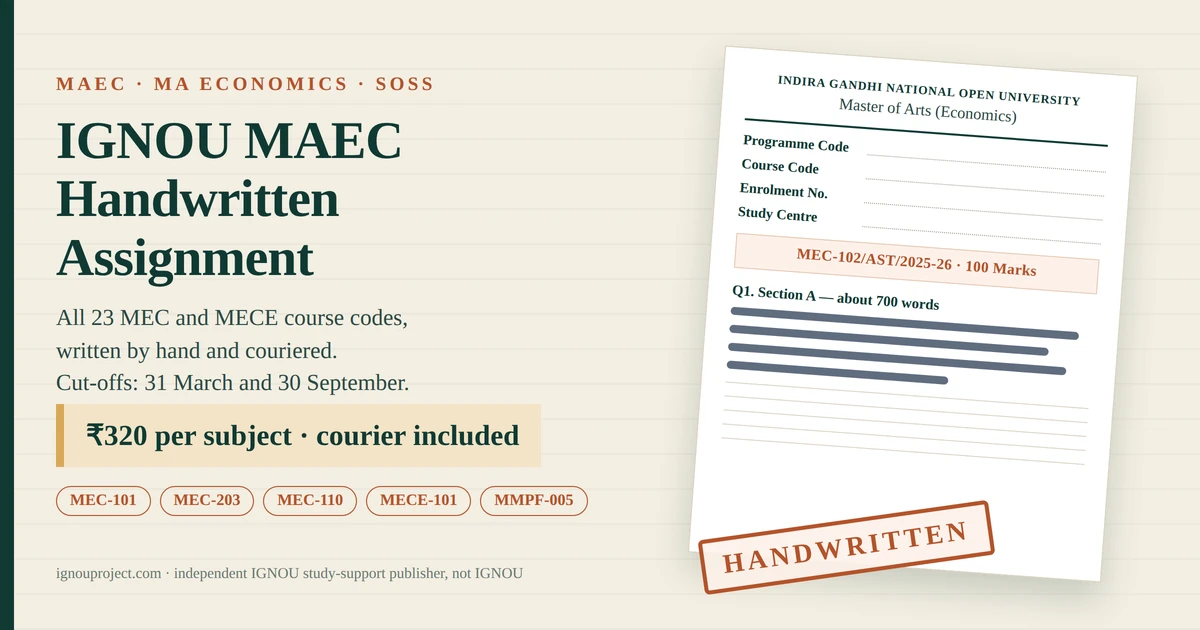
IGNOU MAEC handwritten assignment sets for all 23 course codes, from MEC-101 through the fourth-semester specialisation groups. Each handwritten assignment is written by hand on A4 and couriered ready to submit, at ₹320 per subject.
- 23 MAEC course codes
- 80 credits, four semesters
- SOSS dates: 31 Mar / 30 Sep
- English and Hindi
- Any session, backlog included
- Your own handwriting matched free
Send the course codes printed on your admission record, your session, and your medium for the handwritten assignment set you need. A price and a written confirmation come back in the same chat.
Quick answer. A handwritten assignment is the Tutor Marked Assignment answer set for an IGNOU course, written out by hand on A4 sheets with the cover page filled in, ready to hand over at a study centre; for MAEC, the Master of Arts (Economics) offered by IGNOU’s School of Social Sciences, that covers all 23 course codes across four semesters, from the compulsory MEC-101, MEC-102 and MEC-203 through the fourth-semester specialisation groups and the MECE and MECP codes inside them, and ignouproject.com prepares those sets at ₹320 per subject, hard copy only, with courier included in that price and no separate shipping charge; the service covers all mediums IGNOU issues the TMA paper in, at the same price, which for MAEC means English and Hindi, and any session is accepted, current cycle or older, including backlog courses, at the same ₹320 per subject; send a photo of a page you have written yourself and the handwritten set is matched to your handwriting at no extra charge; assignments carry 30 per cent of the final course result and the term-end examination carries the remaining 70 per cent, and IGNOU’s own MAEC booklet adds that you must secure at least 40 per cent in the assignment to complete a course; to order, message +91 93546 37830 on WhatsApp with your MEC codes, session and medium.
MAEC Submission Cut-Offs: 31 March And 30 September
IGNOU’s own MAEC assignment booklet for 2025-26 prints two dates, and neither of them is the one most of the internet quotes.
For learners intending to sit the June term-end examination. This is the date printed inside the MAEC 2025-26 booklet for the July 2025 and January 2026 admission cycles.
For learners intending to sit the December term-end examination. The same booklet carries both dates, because one MAEC paper serves two consecutive admission cycles.
Dates shift by session and by Regional Centre. Confirm yours on ignou.ac.in and with your Regional Centre before you rely on either figure.
The School of Management Studies works to 31 October and 30 April, and because MBA and MCOM are the loudest programmes online, those two dates get repeated as though they applied to everyone. They do not apply to MAEC. The School of Social Sciences prints 31 March and 30 September on the Master of Arts (Economics) booklet, and has done so consistently across the 2022-23, 2024-25 and 2025-26 sets. A MAEC learner writing a handwritten assignment to an October date is roughly seven months late for the June term-end examination.
One more MAEC-specific line sits at the top of that booklet and is worth reading twice. Assignments carry 30 per cent of the final course result and the term-end examination carries the remaining 70 per cent, and the MAEC booklet adds that securing at least 40 per cent of the assignment marks is mandatory to complete a course successfully. Submitting something is not the whole requirement for this programme. Submitting something that clears 40 per cent is.
Why Thirty Per Cent Of Every MEC Course Is Decided Before The Exam Hall
A MEC-101 paper carries 100 marks in total: two Section A questions at 20 marks each and five Section B questions at 12 marks each. Those 100 marks convert into 30 per cent of what finally appears against MEC-101 on your IGNOU grade card. Nothing in that calculation depends on how well you sit an examination hall for three hours. It depends on whether a handwritten assignment bundle of A4 sheets reached a study centre by 31 March.
Economics makes this harder than it is for most other Master of Arts programmes. MAEC Section A answers run to roughly 700 words each, and Section B answers to roughly 400 words, and a good share of those words are not words at all. They are Cobb-Douglas utility functions, Lagrange problems, pay-off matrices, Jacobians and IS-LM diagrams, all of which have to be copied into the handwritten pages legibly, with the notation intact. A learner who can write a 400-word paragraph in ten minutes will not write a 400-word answer containing three derivations in ten minutes.
Multiply that across a semester. Three courses per semester in the first three semesters means three separate 100-mark assignments, each with seven questions, each answer within its own printed word range. That is 21 questions and roughly 8,400 words of assignment writing per semester before a single diagram is drawn, which is why so many MAEC learners look for a ready handwritten assignment rather than starting from a blank page.
Flat rate, no semester bundling. ₹320 buys one subject-wise handwritten assignment for one MEC course code, whether it is the 8-credit MEC-203 or the 4-credit MECE-101. There is no minimum order: one subject or fourteen, same rate.
Notation copied, not paraphrased. Utility functions, matrices and derivations are reproduced in the handwritten pages as the question paper prints them, because an evaluator marking MEC-101 is looking for the working, not a description of the working.
Both MAEC mediums. The service covers all mediums IGNOU issues the TMA paper in, at the same price. MAEC’s medium of instruction is English and Hindi, so an English medium handwritten assignment and a Hindi medium handwritten assignment cost the same ₹320 for the nine compulsory MEC codes.
Adopted courses handled. MCS-226, MCS-224, MGG-011, MMPC-014, MMPF-005 and MMPF-006 sit inside MAEC Groups A and B and are issued in English only. A handwritten assignment for any of them is quoted at the same ₹320.
Backlog codes accepted. Any session is accepted, current cycle or older, including backlog courses, at the same ₹320 per subject. A handwritten assignment for an older cycle such as 2022-23 MEC-006 is priced identically to one for 2025-26 MEC-106.
Old MEC codes recognised. Learners registered before the restructure carry MEC-001 to MEC-009. A handwritten assignment is still prepared for those codes; send whichever code your admission record actually prints.
Your own hand, at no cost. Send a photo of a page you have written yourself and the handwritten set is matched to your handwriting at no extra charge.
Courier sits inside the price. The rate is ₹320 per subject, hard copy only, with courier included in that price and no separate shipping charge. Nothing is added when the handwritten set is dispatched.
Cover page filled, not blank. Enrolment number, programme code MAEC, course code, assignment code, session and study centre code are entered on each handwritten set’s front sheet before dispatch.
Word ranges respected. The MAEC paper prints its own limits — about 700 words for a 20-mark question and about 400 for a 12-mark one. Those printed ranges set the length of the handwritten answer, not a generic assignment writing convention.
One handwritten set per course code. MAEC requires a separate assignment prepared and submitted for each registered course, so each code is quoted, written and packed as its own handwritten set.
No soft copy in the deal. No soft copy or PDF is sold. If your Regional Centre wants an upload, you scan the delivered hard copy yourself and upload that scan.
Order
Message the course codes exactly as your admission record prints them — MEC-104, MECE-101, MMPF-005 — with your session and medium. You will get the total and a written confirmation of what is being prepared before anything is written.
Get A Price For Your SemesterEvery MAEC Course Code, Semester By Semester
MAEC is the programme code in IGNOU’s Common Prospectus. MEC is the course-code prefix printed on every assignment paper, and it was also the old programme code before the restructure. MECE is the prefix on the fourth-semester specialisation electives, and MECP is the prefix on the project course. The four are not alternatives to each other; they name different things, and a learner needs all four to read their own admission record correctly.
The Common Prospectus for July 2026 states the current structure plainly: the programme runs in semester mode across four semesters of 20 credits each, for a total of 80 credits, with every course in the first, second and third semesters compulsory. Specialisation appears only in the fourth semester. Eligibility is a Bachelor’s degree or higher from a recognised university, the medium of instruction is English and Hindi, and the programme sits with the School of Social Sciences.
First Year: Semesters One And Two
| Code | Official title | Credits | Status |
|---|---|---|---|
| MEC-101 | Microeconomic Theory and Analysis | 6 | Compulsory, Semester 1 |
| MEC-102 | Macroeconomic Theory and Analysis | 6 | Compulsory, Semester 1 |
| MEC-203 | Quantitative Methods | 8 | Compulsory, Semester 1 |
| Semester 1 total | 20 | Three courses | |
| MEC-104 | Economics of Growth and Development | 8 | Compulsory, Semester 2 |
| MEC-109 | Research Methods in Economics | 6 | Compulsory, Semester 2 |
| MEC-205 | Indian Economic Policy | 6 | Compulsory, Semester 2 |
| Semester 2 total | 20 | Three courses | |
Scroll the table sideways on a narrow screen to see the credits and status columns.
Second Year: Semester Three
| Code | Official title | Credits | Status |
|---|---|---|---|
| MEC-106 | Public Economics | 6 | Compulsory, Semester 3 |
| MEC-107 | International Trade and Development | 6 | Compulsory, Semester 3 |
| MEC-110 | Money, Financial Institutions and Markets | 8 | Compulsory, Semester 3 |
| Semester 3 total | 20 | Three courses | |
Scroll the table sideways on a narrow screen to see the credits and status columns.
Nine compulsory codes carry the first three semesters, and their numbering is not sequential. MEC-203 and MEC-205 use the 200 series while everything around them uses the 100 series. That is how the prospectus prints them and it is not an error, but it is why a learner who assumes the second-semester quantitative paper must be MEC-103 will download the wrong booklet.
Second Year: Semester Four Specialisation Groups
The fourth semester is where MAEC stops looking like a single programme. Three specialisation groups are printed, each carrying more courses than the 20 credits a learner actually has to complete, so the group is a menu rather than a fixed set. Two learners in the same fourth semester can therefore be registered in course codes that do not overlap at all.
| Code | Official title | Credits | Medium |
|---|---|---|---|
| MECE-101 | Introductory Econometric Methods | 4 | English only |
| MECE-102 | Advanced Econometric Methods | 4 | English only |
| MCS-226 | Data Science and Big Data (adopted from the MCA programme) | 4 | English only |
| MCS-224 | Artificial Intelligence and Machine Learning (adopted from the MCA programme) | 4 | English only |
| MGG-011 | Geographical Information System-I (adopted from the MA Geography programme) | 4 | English only |
| MECP-301 | Project Work | 4 | English only |
| Group A total as printed | 24 | Complete 20 credits | |
Scroll the table sideways on a narrow screen to see the credits and medium columns.
| Code | Official title | Credits | Medium |
|---|---|---|---|
| MECE-101 | Introductory Econometric Methods | 4 | English only |
| MECE-102 | Advanced Econometric Methods | 4 | English only |
| MECE-203 | Actuarial Economics | 4 | English only |
| MMPC-014 | Financial Management (adopted from the MBA programme) | 4 | English only |
| MMPF-005 | International Financial Management (adopted from the MBA programme) | 4 | English only |
| MMPF-006 | Management of Financial Services (adopted from the MBA programme) | 4 | English only |
| MECP-301 | Project Work | 4 | English only |
| Group B total as printed | 28 | Complete 20 credits | |
Scroll the table sideways on a narrow screen to see the credits and medium columns.
| Code | Official title | Credits | Source school |
|---|---|---|---|
| MECE-101 | Introductory Econometric Methods | 4 | SOSS, Economics |
| MECE-204 | Economics of Social Sector and Environment | 4 | SOSS, Economics |
| MGPE-006 | Gandhi’s Economic Thoughts | 4 | Gandhi and Peace Studies |
| MWG-111 | Women in the Economy | 8 | Gender and Development Studies |
| MGSE-009 | Gender issues in Work, employment and productivity | 4 | Gender and Development Studies |
| MECP-301 | Project Work | 4 | SOSS, Economics |
| Group C total as printed | 28 | Complete 20 credits | |
Scroll the table sideways on a narrow screen to see the credits and source school columns.
Counting across all four semesters, MAEC touches 23 distinct course codes: nine compulsory MEC codes, four MECE electives, one MECP project code, and nine courses adopted from other schools and programmes. Nine of the 23 are marked in the prospectus as being available in English only, which is the single most consequential detail on this page for a Hindi-medium MAEC learner. The programme is bilingual. The fourth semester largely is not.
MECP-301 is a project course, not a tutor marked assignment, and it is not part of the handwritten assignment service. If you are at that stage, the MAEC economics project guide covers topic selection and the report, and the synopsis format and approval route is a separate walkthrough. General project pricing sits on the published services and charges list.
Six syllabus conflicts found while checking MAEC, including one on this website
- Three groups or four? The prospectus paragraph introducing MAEC says a student may opt for any specialisation “out of the four groups” and then names three: A-Data Analytics, B-Insurance and Finance, C-Social Policy. The note immediately below says three groups, A, B and C. The fourth-semester note above the tables then says four groups, A, B, C and D, twice. Only Groups A, B and C are actually printed anywhere. There is no Group D in the July 2026 document.
- Twenty credits against groups totalling 24 and 28. The fourth semester is stated as 20 credits and the programme as 80. The printed group tables total 24 credits for Group A and 28 each for Groups B and C. The groups are menus to select 20 credits from, not lists to complete in full — but the document never says so in those words.
- MECP-201 and MECP-202 against MECP-301. The fourth-semester note warns that students are not permitted to opt for both MECP-201 and MECP-202. Neither code appears in any of the three group tables. The project course printed in all three groups is MECP-301, Project Work, 4 credits. The note is a carry-over from the earlier structure.
- Our own page carries the older project codes. The MAEC project guide on ignouproject.com, linked earlier in this section, is built around MECP-201 and MECP-202. Against the July 2026 prospectus, the current project code is MECP-301. That page is being corrected; until it is, treat the table above as the current position and confirm your own project code with your Regional Centre.
- A wrong assignment code inside IGNOU’s own booklet. The MAEC 2024-25 first semester booklet prints the MEC-102 paper with the assignment code MEC-002/AST/2024-25. MEC-002 is not a current MAEC course code. The 2025-26 booklet corrects it to MEC-102/AST/2025-26. Both booklets were read to confirm this is a corrected error rather than a format variant.
- Old codes still circulating widely. The programme was MEC before the restructure and is MAEC now, and study-material sellers still list the retired codes alongside the current ones: MEC-103 for MEC-203, MEC-004 for MEC-104, MEC-105 for MEC-205, MEC-006 for MEC-106, MEC-007 for MEC-107, MECE-001 for MECE-101 and MECE-003 for MECE-103. Order against the code your own admission record prints, not against a seller’s cross-reference.
Disclosing an error on this website rather than quietly fixing it is deliberate. The IGNOU prospectus reference page is where the current structure is summarised, and the tables above were rebuilt directly from the July 2026 Common Prospectus rather than carried over from an older page.
From Question Paper To Couriered Set: The Five Stages
- The exact MEC paper is pulled and matched against your codes
You send course codes, session and medium. The matching MAEC booklet is opened and the assignment code printed on it is read off — MEC-102/AST/2025-26 rather than a code assumed from another programme. If your codes span two semesters, that is two separate booklets, and both are checked before a price for the handwritten assignment is quoted.
- Answers are drafted to the printed word range before any assignment writing begins
Section A answers are built to roughly 700 words, Section B to roughly 400, because those are the ranges the MAEC paper itself prints. Numerical questions are exempted from the word range by the paper’s own instruction, so a Cournot equilibrium or a Jacobian is solved to completion rather than padded to a target.
- The handwritten set is written on A4 in blue or black, with the working shown
Each question number is written out before its answer and each answer starts on a fresh section. Derivations, matrices and diagrams are reproduced rather than described, since the marks in MEC-101, MEC-203 and MECE-101 sit in the working. Margins are left wide enough for an evaluator to write in, which is the one assignment writing habit that protects marks on every MEC paper.
- The cover sheet is completed for that specific course code
Enrolment number, programme code MAEC, the course code, the assignment code from the booklet, the session and the study centre code go onto the front page of every set. MAEC requires assignments prepared and submitted separately for each course, so a three-course semester arrives as three separately covered sets.
- The handwritten bundle is packed and couriered to your address
Delivery depends on your pin code and is confirmed for your order before you pay. No figure is promised on this page. What you receive is a submission-ready handwritten hard copy; the counter-signature and the trip to the study centre are yours.
Matching Your Own Handwriting At No Extra Charge
Send a photo of a page you have written yourself and the handwritten set is matched to your handwriting at no extra charge. A single page of your own handwriting is enough — a rough note, an old answer sheet, anything carrying your natural slant, letter spacing and pen pressure.
Matching your own handwriting matters more for MAEC than it does for a prose-only programme. An economics handwritten assignment is full of subscripts, Greek letters and equation layout, and those are exactly the marks a reader notices when two handwritten sets look like they came from different hands. Matching your own handwriting keeps a MEC-203 answer consistent with the MEC-101 answer sitting next to it in the same handwritten bundle.
Writing it yourself instead? That is a completely reasonable choice and this site publishes the material for it free. The step-by-step guide to the IGNOU handwritten assignment covers paper, pen, margins and layout end to end, and applies to any programme, not only MAEC. Download a ready sheet from the assignment front page format PDF, check the field-by-field cover page rules, look at a finished bundle in the sample IGNOU assignments, read the assignment format and structure notes, and work out where yours goes using the online and offline submission walkthrough. Hindi-medium MAEC learners will also want the Hindi assignment guidance.
Two Free MAEC Tools, No Sign-Up
Both tools run entirely in your browser. Nothing is sent anywhere, nothing is stored, and neither one asks for a name or a number.
Free tool 1
MEC Paper Cost And Countdown Planner
Enter how many MEC course codes you are short on. The tool computes the handwritten assignment total at ₹320 each, finds the next MAEC cut-off from today’s date, and estimates the assignment writing hours involved using the word ranges the MAEC paper actually prints.
Enter a number of course codes and select a target examination.
Confirm This Total On WhatsApp
This tool is guidance from ignouproject.com, not an IGNOU rule. Using it creates no obligation to order anything.
Free tool 2
Semester And Assignment Code Locator
Type a MAEC course code and the tool tells you which semester it belongs to, its credits, whether it is compulsory or a specialisation elective, what its assignment code should look like in MAEC’s own format, and which medium it is issued in.
Type a MAEC course code to see its semester, credits and expected assignment code.
This tool is guidance from ignouproject.com, not an IGNOU rule. Using it creates no obligation to order anything.
Order
Because Groups A, B and C print more courses than the 20 credits you complete, “Group B” does not identify a set of papers. The list of codes on your admission record does. Send that list.
Book Your MEC Set NowDownloading The Official MEC Assignment Booklet
Every answer in your handwritten assignment is written against IGNOU’s own question paper, and you should have that paper in front of you too. It is free, it is public, and it is the only document that settles what your assignment code and word limits actually are.
- Open the official assignment portal
The download page is at ignou.ac.in/studentService/download/assignments. Choose the Master’s degree category and then MAEC, Master of Arts (Economics). Booklets are grouped by semester, not by individual course, and the current set is labelled by year span such as assignment 2026-27.
- Check the session line on the cover before anything else
The MAEC cover states which two admission cycles the paper serves — the 2025-26 booklet reads “For July 2025 and January 2026 Sessions”. If your admission cycle is not one of the two named, that is not your paper and the answers written from it will not match your questions.
- Read the assignment code off the paper, not off a template
MAEC prints its assignment code in the form MEC-102/AST/2025-26, using AST where most IGNOU programmes print TMA, and using a two-year span rather than a session name. Some MAEC papers in the same booklet print the looser form “Asst /TMA /2024-25” with no course code at all. Copy whichever form your own paper shows onto your cover sheet.
- Note the marks split and the word ranges printed under each section
A MAEC paper carries 100 marks: two questions at 20 marks in Section A and five at 12 marks in Section B. The instruction lines print roughly 700 words for the 20-mark answers and roughly 400 for the 12-mark ones, and exempt numerical questions from both.
If the portal returns an error, which it does periodically, the free reference material is still reachable. Official MA Economics course blocks and units sit on eGyankosh, with an alternate Gyankosh route when the first is slow, and complete study material PDFs are indexed on the IGNOU books download page.
Tracking MEC Assignment Marks On The Grade Card
Handing a bundle over at a study centre is the start of a process, not the end of one. The study centre records the submission, an evaluator marks it, the marks travel to the Student Evaluation Division at IGNOU in New Delhi, and only then do they surface against your course code. The MAEC booklet itself asks you to insist on getting the evaluated assignment back, which is worth remembering when a study centre says it does not return them.
Get a receipt at the counter and keep it. The MAEC booklet says so in plain words, and it also suggests keeping a photocopy of what you submitted. If a MEC-107 mark is missing six months later, the receipt is the only thing that distinguishes “not submitted” from “submitted and lost”.
To check where yours stands, work through the assignment result and status walkthrough, which is the most-used page on this site and covers what each status message means. The narrower assignment marks status lookup and the assignment entries on the grade card cover the two places the numbers appear. Once the term-end result lands too, the final grade card explainer shows how the 30 and the 70 combine. Your enrolment number is required at every one of those lookups; if you are unsure of yours, the enrolment number guide explains where it appears. To convert MAEC grades into a percentage or a CGPA, use the percentage calculator or the CGPA calculator.
Where the bundle physically goes is a separate question with a programme-specific answer: MAEC assignments go to the Coordinator of your Study Centre, which the booklet states directly. The assignment submission guide covers the counter process and what to do when a centre refuses a late bundle.
What MAEC Learners Usually Order In The Same Message
Most MEC handwritten assignment enquiries are not only about handwriting. MA Economics learners tend to be assembling a whole semester’s support at once, and the rest of it sits on this site already.
A MAEC solved assignment for the same MEC codes sits on the solved assignments page, which is the sensible companion if you intend to write some papers yourself and order a handwritten assignment for the rest. For the term-end examination, the guess papers, the solved question papers and the previous year papers are the three that MAEC learners open most, because MEC-203 and MECE-102 reward pattern recognition more than reading does. Unit-level study material sits in the study notes, the help books and the guide books catalogue, broken down by blocks and units. Project and dissertation work for other stages is indexed on the projects page.
For school context, MAEC sits with the School of Social Sciences alongside programmes such as the SOSS Bachelor’s Preparatory Programme, which is why its calendar follows SOSS dates rather than management dates. There is no per-code page on this site for MEC-101 or any other MAEC course yet; those are planned, and until they exist, send the code on WhatsApp for a direct answer.
Medium and session, stated once. The service covers all mediums IGNOU issues the TMA paper in, at the same price, so any medium your paper is printed in is quoted at ₹320 and every medium carries the same rate. For MAEC that resolves to English and Hindi for the nine compulsory MEC codes, and English only for the nine adopted fourth-semester courses and the MECE electives, because that is the restriction IGNOU prints, not a limit set here.
Any session is accepted, current cycle or older, including backlog courses, at the same ₹320 per subject. A MAEC paper serves two admission cycles and then expires, so a learner clearing an older cycle such as 2023-24 needs those questions for the handwritten assignment rather than the current ones — send the year span printed on your own booklet and the matching paper is used.
Placing A MAEC Order: What To Send And What Happens Next
Three steps, and five details that decide whether the set that arrives is the right one.
- Message the codes on WhatsApp
Write to +91 93546 37830 with your MEC, MECE or adopted course codes exactly as your admission record prints them.
- Confirm the total and the paper being used
A total at ₹320 per subject comes back, along with the assignment code and year span of the booklet the answers will be written from. Check that year span against your own booklet before agreeing.
- Receive the handwritten bundle and submit it yourself
The handwritten hard copy arrives at your address with each course covered separately. You sign the declaration, hand it to the Coordinator of your Study Centre, and collect a receipt.
| Detail | Example | Why it decides the outcome |
|---|---|---|
| Course codes | MEC-106, MEC-107, MEC-110 | Prices the order and selects the booklet. Group names do not identify papers. |
| Session or year span | July 2026, booklet 2026-27 | MAEC papers serve two cycles and then expire. The wrong span means the wrong questions. |
| Medium | Hindi for MEC-106, English for MECE-101 | Nine MAEC courses are issued in English only, so medium is decided per code. |
| Enrolment and study centre code | Nine or ten digits, plus centre code | Goes on every cover sheet. A missing centre code stalls the marks, not the submission. |
| Handwriting sample | Photo of one page you wrote | Optional, free, and the only way the handwritten set is matched to your own handwriting. |
Scroll the table sideways on a narrow screen to see the example and reason columns.
Sourcing, Author And Review Record
Three kinds of statement appear on this page and they come from three different places, deliberately kept apart.
From the IGNOU Common Prospectus, July 2026: the 80-credit four-semester structure, every course code and official title in the tables above, the credits, the three specialisation groups, the English-only medium restrictions, the eligibility rule, and the School of Social Sciences attribution. The six conflicts listed in the warning box were found by reading that document against itself.
From IGNOU’s own live MAEC assignment booklets: the 31 March and 30 September cut-offs, the two-admission-cycle validity, the AST assignment code format and its two-year span, the 100-mark split into two 20-mark and five 12-mark questions, the roughly 700 and 400 word ranges, the 40 per cent minimum assignment requirement, the instruction to obtain and keep a receipt, and the requirement to prepare and submit assignments separately for each course. Two booklets were read — the 2025-26 first semester set and the 2024-25 first semester set — which is how the MEC-002 assignment code error was confirmed as an error and not a variant.
From ignouproject.com, as the publisher’s own commercial terms: the ₹320 per subject rate, hard copy only, courier included, no minimum order, all mediums, any session, and free handwriting matching. These are this business’s terms, not IGNOU rules, and nothing on this page should be read as the university endorsing them.
Written and reviewed by BK Sahni, Founder, Shri Chakradhar Publication Pvt. Ltd. and ignouproject.com, who has guided 5,00,000 students till date. ORCID 0009-0005-8092-459X.
- Author
- BK Sahni, Founder, Shri Chakradhar Publication Pvt. Ltd.
- Reviewed by
- BK Sahni · ORCID 0009-0005-8092-459X
- Published
- 12 August 2026
- Last reviewed
- 12 August 2026
- Next scheduled review
- 1 March 2027, ahead of the 31 March MAEC cut-off, and again on 1 September 2027 ahead of the 30 September cut-off
- Corrections
- Report an error on this page · About ignouproject.com
MAEC Handwritten Assignment Questions Learners Ask
IGNOU’s MAEC 2025-26 booklet prints 31 March for learners appearing in the June term-end examination and 30 September for those appearing in December. These are School of Social Sciences dates. The 31 October and 30 April dates quoted across much of the internet belong to the School of Management Studies and do not apply to MAEC. IGNOU does extend deadlines in some sessions, so confirm on ignou.ac.in and with your Regional Centre before relying on either date.
The rate is ₹320 per subject, hard copy only, with courier included in that price and no separate shipping charge. It is the same ₹320 whether the code is the 8-credit MEC-203 or the 4-credit MECE-101, and the same for English or Hindi. There is no minimum order: one subject or fourteen, same rate. A three-course MAEC semester therefore comes to ₹960.
Yes for the courses IGNOU issues in Hindi. The service covers all mediums IGNOU issues the TMA paper in, at the same price. MAEC’s medium of instruction is English and Hindi, so the nine compulsory MEC codes are available in both. The nine adopted fourth-semester courses — MCS-226, MCS-224, MGG-011, MMPC-014, MMPF-005, MMPF-006 and the MECE electives among them — are marked in the prospectus as available only in English. That is IGNOU’s restriction on the paper itself, not a limit set here.
The MAEC 2025-26 booklet prints the MEC-102 code as MEC-102/AST/2025-26. AST is short for assignment, and MAEC uses it where the School of Management Studies prints TMA and a session name. The same booklet also calls the paper a Tutor Marked Assignment on its cover, so both terms describe the same document. Some MAEC papers in the 2024-25 booklet print the looser form “Asst /TMA /2024-25” with no course code in it at all. Copy whichever form your own paper prints onto your cover sheet rather than assuming a house style.
Each MAEC course carries a 100-mark assignment. Section A holds two questions at 20 marks each and Section B holds five at 12 marks each, totalling 100. Section A answers run to roughly 700 words and Section B answers to roughly 400, with numerical questions exempted from both ranges by the paper’s own instruction. Those 100 marks then count for 30 per cent of the course result, and IGNOU’s MAEC booklet requires at least 40 per cent of them to complete the course.
MAEC is 80 credits across four semesters of 20 credits each. Nine compulsory MEC courses fill the first three semesters, three per semester. The fourth semester is a 20-credit specialisation chosen from Group A Data Analytics, Group B Insurance and Finance or Group C Social Policy. Counting the compulsory codes, the MECE electives, the MECP project code and the courses adopted from other programmes, MAEC touches 23 distinct course codes in total.
Because IGNOU’s July 2026 Common Prospectus contradicts itself on this point. The introductory paragraph says a student may opt out of “the four groups” and then names three. The note below it says three groups, A, B and C. The fourth-semester note above the tables says four groups, A, B, C and D, twice. Only Groups A, B and C are printed anywhere in the document, so there is no Group D to choose. Treat the three printed groups as the current position and confirm with your Regional Centre if a counsellor tells you otherwise.
No. The fourth semester is 20 credits, but Group A totals 24 credits as printed and Groups B and C total 28 each. The groups are menus to select 20 credits from, not lists to complete in full. The prospectus never says this in so many words, which is why the totals look wrong on first reading. Your admission record lists the specific codes you are actually registered in, and that list is what to order against.
They name the same degree at different points in time. MEC was the programme code before the restructure under the National Education Policy 2020; MAEC is the programme code now, and it is what the Common Prospectus and the assignment booklets print. MEC survives as the course-code prefix on every assignment paper — MEC-101, MEC-110 and so on. Learners who joined under the older structure continue under their own codes, which is why MEC-001 to MEC-009 papers are still ordered alongside MEC-101 to MEC-205 papers.
Yes. Any session is accepted, current cycle or older, including backlog courses, at the same ₹320 per subject. A MAEC paper is valid for two admission cycles and then expires, so a backlog course needs the questions from the year span you were registered in rather than the current ones. Send the year span printed on your own booklet — for example 2023-24 — and the matching paper is used.
No soft copy or PDF is sold. This service is a physical handwritten set only. If your Regional Centre asks for an online upload, you scan or photograph the delivered handwritten hard copy yourself and upload that scan. Reference answers in PDF form are a different product and sit on the solved assignments page linked earlier on this page.
Delivery depends on your pin code and is confirmed for your order before you pay. No figure is promised on this page. A pin code in a metro and a pin code in a remote district do not receive a courier on the same timeline, so a number quoted before your address is known would be a guess. Ask on WhatsApp with your pin code and you will get a specific answer for your order.
Yes, at no extra charge. Send a photo of a page you have written yourself and the handwritten set is matched to your handwriting at no extra charge. One ordinary page of your own handwriting is enough. For MAEC, matching the handwriting is worth doing even if you would skip it elsewhere, because economics answers carry subscripts, Greek letters and equation layout that make a mismatch between two sets in the same bundle easy to notice.
To the Coordinator of your Study Centre, which is what IGNOU’s MAEC booklet states directly. Obtain a receipt at the counter and keep it, and keep a photocopy of what you submitted if you can — the booklet asks for both. The booklet also says the study centre must return your evaluated assignment to you, and tells you to insist on it. Some Regional Centres additionally run an online upload; that is a local arrangement, so confirm yours before assuming either route.
The fields are the standard IGNOU set: name, enrolment number, programme code, course code, course title, assignment code, study centre code and name, session, contact details, date and signature. What changes for MAEC is what goes in two of those boxes — the programme code is MAEC, and the assignment code is the AST form printed on your own booklet, such as MEC-102/AST/2025-26. Each course code needs its own separate front page, because MAEC requires assignments prepared and submitted separately for each course.
Marks appear only after the study centre records the submission, an evaluator marks it, and the marks reach the Student Evaluation Division at IGNOU in New Delhi. That chain takes time and stalls at different points for different learners. Check the assignment status lookup first to see whether the submission itself is recorded, then the grade card for the mark. If the status shows nothing at all, your submission receipt is the document that settles the question with your Regional Centre, which is why the booklet tells you to keep it.
In the July 2026 Common Prospectus, the project course printed in all three specialisation groups is MECP-301, Project Work, 4 credits. MECP-201 and MECP-202 appear only in a note carried over from the earlier structure, and neither is listed in any group table. The MAEC project page on this site is still built around MECP-201 and MECP-202 and is being corrected. Project work is not part of the handwritten assignment service in any case, since a project is a supervised report rather than a tutor marked assignment.
No. No claim is made about the marks any assignment will receive, about how an evaluator will assess it, or about whether it will be accepted. Assignment evaluation is entirely a matter for IGNOU. What is offered here is a neatly written handwritten hard copy prepared against the official question paper for your course code and session, delivered to your address. Any page anywhere promising acceptance, a grade or a refund tied to marks is promising something the seller does not control.
Important Notice
ignouproject.com is an independent IGNOU study-support publisher. It is not the official website of Indira Gandhi National Open University, is not affiliated with, endorsed by or authorised by the university, and no page on this site should be treated as an official IGNOU communication.
Programme structures, course codes, submission dates and rules change, and only ignou.ac.in and your Regional Centre can confirm the current position for your enrolment.
You sign the declaration on the assignment cover page, so you should read and review the content before submitting it, and satisfy yourself that it represents your own understanding of the course.
No claim is made about the marks any assignment will receive, about how an evaluator will assess it, or about whether it will be accepted. Assignment evaluation is entirely a matter for IGNOU.
MEC-101 through MEC-110, the MECE electives, the adopted MCS, MGG, MMPC, MMPF, MGPE, MWG and MGSE courses — whichever of them you are short on, in whichever session, written by hand and couriered to you.
WhatsApp +91 93546 37830 · Shri Chakradhar Publication Pvt. Ltd. · ignouproject.com is an independent publisher and is not IGNOU.

BK Sahni iD 0009-0005-8092-459X
Founder, Shri Chakradhar Publication Pvt. Ltd. & ignouproject.com — helping IGNOU distance-learning students since 2010 (5,00,000+ students supported across MBA, MCom, MA & more). Author of IGNOU exam guides, solved assignments & project reference books.
Disclosure: Shri Chakradhar Publication Pvt. Ltd. and ignouproject.com are independent third-party study-help services — not the official IGNOU website. Always verify final dates and rules on ignou.ac.in.