MAEDU · MA (Education) · School of Education
Your MAEDU Paper Names A Session But Never A Date. Six Written Papers A Year Still Have To Reach The Counter.
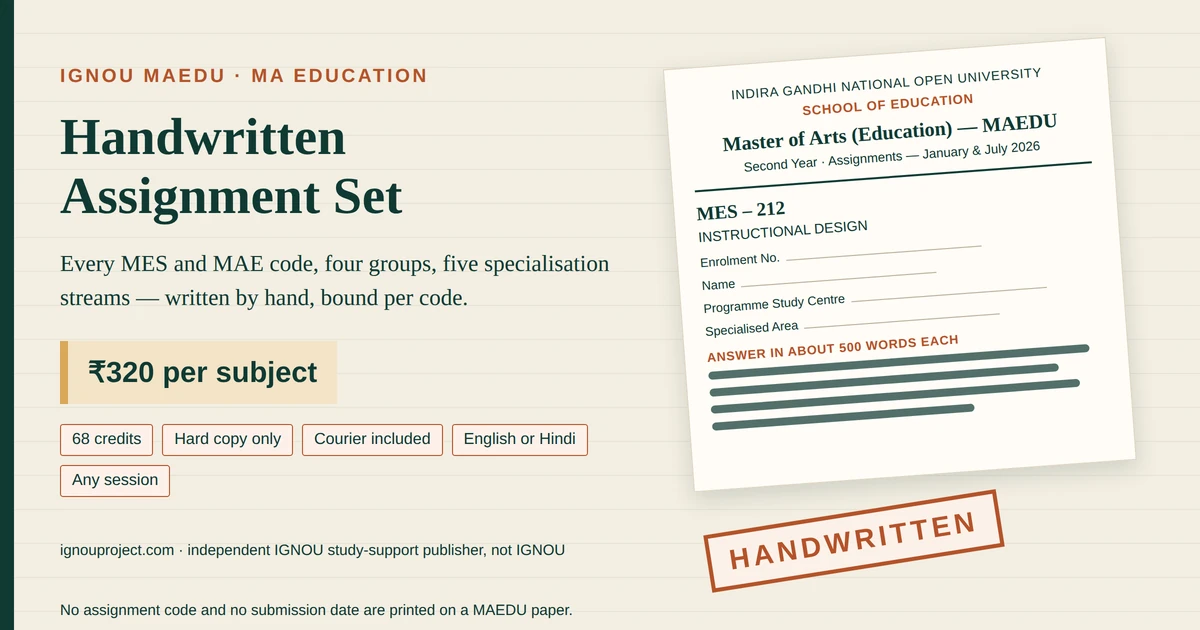
The School of Education issues MAEDU assignments as one booklet for January and July together, with no assignment code line and no submission date printed anywhere on the paper. A handwritten MAEDU set is written against the exact MES or MAE paper your registration carries, and couriered to your address as a hard copy.
- 68 credits, 34 a year
- MES and MAE codes
- Five specialisation streams
- No date on the paper
- English and Hindi booklets
- MESP 1 carries no TMA
Send Your MES And MAE Codes For A Quote
Send the codes as your registration confirmation prints them, your year and specialisation, your medium and your pin code. Delivery depends on your pin code and is confirmed for your order before you pay. No figure is promised on this page.
Quick answer. A handwritten assignment is the answer set for IGNOU’s Tutor Marked Assignment questions, written out by hand on A4 and handed in as a hard copy through your Programme Study Centre, and for MAEDU — Master of Arts (Education), the 68-credit two-year degree run by the School of Education, built from four groups in which MES 11 is the basic course, MES 12 to MES 15 are the four core courses, MES 16 and the MESP 1 dissertation cover knowledge generation, and one of five 24-credit specialised areas supplies the second-year codes MES 101 to MES 104, MES 211 to MES 215, MES 131 to MES 134, MES 41 to MES 44 or MAE 1 to MAE 4 — ignouproject.com prepares that handwritten set one course code at a time. The rate is ₹320 per subject, hard copy only, with courier included in that price and no separate shipping charge. No soft copy or PDF is sold. The service covers all mediums IGNOU issues the TMA paper in, at the same price, which for MAEDU means the English booklet and the Hindi booklet the university publishes for each year. Any session is accepted, current cycle or older, including backlog courses, at the same ₹320 per subject. Send a photo of a page you have written yourself and the handwritten set is matched to your handwriting at no extra charge. Assignments carry 30 per cent of the final course result and the term-end examination carries the remaining 70 per cent; every MAEDU question read off the live January and July 2026 papers asks for about 500 words, the paper prints no assignment code and no submission date at all, MESP 1 is a dissertation and carries no Tutor Marked Assignment, and orders are placed on WhatsApp at +91 93546 37830 by sending your codes, your year and your medium.
What A MAEDU Paper Prints Where A Deadline Should Be
Nothing. That is the finding, and it is the single most useful thing an MA (Education) learner can know before planning any longhand. Three live School of Education papers were opened for this page — the MES 102 booklet headed Assignments — January & July 2026, the MES 212 booklet for the same span, and the Hindi first-year booklet for January and July 2025 — and not one of them prints a last date, a schedule table or an assignment code line. An MBA paper prints MMPC-001/TMA/JULY/2026. An MA English paper prints a two-year span. A MAEDU paper prints the university name, the school, the programme, the year, the session pair, three or four instruction lines and then the questions.
What the MES 212 paper does print in that space is the routing: assignment responses may be handed in personally to the Programme-in-Charge of your Programme Study Centre or sent to that officer by registered post, and you should keep a copy of every response for yourself. It also tells second-year learners to take their questions from the specialised area they actually opted for, which on this programme is not a formality.
Working to the June examination
31 March
Not printed on any MAEDU paper. IGNOU Regional Centre student pages state 31 March as the general submission date for learners heading into the June term-end examination, and direct learners to the university site for extended dates.
Working to the December examination
30 September
Also absent from the paper itself. The same Regional Centre pages give 30 September for the December term-end examination. Both are Regional Centre statements about IGNOU generally, not School of Education instructions about MAEDU.
Because the paper is silent, the operative date for a MAEDU learner is whatever the Regional Centre confirms for that cycle, and the university has moved it repeatedly in recent cycles. Confirm yours on ignou.ac.in and with your own Regional Centre before you commit to a writing plan. The only real urgency for an MA (Education) learner is the date their centre has actually given them; nothing on this page is time-limited by ignouproject.com.
Submission still gates the examination whatever the date turns out to be. A course with an unsubmitted assignment does not complete even when the term-end paper has been passed, which is why the six first-year papers are worth planning around a date you have confirmed rather than one you have read on a listing site.
Six Courses A Year, Thirty Per Cent Of Each, All In Longhand
Assignments carry 30 per cent of the final course result and the term-end examination carries the remaining 70 per cent. MAEDU collects that share six times in the first year and four or five times in the second, depending on which specialised area you took.
The MAEDU question format is unusually uniform and unusually long. Every question on every paper read for this page carries the same instruction: answer in about 500 words. There are three questions to a course. That is roughly 1,500 words of considered educational prose per course, and eighteen questions in the first year alone before the second-year stream is touched. The questions are not recall questions either — MES 016 asks you to draft a short research proposal, MES 013 asks you to take a real school textbook and analyse its content against four separate criteria, and MES 102 asks you to build a lesson plan and a question paper in your own subject.
No MAEDU paper prints a per-question mark split. Where an MBA booklet tells you a question is worth twenty marks and a Rural Development booklet prints forty, fifteen and six, the School of Education prints a word count and nothing else. That is worth knowing before you buy a template from anywhere: there is no internal weighting to write to, so the three answers are treated as equal and each is taken to its own 500 words.
What defeats MA (Education) learners is therefore volume at a steady length rather than a spike of difficulty, and it is the part of the programme that is easiest to recover, because the questions sit on IGNOU’s own site months ahead and the study blocks are free. Once the Programme Study Centre transmits a score it posts against that course code, and the IGNOU assignment status and result checker is where you watch it arrive.
A Reference File Or A Written Set: What MAEDU Actually Takes
Two different objects go by names that MA (Education) learners use interchangeably on WhatsApp, so both are defined here once.
A solved assignment is a reference file in soft copy: model answers set against one course code for one session, opened on a screen. A handwritten assignment is those answers written out by hand on A4 paper and submitted as a physical bundle through your Programme Study Centre. The first is reading material for a learner who intends to write. The second is the submission itself. Nothing downloaded as a PDF is a MAEDU submission, and a printout of a reference file is not a handwritten assignment however cleanly it is printed.
The MES 212 booklet settles the question in its own words rather than ours. Its instruction paragraph says assignment responses may be submitted by hand or sent by registered post to the Programme-in-Charge, and that you should retain a copy of all the assignments in your own interest. Both halves of that sentence describe paper: something you can carry to a counter or put in the post, and something you can photocopy before you part with it.
| Reference file for a MES code | Written MAEDU set | |
|---|---|---|
| Format | Soft copy, read on a screen | Hard copy, written by hand on A4 |
| What a learner does with it | Reads it, then writes their own 500-word answers | Signs the cover page and submits it |
| Who it suits | A learner with writing hours but no reading hours | A learner with reading hours but no writing hours |
| Handwriting | Not involved at any point | Matched to the learner’s own hand from a photo |
| Price on this page | Not sold here | ₹320 per subject, courier included |
Scroll the table sideways on a narrow screen to reach the written-set column.
If a reference file is genuinely what you are after, it belongs on the library of IGNOU solved assignments by programme and course code rather than here, and it should be read before you write rather than copied into a notebook. Every MAEDU question is set on the assumption that the analysis is yours, which is the whole point of asking for a lesson plan or a research proposal rather than a definition.
What ₹320 buys on a MAEDU paper, and what it will not pretend to buy
Twelve statements worth reading before you send a code list. The first six are where an MA (Education) submission goes wrong; the last six are limits this page will not soften.
One rate across all four groups. The rate is ₹320 per subject, hard copy only, with courier included in that price and no separate shipping charge. A basic course worth four credits and a specialisation course worth six are quoted identically, because the paper asks for three answers either way.
The stream on your record decides the paper. Second-year MAEDU questions exist in five parallel sets and only one of them is yours. The specialised area recorded against your enrolment is confirmed before a page is written, because a beautifully written Educational Management answer earns nothing from a Higher Education evaluator.
Codes, never year bundles. There is no minimum order: one subject or fourteen, same rate. Two MAEDU learners in the same second year can hold entirely different code lists, so the unit of ordering here is the course code printed on your registration confirmation.
Both MAEDU booklets, one price. The service covers all mediums IGNOU issues the TMA paper in, at the same price. IGNOU publishes a MAEDU paper in English and a MAEDU paper in Hindi for each year, and the written set costs ₹320 per subject in either.
About 500 words, held to. Every MAEDU question read for this page prints the same length instruction and no mark split. Each answer is taken to about 500 words of its own rather than padded to fill a page or cut to save one.
Written in the hand you already use. Send a photo of a page you have written yourself and the handwritten set is matched to your handwriting at no extra charge. Across two years and up to eleven bundles reaching one Programme Study Centre, that consistency is worth having.
Older cycles are ordinary work. Any session is accepted, current cycle or older, including backlog courses, at the same ₹320 per subject. A first-year MES 014 left unwritten while you moved into a specialisation is written against its own paper.
Three answers, kept as three. A MAEDU paper prints three numbered questions and expects three separate answers. They are written in the booklet’s own order with its own numbering, so the evaluator finds answer two where the paper says question two is.
No assignment code invented for the cover page. Because the School of Education prints none, none is manufactured. The course code and the session pair go on the cover sheet exactly as your paper heads itself, and the assignment-code field is left for your Programme Study Centre to instruct you on.
Paper only, never a file. No soft copy or PDF is sold. Where a Regional Centre asks for an upload, you scan the delivered hard copy yourself, which leaves the written original in your hands for the counter.
No dissertation sold as an assignment. MESP 1 is ten credits of supervised dissertation work and carries no Tutor Marked Assignment. It is not quoted at ₹320 and no written MESP 1 assignment exists here, because there is no question paper to answer.
No claim on the evaluation, and no delivery figure. No claim is made about the marks any assignment will receive, about how an evaluator will assess it, or about whether it will be accepted. Assignment evaluation is entirely a matter for IGNOU. Delivery depends on your pin code and is confirmed for your order before you pay. No figure is promised on this page.
Know Your Stream? Then You Know Your Paper List.
Send the MES or MAE codes from your registration confirmation and name the specialised area recorded against your enrolment. Back comes the paper count, the total at ₹320 each, and the delivery position for your pin code, in one reply.
Price My MES And MAE Paper ListI Do Not Know Which Stream I Am In
Every MES And MAE Code Across Four Groups And Five Streams
MAEDU is the programme code printed on your registration confirmation and in the Common Prospectus. MES is the course-code prefix on every taught course except the Adult Education stream, which uses MAE. MESP is the prefix on the dissertation. Those three prefixes are one programme, and the reason a learner searching for MAEDU papers meets all three is that IGNOU numbers by course rather than by degree.
Section 3.33 of the IGNOU Common Prospectus for July 2026 places the programme in the School of Education, records the medium of instruction as English, sets a two-year minimum and four-year maximum duration, examines it year wise across the January and July cycles, and builds it from four groups totalling 68 credits with 34 to be covered each year. The credits sum as printed rather than on trust: four plus six plus six plus six plus six plus six is the 34 of the first year, and 24 credits of specialisation plus the ten-credit dissertation is the 34 of the second.
| Course code | Official title | Credits | Group |
|---|---|---|---|
| MES 11 | Understanding Education | 4 | A — Basic course |
| MES 12 | Education: Nature and Purposes | 6 | B — Core |
| MES 13 | Learning, Learner and Development | 6 | B — Core |
| MES 14 | Societal Context of Education | 6 | B — Core |
| MES 15 | Operational Dimensions of Education | 6 | B — Core |
| MES 16 | Educational Research | 6 | C — Knowledge generation |
Six papers, 34 credits, every one of them written. Scroll the table sideways on a narrow screen to reach the group column.
Group A is a single four-credit orientation course and Group B is the four compulsory core courses, which together are the whole of the first year apart from MES 16. Group C is where MAEDU splits into a written paper and a piece of fieldwork: MES 16 Educational Research carries a Tutor Marked Assignment like any other course, and MESP 1 Dissertation, ten credits, does not.
| Specialised area | Course code | Official title | Credits |
|---|---|---|---|
| Higher Education | MES 101 | Higher Education: Its Context and Linkages | 6 |
| MES 102 | Instruction in Higher Education | 6 | |
| MES 103 | Higher Education: The Psycho-social Context | 6 | |
| MES 104 | Planning and Management of Higher Education | 6 | |
| Distance Education | MES 211 | Growth and Philosophy of Distance Education | 4 |
| MES 212 | Instructional Design | 4 | |
| MES 213 | Learner Support Systems and Services | 4 | |
| MES 214 | Management of Distance Education | 6 | |
| MES 215 | Educational Communication Technologies | 6 | |
| Educational Technology | MES 131 | Educational Technology: An Overview | 6 |
| MES 132 | Computer in Education | 6 | |
| MES 133 | Selection and Intergration of Technology in Educational Processes | 6 | |
| MES 134 | Design, Development and Delivery of Courseware | 6 | |
| Educational Management | MES 41 | Growth and Development of Educational Management | 6 |
| MES 42 | Dimensions of Educational Management | 6 | |
| MES 43 | Organizational Behaviour | 6 | |
| MES 44 | Institutional Management | 6 | |
| Adult Education | MAE 1 | Understanding Adult Education | 6 |
| MAE 2 | Policy Planning and Implementation of Adult Education in India | 6 | |
| MAE 3 | Knowledge Management, Information Dissemination and Networking in Adult Education | 6 | |
| MAE 4 | Extension Education and Development | 6 | |
| Group C | MESP 1 | Dissertation — no Tutor Marked Assignment exists | 10 |
Every stream totals 24 credits. Scroll the table sideways on a narrow screen to reach the credits column.
Four of the five streams are four courses of six credits. Distance Education is the exception and it is the one worth checking on your own record: it is five courses, four credits for the first three and six for the last two, still 24 credits in total but five written papers instead of four. A learner in that stream produces eleven written papers across the degree rather than ten. Titles above are reproduced as the prospectus prints them, including its own spelling of Intergration in MES 133.
MAEDU also carries a rule that no other programme on this site has: if you already hold a Diploma or Post Graduate Diploma in one of the five offered areas, you must choose a different area. A learner holding the Post Graduate Diploma in Educational Technology is barred from the Educational Technology stream and picks from the remaining four; the same applies to holders of the Post Graduate Diploma in Higher Education and of the Post Graduate Diploma in Educational Management and Administration. It is the reason two learners with identical backgrounds can be sitting different second-year papers, and the reason the stream matters more here than the year does.
Conflicting MAEDU code information, including on this website
Each item below was found by reading two IGNOU documents against each other, or against a live paper. The last two are errors on this site that are queued for correction.
- One prospectus prints the Distance Education stream twice, with two different numbers. Section 3.33 lists the stream as MES 211 to MES 215. Annexure I(a) of the same July 2026 document, headed MAEDU Programme Elective Courses, prints the same five courses in its A2 column as MES111, MES112, MES113, MES114 and MES115. The live 2026 booklet settles it: the paper published by the School of Education is headed MES-212 Instructional Design. Write the 21 series.
- The Educational Technology stream is printed two ways in the same prospectus as well. Section 3.33 gives MES 131 to MES 134. The A3 column of Annexure I(a) gives MES31, MES32, MES33 and MES34. Both blocks describe the same four six-credit courses. The Higher Education, Educational Management and Adult Education columns of that annexure agree with the programme section; only these two do not.
- IGNOU’s English paper and IGNOU’s Hindi paper pad the same code differently. The prospectus prints MES 11 to MES 16 unpadded. The Hindi first-year booklet for January and July 2025 prints them as MES-011 to MES-016, padded to three digits. Commercial sellers carry both forms and file MAE 1 as MAE-001 as well. All of them are the same six courses.
- Two IGNOU addresses are a year apart on the same programme. The MAEDU programme index on the assignment portal still tops out at the January to July 2025 booklets in both mediums. The January and July 2026 papers are already live one course at a time on the university’s own School of Education file path. Both are IGNOU. If the index looks a year behind, that is the index, not your browser.
- The English and Hindi links on that index are crossed for one session. Under the July 2024 second-year row, the link labelled English opens a file named for the Hindi Distance Education paper and the link labelled Hindi opens the English-medium one. Open the PDF and read the first page rather than trusting the label above it.
- The prospectus says English; the portal publishes Hindi. Section 3.33 records the MAEDU medium of instruction as English. IGNOU’s own assignment portal carries a Hindi first-year booklet and a Hindi second-year booklet for the 2025 span, printed in Devanagari and asking for answers in about 500 words. Both are the university’s. Learners writing in Hindi should confirm with their Regional Centre which paper will be accepted, and the guidance on writing IGNOU assignments in Hindi covers the script points.
- Two file-naming conventions sit in one School of Education folder. The Higher Education paper is published as a file named for the course code and the year; the Distance Education paper for the same span is published as a file named for the programme and the course code. Search the course code on the university site rather than editing a path you already have.
- On this website, pending correction. Our own MAEDU dissertation material is duplicated across the MESP 1 project report guide and a second MESP-001 page, and the two print the dissertation code in two forms while the prospectus prints MESP 1. The pair is queued for consolidation.
- Also on this website, pending correction. The ignouproject.com homepage still carries an acceptance-and-refund guarantee, the MMPC-001 course page still promises dispatch inside a fixed number of working days, the MCA assignment page still prints 2019 submission dates, and the MEG assignment page still offers a Hindi paper that does not exist for that programme. None of those claims is made here. All four are wrong, all four are queued for removal, and where those pages and this one disagree, this one is correct.
Never take a code list from a coaching site, this one included, over your own registration confirmation. Programme structures, course codes, submission dates and rules change, and only ignou.ac.in and your Regional Centre can confirm the current position for your enrolment. The source document these tables were read from is indexed on the IGNOU prospectus archive.
Turning One MES Code Into A Bound MAEDU Bundle
Five stages sit between a WhatsApp message and a couriered bundle. Each of them exists because of a way MA (Education) submissions actually fail, and the first two are peculiar to this programme.
- The specialised area is confirmed before the paper is opened. Second-year MAEDU questions exist in five parallel versions and the booklet itself instructs learners to select from the area they opted for. The area recorded against your enrolment is read back to you first, because there is no way to detect the wrong stream from the code alone once the writing has started.
- The code is resolved across both numbering systems. A learner sending MES-112 is sent the MES 212 paper, and a learner sending MES-32 is sent MES 132, because the prospectus annexure and the programme section number those two streams differently. The form on your registration confirmation is used on the cover page and the mismatch is reported back rather than copied forward.
- The three answers are built from the MAEDU blocks. A question on the panchakosha in the Upanishads, on continuous and comprehensive evaluation, or on the Elaboration Theory of instruction is answered out of the programme’s own units, because the evaluator is marking against the block. Free copies sit on eGyanKosh, with a second route on the Gyankosh access page and a general index at IGNOU books download.
- Each answer is taken to about 500 words and no further. The instruction printed above every MAEDU question is the only length rule the paper gives, and it is the one applied. Where a question has lettered parts, as MES 013 does, every part is answered rather than the first two and a summary.
- On A4, tied code by code, cover sheet unfilled, then couriered. Blue or black ink on one side of the sheet, red and green avoided because evaluators write in them, key terms underlined once, a clear left margin kept for comments and each answer opening with the paper’s own question number. Each course code is tied as its own bundle. The cover sheet arrives laid out and unfilled — the cover page filling walkthrough and the blank front page format PDF show the same layout in advance.
Writing The Set In The Hand You Already Use
Send a photo of a page you have written yourself and the handwritten set is matched to your handwriting at no extra charge. One page of your ordinary writing, photographed straight on in daylight, carries enough of your slant, letter size and joins to reproduce across a whole course.
On MAEDU it earns its keep because of where the bundles go. Six reach the Programme-in-Charge in the first year and four or five in the second, all against one enrolment number, all to the same officer, and the earlier ones are already sitting in your own hand. A visibly different hand appearing in a second-year Educational Management bundle is an avoidable inconsistency in a file that stays open for up to four years. It matters more again if you are writing the Hindi paper, since Devanagari letterforms differ far more between writers than Latin ones do. Nothing about the sample is kept beyond the order it belongs to.
Writing the MAEDU set yourself is the better outcome, and every route to it is free here.
Read the step-by-step guide to writing an IGNOU handwritten assignment for the whole method, check margins and numbering against the assignment format and structure rules, look at a worked sample IGNOU assignment to gauge the depth a 500-word answer needs, and use the comparison of online and offline submission when the bundles are ready. Nothing on those pages is gated. This page exists for learners short of weeks, not short of ability.
Free Tools For Planning An Undated MAEDU Cut-Off
Both utilities run entirely in your browser, send nothing anywhere and keep nothing. The first exists because the MAEDU paper prints no date, so the runway has to be built from a date your own centre has given you. The second exists because a MES number does not tell you which stream it belongs to when the same stream is numbered two ways in one prospectus.
Free tool 1
Runway And Longhand Estimator For An Undated Paper
Pick a MAEDU stage or type the number of papers you are short on, then enter the cut-off your Regional Centre has confirmed. The estimator totals the cost at ₹320 each, counts the days from today, and works out the longhand at the 500-word length MAEDU actually prints. Leave the date empty and it falls back to the 31 March and 30 September pair Regional Centre pages give for IGNOU generally, clearly labelled as such.
Choosing a stage fills the count below. MESP 1 is excluded from every option because a dissertation carries no Tutor Marked Assignment.
A whole number from 1 to 11. Eleven is the most a MAEDU record can carry, and only in the Distance Education stream.
Optional. No MAEDU paper prints a date, so enter the one your centre gave you. Leave it blank to use the general Regional Centre pair instead.
Pick a stage or type a paper count, then select Work Out Cost And Runway.
Confirm This MAEDU Total At ₹320 A Paper
This tool is guidance from ignouproject.com, not an IGNOU rule. Using it creates no obligation to order anything. The longhand figure is a planning estimate, and the fallback dates are Regional Centre statements about IGNOU generally, not School of Education instructions about MAEDU.
Free tool 2
MES And MAE Stream Locator
Type one MAEDU course code and choose the medium your paper is issued in. The locator returns the official title, the credits, the group and year the code belongs to, the specialised area where it has one, whether a Tutor Marked Assignment exists at all, the form to write on your cover page for that medium, and the checklist that applies. Codes affected by the annexure numbering are resolved and the conflict named.
Spaces and hyphens are ignored, so MES 212, MES-212, mes212 and the annexure form MES112 all resolve. Read it off your registration confirmation.
This decides the padding shown for the cover page, because IGNOU pads the same code differently in its two mediums.
Type a code such as MES 212 or MAE 3, then select Locate This Code.
Have This One MAEDU Paper Written At ₹320
This tool is guidance from ignouproject.com, not an IGNOU rule. Using it creates no obligation to order anything. Titles and credits follow the July 2026 Common Prospectus and should still be checked against your own registration confirmation.
Eighteen Answers In The First Year Alone. Hand Over The Ones You Cannot Reach.
Order two codes or ten. The rate for a written paper does not change, and the papers you want to write yourself stay yours. Send the list, the stream, the medium and a photo of your own writing.
Locating A MAEDU Paper Across Two IGNOU Addresses
The MAEDU question paper is free from the university and should be taken from the university, whoever writes the pages. On this programme it takes four steps rather than two, because the papers are published in two places that are not in step with each other.
- Start at the university’s own download service. Open the IGNOU assignment download service or the assignment portal and choose Master’s Degree Programmes. Do not type a file address: School of Education file names differ between courses of the same programme, so a path edited from one you already have returns nothing.
- Read the MAEDU index by year, not by course. The programme index carries one first-year link and one second-year link per session, in English and in Hindi, rather than a file per course. Whole years come as one PDF, which is why a second-year learner downloads a file containing all five specialised areas and takes only their own.
- Check the newest session heading, then search the course code separately. The index has been sitting at January to July 2025 while individual January and July 2026 papers are already live on the university’s School of Education file path. If your year is not posted on the index, search the course code on ignou.ac.in before assuming the paper does not exist.
- Open the PDF and read the first page rather than the link label. The cover names the university, the school, the programme, the year and the session pair. That is the only place the session is stated, since there is no assignment code to check it against, and the English and Hindi labels on the index have been crossed at least once.
Once you have the paper, the archive of solved question papers and the previous year paper collection show what the term-end hall asks of an MA (Education) candidate, which is a different question from what the assignment asks.
After The Counter Stamp: Where A MES Mark Surfaces
Handing the bundle over is not the end of the transaction. The MAEDU paper tells you in writing to retain a copy of all the assignments in your own interest, so photograph or photocopy the pages before they leave you, and take a receipt from the Programme Study Centre.
From there the mark travels. Your Programme Study Centre logs receipt, the evaluated score goes to the Student Evaluation Division, and it finally posts against that MES or MAE code. Two different screens report on that journey and they do not report the same thing: one confirms only that a bundle was received, while the grade card is where the number itself appears. Follow the first through the assignment marks status lookup and the second through the assignment grade card explainer, with the grade card status page for a code that refuses to appear and the final grade card guide once both halves are posted.
A MAEDU course sitting as incomplete usually means one component is outstanding rather than failed, and on this programme the outstanding component is often MESP 1 waiting on a supervisor rather than a taught paper. Every one of those screens asks first for the number covered on the enrolment number lookup page. When both halves are visible you can convert them with the percentage calculator or the CGPA calculator, and if a term-end figure looks wrong the revaluation route applies to the examination half only, never to the assignment half. Broader timing sits on the IGNOU result page, the June 2026 result tracker and the MA result page, and the counter itself is covered by the submission walkthrough and the assignment hub.
Reading Support MAEDU Learners Ask For At The Same Time
A written-set order is usually one line of a longer message. These are the other things MA (Education) learners ask about, each on its own page so you can read before deciding.
- For the 70 per cent the assignment does not cover. The guess paper collection and the unit-wise study notes matter more than any assignment does, with the help book range, the online guide books and the study material index compressing the education blocks into revision form.
- MESP 1, which is a different kind of work altogether. Ten credits of supervised research written up as a dissertation runs through the synopsis and proposal service and the project and dissertation service, with layout covered by the project report format guide and pricing on the list of services and charges rather than at the ₹320 assignment rate.
- Cognate education programmes with overlapping codes. Learners often hold or move between MAEDU and the M.Ed. dissertation route, the MA in Distance Education project, the Post Graduate Diploma in Pre-Primary Education project or the BA Education project, and school teachers arriving from a teaching qualification often check the B.Ed. syllabus page first.
Medium, session, and why a MAEDU paper stops being valid. The service covers all mediums IGNOU issues the TMA paper in, at the same price. On MAEDU that phrase is doing real work, because the July 2026 Common Prospectus records the medium of instruction as English while IGNOU’s own assignment portal publishes a Hindi first-year and a Hindi second-year booklet for the same programme. Whichever of the two your centre issues you, the written set is ₹320 per subject.
On sessions: a MAEDU paper belongs to the session pair printed on its cover and stops being useful when that pair closes, which on this programme is harder to spot because there is no assignment code carrying the year. Any session is accepted, current cycle or older, including backlog courses, at the same ₹320 per subject. Name the session pair from your cover page and each paper is answered against its own questions rather than against the newest set on the site.
One Message, Two Numbers, Then The Courier
There is no form on this page, no account and no login. The whole thing runs on WhatsApp at +91 93546 37830.
- One message with five details. The MES or MAE codes exactly as your registration confirmation prints them; your year and, if you are in the second year, the specialised area recorded against your enrolment; your medium; your delivery pin code; and one photo of a page in your own handwriting.
- A reply with two numbers before anything is charged. Back come the paper count priced at ₹320 each, and where your pin code stands for delivery. Delivery depends on your pin code and is confirmed for your order before you pay. No figure is promised on this page, and nothing is charged until you have agreed to both numbers.
- The bundles arrive, you sign, the centre records it. Each code comes tied separately with its own blank cover sheet on top. You complete and sign the cover sheets in your own hand, then hand them to the Programme-in-Charge of your Programme Study Centre or send them by registered post, exactly as the paper instructs, and keep the receipt with your copy.
Separating IGNOU’s Words From The Publisher’s On This Page
From the IGNOU Common Prospectus, July 2026. Section 3.33 gave the School of Education placement, the English medium of instruction, the two-year minimum and four-year maximum duration, the year-wise examination across January and July, the four-group framework, the 68-credit total and the 34 credits a year, the six first-year codes with their official titles and credits, all five specialised areas with their codes, titles and credits, the ten-credit MESP 1 dissertation and the rule barring a learner from a specialisation they already hold a diploma in. The credit totals were checked by summation rather than taken on trust. Annexure I(a) of the same document is where the A2 and A3 columns disagree with section 3.33, and the programme fee and duration line in the front matter confirmed the SOE attribution.
From live IGNOU assignment papers. Three files were opened rather than one, so that a template carry-over in a single document could not be mistaken for the programme’s format. The MES 102 paper for January and July 2026 gave the cover-page layout, the three-question structure and the 500-word instruction. The MES 212 paper for the same span gave the submission routing to the Programme-in-Charge, the registered-post alternative, the retain-a-copy instruction, the instruction to answer from your own specialised area and the confirmation that the live code is MES-212 rather than MES-112. The Hindi first-year paper for January and July 2025 confirmed that a Hindi MAEDU booklet exists, that it prints the same 500-word instruction, and that it pads the codes as MES-011 to MES-016. All three confirmed the absence of any assignment code line and of any submission date. The published-session position was read off IGNOU’s own MAEDU programme index. The 31 March and 30 September pair used as a fallback comes from IGNOU Regional Centre student pages, which state it as a general rule for the university rather than as a School of Education instruction.
From ignouproject.com as publisher. Everything on this page about price, format, medium, session and handwriting is set here and by nobody else. The rate is ₹320 per subject, hard copy only, with courier included in that price and no separate shipping charge. No soft copy or PDF is sold. There is no minimum order: one subject or fourteen, same rate. Delivery depends on your pin code and is confirmed for your order before you pay. No figure is promised on this page. None of that is an IGNOU rule and IGNOU has no part in any of it.
Something wrong above, or a code that has changed since this review? Write through the contact page and it will be checked against the current paper and dated. Who publishes this is set out on the about page and data handling in the privacy policy.
Written and reviewed by BK Sahni, Founder, Shri Chakradhar Publication Pvt. Ltd. and ignouproject.com, who has guided 5,00,000 students till date. ORCID 0009-0005-8092-459X. More on the author and the editorial process is on the BK Sahni profile.
Published 20 August 2026. Last reviewed 20 August 2026. Next scheduled review 1 September 2026, ahead of the 30 September cut-off Regional Centres apply to the December examination, and again by 1 March 2027 ahead of the 31 March cut-off for the June examination.
What MA Education Learners Want Settled Before Ordering
The rate is ₹320 per subject, hard copy only, with courier included in that price and no separate shipping charge. That is the same figure for a four-credit basic course and a six-credit specialisation course, and the same figure in English or Hindi. There is no minimum order: one subject or fourteen, same rate.
No MAEDU paper prints one. Three live School of Education papers were opened for this page and none of them carries a date, a schedule table or a deadline sentence. IGNOU Regional Centre student pages give 31 March for learners heading into the June examination and 30 September for the December examination as a general rule across the university, and the university has extended those dates repeatedly in recent cycles. Ask your own Regional Centre for the date that applies to your enrolment.
The School of Education issues the paper as a question set rather than as a scheduled instruction. Where the School of Management Studies prints an assignment code and a deadline table on the cover, and the School of Continuing Education prints a three-column schedule, the MAEDU cover carries the university name, the school, the programme, the year, the session pair and then the questions. The instruction block that follows covers routing and record-keeping instead of dates.
Yes. Understanding Education is printed as MES 11 in the July 2026 Common Prospectus and as MES-011 in IGNOU’s own Hindi booklet, and commercial sellers use both. The same applies right through MES 12 to MES 16, and to the Adult Education stream where MAE 1 appears as MAE-001. Write whichever form your registration confirmation prints on your cover page.
The 21 series. Section 3.33 of the July 2026 prospectus lists the stream as MES 211 to MES 215, and Annexure I(a) of the same document prints MES111 to MES115 in its A2 column. The live paper published by the School of Education for January and July 2026 is headed MES-212 Instructional Design, which settles it. The same conflict affects the Educational Technology stream, printed as MES 131 to MES 134 in the programme section and MES31 to MES34 in the annexure.
IGNOU’s assignment portal publishes a Hindi first-year and a Hindi second-year MAEDU booklet, printed in Devanagari and asking for answers in about 500 words, even though section 3.33 of the prospectus records the medium of instruction as English. The service covers all mediums IGNOU issues the TMA paper in, at the same price. Because the two IGNOU documents disagree, confirm with your Regional Centre which paper they will accept before writing in Hindi.
A solved assignment is a soft-copy reference file of model answers for one course code and one session, read on a screen. A handwritten assignment is those answers written out by hand on A4 and submitted as a physical bundle through your Programme Study Centre. The first is reading material; the second is the submission itself. Only the second is prepared on this page.
The MAEDU paper does not address the question directly; it says responses may be handed to the Programme-in-Charge or sent by registered post, and that you should keep a copy. Handwritten submission is the convention across IGNOU programmes and is what centres expect, and a printout of a downloaded file is not a submission in any case. Ask your own Programme Study Centre before deviating, because the instruction that governs you comes from them rather than from a listing site.
No. MESP 1 is ten credits of supervised dissertation work in Group C, assessed as a research report rather than through a question paper, and no MESP 1 paper appears in any MAEDU assignment booklet. It is not quoted at ₹320 here and no written MESP 1 assignment is offered, because there is nothing to answer. The dissertation is a synopsis and report route instead.
About 500. Every question on every MAEDU paper read for this page carries the same instruction, in both English and Hindi, and there are three questions per course. Some questions have lettered parts inside them, and the 500 words covers the question as a whole rather than each part. That is roughly 1,500 words per course and eighteen answers in the first year alone.
Assignments carry 30 per cent of the final course result and the term-end examination carries the remaining 70 per cent. Beyond that, no MAEDU paper prints a per-question mark split, so no internal weighting can be quoted for this programme. Third-party pages that state one for MAEDU are not reading the paper. Treat the three answers as equal in the absence of an instruction and confirm anything further with your Programme Study Centre.
No. Section 3.33 states that a learner who already holds a Diploma or Post Graduate Diploma in one of the five offered areas must choose a specialisation from the remaining areas, and it uses the Post Graduate Diploma in Educational Technology as its own worked example. The same bar applies to holders of the higher education, distance education, educational management and adult education diplomas in their respective streams.
From the university’s own assignment download service, then the Master’s Degree index, then the MA (Education) entry, which carries one first-year and one second-year PDF per session in English and in Hindi. If your year is not posted under the newest heading, search the course code on ignou.ac.in separately, because individual School of Education papers are published on a different path from the programme index and have run ahead of it.
Answer the paper your Regional Centre will accept for your enrolment, which is usually the newest set published for your codes. The MAEDU index and the School of Education course-file path have been a year apart, so a January and July 2026 paper can exist for your course while the index still shows 2025. Because there is no assignment code carrying the year, the cover page is the only place the session is stated, so read it before writing.
Yes. Any session is accepted, current cycle or older, including backlog courses, at the same ₹320 per subject. A first-year MES 015 left behind while you moved into a specialisation, or a stream paper from an earlier span, is written against the paper that governs it. Send the session pair printed on that paper’s cover along with the code.
No soft copy or PDF is sold. This page prepares the written hard copy only. If your Regional Centre asks for an upload, you scan the delivered hard copy yourself, which keeps the original in your hands. Reference files for reading before you write are a separate service on a separate page.
No. The rate is ₹320 per subject, hard copy only, with courier included in that price and no separate shipping charge. Delivery depends on your pin code and is confirmed for your order before you pay. No figure is promised on this page.
ignouproject.com is an independent IGNOU study-support publisher. It is not the official website of Indira Gandhi National Open University, is not affiliated with, endorsed by or authorised by the university, and no page on this site should be treated as an official IGNOU communication. No claim is made about the marks any assignment will receive, about how an evaluator will assess it, or about whether it will be accepted. Assignment evaluation is entirely a matter for IGNOU.
Important Notice
Independent website. ignouproject.com is an independent IGNOU study-support publisher. It is not the official website of Indira Gandhi National Open University, is not affiliated with, endorsed by or authorised by the university, and no page on this site should be treated as an official IGNOU communication.
Programme structures, course codes, submission dates and rules change, and only ignou.ac.in and your Regional Centre can confirm the current position for your enrolment.
Your responsibility as the learner. You sign the declaration on the assignment cover page, so you should read and review the content before submitting it, and satisfy yourself that it represents your own understanding of the course.
No claim is made about the marks any assignment will receive, about how an evaluator will assess it, or about whether it will be accepted. Assignment evaluation is entirely a matter for IGNOU.
MAEDU · 68 credits · four groups · five streams
Send The Codes And The Stream. The Five Hundred Words A Time Are Our Problem.
English or Hindi, first year or second, a current code or one carried forward from an older span. Each code is tied as its own bundle with the cover sheet laid out and left blank for you to sign, and couriered to the address you give.
Order MAEDU Papers At ₹320 EachCheck My Pin Code Before I Pay
WhatsApp +91 93546 37830 · Shri Chakradhar Publication Pvt. Ltd. · ignouproject.com, an independent IGNOU study-support publisher, not IGNOU.

BK Sahni iD 0009-0005-8092-459X
Founder, Shri Chakradhar Publication Pvt. Ltd. & ignouproject.com — helping IGNOU distance-learning students since 2010 (5,00,000+ students supported across MBA, MCom, MA & more). Author of IGNOU exam guides, solved assignments & project reference books.
Disclosure: Shri Chakradhar Publication Pvt. Ltd. and ignouproject.com are independent third-party study-help services — not the official IGNOU website. Always verify final dates and rules on ignou.ac.in.