BCOMF · School of Management Studies · FYUP
Your B.Com Is Now BCOMF. Your Cut-Off Is The Fifteenth, Not The Thirty-First.
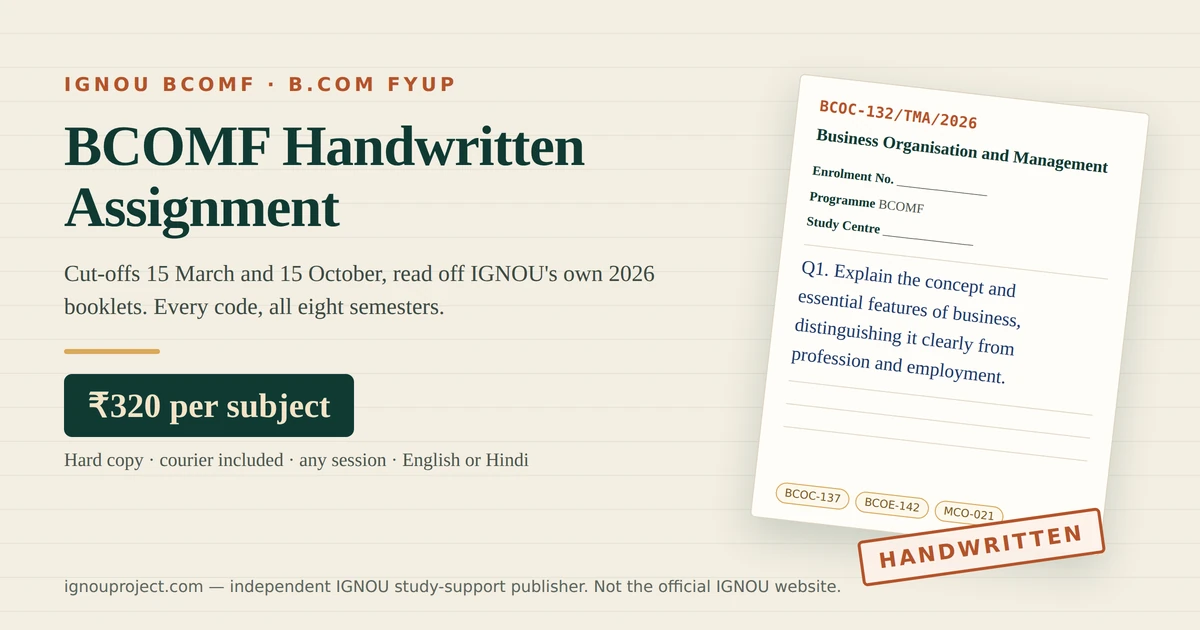
Six different last dates for B.Com assignments are circulating online this year. IGNOU’s own 2026 BCOMF booklets print two: 15 March and 15 October. This page works from the booklets, lists every course code across all eight semesters, and prepares the handwritten assignment set for the codes you are actually short on.
- 160 credits · 8 semesters
- English and Hindi
- Backlog codes accepted
- Your own handwriting
- Courier in the price
- Hard copy only
Message your course codes, session and pin code. Delivery depends on your pin code and is confirmed for your order before you pay. No figure is promised on this page.
Quick answer. An IGNOU BCOMF handwritten assignment is the Tutor Marked Assignment for one Bachelor of Commerce (Honours) course code — BCOC-131 to BCOC-138, BCOE-141, BCOE-142, BCOS-183 to BCOS-186, BRL-101, BECC-101, BEVAE-181, BEDSV-101, BPAS-184, BPCS-186, BECS-144, BMS-1, CPI-101, CPI-102 and the fourth-year MCO codes — answered out by hand on paper and handed to the Coordinator of your Study Centre rather than typed. ignouproject.com writes that handwritten set for BCOMF learners: the rate is ₹320 per subject, hard copy only, with courier included in that price and no separate shipping charge. The service covers all mediums IGNOU issues the TMA paper in, at the same price, which for BCOMF means the English and Hindi papers the School of Management Studies publishes. Any session is accepted, current cycle or older, including backlog courses, at the same ₹320 per subject. Send a photo of a page you have written yourself and the handwritten set is matched to your handwriting at no extra charge. Assignments carry 30 per cent of the final course result and the term-end examination carries the remaining 70 per cent, and IGNOU’s 2026 BCOMF booklets set 15 March for the June term-end examination and 15 October for the December one. WhatsApp your codes, session and pin code to +91 93546 37830 to begin.
The Two Dates BCOMF Actually Prints
The School of Management Studies prints the BCOMF submission schedule on the face of every assignment booklet, and the 2026 booklets for BCOC-132 and BCOC-138 both carry the same pair. These are the dates a BCOMF learner works to.
Read off IGNOU’s own 2026 BCOMF assignment booklets, School of Management Studies.
Two things about that pair deserve saying plainly, because both are routinely got wrong. First, the day is the fifteenth, not the thirty-first — a BCOMF learner working to 31 March has already missed the cut-off by a fortnight. Second, these dates are not the School of Management Studies dates that apply to the postgraduate commerce and management programmes. A learner who reads 31 October and 30 April on a page written for M.Com or MBA has read the right university, the right school and the wrong programme.
The 2026 BCOMF papers also carry a validity window rather than a session name. Each booklet states that the assignment is valid from 1 January 2026 to 31 December 2026, so one calendar-year paper serves both the June and the December sittings. That is why the December instruction tells you to download the new assignment: the paper you used in March expires with the calendar year, and IGNOU replaces it rather than extending it. Dates and validity windows shift by session and by Regional Centre, so confirm yours on ignou.ac.in before you post anything.
A separate pair of dates gets confused with these constantly. The BCOMF Programme Guide sets 31 March for the June examination and 30 September for the December one — but those are the deadlines for submitting the online term-end examination form, not the assignment. Two March deadlines a fortnight apart, for two different tasks, is exactly the kind of thing that costs a learner a whole sitting. Our general IGNOU assignment guide covers the university-wide picture; the numbers above are the BCOMF ones.
Thirty Marks Decided Before You Enter The Exam Hall
Assignments carry 30 per cent of the final course result and the term-end examination carries the remaining 70 per cent. For a six-credit BCOMF paper like BCOC-137 Corporate Accounting, that is thirty marks settled by a bundle of handwritten assignment sheets sitting on a Coordinator’s desk, months before the examination hall opens.
BCOMF makes those thirty marks harder to shrug off than most programmes do, because of one rule in the Programme Guide. You need at least 35 per cent separately in the assignment and separately in the term-end examination, and the guide states that the two scores are not complementary to each other for qualifying a course. A strong examination paper cannot rescue a failed assignment, and an unsubmitted assignment does not merely cost thirty marks — it makes you ineligible to sit the examination at all, and the guide warns that a result obtained without a submitted assignment is liable to be cancelled.
There is a small mercy at the other end. If you clear the term-end examination but the assignment score falls short, only the assignment has to be redone; the examination stands. Learners discover this the slow way, by watching a course read Not Completed on the grade card for a full cycle. You can see how the arithmetic lands on your own marks with the IGNOU percentage calculator, or work the credit-weighted view through the CGPA tool.
One more BCOMF-specific pressure point. Registration for this programme is annual even though the structure is semester-based, and the guide confirms that the term-end examination for semesters one and two is held together at the end of the first year. Two semesters of assignments therefore fall due against a single cut-off. A first-year BCOMF learner is not handwriting four papers by 15 March. They are handwriting eight.
Priced by the code, not the year. ₹320 covers one course code. There is no minimum order: one subject or fourteen, same rate. A learner short on only BCOS-183 pays for BCOS-183.
Both BCOMF mediums. The service covers all mediums IGNOU issues the TMA paper in, at the same price. BCOMF’s medium of instruction is English and Hindi, so the English medium paper and the Hindi medium paper are both in scope at ₹320.
Old calendar-year papers welcome. Any session is accepted, current cycle or older, including backlog courses, at the same ₹320 per subject. An older cycle paper such as a 2023 BCOC-134 is ordered exactly the way a 2026 one is.
Matched to your own handwriting. Send a photo of a page you have written yourself and the handwritten set is matched to your handwriting at no extra charge. Nothing is added to the ₹320 for it.
Courier sits inside the price. The rate is ₹320 per subject, hard copy only, with courier included in that price and no separate shipping charge. Nothing is added at dispatch.
Handwritten paper, not a file. No soft copy or PDF is sold. If your Regional Centre asks for an upload, you scan the delivered hard copy yourself and submit that scan.
Numerical papers get worked answers. BCOC-134, BCOC-137 and BCOC-138 turn on ledgers, variances and stores accounts. Working notes and tables are drawn out by hand across the handwritten pages rather than summarised away.
Handwritten to the marks on the paper. A ten-mark BCOMF question and a five-mark one get different lengths. The mark allocation printed beside each question sets the depth, not a guess.
Foolscap and a four-centimetre margin. The BCOMF Programme Guide asks for foolscap sheets, a 4 cm left margin and at least four blank lines between answers. The handwritten pages follow that layout rather than the generic A4 advice.
One code, one handwritten bundle. The guide says each assignment is written separately and not run on in continuity. Codes arrive tied as separate handwritten sets, ready to hand over individually.
Fourth-year MCO codes included. Semesters seven and eight run on MCO-04, MCO-01, MCO-021, MCO-023 and MCO-024. Postgraduate-prefixed codes inside a bachelor’s programme are ordered at the same ₹320.
No claim on the outcome. No claim is made about the marks any assignment will receive, about how an evaluator will assess it, or about whether it will be accepted. Assignment evaluation is entirely a matter for IGNOU.
Send the codes you are short on. Not the whole semester.
₹320 per subject · hard copy · courier included · no minimum order
Message your BCOMF course codes, your session, whether you need the English or the Hindi paper, and your pin code. Delivery depends on your pin code and is confirmed for your order before you pay. No figure is promised on this page.
Get A Price For These CodesEvery BCOMF Course Code, Semester By Semester
BCOMF is the Bachelor of Commerce run by the School of Management Studies, SOMS, under the four-year undergraduate scheme. It is 160 credits across eight semesters, 20 credits per semester, with four exit points: a UG Certificate after year one, a UG Diploma after year two, a UG Degree with Major at 120 credits after year three, and the full Honours degree at 160. Eligibility is 10+2 or its equivalent, the medium of instruction is English and Hindi, and the minimum duration is four years against a maximum of eight.
The table below is built from the July 2026 Common Prospectus structure table and the School of Management Studies BCOMF Programme Guide, with the two read against each other course by course. Credits sum to 20 in every semester and to 160 across the eight.
| Semester | Code | Official title | Credits | Category |
|---|---|---|---|---|
| 1 | BCOC-132 | Business Organisation and Management | 6 | Discipline specific core |
| 1 | BRL-101 | Overview of Retailing | 4 | Vocational |
| 1 | BEVAE-181 | Environmental Studies | 4 | Ability enhancement |
| 1 | BECC-101 | Introductory Microeconomics | 6 | Inter-disciplinary |
| 2 | BCOC-131 | Financial Accounting | 6 | Discipline specific core |
| 2 | BCOS-186 | Personal Selling and Salesmanship | 4 | Vocational |
| 2 | BCOS-183 | Computer Application in Business | 4 | Skill enhancement |
| 2 | BEDSV-101 | Value Education | 6 | Value added |
| Exit 1 | BFDI-073 | Introduction to Fashion Industry | 4 | Vocational, only if exiting with the UG Certificate at 40 credits |
| 3 | BCOC-134 | Business Mathematics and Statistics | 6 | Discipline specific core |
| 3 | BCOC-133 | Business Law | 6 | Discipline specific core |
| 3 | BPAS-184 | Logistics Management | 4 | Minor |
| 3 | BEGAE-182 | English Communication Skills, or a Modern Indian Language paper in its place | 4 | Ability enhancement, learner chooses |
| 4 | BCOC-136 | Income Tax Law and Practice | 6 | Discipline specific core |
| 4 | BCOE-141 | Principles of Marketing | 6 | Discipline specific core |
| 4 | BCOS-185 | Entrepreneurship | 4 | Vocational |
| 4 | BCOS-184 | E-Commerce | 4 | Skill enhancement |
| Exit 2 | CPI-101 | Consumer and Consumer Protection Legislations | 4 | Vocational, only if exiting with the UG Diploma at 80 credits |
| 5 | BCOC-137 | Corporate Accounting | 6 | Discipline specific core |
| 5 | BCOC-135 | Company Law | 6 | Discipline specific core |
| 5 | CPI-102 | Redressal of Consumer Grievances: Role of Various Stakeholders | 4 | Minor |
| 5 | BPCS-186 | Managing Stress | 4 | Inter-disciplinary |
| 6 | BCOC-138 | Cost Accounting | 6 | Discipline specific core |
| 6 | BCOE-142 | Management Accounting | 6 | Discipline specific core |
| 6 | BMS-1 | Introduction to NGO Management | 4 | Minor |
| 6 | BECS-144 | Data Analysis | 4 | Skill enhancement, or an internship in its place |
| 7 | MCO-04 | Business Environment | 6 | Discipline specific core |
| 7 | MCO-01 | Organisation Theory and Behaviour | 6 | Discipline specific core |
| 7 | MCO-021 | Managerial Economics | 4 | Minor |
| 7 | MCO-023 | Strategic Management | 4 | Minor |
| 8 | Not yet coded | Business Research — the Programme Guide lists it as a new course under development by the School of Management Studies | 8 | Discipline specific core |
| 8 | Project | Project work, taken instead of the three minor papers below | 12 | Route A for the final 12 credits |
| 8 | MCO-024 | Business Ethics and CSR | 4 | Route B, minor |
| 8 | MMPF-006 | Management of Financial Services | 4 | Route B, vocational, adopted from the management discipline |
| 8 | MMPM-001 | Consumer Behaviour | 4 | Route B, minor, adopted from the management discipline |
Scroll the table sideways on a phone to reach the credits and category columns.
Two structural points follow from that table and both change what a learner orders. Semester eight is not a fixed set: the 12 credits after Business Research are either a project or three taught papers, and a learner who picks the project will never need MCO-024, MMPF-006 or MMPM-001. And the fourth year runs on MCO codes carrying a postgraduate prefix, which surprises learners who expect a bachelor’s programme to stay on B-prefixed codes throughout. If the project route is the one you take, the BCOMF project topics and guidelines page covers that side of it, and the synopsis format guide deals with the proposal that precedes it.
Conflicts found in IGNOU’s own documents, and one on this site, disclosed openly
Every item below was found by reading the July 2026 Common Prospectus, the School of Management Studies BCOMF Programme Guide and two live 2026 BCOMF assignment booklets against each other. Nothing here is a criticism of the university; the point is that a learner reading one document alone will be misled, so the table above reconciles them.
- BCOMG has gone, and this site has not caught up. The programme code BCOMG does not appear once in the July 2026 Common Prospectus. The Choice Based Credit System B.Com has been replaced by BCOMF under the four-year scheme, and existing BCOMG learners continue on their old structure. Our own B.Com programme page still presents BCOMG as the current route. That is a pending correction on our side, and the table above is the one to work from.
- IGNOU’s BCOC-138 booklet still carries the old programme heading. The live 2026 BCOC-138 Cost Accounting booklet is headed Bachelor of Commerce (General), B.Com G, Choice Based Credit System, and labels the course as fourth semester. The 2026 BCOC-132 booklet from the same school and the same session is headed B.Com (FYUP) and labels its course first semester, and the prospectus places BCOC-138 in semester six of BCOMF. Cross-reading the two booklets shows the BCOC-138 heading is a template carry-over rather than a different programme. The paper itself is the right paper; only the cover wording is stale.
- Two codes for one semester-six slot. The prospectus structure table gives BECS-144 for the semester-six skill enhancement slot, while its own Skill Enhancement Course list a page later gives BECS 184 Data Analysis. The Programme Guide gives BECS-144 Data Analysis in both its structure table and its syllabus section, so BECS-144 is the code to use and the prospectus list entry is the error.
- Two course titles are misspelt in the prospectus. BCOE-141 prints as Principal of Marketing and BCOS-185 prints as Entrepreneursihp. The Programme Guide gives Principles of Marketing and Entrepreneurship. Order against the codes, not against either spelling.
- The prospectus course list contradicts its own heading twice. It is headed as the list of courses for the first to sixth semesters, then states in the next sentence that only the first and second semester courses are provided and the rest will follow, and then lists courses running through to semester eight. All three statements sit on the same page.
- Eight credits of semester eight do not exist yet. The prospectus prints the semester-eight core as to be announced; the Programme Guide names it Business Research and marks it under development. No code, no booklet and no assignment can exist for it until the School of Management Studies releases it.
- The annual fee is printed two different ways. The July 2026 Common Prospectus gives Rs 5,000 per year. The BCOMF Programme Guide gives a total of Rs 18,000 at Rs 4,500 a year. Fees are outside what any study-support publisher can confirm; check the figure on the Samarth admission portal before paying.
- The programme is named four ways and the codes are padded two ways. Bachelor of Commerce (BCOMF), Bachelor of Commerce (Major/FYUP Hons.), Bachelor of Commerce (Honours) and B.ComF all refer to the same programme. Within one structure table MCO-04 and MCO-01 carry two digits while MCO-021, MCO-023 and MCO-024 carry three, and BMS-1 also appears as BMS 01. Type the code exactly as your admission record prints it when you search the portal.
- How many assignments per course is stated two ways. The Programme Guide says each course carries two to three Tutor Marked Assignments depending on its nature. Both live 2026 booklets open by telling you that you have to do one Tutor Marked Assignment in that course. Go by the booklet you download for your own code and session.
- The BCOC codes are not yours alone. BCOC-131 and BCOC-132 are issued against BCOMF, BCOMG, BBA, BAVMSME, BAMSME and BCA_NEW. Downloading a paper by code alone is how a learner ends up writing the right subject from the wrong programme’s paper.
If a code in the table is one you want reference answers for rather than a written set, the BCOC-134 Business Mathematics and Statistics page shows the depth those per-code pages go to, and the wider solved assignment library covers the rest of the commerce codes, including the BCOMF solved assignment sets learners read alongside a handwritten order. The structure figures above come from the IGNOU prospectus page and the two official documents named in the editorial note.
From Your Code List To A Couriered Bundle
Five stages sit between a WhatsApp message carrying four course codes and a tied bundle of handwritten foolscap sheets arriving at your address. Assignment writing for a commerce programme is slow work, and the whole point of the sequence below is that none of it lands on you. Nothing in the sequence involves you writing anything except the codes, the session and the pin code.
1Your codes are matched to the live 2026 BCOMF papers before any handwritten page is started.
Every code you send is checked against the paper IGNOU currently publishes for it, in the medium you need, for the session you name. Because BCOC codes are shared across six programmes, the check is against the BCOMF paper specifically rather than against the code alone. If a code you send has no live paper — the semester-eight Business Research course being the obvious case — you are told before you pay, not after.
2Answers are drafted to the mark allocation on the paper.
BCOMF booklets do not use a uniform question pattern. BCOC-132 runs five long questions at 10 marks, five medium at 6 and four short at 5. BCOC-138 runs five at 10, five at 6 and two at 10 split into pairs of 5. Both total 100. The marks printed beside each question set the length of each answer, so a 5-mark BCOMF question is not padded to the size of a 10-mark one.
3The handwritten set is written out in the BCOMF layout.
Foolscap sheets, a 4 cm margin down the left, at least four blank lines between answers, the question number written before each answer, and blue or black ink. Numerical papers get their working notes, ledger formats and variance tables drawn out by hand rather than compressed into prose, because a handwritten table that is legible to an evaluator is worth more than a tidy paragraph that hides the method. Each course code is written as its own separate set, never run on in continuity with the next code.
4The cover sheet on the handwritten set is filled to the Programme Guide’s own layout.
Enrolment number, name, full address, signature and date on the top right of the first page; programme title, course code, course title, assignment code and study centre on the left. The assignment code is copied from the booklet itself, which for a 2026 BCOMF paper takes the form BCOC-132/TMA/2026 — a single calendar year with no session name attached. Signature and date are left blank on the handwritten set for you to complete.
5The bundle is couriered to your pin code, codes kept separate.
The handwritten bundle is tied per code and packed so you can hand each handwritten set over on its own. Courier is inside the ₹320. Delivery depends on your pin code and is confirmed for your order before you pay. No figure is promised on this page. When it arrives, read the handwritten pages, satisfy yourself they represent your understanding, sign the declaration and submit.
Matching The Set To Your Own Handwriting
Send a photo of a page you have written yourself and the handwritten set is matched to your handwriting at no extra charge. One clear photograph of half a page of your own handwriting, in your own hand, is enough — a page from a notebook, a filled form, anything with a normal amount of your own hand on it. Nothing is traced from the photograph; it is a reference for shaping the handwritten pages so they read as yours.
Handwriting matching matters more in BCOMF than in a purely descriptive programme, because a commerce learner rarely orders a handwritten set once. Someone who orders a handwritten BCOC-131 and BCOC-134 in year one and comes back for BCOC-137 and BCOC-138 in year three is building a run of handwritten submissions across the same Study Centre and often the same Coordinator. A run of handwritten sheets in one consistent hand across three years reads as one learner’s work, which is what the declaration you sign says it is. Matching your own handwriting is a continuity decision as much as a cosmetic one.
There is no surcharge for matching the handwriting, no premium tier that unlocks it, and no minimum number of codes before it applies. It is part of the ₹320.
Writing the BCOMF set yourself instead? Doing the assignment writing yourself is a legitimate route and this page is not the only thing on the site about it. The step-by-step handwritten assignment guide walks the whole process from download to submission. For the sheet that goes on top, use the assignment cover page guide or take the ready template from the front page format PDF. To see how a finished set is laid out before you start, look at these sample assignments and at the format and structure notes. If you are writing in Hindi, the Hindi-medium assignment page covers what changes and what does not. Then confirm where it goes using the online and offline submission comparison.
Two Free BCOMF Planning Tools
Both tools run entirely in your browser, store nothing and send nothing anywhere. Neither requires you to order a handwritten assignment or to give any contact detail. They are built for the two questions a BCOMF learner actually has in front of a deadline: how much longhand is left to do, and which semester a given code belongs to.
Free tool 1
BCOMF Writing-Hours and Deadline Estimator
Enter how many BCOMF course codes you still owe. The tool costs the handwritten set at ₹320 a code, finds the next BCOMF cut-off from today’s date, and estimates the longhand hours you would be taking on if you wrote all of it yourself.
This tool is guidance from ignouproject.com, not an IGNOU rule. Using it creates no obligation to order anything. The hours figure assumes roughly seven hours of longhand for one complete TMA set and will vary with your writing speed and the paper’s question pattern.
Free tool 2
Semester Placement and TMA Code Finder
Type a BCOMF course code to see which semester it sits in, its credits, its category, and the assignment code that a School of Management Studies booklet would print for it in a given year.
This tool is guidance from ignouproject.com, not an IGNOU rule. Using it creates no obligation to order anything. Placement follows the July 2026 Common Prospectus and the BCOMF Programme Guide; the assignment code shown is the format the booklets use, and your own booklet is the authority.
Backlog codes cost the same as current ones.
₹320 per subject · any session · English or Hindi · courier included
A 2022 BCOC-131 paper you never submitted is ordered exactly like a 2026 one. Send the code, the year printed on the booklet, and the medium.
Clear A BCOMF BacklogDownloading The Right BCOMF Paper, Not A Look-Alike
The official questions are free and they come from IGNOU, not from any publisher. The current assignments portal is at ignou.ac.in, and School of Management Studies booklets also sit under the university’s own file directory. Four checks separate the right BCOMF paper from a look-alike.
- Search by your exact code, punctuation and all. Type it the way your admission record prints it. The prospectus itself pads MCO-04 with two digits and MCO-021 with three, so a search that assumes one convention will miss the other.
- Read the programme name on the cover, not just the code. BCOC-131 and BCOC-132 are issued against BCOMF, BCOMG, BBA, BAVMSME, BAMSME and BCA_NEW. A BCOMF cover should read Bachelor of Commerce, B.Com (FYUP). If it reads B.Com G under the Choice Based Credit System, note the semester it claims and compare it against the table above before you use it.
- Check the validity line, not the file name. A 2026 BCOMF booklet states that it is valid from 1 January 2026 to 31 December 2026. That single line settles the session question more reliably than anything in the file name or the folder path.
- Confirm the assignment code inside matches the course code on the cover. Open the booklet to the Tutor Marked Assignment header and read the assignment code. For BCOC-132 in 2026 it prints as BCOC-132/TMA/2026. A mismatch between the code on the cover and the code in that header is worth raising with your Study Centre before you write anything.
The blocks the answers come from are free as well. IGNOU’s digital repository holds the BCOMF study material, reachable through eGyanKosh or through the alternate GyanKosh route if the first is down, and printed sets can be pulled from the IGNOU books download page. Past term-end papers for the same codes are on the previous year paper archive. Scale matters when you plan: the BCOMF Programme Guide puts a six-credit course at five or six blocks running to roughly 20 to 24 units, and a four-credit course at four or five blocks. Every answer in a handwritten BCOMF set is drawn from those units rather than from any outside study guide.
Tracking A BCOMF Assignment After It Reaches The Coordinator
You submit at the study centre: BCOMF handwritten assignments go to the Coordinator of your Study Centre, not to the Regional Centre. The Programme Guide is blunt on this: assignments submitted anywhere other than the Study Centre allotted to you will not be evaluated, and if you have applied for a change of centre you still submit to the original one until the change is notified. Take the acknowledgement on the assignment remittance-cum-acknowledgement card when you hand the handwritten bundle over: that card is your receipt and, if a score goes missing later, your proof of submission. Keep a photocopy of every response sheet as well.
BCOMF assignment status is read off the grade card rather than off any assignment-specific screen, and the delay between submission and the marks appearing is measured in weeks, not days. The assignment result and status page is the most-used page on this site for exactly that reason, and it is where most BCOMF assignment status questions get settled, and the marks status walkthrough covers the lookup itself. If the wider record is what you need, the grade card status guide, the assignment entry on the grade card and the final grade card explainer each cover a different stage.
Two BCOMF-specific things to expect on that grade card. A course reads Not Completed until both the assignment and the term-end examination are cleared separately, so a paper with a good assignment score and no examination still shows incomplete. And because the first-year examination covers semesters one and two together, a first-year BCOMF grade card can show eight course rows filling in at once rather than four. If a score is missing or wrong, the Programme Guide routes you to the Coordinator of your Study Centre to have the corrected award list forwarded to the Student Evaluation Division. You will need your enrolment number for any of these lookups.
What BCOMF Learners Usually Add To The Same Order
A handwritten assignment answers the 30 per cent. It does not prepare you for the 70 per cent that follows, and commerce learners tend to order for both at once.
For the term-end paper, guess papers and solved question papers cover the likely ground, while condensed study notes, help books and guide books compress six blocks of BCOMF material into something readable in a week. Fourth-year learners taking the project route rather than the three minor papers will want the project reports section, and pricing for that side of the work sits on the services and charges page. When the finished set is ready to go in, the submission walkthrough covers handing it over.
None of that is bundled into the ₹320 and none of it is required. The handwritten assignment is priced on its own, per code, and ordering one thing has never been a condition of ordering another.
Which BCOMF paper, and which year you are ordering. BCOMF’s medium of instruction is English and Hindi, which the July 2026 Common Prospectus states directly for this programme. That is genuinely two papers, not one paper with a translation bolted on, and the School of Management Studies publishes both. The service covers all mediums IGNOU issues the TMA paper in, at the same price, so a Hindi-medium BCOMF learner and an English-medium one pay the identical ₹320 per subject for the handwritten assignment. Every medium the university publishes for this programme is in scope, and any medium you are registered in costs the same.
The year matters as much as the medium, because BCOMF papers expire on a calendar. A booklet marked valid from 1 January 2026 to 31 December 2026 does not roll into 2027; IGNOU issues a replacement and the December instruction inside the 2026 booklet already tells you to download the new one. A learner sitting on an old set of questions is answering a paper that has been withdrawn. Any session is accepted, current cycle or older, including backlog courses, at the same ₹320 per subject, so an expired year is a thing to order against, not a thing to be embarrassed about.
One boundary worth naming. BCOMFOL is the online-mode Bachelor of Commerce listed separately in the prospectus, and its papers can differ from the distance-mode BCOMF ones. If you registered through the online programme rather than the open and distance route, say so when you send your codes so the right booklet is used.
Placing A BCOMF Order: What To Send And What Happens Next
There is no form, no account and no cart. One WhatsApp message on +91 93546 37830 carrying five details is the whole of it.
- Your course codes. Written the way your admission record prints them. BCOC-137, MCO-021, BMS-1 — whichever ones you are short on. Not the semester number.
- The year on the booklet. BCOMF papers carry a single calendar year. If you are clearing a backlog, give the year of the paper you were issued, not the year you are submitting in.
- English or Hindi. Both are published for BCOMF and both cost the same.
- Your pin code. This is what determines the courier route and lets a realistic timeline be confirmed for your order specifically.
- A photo of your own handwriting, if you want it matched. Optional, free, and best sent at the start rather than after the handwritten pages are begun.
What comes back is a confirmation of which codes have live BCOMF papers for the year you named, the total at ₹320 a code, and a delivery window worked out for your pin code before any handwritten assignment writing starts. Delivery depends on your pin code and is confirmed for your order before you pay. No figure is promised on this page. There is no minimum order: one subject or fourteen, same rate.
Sourcing, Authorship And Review For This Page
Three kinds of statement appear on this page and they are worth keeping separate, because they carry different weight and come from different places.
Programme structure, course codes, credits and titles come from the IGNOU Common Prospectus for July 2026, section 5.12, read against the School of Management Studies BCOMF Programme Guide. Where the two disagree, both readings are printed in the conflicts box above rather than one being quietly picked.
Submission dates, the assignment code format, the marks and question pattern, the validity window and the cover-sheet layout were read off IGNOU’s own live 2026 BCOMF assignment booklets for BCOC-132 and BCOC-138, and off the assignment instructions in the BCOMF Programme Guide. Two booklets were fetched rather than one so that a heading anomaly on the BCOC-138 cover could be identified as a template carry-over instead of being reported as a different programme.
The price, the handwritten format, the courier arrangement, the own-handwriting matching and the session policy are the publisher’s own commercial terms. They are set by ignouproject.com, they are not IGNOU rules, and no part of them commits the university to anything.
Written and reviewed by BK Sahni, Founder, Shri Chakradhar Publication Pvt. Ltd. and ignouproject.com, who has guided 5,00,000 students till date. ORCID 0009-0005-8092-459X.
Published 11 August 2026. Last reviewed 11 August 2026. Next scheduled review before 15 October 2026, which is this programme’s December cut-off, and again before 15 March 2027 for the June cycle. If you find something on this page that disagrees with your own BCOMF booklet, write to us through the contact page and it will be checked against the source and corrected. Who we are is set out on the about page.
BCOMF Handwritten Assignment Questions Learners Ask
IGNOU’s own 2026 BCOMF assignment booklets print 15 March 2026 for learners appearing in the June 2026 Term End Examination and 15 October 2026 for those appearing in December 2026. Both dates were read off the live BCOC-132 and BCOC-138 booklets published by the School of Management Studies. Note the day: it is the fifteenth, not the thirty-first, and it is not the 31 October and 30 April pair that applies to the postgraduate commerce programmes. Dates shift by session and by Regional Centre, so confirm yours on ignou.ac.in.
The BCOMF Programme Guide sends the completed assignment to the Coordinator of the Study Centre allotted to you, and states that assignments submitted anywhere else will not be evaluated. It also points to the university’s online submission service as a route, and where online submission is open your acknowledgement is the portal receipt rather than a signed card. Which routes are open in your cycle is decided by your Regional Centre, not by the guide, so ask your Study Centre before assuming either. The submission comparison on this site covers what changes between the two.
The BCOMF Programme Guide sets out a two-corner layout rather than a box. Enrolment number, name, full address, signature and date go on the top right-hand corner of the first page of your response sheet. Programme title, course code, course title, assignment code and the name of your Study Centre go on the left-hand corner. The course code and the assignment code are copied straight from the booklet. Many learners look for a BCOMF front page template and attach a printed cover sheet as well, which is fine, but the guide’s own requirement is the information, not a particular template.
BCOMF’s medium of instruction is English and Hindi, and the university treats your registered medium as a matter of record rather than of preference. The Programme Guide has a formal change of medium process, allowed within 30 days of receiving your first set of course material in the first semester or year, on payment of a fee to your Regional Centre. Writing in the other medium without that change is a question for your Study Centre Coordinator, not something a study-support publisher can rule on. We can prepare the handwritten assignment in either medium at the same ₹320 per subject, since every medium IGNOU publishes for BCOMF costs the same here.
Try the code with and without its hyphen first, because IGNOU’s own documents pad codes inconsistently. Then widen the search: the BCOMF syllabus shares codes with older structures, so BCOC papers sit under commerce listings that may be labelled for the older Choice Based Credit System rather than for BCOMF, and the same code is issued to several programmes. If the paper still does not surface, the Programme Guide provides a requisition form for a fresh set of assignments, and your Study Centre Coordinator can raise it. For the semester-eight Business Research course there is no paper to find at all, because the course is still under development.
Because BCOMF requires at least 35 per cent separately in the assignment and separately in the term-end examination, and the Programme Guide states the two scores are not complementary to each other for qualifying a course. A row with an assignment score and an empty theory column reads Not Completed until the examination is cleared. It is not an error and it does not mean the assignment was rejected. If a score is genuinely missing or wrong, the guide routes the correction through the Coordinator of your Study Centre to the Student Evaluation Division.
No. BCOMG was the Bachelor of Commerce (General) under the Choice Based Credit System. BCOMF is the Bachelor of Commerce under the four-year undergraduate scheme, 160 credits across eight semesters with four exit points. The code BCOMG does not appear anywhere in the July 2026 Common Prospectus, so it is no longer on offer for fresh admission, while learners already registered in BCOMG continue on their existing structure. Several course codes, BCOC-131 and BCOC-132 among them, are common to both, which is why the confusion persists.
Both, and four more besides. BCOC-131 Financial Accounting is issued against BCOMF, BCOMG, BBA, BAVMSME, BAMSME and BCA_NEW. In BCOMF it is the semester-two discipline specific core, worth 6 credits. The practical consequence is that you cannot pick a paper by code alone: read the programme name on the booklet cover and check it against your own registration before you write a word.
A single calendar year, with no session name attached: the 2026 booklets print BCOC-132/TMA/2026 and BCOC-138/TMA/2026. This differs from the postgraduate management format, which inserts the session, and from the School of Humanities format, which uses a two-year span. Read the assignment code off the header inside your own booklet and copy it onto the first page exactly as printed.
In effect, yes, for the year you are appearing in. BCOMF is semester-based in structure but registration is annual, and the Programme Guide confirms that the term-end examination for semesters one and two is held together at the end of the first year, with the same pairing for the second and third years. Since the assignment must be submitted to be eligible for the examination, a first-year BCOMF learner has eight course codes falling due against one cut-off, not four. The guide does allow you to attempt only the courses you plan to sit for and carry the rest forward.
The BCOMF Programme Guide asks for foolscap size paper, tied together, avoiding very thin paper, with a 4 cm margin allowed on the left and at least four blank lines between answers so the evaluator can write comments. It also requires that responses be written in your own hand rather than printed or typed, that each assignment be written separately instead of run on in continuity, and that the question number appear with each answer. Nothing in the guide asks for hard binding, only that the pages be tied together; a page number on each sheet is a sensible precaution the guide does not itself demand. That is a stricter and more specific layout than the generic A4 advice circulating on assignment-writing pages, and it is what the handwritten sets are prepared to.
Each BCOMF Tutor Marked Assignment carries a maximum of 100 marks across three sections, but the split inside those sections varies by course. The 2026 BCOC-132 booklet runs five long questions at 10 marks, five medium at 6 and four short at 5. The 2026 BCOC-138 booklet runs five at 10, five at 6 and two at 10 broken into pairs of 5. Both add to 100 and both carry the same 30 per cent weightage. Write to the marks printed beside each question rather than to a fixed word count. Worth knowing: the 2026 BCOMF booklets print no word limit at all, unlike some other schools whose papers state one per question. The mark allocation is the only length signal a BCOMF learner is given, which is why the handwritten answers are sized against it.
No soft copy or PDF is sold. The ₹320 buys a physical handwritten assignment on paper, couriered to your address. If your Regional Centre asks for an upload, you scan or photograph the delivered hard copy yourself and submit that scan. Selling a PDF and selling a handwritten set are different products, and only the second one is on offer here.
There is no minimum order: one subject or fourteen, same rate. Learners frequently order a handwritten assignment for a single code, most often the numerical ones like BCOC-134, BCOC-137 or BCOC-138, and do the assignment writing for the descriptive papers themselves. The rate is ₹320 per subject, hard copy only, with courier included in that price and no separate shipping charge, whether the order is one code or a whole year.
Delivery depends on your pin code and is confirmed for your order before you pay. No figure is promised on this page. Send your pin code with your codes and a realistic window will be given for your specific route, covering both the handwritten assignment writing and the courier leg, before any money changes hands. Pages promising a fixed number of working days to every address in India are promising something the courier network does not deliver uniformly.
Send a photo of a page you have written yourself and the handwritten set is matched to your handwriting at no extra charge. Half a page of your own handwriting is enough to work from, and the handwritten pages are then shaped to match it. It is worth doing if you expect to order again across your BCOMF years, since consistency across submissions to the same Study Centre is the point of it.
No, and any page that offers such a guarantee is offering something it has no power over. No claim is made about the marks any assignment will receive, about how an evaluator will assess it, or about whether it will be accepted. Assignment evaluation is entirely a matter for IGNOU. Some pages elsewhere on this site still carry older acceptance and refund wording, including a full-refund guarantee on the homepage, that predates this policy; that wording is being corrected, and this paragraph is the position that applies.
No. The BCOMF Programme Guide sets a minimum of four years across eight semesters for the full Honours degree, with a maximum of eight years and two further years available through readmission. The exit points shorten the qualification, not the clock: a UG Certificate after year one, a UG Diploma after year two, a UG Degree with Major at 120 credits after year three. Pages advertising a one-year or two-year IGNOU B.Com are describing something the university does not offer.
Important Notice
ignouproject.com is an independent IGNOU study-support publisher. It is not the official website of Indira Gandhi National Open University, is not affiliated with, endorsed by or authorised by the university, and no page on this site should be treated as an official IGNOU communication.
Programme structures, course codes, submission dates and rules change, and only ignou.ac.in and your Regional Centre can confirm the current position for your enrolment.
You sign the declaration on the assignment cover page, so you should read and review the content before submitting it, and satisfy yourself that it represents your own understanding of the course.
No claim is made about the marks any assignment will receive, about how an evaluator will assess it, or about whether it will be accepted. Assignment evaluation is entirely a matter for IGNOU.
Fifteen March, or fifteen October. Whichever one is next, the codes are the same.
Send the BCOMF codes you are short on, the year printed on the booklet, the medium, and your pin code. You will get back a confirmation of which papers are live, the total, and a delivery window worked out for your address.
₹320 per subject · hard copy only · courier included · any session
Start A BCOMF Order On WhatsApp Send A Handwriting Sample FirstWhatsApp +91 93546 37830 · Written and reviewed by BK Sahni, ORCID 0009-0005-8092-459X · ignouproject.com is an independent IGNOU study-support publisher and is not the official IGNOU website.

BK Sahni iD 0009-0005-8092-459X
Founder, Shri Chakradhar Publication Pvt. Ltd. & ignouproject.com — helping IGNOU distance-learning students since 2010 (5,00,000+ students supported across MBA, MCom, MA & more). Author of IGNOU exam guides, solved assignments & project reference books.
Disclosure: Shri Chakradhar Publication Pvt. Ltd. and ignouproject.com are independent third-party study-help services — not the official IGNOU website. Always verify final dates and rules on ignou.ac.in.