MAHI · School of Social Sciences · ₹320 Per Subject
Two MHI Code Series Are Live at Once. Order the One Printed on Your Paper.
IGNOU is currently issuing M.A. History assignments under two different course-code series for the same July 2025 and January 2026 window — MHI-101 to MHI-111 and MHI-01 to MHI-10. A handwritten assignment written against the wrong series is a wasted subject. Send the code printed on your own question paper and the handwritten pages come back matched to it.
- 80 credits
- 12 courses submitted
- English and Hindi
- 31 March cut-off
- Courier included
- Your own handwriting
Send Your MHI Codes on WhatsApp
Message the codes exactly as they print on your question paper, plus your session and medium. A per-subject total and a courier estimate for your pin code come back on the same thread.
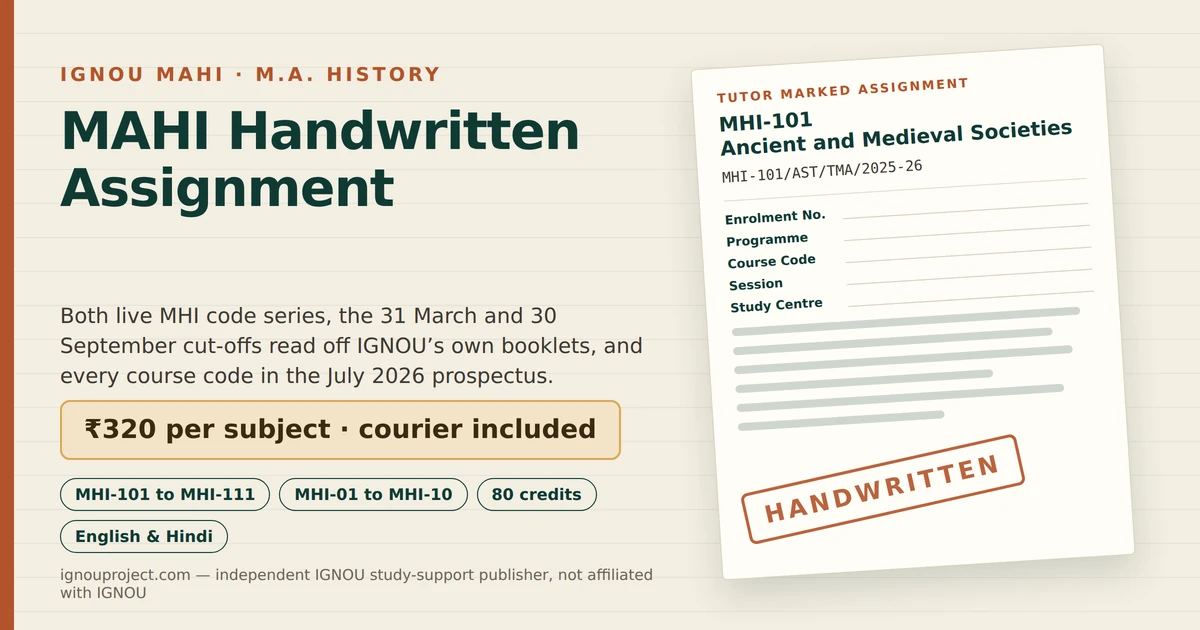
Quick answer. An IGNOU MAHI handwritten assignment is the tutor marked assignment for Master of Arts (History) written out by hand on A4 paper instead of being typed, because the university’s assignment scheme is built around handwritten submission to a Study Centre; ignouproject.com prepares that handwritten assignment for any MHI course code a M.A. History learner is registered in — the three-digit MHI-101 to MHI-111 series in the July 2026 Common Prospectus, the two-digit MHI-01 to MHI-10 series IGNOU is still issuing papers under, and the MPSE-003, MPSE-004 or MGP-004 elective — at ₹320 per subject, hard copy only, with courier included in that price and no separate shipping charge, in the medium your paper is issued in, for any session including a backlog course, matched to a photo of your own handwriting at no extra charge, on work that carries 30 per cent of the final course result against 70 per cent for the term-end examination, ordered by sending your codes to WhatsApp +91 93546 37830.
MAHI Cut-Offs Fall in March and September, Not October
Both M.A. History assignment booklets IGNOU published for the current window carry the same two dates on page two, and neither of them is the 31 October figure that circulates for management programmes. These are read off IGNOU’s own MHI booklets for July 2025 and January 2026.
The Faculty of History prints one date per intake, and the gap between them is six months.
July 2025 intake
31 March 2026
Printed as the last date of submission for July session students on the MHI first-year and second-year booklets and on the standalone MHI-101 paper.
January 2026 intake
30 September 2026
Printed for the January session on the same booklets. The MHI-101 sheet mislabels this row as the January 2025 session, which is a typing error on IGNOU’s side, not a different cohort.
Dates shift by session and occasionally by Regional Centre. Confirm yours on ignou.ac.in and with your Regional Centre before you post anything.
Thirty Marks Are Decided Before You Sit the Paper
Assignments carry 30 per cent of the final course result and the term-end examination carries the remaining 70 per cent. For a M.A. History learner that arithmetic is unusually harsh, because MHI papers are long. Each one is a hundred-mark tutor marked assignment split into Section A and Section B, and you answer five questions with at least two from each section — four essays of roughly 500 words at 20 marks apiece plus a short-note question answered in two parts of about 250 words each.
Multiply that by the twelve courses a MAHI learner submits across four semesters and the assignment writing load runs to somewhere near thirty thousand handwritten words of continuous prose, before any reading. That 30 per cent weightage is the same weightage carried by every other IGNOU programme, but the volume behind it is not. That is why the 30 per cent is the block most often surrendered by learners who are working, and why a legible submitted handwritten assignment is worth more than a brilliant unsubmitted one. Marks and evaluation remain entirely a matter for IGNOU; what a handwritten assignment service removes is the risk of not submitting at all.
If you would rather write the handwritten pages yourself, that is the better outcome and the site supports it: the complete step-by-step handwritten assignment walkthrough covers the whole process at no cost, and the assignment format and structure notes cover margins, numbering and ordering.
What a MAHI order actually buys, in twelve lines. Every term below is fixed for this programme and does not move with the size of the order.
Flat per-paper rate. The rate is ₹320 per subject, hard copy only, with courier included in that price and no separate shipping charge. A six-paper year and a single backlog course price the same way.
Either code series. MHI-101 through MHI-111 or MHI-01 through MHI-10, plus MPSE-003, MPSE-004 and MGP-004. The set is written against the paper you send, not against a stock list.
Your own handwriting, free. Send a photo of a page you have written yourself and the handwritten set is matched to your handwriting at no extra charge. Nothing about the handwritten pages has to look outsourced.
Any medium, every medium. The service covers all mediums IGNOU issues the TMA paper in, at the same price. M.A. History runs in English and Hindi, so a Hindi-medium MHI handwritten assignment costs exactly what an English one costs.
Old sessions welcome. Any session is accepted, current cycle or older, including backlog courses, at the same ₹320 per subject. A MHI-06 paper left over from an earlier registration is ordered the same way as a current one.
No bundle minimum. There is no minimum order: one subject or fourteen, same rate. Order handwritten assignment sets for the three you are short on and write the rest in your own handwriting if you prefer.
Section A and B respected. The five-question, two-section structure printed on the MHI paper is followed exactly in the handwritten answers, with the 500-word and 250-word limits treated as limits rather than suggestions.
Assignment code carried across. The AST/TMA code from your paper, such as MHI-101/AST/TMA/2025-26, is reproduced on the handwritten set so a Study Centre can match it to the correct session at a glance.
Paper only, never a file. No soft copy or PDF is sold. If your Regional Centre asks for an upload, you scan the delivered pages yourself and keep the original.
Courier, not a promise. Delivery depends on your pin code and is confirmed for your order before you pay. No figure is promised on this page.
A cover page you can sign. Enrolment number, programme, course code, assignment code, session, Study Centre code and signature block are laid out so nothing is missing when you hand it over.
Codes checked before writing. Every code you send is read back against IGNOU’s live MHI booklets before a handwritten page is written, because the two live series are easy to confuse.
Send Your MHI Code List and Get a Total Back
Type the codes exactly as they appear on your question paper — MHI-104 and MHI-04 are different papers — along with your session, your medium and your delivery pin code.
₹320 per subject · hard copy only · courier included · no minimum order
Every MAHI Course Code in the July 2026 Prospectus
MAHI is the programme code the Common Prospectus prints for Master of Arts (History); MHI is the course-code prefix on every assignment paper the Faculty of History issues; MAH is the older programme code IGNOU still uses for the assignment folder on its own server. All three refer to the same degree, so an IGNOU MA History enquiry, a MHI handwritten assignment enquiry and a MAHI handwritten assignment enquiry are the same enquiry. The programme runs under the School of Social Sciences, abbreviated SOSS, is open to graduates of any discipline, and is offered in English and Hindi.
The structure below is transcribed from section 3.19 of the IGNOU Common Prospectus for July 2026. It is a two-year, 80-credit programme described there as four semesters of 20 credits each. Thirteen course codes appear in the table because the third semester offers a choice of two; a learner completes and submits twelve.
| Semester | Course code | Official title | Nature | Credits |
|---|---|---|---|---|
| Year 1, Semester 1 | MHI 101 | Ancient and Medieval Societies | Theory | 6 |
| Year 1, Semester 1 | MHI 104 | Political Structures in India through the Ages | Theory | 8 |
| Year 1, Semester 1 | MHI 105 | History of Indian Economy-1: From Earliest Times to C.1700 | Theory | 6 |
| Year 1, Semester 2 | MHI 102 | Modern World | Theory | 6 |
| Year 1, Semester 2 | MHI 106 | Social Structures in India through the Ages | Theory | 8 |
| Year 1, Semester 2 | MHI 107 | History of Indian Economy-2: C.1700 to 2000 | Theory | 6 |
| Year 2, Semester 3 | MHI 103 | Historiography and Research Methods | Theory | 8 |
| Year 2, Semester 3 | MHI 109 | Indian National Movement | Theory | 8 |
| Year 2, Semester 3 | MPSE 004 | Social and Political Thought in Modern India | Any one of these two | 4 |
| Year 2, Semester 3 | MGP 004 | Gandhi’s Political Thought | Any one of these two | 4 |
| Year 2, Semester 4 | MHI 108 | Environmental Histories of the Indian Subcontinent | Theory | 8 |
| Year 2, Semester 4 | MHI 110 | Urbanization in India-1 | Theory | 6 |
| Year 2, Semester 4 | MHI 111 | Urbanization in India-2 | Theory | 6 |
| Total credits | 80 | |||
Scroll the table sideways on a narrow screen to reach the credits column.
Read the semester grouping as a guide rather than a rule for ordering purposes. The same prospectus lists MAHI in its programme-fee table as a year-wise registration at ₹8,200 per year against a total of ₹16,400, admitted in January and July — and IGNOU’s own assignment booklets are packaged as First Year and Second Year, not as four semesters. Order by course code, not by semester.
The Second MHI Series IGNOU Is Still Issuing Papers Under
Alongside the three-digit codes above, the Faculty of History published a first-year and a second-year MHI booklet for the same July 2025 and January 2026 window using two-digit codes. These are live papers, not archive material, and a learner registered under the earlier structure answers these. Titles and credits below are as printed on those two booklets and, where a credit value is stated, on section 3.48 of the same prospectus.
| Booklet | Course code | Title as printed | Assignment code printed |
|---|---|---|---|
| First Year | MHI-01 | Ancient and Medieval Societies | MHI-01/AST/TMA/2025-26 |
| First Year | MHI-02 | Modern World | MHI-02/AST/TMA/2025-2026 |
| First Year | MHI-04 | Political Structures in India | MHI-04/AST/TMA/2025-2026 |
| First Year | MHI-05 | History of Indian Economy | MHI-05/AST/TMA/July 2025-January 2026 |
| Second Year | MHI-03 | Historiography | MHI-03/AST/TMA/2025-26 |
| Second Year | MHI-06 | Evolution of Social Structures in India Through the Ages | MHI-06/AST/TMA/2025-2026 |
| Second Year | MHI-08 | History of Ecology and Environment: India | MHI-08/AST/TMA/2025-26 |
| Second Year | MHI-09 | Indian National Movement | MHI-09/AST/ TMA/2025-26 |
| Second Year | MHI-10 | Urbanisation in India | MHI-10/AST/TMA/July 2025-January26 |
| Second Year | MPSE-003 | Western Political Thought (From Plato to Marx) | Listed on the second-year booklet cover |
| Second Year | MPSE-004 | Social and Political Thought in Modern India | Listed on the second-year booklet cover |
Scroll the table sideways on a narrow screen to reach the assignment code column.
Note what the fourth column shows. Across two booklets IGNOU prints the same session four different ways — 2025-26, 2025-2026, July 2025-January 2026 and July 2025-January26 — and inserts a stray space in MHI-09/AST/ TMA/2025-26. Copy whichever version your own paper prints. A Study Centre matches the course code and the session, and the punctuation around them is IGNOU’s inconsistency rather than yours.
Six documented MAHI code conflicts, including one on this website
1. Two live code series. The July 2026 prospectus lists MHI 101 to MHI 111. IGNOU’s Faculty of History simultaneously published MHI-01 to MHI-10 booklets for July 2025 and January 2026, and separately published MHI-101, MHI-102, MHI-103 and MHI-110 papers for the identical window. Both series are current. Your admission record and your downloaded question paper decide which applies to you.
2. One course or two. The prospectus splits urbanisation into MHI 110 Urbanization in India-1 and MHI 111 Urbanization in India-2 at 6 credits each. Section 3.48 of the same prospectus, covering M.A. Urban Studies, prints MHI-10 Urbanization in India as a single 8-credit course, and the live second-year booklet issues one MHI-10 paper spelled Urbanisation. Same subject, three descriptions, one document.
3. Two assignment folders for one programme. IGNOU’s Master’s assignment index links both M.A.(History)/MAH and MAHI as separate entries pointing at separate directories. The MAH directory holds the two-digit booklets back to 2021-22; the MAHI directory holds the three-digit papers.
4. Cross-wired download links. On IGNOU’s M.A. History index for 2025-26, the Hindi link under First Year opens the Second Year English booklet, and the English link under Second Year opens the First Year Hindi booklet. Check the cover of any file you download before you start writing.
5. Credits reported as 64. Several study-help sites describe MAHI as a 64-credit programme of eight courses. The July 2026 Common Prospectus states 80 credits across four semesters of 20, and its own table sums to 80. Where a site and the prospectus disagree, the prospectus is the document your Regional Centre works from.
6. Our own page, and a wrong deadline elsewhere. This website’s M.A. History programme overview still presents the degree under the retired MAH programme code rather than MAHI; that page is queued for correction and the table above is the one to work from. Separately, our MMPC-001 course page promises dispatch within seven working days, which contradicts the position stated here and on every current programme page, and it is being corrected. Elsewhere on the web, at least three sites publish MHI submission dates of 30 April and 31 October; IGNOU’s own MHI booklets print 31 March and 30 September.
Per-code reference pages and free material sit elsewhere on the site: official IGNOU book and block downloads cover the study material behind each MHI course, the eGyankosh repository route reaches the same units directly, and the alternate Gyankosh entry point is worth trying when the first is slow.
From Your Code List to a Sealed Courier Packet
Five stages sit between the message you send and the handwritten packet that reaches you. Nothing in the sequence asks you to hand over portal credentials.
-
Codes are read back against the live booklet
You send your MHI codes, session and medium. Each code is checked against the current M.A. History booklet on ignou.ac.in before anything is written, so a learner who says MHI-110 but holds a MHI-10 paper is caught at the start rather than after nine hundred words. The Common Prospectus reference page is where the structure side of that check comes from.
-
The question paper is pulled for your exact session
Answers are written against the paper carrying your assignment code, not against last year’s. A MAHI assignment 2025-26 paper is not the previous year’s paper: history questions rotate heavily between sessions — the MHI-101 paper for July 2025 asks about Egyptian civilisation and West African monarchies, where an earlier one asked about pastoral nomadism and the Bronze Age. A handwritten set answering the wrong year is worth nothing at the Study Centre.
-
Five answers are drafted to the printed limits
Four essay answers at roughly 500 handwritten words and one short-note question split into two parts of about 250 words, with at least two questions taken from Section A and two from Section B, exactly as the note at the head of every MHI paper requires. Assignment writing for history is drafted before it is written out, never composed straight onto the sheet. Those limits, printed on the paper, decide the length.
-
The handwritten pages are produced
A4 sheets, blue or black ink, a clear left margin for the evaluator, the question number stated above every answer and a fresh sheet for each new question. Handwriting stays legible from the first MHI paper to the last. The cover page carries your enrolment number, programme, course code, assignment code, session and Study Centre code. The assignment cover page reference shows the layout that is followed.
-
The bundle is couriered to your address
Handwritten sets are ordered by course code, cover page on top, and sent to the address you give. Courier is inside the ₹320. You take the handwritten packet to your Study Centre, sign the declaration and collect the receipt — the assignment submission guide and the online and offline submission comparison cover what each Regional Centre accepts.
Matching Your Own Handwriting on MHI Papers
Send a photo of a page you have written yourself and the handwritten set is matched to your handwriting at no extra charge. One clear picture of half a page of ordinary writing is enough — a page of rough notes, an old submitted answer, anything in your normal hand under decent light.
This matters more on M.A. History than on shorter programmes. A MAHI learner may submit twelve handwritten papers over two years to the same Study Centre coordinator, and a handwritten set that reads in one hand for MHI-101 and a visibly different hand for MHI-104 invites a question nobody wants asked. Own-handwriting matching is free, it is optional, and it is requested by roughly the same learners who tell us they have already written half the year themselves.
Writing the MHI papers yourself is a legitimate plan, and the free material is on this site. Twelve papers is a lot of prose but it is spread across two years, and history answers get easier once you have the block structure in your head. Start with the handwritten assignment guide if you have not written one before, take the cover sheet from the assignment front page format PDF, look at a finished example in the sample IGNOU assignment collection, and if you are writing in Hindi the Hindi-medium assignment notes cover the wording conventions. An IGNOU MAHI solved assignment used purely as a reference, never as something to copy, sits in the MHI solved assignment library, and the assignment overview page explains how the whole scheme fits together.
Two Free Planners Built Around the MHI Paper
Both run entirely in your browser, store nothing and send nothing. They are useful whether or not you ever order a handwritten assignment. Ignouproject.com built them for MA History assignment planning specifically, not as generic calculators.
Free tool 1
Paper Count and Days-Left Planner
Choose how many MHI papers you are carrying and which intake you are registered in. The planner returns the cost at ₹320 a paper, the next cut-off for your intake calculated from today’s date, the days left, and an estimate of the handwriting time involved.
Order These MHI Papers at ₹320 Each
Handwriting time is an estimate only, built from the 500-word and 250-word limits printed on the MHI paper — about 2,500 written words per paper at roughly 300 legible words an hour, excluding reading and drafting. This tool is guidance from ignouproject.com, not an IGNOU rule. Using it creates no obligation to order anything.
Free tool 2
MHI Code Series Resolver
Type a course code and the resolver tells you which of the two live MHI series it belongs to, where it sits in the programme, its credits where the prospectus states them, the assignment code pattern to expect, and what to verify before writing.
Credits and titles are transcribed from the July 2026 Common Prospectus and from IGNOU’s live M.A. History booklets. Your admission record is the authority on which codes you are registered in. This tool is guidance from ignouproject.com, not an IGNOU rule. Using it creates no obligation to order anything.
Resolved Your Codes? Put Them on a Thread
One message with your code list, session, medium and pin code is all it takes. Codes are re-checked against IGNOU’s live booklet before writing starts.
₹320 per subject · both MHI series · English or Hindi · courier included
Pulling the Official MHI Question Paper Yourself
Every MHI assignment is published free by IGNOU. Nobody needs to buy a question paper, and a handwritten set written against a paper you have not seen is a handwritten set you cannot check. Four steps get you the right file.
-
Open the official assignment portal
Go to the IGNOU student service assignment download portal and choose Master’s Degree Programmes. M.A. History appears twice in that index, once as M.A.(History)/MAH and once as MAHI. Both are the same degree.
-
Pick the folder matching your code series
The MAH folder carries the combined First Year and Second Year booklets under two-digit codes. The MAHI folder carries individual three-digit papers. If your admission record shows MHI-104 you want the MAHI side; if it shows MHI-04 you want the MAH side.
-
Open the cover before you trust the link
On the 2025-26 listing the Hindi and English links under First Year and Second Year are cross-wired. The cover page of every booklet names the year, the medium, the session and the codes inside. Read it before you print anything.
-
Check the session line against your intake
The newest M.A. History set published is July 2025 and January 2026; papers for July 2026 and January 2027 were not on the index at the time of this review. Where no new paper exists, IGNOU’s standing instruction is to use the latest published assignment. Past term-end question papers, which are a different document from the assignment, sit in the solved question papers archive and the previous year paper collection.
Where a Submitted MHI Paper Shows Up Next
Handing the handwritten packet over is not the last step. The Study Centre coordinator receives it, returns it to you after evaluation, and forwards the marks to the Student Evaluation Division in New Delhi, where they are entered on your grade card. That chain is described on page two of every MHI booklet, and it is slow — a paper submitted in March may not appear against your enrolment number until well into the following cycle.
Keep the receipt the Study Centre gives you. It is the only proof that a paper was handed in before 31 March or 30 September, and it is what a Regional Centre asks for when a status line stays blank. Keep a photocopy or a phone photo of the submitted pages as well; IGNOU’s own instruction on the booklet says the same thing.
Once the entry exists you can read it directly. The assignment result and status checker is the most used page on this site and walks through the enrolment-number lookup; the marks status explainer covers what each status line means, the assignment grade card notes deal with entries that appear incomplete, the grade card status page covers portal problems, and the final grade card guide explains how assignment marks fold into the closing statement. If you need your enrolment number itself, the enrolment number lookup covers it.
Converting the numbers is a separate job. The percentage calculator and the CGPA calculator both handle the 30 and 70 split. If an evaluated MHI mark looks wrong against the answer you submitted, the revaluation process page sets out what can and cannot be re-examined.
What MAHI Learners Order Alongside the Handwritten Set
History learners tend to arrive for one handwritten paper and stay for the reading list. These are the neighbouring services on the site, each with its own pricing, and none of them is assignment writing.
For term-end preparation, the guess paper collection narrows a large syllabus to the questions that recur, and the subject-wise study notes compress the MHI blocks into something readable in a week. Help books and the online guide book catalogue cover the same ground in print, and the Shri Chakradhar Publication list is where the titles published in-house sit.
MAHI itself has no project or dissertation course — all twelve credits-bearing courses are theory papers ending in a term-end examination. Learners who hold a second registration in a programme that does need one use the synopsis and proposal service, the project report service, and the rates published on the services and charges page. Handwritten assignment work stays at ₹320 per subject regardless.
Medium, session, and the fact that MHI papers expire. Master of Arts (History) is offered in English and Hindi, and IGNOU publishes each MHI booklet in both. The service covers all mediums IGNOU issues the TMA paper in, at the same price, so a learner ordering a handwritten MHI-106 in Hindi and a handwritten MHI-103 in English pays ₹320 for each. Say which medium your paper is in when you send the codes, because the Hindi and English versions of a MHI booklet do not always carry identical question numbering.
Assignment papers expire. A MHI question paper is valid for the session printed on it and is replaced when the Faculty of History issues the next one, which is why the assignment code carries the year span. Any session is accepted, current cycle or older, including backlog courses, at the same ₹320 per subject — but the handwritten set is written against whichever paper is currently valid for your enrolment, not against an old one you happen to have saved.
Because papers turn over twice a year, this page is rebuilt against IGNOU’s live booklets each cycle rather than left to age.
Placing a MAHI Order in Three Messages
The whole thing happens on one WhatsApp thread. Three messages from you, five details in the first one.
-
Send the five details
Your MHI course codes exactly as printed, the session on the paper, the medium, your delivery pin code, and whether you want handwriting matching. That is everything needed to quote.
-
Confirm the read-back
You get the code list repeated back with the series identified, the total at ₹320 per paper, and a courier estimate for your pin code. Correct anything that looks wrong before you pay, because writing starts after this step.
-
Receive, check and submit
The packet arrives at your address. Read the answers, satisfy yourself they represent your own understanding, sign the declaration on the cover page and hand the handwritten set in at your Study Centre against a receipt.
Five details, one thread, and no account access requested at any point: codes, session, medium, pin code, handwriting sample. Delivery depends on your pin code and is confirmed for your order before you pay. No figure is promised on this page.
Sources Behind This MAHI Page and When It Is Rechecked
Three separate kinds of statement appear above and it is worth being clear about which is which.
From the IGNOU Common Prospectus, July 2026: the MAHI programme code, School of Social Sciences, the 80-credit four-semester structure, all thirteen course-code slots with their official titles, credits and nature, the English and Hindi medium of instruction, the eligibility line, and the year-wise fee entry of ₹8,200 per year. Section 3.19, plus section 3.48 for the MHI-10 credit value.
From IGNOU’s live M.A. History assignment booklets for July 2025 and January 2026: the 31 March 2026 and 30 September 2026 submission dates, the AST/TMA assignment code format and its four printed variants, the 100-mark total, the five-question Section A and Section B structure, the 500-word and 250-word limits, the cover-page fields, the two-digit course list, the cross-wired index links and the January 2025 mislabel. Read from the First Year and Second Year booklets in the MAH folder and the standalone MHI-101 paper published under the School of Social Sciences.
Publisher’s own commercial terms, set by ignouproject.com and not by IGNOU: the ₹320 per subject rate, hard copy only with courier included, no soft copy or PDF sold, no minimum order, free handwriting matching, acceptance of any session including backlog courses, and the position that no delivery figure is promised.
Written and reviewed by BK Sahni, Founder, Shri Chakradhar Publication Pvt. Ltd. and ignouproject.com, who has guided 5,00,000 students till date. ORCID 0009-0005-8092-459X.
Published: 11 August 2026. Last reviewed: 11 August 2026. Next scheduled review: February 2027, ahead of the 31 March cut-off for July intake learners, and again in August 2027 ahead of the 30 September cut-off for the January intake.
Corrections: anything inaccurate on this page can be reported on WhatsApp +91 93546 37830 or through the contact page. Publisher details are on the about page and the author profile is at the BK Sahni page.
MAHI Handwritten Assignment Questions Learners Send Us
Yes. The only handwritten assignment IGNOU accepts for MHI is one written by the learner in the learner’s own hand: the assignment scheme is built around handwritten submission, and every MHI booklet instructs you to write the answers in your own handwriting and in your own words, and to hand the handwritten pages to the Coordinator of your Study Centre. Typed submissions are commonly refused. Where a Regional Centre asks for an upload instead, it wants a scan of handwritten pages, not a word-processed file.
31 March 2026, printed as the last date of submission for July session students on IGNOU’s M.A. History booklets for July 2025 and January 2026. January 2026 intake learners are given 30 September 2026 on the same booklets. Ignore the 30 April and 31 October dates published by several study-help sites for MHI — those belong to other schools. Dates shift by session and by Regional Centre, so confirm yours on ignou.ac.in.
Whichever is printed on your own admission record and on the question paper you downloaded. IGNOU is running both series concurrently: MHI-101 to MHI-111 in the July 2026 Common Prospectus, and MHI-01 to MHI-10 on the First Year and Second Year booklets for the same July 2025 and January 2026 window. They are not interchangeable — MHI-104 and MHI-04 carry different question sets. Paste your code into the resolver above if you are unsure.
The Faculty of History uses an AST/TMA pattern: MHI-101/AST/TMA/2025-26 on the three-digit series and MHI-01/AST/TMA/2025-26 on the two-digit one. The AST segment is specific to this programme and does not appear on management or literature papers. IGNOU prints the year part four different ways across two booklets — 2025-26, 2025-2026, July 2025-January 2026 and July 2025-January26 — so copy the exact string from your own paper onto the cover page.
The rate is ₹320 per subject, hard copy only, with courier included in that price and no separate shipping charge. A six-paper MAHI year is six subjects. There is no minimum order: one subject or fourteen, same rate. The price does not change with the medium, the session, the code series or the length of the paper.
Yes. The July 2026 Common Prospectus lists the medium of instruction for MAHI as English and Hindi, and IGNOU publishes each MHI booklet in both. The service covers all mediums IGNOU issues the TMA paper in, at the same price. Mention your medium when you send the codes, and take the medium from the booklet cover rather than from the download link, because the 2025-26 index links are cross-wired.
No soft copy or PDF is sold. What is couriered is the physical handwritten set. If your Regional Centre accepts uploads, you photograph or scan the delivered pages yourself and keep the paper original, which is also what you will want if the Study Centre later queries a submission.
Send a photo of a page you have written yourself and the handwritten set is matched to your handwriting at no extra charge. Half a page of ordinary writing in reasonable light is enough. On a twelve-paper programme submitted to the same Study Centre over two years, consistency across the whole handwritten set is worth having.
Twelve, one per course, under the 80-credit structure in the July 2026 Common Prospectus. Thirteen codes appear in the prospectus table because the third semester offers MPSE 004 or MGP 004 and you take one of them. A MAHI 1st year learner therefore has six MA History assignment papers to produce and a MAHI 2nd year learner six more. Learners on the two-digit series work from a four-paper First Year booklet and a seven-code Second Year booklet instead.
Any session is accepted, current cycle or older, including backlog courses, at the same ₹320 per subject. One caution specific to history: IGNOU’s standing instruction is to submit the latest published assignment even when you registered earlier, so tell us your registration year and we will work out which paper is currently valid for you rather than assuming the old one.
From IGNOU’s own student service assignment portal, under Master’s Degree Programmes. M.A. History is listed twice there, once as M.A.(History)/MAH holding the two-digit booklets and once as MAHI holding the three-digit papers. It is free, and you should open the cover page of the file before printing, because the 2025-26 Hindi and English links are swapped between First Year and Second Year.
Every MHI booklet names one destination: the Coordinator of your Study Centre. Some Regional Centres additionally accept posted or uploaded submissions, and the instruction from your own Regional Centre governs. Whichever route you use, obtain and keep the receipt — the booklet tells you to insist on it, and it is the only evidence that a paper reached IGNOU before 31 March or 30 September.
Through IGNOU’s grade card portal using your enrolment number and programme code. The route runs Study Centre to Student Evaluation Division to grade card, as printed on the MHI booklet, and it takes time — a blank line weeks after submission usually means the entry has not been made yet rather than that the paper is lost. The assignment status pages linked above walk through the lookup.
No. Every course in the MAHI table in the July 2026 Common Prospectus is marked Theory, including MHI 103 Historiography and Research Methods, which teaches research method without requiring a dissertation. There is no MHIP code and no synopsis stage. That makes MAHI unusual among IGNOU master’s programmes and it is why this page carries no project pricing.
Because the programme was restructured and older descriptions are still circulating. The July 2026 Common Prospectus states 80 credits across four semesters of 20 each, and its own course table sums to exactly 80. The 64-credit figure belongs to the earlier structure that the two-digit MHI codes came from. Neither number changes what you order, since ordering is by course code.
Delivery depends on your pin code and is confirmed for your order before you pay. No figure is promised on this page. Send the pin code with your code list and an estimate comes back on the same thread, so you can decide against your own 31 March or 30 September cut-off rather than against a generic number.
A4 sheets, blue or black pen, legible writing, clear margins for evaluator comments, the question number stated before each answer and a new question started on a fresh sheet, with a completed cover page on top. The MHI booklet adds its own instruction to underline the points you wish to emphasise and to keep each answer inside the printed word limit. Regional Centres occasionally add requirements, so read anything your own centre publishes.
Submission of the assignment is compulsory before taking the term-end examination, so a missed cut-off normally means waiting for the next cycle’s paper and the next examination window for that course. IGNOU has extended assignment deadlines by notification in past cycles, but an extension is an announcement you wait for rather than a plan you rely on. Check ignou.ac.in and your Regional Centre before assuming either way.
Important Notice
ignouproject.com is an independent IGNOU study-support publisher. It is not the official website of Indira Gandhi National Open University, is not affiliated with, endorsed by or authorised by the university, and no page on this site should be treated as an official IGNOU communication.
Programme structures, course codes, submission dates and rules change, and only ignou.ac.in and your Regional Centre can confirm the current position for your enrolment.
You sign the declaration on the assignment cover page, so you should read and review the content before submitting it, and satisfy yourself that it represents your own understanding of the course.
No claim is made about the marks any assignment will receive, about how an evaluator will assess it, or about whether it will be accepted. Assignment evaluation is entirely a matter for IGNOU.
Your MHI Codes, Written Out by Hand and Couriered
Send the code list from your question paper and get a read-back, a total and a pin-code estimate on the same thread. Both MHI series, English or Hindi, any session.
Start a MAHI Order Ask a Code Question First
WhatsApp +91 93546 37830 · ignouproject.com · Shri Chakradhar Publication Pvt. Ltd. · independent of IGNOU

BK Sahni iD 0009-0005-8092-459X
Founder, Shri Chakradhar Publication Pvt. Ltd. & ignouproject.com — helping IGNOU distance-learning students since 2010 (5,00,000+ students supported across MBA, MCom, MA & more). Author of IGNOU exam guides, solved assignments & project reference books.
Disclosure: Shri Chakradhar Publication Pvt. Ltd. and ignouproject.com are independent third-party study-help services — not the official IGNOU website. Always verify final dates and rules on ignou.ac.in.