MA Library and Information Science · School of Social Sciences, SOSS
Ten MLIS courses. Eight tutor marked assignments. Two components on every one of them.
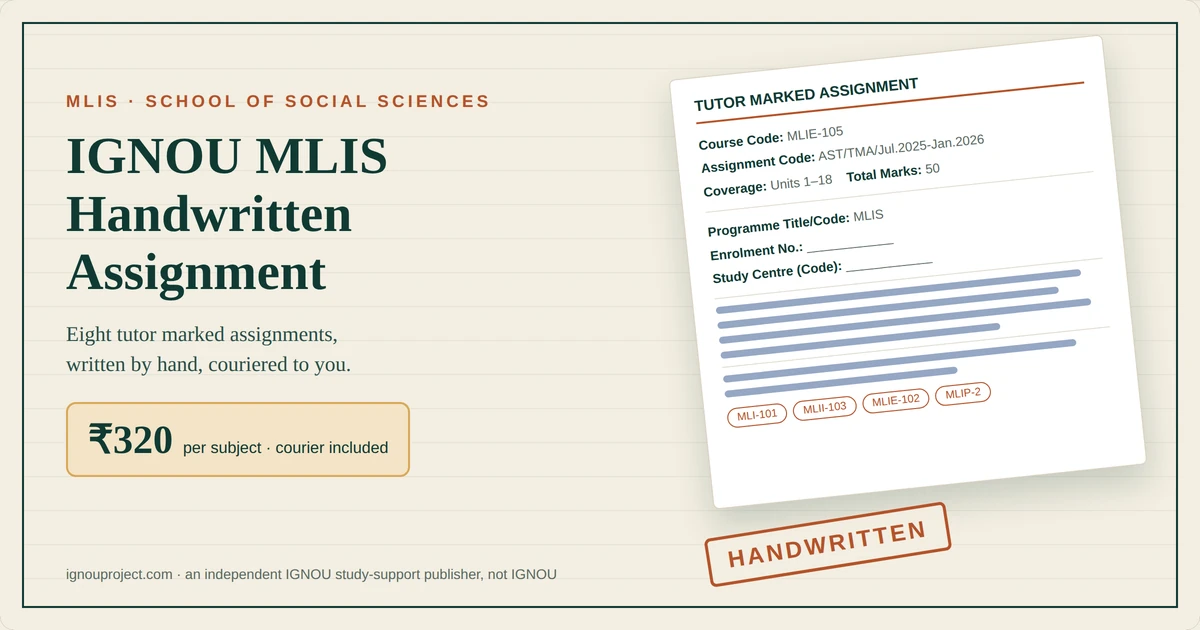
MLIP-2 and MLII-105 carry no assignment paper at all. The other eight each carry a fifty-mark TMA plus a seminar or a practical, and only the TMA is a written paper anyone can prepare for you. Send the codes on your admission record and the handwritten assignment set is written by hand against your own booklet, in your own handwriting if you send a sample.
- 31 March · 30 September cut-offs
- 40 credits, one year
- English or Hindi paper
- Own handwriting matched
- Backlog sessions accepted
- Courier included
Message the course codes printed on your admission record, the session on your booklet cover, and your medium. Delivery depends on your pin code and is confirmed for your order before you pay.
Quick answer. An IGNOU MLIS handwritten assignment is a handwritten set of Tutor Marked Assignment answers written out by hand for the courses of the Master of Library and Information Science programme, which the School of Social Sciences runs through its Faculty of Library and Information Science across the four course-code prefixes MLI, MLII, MLIE and MLIP, covering MLI-101 and MLI-102, MLII-101 to MLII-105, MLIP-2 and the six electives MLIE-101 to MLIE-106, forty credits in total over a one-year programme; ignouproject.com prepares that handwritten assignment set at ₹320 per subject, hard copy only, with courier included in that price and no separate shipping charge, in any medium IGNOU issues the paper in, and for any session including an older cycle or a backlog paper, matching the writing to a photo of a page you have written yourself at no extra charge; this matters because assignments carry 30 per cent of the final course result and the term-end examination carries the remaining 70 per cent, because the MLIS booklet prints 31 March for the July session and 30 September for the January session rather than the 30 April date many listing pages repeat, and because IGNOU’s own MLIS booklet states that typed and computer-printed assignments are not permissible, so the copy has to be handwritten either by you or for you; to order, send your codes on WhatsApp at +91 93546 37830.
MLIS Papers Are Due on 31 March and 30 September
Both dates below were read off IGNOU’s own MLIS assignment booklet for July 2025 and January 2026, in English and again in Hindi, rather than carried across from another school. Learners searching for the MLIS assignment last date and copying the 30 April figure from a listing page are reading a School of Management Studies cut-off that has never applied to MLIS.
July session
31 March
The booklet prints 31st March 2026 as the cut-off for the July 2025 session, which is the date that keeps the June term-end examination open for that year’s papers.
January session
30 September
The same booklet prints 30th September 2026 for the January 2026 session, the date that keeps the December term-end examination open for those papers.
One MLIS booklet covers both sessions, which is why the assignment code carries a two-session span rather than a single year. The validity of an MLIS assignment is one year: a learner who registers in July attempts the July paper only, and missing that cut-off means starting again on the next July set rather than submitting late against the old one. Programme structures, course codes, submission dates and rules change, and only ignou.ac.in and your Regional Centre can confirm the current position for your enrolment. The first tool further down works out whichever of the two dates falls next from today instead of printing a countdown that goes stale.
Eight TMAs, Two Components Each, and the Hours That Follow
Assignments carry 30 per cent of the final course result and the term-end examination carries the remaining 70 per cent. What makes MLIS different from most masters programmes is that the thirty per cent has two halves. IGNOU’s booklet states that every candidate does one Tutor Marked Assignment and a seminar or a practical in each of the six core courses and the two electives chosen. The TMA is fifty marks of written work. The seminar or practical is fifty marks performed at the study centre in front of a counsellor, and no publisher can prepare that for you.
That split is the honest boundary of this service. Eight fifty-mark tutor marked assignments are written papers and a handwritten assignment set can be prepared for every one of them. Eight seminars and practicals are not, and anyone selling you a handwritten file for a WINISIS database exercise or a seminar presentation is selling you something the study centre will not accept in that form. What the handwritten pages do is clear the written half so your remaining time goes to the half you have to be present for. Assignment writing is the part that can be handed over; attendance is not.
Each MLIS tutor marked assignment sets five questions of ten marks. Four of them offer a choice between two alternatives, and the fifth asks for short notes on any two of four options. That is five substantial answers per course. A learner carrying six core papers plus two electives is looking at forty handwritten answers before a single seminar is booked, alongside reading blocks that run to nineteen units on some courses. Leave an MLIS course without an assignment on record and you do not merely forfeit thirty marks. The course never closes: it holds an incomplete status on the grade card that a term-end mark, however high, has no power to clear. Learners who discover that later usually end up on the IGNOU assignment result and status page working out why a paper they sat is still pending.
Only the TMA half is written. Handwritten preparation covers the fifty-mark tutor marked assignment for each course, handwritten in full. The seminar or practical stays yours, and this page says so rather than quietly bundling it in.
Full scape, not A4, if your centre insists. The MLIS booklet asks for full scape size paper and a three-inch left margin, which is not the four-centimetre A4 convention other IGNOU programmes use. Say which your study centre accepts and the handwritten pages are ruled to match.
Answers written, not copied out of units. The booklet warns that reproducing the MLIS study material word for word scores zero. Handwritten answers are drafted from the blocks and units of the syllabus in ordinary prose instead of being transcribed, because that is what assignment writing means on this programme.
Either-or questions decided deliberately. Every MLIS question offers 1.1 or 1.2. Which alternative gets answered is chosen against the units you were sent, not against whichever looks shortest on the page.
Four prefixes handled separately. MLI, MLII, MLIE and MLIP behave differently on the cover page. A handwritten set that treats them as one prefix gets the code block wrong before the evaluator reads a line of your handwritten answers.
Hindi papers written in Hindi. IGNOU publishes a full Hindi MLIS booklet alongside the English one and states that assignments may be written in either, so every medium the paper exists in is a medium the handwritten set is prepared in. The service covers all mediums IGNOU issues the TMA paper in, at the same price.
Typed pages are ruled out by IGNOU. The booklet’s own instruction is that typed and computer-printed assignments are not permissible, which is why a handwritten copy is the only submittable form.
Old cycles still accepted. Any session is accepted, current cycle or older, including backlog courses, at the same ₹320 per subject. A stranded MLIE-103 from an earlier span is ordered exactly like a current handwritten assignment.
Your hand, not a stranger’s. Send a photo of a page you have written yourself and the handwritten set is matched to your handwriting at no extra charge.
One paper is a valid order. There is no minimum order: one subject or fourteen, same rate. On a one-year degree the usual message names an elective and one core paper, not the whole set.
Courier sits inside the price. The rate is ₹320 per subject, hard copy only, with courier included in that price and no separate shipping charge.
Nothing is sold as a file. No soft copy or PDF is sold. If your Regional Centre wants an upload, you scan the delivered hard copy yourself.
Six core papers, two electives, or the one you ran out of time for
Type the codes exactly as your admission record prints them and say whether your booklet is the English or the Hindi set. If your two electives are already chosen, name them; if they are not, the second tool below will tell you what each one is worth before you commit.
₹320 per subject · hard copy with courier included · no minimum order
Every MLIS Course Code and the Two That Carry No TMA
MLIS is the programme code for the Master of Library and Information Science. It is not a course-code prefix, and that is where most MLIS ordering mistakes begin. The prefixes actually printed on the papers are four: MLI for two of the core theory courses, MLII for the rest of the core group, MLIE for all six electives, and MLIP for the project. Anyone reading the MLIS syllabus for the first time meets all four at once, which is why a code list copied from memory so often produces a handwritten set for the wrong paper. The programme comprises eight compulsory courses and two electives chosen from six, each worth four credits, reaching forty credits over a minimum of one year and a maximum of two. Course titles, codes and credits below come from section 3.23 of the IGNOU Common Prospectus for July 2026; the marks, unit coverage and assignment-code shapes come from the MLIS assignment booklet on IGNOU’s own portal. Eight of these ten courses carry a tutor marked assignment. Two do not.
| Course code | Official title | Credits | Units covered | Second component |
|---|---|---|---|---|
| MLI-101 | Information, Communication and Society | 4 | Units 1–16 | Seminar, 50 marks |
| MLII-101 | Information Sources, Systems and Services | 4 | Units 1–19 | Practical, 50 marks |
| MLI-102 | Management of Library and Information Centres | 4 | Units 1–18 | Seminar, 50 marks |
| MLII-102 | Information Processing and Retrieval | 4 | Units 1–19 | Practical, 50 marks |
| MLII-103 | Fundamentals of Information Communication Technologies | 4 | Units 1–14 | Practical, 50 marks |
| MLII-104 | Information Communication Technologies: Applications | 4 | Units 1–16 | Practical, 50 marks |
Scroll the table sideways on a narrow screen. Every course in this group carries a fifty-mark tutor marked assignment, and the handwritten assignment covers that column only.
| Course code | Official title | Credits | What it actually is |
|---|---|---|---|
| MLIP-2 | Project | 4 | A dissertation carrying 100 marks. IGNOU’s own MLIS programme guide states plainly that there is no assignment for this course and no continuous evaluation on it. |
| MLII-105 | Internship | 4 | A supervised attachment at a library or information centre with a daily workbook and a report, assessed on the placement rather than on a written paper. |
Scroll sideways for the fourth column. Neither of these appears in the assignment booklet, and neither is ordered as a handwritten assignment. The MLIS project guide for MLIP-002 covers the dissertation, the MLII-105 internship report walkthrough covers the placement, and the MLIS project submission process covers filing them.
| Course code | Official title | Credits | Units covered | Second component |
|---|---|---|---|---|
| MLIE-101 | Preservation and Conservation of Library Materials | 4 | Units 1–16 | Seminar, 50 marks |
| MLIE-102 | Research Methodology | 4 | Blocks 1–4, Units 1–18 | Seminar, 50 marks |
| MLIE-103 | Academic Library System | 4 | Units 1–14 | Seminar, 50 marks |
| MLIE-104 | Technical Writing | 4 | Units 1–14 | Seminar, 50 marks |
| MLIE-105 | Informetrics and Scientometrics | 4 | Units 1–18 | Seminar, 50 marks |
| MLIE-106 | Public Library System and Services | 4 | Units 1–17 | Seminar, 50 marks |
Scroll sideways to see the unit coverage. Two of these six are taken, so two learners in the same MLIS year can be sitting entirely different elective papers, which is exactly why an order is written against your codes rather than a standard bundle.
The arithmetic that matters when you are buying by the subject: eight compulsory courses at four credits each make thirty-two, two electives at four each make eight, and forty is the total the prospectus states. But only six of the eight compulsory courses have a tutor marked assignment, so the maximum handwritten assignment order across the whole degree is eight papers, not ten. A reference MLIS solved assignment for those eight sits with the subject-wise IGNOU solved assignments, and the official blocks behind every code download free from eGyanKosh, with the alternate GyanKosh route when the main repository is slow.
Conflicts Found Across the MLIS Documents
Deadline. Listing pages variously print 30 April, 31 October and 31 May for MLIS. The booklet on IGNOU’s own portal prints 31 March and 30 September. Treat the booklet as the source and confirm with your Regional Centre.
Elective title. The Common Prospectus prints MLIE-105 as Informatrics and Scientometrics. Both the English and the Hindi assignment booklets print Informetrics, which is the discipline’s actual name. The table above uses the booklet spelling.
Code padding, three ways in one document. Section 3.23 of the prospectus prints MLI 101, MLII 101, MLIE 101 and MLIP 2 with spaces and no padding. Annexure I(b) of the same prospectus prints MLIE101 to MLIE106 with no space at all. The booklets and the study material use MLI-101, MLII-101, MLIE-101, and the programme guide and grade card use MLIP-002 and MLII-105. They are the same courses.
Assignment codes contradict themselves. MLII-101’s tutor marked assignment prints AST/TMT/ where every other TMA prints AST/TMA/. Both the assignment and the practical for MLII-102 print AST/SEM/, which belongs to seminars. The seminar pages for MLIE-101 and MLIE-104 print AST/TMA/ rather than AST/SEM/. Copy the string off your own downloaded booklet rather than reconstructing it.
Unit coverage. The MLIE-101 assignment page states Units 1–16 and its own seminar page states Units 1–15, in the same booklet.
A date typo in the instructions. The booklet’s worked example says a July 2025 learner who misses the deadline by 31st March 2025 moves to the July 2026 set. The year should read 2026; the cut-off table two pages earlier gives the correct date.
Weightage wording. The English booklet says the assignment and the seminar or practical carry 30 per cent weightage each and the term-end examination 70 per cent, which does not sum. The Hindi booklet of the same set gives the standard single 30 per cent for continuous evaluation against 70 for the term-end. The Hindi wording matches IGNOU’s general scheme.
The Hindi paper is not a translation. MLII-101’s short-note question offers four options in English and five in Hindi. MLII-102’s practical names WINISIS in English and CDS/ISIS in Hindi. Order against the medium you are registered in and the handwritten answers are written from that paper, not from the other one.
Course count. Several sites state that MLIS is eight courses. The prospectus structure is ten: eight compulsory including the project and the internship, plus two electives.
Maximum duration. The prospectus gives one year minimum and two years maximum. Some listing pages print four years. The programme guide agrees with the prospectus at two.
Paper size. Generic IGNOU advice, including advice on this site, says A4 and a four-centimetre margin. The MLIS booklet specifically says full scape. Ask your study centre which they take and say so when you order.
No online-mode variant exists. IGNOU’s online-mode programme list carries BLISOL and CLISOL but no MLISOL. Anyone offering you an MLISOL paper is offering something the university does not currently issue.
On this site. Three pages here are queued for correction and are named openly: the homepage carries an acceptance-and-refund promise no page on this site is permitted to make, an MMPC-001 page promises dispatch within a set number of working days when delivery actually depends on pin code, and the general step-by-step handwritten assignment guide prints a 30 March 2027 July-session date and the four-centimetre A4 margin convention, where the MLIS booklet gives 31 March and a three-inch margin on full scape. Where they disagree with this page, this page and the booklet are correct for MLIS.
From the MLIS Booklet to a Finished Answer Sheet
Five stages, in the order they happen once your codes land on WhatsApp.
- The right booklet is opened before anything else
One MLIS file covers both the July and the January sessions of a span, so the first check is whether the span on your admission record matches the span on the file. IGNOU’s MLIS index has carried five spans at once, and the newest published set is not automatically your set. A handwritten assignment written from the wrong span is wasted writing however good the answers are.
- The either-or choices are settled against your units
Each MLIS question hands you two alternatives and takes one answer. That choice is made against the blocks IGNOU actually sent you, so the handwritten answer draws on material you can defend in a seminar rather than on the alternative that happens to be easier to write.
- Length is set by the marks, because the paper mostly does not set it
The MLIS booklet prints ten marks against each question but no word count on most of them; only a few short-note questions specify about 300 words each. Ten-mark answers are therefore written to a consistent length across the paper, and where the booklet does print a word limit, that word limit decides it rather than any house convention.
- The handwritten pages go down in blue or black with a three-inch margin
Full scape sheets of ordinary writing paper, neither too thick nor too thin, as the booklet specifies. Three inches clear on the left, four blank lines between answers, the question number written beside every answer, and legible writing throughout. Typed and computer-printed pages are not permissible, so every page is handwritten.
- The cover block is set out the way the booklet demands
Enrolment number, name, full address and date of dispatch at the top right; programme title and code, course title and code, assignment number and study centre name and code at the top left. The booklet warns that assignments not following this format may not be evaluated. The IGNOU assignment cover page format shows every field, and the enrolment number lookup explains where to find the number that goes at the top. Delivery depends on your pin code and is confirmed for your order before you pay. No figure is promised on this page.
Matching Your Own Hand on an MLIS Set
Send a photo of a page you have written yourself and the handwritten set is matched to your handwriting at no extra charge. On a one-year programme this matters more than on a four-semester one, because an MLIS learner hands the whole degree’s assignments to the same study centre coordinator inside a single cycle. Eight thick handwritten files in a hand that plainly is not yours, delivered in one visit, is conspicuous in a way that a single thin file across two years is not. One sample is enough: ordinary lined paper, daylight, no filter, a few sentences in your own handwriting.
You sign the declaration on the assignment cover page, so you should read and review the content before submitting it, and satisfy yourself that it represents your own understanding of the course. That is doubly practical on MLIS, because the seminar attached to the same course is presented by you in front of the counsellor who marked the written half.
Writing the MLIS set yourself. Everything you need is free here and no order is required. The assignment front page format PDF is downloadable and printable, sample IGNOU assignments show what a finished file looks like, assignment format and structure covers margins and page rules, and online and offline submission explains what happens after the writing is done. Library and information science answers reward classification and structure over volume, so an outline before you start your own assignment writing is worth more than an extra page at the end.
Two Free MLIS Tools for Paper Count and Code Lookup
Both run in your browser, keep nothing and need no account. The first turns a count of outstanding papers into a cost and the next MLIS cut-off. The second takes one course code and returns where it sits, what it is worth, whether it has a tutor marked assignment at all, and the assignment-code shape the booklet actually prints for it.
Free tool 1
MLIS TMA Load and Deadline Clock
Enter a paper count to see the total at ₹320 per subject and the days left to the next MLIS cut-off.
This tool is guidance from ignouproject.com, not an IGNOU rule. Using it creates no obligation to order anything.
Free tool 2
MLIS Code, Component and AST Shape Finder
Enter a code to see its group, credits, whether it carries a tutor marked assignment, and the assignment-code shape the MLIS booklet prints for it.
This tool is guidance from ignouproject.com, not an IGNOU rule. Using it creates no obligation to order anything.
Two papers or eight, the rate does not move
Most MLIS messages name two or three codes rather than the whole year. That is a normal order. Send the codes, the span printed on your booklet cover, and your medium, and the handwritten assignment is written against those exact papers.
₹320 per subject · hard copy with courier included · own handwriting matched free
Finding the MLIS Booklet That Covers Your Span
IGNOU publishes the MLIS assignment question paper free on its own site and nobody needs to buy it. Four steps get you to the right file, and library science learners most often skip the fourth.
- Open the official assignment service
Go to IGNOU’s assignment download service and choose the Master’s Degree Programmes category. Do not use a direct file link copied from a forum or a comment thread; IGNOU relocates them without notice.
- Pick M.A. in Library and Information Science, not BLIS or CLIS
Three library programmes sit near each other on the index. BLIS is the bachelor’s degree, CLIS is the certificate, and MLIS is the master’s. The undergraduate BLII-230 internship report guide is a different course entirely, and BLIS result checking follows a different cycle.
- Choose your medium, because both exist in full
The MLIS index lists an English file and a Hindi file for every span. This is unusual for a programme whose medium of instruction is English, and it is the practical reason a Hindi-medium MLIS learner can write the whole set in Hindi. Hindi medium assignment support covers how that works across programmes.
- Read the span on page one before writing a word
The cover names both sessions it serves, for example July 2025 and January 2026. At the time of writing, that span is the newest MLIS set IGNOU has published; no 2026-27 MLIS paper has appeared on the index yet. If the span on the file does not match your admission record, ask your Regional Centre which paper they will accept before starting.
Term-end question papers are a different document from the MLIS question paper issued for assignments, and reading a previous year set alongside the current one is the fastest way to see which library science themes repeat. Those sit with the solved question papers and the last year paper archive. The official course blocks download free from the study material download page, and a printed study guide is a separate purchase again.
Receipts, Marks and the MLIS Grade Card Column
The MLIS booklet is explicit about where the file goes: to the Coordinator or Programme In-charge of your allotted study centre, within the due date. Get the acknowledgement and keep it, because the paper and the marks travel separately. The evaluated assignment comes back to you from the study centre along with an evaluation sheet carrying the counsellor’s comments, and only afterwards does the marks record reach the university.
On the grade card an MLIS course shows its assignment column beside its theory column, and a paper closes only when both are in and both clear the minimum. Checking your MLIS assignment status is therefore worth doing twice: once after submission and once when the cycle’s marks are released. Where to look: the assignment marks status page explains what each assignment status word means, the assignment grade card page covers the marks column itself, and the final grade card page covers the consolidated statement at the end of the programme. For working out what the thirty and seventy split leaves you with, the percentage calculator and the CGPA calculator do the arithmetic.
A blank column is usually timing rather than rejection. MLIS has an extra complication here that most programmes do not: the seminar or practical mark is generated at the study centre on a different date from the tutor marked assignment mark, so a course can sit half-filled for weeks through no fault of yours. If it stays empty well past the cycle, the acknowledgement is what the Regional Centre will ask to see, which is exactly why the booklet tells you to collect it. Where a Regional Centre runs online submission, keep the upload confirmation the same way, and the MA result page explains when postgraduate results are usually declared.
What Library Science Learners Add to the Same Message
MLIS orders follow a pattern. Alongside the handwritten assignment, the usual additions are exam-side: guess papers for the June and December cycles, study notes that condense the MLIS study material for the theory-heavy blocks in MLII-102 and MLIE-105, and help books or guide books online, which double as a study guide for the courses being sat that session. Learners searching for an MLIS assignment 2026 file usually want one of these alongside the handwritten pages rather than instead of them, and the general IGNOU assignment overview explains how the whole cycle fits together.
The second cluster is project-side and applies to every MLIS learner rather than only some, because MLIP-2 is compulsory rather than optional. A dissertation needs a synopsis approved before it is written, which is separate work on a separate timetable; the synopsis and proposal guide covers the approval stage, the wider project service lists what is available, and rates for that work sit on the services and charges page rather than here, because ₹320 per subject is an assignment rate and does not cover dissertations. Learners who came to MLIS through the library automation route sometimes also want the PGDLAN guidance for MLIP-008, and the School of Social Sciences overview is useful background on the school that runs all of it.
Medium and session, stated plainly. MLIS is taught in English, but IGNOU issues the MLIS assignment booklet in Hindi as well and states in both files that you may write your assignments in either. The service covers all mediums IGNOU issues the TMA paper in, at the same price. Any session is accepted, current cycle or older, including backlog courses, at the same ₹320 per subject, which on a one-year programme usually means a single stranded elective from a span two or three years back rather than a whole year’s set.
Placing an MLIS Order and What the Message Carries
Three steps and five details. The details matter on MLIS because your elective pair is not predictable from your year, and because two of your ten courses are not orderable at all.
- Message the codes on WhatsApp
+91 93546 37830. Type the codes out rather than describing them, because MLIE 105, MLIE-105 and MLIE105 all appear in IGNOU’s own documents for the same elective, and MLI-101 and MLII-101 are two different courses one character apart.
- The list comes back confirmed with a total
Codes, booklet span, medium and the count at ₹320 each. If you have included MLIP-2 or MLII-105 by mistake, you are told before you pay rather than after, because neither has a tutor marked assignment to write. Delivery depends on your pin code and is confirmed for your order before you pay. No figure is promised on this page.
- The handwritten assignment arrives and you submit it
You take the file to your allotted study centre, or upload a scan where your Regional Centre requires it; how to submit an IGNOU assignment walks through both routes. Collect the acknowledgement the booklet tells you to collect, and keep a photocopy of what you handed in.
The five details: the course codes exactly as your admission record prints them; the span on your booklet cover; the medium, English or Hindi; your delivery pin code; and a handwriting sample photo of your own handwriting if you want the handwritten set matched. There is no minimum order: one subject or fourteen, same rate.
Where Every MLIS Fact on This Page Came From
From the prospectus. Programme structure, course codes, official titles, credit values, the forty-credit total, the one-year minimum and two-year maximum, the English medium of instruction with Hindi permitted for assignments and the term-end examination, and the absence of an online-mode MLIS all come from section 3.23 and the programme-duration table of the IGNOU Common Prospectus for July 2026, cross-checked against Annexure I(b) of the same document. Background on that publication sits on the IGNOU prospectus page.
From the live TMA booklets. Both submission dates, the AST assignment-code shapes, the fifty-mark five-question pattern, the either-or structure, the unit coverage per course, the full scape and three-inch margin instruction, the prohibition on typed submissions, the one-year validity rule and the cover-page layout were read off IGNOU’s own MLIS assignment booklet for July 2025 and January 2026 on the university’s assignment portal. The English and the Hindi files were both fetched and compared while this page was written, which is how the weightage-wording discrepancy and the divergent short-note options were found rather than inferred.
From the programme guide. The statement that MLIP-002 carries no assignment and no continuous evaluation, and that the practical component attaches to MLII-101 to MLII-104 with seminars in the remaining courses, comes from IGNOU’s published MLIS programme guide.
From the publisher. The rate of ₹320 per subject, hard copy only, courier included, no minimum order, all mediums, any session, and handwriting matching at no extra charge are the commercial terms of ignouproject.com and are not IGNOU rules. Delivery timing is never promised in advance because it depends on the destination pin code.
Author and review. Written and reviewed by BK Sahni, Founder, Shri Chakradhar Publication Pvt. Ltd. and ignouproject.com, who has guided 5,00,000 students till date. ORCID 0009-0005-8092-459X.
Dates. Published 13 August 2026. Last reviewed 13 August 2026. Next scheduled review before 30 September 2026, the January-session MLIS cut-off, and again before 31 March 2027, the July-session MLIS cut-off. Corrections to the contact page; publisher background on the about page; data handling on the privacy policy.
MLIS Handwritten Assignment Questions Learners Send
IGNOU’s MLIS assignment booklet for July 2025 and January 2026 prints 31st March 2026 for the July 2025 session and 30th September 2026 for the January 2026 session. Those are School of Social Sciences dates for MLIS and they are not the 30 April and 31 October pair that assignment listing pages copy from School of Management Studies programmes. Dates shift by session and sometimes by Regional Centre, so confirm the current notice on ignou.ac.in before you plan around them.
At the time this page was written the newest MLIS set on IGNOU’s assignment index was the July 2025 and January 2026 span, in English and in Hindi. No 2026-27 MLIS booklet had been published. The index also still carries the 2024-25, 2023-24, 2022-23 and 2021-22 spans, which is useful if you are clearing a backlog paper. A handwritten assignment can be prepared from any of those spans at the same ₹320 per subject.
MLIS does not print the course code inside the assignment code the way most IGNOU programmes do. It prints the component and the span: AST/TMA/Jul.2025-Jan.2026 for a tutor marked assignment, AST/SEM/ with the same span for a seminar, and AST/PRAC/ for a practical. The course code appears on its own line above it. Note that the booklet is inconsistent about this: MLII-101’s assignment prints AST/TMT/, and both components of MLII-102 print AST/SEM/. Copy the string from your own downloaded file.
Fifty marks. Every MLIS tutor marked assignment sets five questions worth ten marks each, and all five must be answered. Four of the five give you a choice between two alternatives and the fifth asks for short notes on any two of four topics. The seminar or practical attached to the same course carries a further fifty marks and is assessed at the study centre, not on paper.
There are practicals, and they require attendance. MLII-101, MLII-102, MLII-103 and MLII-104 each carry a practical component covering things like building a database in WINISIS, XML coding, MS-DOS commands and comparing search engines. The remaining courses carry a seminar instead, presented at the study centre on a topic the counsellor sets. MLII-105 adds a one-month library internship. So MLIS is a distance programme with a real study centre component, and only the written tutor marked assignment half can be prepared for you.
Yes. The prospectus records the MLIS medium of instruction as English while allowing students to write assignments and the term-end examination in Hindi, and IGNOU backs that up by publishing a complete Hindi MLIS assignment booklet for every span alongside the English one. Both booklets carry the same instruction in writing. The handwritten set is prepared in whichever medium your paper is issued in; the service covers all mediums IGNOU issues the TMA paper in, at the same price. Note that the Hindi paper is not a strict translation, so say which medium you are registered in.
No. Instruction 7 in the MLIS booklet states that typed and computer-printed assignments are not permissible, in the English file and again in the Hindi one. This is not a study centre preference or a convention repeated by blogs; it is printed in the assignment paper you download. Every page has to be handwritten, either by you or on your behalf, which is the whole reason a handwritten assignment service exists for this programme.
Full scape, which is the older foolscap sheet, and the booklet adds that ordinary writing paper is fine so long as it is neither too thick nor too thin. It also asks for a three-inch left margin and at least four blank lines between answers. That differs from the A4 sheet and four-centimetre margin that generic IGNOU advice describes, including on some pages of this site. Study centres vary in how strictly they apply it, so ask yours and say which you need when you order.
At the study centre allotted to you at admission, addressed to the Coordinator or Programme In-charge, before the date printed in your booklet. The MLIS booklet says this twice, on the dates page and again in the instructions. Collect the acknowledgement and keep a photocopy of what you handed over, because the evaluated file comes back to you from the study centre while the marks travel separately to the university.
Eight tutor marked assignments across the whole degree: one for each of the six core theory courses MLI-101, MLII-101, MLI-102, MLII-102, MLII-103 and MLII-104, plus one for each of the two electives you chose from MLIE-101 to MLIE-106. The programme has ten courses in total, but MLIP-2 and MLII-105 carry no assignment. Eight is therefore the largest handwritten assignment order the programme can generate.
No, and neither appears in the assignment booklet. MLIP-002, printed as MLIP 2 in the prospectus, is a four-credit project carrying 100 marks, and IGNOU’s MLIS programme guide states that there is no assignment for it and no continuous evaluation on it. MLII-105 is the MLIS internship, a one-month placement assessed through a daily workbook and a report on the attachment itself. Both are separate pieces of work with separate timetables and neither is priced at the ₹320 assignment rate.
Yes, one per course. Learners looking for an MLIS assignment front page will find that the booklet sets out the layout precisely: enrolment number, name, full address and date of dispatch at the top right of the first page, and programme title and code, course title and code, assignment number, and study centre name and code at the top left. The booklet adds that candidates must follow this format strictly or the assignment may not be evaluated, which makes the cover block worth checking twice before you sign it.
Usually timing rather than rejection, and MLIS has an extra reason for it. Each course produces two marks that are generated on different dates, the tutor marked assignment mark and the seminar or practical mark, so a course can show one and not the other for weeks. If the column is still blank well past the cycle, take the acknowledgement you collected at the study centre to your Regional Centre. That receipt is the only proof of submission you hold, which is why the booklet insists on it.
The booklet states that a candidate must complete the assignments and participate in the seminars and practicals in order to qualify for the term-end examination of that course. A course with nothing on record stays open on the grade card as incomplete, and a term-end mark alone cannot close it. Because the validity of an MLIS assignment is one year, missing your cut-off means attempting the fresh set for the next equivalent session rather than submitting the old paper late.
The rate is ₹320 per subject, hard copy only, with courier included in that price and no separate shipping charge. One MLIS paper costs ₹320, three cost ₹960, and a full set of eight costs ₹2,560. There is no minimum order: one subject or fourteen, same rate. Delivery depends on your pin code and is confirmed for your order before you pay. No figure is promised on this page.
Yes. Any session is accepted, current cycle or older, including backlog courses, at the same ₹320 per subject. IGNOU’s MLIS index still lists the 2021-22, 2022-23, 2023-24 and 2024-25 spans, so an older paper is genuinely retrievable rather than reconstructed. Send the span printed on the booklet cover along with the code, because on MLIS the span is the only thing distinguishing one year’s paper from another in the assignment code.
No soft copy or PDF is sold. The handwritten assignment is delivered as paper, couriered to the address you give. If your Regional Centre or study centre asks for an upload instead of a hard copy, you scan the delivered pages yourself and submit that scan. That keeps the file yours rather than one circulating in identical form, which matters on a small programme where a study centre may hold only a handful of MLIS learners.
That is your academic decision and no page can make it for you, but the practical facts are these: all six electives carry four credits, all six carry a fifty-mark tutor marked assignment, and all six attach a seminar rather than a practical, so none is lighter than another on paper. MLIE-102 Research Methodology is the one that most obviously supports the compulsory MLIP-2 dissertation later. Confirm your choice with your study centre, because the elective seminar topics are set locally and Regional Centres publish the seminar lists by code.
Send a photo of a page you have written yourself and the handwritten set is matched to your handwriting at no extra charge. One clear sample on ordinary lined paper in daylight is enough. On a one-year programme this matters because the whole degree’s handwritten assignments reach the same study centre coordinator inside a single cycle, so consistency across the eight papers is visible in a way it would not be on a spread-out four-semester programme.
Important Notice
ignouproject.com is an independent IGNOU study-support publisher. It is not the official website of Indira Gandhi National Open University, is not affiliated with, endorsed by or authorised by the university, and no page on this site should be treated as an official IGNOU communication.
Programme structures, course codes, submission dates and rules change, and only ignou.ac.in and your Regional Centre can confirm the current position for your enrolment.
You sign the declaration on the assignment cover page, so you should read and review the content before submitting it, and satisfy yourself that it represents your own understanding of the course. No claim is made about the marks any assignment will receive, about how an evaluator will assess it, or about whether it will be accepted. Assignment evaluation is entirely a matter for IGNOU.
MLI-101 · MLI-102 · MLII-101 to MLII-104 · MLIE-101 to MLIE-106
Eight papers is the whole degree’s written half. Send the ones you are short of.
Core theory, an elective pair, or one stranded paper from a span three years back. Every page handwritten because IGNOU does not permit anything else, matched to your handwriting if you send a sample, and couriered to your pin code.
₹320 per subject · hard copy with courier included · no soft copy sold
WhatsApp +91 93546 37830 · Shri Chakradhar Publication Pvt. Ltd. · ignouproject.com · an independent IGNOU study-support publisher, not IGNOU.

BK Sahni iD 0009-0005-8092-459X
Founder, Shri Chakradhar Publication Pvt. Ltd. & ignouproject.com — helping IGNOU distance-learning students since 2010 (5,00,000+ students supported across MBA, MCom, MA & more). Author of IGNOU exam guides, solved assignments & project reference books.
Disclosure: Shri Chakradhar Publication Pvt. Ltd. and ignouproject.com are independent third-party study-help services — not the official IGNOU website. Always verify final dates and rules on ignou.ac.in.