MARD · MA (Rural Development) · School of Continuing Education
IGNOU Prints Ten TMA Numbers For MARD. You Hand In Nine Of Them.
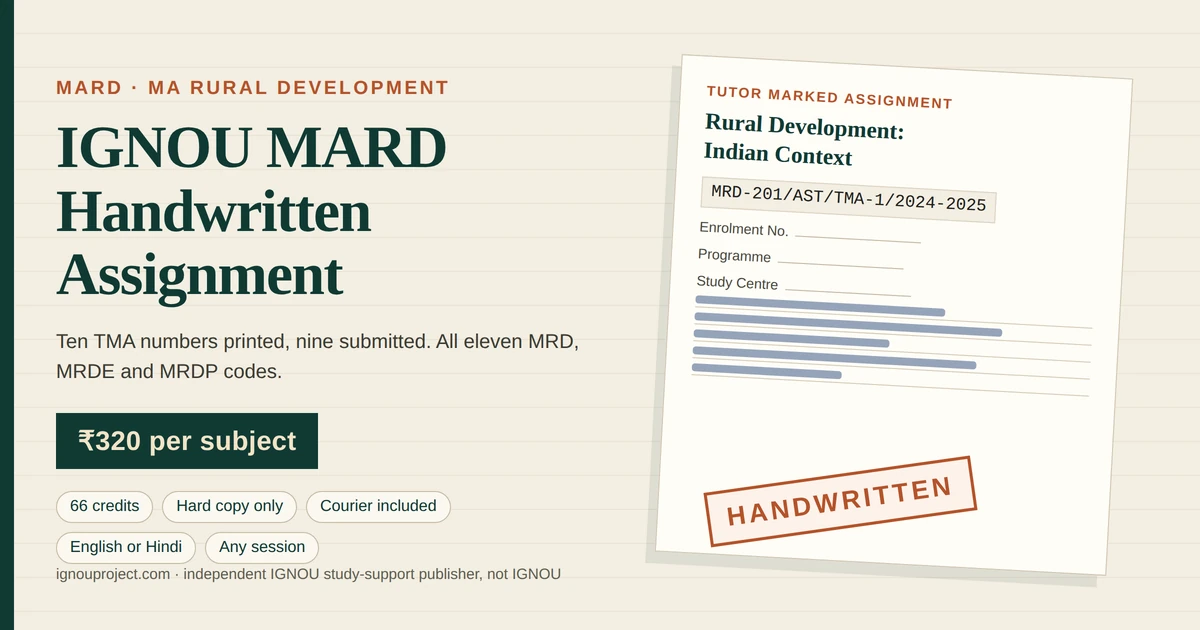
The MA (Rural Development) booklets number the assignments straight through from TMA-1 to TMA-10, then the second year offers six optional courses and asks you to take five. A handwritten MARD set is written against the numbered paper your own course code actually carries, and couriered to your address as a hard copy.
- 66 credits, 11 courses
- Nine TMAs of ten printed
- 31 March · 30 September
- MRD-201/AST/TMA-1 format
- English or Hindi in ODL
- MRDP-1 carries no TMA
Send Your MRD And MRDE Codes For A Quote
Send the codes exactly as your admission record prints them, the session span from your booklet cover, and one photo of a page in your own hand. Delivery depends on your pin code and is confirmed for your order before you pay. No figure is promised on this page.
Quick answer. A handwritten assignment is the answer set for IGNOU’s Tutor Marked Assignment questions, written out by hand on A4 and handed in as a hard copy at your Study Centre, and for MARD — Master of Arts (Rural Development), the 66-credit, year-wise two-year degree run by the Discipline of Rural Development in the School of Continuing Education, whose eleven courses are MRD-201, MRD-202, MRD-203 and MRD-004 in the first year with the 12-credit MRDP-1 dissertation, then five chosen from the six optional papers MRDE-201, MRDE-202, MRDE-203, MRDE-002, MRDE-003 and MRDE-004 in the second year — ignouproject.com prepares that handwritten set paper by paper. The rate is ₹320 per subject, hard copy only, with courier included in that price and no separate shipping charge. No soft copy or PDF is sold. The service covers all mediums IGNOU issues the TMA paper in, at the same price, which for MARD means the English and the Hindi booklet the university publishes for the ODL mode. Any session is accepted, current cycle or older, including backlog courses, at the same ₹320 per subject. Send a photo of a page you have written yourself and the handwritten set is matched to your handwriting at no extra charge. Assignments carry 30 per cent of the final course result and the term-end examination carries the remaining 70 per cent, each MARD paper is marked out of 100 in a 40, 15 and 6 mark pattern, the MA(RD) booklets print 31 March for the July session and 30 September for the January session, MRDP-1 has no Tutor Marked Assignment at all because it is a dissertation, and orders are placed on WhatsApp at +91 93546 37830 by sending your codes, session span and medium.
Both MARD Cut-Offs Land In The Calendar Year After Your Session
The Discipline of Rural Development dates a MARD assignment into the year after the session it belongs to, which is why a July admission is not working to a July-year deadline.
July session
31 March
Both live MA(RD) booklets for the July 2024 and January 2025 span print 31st March 2025 against the July 2024 session. The date sits in a three-column schedule table headed Assignment Number, Last Date of Submission and Whom to Send, on the page before the first question.
January session
30 September
The same two booklets print 30th September 2025 against the January 2025 session. The third column names the destination in both cases: the coordinator of your Study Centre, not the Regional Centre and not the discipline at Maidan Garhi.
That pairing is not the one most assignment websites reproduce. The 31 October and 30 April dates belong to the School of Management Studies and are printed on MBA and M.Com papers; at least one commercial MARD syllabus page currently gives 30th April 2026 and 31st October 2026 as the Rural Development cut-offs. IGNOU’s own MA(RD) booklet prints 31 March and 30 September. Where a third-party page and the booklet in your hand disagree, the booklet is the one you are held to.
The MARD version has a second wrinkle worth understanding before you plan any longhand. One MA(RD) booklet covers both sessions of a single academic span, so the July 2024 and January 2025 cohorts answer identical questions and differ only in the date column. A July learner therefore gets roughly eight months from the session opening to 31 March, and a January learner gets roughly eight months to 30 September. The runway is generous; what is not generous is the amount of writing, because a MARD paper is a 1000-word essay, two 500-word answers and five 100-word notes rather than a short-answer sheet.
Dates shift by session and by Regional Centre, so confirm yours on ignou.ac.in and with your Regional Centre before committing to a writing plan. The only real urgency here is the date printed inside your own booklet; nothing on this page is time-limited by ignouproject.com. The whole reason submission matters beyond the marks is that MARD papers gate the examination: the booklet’s own instruction is to submit within the stipulated period, and a course with an unsubmitted assignment does not complete even when the term-end paper is passed.
Nine Papers At A Hundred Marks Each, All Written By Hand
Assignments carry 30 per cent of the final course result and the term-end examination carries the remaining 70 per cent. On MARD that share is collected nine times, once for every taught course.
The MA(RD) booklets are unusually explicit about the arithmetic. Each of the nine taught papers is marked out of 100, and the internal split is printed above each section: one long answer chosen from three, carrying 40 marks; any two medium answers chosen from three, carrying 15 marks each; and any five short notes chosen from eight, carrying 6 marks each. Forty plus thirty plus thirty is the hundred. The word ceilings are printed in the same note and they are the programme’s own, not a general convention: a long answer must not exceed 1000 words, a medium answer 500 words each, and a short note 100 words each.
Written out by hand that is a substantial object. A single MARD assignment runs to roughly 2500 words of prose across eight separate answers, and nine of them is close to 23,000 handwritten words before revision starts. This is the part of Rural Development that defeats learners on writing hours rather than on subject difficulty, and it is also the part that is easiest to recover: the questions are known months in advance and the study blocks are free.
The marks then travel separately from the examination marks, which is why a MARD course can sit as incomplete for months after a passed term-end paper. You can follow the entry through the IGNOU assignment status and result checker, and the step-by-step guide to writing an IGNOU handwritten assignment sets out the whole method free of charge if you have the weeks to do the writing yourself.
Solved Assignment Or Handwritten Set: What A MARD Learner Actually Submits
These are two different objects, and MARD learners message about them interchangeably. Defining them once removes most of the confusion.
A solved assignment is a soft-copy reference file of model answers prepared for one course code and one session, read on a phone or a laptop. A handwritten assignment is those answers written out by hand on A4 paper and submitted as a physical bundle at your Study Centre. The first is reading material. The second is the submission itself. Nothing downloaded as a PDF can be handed in as a MARD submission, and a printed copy of a solved file is not a handwritten assignment however neat the printout is.
What the MA(RD) booklet itself says about the route is short and unambiguous. The schedule table’s third column reads “The coordinator of your Study Centre”, and the instruction under it advises doing the assignments one by one alongside the study of each course and submitting them as you go, so that the counsellor’s marks and comments come back with the evaluated paper. That is a description of paper moving across a counter and returning with handwriting on it. It is not a description of a file transfer.
| Solved reference file | Handwritten MARD set | |
|---|---|---|
| Format | Soft copy, read on screen | Hard copy, written by hand on A4 |
| What you do with it | Read it, then write your own answers | Sign the cover page and hand it in |
| Who it suits | A learner with writing time but no reading time | A learner with reading time but no writing hours |
| Handwriting | None involved | Matched to your own hand from a photo |
| Price here | Not sold on this page | ₹320 per subject, courier included |
Scroll the table sideways on a narrow screen to reach the handwritten column.
If a reference file is what you actually want, it lives on the IGNOU solved assignment library for every programme and course code rather than here, and it should be treated as reading before you write rather than as text to reproduce. Every MA(RD) paper is set on the assumption that the answers are yours.
Conflicts found in the MARD sources, named individually
Each item below was found by reading two IGNOU documents against each other, and the last one is an error on this website that is queued for correction.
- The MARD Second Year booklet opens with a 2022 First Year schedule. The July 2024 and January 2025 Second Year English booklet begins with a page headed “ASSIGNMENTS MRD-101, MRD-102 AND MRD-103 & MRD-004, Schedule for January 2022 / July 2022”, listing MRD-101/AST/TMA-1/2022 through MRD-004/AST/TMA-4/2022 with 31st March 2022 and 30th September 2022 as the dates. The correct second-year schedule follows on the next page. Cross-reading the First Year booklet, which prints MRD-201, MRD-202, MRD-203 and MRD-004 against 2024-2025, confirms the opening page as a template carry-over rather than a live requirement. Ignore that first page.
- One code is printed as MRED-003 inside the booklet that gets it right two pages earlier. The Assignment-9 header names Course Code MRDE-003 and the title Land Reforms and Rural Development, then prints the assignment number as MRED-003/AST/TMA-9/2024-2025 with the letters transposed. The schedule table at the front of the same file prints MRDE-003/AST/TMA-9/2024-2025 correctly. Write MRDE-003 on your cover page.
- The Hindi paper prints a shorter assignment number than the English one. The Hindi First Year booklet’s schedule table gives the full span, but each per-assignment header inside it prints the number ending in 2024 alone rather than 2024-2025. The English booklet prints the complete 2024-2025 span in both places. Same paper, same session, two written forms of one code.
- Code padding differs between IGNOU’s own documents. The Common Prospectus for July 2026 and the assignment booklets print MRDE 003 and MRDE 004. IGNOU’s own MARDOL programme information sheet on the Samarth portal prints MRDE 3 and MRDE 4, unpadded. All four references are to the same two courses.
- The online-mode programme has two codes and one missing paper. The Common Prospectus lists the online variant as MARDOL. IGNOU’s assignment portal files it as MRDOL. The Samarth sheet records the MARDOL medium as English and Hindi, yet the portal publishes only an English booklet for the online mode in both years, with the Hindi column left as plain text rather than a link.
- The MRD-203 title is rendered four ways. Section 3.29 of the prospectus prints Rural Development Planning and Management. The Certificate in Rural Development table prints Rural Development : Planning and Management with a spaced colon. The MARDOL sheet and the assignment booklet both print Rural Development – Planning and Management with a dash. The course is one course.
- An annexure lists elective codes that appear in no programme table. Annexure I(f) of the same prospectus carries a PGDRD elective heading above the codes MRDE101, RDD6 and RDD7. None of those three appears in the PGDRD table in section 8.1, which names MRDE-201, MRDE-202 and MRDE-203 instead, and MRDE101 occurs nowhere else in the document. The annexure block is also visibly column-bled between three programme headings, so treat it as unreliable and read section 8.1.
- IGNOU has published no MARD paper newer than July 2024 and January 2025. The MA(RD) programme index lists that span at the top for both years and both mediums, and the block below it for July 2023 and January 2024. Sets are nevertheless marketed elsewhere as 2025-26 MARD combos. Check the span printed on the cover of the file you are actually given.
- On this website, pending correction. The ignouproject.com homepage still carries an acceptance-and-refund guarantee and the MMPC-001 course page still promises dispatch inside a fixed number of working days. Neither claim is made here. Both are wrong and both are queued for removal, and where those pages and this one disagree, this one is correct.
One rate whichever paper it is. The rate is ₹320 per subject, hard copy only, with courier included in that price and no separate shipping charge. A 1000-word essay on land tenure and one on watershed management are priced the same, and no optional paper carries a surcharge.
Ordered by TMA number, not by year. There is no minimum order: one subject or fourteen, same rate. Because MARD numbers its assignments one to ten, an order is a list of numbers as much as a list of codes, and a mixed list from both years is ordinary.
Matched to the hand already in your file. Send a photo of a page you have written yourself and the handwritten set is matched to your handwriting at no extra charge. A Rural Development learner hands in nine bundles across two years to the same Study Centre counter, so consistency is worth having.
The medium your booklet is issued in. The service covers all mediums IGNOU issues the TMA paper in, at the same price, which for MARD in the ODL mode means the English booklet or the Hindi booklet, both of which the university publishes for each session.
Superseded codes are ordinary work. Any session is accepted, current cycle or older, including backlog courses, at the same ₹320 per subject. A learner still clearing MRD-102 from a pre-revision year is quoted the same rate as one starting MRD-201 this cycle.
Three sections, kept as three. The long, medium and short sections are written in the booklet’s own order with its own headings, and the answer count in each is exactly what the paper asks: one long, two medium, five short. A set that answers three medium questions has broken the paper’s instruction before it is read.
Word ceilings taken from the paper. The 1000, 500 and 100 word limits printed in the MA(RD) note set the length of every answer. No house length is applied over them, and no answer is padded to look longer than the paper asked for.
Paper only, never a file. No soft copy or PDF is sold. Centres that want a MARD bundle uploaded are asking for a scan of paper that already exists, so you photograph or scan what arrives and the physical set stays with you for the counter.
The AST code block copied as printed. Rural Development papers carry an AST segment and a running TMA number that most schools do not use. That block is reproduced in the booklet’s own form, and where the booklet contradicts itself the correct course code is used and the discrepancy is flagged back to you.
No dissertation dressed up as an assignment. MRDP-1 is 12 credits of empirical fieldwork in rural areas and carries no Tutor Marked Assignment. It is not quoted at ₹320 and no handwritten MRDP-1 assignment is offered here, because there is no paper to answer.
No claim on the evaluation. No claim is made about the marks any assignment will receive, about how an evaluator will assess it, or about whether it will be accepted. Assignment evaluation is entirely a matter for IGNOU.
No delivery figure, on purpose. Delivery depends on your pin code and is confirmed for your order before you pay. No figure is promised on this page. Rural Development enrolment reaches district and block-level Study Centres where one national number would be untrue.
Nine Papers Outstanding, Or Just The Two You Ran Out Of Weeks For?
Send the course codes as your admission record prints them and the session span from your booklet cover. What comes back is the paper count, the total, the cut-off that governs your session and the delivery position for your pin code, in one reply.
₹320 per subject · hard copy · courier included · no minimum order
Price My MARD Paper Count At ₹320Ask About A Backlog MRD Code First
Every MRD, MRDE And MRDP Code Inside The 66-Credit Structure
MARD is the programme code printed on your admission record and in the Common Prospectus. MRD is the prefix on the four compulsory first-year courses, MRDE is the prefix on the six second-year optional courses, MRDP is the prefix on the dissertation, and MARDOL — filed as MRDOL on the assignment portal — is the online-mode variant of the same degree. That resolves in one pass the reason a learner searching for MARD papers finds three different prefixes.
Section 3.29 of the Common Prospectus for July 2026 places the programme in the School of Continuing Education, records the medium of instruction as English and Hindi, sets the minimum duration at two years and the maximum at four, and examines it year wise rather than semester wise across January and July cycles. The credits sum as printed: 36 in the first year and 30 in the second give the stated 66.
| Code | Official title | Credits | TMA number |
|---|---|---|---|
| MRD 201 | Rural Development: Indian Context | 6 | TMA-1 |
| MRD 202 | Rural Development Programmes | 6 | TMA-2 |
| MRD 203 | Rural Development Planning and Management | 6 | TMA-3 |
| MRD 004 | Research Methods in Rural Development | 6 | TMA-4 |
| MRDP 1 | Dissertation | 12 | None. No TMA exists |
Scroll the table sideways on a narrow screen to reach the TMA number column.
Four taught papers plus the dissertation is 36 credits. Note the code generations sitting side by side: MRD-201, MRD-202 and MRD-203 belong to the revised 200 series, while MRD-004 has kept its older zero-padded number and was never renumbered. Both forms are current, and a learner still carrying MRD-101, MRD-102 or MRD-103 as a backlog is holding pre-revision codes that the current booklet no longer prints in its live schedule.
| Code | Official title | Credits | TMA number |
|---|---|---|---|
| MRDE 201 | Rural Social Development | 6 | TMA-5 |
| MRDE 202 | Rural Health Care | 6 | TMA-6 |
| MRDE 203 | Communication and Extension in Rural Development | 6 | TMA-7 |
| MRDE 002 | Voluntary Action in Rural Development | 6 | TMA-8 |
| MRDE 003 | Land Reforms and Rural Development | 6 | TMA-9 |
| MRDE 004 | Entrepreneurship and Rural Development | 6 | TMA-10 |
Scroll the table sideways on a narrow screen to reach the TMA number column.
Six papers exist and five are taken, so the second year is 30 credits and one optional is left unwritten. That single fact produces the headline arithmetic of this programme: ten TMA numbers are printed across the two booklets, nine are submitted, and which of the six second-year numbers you skip is your own choice. It also means two MARD learners in the same year can hold different code lists, so the unit of ordering is the code on your record and never the year.
One more structural point matters when you go looking for your paper. The MRD codes are not exclusive to MARD. MRD-201, MRD-202 and MRD-203 are the three compulsory courses of the Post Graduate Diploma in Rural Development and the entire course list of the Certificate in Rural Development, MRD-202 appears as an elective alternative inside the M.Sc. in Home Science (Community Development and Extension Management), and MRDE-203 is a second-year theory course of the MA in Development Journalism. One booklet therefore serves several qualifications, which is why a PGDRD or CRD learner writes papers identical to a first-year MARD learner’s.
The two rural development programmes also connect formally. The prospectus states that PGDRD learners moving into MARD are entitled to credit transfer except for MRDP205, and that learners who have completed the Certificate in Rural Development are entitled to credit transfer into both MARD and PGDRD. The consequence for assignment work is simple: a transferring learner still has to produce MRDP-1, because the diploma’s own 6-credit project course MRDP-205 does not carry across to the 12-credit MARD dissertation. Guidance for both sits on the MRDP-1 dissertation guide for MARD and the MRDP-205 project guide for PGDRD, and the structure quoted above is read from the document indexed on the IGNOU prospectus archive. Learners arriving from an agriculture background often reach MARD through one of the programmes listed under IGNOU agriculture and rural courses.
Building A MARD Set From Assignment One To Assignment Ten
Five stages sit between your WhatsApp message and the couriered bundle. Each one exists to stop a specific way a Rural Development submission goes wrong.
- The span on your booklet cover decides which questions are answered. MA(RD) papers are republished by academic span and the questions change between them, so the span you name is the span used. This matters more on MARD than on most programmes because IGNOU’s newest published set is July 2024 and January 2025, which means the paper a learner is given in a later cycle may still be that one. The span is read off the cover rather than assumed from the calendar.
- Each code is resolved to its own TMA number before anything is written. A MARD paper is identified by two things at once, the course code and the running assignment number, and the booklets do not always agree with themselves. Where a code appears in one form in the schedule table and another in the assignment header, the course code from the prospectus is used and the mismatch is reported back to you rather than copied forward.
- The eight answers are selected to the paper’s own quotas. One long answer from the three offered, two medium answers from the three offered, five short notes from the eight offered. That is eight pieces of writing per paper, not ten, and the selection is made before any page is filled so the section balance the booklet demands is satisfied.
- Answers are written from the Rural Development blocks to the printed word ceilings. A question on the Pradhan Mantri Awas Yojana Gramin, on phenomenological approaches in social research or on the consolidation of land holdings is answered out of the programme’s own study material, because the counsellor marks against the block. Length follows the 1000, 500 and 100 word ceilings printed on the paper.
- Written on A4, bound per code, cover sheet left blank, couriered. Blue or black ink on one side of A4, red and green avoided because counsellors write in them, key terms underlined once, a clear left margin kept for comments, each answer opening with the booklet’s own question number. Each code is bound as its own bundle. The cover sheet arrives laid out and unfilled — the cover page filling walkthrough and the blank front page format PDF show the same layout in advance.
Written In The Hand Your Study Centre Already Has
Send a photo of a page you have written yourself and the handwritten set is matched to your handwriting at no extra charge. One clearly photographed page of your ordinary writing, taken straight on in daylight, is enough to carry your slant, letter size and the way you form and join characters onto every page of the set.
It earns its keep on this programme specifically because of how MARD submissions accumulate. Four bundles reach the counter in the first year and five in the second, all to the same coordinator, all against one enrolment number, and the earlier ones are already sitting in your own hand. A visibly different hand appearing in the second year is an inconsistency in a file that stays open for up to four years. If your medium is Hindi the case is stronger still, because Devanagari letterforms differ far more between writers than Latin ones do, and the guidance on writing IGNOU assignments in Hindi covers the script points. Nothing about the sample is kept beyond the order it belongs to.
Writing the nine MARD papers yourself is the better outcome
Every route to doing that is free on this site and none of it is gated. Read the rules on assignment format and structure for margins and numbering, look at a worked sample IGNOU assignment to gauge the expected depth, and use the comparison of online and offline submission when the bundles are ready. The MA(RD) instruction is to do the papers one at a time alongside each course, which is genuinely the easier way. This page exists for learners short of weeks, not short of ability.
Two Free MARD Utilities Built Round The AST Code Format
Both tools run in your browser, send nothing anywhere and keep nothing. The first exists because the MARD cut-off falls in the year after the session and is easy to place wrongly. The second exists because a MARD paper needs a course code and a TMA number together, and the number is not derivable from the code without the table.
Free tool 1
Paper Count And 31 March Runway Planner
Choose a MARD stage or type the number of papers you are short on. The planner totals the cost at ₹320 each, works out the next School of Continuing Education cut-off from today’s date, gives the days remaining, and estimates the longhand at MARD answer lengths.
Choosing a stage fills the count below. MRDP-1 is excluded everywhere because a dissertation carries no TMA.
A whole number from 1 to 10. Ten is the highest TMA number MARD prints, even though nine are submitted.
Read the session from your booklet cover. Both MARD cut-offs fall in the calendar year after the session opens.
Pick a stage or type a paper count, then select Work Out Cost And Runway.
Lock This MARD Total In On WhatsApp
This tool is guidance from ignouproject.com, not an IGNOU rule. Using it creates no obligation to order anything. The longhand estimate is for planning only.
Free tool 2
MRD Code To AST Number Resolver
Type one MARD course code and the academic span printed on your booklet. The resolver returns the official title, the credits, the year the code belongs to, whether it is compulsory or optional, whether a Tutor Marked Assignment exists at all, and the full assignment number in the AST form the MA(RD) booklet prints.
Spaces and hyphens are ignored, so MRD 201, MRD-201 and mrd201 all resolve. Superseded codes and MRDP-205 are recognised and explained.
MA(RD) booklets are published as a two-year span covering one July session and the January that follows it.
Type a code such as MRDE-203, then select Resolve This Code.
Have This One MRD Paper Written
This tool is guidance from ignouproject.com, not an IGNOU rule. Using it creates no obligation to order anything. The assignment number follows the form printed on live MA(RD) booklets and should still be checked against your own paper.
Twenty-Three Thousand Words Of Longhand, Or One Message
Send the codes, the span and the medium and the nine-paper problem stops being yours. Every code is checked against the booklet that governs it before a page is written, and you are told plainly if the paper for a code is not published for your span.
₹320 per subject · written by hand · bound per code · couriered
Reaching The MARD Booklet On IGNOU’s Own Assignment Index
The MA(RD) question paper is free from the university and should be taken from the university, whoever ends up writing the pages. Four steps, and the third is the one Rural Development learners skip.
- Start at the university’s own download service. Go to the IGNOU assignment download page or the assignment portal and choose Master’s Degree Programmes rather than typing a file address. Rural Development file names have changed between spans and a guessed path returns nothing.
- Look for the programme under MA(RD), not MARD. On the master’s degree index the entry is headed Master’s Programme in Rural Development and the folder is written with brackets. The online mode sits under a second heading on the same page, labelled MRDOL.
- Read the year headings before downloading anything. The index is laid out newest first, with a First Year and a Second Year column and an English and a Hindi link under each. As at this review the newest MA(RD) block is headed July 2024 and January 2025, and the block below it July 2023 and January 2024. If that looks a year behind, it is the index rather than your browser, and it is also why you should confirm with your Regional Centre which span they will accept.
- Open the cover page and read the schedule table. The first page names the span, the four or six codes the file covers, both submission dates and the AST assignment numbers. If the span is not yours, the questions inside are not yours either, and a well-written answer to a superseded question earns nothing.
The study blocks that those questions are set from are free as well. They sit on eGyanKosh, with a second route described on the Gyankosh access page and a general index at IGNOU books download. For the examination rather than the assignment, the archive of solved question papers and the previous year paper collection show what Rural Development actually asks in the term-end hall.
Where A MARD Assignment Mark Goes After The Counter Stamp
Handing the bundle over is not the end of the transaction. The MA(RD) booklet asks you to keep a copy of what you submitted and tells you that the evaluated paper comes back with the counsellor’s marks and comments on it, so take the receipt at the counter and keep it with your copy.
The score then moves in stages: the Study Centre records the submission, the evaluated mark is transmitted to the Student Evaluation Division, and the figure eventually posts against that course code. Two different screens matter and they answer different questions. The submission screen only says whether receipt has been recorded; the grade card carries the mark itself. Follow the first through the assignment marks status lookup and the second through the assignment grade card explainer, with the grade card status page for a code that refuses to appear and the final grade card guide once both halves are posted.
A MARD course sitting as incomplete usually means one component is outstanding rather than failed, and on this programme the missing component is often an optional paper the learner assumed was not required, or MRDP-1 waiting on fieldwork. Every one of those screens asks first for the number covered on the enrolment number lookup page. Once the assignment and examination marks are both visible you can convert them with the percentage calculator or the CGPA calculator, and if a term-end figure looks wrong the revaluation route applies to the examination half only, never to the assignment half. Broader timing sits on the IGNOU result page and the June 2026 result tracker, and the submission walkthrough covers the counter itself.
What Rural Development Learners Add Beside The Handwritten Set
A handwritten assignment order is usually one line of a longer message. These are the other things MARD learners ask about, each on its own page so you can read before deciding.
For the 70 per cent that the assignment does not cover, the guess paper collection and the unit-wise study notes matter more than any assignment does, with the help book range and the online guide books compressing the Rural Development blocks into revision form.
MRDP-1 is the other half of a MARD enrolment and it is a different kind of work altogether: twelve credits of empirical research in villages and panchayats, written up as a dissertation with a supervisor. That runs through the synopsis and proposal service and the project and dissertation service, priced on the list of services and charges rather than at the ₹320 assignment rate. Learners whose fieldwork sits at block or panchayat level sometimes also hold the panchayat level administration project from a companion programme.
Medium, session and why a MARD paper stops being valid. The service covers all mediums IGNOU issues the TMA paper in, at the same price. For MARD in the ODL mode that means English or Hindi at the same ₹320 per subject, both published for each span. The online mode is the exception worth knowing before you order: IGNOU’s portal carries an English booklet for MRDOL in both years and no Hindi one, even though the Samarth programme sheet records the medium as English and Hindi, so a Hindi-medium online learner should confirm with the Regional Centre which paper will be accepted rather than assume a translation exists. On sessions, any session is accepted, current cycle or older, including backlog courses, at the same ₹320 per subject. A TMA paper belongs to the span printed on its cover and stops being valid when that span closes, so name the span and each paper is answered against its own questions.
From WhatsApp Message To Stamped Receipt On A MARD Order
There is no form on this page, no account and no login. Everything runs on WhatsApp at +91 93546 37830, and the order closes when a counter clerk stamps your receipt.
- One message with five details. The MRD or MRDE codes exactly as your admission record prints them; the academic span from your booklet cover; your medium; your delivery pin code; and one photo of a page in your own handwriting. Five things, one message, no follow-up needed.
- A reply with two numbers before anything is charged. The paper count confirmed at ₹320 each and the delivery position for your pin code. Delivery depends on your pin code and is confirmed for your order before you pay. No figure is promised on this page, and nothing is charged until you have agreed to both.
- The bundles arrive, you sign, the counter stamps. Each code comes bound separately with its own blank cover sheet on top. You complete and sign the cover sheets in your own hand, submit to the coordinator of your Study Centre, and take the receipt.
Prospectus, Booklet Or Publisher: Separating The MARD Sources
Three kinds of fact appear above and they are deliberately not mixed.
From the IGNOU Common Prospectus, July 2026. Section 3.29 gave the MARD placement in the School of Continuing Education, the English and Hindi medium of instruction, the two-year minimum and four-year maximum duration, the year-wise examination mode across January and July, the eleven course codes with their official titles and credits, the first-year and second-year split, the choose-any-five instruction and the 66-credit total, which was checked by summation rather than taken on trust. Section 8.1 gave the PGDRD table and the MRDP205 credit-transfer exception, section 11.8 the Certificate in Rural Development table, section 3.30 the M.Sc. Home Science elective carrying MRD-202, section 3.65 the MA in Development Journalism course list carrying MRDE-203, and the online-programme list gave MARDOL. Annexure I(f) is where the unmatched MRDE101, RDD6 and RDD7 codes appear.
From live IGNOU assignment booklets. Three files were read rather than one, so that a template carry-over in a single document could not be mistaken for the programme’s format. The MA(RD) First Year English booklet for July 2024 and January 2025 gave the 31 March and 30 September dates, the MRD-201/AST/TMA-1/2024-2025 code form, the 100-mark total, the 40, 15 and 6 mark split, the one-of-three, two-of-three and five-of-eight selection quotas, the 1000, 500 and 100 word ceilings and the Study Centre coordinator as the destination. The Second Year English booklet for the same span gave TMA-5 to TMA-10, confirmed the identical dates, and is where the stale 2022 opening schedule and the MRED-003 transposition were found. The Hindi First Year booklet for the same span confirmed that a Hindi paper is published and is where the truncated single-year assignment number was found. The published-span position was read off IGNOU’s own MA(RD) programme index, and the unpadded MRDE 3 and MRDE 4 forms off the MARDOL programme information sheet on the Samarth portal.
From ignouproject.com as publisher. The ₹320 per subject rate, hard copy only with courier included and no separate shipping charge, no soft copy or PDF sold, no minimum order, all mediums at one price, any session including backlog courses, handwriting matching from your own sample at no extra charge, and the refusal to state a delivery figure are commercial terms set by this publisher. They are not IGNOU rules and IGNOU has no part in them.
Something wrong above, or a code that has changed since this review? Write through the contact page and it will be checked against the current booklet and dated. Who publishes this is set out on the about page and data handling in the privacy policy.
Rural Development Learners Ask These Before Ordering
The rate is ₹320 per subject, hard copy only, with courier included in that price and no separate shipping charge. One MRDE paper and nine papers are quoted at the same per-subject rate, and there is no minimum order: one subject or fourteen, same rate.
A solved assignment is a soft-copy reference file of model answers for one course code and session, meant to be read. A handwritten assignment is those answers written out by hand on A4 and submitted as a physical bundle at your Study Centre. Only the second one is a submission. A downloaded PDF cannot be handed in, and a printout of it is not a handwritten assignment.
The MA(RD) booklet describes a paper submitted to the coordinator of your Study Centre and returned to you with the counsellor’s written comments on it, which is a handwritten process. Practice on typed submissions varies by centre and by mode, so confirm with your own Study Centre or Regional Centre before deciding. What is sold here is the handwritten hard copy, because that is what the booklet’s own route describes.
No. MRDP-1 is a 12-credit dissertation based on empirical research in rural areas, and neither MA(RD) booklet contains a paper for it. The First Year booklet covers MRD-201, MRD-202, MRD-203 and MRD-004 only. If anyone offers you a handwritten MRDP-1 assignment or an MRDP-1 question paper, there is no such document. The dissertation route is set out on the MRDP-1 guide linked in the course-code section above.
Both live MA(RD) booklets for July 2024 and January 2025 print 31st March 2025 for the July session and 30th September 2025 for the January session, in a schedule table on the page before the first question. The same 31 March and 30 September positions apply to the cycles that follow, with the date falling in the calendar year after the session opens. Dates shift by session and by Regional Centre, so confirm yours on ignou.ac.in.
Because those are the School of Management Studies dates, printed on MBA and M.Com booklets and then reproduced as though they were universal. At least one commercial MARD syllabus page currently gives 30th April 2026 and 31st October 2026 for Rural Development. The MA(RD) booklet prints 31 March and 30 September. Where a third-party page and IGNOU’s own booklet disagree, the booklet governs.
Nine. The two booklets number the papers TMA-1 to TMA-10 across both years, but the second year lists six optional courses and asks you to take five, so one of the ten numbers is never written. MRDP-1 adds nothing to the count because a dissertation carries no Tutor Marked Assignment.
The form is course code, then AST, then the running TMA number, then the two-year academic span. On the July 2024 and January 2025 First Year booklet that reads MRD-201/AST/TMA-1/2024-2025, and the Second Year booklet continues the sequence to MRDE-004/AST/TMA-10/2024-2025. The AST segment and the running number are particular to this discipline and are not the form used on management or humanities papers.
Because of an inconsistency inside IGNOU’s own Hindi file. Its schedule table gives the full 2024-2025 span, but each per-assignment header inside the same booklet prints the number ending in 2024 alone. The English booklet prints the complete span in both places. The paper and the session are identical; only the printed form of the number differs, so copy whichever appears on the paper you were issued and keep the course code correct.
Yes for the ODL mode. The Common Prospectus records the MARD medium of instruction as English and Hindi, and IGNOU publishes a Hindi MA(RD) booklet for both years alongside the English one. The service covers all mediums IGNOU issues the TMA paper in, at the same price, so a Hindi-medium MARD paper is ₹320 per subject exactly as an English one is.
Not on IGNOU’s assignment index as at this review. The online variant, which the prospectus calls MARDOL and the portal files as MRDOL, has an English booklet posted for the first year and the second year, with the Hindi entry left as plain text rather than a link, even though the Samarth programme sheet records the medium as English and Hindi. A Hindi-medium online learner should confirm with the Regional Centre which paper will be accepted.
MRD-201, MRD-202 and MRD-203 are the current first-year codes and appear in the live schedule of the July 2024 and January 2025 booklet. MRD-101, MRD-102 and MRD-103 are the pre-revision codes and survive only inside a stale schedule page at the front of the Second Year file, and on the records of learners still clearing them as backlogs. MRD-004 is current in its zero-padded form and was never renumbered into the 200 series.
The span your Regional Centre will accept for your submission, which is normally the latest set IGNOU has published for that code. As at this review the newest MA(RD) block on IGNOU’s own index is July 2024 and January 2025 in both mediums and for both years, with July 2023 and January 2024 below it. Sets marketed elsewhere as 2025-26 MARD combos should be checked against the span actually printed on the cover of the file you are given.
Yes. Any session is accepted, current cycle or older, including backlog courses, at the same ₹320 per subject. That covers a first-year paper left unwritten while you moved into the second year, and it covers a pre-revision code such as MRD-102 carried forward from an earlier structure. Send the code and the span and the paper is written against its own questions.
No soft copy or PDF is sold. What is prepared and dispatched is the handwritten hard copy. If your Regional Centre asks for an upload, you scan the delivered hard copy yourself, which keeps the original in your hands for the Study Centre counter to stamp.
No. The rate is ₹320 per subject, hard copy only, with courier included in that price and no separate shipping charge. Delivery depends on your pin code and is confirmed for your order before you pay. No figure is promised on this page.
A single paper is fine. There is no minimum order: one subject or fourteen, same rate. Because MARD learners choose five optionals from six, a learner short on one MRDE paper is a normal order rather than an exception.
Largely yes, and that is a property of IGNOU’s own structure rather than of this service. MRD-201, MRD-202 and MRD-203 are the three compulsory Post Graduate Diploma in Rural Development courses and the whole Certificate in Rural Development course list, so those learners write papers identical to a first-year MARD learner’s. The diploma’s project course MRDP-205 is separate and does not transfer into the MARD dissertation, which the prospectus states explicitly.
No to both. ignouproject.com is an independent IGNOU study-support publisher and is not the official website of Indira Gandhi National Open University. No claim is made about the marks any assignment will receive, about how an evaluator will assess it, or about whether it will be accepted. Assignment evaluation is entirely a matter for IGNOU.
Important Notice
Independent website
ignouproject.com is an independent IGNOU study-support publisher. It is not the official website of Indira Gandhi National Open University, is not affiliated with, endorsed by or authorised by the university, and no page on this site should be treated as an official IGNOU communication.
Programme structures, course codes, submission dates and rules change, and only ignou.ac.in and your Regional Centre can confirm the current position for your enrolment.
Your responsibility as the learner
You sign the declaration on the assignment cover page, so you should read and review the content before submitting it, and satisfy yourself that it represents your own understanding of the course.
No claim is made about the marks any assignment will receive, about how an evaluator will assess it, or about whether it will be accepted. Assignment evaluation is entirely a matter for IGNOU.
MARD · 66 credits · ten TMA numbers · nine submissions
Send The Codes And The Span. The Nine Notebooks Are Our Problem.
English or Hindi, first year or second, current cycle or a backlog from an older structure. Each code is bound as its own handwritten bundle with the cover sheet laid out and left for you to sign, and couriered to your address.
₹320 per subject · no minimum · courier included · handwriting matched free
Order MARD Papers At ₹320 EachCheck My Pin Code Before I Pay
WhatsApp +91 93546 37830 · Shri Chakradhar Publication Pvt. Ltd. · ignouproject.com, an independent IGNOU study-support publisher, not IGNOU.

BK Sahni iD 0009-0005-8092-459X
Founder, Shri Chakradhar Publication Pvt. Ltd. & ignouproject.com — helping IGNOU distance-learning students since 2010 (5,00,000+ students supported across MBA, MCom, MA & more). Author of IGNOU exam guides, solved assignments & project reference books.
Disclosure: Shri Chakradhar Publication Pvt. Ltd. and ignouproject.com are independent third-party study-help services — not the official IGNOU website. Always verify final dates and rules on ignou.ac.in.