MTTM · Master of Tourism and Travel Management · SOTHSM
IGNOU Printed Two MTTM Booklets For 2026. They Give Two Different June Deadlines.
The first-year paper says 30 April. The second-year paper says 31 March. Both are the university’s own 2026 files. A handwritten MTTM set is written against the exact paper your code sits on, and couriered to your address as a hard copy.
- 30 April or 31 March
- Two numbering systems
- Five answers from ten
- About 500 words each
- English medium
- Courier included
Send Your MTTM Codes For A Quote
Send the codes as your registration confirmation prints them, your year, whether you are a Category 1 or Category 2 learner, and your pin code. Delivery depends on your pin code and is confirmed for your order before you pay. No figure is promised on this page.
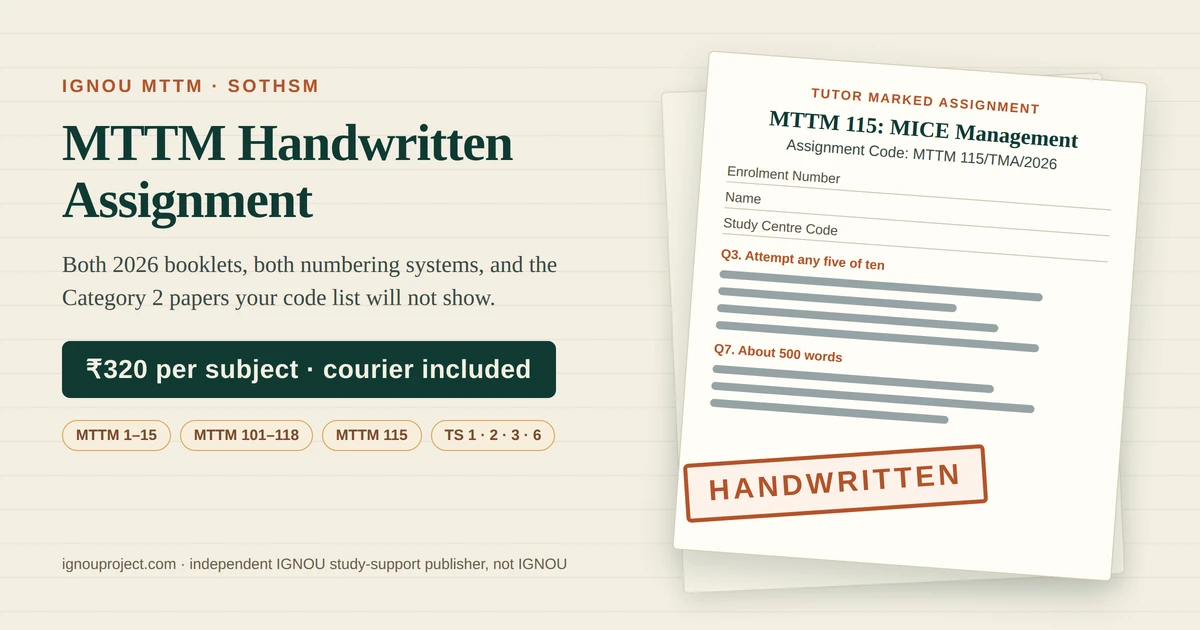
Quick answer. A handwritten assignment is the answer set for IGNOU’s Tutor Marked Assignment questions, written out by hand on A4 and handed in as a hard copy to the Coordinator of your Study Centre, and for MTTM — Master of Tourism and Travel Management, the four-semester, 80-credit degree run by the School of Tourism and Hospitality Services Management, which the July 2026 Common Prospectus codes as MTTM_NEW and lists as MTTM 101 to MTTM 118 plus the eight-credit MTTMP 119 dissertation, while IGNOU’s live 2026 assignment booklets issue papers against the older MTTM 1 to MTTM 15 series plus MTTM 115 — ignouproject.com prepares that handwritten set one course code at a time. The rate is ₹320 per subject, hard copy only, with courier included in that price and no separate shipping charge. No soft copy or PDF is sold. The service covers all mediums IGNOU issues the TMA paper in, at the same price, which for MTTM means the English paper the university prints, since the prospectus records the medium of instruction as English. Any session is accepted, current cycle or older, including backlog courses, at the same ₹320 per subject. Send a photo of a page you have written yourself and the handwritten set is matched to your handwriting at no extra charge. Assignments carry 30 per cent of the final course result and the term-end examination carries the remaining 70 per cent; each MTTM paper is one hundred marks made of ten questions from which you attempt any five at twenty marks and about five hundred words each, the code printed on the paper takes the form MTTM3/TMA/2026, and orders are placed on WhatsApp at +91 93546 37830 by sending your codes, your year and your category.
Two MTTM Booklets, Two June Deadlines, One Programme
Both files below are IGNOU’s own, both are headed 2026, both cover the January and July academic cycles, and they do not agree on when a June-examination learner has to hand the pages in.
First-year booklet, June 2026 examination
30 April 2026
The MTTM first-year booklet covering MTTM 1 to 8, and TS-1, 2, 3 and 6 for Category 2 learners, prints 30th April 2026 against the June Term End Examination and 30th October 2026 against the December one.
Second-year booklet, June 2026 examination
31 March 2026
The MTTM second-year booklet covering MTTM 9 to 15 and MTTM 115 prints 31st March 2026 against the same June examination. Its December date, 30th October 2026, matches the first-year file exactly.
That is a one-month gap inside one programme in one session, and it was found by opening both booklets rather than one. The December cut-off is not in dispute: both files print 30th October, which is also a day earlier than the 31 October that the School of Management Studies prints on MBA and M.Com papers and that most search results repeat as though it were a university-wide rule. It is not. Read the table in your own booklet.
Neither MTTM booklet dates its assignments by the session you were admitted in. Both anchor the cut-off to the examination you are heading towards, June or December, which is a different system again from the admission-batch dating the School of Social Sciences uses on its own papers. If you are unsure which examination you are entering, that is the question to settle before you plan any writing, because on this programme it is the only thing the date depends on.
Both booklets also repeat the same footnote in the same words: keep checking the IGNOU website for any change in the date of submission. Cut-offs move between sessions and between Regional Centres, so verify yours on ignou.ac.in and with your own centre before you build a writing schedule on top of one. The only genuine urgency for an MTTM learner is the date printed on the paper in front of them; nothing on this page is time-limited by ignouproject.com.
Submission is also an eligibility gate rather than a scoring exercise. Both booklets state that assignments must be submitted in time in order to appear in the term-end examination, and both add a flexibility clause worth reading twice: IGNOU operates a flexi-open learning system, and you decide which courses you complete in a given semester, so you submit only the assignments for the courses you actually plan to sit that cycle.
Five Answers Out Of Ten, And Thirty Per Cent Riding On Them
Assignments carry 30 per cent of the final course result and the term-end examination carries the remaining 70 per cent. On MTTM that share arrives in an unusually forgiving shape and an unusually demanding volume at the same time, and both halves of that sentence are printed on the paper.
The forgiving half is the choice. Every MTTM TMA read for this page carries the same instruction: the paper consists of ten questions, you attempt any five, each carries twenty marks, and the total is one hundred. Five of the ten can simply be left alone. That is not how an MBA core paper or a School of Education paper works, and it means an MTTM learner can route around a block they never covered.
The demanding half is the length. Each of those five answers is to run to about five hundred words, which the booklet states in its general guidance rather than question by question. Five answers at five hundred words is roughly two and a half thousand handwritten words for one course code, and a full semester is five course codes. A Category 2 learner in the first year adds four more papers on top of that.
The questions themselves are descriptive rather than numerical, which changes what the writing time is spent on. The MTTM 3 paper asks what personnel management is and what characterises it, what career planning is and where it falls short, and how performance appraisal methods fail. The MTTM 115 paper asks for the logistics of a convention across accommodation, transport and food and beverage, for the layout of a world-class exhibition centre, and for an analysis of virtual exhibitions against physical ones. There is nothing to calculate and nowhere to be brief.
One question on each paper breaks the pattern and is worth planning for separately. The MTTM 3 paper’s eighth question is short notes on any two of three options at ten marks each; the MTTM 115 paper’s tenth question is four short notes of about 150 words at five marks each, and that is the only place either booklet prints a word count against an individual question. Everything else runs to the five-hundred-word general instruction.
Nothing here is invigilated. The tourism blocks stay open on the table while you write, which is exactly why a learner who slips a month tends to give up these marks rather than examination marks. Once the Study Centre transmits the score it posts against that course code and stays there, and the assignment status and result checker is where you watch it arrive.
Reference PDF Versus Written Bundle: Which One Reaches The Counter
Two different objects go by names that MTTM learners use interchangeably in a WhatsApp message, so both are defined here once and then kept apart.
A solved assignment is a screen-read reference document: worked answers for one course code in one assignment year, supplied as a file. A handwritten assignment is that same material in longhand on A4, tied up and carried to your Study Centre Coordinator as a physical object. The first is reading material for a learner who intends to write. The second is the submission itself. Nothing downloaded as a PDF is an MTTM submission, and a printout of a reference file is not a handwritten assignment however cleanly it comes off the printer.
The MTTM booklets settle this in their own words rather than ours. Both files instruct you to send the assignment to the Coordinator of your Study Centre, to obtain a receipt for it and retain that receipt, to keep a photocopy of the assignment if possible, and to insist that the Study Centre returns the evaluated assignment to you afterwards. Every one of those four instructions describes paper: something you hand over a counter, something a counter can stamp, something a machine can copy, and something that can be handed back.
| Reference file for an MTTM code | Written MTTM bundle | |
|---|---|---|
| Format | Soft copy, read on a screen | Hard copy, written by hand on A4 |
| What the learner does with it | Reads it, then writes five answers of about 500 words | Signs the cover page and hands it to the Coordinator |
| Who it suits | A learner with writing hours but no reading hours | A learner with reading hours but no writing hours |
| Handwriting | Not involved at any point | Matched to the learner’s own hand from a photo |
| Price on this page | Not sold here | ₹320 per subject, courier included |
Scroll the table sideways on a narrow screen to reach the written-bundle column.
Wanting the file rather than the bundle is a perfectly reasonable position, and the library of IGNOU solved assignments by programme and course code is where that lives. Read it, close it, then write. The MTTM booklets ask you to plan each answer, to organise it before drafting, and to give proper attention to your introduction and conclusion, all of which assumes the writing is yours.
What ₹320 covers on an MTTM paper, and what it will not pretend to cover.
Twelve statements worth reading before you send a code list. The first six are where an MTTM submission goes wrong; the last six are limits this page will not soften.
One rate across both years. The rate is ₹320 per subject, hard copy only, with courier included in that price and no separate shipping charge. A first-semester MTTM 1 and a fourth-semester MTTM 115 are quoted identically, because each paper asks for the same five answers at the same length.
Your category decides how many papers you owe. Category 2 learners carry TS-1, TS-2, TS-3 and TS-6 on top of the MTTM series. That is four additional written papers, four additional ₹320 units, and the single most common reason an MTTM code list arrives short.
Five answers chosen, not ten written. The paper offers ten questions and asks for five. The five selected are named back to you before writing begins, so you are not paying for answers the evaluator will never read.
Codes, never semester bundles. There is no minimum order: one subject or fourteen, same rate. MTTM learners routinely carry one backlog paper from an earlier semester alongside a current set, so the unit of ordering here is the course code on your registration confirmation.
The paper your code actually sits on. A learner sending MTTM 115 gets the second-year booklet; a learner sending MTTM 15 gets the same paper, because IGNOU’s own second-year file writes the pair as MTTM 15/MTTM 115. A learner sending MTTM 116 is told plainly that no such assignment paper is published yet.
Written in the hand you already use. Send a photo of a page you have written yourself and the handwritten set is matched to your handwriting at no extra charge. Across four semesters reaching one Study Centre against one enrolment number, that consistency is worth having.
The medium IGNOU prints for MTTM. The service covers all mediums IGNOU issues the TMA paper in, at the same price. The July 2026 Common Prospectus records the MTTM_NEW medium of instruction as English, and the 2026 booklets are published in English, so that is the medium quoted.
Backlog codes are ordinary work. Any session is accepted, current cycle or older, including backlog courses, at the same ₹320 per subject. A first-semester MTTM 4 left unwritten while you moved into the second year is written against its own paper.
Question numbers as the booklet prints them. The five answers carry the booklet’s own numbering, so an answer to question seven is headed question seven even though questions one to six were not attempted. Renumbering five chosen answers one to five is a reliable way to confuse an evaluator.
Paper only, never a file. No soft copy or PDF is sold. Where an upload is demanded, the scan is made by you from the delivered pages, so the written original never leaves your possession before the counter stamps it.
No dissertation sold as an assignment. The MTTM dissertation, printed as MTTM 16 on the second-year booklet’s semester table and as MTTMP 119 in the prospectus, is supervised research worth eight credits. It carries no Tutor Marked Assignment, it is not quoted at ₹320, and no written MTTM 16 assignment exists here because there is no question paper to answer.
No claim on the evaluation, and no delivery figure. No claim is made about the marks any assignment will receive, about how an evaluator will assess it, or about whether it will be accepted. Assignment evaluation is entirely a matter for IGNOU. Delivery depends on your pin code and is confirmed for your order before you pay. No figure is promised on this page.
Category 1 Or Category 2? That Changes The Bill Before It Changes The Writing.
Send the MTTM codes from your registration confirmation and say which category you were admitted under. Back comes the paper count including any TS papers you owe, the total at ₹320 each, and the delivery position for your pin code, in one reply.
Price My MTTM Paper List I Do Not Know My Category
Nothing is charged until the paper count and the pin-code position have both been agreed with you.
Every MTTM Code In Both Numbering Systems
MTTM is the programme code your Study Centre and your booklets use. MTTM_NEW is the code the Common Prospectus uses for the same degree. MTM is the folder IGNOU’s own assignment portal files it under, where the index page is headed Master’s in Tourism Management (MTM/MTTM). MTTMP is the prefix the prospectus puts on the dissertation. Four labels, one programme, and a learner meets all four inside a week.
Section 3.36 of the IGNOU Common Prospectus for July 2026 places the programme in the School of Tourism and Hospitality Services Management, records the medium of instruction as English, sets eligibility at any graduate from a recognised institution or university, runs it over four semesters with a two-year minimum and four-year maximum duration, admits semester wise across the January and July cycles, and prices it at Rs. 9,100 per year, Rs. 18,200 in total.
The credits sum rather than being taken on trust. Eighteen theory courses at four credits each is 72, the dissertation adds 8, and the total is 80 — which matches the four semesters at 20 credits each that the prospectus heading states. That check matters here, because the prospectus row where the numeric total belongs prints the word Theory instead of a number, so the 80-credit figure has to be derived by addition rather than read off.
The Prospectus Structure: MTTM 101 To MTTMP 119
| Semester | Code | Official title | Type | Credits |
|---|---|---|---|---|
| I | MTTM 101 | Travel and Tourism Industry | Theory | 4 |
| I | MTTM 102 | Introduction to the Hospitality Industry | Theory | 4 |
| I | MTTM 103 | Management Concepts and Organisational Behaviour in Tourism | Theory | 4 |
| I | MTTM 104 | Accounting and Finance in Tourism | Theory | 4 |
| I | MTTM 105 | Business Communication in Tourism | Theory | 4 |
| II | MTTM 106 | Management of Travel and Tourism Business | Theory | 4 |
| II | MTTM 107 | Tourism Marketing Management | Theory | 4 |
| II | MTTM 108 | Human Resource Management in Tourism | Theory | 4 |
| II | MTTM 109 | Design and Development of Special Interest Tourism Products | Theory | 4 |
| II | MTTM 115 | MICE Management | Theory | 4 |
| III | MTTM 110 | Tourism Planning and Development | Theory | 4 |
| III | MTTM 111 | Tourism Content Creation and Dissemination | Theory | 4 |
| III | MTTM 112 | Technological Environment and Tourism | Theory | 4 |
| III | MTTM 113 | Research Methodology for Tourism and Hospitality | Theory | 4 |
| III | MTTM 114 | Digital Marketing for Tourism | Theory | 4 |
| IV | MTTM 116 | Cultural Producation and Heritage Management | Theory | 4 |
| IV | MTTM 117 | Innovation, Entrepreneurship and Incubation in Tourism | Theory | 4 |
| IV | MTTM 118 | Tourism Destination Management | Theory | 4 |
| IV | MTTMP 119 | Dissertation Work | Dissertation | 8 |
Nineteen entries, 80 credits. Scroll the table sideways on a narrow screen to reach the credits column.
Two things in that table are worth pointing at rather than passing over. MTTM 115 sits in Semester II despite its number, so a learner sorting the list numerically would file it after MTTM 114 and put it in the wrong year. And the MTTM 116 title is printed Cultural Producation and Heritage Management in the prospectus; the misspelling is IGNOU’s and it is reproduced above rather than silently corrected, because the code and the title as printed are what your registration confirmation will match.
The Series IGNOU Is Actually Issuing Papers Against
The 2026 assignment booklets do not use the 101 series at all. They use the older MTTM 1 to MTTM 15 numbering, print their own semester tables, and place the dissertation as MTTM 16. Both semester tables below are read off those two live files. Titles are given only where the booklet itself prints one, and the remainder are deliberately left blank rather than filled in from a seller’s catalogue — read your own titles off your registration confirmation or off the first page of your own paper.
| Semester | Code on the booklet | Title where the booklet prints one | Who takes it |
|---|---|---|---|
| I | MTTM 1, MTTM 2, MTTM 4 | Not printed on the 2026 booklet cover sheet read for this page | Category 1 and Category 2 |
| I | MTTM 3 | Managing Personnel in Tourism | Category 1 and Category 2 |
| I | TS 1 | Foundation Course in Tourism | Category 2 only |
| I | TS 2 | Tourism Development: Products, Operations and Case Studies | Category 2 only |
| II | MTTM 5, MTTM 6, MTTM 7, MTTM 8 | Not printed on the 2026 booklet cover sheet read for this page | Category 1 and Category 2 |
| II | TS 3 | Management in Tourism | Category 2 only |
| II | TS 6 | Tourism Marketing | Category 2 only |
| III | MTTM 09, MTTM 10, MTTM 11 | Not printed on the 2026 booklet cover sheet read for this page | Category 1 and Category 2 |
| III | MTTM 16 | Dissertation — no Tutor Marked Assignment exists | Category 1 and Category 2 |
| IV | MTTM 12, MTTM 13, MTTM 14 | Not printed on the 2026 booklet cover sheet read for this page | Category 1 and Category 2 |
| IV | MTTM 15 / MTTM 115 | MICE Management | Category 1 and Category 2 |
Scroll the table sideways on a narrow screen to reach the category column.
Category is the structural feature that makes MTTM different from the other master’s programmes on this site. A Category 1 learner arrives holding a tourism qualification and takes the MTTM series alone. A Category 2 learner arrives from any other graduate background and must additionally pass TS 1 and TS 2 in the first semester and TS 3 and TS 6 in the second, which the booklet advises completing during the first year itself. Two learners sitting in the same first-year classroom therefore owe eight written papers and twelve written papers respectively, and the difference is not visible from a code list alone.
Conflicting MTTM information found in IGNOU’s own documents, and on this website.
Each item below was found by reading two IGNOU documents against each other, or a document against a live paper. The last two are errors on this site and are queued for correction.
- The two 2026 booklets print different June cut-offs. The first-year file gives 30th April 2026 for the June Term End Examination; the second-year file gives 31st March 2026 for the same examination. Both are 2026 files, both cover the January and July cycles, and both give 30th October 2026 for December. Work to the date on the booklet your own code sits on, and confirm it with your Regional Centre.
- Two complete numbering systems run side by side. The July 2026 Common Prospectus lists MTTM 101 to MTTM 118 with MTTMP 119. IGNOU’s 2026 assignment booklets issue against MTTM 1 to MTTM 15 with MTTM 16. MTTM 115 is the only code that appears in both, which is why it is the one code nobody misfiles.
- MTTM 115 is in two different semesters depending on which IGNOU document you open. The prospectus places MICE Management in Semester II. The second-year booklet places MTTM 15/MTTM 115 in Semester IV. Both are the university’s.
- The dissertation is in two different semesters as well. The second-year booklet’s semester table puts MTTM 16 Dissertation in Semester III. The prospectus puts MTTMP 119 Dissertation Work in Semester IV.
- One booklet contradicts itself on its own cover. The second-year file is headed MTTM — 9 to 15 and MTTM 115, while the instruction paragraph two lines down says you will do one assignment in each of the courses MTTM-09 to 14 and MTTM 115. The cover includes MTTM 15; the body does not.
- The prospectus prints no numeric credit total. The row reading Total Credits (4 Semesters, 20 Credits each) carries the word Theory in the credits column where the figure should be. The 80-credit total is arrived at by summing the table.
- The school is spelled three ways in three IGNOU documents. The prospectus schools list gives School of Tourism and Hospitality Service Management; section 3.36 of the same prospectus gives School of Tourism and Hospitality Services Management; both 2026 booklet covers give School of Tourism and Hospitality Services Sectoral Management. The abbreviation SOTHSM is constant throughout.
- The programme has three names across three IGNOU systems. MTTM_NEW in the prospectus, MTTM on the booklets, and MTM/MTTM on the assignment portal, where the index sits in a folder named MTM. A search for MTTM papers that returns nothing has usually been run against the wrong one of the three.
- Typographical errors carried across from IGNOU’s files. The prospectus prints Cultural Producation for MTTM 116, and the MTTM 3 booklet lists Fridge Benefits among its short-note options where fringe benefits is meant. Neither affects what you have to answer, but both will be reproduced by anyone copying the paper mechanically.
- MTT and MTTP are not tourism codes. They belong to the School of Translation Studies and Training: MTT 051 to MTT 055 and MTTP 006 sit in the Post Graduate Diploma in Translation, and MTT 022 belongs to the MA Translation Studies programme covered on the MATS project guide for MTT 022, with the diploma project on the PGDT project page for MTTP 006. If a seller offers you an MTT-numbered paper for a tourism degree, it is the wrong programme.
- On this website, pending correction. The site’s navigation still lists this degree as MTM (MA in Tourism Management), and the MTTM 16 dissertation guide uses the booklet code without naming the prospectus code MTTMP 119 alongside it. Both are queued for an alias line so that a learner searching either term lands correctly.
- Also on this website, pending correction. The ignouproject.com homepage still carries an acceptance-and-refund guarantee; the MMPC-001 course page still promises dispatch inside a fixed number of working days; the MMPC-002 page prints 31 May 2026 as a June-examination cut-off, which matches no booklet read for this page; and the MEG assignment page still offers a Hindi paper that does not exist for that programme. None of those claims is made here. Every one of those four is wrong. Each is queued for correction, and until that lands, treat this page as the accurate one.
Your registration confirmation outranks every code list published online, this one included. Programme structures, course codes, submission dates and rules change, and only ignou.ac.in and your Regional Centre can confirm the current position for your enrolment. The source document behind the first table is indexed on the IGNOU prospectus archive.
How An MTTM Paper Gets Written, Checked And Tied
Five stages sit between a WhatsApp message and a couriered bundle. The first two are peculiar to this programme, and they are where MTTM orders go wrong far more often than the writing does.
- The code is resolved across both numbering systems before anything is opened. A learner sending MTTM 107 is looking for a paper IGNOU publishes as part of the MTTM 1 to 15 series, and a learner sending MTTM 15 and a learner sending MTTM 115 are asking for the same file. Every code you send is matched to the booklet that actually governs it, and if no live paper exists for it you are told that instead of being sold one.
- Your category is confirmed, because it changes the paper count. Category 2 learners owe TS 1, TS 2, TS 3 and TS 6 in addition to the MTTM series. Those four are read back to you before the total is quoted, so that a Category 2 learner does not discover four unwritten papers a fortnight before the cut-off.
- Five questions are selected from the ten and named back to you. The paper allows any five, so the choice is made against what your study material actually covers rather than by taking the first five in order, and the selection is confirmed with you before a page is written.
- Each answer is taken to about five hundred words. That is the length the booklet’s own guidance prints, and it is the length applied. Where a question carries its own instruction — the four short notes of about 150 words on the MTTM 115 paper, or the two short notes at ten marks each on the MTTM 3 paper — that instruction overrides the general one.
- On A4, tied code by code, cover sheet left blank, then couriered. Blue or black ink on one side of the sheet, red and green avoided because evaluators write in them, key terms underlined once as the booklet asks, a clear left margin kept for comments, and each answer opening with the booklet’s own question number. Each course code is tied as its own bundle. The cover sheet arrives laid out and unfilled — the cover page filling walkthrough and the blank front page format PDF show the same layout in advance, and the fields the MTTM booklets specifically ask for on the first page are your enrolment number, your name, your address, the assignment code and your Study Centre code.
Matching The Hand Your Earlier Semesters Are Already In
Send a photo of a page you have written yourself and the handwritten set is matched to your handwriting at no extra charge. A single sheet of your everyday hand, shot square-on in daylight, gives enough slant, sizing and joining to work from across five long answers at a stretch.
On a four-semester programme this is worth more than it looks, because of what the MTTM booklets tell the Study Centre to do. Both files instruct the centre to return the evaluated assignment to you after marking, and both tell you to insist on that. A programme where your earlier bundles physically come back to you is a programme where a visibly different hand in a later semester is easy to notice. Nothing about the sample is kept beyond the order it belongs to.
Writing the MTTM set yourself is the better outcome, and every route to it is free here.
The whole method sits in the step-by-step guide to writing an IGNOU handwritten assignment. Margins, numbering and tying are settled by the assignment format and structure rules. For a feel of how much five hundred words actually holds, open a worked sample IGNOU assignment before you start question one. When the five answers are done, the comparison of online and offline submission covers which route your centre wants. If your Regional Centre issues you a Devanagari paper for any reason, the guidance on writing IGNOU assignments in Hindi covers the script points. Nothing on those pages is gated. This page exists for learners short of weeks, not short of ability.
Two Free Tools Built Around The MTTM Numbering Muddle
Both utilities run entirely in your browser, send nothing anywhere and keep nothing. The first exists because an MTTM learner’s paper count depends on a category rather than a semester. The second exists because an MTTM code number tells you almost nothing until you know which of the two numbering systems it came from.
Free tool 1
Category And Semester Load Estimator
Pick a semester or type the number of papers you are short on, choose your category, and choose the examination you are heading into. The estimator totals the cost at ₹320 each, counts the days remaining from today to the cut-off the MTTM booklets print for that examination, and works out the longhand at the five-hundred-word length MTTM actually asks for.
The dissertation is excluded from every option, because MTTM 16 carries no Tutor Marked Assignment. Category 2 papers are added by the next field.
Category 2 adds four TS papers to the first year. If a semester is selected above, only the TS papers belonging to that semester are added.
A whole number from 1 to 19. Filled in for you when you pick a semester above.
Two options are offered for June because IGNOU’s two 2026 MTTM booklets print two different dates for it. Pick the one on your own paper.
Confirm This MTTM Total At ₹320 A Paper
This tool is guidance from ignouproject.com, not an IGNOU rule. Using it creates no obligation to order anything. The longhand figure is a planning estimate built on an assumed writing rate of 450 words an hour, and the dates are the ones IGNOU printed on its 2026 MTTM booklets rather than a prediction about your session.
Free tool 2
MTTM Code And Booklet Resolver
Type one MTTM course code and choose the year your paper belongs to. The resolver names which of the two numbering systems the code comes from, the semester each IGNOU document places it in, whether a Tutor Marked Assignment exists for it at all, the assignment-code form to write on your cover page, and the checklist that applies to that paper.
Spaces and hyphens are ignored, so MTTM 115, MTTM-115 and mttm115 all resolve. TS codes are accepted for Category 2 learners.
A four-digit year between 2020 and 2030. MTTM booklets print a single year in the assignment code, not a two-year span.
Have This One MTTM Paper Written At ₹320
This tool is guidance from ignouproject.com, not an IGNOU rule. Using it creates no obligation to order anything. Titles and credits follow the July 2026 Common Prospectus and the live 2026 booklets, and should still be checked against your own registration confirmation.
Ten Questions Offered, Five Answers Owed, Five Hundred Words Each.
Order two codes or ten. Volume does not move the per-paper rate, and nothing here stops you keeping back the codes you would rather answer in person. Send the code list, your category, the examination you are entering and a photo of your own writing.
Every code is checked against the booklet that governs it before any handwritten page is started, and you are told if one of them has no live paper for your session.
Finding Your Own MTTM Paper Under The MTM Folder
The MTTM question paper is free from the university and should be taken from the university, whoever writes the pages. On this programme the route has one step that catches nearly everybody, and it is the folder name.
- Start at the university’s own download service. Go to the IGNOU assignment download service, or straight to the assignment portal, and pick the Master’s Degree branch.
- Look under MTM, not under MTTM. The portal files this degree in a folder named MTM and heads the index page Master’s in Tourism Management (MTM/MTTM). A learner scanning an alphabetical list for MTTM walks straight past it. Both names mean this programme.
- Take the year, not the course. The MTTM index publishes one first-year file and one second-year file per session rather than a file per course, so a first-year learner downloads a single PDF containing MTTM 1 to 8 and the TS papers, and takes only the codes they are registered in.
- Read the cover before you write anything. The first page names the university, the school, the programme, the category, the semester pair, the assignment year and the examinations the file is applicable for. That cover is also where the submission table sits, and it is the table that differs between the first-year and second-year files.
Free official reading sits alongside the papers. The study blocks are on eGyanKosh, with an alternate route described on the Gyankosh access page and a general index at IGNOU books download, and the broader study material index covers what else the university publishes free. The assignment and the examination test different things entirely. To see what the hall puts to a tourism candidate, open the archive of solved question papers and the previous year paper collection.
Where An MTTM Assignment Mark Finally Appears
Handing the bundle over is not the end of the transaction, and the MTTM booklets are unusually specific about what happens next. Obtain a receipt from the Study Centre for the assignments submitted and retain it. Keep a photocopy of the pages if you can. And insist that the Study Centre returns the evaluated assignment to you afterwards, because both booklets state in writing that it has to.
From there the mark travels. The Study Centre sends the marks to the Student Evaluation Division at IGNOU in New Delhi — the first-year booklet abbreviates it to SED and the second-year booklet spells it out — and it eventually posts against that course code. Receipt and marks are two separate records, and MTTM learners regularly mistake one for the other. A submission log says a bundle reached the centre; it says nothing whatever about what the bundle scored. Receipt is traced on the assignment marks status lookup, the number itself surfaces on the assignment grade card explainer, the grade card status page covers a tourism code that stays stubbornly blank, and the final grade card guide deals with the document you will need at convocation.
An MTTM course sitting as incomplete usually means one component is outstanding rather than failed, and on this programme the outstanding component is often a Category 2 TS paper that the learner never counted as a subject. All of those screens open by demanding an enrolment number, which the enrolment number lookup page explains how to retrieve. With both figures on screen the percentage calculator and the CGPA calculator turn the thirty-and-seventy split into the number you actually wanted. Do not send an assignment score for revaluation: that route reopens an examination script and nothing else. Release timing for a whole cycle is tracked separately on the IGNOU result page and the June 2026 result tracker, with master’s cohorts on the MA result page. What happens at the counter on the day belongs to the submission walkthrough and the assignment hub.
What MTTM Learners Order Beside The Written Set
A written-set order is usually one line of a longer message. These are the other things tourism learners ask about, each on its own page so you can read before deciding.
- For the 70 per cent the assignment does not cover. Seventy marks in every hundred are decided in the hall rather than at your desk, so the guess paper collection, the unit-wise study notes, the help book range and the online guide books deserve more of your week than any assignment does.
- The dissertation, which is a different kind of work altogether. The dissertation is eight credits of supervised research and belongs to a different service entirely: synopsis and proposal writing first, then full project and dissertation support, with binding and layout in the project report format guide and a tourism-specific walkthrough on the dissertation page linked in the conflict list further up. Pricing for that work sits on the list of services and charges rather than at the ₹320 assignment rate.
- Cognate tourism programmes with overlapping papers. Category 2 learners are writing the same TS codes that undergraduates take, so the BTS project guide for PTS 1 and PTS 2, the Diploma in Tourism Studies project pages, the BFTTM tourism degree project guide, the BAVTM guide for BTMP 142 and the BAFVTM vocational tourism project page all cover ground an MTTM learner has already crossed or is about to.
- Management papers from the neighbouring school. Learners moving between tourism management and general management sometimes hold both, and the MBA assignment guide sets out how differently the School of Management Studies dates and structures its papers.
Medium, session, and why an MTTM paper stops being valid. The service covers all mediums IGNOU issues the TMA paper in, at the same price. On MTTM that phrase resolves simply: the July 2026 Common Prospectus records the medium of instruction as English, and both 2026 booklets read for this page are English files, so English is what is quoted and what is written. If your Regional Centre issues you anything else, say so at the start and it is covered at the same ₹320. On sessions: an MTTM paper is stamped with a single assignment year and is applicable for the two examinations named on its cover, and it stops being the right paper once that pair has passed. Any session is accepted, current cycle or older, including backlog courses, at the same ₹320 per subject. Name the assignment year from your own cover page and each paper is answered against its own ten questions rather than against the newest set on the site.
What To Put In The First WhatsApp Message
There is no form on this page, no account and no login. The whole thing runs on WhatsApp at +91 93546 37830.
- One message with four details. The MTTM codes exactly as your registration confirmation prints them; your admission category, because Category 2 owes four TS papers the code list will not show; the examination you are entering, June or December; and your delivery pin code. Add one photo of a page in your own handwriting if you want the set matched.
- A reply with two numbers before anything is charged. The reply carries two figures and nothing else: how many papers you owe at ₹320 apiece, and what your pin code means for despatch. Delivery depends on your pin code and is confirmed for your order before you pay. No figure is promised on this page, and nothing is charged until you have agreed to both numbers.
- The bundles arrive, you sign, the counter stamps it. Codes arrive as separate tied bundles, an unfilled cover sheet on each. You complete and sign the cover sheets in your own hand, hand them to the Coordinator of your Study Centre, take the receipt the booklet tells you to insist on, and keep it with your photocopy.
Prospectus, Booklet Or Publisher: Where Each Line Above Came From
From the IGNOU Common Prospectus, July 2026. Section 3.36 gave the MTTM_NEW programme code, the School of Tourism and Hospitality Services Management placement, the English medium of instruction, the any-graduate eligibility, the four-semester structure, the semester-wise admission across the January and July cycles, the two-year minimum and four-year maximum duration, the Rs. 9,100 per year and Rs. 18,200 total fee, and the full table of MTTM 101 to MTTM 118 with MTTMP 119, including each official title and each credit weight. The 80-credit total was arrived at by summing that table rather than reading it off, because the row where the numeric total belongs prints the word Theory instead of a figure.
From live IGNOU assignment papers. Two files were opened rather than one, which is the only reason the date discrepancy on this page could be reported as a discrepancy rather than passed on as a fact. The MTTM 3 booklet for 2026 gave the first-year cover layout, the Category 1 and Category 2 split, the TS 1, TS 2, TS 3 and TS 6 titles, the first-year and second-semester course tables, the 30 April and 30 October submission pair, the assignment code form MTTM3/TMA/2026, the ten-questions-attempt-five structure at twenty marks each, the about-five-hundred-words guidance, the flexi-open learning clause and the receipt, photocopy and return-of-assignment instructions. The MTTM 115 booklet for 2026 gave the second-year cover layout, the MTTM 15/MTTM 115 equivalence, the placement of MTTM 16 Dissertation in Semester III, the 31 March and 30 October submission pair, the assignment code form MTTM 115/TMA/2026, the MICE Management title and the 150-word instruction on its final question. The programme index position was read off IGNOU’s own MTM assignment index. Both booklet covers are the source for the third spelling of the school name.
From ignouproject.com as publisher. The commercial half of this page is entirely ours: the rate, the format, the medium coverage, the session policy and the handwriting matching. The rate is ₹320 per subject, hard copy only, with courier included in that price and no separate shipping charge. No soft copy or PDF is sold. There is no minimum order: one subject or fourteen, same rate. Delivery depends on your pin code and is confirmed for your order before you pay. No figure is promised on this page. None of that is an IGNOU rule and IGNOU has no part in any of it.
Something wrong above, or a code that has changed since this review? Send it through the contact page; it gets checked against the live booklet and the correction is dated on the page. Who publishes this is set out on the about page and data handling in the privacy policy.
Written and reviewed by BK Sahni, Founder, Shri Chakradhar Publication Pvt. Ltd. and ignouproject.com, who has guided 5,00,000 students till date. ORCID 0009-0005-8092-459X. More on the author and the editorial process is on the BK Sahni profile.
Published 21 August 2026. Last reviewed 21 August 2026. Next scheduled review 1 October 2026, ahead of the 30 October cut-off both MTTM booklets print for the December examination, and again by 1 March 2027 ahead of the 31 March and 30 April pair the two booklets print for the June examination.
MTTM Questions That Arrive Before The Order Does
The rate is ₹320 per subject, hard copy only, with courier included in that price and no separate shipping charge. A first-semester MTTM paper and a fourth-semester one cost the same, and a Category 2 TS paper costs the same again. There is no minimum order: one subject or fourteen, same rate.
It depends on which booklet your course code sits on. IGNOU’s 2026 MTTM first-year booklet prints 30th April 2026 for the June Term End Examination and 30th October 2026 for the December one. The 2026 second-year booklet prints 31st March 2026 for June and the same 30th October 2026 for December. Both files carry the university’s own footnote telling you to keep checking the IGNOU website for any change, and dates also vary by Regional Centre.
No reason is given in either file. Both are headed 2026, both cover the January and July academic cycles, both are published by the School of Tourism and Hospitality Services Sectoral Management, and they differ by a month on the June cut-off while agreeing exactly on the December one. This page reports it rather than resolving it, because only IGNOU can resolve it. Work to the date on the booklet your own code appears in and confirm it with your Regional Centre before you plan any writing.
Yes. IGNOU’s own second-year booklet for 2026 writes the Semester IV entry as MTTM 15/MTTM 115, which settles it in the university’s own words. The paper published for it is headed MTTM 115: MICE Management and carries the assignment code MTTM 115/TMA/2026. Order under whichever form your registration confirmation prints and the same paper is written.
Order under the code your registration confirmation prints, and say which document you took it from. The July 2026 Common Prospectus lists the programme as MTTM 101 to MTTM 118 with MTTMP 119, while IGNOU’s live 2026 assignment booklets issue papers against MTTM 1 to MTTM 15 with MTTM 16. Both are the university’s own numbering. The written set is produced against the paper that actually exists for your session, and any mismatch between the two systems is reported back to you rather than absorbed silently.
On IGNOU’s assignment portal they are treated as one. The index page is headed Master’s in Tourism Management (MTM/MTTM) and sits in a folder named MTM, which is why searching the portal for MTTM alone can return nothing. The July 2026 Common Prospectus uses a third label again, MTTM_NEW. Master of Tourism and Travel Management is the degree all three refer to.
Category 2 learners have to pass four additional papers that Category 1 learners do not: TS 1 Foundation Course in Tourism and TS 2 Tourism Development: Products, Operations and Case Studies in the first semester, and TS 3 Management in Tourism and TS 6 Tourism Marketing in the second. The first-year booklet states that only Category II students should attempt those four, and advises completing them during the first year itself. It is the single most common reason an MTTM order arrives four papers short.
A solved assignment is a reference file in soft copy: model answers for one course code and session, read on a screen. A handwritten assignment is those answers written out by hand on A4 and submitted as a physical bundle to the Coordinator of your Study Centre. The first is reading material for someone who intends to write; the second is the submission itself. Reference files for tourism codes sit in the solved assignments library linked from the comparison section above, and nothing downloaded from there is a submission.
The MTTM booklets describe a paper submission throughout: you send it to the Coordinator of your Study Centre, you obtain a receipt for it, you keep a photocopy, and the centre returns the evaluated copy to you. Handwriting requirements are set by IGNOU and enforced by your Study Centre, so confirm the position with your own centre and with your Regional Centre. A printed copy of a downloaded reference file is not a handwritten assignment however cleanly it prints.
No soft copy or PDF is sold on this page. What is prepared here is the handwritten hard copy at ₹320 per subject, courier included. An upload request is answered by scanning what arrives rather than by buying a file, which is also how the paper copy stays available for the centre to stamp and hand back.
Five. Every MTTM Tutor Marked Assignment read for this page carries the same note: the paper consists of ten questions, out of which you attempt any five, each carrying twenty marks, for a total of one hundred. That choice is unusual among IGNOU master’s programmes and it means five of the ten questions can be left entirely alone.
About five hundred, unless the question itself says otherwise. The booklets print that in their general guidance rather than against each question. Two questions read for this page carry their own instruction instead: the MTTM 115 paper asks for four short notes of about 150 words each at five marks, and the MTTM 3 paper asks for short notes on any two options at ten marks each. Where a question prints its own length, that overrides the general figure.
Assignments carry 30 per cent of the final course result and the term-end examination carries the remaining 70 per cent. Each MTTM assignment paper is marked out of one hundred, made up of five answers at twenty marks each, and both booklets state that assignments must be submitted in time in order to appear in the term-end examination at all.
No. MTTM 16 is the dissertation, which the second-year booklet lists in its Semester III table and then excludes from the courses you have to write an assignment for. The July 2026 Common Prospectus carries the same work as MTTMP 119 Dissertation Work, eight credits, in Semester IV. It is supervised research rather than a question paper, it is not quoted at ₹320, and the dissertation walkthrough linked earlier on this page covers it instead.
The July 2026 Common Prospectus records the MTTM_NEW medium of instruction as English, and both 2026 booklets read for this page are English files. If your Regional Centre issues you a paper in another medium, the service covers all mediums IGNOU issues the TMA paper in, at the same price, so say so when you send your codes.
Yes. Any session is accepted, current cycle or older, including backlog courses, at the same ₹320 per subject. Send the assignment year printed on your own paper along with the code, because MTTM booklets stamp a single year rather than a two-year span, and the questions change between years.
No. Courier is included in the ₹320 and there is no separate shipping charge. Delivery depends on your pin code and is confirmed for your order before you pay. No figure is promised on this page.
No to both. ignouproject.com is an independent IGNOU study-support publisher. It is not the official website of Indira Gandhi National Open University, is not affiliated with, endorsed by or authorised by the university, and no page on this site should be treated as an official IGNOU communication. No claim is made about the marks any assignment will receive, about how an evaluator will assess it, or about whether it will be accepted. Assignment evaluation is entirely a matter for IGNOU.
Important Notice
Independent website. ignouproject.com is an independent IGNOU study-support publisher. It is not the official website of Indira Gandhi National Open University, is not affiliated with, endorsed by or authorised by the university, and no page on this site should be treated as an official IGNOU communication.
Programme structures, course codes, submission dates and rules change, and only ignou.ac.in and your Regional Centre can confirm the current position for your enrolment.
Your responsibility as the learner. You sign the declaration on the assignment cover page, so you should read and review the content before submitting it, and satisfy yourself that it represents your own understanding of the course.
No claim is made about the marks any assignment will receive, about how an evaluator will assess it, or about whether it will be accepted. Assignment evaluation is entirely a matter for IGNOU.
MTTM · 80 credits · four semesters · two numbering systems
Send The Codes And Your Category. The Five Hundred Words A Time Are Our Problem.
Category 1 or Category 2, a current code or one carried forward from an older assignment year. One bundle per course code, an unfilled cover sheet clipped in front of each, posted to whatever address you nominate.
Order MTTM Papers At ₹320 Each Check My Pin Code Before I Pay
WhatsApp +91 93546 37830 · Shri Chakradhar Publication Pvt. Ltd. · ignouproject.com, an independent IGNOU study-support publisher, not IGNOU.

BK Sahni iD 0009-0005-8092-459X
Founder, Shri Chakradhar Publication Pvt. Ltd. & ignouproject.com — helping IGNOU distance-learning students since 2010 (5,00,000+ students supported across MBA, MCom, MA & more). Author of IGNOU exam guides, solved assignments & project reference books.
Disclosure: Shri Chakradhar Publication Pvt. Ltd. and ignouproject.com are independent third-party study-help services — not the official IGNOU website. Always verify final dates and rules on ignou.ac.in.