MSCENV · M.Sc. (Environmental Science) · School of Inter-disciplinary and Trans-disciplinary Studies
Twenty-Two Codes Sit In The Prospectus. IGNOU Publishes Four MSCENV Booklets. You Write Thirteen Papers.
Three of your courses are laboratory work and one is an eight-credit dissertation, and none of those four carries a Tutor Marked Assignment. A handwritten MSCENV set is written only against the codes that actually have a question paper, and couriered to your address as ink on A4.
- 72 credits, 17 courses
- 13 papers carry a TMA
- 100 marks, five of eight
- English-medium programme
- Paper valid to Dec 2026
- ₹320 per subject
Send Your MEV And MEVE Codes For A Quote
Send the codes as your registration confirmation prints them, the semester they sit in, the session span from the cover of your booklet, and your pin code. Delivery depends on your pin code and is confirmed for your order before you pay. No figure is promised on this page.
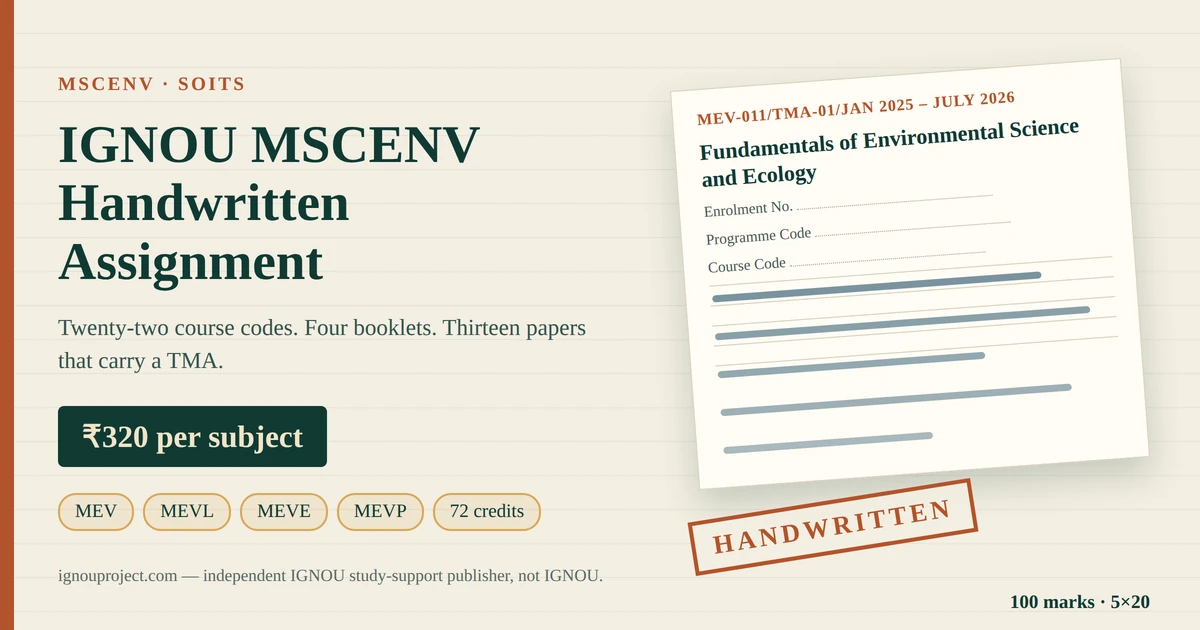
Quick answer. A handwritten assignment is the answer set for IGNOU’s Tutor Marked Assignment questions, written out by hand on A4 and submitted as a hard copy to the Coordinator of your allotted Study Centre, and for MSCENV — Master of Science (Environmental Science), the 72-credit, four-semester degree run by the School of Inter-disciplinary and Trans-disciplinary Studies in which nine theory courses run MEV 011 to MEV 019, three laboratory courses run MEVL 011 to MEVL 013, four electives are chosen from the nine codes MEVE 011 to MEVE 019, and MEVP 011 is the eight-credit dissertation — ignouproject.com prepares that handwritten set one course code at a time. The rate is ₹320 per subject, hard copy only, with courier included in that price and no separate shipping charge. No soft copy or PDF is sold. The service covers all mediums IGNOU issues the TMA paper in, at the same price, which on MSCENV means the English paper, since the July 2026 Common Prospectus records the medium of instruction as English. Any session is accepted, current cycle or older, including backlog courses, at the same ₹320 per subject. Send a photo of a page you have written yourself and the handwritten set is matched to your handwriting at no extra charge. Assignments carry 30 per cent of the final course result and the term-end examination carries the remaining 70 per cent; every live MSCENV paper read for this page carries 100 marks split five answers of twenty from a choice of eight questions, prints its assignment code in the form MEV-011/TMA-01/January 2025 to July 2026 session, and carries a validity window rather than a submission date, and orders are placed on WhatsApp at +91 93546 37830 by sending your codes, your semester and your session span.
Your MSCENV Booklet Prints An Expiry, Not A Deadline
Three live MSCENV booklets were opened for this page and not one of them names a last date. What all three name instead is the date the paper itself stops being answerable.
Printed on the MSCENV cover
31 December 2026
Each of the four current booklets is headed January 2025 to July 2026 Sessions and then, in brackets underneath, Valid from Jan 2025 to December 2026. That bracketed line is the only calendar fact IGNOU prints on an MSCENV paper, and it marks when the questions expire rather than when your bundle is due.
Not printed anywhere on it
31 March · 30 September
IGNOU Regional Centre student pages give 31 March for learners heading into the June term-end examination and 30 September for the December one, and add that extended dates are announced on the university site. Those are statements about IGNOU at large. Neither appears in an MSCENV booklet, so neither is quoted here as the programme’s own cut-off.
What the booklets say in place of a schedule is a condition: it is compulsory to submit the assignments within the stipulated time to be eligible for appearing in the term-end examination, and unless you do, you will not be permitted to sit the paper. The word stipulated is doing all the work there, and the booklet never stipulates.
That leaves an environmental science learner with two dates to hold at once, and they answer different questions. The validity line answers “are these still the right questions?” The Regional Centre answers “by when must the bundle reach the counter?” A set written in November 2026 against the current booklet is still on-syllabus; whether it is still on time is a separate matter your centre settles. Confirm the operative figure on ignou.ac.in and with your own Regional Centre before you build any writing plan, because IGNOU has moved these figures within a single cycle. The only genuine urgency for an MSCENV learner is the date their own centre has issued and the expiry stamped on their own booklet; nothing on this page is time-limited by ignouproject.com.
Thirteen Written Papers, Sixty-Five Answers, And A Third Of Every Result
Assignments carry 30 per cent of the final course result and the term-end examination carries the remaining 70 per cent. MSCENV collects that share thirteen times across the degree rather than seventeen, because four of the seventeen courses on your record have no question paper behind them at all.
The question pattern is identical on every MSCENV paper read for this page, which is unusual and useful. Each Tutor Marked Assignment carries 100 marks, prints the split as 5×20=100, lists eight questions and instructs you to answer any five. Every question is worth the same twenty marks, and the coverage line above them reads All Blocks rather than naming a unit range. Five answers multiplied by thirteen papers is sixty-five separate answers across the whole M.Sc., each carrying twenty marks of a course you must otherwise pass in a hall.
No MSCENV question prints a word count. That is worth stating plainly because the booklet’s own instruction list tells you to make sure your answer “does not exceed the number of words indicated in the question” — and then no question indicates one. The same contradiction appears in the first-semester, third-semester and elective booklets alike, so it is the programme’s house style rather than one file’s slip. In the absence of a printed limit, a twenty-mark environmental science answer is written to the depth the question actually asks for: a question that says “explain the principle, instrumentation and environmental applications of IR Spectrometry and Mass Spectrometry” is three demands in one sentence and cannot be discharged in two paragraphs.
What makes these marks easy to lose is not difficulty. It is that they are written at home, against an expiry rather than a deadline, on a programme where the laboratory work and the dissertation are the components everybody worries about instead. Once the Study Centre transmits the figure it attaches itself to that course code permanently, and the IGNOU assignment status and result checker shows how it travels.
Solved Files And Written Sets Are Two Different Purchases
Two products share a name in WhatsApp messages and only one of them can be submitted, so both are defined here before anything else is said about either.
A solved assignment is a digital answer key: model responses to one course code’s questions for one session span, delivered as a file and used as reading. A handwritten assignment is the physical object IGNOU actually collects — those answers written by hand across A4 sheets, tied per course code, and handed to the Coordinator of your allotted Study Centre. One is preparation. The other is the submission. No downloaded file becomes an MSCENV submission by being printed, and the MSCENV booklet is explicit on the point in its own instruction list: you should write the answer in your own handwriting.
The gap between the two matters more on this programme than the price difference suggests, because of what MSCENV questions ask. MEV-019 wants Spearman’s rank correlation coefficient, Type-I and Type-II error and the properties of regression coefficients written out. MEVE-018 wants the working method of a nanoscale optofluidic sensor array. MEV-013 wants the instrumentation behind High-Performance Liquid Chromatography. Those are answers with diagrams, derivations and named instruments in them, and copying them off a screen into a notebook without following the chemistry is how a legible bundle still reads as unlearned.
| Solved assignment file for a MEV code | Handwritten MSCENV bundle | |
|---|---|---|
| How it arrives | A digital file you open | A tied paper bundle delivered by courier |
| What it is for | Understanding the answer before you write it | Handing across the Study Centre counter |
| Hours it saves | The reading and drafting hours | The sixty-five answers of longhand |
| Handwriting | Does not arise | Reproduced from a photo of your own writing |
| Rate here | Handled on a separate page, not this one | ₹320 per subject, courier included |
Drag the table left and right on a small screen to reach the handwritten column.
If the answer key is genuinely what you came for, it lives in the IGNOU solved assignment library organised by programme and course code, and it should be read alongside the blocks rather than transcribed. Nothing on this page is a substitute for either.
What ₹320 settles on an MSCENV paper, and what it will not
Twelve statements, written before you send a code list. The first six are where an environmental science submission goes wrong. The last six are limits this page declines to soften.
One rate, laboratory-adjacent or not. The rate is ₹320 per subject, hard copy only, with courier included in that price and no separate shipping charge. A theory paper on environmental legislation and one on instrumentation techniques are quoted alike, because each asks for five answers out of eight either way.
Four of your codes are quietly excluded. MEVL 011, MEVL 012 and MEVL 013 are laboratory courses and MEVP 011 is the dissertation. IGNOU publishes no Tutor Marked Assignment for any of them, so none is quoted at ₹320 and none is written here. A code list of seventeen comes back priced as thirteen, with the four named.
Padding is normalised before pricing. Your prospectus prints MEV 11. Your booklet cover prints MEV 011. The assignment code line inside prints MEV-011. All three are one course, and whichever form you send is resolved to the paper rather than bounced back as unrecognised.
Ordered by code, never by semester. There is no minimum order: one subject or fourteen, same rate. Two MSCENV learners in the same semester share the seven compulsory theory codes and can differ on all four electives, so the unit of ordering is the code on your registration confirmation.
Five answers, chosen not skimmed. Eight questions are printed and five are answered. The five are selected for what the blocks actually support, so a MEVE-014 bundle does not open with three consecutive short-note questions because they looked quicker.
The session span comes off your cover. Because MSCENV papers change under an unchanged code, the span printed on your own booklet is used to pick the questions, rather than whatever the portal is showing on the day you write.
Matched to the hand you already write in. Send a photo of a page you have written yourself and the handwritten set is matched to your handwriting at no extra charge. Over four semesters reaching one Study Centre, a change of hand halfway through is an avoidable inconsistency.
Whatever medium the paper is issued in. The service covers all mediums IGNOU issues the TMA paper in, at the same price. On MSCENV the prospectus records instruction as English and the four live booklets are English, so in practice that is what your set will be.
A 2023 elective is ordinary work. Any session is accepted, current cycle or older, including backlog courses, at the same ₹320 per subject. A MEVE-016 left unwritten while you moved into the third semester is answered against the questions its own span printed.
Paper only, never a file. No soft copy or PDF is sold. If your Regional Centre asks for an upload, you scan the delivered hard copy yourself, which keeps the ink original in your hands until the counter stamps it.
No promise about the evaluation. No claim is made about the marks any assignment will receive, about how an evaluator will assess it, or about whether it will be accepted. Assignment evaluation is entirely a matter for IGNOU.
No courier figure, and the signature stays yours. Delivery depends on your pin code and is confirmed for your order before you pay. No figure is promised on this page. You sign the declaration on the assignment cover page, so you should read and review the content before submitting it, and satisfy yourself that it represents your own understanding of the course.
Seventeen Codes On The Record, Thirteen Of Them Answerable
Send the whole list if it is easier. The reply names which of your codes carry a live question paper, prices only those, and says where your pin code stands for delivery before anything is charged.
Price My MEV And MEVE List At ₹320 Each Tell Me Which Of My Codes Have A Paper
The Twenty-Two Course Codes Behind Seventy-Two MSCENV Credits
MSCENV is the programme code printed on your admission record and in the Common Prospectus. MEV is the prefix on the nine compulsory theory courses, MEVL on the three laboratory courses, MEVE on the nine electives and MEVP on the dissertation. Four prefixes, one degree, and twenty-two published codes from which your own seventeen are drawn.
Section 3.38 of the IGNOU Common Prospectus for July 2026 places MSCENV in the School of Inter-disciplinary and Trans-disciplinary Studies, records the medium of instruction as English, and gives a two-year minimum against a four-year maximum with semester-wise examination in the January and July cycles. The credit tables below were checked by addition rather than accepted on sight: sixteen in the first semester, twenty in the second, twenty in the third and sixteen in the fourth is the seventy-two the prospectus states. IGNOU’s own MSCENV Programme Guide reaches the same figure from the other direction, describing thirteen courses covering 56 credits out of 72 with nine electives from which four are chosen.
Semester One To Three: The Nine MEV Theory Papers
| Code | Official title | Credits | Semester | TMA published in |
|---|---|---|---|---|
| MEV 011 | Fundamentals of Environmental Science and Ecology | 4 | I | Semester I booklet |
| MEV 012 | Earth Processes | 4 | I | Semester I booklet |
| MEV 013 | Environmental Chemistry | 4 | I | Semester I booklet |
| MEV 014 | Sustainable Natural Resource Management | 4 | II | Semester II booklet |
| MEV 015 | Environmental Pollution, Control and Management | 4 | II | Semester II booklet |
| MEV 016 | Environmental Impact Assessment | 4 | II | Semester II booklet |
| MEV 017 | Environmental Legislations | 4 | III | Semester III booklet |
| MEV 018 | Environmental Health and Ecotoxicology | 4 | III | Semester III booklet |
| MEV 019 | Research Methodology for Environmental Science | 4 | III | Semester III booklet |
Drag the table left and right on a small screen to reach the booklet column.
Nine papers, thirty-six credits, every one of them carrying a Tutor Marked Assignment. Three booklets cover the nine: the first-semester file holds MEV 011, MEV 012 and MEV 013 together, and the second and third do the same for their trios. That packaging is worth knowing before you download, because one PDF contains three separate assignments and a learner short of only one of them still opens the same file.
The Three MEVL Lab Courses And The MEVP 011 Dissertation
| Code | Official title | Credits | Semester | TMA |
|---|---|---|---|---|
| MEVL 011 | Environmental Science Lab Course –1 | 4 | I | None published |
| MEVL 012 | Environmental Science Lab Course –2 | 4 | II | None published |
| MEVL 013 | Environmental Science Lab Course – 3 | 4 | III | None published |
| MEVP 011 | Dissertation/Project | 8 | IV | None published |
Drag the table left and right on a small screen to reach the TMA column.
Twenty credits of your degree sit in this table and none of it is assignment work. The three laboratory courses are practical components attached to designated study centres; the dissertation is eight credits of supervised research with a viva behind it, covered separately on the MEVP 11 dissertation and synopsis guide and on the page explaining how the MEVP-11 hundred marks are split at evaluation and viva. Neither is quoted at the ₹320 assignment rate, and neither should be, because there is no question paper to answer.
Note the third row. The prospectus prints the first two lab titles with a tight en dash and the third with a spaced one — Lab Course –1, Lab Course –2, then Lab Course – 3. It is a typesetting slip rather than three different courses, reproduced here as printed because the tables on this page quote the prospectus rather than tidy it.
Nine MEVE Electives, Four Chosen
| Code | Official title | Credits |
|---|---|---|
| MEVE 011 | Global Climate Change | 4 |
| MEVE 012 | Environmental Management | 4 |
| MEVE 013 | Environmental Biotechnology | 4 |
| MEVE 014 | Biodiversity Conservation and Management | 4 |
| MEVE 015 | Disaster Management | 4 |
| MEVE 016 | Urban Environment | 4 |
| MEVE 017 | Environment and Society | 4 |
| MEVE 018 | Instrumentation Techniques for Environmental Monitoring | 4 |
| MEVE 019 | Environmental Issues | 4 |
Drag the table left and right on a small screen to reach the credits column.
The prospectus sets the distribution as one elective in the second semester, one in the third and two in the fourth. All nine sit in a single elective booklet, which is the reason a fourth-semester learner with two electives outstanding downloads one file and answers two assignments out of it. Four electives at four credits is the sixteen that, added to thirty-six theory, twelve laboratory and eight dissertation credits, makes seventy-two.
Conflicting MSCENV information found by reading IGNOU’s own documents against each other, including three items on this website
- The same prospectus pads MSCENV codes one way and every other environment programme the other. Section 3.38 prints the MSCENV table as MEV 11, MEV 12, MEVL 11, MEVE 11 and MEVP 11 — two digits, no padding. Section 3.42, the MA (Environmental Studies) table run by the same school with the same three programme coordinators, prints the identical courses under identical titles as MEV 011, MEV 015, MEVE 011 and MEVE 016. The MA (Environment and Occupational Health) table does the same. One document, one school, two numbering systems for one set of courses.
- IGNOU’s own file paths carry both forms as well. The first-semester booklet is published on the university’s School of Inter-disciplinary and Trans-disciplinary Studies path under a filename built on MEV-11, and the third course in the same file is filed under MEV-13, while the assignment code line printed inside both reads MEV-011 and MEV-013. The archived term-end question papers repeat the split, storing MEV-11 for one year and MEV-012 for another. Search the course code both ways before concluding a paper does not exist.
- One elective is titled two ways in one prospectus, and the booklet settles it. The MSCENV table gives MEVE 17 as Environment and Society. The MA (Environmental Studies) table gives MEVE 017 as Environmental and Society. The live MSCENV elective booklet heads the paper ENVIRONMENT AND SOCIETY, so the MSCENV table is right and the sister table carries the typing slip.
- The prospectus states MSCENV eligibility two different ways. The programme-summary table in the front matter records the entry requirement as graduation in science from a recognised university. Section 3.38 records it as a bachelor’s degree in any discipline covering Science, Engineering, Agricultural Science, Forestry or Veterinary Science. An engineering graduate reading only the summary table would conclude they were ineligible.
- Every MSCENV booklet contradicts itself on word limits. Instruction (d) tells you to make sure your answer does not exceed the number of words indicated in the question. No question in the first-semester, third-semester or elective booklet indicates a number of words. Three files, one instruction, zero word counts.
- The MEV-019 paper carries a stray fragment and an inconsistent marks tag. Its eighth question ends with an orphaned line reading measures of Central Tendency. (20 marks) after the regression question has already closed, and questions seven and eight are the only two in that file tagged with a mark figure while one to six carry none. Answer the regression question as set and treat the fragment as the carry-over it is.
- Two instructions about handwriting sit at different strengths in the same booklet. One line states that you should write the answer in your own handwriting. A later line says it is preferred to write all assignments neatly in your own handwriting. Both are IGNOU’s, in one file, and a Study Centre asked to accept a typed MSCENV bundle will be reading the stronger of the two.
- MEV and MEVE codes are shared across four environment programmes. MEV 014, MEVE 011 and MEVE 015 also appear in the MA (Environment and Occupational Health) structure, and a longer list including MEV 011, MEV 015 to MEV 019 and six MEVE codes appears in MA (Environmental Studies). When you order or download, name MSCENV as well as the course code, because the same code number is a different learner’s paper under a different programme.
- On this website, pending correction. The ignouproject.com homepage still carries an acceptance-and-refund guarantee. No such guarantee is made on this page and none is defensible.
- Also on this website, pending correction. The MMPC-001 course page still promises dispatch inside a fixed number of working days, and the MCA assignment page still prints submission dates from 2019. Both are queued for removal, and where either disagrees with this page, this page governs.
- A third in-house item, found during this review. The MEG assignment page continues to offer a Hindi paper for a programme IGNOU publishes in English only. It is the same class of error this page exists to avoid, it is logged, and it does not affect the MSCENV tables above.
Never take a code list from any study-help site, this one included, over your own registration confirmation. Programme structures, course codes, submission dates and rules change, and only ignou.ac.in and your Regional Centre can confirm the current position for your enrolment. The document these tables were read from is indexed on the IGNOU prospectus archive.
How A MEV Code Becomes Five Answered Questions On A4
Five stages sit between the message you send and the parcel that arrives. The first two exist because MSCENV loses more submissions to code identification than to writing quality.
- Your code is normalised and checked for a live paper. Whatever padding you send is resolved to one of the twenty-two published codes, and any MEVL or MEVP code in your list is set aside with a note rather than silently priced. What comes back is the count of codes that carry questions, not the count you sent.
- The span on your booklet cover fixes the questions. Because MSCENV papers carry a validity window rather than a serial number that changes, two different question sets can circulate under one course code. The span line from your own cover is used, so a learner still working through the earlier span is answered against the earlier paper.
- Five of the eight questions are chosen deliberately. The selection is made where the blocks give the strongest support, not where the wording looks shortest, and the numbers the booklet gave are kept so that an evaluator marking against the paper finds question six where question six should be.
- Each answer is built out of the MSCENV blocks. A question on bioleaching, on the Cartagena Protocol on Biosafety or on the Pitambar and Tiwari Committees is answered from the programme’s own units, because the counsellor is marking against those units. The environment blocks are published free by IGNOU: open them through eGyanKosh or, if that repository is slow, by the alternate Gyankosh access route, and the wider catalogue is indexed at IGNOU books download.
- A4 in blue or black, tied per code, cover sheet laid out and unfilled. One side of each sheet, red and green left to the evaluator, key terms underlined once, a clear left margin, pages numbered through, and every diagram drawn rather than pasted. Each code travels as its own bundle with the ten-field sheet on top — the cover page filling walkthrough and the blank front page format PDF show that layout in advance, and the MSCENV booklet asks for name, enrolment number, cycle of admission, programme code, assignment code, course code, course title, address, contact number and date of submission.
Keeping One Hand Across Thirteen Environmental Science Bundles
Send a photo of a page you have written yourself and the handwritten set is matched to your handwriting at no extra charge. One sheet of your everyday writing, shot square-on in daylight, supplies enough of your slope, letter height and habitual joins to carry a whole course of answers.
On MSCENV the argument for it is arithmetical. Thirteen bundles reach one Study Centre against one enrolment number over a registration that may run four years, and the practical and dissertation components keep that file open longer than a taught-only degree would. A second-year ecotoxicology bundle arriving in a visibly different hand from a first-year chemistry bundle beside it is a discrepancy nobody needed. The photograph is used for the order it belongs to and discarded with it.
Writing the MSCENV set yourself is the better result, and none of the method is behind a payment
The whole sequence is set out in the step-by-step guide to writing an IGNOU handwritten assignment. Margins, numbering and binding are covered in the assignment format and structure rules, a finished sample IGNOU assignment shows the depth a twenty-mark answer reaches, the comparison of online and offline submission covers what happens once the bundles are tied, and learners writing in Devanagari for a cognate programme will want the notes on writing IGNOU assignments in Hindi. This page is for learners short of weeks, not short of chemistry.
Free Tools: Counting Papers And Decoding MEV Padding
Both utilities below run inside your browser, contact nothing and retain nothing. The first exists because an MSCENV booklet gives you an expiry and your centre gives you a deadline, and the two need holding side by side. The second exists because a MEV number written three ways in three IGNOU documents is the single most common reason an MSCENV learner downloads the wrong file.
Free tool 1
Paper Count And Validity Window Planner
Choose a stage or type the number of MSCENV papers you are short on, then add the cut-off your Regional Centre has confirmed if you have one. The planner returns the cost at ₹320 each, the answer count at five per paper, an estimate of the longhand, the days left to the validity expiry printed on your booklet, and the days left to your centre’s date where you supply it.
Every option excludes MEVL 011, MEVL 012, MEVL 013 and MEVP 011, because IGNOU publishes no Tutor Marked Assignment for a laboratory course or a dissertation.
A whole number from 1 to 13. Thirteen is the most an MSCENV record can carry. Choosing a stage above fills this for you.
Optional. No MSCENV booklet prints a submission date, so enter the one your centre gave you. Leave it blank and the general 31 March and 30 September pair from Regional Centre pages is used instead, labelled as such.
Pick a stage or type a paper count, then select Work Out Cost And Runway.
Confirm This MSCENV Total At ₹320 A Paper
This tool is guidance from ignouproject.com, not an IGNOU rule. Using it creates no obligation to order anything. The longhand figure is a planning estimate, and the fallback pair of dates comes from Regional Centre pages describing IGNOU generally rather than from any School of Inter-disciplinary and Trans-disciplinary Studies instruction about MSCENV.
Free tool 2
MEV Code Padding And Booklet Router
Type any MSCENV course code in any of the three forms IGNOU uses. The router returns the official title, the credits, the semester, both padded and unpadded spellings, whether a Tutor Marked Assignment exists, which of the four booklets publishes it, the assignment code string for your span, and the checklist that applies to that kind of course.
Spaces and hyphens are ignored and both paddings resolve, so MEV 15, MEV-015 and mev015 all reach the same paper. Read the code off your registration confirmation.
MSCENV booklets are headed by a two-session span rather than by a single year, and the same course code carries different questions across spans.
Type a code such as MEVE 013 or MEVL 11, then select Route This MSCENV Code.
Have This One Paper Written At ₹320
This tool is guidance from ignouproject.com, not an IGNOU rule. Using it creates no obligation to order anything. Titles and credits follow the July 2026 Common Prospectus and the assignment code form follows the live booklets; both should still be checked against your own paper.
Sixty-Five Answers Across The Degree. Hand Over The Ones You Cannot Reach.
Two codes or thirteen, current span or an older one. The papers you want to work through yourself stay yours. Send the list, the semester, the span from your cover and one photo of your own writing.
Downloading The Right MSCENV Booklet From The Master-Degree Index
Every MSCENV question paper is free from the university and should be taken from the university, whoever ends up writing the pages. Four steps, and on this programme the third is where learners go wrong.
- Begin at IGNOU’s own download service. Open the IGNOU assignment download service or go straight to the assignment portal and choose the Master’s Degree listing, then MSCENV. Do not type a file address from memory: the same booklet exists under two different filename conventions on two IGNOU hosts.
- Expect four links and no more. The MSCENV programme index publishes exactly four files — 1st Semester, 2nd Semester, 3rd Semester and Elective Courses. There is no fourth-semester link, because the fourth semester is the dissertation plus two electives and the electives live in the elective file.
- Read the bracketed validity line, not just the session heading. The cover states the session span and then, underneath, the date the paper stops being valid. That second line is the one that tells you whether the questions in your hand are still the questions IGNOU will mark.
- If a code will not resolve, try the other padding. A search for MEV-11 and a search for MEV-011 do not return the same files on ignou.ac.in, and the same is true of the archived term-end papers. Try both before concluding that your paper has not been published.
Once the questions are in hand, the archive of solved question papers and the previous year paper collection show what the three-hour hall asks of an environmental science candidate, which is a noticeably different question from what the assignment asks: the term-end MEV papers have run to ten questions where the assignment sets eight.
Tracking A MEV Score From Study Centre To Grade Card
The counter is a checkpoint rather than a finish line. Take a receipt, and keep a photocopy or a photograph of every page before the bundle leaves you — the MSCENV booklet asks for exactly that, in writing, in case what you submitted is lost in transit.
From there the figure moves in three stages: your Study Centre records receipt, the counsellor’s award goes up to the Student Evaluation Division, and only then does a number attach to that course code. Receipt and score are reported on different screens and they answer different questions, so follow the first through the assignment marks status lookup and the second through the assignment grade card explainer, with the grade card status page for a code that refuses to appear and the final grade card guide once both halves are posted. Each of those lookups opens by asking for the identifier explained on the enrolment number lookup page, and the counter itself is covered by the submission walkthrough and the general assignment hub.
An MSCENV course showing as incomplete has causes peculiar to a laboratory degree. The outstanding component is often a MEVL practical waiting on a study centre slot or MEVP 011 waiting on a supervisor, neither of which an assignment would fix. When both halves of a taught course are visible, the percentage calculator and the CGPA calculator convert them, and a disputed term-end figure goes through the revaluation route, which reaches the examination script and never the assignment. Wider timing sits on the IGNOU result page, the June 2026 result tracker and the postgraduate result page.
Other MSCENV Work Learners Bundle Into The Same Message
An assignment order is rarely the only line in a message from an environmental science learner. These are the other things asked for, each on its own page.
- The seventy per cent an assignment cannot touch. The term-end script carries the larger share, so the guess paper collection and the unit-wise study notes repay attention faster than any bundle does, with the help book range, the online guide books and the study material index compressing the environment blocks into something revisable.
- MEVP 011, which is a different order entirely. Eight credits of supervised research written up as a dissertation runs through the synopsis and proposal service and the project and dissertation service, with layout on the project report format guide, general rules on the IGNOU project guidelines page and pricing on the list of services and charges rather than at the ₹320 assignment rate.
- Cognate environment programmes whose codes cross into this one. Learners move between MSCENV and MA (Environmental Studies), whose MEVP-12 project route uses a neighbouring code, and MA (Environment and Occupational Health), whose MEVP-001 project uses another. All three sit in the same school and share taught codes, which is why a programme code belongs on every download and every order.
Medium, session, and why an MSCENV paper stops being answerable. The service covers all mediums IGNOU issues the TMA paper in, at the same price. On MSCENV the July 2026 Common Prospectus records the medium of instruction as English and all four live booklets are published in English, so that clause resolves to one paper rather than a choice. On sessions: an MSCENV paper is answerable only until the expiry printed under its own session heading, which on the current set is December 2026, after which the questions are replaced under unchanged course codes. Any session is accepted, current cycle or older, including backlog courses, at the same ₹320 per subject — name the span from your cover and the answers are written against the questions that belong to it.
What To Put In The First Message
There is no form on this page, no account and no login. Everything happens on WhatsApp at +91 93546 37830, and the order is not finished when the parcel lands — it is finished when a stamped receipt from your Study Centre is in your hand.
- One message carrying four things. The MEV, MEVL, MEVE or MEVP codes exactly as your registration confirmation prints them; the semester each sits in; the session span from the cover of your booklet; and your delivery pin code. A photo of a page in your own handwriting can follow in the same thread.
- A reply carrying two numbers. The count of codes that actually carry a live paper, priced at ₹320 each with any MEVL or MEVP code removed and named, and where your pin code stands for delivery. Delivery depends on your pin code and is confirmed for your order before you pay.
- Bundles arrive, you complete the sheet, the counter records it. Each code comes tied on its own with a ten-field cover sheet on top, deliberately unfilled. You enter the enrolment details and sign beneath them, because the declaration is yours to make and nobody else can make it for you.
Sourcing: What The Prospectus Said, What The Booklets Said, What We Set
From the IGNOU Common Prospectus, July 2026. Section 3.38 supplied the School of Inter-disciplinary and Trans-disciplinary Studies placement, the English medium of instruction, the two-year minimum against a four-year maximum, the semester-wise examination across the January and July cycles, the eligibility wording, all twenty-two course codes with their official titles and credits, the semester distribution of the four electives and the stated total of 72 credits. That total was confirmed by addition rather than accepted on sight, and the credit line in the programme-summary table supplied the conflicting eligibility wording named in the warning box. Sections 3.41 and 3.42 supplied the MA (Environment and Occupational Health) and MA (Environmental Studies) tables against which the padding and title conflicts were found. The 56-credit and 13-course figure quoted above comes from IGNOU’s own MSCENV Programme Guide as published on eGyanKosh.
From live IGNOU assignment booklets. Three were opened rather than one, so a template carry-over in a single file could not be mistaken for the programme’s format: the Semester I booklet covering MEV 011, MEV 012 and MEV 013, the Semester III booklet covering MEV 017, MEV 018 and MEV 019, and the Elective Courses booklet covering MEVE 011 to MEVE 019, all for the January 2025 to July 2026 sessions. Between them they supplied the 100-mark total, the 5×20 split, the answer-any-five-of-eight instruction, the All Blocks coverage line, the assignment code form, the ten cover-page fields, the 30 per cent weightage statement, the two differently worded handwriting instructions, the word-limit contradiction, the MEV-019 fragment and the validity window. The count of four published booklets and the absence of any laboratory or dissertation paper were read off IGNOU’s own MSCENV programme index on the assignment portal. The 31 March and 30 September pair used as a fallback in the first tool comes from IGNOU Regional Centre student pages, which state it as a general university rule and direct learners to the university site for extensions.
From ignouproject.com as publisher. Price, format, medium policy, session policy and handwriting matching are decisions taken here and nowhere else. The rate is ₹320 per subject, hard copy only, with courier included in that price and no separate shipping charge. No soft copy or PDF is sold. There is no minimum order: one subject or fourteen, same rate. Delivery depends on your pin code and is confirmed for your order before you pay. No figure is promised on this page. None of that is an IGNOU rule and IGNOU has no part in any of it.
Something above wrong, or an MSCENV code moved since this review? Write through the contact page and it will be checked against the live booklet and dated. Who publishes this is set out on the about page, and what happens to anything you send is in the privacy policy.
MSCENV Queries That Arrive Before A Code List Does
The rate is ₹320 per subject, hard copy only, with courier included in that price and no separate shipping charge. There is no minimum order: one subject or fourteen, same rate. A four-credit theory paper and a four-credit elective are quoted identically, because both ask for five answers out of eight.
The MSCENV booklet does not print one. All four current files state a session span of January 2025 to July 2026 and a validity line reading valid from January 2025 to December 2026, and then say only that assignments must be submitted within the stipulated time to be eligible for the term-end examination. IGNOU Regional Centre pages give 31 March for the June examination and 30 September for the December one as a general university rule, and direct learners to the university site for extended dates. Confirm the operative figure with your own Regional Centre.
The two answer different questions. The validity window tells you when the questions expire, which matters because MSCENV publishes one set of questions across two sessions under unchanged course codes. The deadline tells you when your bundle must reach the counter, which the School of Inter-disciplinary and Trans-disciplinary Studies leaves to the university-wide notification and to Regional Centres. A paper written in late 2026 against the current booklet is on-syllabus; whether it is on time is a separate question for your centre.
Thirteen. The degree carries seventeen courses across 72 credits, but the three MEVL laboratory courses and the eight-credit MEVP 011 dissertation have no Tutor Marked Assignment published for them. That leaves the nine MEV theory papers and your four chosen MEVE electives, at five answers each, which is sixty-five answers across the whole M.Sc.
No. IGNOU’s MSCENV programme index publishes four booklets and none of them contains a laboratory paper. The MEVL courses are practical components assessed through work at a designated study centre, so no handwritten assignment for them is quoted at ₹320 and none exists here. Any seller offering one is offering something IGNOU has not published.
No. MEVP 011 is eight credits of dissertation work in the fourth semester, evaluated as a report with a viva rather than through a question paper. It is a separate service from the assignment rate on this page, and the dissertation and evaluation routes are covered on their own pages.
Both spellings are IGNOU’s and they name the same course. The Common Prospectus MSCENV table prints MEV 11; the booklet cover prints MEV 011; the assignment code line inside prints MEV-011. Write whichever form your own registration confirmation shows, and if you are searching the university site for a file, try both, because the two do not return the same results.
Each Tutor Marked Assignment carries 100 marks and the booklet prints the split as 5×20=100. Eight questions are set, you answer any five, and all five carry equal marks. The coverage line reads All Blocks, so the paper is based on the entire course rather than a unit range. Assignments carry 30 per cent of the final course result and the term-end examination carries the remaining 70 per cent.
The paper does not say. The booklet’s instruction list tells you not to exceed the number of words indicated in the question, and then no question indicates one — the same contradiction appears in all three booklets read for this page. Nothing is invented to fill the gap here. A twenty-mark answer is written to the demands the question actually makes, which on a three-part instrumentation question is considerably more than on a short-note question.
The form IGNOU prints on the paper itself, which is the course code, then TMA-01, then the session span — for example MEV-011/TMA-01/January 2025 to July 2026 session. Copy it from your own booklet rather than constructing it, because the span changes and the serial does not.
A solved assignment is a digital answer key for one course code and one session span, used as reading. A handwritten assignment is the physical bundle written by hand on A4 and handed to the Coordinator of your Study Centre. Only the second is a submission. Printing a solved file does not convert it into one, and the MSCENV booklet instructs you to write the answer in your own handwriting.
The MSCENV booklet contains two instructions on this, at different strengths: one says you should write the answer in your own handwriting, and a later one says it is preferred to write all assignments neatly in your own handwriting. A Study Centre reading the stronger of the two will expect ink. Ask your own centre before assuming a typed bundle will be taken, and note that no page here can commit IGNOU to accepting anything.
Section 3.38 of the July 2026 Common Prospectus records the MSCENV medium of instruction as English, and all four booklets on the programme index are in English. The service covers all mediums IGNOU issues the TMA paper in, at the same price, but on this programme IGNOU issues one. If your Regional Centre tells you otherwise for your enrolment, send that in writing with your order.
The Semester I file holds MEV 011, MEV 012 and MEV 013; the Semester II file holds MEV 014, MEV 015 and MEV 016; the Semester III file holds MEV 017, MEV 018 and MEV 019; and the Elective Courses file holds all nine MEVE papers. There is no fourth-semester file because the fourth semester is the dissertation plus two electives, and the electives are already in the elective booklet.
Yes. Any session is accepted, current cycle or older, including backlog courses, at the same ₹320 per subject. Send the span printed on the cover of the booklet you are answering, because MSCENV reuses course codes across spans and the questions differ.
The course is the same and the title is the same, but the assignment file is not necessarily the one you want. MEV 014, MEVE 011 and MEVE 015 appear in the MA (Environment and Occupational Health) structure and a longer list appears in MA (Environmental Studies), all inside the same school. Name MSCENV alongside the course code whenever you download or order, so the paper you get is the one your programme is marked against.
No soft copy or PDF is sold. This page covers the handwritten hard copy only. If your Regional Centre later asks for a digital submission, you scan the bundle already in your possession, which means the ink original never leaves you before the counter has seen it.
No. Courier is included in the ₹320 and there is no separate shipping charge. How long it takes depends on your pin code and is confirmed for your order before you pay. No figure is promised on this page.
On this programme the outstanding component is frequently not the assignment. A MEVL laboratory course waiting on a study centre slot, or MEVP 011 waiting on a supervisor, will hold a record open regardless of how many taught papers are in. Check what is actually missing on the grade card before re-submitting anything.
No claim is made about the marks any assignment will receive, about how an evaluator will assess it, or about whether it will be accepted. Assignment evaluation is entirely a matter for IGNOU. Any page promising a grade or an acceptance guarantee, including anything of that kind still live elsewhere on this website, is wrong and is being corrected.
ignouproject.com is an independent IGNOU study-support publisher. It is not the official website of Indira Gandhi National Open University, is not affiliated with, endorsed by or authorised by the university, and no page on this site should be treated as an official IGNOU communication.
Important Notice
ignouproject.com is an independent IGNOU study-support publisher. It is not the official website of Indira Gandhi National Open University, is not affiliated with, endorsed by or authorised by the university, and no page on this site should be treated as an official IGNOU communication.
Programme structures, course codes, submission dates and rules change, and only ignou.ac.in and your Regional Centre can confirm the current position for your enrolment.
You sign the declaration on the assignment cover page, so you should read and review the content before submitting it, and satisfy yourself that it represents your own understanding of the course.
No claim is made about the marks any assignment will receive, about how an evaluator will assess it, or about whether it will be accepted. Assignment evaluation is entirely a matter for IGNOU.
MSCENV · 72 credits · 22 codes · 13 answerable papers
Send The Codes That Have A Paper. The Sixty-Five Answers Are Our Problem.
Theory or elective, current span or an older one, tied code by code with the ten-field cover sheet on top and left for you to sign. Laboratory and dissertation codes are named and removed rather than quietly billed.
Order MSCENV Papers At ₹320 Each Check My Pin Code Before I Pay
WhatsApp +91 93546 37830 · Shri Chakradhar Publication Pvt. Ltd. · Published by ignouproject.com, an independent study-support imprint with no IGNOU affiliation.

BK Sahni iD 0009-0005-8092-459X
Founder, Shri Chakradhar Publication Pvt. Ltd. & ignouproject.com — helping IGNOU distance-learning students since 2010 (5,00,000+ students supported across MBA, MCom, MA & more). Author of IGNOU exam guides, solved assignments & project reference books.
Disclosure: Shri Chakradhar Publication Pvt. Ltd. and ignouproject.com are independent third-party study-help services — not the official IGNOU website. Always verify final dates and rules on ignou.ac.in.