MSCGG · M.Sc. Geography · School of Sciences
Your MSCGG booklet does not say A4. It says foolscap.
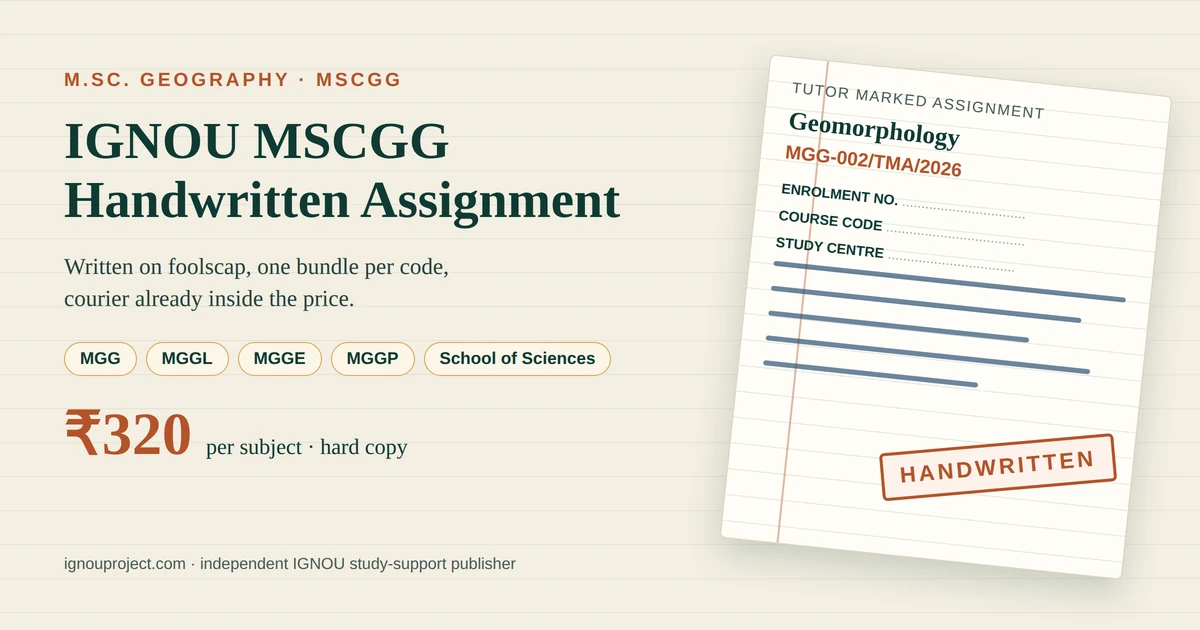
Instruction 2 on every M.Sc. Geography assignment paper published by the School of Sciences asks for foolscap size writing paper and a 4 cm margin on three sides. Send the MGG codes on your registration slip and the set arrives written that way, one bundle per code.
- Foolscap as the booklet asks
- 4 cm margin, three sides
- Parts A, B and C kept separate
- One bundle per MGG code
- Your own handwriting
- Any session, 2024-25 included
₹320 covers the writing and the courier. Message +91 93546 37830 with your codes, your admission cycle and your pin code.
Quick answer. A handwritten assignment is the answer set for IGNOU’s Tutor Marked Assignment questions, written out by hand and handed in at your Study Centre, and for MSCGG, the 80-credit Master of Science (Geography) taught by the School of Sciences across four semesters in which 22 course codes are listed and 20 course units are taken, ignouproject.com writes that set one MGG code at a time. Fourteen theory papers carry a Tutor Marked Assignment, one from each pair of the three MGGE electives included; the five MGGL practicals and the eight-credit MGGP-001 project did not surface a TMA booklet in this research. The rate is ₹320 per subject, hard copy only, with courier included in that price and no separate shipping charge. No soft copy or PDF is sold. The service covers all mediums IGNOU issues the TMA paper in, at the same price, which on MSCGG resolves to the English paper, because section 3.54 of the July 2026 Common Prospectus records the medium of instruction as English. Any session is accepted, current cycle or older, including backlog courses, at the same ₹320 per subject. Send a photo of a page you have written yourself and the handwritten set is matched to your handwriting at no extra charge. Assignments carry 30 per cent of the final course result and the term-end examination carries the remaining 70 per cent, collected here through one 100-mark paper per code, split into Part A, Part B and Part C, of which 35 per cent is needed to pass, written on foolscap with a 4 cm margin on the left, top and bottom. Orders go to WhatsApp +91 93546 37830 with your codes, your admission cycle and your pin code.
Two Dates, 31 March And 30 September, And The Booklet That Decides Which
MSCGG assignments are due on either 31 March or 30 September, and which of the two applies to you depends on the edition of the booklet your course code was published in. That is not a hedge. Five School of Sciences booklets were opened for this page and they split into two families that date the same admission cycle differently.
Named for the January cycle on the January-to-December booklets, and for the July cycle on the July-to-June booklets. MGG-007 and MGGE-003, both valid 1 January 2026 to 31 December 2026, print it against the January cycle.
Named for the July cycle on the January-to-December booklets, and for the January cycle on the July-to-June booklets. MGG-002, valid 1 July 2026 to 30 June 2027, prints it against the January 2026 cycle.
Work through what that means for a learner admitted in July 2026. The MGG-007 booklet gives them 30 September 2026. The MGG-002 booklet gives them 31 March 2027. Same programme, same school, same discipline, two papers in the same year, six months between the two dates printed on them. Neither booklet is a draft and both were live on ignou.ac.in when this page was researched.
The safe reading is the earlier one. Work to whichever of 31 March or 30 September falls first after your enrolment, confirm it against the paper you actually downloaded, and check the current notice on ignou.ac.in or with your Regional Centre before you plan around it. IGNOU has extended assignment dates in past sessions, and an extension is a reprieve you cannot budget for in advance.
One line on every MSCGG booklet is worth more attention than the date itself: you cannot fill the examination form for a course until its assignment has been submitted. The cut-off is not only about thirty marks. It is the gate on the December term-end examination timetable as well.
The Thirty Marks You Write At Home, And The Thirty-Five You Must Clear
Each MSCGG assignment is marked out of 100 and needs 35 per cent to pass, and that assignment carries 30 per cent of the course result while the term-end paper carries 70. Both figures are printed in the opening paragraph of every M.Sc. Geography booklet, in the same sentence, and learners routinely conflate them.
They are different thresholds doing different jobs. The 30 per cent is the weight your assignment mark carries into the final course result. The 35 per cent is the score you have to reach on the assignment itself for it to count as passed at all. Fall under 35 and the booklet is explicit about the consequence: you collect the following year’s assignment and write it again.
The paper that produces those marks has a fixed shape across every MSCGG booklet examined. Part A holds four compulsory questions of ten marks. Part B holds three compulsory questions of ten marks. Part C is a single question carrying six short notes at five marks each. Four plus three plus six items, one hundred marks, nothing optional anywhere in it.
No word limit is printed against any question on any of the five booklets read for this page. That absence matters more than it looks. Programmes that print limits hand you a length budget; MSCGG does not, so the marks are the only guide to how long an answer should run, and a ten-mark question in Part A plainly expects more than a five-mark short note in Part C.
Solved File Or Written Set: What MSCGG Learners Are Actually Choosing Between
These are two different products and only one of them can be handed in. A solved assignment is a soft-copy reference file of model answers for a course code and session, read on a screen and used to study from. A handwritten assignment is those answers written out by hand on paper and submitted in hard copy at the study centre, which is the object the Study Centre counter actually accepts.
A downloaded PDF cannot be submitted as it stands. Print it and you have a printout, and MSCGG’s own instruction sheet asks for answers written on foolscap in your hand, not for pages off a laser printer.
| Solved assignment | Handwritten assignment | |
|---|---|---|
| Format | Soft copy file on a screen | Written by hand on foolscap, hard copy |
| What you do with it | Read it, study from it, write your own answers | Fill the cover-page fields, sign, submit |
| Who it suits | Learners who will write the pages themselves | Learners short of writing time before the cut-off |
| Submitted as-is | No | Yes, once you complete and sign the cover page |
| Price here | Covered on the solved assignment lane | ₹320 per subject, courier included |
Drag the table sideways on a narrow screen.
Reference answers to study from sit on the IGNOU solved assignment files by course code page, which is the right place for that query. This page is only about the written object.
Foolscap, as instruction 2 asks. The School of Sciences asks for foolscap size writing paper, not of a very thin variety. Several MSCGG booklets add that A4 is acceptable if foolscap is unavailable; several do not.
A 4 cm margin on three sides. Instruction 3 asks for four centimetres clear on the left, the top and the bottom, which is wider and on more sides than the single left margin most programmes ask for.
Part A, Part B and Part C completed separately. Instruction 5 asks for each part to be completed on its own and the three then submitted together, so the set is assembled that way rather than run continuously.
Written against your own code’s paper. Answers follow the questions printed on the booklet carrying your course code and validity window, not a set carried over from a neighbouring MGG paper.
Four, three and six. Part A takes four ten-mark questions, Part B three, and Part C six short notes of five marks, which is how the length of each answer is judged in the absence of a printed word limit.
Blue pen where the booklet asks for it. The longer form of instruction 2 asks for lined paper, blue pen only, and no red pen anywhere, including for highlighting. Other highlighters are permitted.
One bundle per MGG code. Each course code is tied on its own. MGG-002 and MGG-003 never travel to the counter as a single stack.
Cover-page fields as your booklet prints them. Most MSCGG booklets open with ENROLMENT NO.; the MGG-012 booklet opens with ROLL NO. The set is prepared against the field list on your own paper.
Written in your own handwriting. Send a photo of a page you have written yourself and the handwritten set is matched to your handwriting at no extra charge.
English, the medium MSCGG issues. The service covers all mediums IGNOU issues the TMA paper in, at the same price. Section 3.54 of the July 2026 Common Prospectus records MSCGG’s medium of instruction as English.
Any session, current or older. Any session is accepted, current cycle or older, including backlog courses, at the same ₹320 per subject, which covers the 2024-25 papers still being cleared.
No minimum order. There is no minimum order: one subject or fourteen, same rate. Fourteen is the whole taught spine of the degree.
Three papers this semester or all fourteen across the degree
Send the MGG codes exactly as they appear on your registration slip, along with your admission cycle. You get the count, the total and the cut-off that applies to those specific codes in one reply.
₹320 per subject · hard copy · courier included · no soft copy
Every MGG, MGGL, MGGE And MGGP Code Across Four Semesters
MSCGG lists 22 course codes and a learner takes 20 course units worth 80 credits, because only one of the three MGGE electives in the fourth semester is written. Those codes carry four prefixes that do different jobs: MGG for theory, MGGL for the five practicals, MGGE for the fourth-semester electives, and MGGP for the project. Order against the codes printed on your own admission record.
| Semester 1 code | Course title | Nature | Credits |
|---|---|---|---|
| MGG-001 | Introduction to Geographical Thought | Theory | 2 |
| MGG-008 | Advances in Geographical Thought | Theory | 2 |
| MGG-002 | Geomorphology | Theory | 4 |
| MGG-003 | Regional Geography of India | Theory | 4 |
| MGG-004 | Population and Settlement Geography | Theory | 4 |
| MGGL-001 | Cartography | Practical | 4 |
Drag the table sideways on a narrow screen.
MGG-001 and MGG-008 are the only two-credit codes in the whole degree and the prospectus marks them to be taken together, which is why the 2024-25 first-semester booklet prints both of them and their assignments run back to back in one file. Everything else in MSCGG is a four-credit course except the eight-credit project.
| Semester 2 code | Course title | Nature | Credits |
|---|---|---|---|
| MGG-005 | Climatology | Theory | 4 |
| MGG-006 | Economic Geography | Theory | 4 |
| MGG-007 | Environmental Geography | Theory | 4 |
| MGG-010 | Urban Geography | Theory | 4 |
| MGGL-002 | Methods of Geographical Analysis: Quantitative and Qualitative | Practical | 4 |
Drag the table sideways on a narrow screen.
| Semester 3 code | Course title | Nature | Credits |
|---|---|---|---|
| MGG-009 | Social Geography | Theory | 4 |
| MGG-013 | Oceanography | Theory | 4 |
| MGG-011 | Geographical Information System (GIS) | Theory | 4 |
| MGGL-003 | Geospatial Analysis | Practical | 4 |
| MGGL-004 | Field Survey Methods: Physical and Socio-Economic | Practical | 4 |
Drag the table sideways on a narrow screen.
| Semester 4 code | Course title | Nature | Credits |
|---|---|---|---|
| MGG-012 | Introduction to Remote Sensing | Theory, compulsory | 4 |
| MGGL-005 | Remote Sensing Techniques | Practical, compulsory | 4 |
| MGGE-002 | Natural Resources Management | Theory, elective | 4 |
| MGGE-003 | Natural Hazards and Disaster Management | Theory, elective | 4 |
| MGGE-004 | Hydrology and Water Resources | Theory, elective | 4 |
| MGGP-001 | Project | Project, compulsory | 8 |
Drag the table sideways on a narrow screen.
The fourth semester is where two learners stop having the same code list. MGG-012 and MGGL-005 are compulsory, the project is compulsory, and exactly one elective is chosen from MGGE-002, MGGE-003 and MGGE-004. That gives 4 plus 4 plus 4 plus 8, which is the 20 credits the semester needs, and it is also why an elective ordered on a friend’s advice can be an elective you are not registered in. The elective numbering starts at 002; no MGGE-001 appears anywhere in the July 2026 Common Prospectus.
Adding the four semesters gives 20, 20, 20 and 20, which sums to the 80 credits section 3.54 states. Fourteen of the units you take are theory papers with a Tutor Marked Assignment behind them, five are MGGL practicals, and one is the project.
Conflicts found in IGNOU’s own documents, and one of ours
- MGG-011 is carried by two programmes under two titles. Section 3.54 lists it as Geographical Information System (GIS). The MA Economics Group A table in the same prospectus lists it as Geographical Information System-I and attributes it to an MA Geography programme, which has no course table anywhere in that document. MSCGG is a Master of Science, not an MA.
- The summary table calls MSCGG year wise; section 3.54 is built in four semesters. Entry 40 of the programme summary records the mode of examination as year wise. The course structure that follows is grouped as first, second, third and fourth semester. Entry 41, M.Sc. Geoinformatics, is recorded as semester wise on the row immediately below.
- MGG-002 is placed in two different semesters. The prospectus and the 2024-25 first-semester booklet both put Geomorphology in semester one. The cover of its own 2026-27 booklet reads 2nd Semester.
- Instruction 2 exists in two versions. The MGG-002, MGG-007, MGG-010 and MGGE-003 booklets ask for foolscap and stop there. The MGG-012 and third-semester booklets add that A4 is acceptable when foolscap is unavailable, that paper should be lined, that only blue pen should be used, and that red pen should be avoided even for highlighting.
- Two booklet validity windows date the same cycle differently. Set out in full in the deadline section above.
- Two typographical errors sit in the official files. The prospectus prints Introduction to Geograhical Thought, missing a letter; the correct spelling appears on the MGG-001 booklet. The 2026 booklets print 31th December twice where 31st is meant.
- The cover-page field list is not consistent. MGG-002, MGG-007, MGGE-003 and the 2024-25 booklet ask for ENROLMENT NO. as the first field. MGG-012 asks for ROLL NO.
- An error on this site. The ignouproject.com homepage still carries an acceptance-and-refund line that conflicts with the position taken here and on every current page: no claim is made about acceptance, marks or evaluation. It is queued for correction, and it is named here rather than left for a reader to find.
From Your Code List To A Tied Bundle On Foolscap
Five steps, none of them automated.
- Your codes are checked against the four-semester table. An MGGL code or MGGP-001 in your list gets queried before anything is written, because no Tutor Marked Assignment booklet was located for either during this research.
- The right edition of the booklet is pulled. MSCGG papers exist in a January-to-December edition and a July-to-June edition, and they carry different questions. The validity line printed on the cover decides which one your session needs.
- Answers are drafted to the four, three and six split. Part A takes four ten-mark answers, Part B three, and Part C six short notes. With no printed word limit on the MSCGG papers, the mark value sets the length.
- The set is written on foolscap with the margin instruction 3 asks for. Four centimetres clear on the left, the top and the bottom. Blue pen. Parts A, B and C completed separately and then assembled together, as instruction 5 requires.
- Bundled one code to a bundle and couriered. Each course code is tied on its own and posted to your address, with the cover page fields walked through so you can complete and sign them, and your enrolment number located if you are unsure which one the booklet wants.
Matching Your Own Hand, At No Extra Charge
Send a photo of a page you have written yourself and the handwritten set is matched to your handwriting at no extra charge. Letter shapes, slant and spacing are followed as closely as a writer can follow them.
There is a practical reason it matters on a four-semester degree rather than a vanity one. An MSCGG learner writes across two years and twenty course units, and a record where semester one arrives in one hand, semester two in a visibly different one and semester three back in the first reads oddly to anyone who looks at the file. It matters more still if you are ordering three papers and writing the other two yourself in the same submission window.
Writing them yourself is a perfectly reasonable choice. If you have the fortnight, the method is free and set out in full. The step-by-step guide to writing an IGNOU assignment by hand covers the whole process, with the front page template as a downloadable PDF, the layout and structure rules, a worked example to model your pages on, and the choice between handing in and uploading. Read instruction 2 on your own MGG booklet before you buy paper; whether A4 is permitted for your code is printed there and it varies.
Two Free Tools: Count Your Papers And Check Your Code
Both run in the browser and store nothing. The second is worth a minute even if you never order, because it tells you which paper-size instruction applies to the code you are about to write.
Tool 1 · MSCGG Paper Count and Cut-Off Planner
Pick a semester or enter how many papers you are short of, choose your admission cycle, and this returns your total at ₹320 each, both cut-off dates computed from today, the days left to the earlier one, and the writing hours you would be taking on.
Free tool 1
Your total and both cut-off dates appear here.
This tool is guidance from ignouproject.com, not an IGNOU rule. Using it creates no obligation to order anything.
Tool 2 · MGG Code, Semester and Paper-Size Checker
Choose a course code and the assignment year printed on your booklet. This returns the semester the code sits in, its credits, whether a Tutor Marked Assignment was located for it, the assignment code format to expect, and which version of the paper instruction applies.
Free tool 2
The semester, credits and paper instruction for your code appear here.
This tool is guidance from ignouproject.com, not an IGNOU rule. Using it creates no obligation to order anything.
Fourteen papers, four semesters, one message
Whether it is a single backlog paper from the 2024-25 booklet or a full semester before the cut-off, the rate does not move and the codes are checked before anything is written.
₹320 per subject · written on foolscap · courier already inside that figure
Downloading Your Own MGG Paper From IGNOU
IGNOU publishes every MSCGG assignment paper free on its own site, and you should hold your own copy whoever writes the answers. It is the only way to be sure the validity window on the cover matches the session you are registered in.
- Open the official IGNOU assignment download service and look under Master’s Degree programmes for MSCGG.
- Read the validity line under the programme name on the cover. A booklet marked valid from 1 January to 31 December is a different edition from one marked 1 July to 30 June, and the questions differ.
- Check the assignment code inside, printed above Maximum Marks. A 2026 paper reads MGG-007/TMA/2026; a 2024-25 paper reads MGG-001/TMA/2024-25. The format changed between those sessions.
- Read instruction 2 before you buy paper, because whether A4 is permitted for your code is printed there and it is not the same on every MSCGG booklet.
The study blocks the answers come from are free as well. You can download the MSCGG study material by course code, reach the same blocks through the eGyanKosh repository walkthrough or its alternate access route when the first is slow, and check the Common Prospectus edition the code tables above were read from. Writing against last session’s paper is the most common avoidable error on any IGNOU assignment, and on MSCGG it is easier to make than usual, because two editions of the same course code are in circulation at once.
What Happens After The Study Centre Takes Your Bundle
Take a receipt at the counter and keep it, because an unrecorded submission looks exactly like a paper you never wrote. Instruction 6 on the MSCGG booklets also asks you to retain a copy of your answer sheets, which is worth doing for the same reason.
- Hold the acknowledgement the Study Centre gives you, or the upload confirmation if your Regional Centre takes scans.
- Check the record about four to six weeks later. Marks post code by code, so MGG-002 can appear while MGG-003 is still blank.
- If a code shows nothing two months on, go back with the receipt rather than waiting for it to resolve itself.
How each status message reads and when marks appear is covered on the assignment status and result checker, with course-wise marks lookup, the assignment entries on the grade card and the consolidated grade card at the end of the degree handled separately. Because assignments carry 30 per cent of each course, those marks sit on the record permanently, and you can work out what they do to your aggregate with the percentage converter or the CGPA calculator.
What MSCGG Learners Ask For Alongside The Written Set
The written set covers thirty per cent of each course. The other seventy is a three-hour paper, and most learners are working on both at once.
For the examination side there are guess papers by programme, solved question papers from earlier terms, the previous year paper archive, condensed study notes, printed help books and guide books ordered online. Rates for everything sit on the services and charges list. The fourth-semester MGGP-001 project is a separate piece of work with its own rules, covered on the MSCGG project and MGGP-001 guidance page, alongside general synopsis formatting and project support. Learners on the sister M.Sc. in Climate Change will find their own code list on the MSCCC handwritten assignment page. Mention whatever else you need in the same message and it is handled on one thread.
Medium and session. The service covers all mediums IGNOU issues the TMA paper in, at the same price, and on MSCGG that resolves to English, because section 3.54 of the July 2026 Common Prospectus records the medium of instruction as English and every booklet read for this page was an English paper. If you hold a paper in another medium, send it and the set is matched to it; learners on other programmes will find the Hindi-medium assignment guidance useful. Any session is accepted, current cycle or older, including backlog courses, at the same ₹320 per subject, which covers a learner clearing an MGG paper from the 2024-25 booklet two years after their batch moved on.
Placing The Order: Five Details, Three Steps
- Send five things. Your programme code MSCGG, the exact MGG codes off your registration slip, your admission cycle and year, the medium of the paper you hold, and your pin code. Add a photo of your own handwriting if you want the set matched to it, which costs nothing extra.
- Get the count and the total back. ₹320 multiplied by the number of papers, courier included. Delivery depends on your pin code and is confirmed for your order before you pay. No figure is promised on this page.
- Confirm, receive, sign and hand in. The set arrives bundled one code to a bundle. You complete and sign the cover page and hand it in at the Study Centre, or upload the scan where your Regional Centre works that way.
If your cut-off is inside a fortnight, say so in the first message rather than after ordering. Writing fourteen papers takes real weeks and courier takes real days, and an honest answer about whether it can reach you in time is more use than a confident one.
Sources Behind Every Figure On This Page
From the July 2026 Common Prospectus. The 22 course codes, their official titles, the theory, practical and project classification, the credit values, the four-semester grouping, the 80-credit total and the English medium of instruction all come from section 3.54 and from entry 40 of the programme summary table. The credits were summed semester by semester and reach 80 against the stated total. The MGG-011 discrepancy was found by reading section 3.54 against the MA Economics Group A table in the same document.
From live Tutor Marked Assignment booklets. Five MSCGG booklets published by the School of Sciences were opened and read against one another: MGG-002 for 2026-27, MGG-007 and MGGE-003 for 2026, MGG-012 for 2025, and the combined first-semester booklet for 2024-25. The submission dates, the 100-mark Part A, B and C structure, the 35 per cent pass mark, the 30 and 70 per cent weighting, the assignment code formats, the paper and margin instructions and the cover-page field lists are read off those five papers, not carried from another programme.
From ignouproject.com as publisher. The ₹320 rate, hard copy only, courier included, handwriting matching at no extra charge, no minimum order and acceptance of any session are this publisher’s own commercial terms. They are not IGNOU rules and nothing on this page should be read as though they were.
What this research could not settle. No Tutor Marked Assignment booklet was located for any of the five MGGL practical courses or for MGGP-001, so whether those carry a written assignment is genuinely open and should be confirmed with your Study Centre rather than assumed either way. Nor could the year-wise versus semester-wise contradiction in the prospectus be resolved from the prospectus alone. Where the five booklets disagree with each other, the disagreement is reported above rather than averaged away.
Written and reviewed by BK Sahni, Founder, Shri Chakradhar Publication Pvt. Ltd. and ignouproject.com, who has guided 5,00,000 students till date. ORCID 0009-0005-8092-459X.
Published: 8 September 2026 · Last reviewed: 8 September 2026 · Next scheduled review: before 31 March 2027, and again before 30 September 2027, the two cut-offs MSCGG booklets print.
Found an error? Send a correction · About the author · Privacy policy
Questions MSCGG Learners Ask Before They Order
No. Every M.Sc. Geography booklet asks for answers written on your own answer sheet by hand, and instruction 2 specifies the paper to write them on. A printout is not an answer sheet. If your Regional Centre accepts uploads, what it wants is a scan of handwritten pages, not a document produced on a computer.
Either 31 March or 30 September, and which one applies depends on the edition of your booklet. The MGG-007 and MGGE-003 booklets valid for 2026 give the January cycle 31 March 2026 and the July cycle 30 September 2026. The MGG-002 booklet valid from July 2026 to June 2027 gives the January 2026 cycle 30 September 2026 and the July 2026 cycle 31 March 2027. Work to the earlier date that falls after your enrolment and confirm it on ignou.ac.in.
Foolscap, unless your own booklet says otherwise. Instruction 2 on the MGG-002, MGG-007, MGG-010 and MGGE-003 booklets asks for foolscap size writing paper and offers no alternative. The MGG-012 booklet and the third-semester booklet add that A4 may be used if foolscap is unavailable, that the paper should be lined and that only blue pen should be used. Read instruction 2 on the paper carrying your code before buying anything.
The rate is ₹320 per subject, hard copy only, with courier included in that price and no separate shipping charge. A three-paper third semester is ₹960 and the whole fourteen-paper taught spine is ₹4,480. There is no minimum order: one subject or fourteen, same rate.
Any of the fourteen theory papers a learner writes: MGG-001, MGG-002, MGG-003, MGG-004, MGG-005, MGG-006, MGG-007, MGG-008, MGG-009, MGG-010, MGG-011, MGG-012, MGG-013 and whichever one of MGGE-002, MGGE-003 or MGGE-004 you are registered in. Send the codes off your registration slip rather than from memory.
No soft copy or PDF is sold. This page covers the written hard copy only. If your Regional Centre asks for an upload, you scan the delivered pages yourself and submit the scan.
Each MSCGG assignment is out of 100 marks and 35 per cent is needed to pass it. Separately, assignments carry 30 per cent of the final course result and the term-end examination carries the remaining 70 per cent. The 100 marks split into four ten-mark questions in Part A, three in Part B, and six five-mark short notes in Part C.
No, and on MSCGG the risk is higher than usual because two editions circulate at once. The booklets state that a learner who fails or misses the date collects the following year’s assignment instead. Check the validity line on the cover and the assignment code inside before writing a word.
At the Study Centre allotted to you at admission. Instruction 6 on every MSCGG booklet says the answer sheets go to your Study Centre within the due date and that sheets received after the due date will not be accepted. Take a receipt and keep a copy of the pages.
No Tutor Marked Assignment booklet was found for MGGL-001, MGGL-002, MGGL-003, MGGL-004 or MGGL-005 during the research for this page, nor for the eight-credit MGGP-001 project. That is an absence of evidence rather than proof, so confirm with your Study Centre what those five practicals require. Handwritten preparation is offered for the theory papers.
No. Courier is included in that price and no separate shipping charge is added. Delivery depends on your pin code and is confirmed for your order before you pay. No figure is promised on this page.
Yes. Send a photo of a page you have written yourself and the handwritten set is matched to your handwriting at no extra charge. It is worth doing on a two-year degree where you may write some semesters yourself and order others.
Yes. Any session is accepted, current cycle or older, including backlog courses, at the same ₹320 per subject. Send the assignment code exactly as printed, because the 2024-25 papers use the MGG-001/TMA/2024-25 span format rather than the single-year format now in use.
Because the format changed between sessions. The 2024-25 booklets print a two-year span, as in MGG-002/TMA/2024-25. The 2025 and 2026 booklets print a single year, as in MGG-007/TMA/2026, even where the cover names a two-year edition such as 2026-27. Quote whichever one is printed on your own paper.
MSCGG is the Master of Science (Geography), an 80-credit M.Sc. run by the School of Sciences. MGG is the course-code prefix on the theory papers, MGGL on the practicals, MGGE on the fourth-semester electives and MGGP on the project. MGY is a different family entirely and belongs to M.Sc. Geoinformatics. Several sites label MSCGG an MA in Geography, and the MA Economics table in the July 2026 Common Prospectus does the same when it attributes MGG-011 to an MA Geography programme.
You cannot fill the examination form for that course until the assignment is submitted. Every MSCGG booklet carries that line as instruction 8. Missing the date also means collecting the next year’s assignment and writing it against fresh questions.
Four things, and they apply to every seller including this one. Ask which paper size the set will be written on and compare it against instruction 2 on your own MGG booklet, since several suppliers write every programme on A4. Ask what margin will be left, against the 4 cm on three sides instruction 3 asks for. Ask which booklet edition the answers are written against, because two MSCGG editions circulate at once. And ask whether any promise is being made about acceptance or marks, because no one is in a position to make one.
ignouproject.com is an independent IGNOU study-support publisher. It is not the official website of Indira Gandhi National Open University, is not affiliated with, endorsed by or authorised by the university, and no page on this site should be treated as an official IGNOU communication.
Important Notice
ignouproject.com is an independent IGNOU study-support publisher. It is not the official website of Indira Gandhi National Open University, is not affiliated with, endorsed by or authorised by the university, and no page on this site should be treated as an official IGNOU communication.
Programme structures, course codes, submission dates and rules change, and only ignou.ac.in and your Regional Centre can confirm the current position for your enrolment.
You sign the declaration on the assignment cover page, so you should read and review the content before submitting it, and satisfy yourself that it represents your own understanding of the course.
No claim is made about the marks any assignment will receive, about how an evaluator will assess it, or about whether it will be accepted. Assignment evaluation is entirely a matter for IGNOU.
Send your MGG codes and your admission cycle
Codes off the registration slip, the cycle you were admitted in, and a pin code. If a code you send has no Tutor Marked Assignment behind it, you are told that rather than sold something you cannot hand in.
₹320 per subject · hard copy with courier included · no soft copy
+91 93546 37830 · Monday to Saturday · Code checks cost nothing.

BK Sahni iD 0009-0005-8092-459X
Founder, Shri Chakradhar Publication Pvt. Ltd. & ignouproject.com — helping IGNOU distance-learning students since 2010 (5,00,000+ students supported across MBA, MCom, MA & more). Author of IGNOU exam guides, solved assignments & project reference books.
Disclosure: Shri Chakradhar Publication Pvt. Ltd. and ignouproject.com are independent third-party study-help services — not the official IGNOU website. Always verify final dates and rules on ignou.ac.in.