MAJMC · MA Journalism and Mass Communication · SOJNMS
One MAJMC booklet prints the submission dates. The other one, for the same session, prints none.
The second-year paper carries 31 March and 30 September against all six of its courses. The first-year paper, issued for the identical cycle by the identical school, tells you to check the website instead. Send the MJM codes on your registration record and the set is written against whichever of the two you actually hold.
- 80 credits over two years
- 12 MJM papers carry questions
- 5 questions, 100 marks each
- 500 words in Year One
- 600 words in Year Two
- English, Hindi and Tamil listed
Four lines settle a quote on this programme: the MJM codes as your registration record spells them, whether you are in Year One or Year Two, the cycle printed on the booklet you downloaded, and your delivery pin code. Delivery depends on your pin code and is confirmed for your order before you pay. No figure is promised on this page.
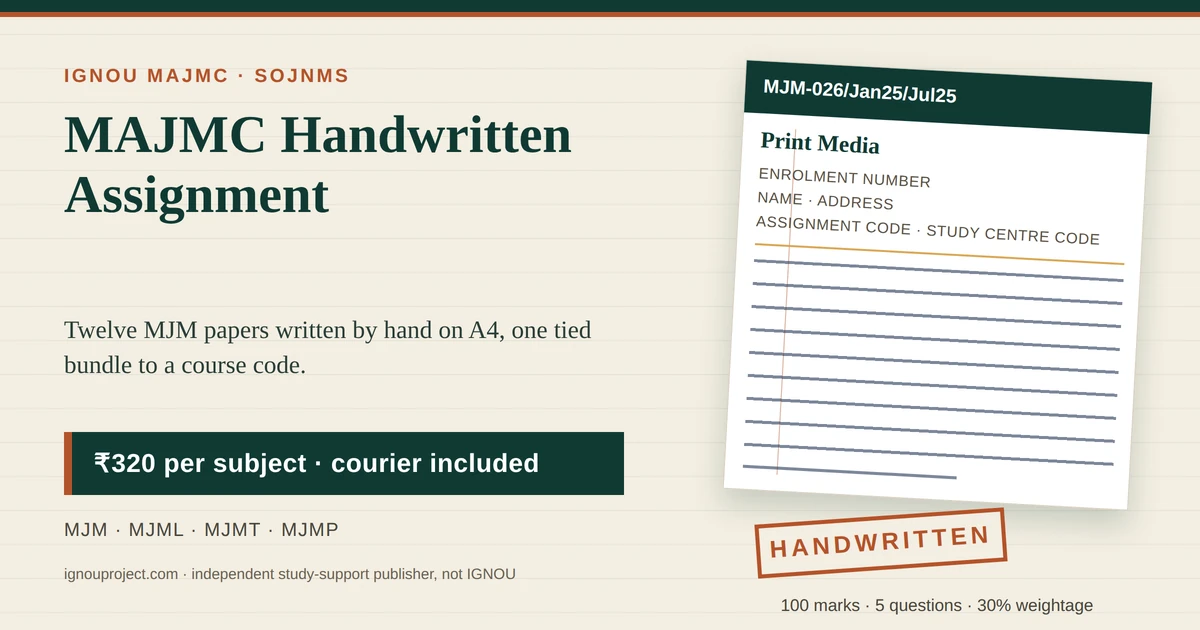
Quick answer. A handwritten assignment is the answer set for IGNOU’s Tutor Marked Assignment questions, written out by hand on A4 and handed in as a hard copy at the Study Centre allotted to you, and for MAJMC, the 80-credit Master of Arts (Journalism and Mass Communication) run year wise over two years by the School of Journalism and New Media Studies, whose nineteen printed rows sit under five prefixes (MJM on the twelve theory papers, MJML on the four practicals, MJMT on the internship, MJMP on the project and portfolio), ignouproject.com prepares that handwritten set one course code at a time. Twelve MJM codes carry a Tutor Marked Assignment: MJM 120, 021, 022, 023, 124 and 025 in Year One, then MJM 126, 027, 028, 029, 130 and 031 in Year Two. The rate is ₹320 per subject, hard copy only, with courier included in that price and no separate shipping charge. No soft copy or PDF is sold. The service covers all mediums IGNOU issues the TMA paper in, at the same price, which on MAJMC is worth reading carefully: section 3.62 of the July 2026 Common Prospectus records the medium of instruction as English, Hindi and Tamil, while the official MAJMC assignment index publishes English and Hindi files only. Any session is accepted, current cycle or older, including backlog courses, at the same ₹320 per subject. Send a photo of a page you have written yourself and the handwritten set is matched to your handwriting at no extra charge. Assignments carry 30 per cent of the final course result and the term-end examination carries the remaining 70 per cent, collected here through one 100-mark paper per code holding five questions worth 20 marks each, answered in about 500 words apiece in Year One and about 600 in Year Two. The whole exchange runs on WhatsApp at +91 93546 37830, starting with your codes, your year and your pin code.
Two MAJMC Booklets, One Session, And Only One Of Them Prints A Date
The MAJMC second-year booklet prints 31 March for the June term-end examination and 30 September for the December term-end examination, against every one of its six courses. Those are the only submission dates any MAJMC paper states. They were read off the second-year assignment file for the January 2025 and July 2025 cycle, published by the School of Journalism and New Media Studies, where the line sits directly under each course heading from MJM-026 through MJM-031.
31 March
Printed on the MAJMC Year Two booklet for learners appearing in the June term-end examination. The same booklet adds, in its own words, that you should check the website for the latest update on the due date.
30 September
Printed on the same Year Two booklet for the December term-end examination. Both figures belong to the School of Journalism and New Media Studies and are not the 31 October and 30 April dates the School of Management Studies uses.
The MAJMC first-year booklet prints no submission date anywhere in it. It covers MJM-020/120, MJM-021, MJM-022, MJM-023, MJM-024/124 and MJM-025 for the identical January 2025 and July 2025 cycle, and against all six it repeats one bracketed line instead: check the website for the latest update on due date. No figure ever follows. A first-year learner therefore has a paper that names a deadline six times and states one zero times, while a second-year learner in the same programme has both dates in front of them.
That is worth knowing before you go looking. Search for a MAJMC submission date and the web offers three different answers: 30 April, 31 May and 30 September appear across four widely read study-help sites, and the 30 April figure in particular is the School of Management Studies date being applied to a School of Journalism programme it does not govern. IGNOU’s own second-year MAJMC file says 31 March. Where a circulating figure and the paper in your hand disagree, the paper wins, and your Study Centre settles anything the paper leaves open.
One consequence follows for everybody. A missed assignment is not only thirty marks lost; on the standard IGNOU rule the assignment has to be in before the examination form for that course can be filled, which is why a bundle that slips costs a term-end paper as well. The December 2026 term-end timetable sits on the far side of whichever date applies to you.
Thirty Marks On Paper Before Seventy Marks In A Hall
Every MAJMC assignment is marked out of 100 and carries 30 per cent weightage, printed in those exact words on all twelve papers. Assignments carry 30 per cent of the final course result and the term-end examination carries the remaining 70 per cent. Underneath that headline the structure is unusually regular for IGNOU: each of the twelve MJM papers sets five questions, each question carries 20 marks, and the instruction line reads that all questions must be answered.
The two years part company on length: MJM Year One asks for about 500 words a question and MJM Year Two asks for about 600. Both figures are printed on the papers themselves, in the note under the marks line. Same programme, same session, same school, a hundred words a question apart, which across five questions and six papers is three thousand extra words in the second year before a single sub-part is counted.
Some Year Two questions then split further and print their own internal limits. MJM-026 asks for four terms explained at 150 words each and two short notes at 300 words each. MJM-030 asks for four short notes at 150 words from a list of six. Those sub-limits are printed on the paper, they override the 600-word guidance for that question, and they are the reason a MJM word count read off a template rather than off your own file comes out wrong.
Only 12 of the 19 MAJMC rows carry an assignment paper at all. The four MJML practicals, the MJMT 021 internship and the two MJMP project routes returned no Tutor Marked Assignment booklet in this research, and section 3.62 of the July 2026 Common Prospectus explains why: practical and project manuals are issued in digital form on eGyanKosh rather than as assignment papers. Once a mark is recorded it belongs to that course code permanently, and the assignment status and result checker traces where it went.
A File On Your Screen Or Six Bundles At The Counter
A solved assignment is a soft-copy reference file of model answers for a course code and session; a handwritten assignment is those answers written out by hand on A4 and submitted in hard copy at the study centre. Only the second one is a submission. The first is read on a screen while you draft; the second is tied per course code, carries a header sheet, and is what a Study Centre counter stamps a receipt for. Printing the first does not convert it into the second.
MAJMC widens that gap more than most programmes, because of what its questions actually ask for. MJM-021 asks you to track a trending fashion hashtag on Instagram or X over three days and report on at least three influencers driving it. MJM-022 asks you to interview somebody in your own community and write a magazine-style profile. MJM-027 asks you to photograph a scene using leading lines with your own phone and attach a printed copy of the picture to the answer. Those are not answers that exist in any reference file, because they are answers about your street, your interview and your photograph.
| Solved file for a MJM code | Handwritten MAJMC bundle | |
|---|---|---|
| Format | A document opened on a phone or a laptop | A4 sheets arriving by courier, tied per course code |
| What you do with it | Draft your own five answers alongside it | Fill the header, sign it, hand it across the counter |
| Who it suits | A learner unsure of the media theory blocks | A learner who has run out of writing weeks |
| Fieldwork questions | Cannot supply your interview or your photograph | Written around the material you send in |
| Rate here | A separate lane, not this page | ₹320 per subject, courier included |
Three columns on a narrow phone screen; swipe the table sideways to reach the last one.
Neatness of the final written version is part of what is being assessed, and both MAJMC booklets say so. Each closes its guidance with the same instruction: once you are satisfied with the answer, write down the final version for submission, writing each answer neatly. That is a sentence about handwriting, printed by the programme coordinators themselves. A learner who wanted the reference file rather than the bundle should go to the catalogue of IGNOU solved assignments listed by programme and course code, which holds that lane and answers it properly. Neither product replaces the journalism blocks IGNOU already posted you.
What ₹320 Covers On A MJM Paper, And What It Leaves With You
Twelve statements before any code list turns into a number. The first six are where MAJMC submissions go wrong. The last six are limits that do not move.
One flat rate whatever the credit weight. The rate is ₹320 per subject, hard copy only, with courier included in that price and no separate shipping charge. MAJMC mixes four-credit and six-credit courses, and the six-credit ones are not billed higher.
Your year decides your word load. Year One asks about 500 words a question and Year Two about 600, so a first-year paper runs to roughly 2,500 words and a second-year paper to roughly 3,000 before sub-parts are counted. Say which year you are in and the estimate is right.
Seven rows are named and set aside. MJML 220, MJML 221, MJML 023, MJML 222, MJMT 021, MJMP 120 and MJMP 022 returned no assignment booklet. A list of nineteen comes back priced as twelve, with the rest flagged rather than quietly billed.
Fieldwork answers need your material. Several MJM questions ask for an interview, a locality survey, a screenshot set or a photograph you took. Send those in the same thread and they are built into the answer; without them the question is answered generically and you should know that in advance.
The dual code is written as your booklet writes it. Four MAJMC courses print two numbers joined by a slash, MJM-020/120, MJM-024/124, MJM-026/126 and MJM-030/130. Whichever form your registration record uses reaches the same paper.
Ordered by code, never by year. There is no minimum order: one subject or fourteen, same rate. A learner carrying one failed MJM-023 while writing a full second year orders exactly what they are short of.
Matched to the hand you already write in. Send a photo of a page you have written yourself and the handwritten set is matched to your handwriting at no extra charge. Twelve bundles reaching one Study Centre against one enrolment number is a long stretch for a hand to change halfway.
Whatever medium IGNOU issues. The service covers all mediums IGNOU issues the TMA paper in, at the same price. On MAJMC the prospectus names three and the assignment index currently publishes two, so the honest answer is: name your medium and the position for your codes is checked before anything is quoted.
An older cycle is ordinary work. Any session is accepted, current cycle or older, including backlog courses, at the same ₹320 per subject. The answers follow the questions your own cover printed, not this year’s replacements.
Paper only, never a file. No soft copy or PDF is sold. Where a Regional Centre runs an upload route, you scan or photograph the delivered pages yourself, so the inked original stays with you until it has been receipted.
Nothing is claimed about the evaluation. No claim is made about the marks any assignment will receive, about how an evaluator will assess it, or about whether it will be accepted. Assignment evaluation is entirely a matter for IGNOU.
No delivery figure, and the declaration stays yours. Delivery depends on your pin code and is confirmed for your order before you pay. No figure is promised on this page. You sign the declaration on the assignment cover page, so you should read and review the content before submitting it, and satisfy yourself that it represents your own understanding of the course.
Twelve Papers Quoted, The Practicals And The Project Set Aside
Paste the MJM codes as your registration record spells them and add the cycle line off any booklet you have already downloaded. The reply names which of your codes carry a published paper, which of them do not, and what the whole thing comes to.
₹320 a code · A4 hard copy · courier already counted · order one paper if that is all you need
Eighty Credits, Nineteen Rows, Twelve Papers That Carry Questions
MAJMC is an 80-credit degree taken 40 credits a year over two years, and section 3.62 of the July 2026 Common Prospectus prints nineteen course rows to reach that total. The prospectus places the programme in the School of Journalism and New Media Studies, sets eligibility at a bachelor’s degree in any discipline with access to a computer and the internet, records the medium of instruction as English, Hindi and Tamil, and describes the structure as modular, with a lateral exit after 40 credits that awards the Post Graduate Diploma in Journalism and Mass Communication.
Six taught courses plus two chosen practicals reach 40 credits in Year One, and six taught courses plus one chosen practical or internship plus one chosen project route reach 40 in Year Two. Eighty in total, which is exactly what the prospectus states at the foot of its own table. The column was added up before it was trusted, and on MAJMC nothing needed adjusting, which is not always the case.
Year One: Six Theory Codes And Two Practicals Out Of Three
| Code | Official title | Credits | TMA located |
|---|---|---|---|
| MJM 120 | Introduction to Journalism and Mass Communication | 6 | Yes, printed as MJM-020/120 |
| MJM 021 | Reporting Techniques | 4 | Yes |
| MJM 022 | Writing and Editing for Print Media | 4 | Yes |
| MJM 023 | Broadcast and Online Journalism | 4 | Yes |
| MJM 124 | Media and Society | 6 | Yes, printed as MJM-024/124 |
| MJM 025 | Media Ethics and Laws | 4 | Yes |
| MJML 220 | Practical: Print | 6 | Choose any two of these three; no assignment booklet located |
| MJML 221 | Practical: Audiovisual | 6 | Choose any two of these three; no assignment booklet located |
| MJML 023 | Practical: Digital Media | 6 | Choose any two of these three; no assignment booklet located |
Narrow screens cut this table before the final column; swipe it left.
Two things in that table repay a second look. The first is the credit split: the two six-credit courses are the ones carrying a three-digit number, MJM 120 and MJM 124, while every four-credit course keeps a padded two-digit one. The second is MJML 023, which breaks that reading, because it is a six-credit practical numbered like a four-credit theory paper. Read the credits column rather than the digit count.
Year Two: Six Theory Codes And Two Choices Of One
| Code | Official title | Credits | TMA located |
|---|---|---|---|
| MJM 126 | Print Media | 6 | Yes, cover prints MJM 026/126 |
| MJM 027 | Electronic Media | 4 | Yes |
| MJM 028 | Digital Media | 4 | Yes |
| MJM 029 | Advertising and Public Relations | 4 | Yes |
| MJM 130 | Media and Communication Theories | 6 | Yes, cover prints MJM 030/130 |
| MJM 031 | Communication Research Methods | 4 | Yes, but no assignment code line is printed |
| MJML 222 | Practical: Research Methodology | 6 | Choose one of these two; no booklet located |
| MJMT 021 | Internship | 6 | Choose one of these two; no booklet located |
| MJMP 120 | Major Project Work (Dissertation) | 6 | Choose one of these two; supervisor arranged by the learner |
| MJMP 022 | Research Portfolio | 6 | Choose one of these two; no booklet located |
The last column runs off a phone screen; scroll the table sideways.
MJM 031 is the row to check against your own file. It is the only one of the twelve papers whose block carries a course code line, a due date line and a marks line but no assignment code line at all, where the other five second-year courses print one. Write the course code on your header and ask your Study Centre what it wants in the assignment code field rather than inventing a string.
Lateral Entry Puts MNM Codes On A MJM Record
A learner entering the second year of MAJMC from PGJMC with 32 credits is assigned MNM-034 Mobile Journalism and MNM-036 Digital Media Literacy on top of the standard second-year list. Those are four credits each and they carry an MNM prefix, not MJM, because they belong to the Master of Arts (Journalism and Digital Media) structure printed in section 3.63. A PGJMC holder with 36 credits picks up MNM-036 alone. A PGJMC holder with 40 credits, from the January 2025 cycle onwards, moves straight into the second year with the ordinary 40 credits and nothing added.
The practical consequence is a code list that does not look like anybody else’s. A 32-credit lateral entrant writes eight papers in a year where the standard route writes six, and two of those eight sit under a prefix that does not appear anywhere in the MAJMC table. Check the credit figure printed on your PGJMC award before assuming which of the three routes you are on, because the difference is two whole papers.
Where The Prospectus And The Two Booklets Disagree
- The first-year booklet counts eight courses and lists six. Its opening paragraph tells the learner to submit one assignment in each of the eight courses. Six course headings follow: MJM-020/120, 021, 022, 023, 024/124 and 025. The two missing ones are almost certainly the chosen practicals, which are not in that file. The second-year booklet avoids the problem by naming its six codes in the sentence itself.
- One course code, two titles, one prospectus. Section 3.62 prints MJM 025 as Media Ethics and Laws. Section 3.63, the MAJDM table on the very next page, prints the same code MJM 025 as Media Laws and Ethics. The first-year assignment booklet uses the section 3.62 wording, so that is the version to copy into a COURSE TITLE field.
- Two assignment code formats for one programme and one session. The first-year booklet writes MJM-020/120/ Jan.2025/ July2025 Cycle. The second-year booklet writes MJM-026/Jan25/Jul25. Same cycle, same school, two conventions, and the MJM-030 block prints a stray space inside its own version.
- A Tamil medium with no Tamil paper on the index. Section 3.62 records the medium as English, Hindi and Tamil, and the admission table adds MAJMCT as a separate programme code for the Tamil route. The official MAJMC assignment index links English and Hindi files only. IGNOU’s Regional Centre Madurai has publicly directed both PGJMCT and MAJMCT learners to that same index. Ask your Regional Centre which paper applies to you before writing anything in Tamil.
- The newest published MAJMC set is January 2025 and July 2025. At the time of this review the official index carried no 2026-27 MAJMC papers for either year. That is a statement about what IGNOU has published, not about what your Study Centre will accept.
- The dual code disappears inside the booklet. The second-year cover lists MJM 026/126 and MJM 030/130, and the course blocks inside then read Course Code: MJM-026 and Course Code: MJM-030 with the three-digit half dropped. Both forms are IGNOU’s own.
- Circulating dates that no MAJMC paper prints. Study-help sites currently give 30 April, 31 May and 30 September as the MAJMC submission date. The 30 April figure belongs to the School of Management Studies calendar. IGNOU’s own second-year MAJMC booklet says 31 March for the June examination.
- On this website and its sister store, pending correction. The front page of ignouproject.com still carries an acceptance-and-refund promise that no page should make. The MMPC-001 course page still quotes a dispatch window counted in working days. Neither claim is made anywhere above, both are queued for correction, and this page governs where they disagree with it.
Where your own registration record and any published list disagree, including the two tables above, the record decides. Programme structures, course codes, submission dates and rules change, and only ignou.ac.in and your Regional Centre can confirm the current position for your enrolment. Every table above came out of one document, and that edition is catalogued in the IGNOU prospectus archive.
From A MJM Number To Five Answers Of Five Hundred Words
Five steps, in the order they actually happen. Step three is the one that separates MAJMC from most programmes, because a fair share of these questions cannot be answered from a study block at all.
- Each code is matched to the booklet that carries it. Your list is checked against the nineteen rows in section 3.62, split into the six Year One codes and the six Year Two codes that have papers, with any MJML, MJMT or MJMP row queried and set aside rather than priced. What comes back is a count of papers that exist, which on this programme is often smaller than the count of codes you typed.
- The cycle line on your cover decides which questions get answered. A January 2025 and July 2025 cover and an older one carry different questions under identical course codes. Nothing is drafted until that line has been read off your own download rather than assumed from the year you enrolled.
- The fieldwork questions are separated out and put back to you. MJM-021 asks for three days of hashtag tracking, with screenshots, naming at least three influencers or brands driving the trend, while MJM-022 asks you to sit down with somebody in your own community and write their profile. MJM-024/124 wants two development posters photographed near where you live. MJM-027 goes furthest: take the photograph yourself, print it, staple it to the answer. Those are listed for you at the start, and whatever you send back is written into the answer rather than replaced by an invented example.
- The remaining answers are built from the journalism blocks IGNOU issued. A question on the Uses and Gratifications Theory, on the AIDA model, on planography, on snowball sampling or on the Right to Information Act is answered from the programme’s own units, because that is what a counsellor marks against. Those blocks are free: reach them through the eGyanKosh repository, or by the alternate Gyankosh route when that server is slow, with the wider catalogue at IGNOU books download.
- A4, one side, five answers, one bundle per code, header left blank. Questions are numbered as the booklet numbers them, key terms are underlined once, and each course code travels as its own tied set with the header sheet on top and deliberately unfilled. The cover page walkthrough and the blank front page format PDF show the layout, and assignment format and structure covers what surrounds it.
The header fields are named in the booklets themselves, and it is a short list: Enrolment Number, Name, Address, Assignment Code and Study Centre Code, written on the first page of the assignment. The same paragraph tells you to obtain a receipt from the Study Centre and to retain a photocopy. Finding your enrolment number is the one field learners most often have to go looking for.
One Hand Across Journalism And Research Method Papers
Send a photo of a page you have written yourself and the handwritten set is matched to your handwriting at no extra charge. A single sheet is enough. Daylight, camera held square to the page, nothing propped at an angle.
MAJMC puts an unusual amount of strain on that match. A learner ordering across both years hands in twelve bundles against one enrolment number, and several of them arrive with the learner’s own attachments stapled in: a printed photograph for MJM-027, screenshots for MJM-021, an interview transcript for MJM-022. Prose in one hand sitting beside material the learner clearly gathered themselves is the sort of mismatch a counsellor notices without going looking for it. The photograph is used for the order it belongs to and discarded with it.
Writing The MJM Set Yourself Costs Weeks, Not Rupees
Nothing here is a secret and none of the method is charged for. The handwritten assignment method explained step by step covers the sequence, a finished worked example shows the depth a twenty-mark answer reaches, the comparison of online and offline submission covers what happens once the bundles are tied, and the submission walkthrough covers the counter itself. Hindi-medium MAJMC learners will want the notes on writing IGNOU assignments in Hindi, since IGNOU publishes a full Hindi MJM paper for both years. This page is for learners short of weeks, not short of journalism.
Two Free Tools Built On What The MAJMC Papers Actually Print
Both run inside this browser tab, reach nothing and store nothing. The first exists because MAJMC sets a different word limit in each year, so a paper count alone does not tell a learner what they have taken on. The second exists because the assignment code you are asked to write on your header is not derivable from your course code on this programme.
Free tool 1
MJM Word Load And Cut-Off Planner
Choose your year, say how many MJM papers you are short of, and pick the term-end examination you are heading for. The planner returns the cost at ₹320 each, the approximate words those papers require at the limit your own booklet prints, the marks at stake, and the days left to the cut-off the second-year MAJMC booklet names.
The word limit is printed on the paper itself. Year One says about 500 words; Year Two says about 600.
A whole number from 1 to 12. Twelve is every MJM paper in the degree, six in each year.
The Year Two booklet prints 31 March for the June examination and 30 September for the December one.
Pick a year, enter a paper count, choose your examination, then select Work Out Words And Days.
Confirm This Total At ₹320 A Paper
This tool is guidance from ignouproject.com, not an IGNOU rule. Using it creates no obligation to order anything. Word figures use five questions a paper at the limit printed in the booklet for that year, before any 150-word or 300-word sub-parts are counted, and the cut-off shown is the one the MAJMC second-year booklet prints. The first-year booklet prints none.
Free tool 2
MJM Code And Assignment Line Resolver
Choose any MAJMC course code and the resolver returns the year, the credits, the dual-code form where one exists, which of the two booklets carries it, whether a Tutor Marked Assignment was located, and the assignment code string that booklet actually prints.
Spaces and hyphens are ignored, so MJM 021, MJM-021 and MJM-21 all reach the same paper. Read the code off your registration record.
Four digits, taken from the cycle line on the cover rather than from a file name or from the year you enrolled.
Choose a code such as MJM 026, enter the cycle year, then select Resolve This MJM Code.
Have This One Paper Written At ₹320
This tool is guidance from ignouproject.com, not an IGNOU rule. Using it creates no obligation to order anything. Titles and credits follow section 3.62 of the July 2026 Common Prospectus, and the assignment code strings are quoted from the two MAJMC booklets for the January 2025 and July 2025 cycle, both of which can be replaced without notice.
Twelve Papers, One Thread, One Total
Your MJM codes, your year and the cycle line on the cover are enough to start. The reply names which papers exist, what the total comes to at ₹320 per subject, and where your pin code stands for delivery before any money moves.
One tied bundle per paper · ₹320 a code · courier inside the figure · hand matched free
Where The Current MJM Papers Are Published
Start at IGNOU rather than at a study-help site. Every MAJMC question paper is free from the university, and on this programme there is one index page that holds all four current files.
- Open the MAJMC programme index. Reach it through the IGNOU assignment download service or the assignment portal under Master’s Degree, then MAJMC. The page carries a single session heading and four links: first year and second year, each in English and in Hindi.
- Read the session heading before the files. At the time of this review that heading read January 2025 to July 2025, and no 2026-27 MAJMC set had been posted for either year. A stale index is not the same thing as a cancelled paper, and your Regional Centre is the only place that can say what your batch should be writing in the meantime.
- Take the file that matches your year, not your enrolment date. A lateral entrant admitted this year takes the second-year file. A PGJMC learner takes the first-year file, because the first-year booklet is issued jointly to PGJMC and MAJMC and both programmes answer the same six papers.
- Check the medium before you start writing. The index publishes English and Hindi. If you were admitted under MAJMCT or you are studying in Tamil, write to your Regional Centre first, because the second-year file on that index is an English paper and no Tamil version was linked there.
With the questions in hand, the archive of solved question papers and the previous year paper collection show how a three-hour hall treats media law and communication theory differently from a Tutor Marked Assignment, which is a genuinely different question from the one the TMA asks.
After A MJM Bundle Reaches The Counter
Take the receipt and keep it. Both MAJMC booklets say so in the same words: obtain a receipt from the Study Centre for the assignments submitted and retain it, and retain a photocopy of the assignments as well. An unrecorded submission is indistinguishable from a paper you never wrote.
A receipted bundle is not yet a mark. Your centre records that the pages arrived, a counsellor reads them, and the award travels upward to the Student Evaluation Division at IGNOU New Delhi, which is the route both booklets describe explicitly. A number appears against the course code last of all, sometimes weeks later, which is why the course-wise marks lookup and the assignment entries on the grade card answer two different questions. Use the grade card status page when a MJM code refuses to surface at all, and the consolidated grade card once both halves are posted. Everything else lives on the general assignment hub.
One line in both files gets missed by almost everybody: after evaluation, the assignments have to be returned to you by the Study Centre, and IGNOU’s own instruction is to insist on that and keep a record. Where both halves of a course are visible, the percentage calculator and the CGPA calculator turn the pair into something readable. A MJM assignment mark is final once posted; revaluation reopens the three-hour script and nothing else. When any of it appears is answered by the IGNOU result page, by the June 2026 result tracker during that window, and by the postgraduate result page.
The Other Four Fifths Of A MAJMC Enrolment
Twelve bundles cover thirty per cent of twelve courses. The larger share is a three-hour paper, and the practicals and project sit outside assignment work altogether.
- The seventy per cent no bundle reaches. The term-end script outweighs any assignment, so the unit-wise study notes and the guess paper collection repay attention faster, with the help book range and the online guide books compressing the journalism blocks into something revisable.
- MJMP 120 belongs to a different queue. Six credits of dissertation work is not assignment work and is not priced at the ₹320 rate, and the prospectus adds that the learner arranges the research supervisor. Start at the MJMP-120 guidance page. Proposal drafting sits with the synopsis and proposal service and the write-up with the project and dissertation service, with layout on the report format guide, the university-wide rules on the IGNOU project guidelines page and rates on the list of services and charges.
- Neighbouring SOJNMS degrees that share MJM codes. MAJEM issues its own first-year paper against several of the same course codes, and its project work is covered on the MAJEM project page; the digital-media sibling MAJDM, whose MNM codes turn up on lateral-entry MAJMC records, is covered on the MAJDM project page.
- Other year-wise master’s programmes with the same March and September rhythm. The MEG handwritten assignment page covers MA English, the MAHD handwritten assignment page covers the Hindi-medium MA, and the MASO handwritten assignment page covers MA Sociology.
Medium, cycle and the line on your cover. The service covers all mediums IGNOU issues the TMA paper in, at the same price. On MAJMC that clause does real work rather than resolving to one option: the prospectus names English, Hindi and Tamil, the assignment index links an English file and a Hindi file for each year, and MAJMCT exists as a separate programme code in the admission table for the Tamil route. Whichever paper your Regional Centre confirms for your enrolment is the one the set is written from, at the same ₹320. On cycles: a MAJMC paper belongs to a named session and the questions are replaced under unchanged course codes when the next set is published. Any session is accepted, current cycle or older, including backlog courses, at the same ₹320 per subject, so name the cycle printed on your own cover and the answers follow the questions belonging to it.
Sending MAJMC Codes On WhatsApp Without A Form
No form, no account, no login. Everything happens on WhatsApp at +91 93546 37830, and the job is not finished when a courier hands the parcel over. It is finished when a stamped receipt is in your hand.
- Message the number with your codes. The MJM, MJML, MJMT or MJMP codes exactly as your registration record spells them, dual codes and all.
- Your paper count and total come back. Codes with no published Tutor Marked Assignment are named and removed, the year and word limit for each remaining paper is stated, the total is confirmed at ₹320 per subject, and delivery for your pin code is confirmed before you pay.
- The bound set arrives. One code, one tied bundle of A4, header sheet on top with nothing written on it. The five fields and the declaration beneath them stay unwritten, because that signature says the understanding on those pages is yours.
Five things worth putting in that first message:
- Course codes. Copied off your registration record rather than from memory, since MAJMC prints several of them two ways.
- Year, and whether you entered laterally. The word limit differs by year, and a PGJMC lateral entrant on 32 credits carries two MNM papers the standard route never sees.
- Medium. English, Hindi or Tamil, so the right paper is located before anything is drafted.
- Your fieldwork material. The interview, the screenshots or the photograph any of your questions ask for, if you already have them.
- Pin code, and anything your Study Centre insists on. If your centre wants the question paper stapled in front or a particular assignment code written in, say so at the start rather than after delivery. A handwriting sample can follow later in the same thread; matching is not charged for.
Sourced From One Prospectus Section, Two Booklets And One Index
From the IGNOU Common Prospectus, July 2026. Section 3.62 supplied the School of Journalism and New Media Studies placement, the eligibility rule, the English, Hindi and Tamil medium line, the modular two-year structure, the PGJMC lateral exit, all three lateral-entry credit-deficiency routes with their MNM course codes, every course code with its official title and credits, the note that practical and project manuals are issued in digital form on eGyanKosh, the requirement that the learner arranges a supervisor for MJMP-120, and the stated total of 80 credits. That total was added up rather than accepted: six taught courses plus two chosen practicals reach 40 in Year One, and six taught courses plus one chosen practical or internship plus one chosen project route reach 40 in Year Two. Entries 50 and 50A of the programme summary supplied the ₹13,500 per year fee, the year-wise examination mode, the January and July sessions, and the separate MAJMCT programme code for the Tamil route. Section 3.63, the MAJDM table on the following page, is where the second title for MJM 025 was found.
From two live IGNOU assignment booklets. Both were opened, deliberately, and the reason showed up immediately: they disagree. The first is the joint PGJMC and MAJMC first-year file for the January 2025 and July 2025 cycle, signed by Dr Shikha Rai as Programme Coordinator. The second is the MAJMC second-year file for the same cycle, signed by Dr Amit Kumar. Between them they supplied the 100-mark total, the 30 per cent weightage statement, the five-question pattern at 20 marks each, the 500-word and 600-word limits, the printed sub-limits of 150 and 300 words, the two different assignment code formats, the missing assignment code line on MJM-031, the five header fields, the receipt and photocopy instructions, the route by which marks reach the Student Evaluation Division, the 31 March and 30 September dates on the second-year file and their complete absence from the first, and the eight-versus-six course count.
From IGNOU’s own MAJMC assignment index. The session heading, the four linked files, the presence of English and Hindi and the absence of Tamil were read off that page directly, as was the fact that no 2026-27 set had been posted at the time of this review.
From ignouproject.com as publisher. A short list of things above were settled in an office rather than by a university: the price of a paper, the refusal to sell a file, the treatment of an older cycle, the absence of an order minimum, and the fact that matching your hand costs nothing. The rate is ₹320 per subject, hard copy only, with courier included in that price and no separate shipping charge. No soft copy or PDF is sold. There is no minimum order: one subject or fourteen, same rate. Delivery depends on your pin code and is confirmed for your order before you pay. No figure is promised on this page. IGNOU sets none of it and takes no part in any of it.
What this research could not settle. No assignment booklet was located for MJML 220, MJML 221, MJML 023, MJML 222, MJMT 021, MJMP 120 or MJMP 022, so whether the practicals and the internship carry any written assignment component beyond their eGyanKosh manuals is genuinely open, and your Learner Support Centre is the place to settle it. The first-year booklet’s count of eight courses is most plausibly the six theory papers plus two chosen practicals, but the booklet does not say so and that reading is an inference rather than a printed instruction. No Tamil-medium MAJMC assignment file was found on the official index despite the prospectus naming Tamil as a medium and the admission table carrying MAJMCT as a programme code; whether a Tamil paper is issued through Regional Centres instead could not be established from any document read here. And whether the first-year deadline follows the second-year booklet’s 31 March and 30 September is not knowable from the first-year paper, which prints no date at all.
If something above is wrong, or a MAJMC paper has appeared since this review, say so through the contact page. Anything reported is checked against the file itself, and the amendment is dated when it goes up. Who publishes this is on the about page, and what happens to anything you send is in the privacy policy.
Written and reviewed by BK Sahni, Founder, Shri Chakradhar Publication Pvt. Ltd. and ignouproject.com, who has guided 5,00,000 students till date. ORCID 0009-0005-8092-459X. More on the author and the editorial process is on the BK Sahni profile.
Published 10 September 2026. Last reviewed 10 September 2026. Next scheduled review 1 February 2027, ahead of the 31 March cut-off the MAJMC second-year booklet prints, and again in August 2027 ahead of the 30 September one.
Questions MAJMC Learners Send Before They Send Codes
The rate is ₹320 per subject, hard copy only, with courier included in that price and no separate shipping charge. That figure does not change with the credit weight of the course, so a six-credit MJM 120 paper and a four-credit MJM 021 paper cost the same. There is no minimum order: one subject or fourteen, same rate.
The MAJMC second-year booklet prints 31 March for the June term-end examination and 30 September for the December one, against all six of its courses. The first-year booklet for the same cycle prints no date at all and tells the learner to check the website instead. Study-help sites currently circulate 30 April, 31 May and 30 September for this programme; the 30 April figure belongs to a different school’s calendar. Confirm the current position for your cycle on ignou.ac.in and with your Study Centre.
Twelve MJM codes carry a published Tutor Marked Assignment: MJM 120, MJM 021, MJM 022, MJM 023, MJM 124 and MJM 025 in Year One, then MJM 126, MJM 027, MJM 028, MJM 029, MJM 130 and MJM 031 in Year Two. The four MJML practicals, the MJMT 021 internship and the two MJMP project routes returned no assignment booklet, and the prospectus records that their manuals are issued in digital form on eGyanKosh instead.
Both MAJMC booklets close their guidance by telling the learner to write down the final version for submission, writing each answer neatly, which is an instruction about handwriting rather than about typesetting. IGNOU Study Centres across programmes generally decline typed or printed answer sets. Neither MAJMC booklet contains a clause permitting a typed submission, so treat a hard copy in your own hand as the requirement and ask your own Study Centre before doing anything else.
Each MAJMC assignment is marked out of 100 and carries 30 per cent weightage, printed in those words on all twelve papers. Assignments carry 30 per cent of the final course result and the term-end examination carries the remaining 70 per cent. Every paper sets five questions and every question carries 20 marks, with the instruction that all of them must be answered.
About 500 words per question in Year One and about 600 in Year Two, printed on the papers themselves. Some Year Two questions then set their own internal limits that override the headline figure: MJM-026 asks for four terms at 150 words each and two short notes at 300 words each, and MJM-030 asks for four short notes at 150 words. Read the limit off your own paper rather than applying one figure across the degree.
Yes. IGNOU’s official MAJMC assignment index links a Hindi file alongside the English one for both the first year and the second year. Section 3.62 of the July 2026 Common Prospectus records the medium of instruction for MAJMC as English, Hindi and Tamil, and the service covers all mediums IGNOU issues the TMA paper in, at the same price.
No Tamil MAJMC assignment file was linked on the official index at the time of this review, which carried English and Hindi only. The July 2026 Common Prospectus names Tamil as a medium of instruction in section 3.62 and lists MAJMCT as a separate programme code at entry 50A, and IGNOU’s Regional Centre Madurai has publicly pointed both PGJMCT and MAJMCT learners at that same MAJMC index. Write to your Regional Centre before drafting anything in Tamil.
From IGNOU’s own assignment portal, free. Open the assignment download service on ignou.ac.in or the assignment portal on webservices.ignou.ac.in, go to Master’s Degree and then MAJMC, and you will find four links under one session heading: first year and second year, each in English and in Hindi. The first-year file is issued jointly to PGJMC and MAJMC learners.
Because the two missing courses are the practicals, which are not in that file. The joint PGJMC and MAJMC first-year booklet opens by telling the learner to submit one assignment in each of the eight courses, then prints six course headings: MJM-020/120, MJM-021, MJM-022, MJM-023, MJM-024/124 and MJM-025. Year One requires two practicals chosen from MJML 220, MJML 221 and MJML 023, which reaches eight, but the booklet never says so and that reading is an inference. Ask your Study Centre what it expects for the two practical courses.
Copy it from the block for your own course in your own booklet, because MAJMC uses two formats. The first-year file writes it as MJM-020/120/ Jan.2025/ July2025 Cycle. The second-year file writes it as MJM-026/Jan25/Jul25. MJM-031 prints no assignment code line at all, so for that paper write the course code and ask your Study Centre what it wants in that field.
Because four MAJMC courses carry both an older and a revised number, and IGNOU prints them together. The pairs are MJM-020/120, MJM-024/124, MJM-026/126 and MJM-030/130, and all four of those courses carry six credits while the two-digit codes carry four. The second-year booklet then drops the three-digit half inside its own course blocks, printing Course Code: MJM-026. Either form reaches the same paper.
Both MAJMC booklets name five fields for the first page of the assignment: Enrolment Number, Name, Address, Assignment Code and Study Centre Code. The same paragraph adds two things learners skip: obtain a receipt from the Study Centre and retain it, and keep a photocopy of the assignment. Where the general IGNOU front page template and your own booklet differ, the booklet in your hand is the one your evaluator is holding.
Yes. Any session is accepted, current cycle or older, including backlog courses, at the same ₹320 per subject. Name the cycle printed on your own cover, because a MAJMC paper belongs to a named session and the questions are replaced under unchanged course codes when the next set is published. The answers are written against the questions your cover actually carries.
Those questions are listed for you at the start and the material comes from you. MJM-021 asks for three days of hashtag tracking with screenshots, MJM-022 for an interview with somebody in your own community, MJM-024/124 for two posters photographed in your locality, and MJM-027 for a photograph you took using leading lines, printed and attached. Send what you have in the same WhatsApp thread and it is written into the answer. Without it the question is answered in general terms, and you should know that before ordering rather than afterwards.
It depends on the credit figure on your PGJMC award. Section 3.62 of the July 2026 Common Prospectus sets three routes: 32 credits adds MNM-034 Mobile Journalism and MNM-036 Digital Media Literacy to the standard second-year list, 36 credits adds MNM-036 alone, and 40 credits from the January 2025 cycle onwards adds nothing. Those MNM codes belong to the MAJDM structure in section 3.63, so a lateral entrant can be writing under two prefixes in one year.
No soft copy or PDF is sold on this page. What is prepared here is a handwritten set on A4, delivered as a hard copy with courier included in the ₹320. A solved assignment is a soft-copy reference file of model answers for a course code and session and belongs to a separate lane; a handwritten assignment is those answers written out by hand and submitted at the study centre. Where a Regional Centre asks for an upload, you scan the delivered pages yourself.
Four things, and they apply to every supplier including this one. Ask which session’s questions the set will be written against and get the cycle line named, since MAJMC papers are replaced under unchanged course codes. Ask what happens with the fieldwork questions that need your own interview or photograph. Ask whether any promise is being made about acceptance or marks, and treat one as a warning rather than a reassurance, because evaluation is entirely a matter for IGNOU. Ask what the total is before you pay, including delivery to your pin code.
No. ignouproject.com is an independent IGNOU study-support publisher. It is not the official website of Indira Gandhi National Open University, is not affiliated with, endorsed by or authorised by the university, and no page on this site should be treated as an official IGNOU communication. Programme structures, course codes, submission dates and rules change, and only ignou.ac.in and your Regional Centre can confirm the current position for your enrolment.
Important Notice
ignouproject.com is an independent IGNOU study-support publisher. It is not the official website of Indira Gandhi National Open University, is not affiliated with, endorsed by or authorised by the university, and no page on this site should be treated as an official IGNOU communication.
Programme structures, course codes, submission dates and rules change, and only ignou.ac.in and your Regional Centre can confirm the current position for your enrolment.
You sign the declaration on the assignment cover page, so you should read and review the content before submitting it, and satisfy yourself that it represents your own understanding of the course.
No claim is made about the marks any assignment will receive, about how an evaluator will assess it, or about whether it will be accepted. Assignment evaluation is entirely a matter for IGNOU.
MAJMC · 80 credits · 19 rows · 12 papers that carry questions
Send the MJM codes and say which year. The word limit follows from that.
Year One or Year Two, a current cycle or a backlog code, written on A4 in your own matched hand, five answers to a paper, tied code by code with the header sheet on top and left for you to sign. MJML, MJMT and MJMP rows are named and set aside rather than quietly billed, and any question needing your own interview or photograph is flagged before a rupee moves.
Order MAJMC Papers At ₹320 Check Delivery For My Pin Code
WhatsApp +91 93546 37830 · Shri Chakradhar Publication Pvt. Ltd. · ignouproject.com publishes this page and has no connection to the university whose programme it describes.

BK Sahni iD 0009-0005-8092-459X
Founder, Shri Chakradhar Publication Pvt. Ltd. & ignouproject.com — helping IGNOU distance-learning students since 2010 (5,00,000+ students supported across MBA, MCom, MA & more). Author of IGNOU exam guides, solved assignments & project reference books.
Disclosure: Shri Chakradhar Publication Pvt. Ltd. and ignouproject.com are independent third-party study-help services — not the official IGNOU website. Always verify final dates and rules on ignou.ac.in.